




Abstract
This paper focuses on the process and theory of action-research for transformation (ART) targeting individual transformation as a required means for global change. Addressing the lack of a practical framework to organize and report transformation, we conceptualise, identify and demonstrate an approach by linking ART with Interiority and Constructive Development Theory. Interiority focuses on the individual’s sense-making as it relates to the sensed world and provides direction for data to be collected. Crucially, the individual’s capacity for sense-making impacts how data are identified, experienced, interpreted and evaluated. It is shifts in this capacity that constitute fundamental transformation required to better handle complexity and ambiguity - intrinsic to ART. We propose Constructive Developmental Interiority (CDI) that provides a lens to recognise, analyse and frame constructive developmental shifts. Two case studies are presented in which researchers engaged in applying CDI for transformation. Both cases highlight, through first-person action-research and reflexive collaboration, that although the will to address developmental transformational challenges was an espoused motivation, its misalignment with the capacities for transformative change is always a possibility. Applying CDI reveals the nature of the challenge (time, effort and support), how transitions were made, and the potential for transformational impact.
Keywords
Introduction
Appreciating the epistemological assumption of action research - to change the world - its purpose goes beyond description or explanation to build on the past, take place in the present with a view to shaping the future (Coghlan & Brannick, 2014; Reason and Torbert, 2001). A specific call for action research to generate transformation (ART) incited engagement to encourage global transformative change (Bartels & Friedman, 2022; Bradbury et al., 2020). The targets of this injunction include global challenges of sustainability and climate action (Bradbury et al., 2019:4). The ambitious challenge for such action research is “to contribute to conversations for change about ways of knowing, doing and being” (Bradbury et al., 2019: 9), to create “knowledge that is capable of revising beliefs in the face of new evidence” (Bradbury & Divecha, 2020: 273).
We address this call for ART by recognising that the focus on transformation at the individual level is a fundamental requirement for global efforts: it is the context selected for this research. We report on explorations of the interiority of individuals' observations and sense-making which relate to the external world (Shani and Coghlan, 2019). ART recognizes that engagement and understanding of the world “how we know it - is a requirement for broadening our repertoires of learning and enacting the future” (Bradbury et al., 2019: 7), so our focus is on sense-making processes and outcomes (Kegan, 1994). Specifically, the consideration is on the interpretation and evaluation of meaning taken from experience (McCauley et al., 2006) and what constitutes transformation.
The context of this research recognising action research for transformation was doctoral research of first-person lived experience, and its relationalities, in the professional setting, which generated meaningful data for analysis. The research design included a focus on interiority through the first-person self (LaBoskey, 2004; Hamilton et al., 2008). This was complemented with reflexive collaboration, a second-person approach that allowed for a more expansive order to be iteratively imposed on the data through a community of inquiry (Ripamonti et al., 2016). Two distinctive cases are examined here, in both of which the commitment to address developmental transformational challenges was an espoused motivation, however, misalignment of such will with the capacities for transformative change is always a possibility of such endeavours (Giuliani et al., 2021). This study identifies means to address transformational commitments and challenges practically, through linking interiority with ART and constructive development with implications for transformational impact.
The individual in ART
We emphasise the individual, recognising that for people to be transformational in their organisational or social contexts, they need familiarity with engaging in transforming themselves: Berger (2011) argues this for leaders while Sharmer and Kaufer (2013) echo the same point for organisations. As Scharmer (2022: xv) noted, finding solutions to broad challenges lie within reach but require an “awareness-based capacity” that comes from learning to “see ourselves through the eyes of others” and, more challengingly, “to see ourselves through the eyes of the whole”. The development of one’s “form of mind”, taken as the nature of an entire sense-making system, “shapes how we see the world” (Berger & Johnston, 2015: 178). This implies that for transformation to occur at the individual level, both the form to be transformed must be understood and also how it is transforming (Kegan, 2009).
We investigate ‘form’ through a constructively developmental lens examining the handling of complexity and ambiguity that constitutes many of the most challenging organisational and global issues (Berger, 2011; Berger & Johnston, 2015). We recognise that there has been “little room to voice - nor have valued - one’s own experience outside a narrow range of “objective” facts that describe the world” (Bradbury et al., 2019: 6). Therefore, we explore the impact of recognising, analysing and framing the constructive development of personal experiences and sense-making (Kegan, 1994).
ART and constructive development
A central tenet of action research is intended change which typically involves re-education at the level of norms and values and is evident in transforming patterns of thinking and action (Coghlan, 2007). Action research is recursive, iterative, spiralling, and cyclical - a process of acting, reflecting and acting in new ways (Pine, 2009). Research points to constructive developmental theory (CDT) as a significant link in explaining transformational shifts as it addresses how interpretation and meaning are constructed individually from experience, shaped by the underlying belief system, as opposed to “taking in an objective world” (McCauley et al., 2006: 636). Such construction represents an “individual’s understanding of reality” (Berger, 2005:3) and beliefs (implicit or explicit) are an interpretive lens through which meaning is made (Helsing et al., 2004). The theory is developmental as focus is on the process of change in construction capacity about oneself (self-concept) and the world, with greater capacity for complexity emerging if and when transformation occurs (McCauley et al., 2006; Berger, 2005).
Development is defined in terms of the complexity of meaning-making abilities (Helsing & Howell, 2014) and ability to deal with complexity (Kegan, 1994). If a gap arises where mental complexity falls behind, then “we are in over our heads” (Kegan, 1994: 80). Kegan (1994) identified orders of mind corresponding to constructive-developmental stages where five orders represent transformations of meaning-making - evident in thinking, feeling, social relating and relating to oneself - with each stage subsumed into another, coincident with transformative development, should it occur.
Kegan (1994) links life’s demands to social criteria and maps the historical eras of traditionalism, modernism, and postmodernism to third, fourth and fifth orders, respectively (Berger, 2005). In traditional societies, for example, demands are suited to adults at the third order who look to leaders or external theology to borrow fourth order complexities and take their sources of absolute direction from external sources (Fitzgerald and Berger, 2002). Many demands in the modern era require fourth order capacity of self-governing individuals, with an internal seat of judgement, who are self-guided, self-motivated, and self-evaluative (Kegan et al., 2016). However, the majority of adults try to meet these demands from their limited third order capacity (Fitzgerald and Berger, 2002). Significant, in our view, is an all too prevalent assumption that individuals working to address transformative challenges (through global eco-social imperatives or professional/personal development transformations) have already reached self-evaluative and self-governing levels of operating and thinking.
Arguably, now in late modernity current challenges call for fifth order thinking requiring opening and questioning worldviews with an open and questioning sense-making system (Berger, 2005). At this order, individuals see beyond themselves, recognising that they are systems, linked to others, and the planet, and need to work collectively to harness these seismic changes to solve rather than create problems. Individual development is important and necessary and, likewise, CDT is also evolving “… toward a more holistic, integrative perspective that views individual development as one facet of a developing system” (McCauley et al., 2006: 650).
Constructively developmental interiority
Interiority has been explained as a term that “expresses a way of holding both our engagement with what we see and hear, etc. (the outer data of sense) with how we are thinking and feeling (inner data of consciousness)” (Shani and Coghlan, 2019: 519). Reporting such data offers potential for tracking first-person states and experiences as they relate to transformation and points more broadly to the range and extent of potential data appropriate to collection and analysis of ART and specifically constructively-developmental ART, that reports on lived experience.
Interiority hinges on cognitive and affective perceptions - what is known and felt from a first-person orientation. It finds expression in actions and behaviour resulting from sense-making activities that generate and ascribe meaning (Weick, 1995; 2010). In the cognitive realm, deliberation is relevant as effortful reasoning underlies what is known and understood about a situation or experience. In comparison, the affective realm concerns feelings elicited by circumstance, which may generate evaluation or judgement, often even before any cognitive reasoning occurs (Kahneman, 2003). Analytically, these realms have been identified as separate ‘selves’, e.g. a planner and a doer (Thaler, 1980). Milkman et al., (2008) outlined individuals that embody a self, focusing both on what they ‘should’ do and, separately, on what they ‘want’ to do; each ‘self’ driven by cognition and affect, respectively. Where the cognitive-driven and affect-driven selves collide, time and effort towards reconciliation may be required and necessitates revisiting the data and information perceived by each ‘self’, reflecting on it and evaluating appropriate action.
These alternative windows into knowing, via cognition and affect, are elements of interiority and “differentiated consciousness” that exist within the “private world of intentional consciousness” (Shani and Coghlan, 2021a: 481). Such subjective and private accounts of experience can be exposed and presented for scrutiny by collecting and sharing first-person data on lived experience. Through the two case studies presented we bring interiority and constructive development together and demonstrate how they jointly support understanding of the meaning such data may generate and how this aligns with ART (Varela and Shear, 1999).
A method for operationalising constructive development is proposed in Drago-Severson (2012) and Drago-Severson and Blum-DeStefano’s (2014) approaches to effective development. It is founded on the definition of professional transformation as “increases in our cognitive, affective (emotional), interpersonal and intrapersonal capacities that enable us to better manage the complex demands of teaching, learning, leadership, and life” (Drago-Severson, 2012: 190). These four separate, but related, developmental capacities connect with interiority (see Coghlan et al., 2020) focusing on a range of perceptions experienced by the individual across the four realms that may generate actions and reactions across some, or all, of the realms immediately or possibly asynchronously as the actions and reactions cumulate, or dissipate, as they are processed and, perhaps, internalized by the individual.
Intra-personal and inter-personal capacities deserve further elaboration. Individuals’ assessments of their role, identity, how they are perceived by others and how they connect with others are important constructions that influence how they interpret and act on their world – the ‘worldview’ or ‘image’ that governs actions (see Fisher et al., (1987) on worldview and Boulding (1956) on image). The individuation/integration tendencies differ across individuals, and over time, and are evident where alignment with the beliefs of others may be central to the sense of self at certain developmental stages, but not others. This alignment (often unconscious) can impede the individual’s capacity of “…revising beliefs in the face of new evidence” (Bradbury & Divecha, 2020: 273) which stifles change, and cements the status quo in political and economic systems. Transformation between stages is, therefore, revealed in changes in cognition and affect, and in how we think and feel about our inter- and intra-personal relations.
Developmental changes can be reported by focusing on capacities and how they are impacted as revealed through data collection, analysis and reflection. Transformation corresponds to significant and sustained qualitative differences across some, or all, of the four realms. A constructive-developmental approach puts the knowing, acting, professional at the centre of the transformative action they engage in and research. It points to approaches suitable to identifying and collecting data aligned with each capacity and requires integrating appropriate questions imperative for assessing the nature of each capacity and its development. This extends the discussion of interiority, linking it to transformational professional development that may be reported as first-person reflections on professional (and personal) development focusing intra-personally and also inter-personally.
What is known and experienced, therefore, consists of feelings, concepts and ideas, self-knowledge (self-relation) and relations with others. The stages approaches to constructive development build on research on inter-personal development (Selman, 1980), moral development (Kohlberg, 1969), ego development (Loevinger, 1976), the evolution of meaning making of Kegan (1982) and structural development (Fisher et al., 1987). The consistent thread in this research is that perception and action are inter-linked and the systems of perception and action develop and plateau at different stages over the life-span. Although the systems are resistant to change, they can and do transform (Kegan et al., 2016; Kegan, 1994).
Exploring interiority and its manifestations through the four developmental capacities, or realms, offers windows into different aspects of experience. This permits identification of individual situatedness within developmental stages and offers an interiority-based bridge from data collected corresponding to these realms when engaging in action research.
Methodological approach
Framed by constructive development and coupled with the concept of interiority, we apply a practical, although labour intensive reflexive method to identify and report on learning and transformation. The method addresses a general lack of guidance, or processes, appropriate to stimulating and developing intentional and effective action inquiry as routine elements of practice (noted in Torbert, 2004). The first-person based cases here strive to implement such routines. Marshall’s (1999) ‘living life as inquiry’ (Gearty and Marshall, 2021) offers some guidance for what an inquiring attitude to first-person action research entails and is relevant here in different aspects – although it “offers no directive rubric of what to do” (Gearty and Marshall, 2021:444).
In the spirit of ‘living inquiry’, we propose that the interior territory of Coghlan (2007) may be explored across four realms, offering demonstrations of engagement of both developmental intention and action. This represents the categorical mode of thinking (Freeman, 2016) where the focus of the data collection and analysis relate to the conceptual scheme that differentiates experience (by realm), informing aspects of transformation in terms of process, content and premise (Mezirow, 1990). Elements of narrative thinking (Freeman, 2016) are also in evidence as first-person reflective narratives generate data offering perspectives into connections created by the practitioner-researchers, i.e. how they identify meaning, and how connections change over time, for example.
Methodologically, our privileging of the first-person self (LaBoskey, 2004; Hamilton et al., 2008) of interiority and its data, represents just one element of the research method. It is complemented with reflexive collaboration in line with Marshall’s (2016) consideration of first-person inquiry as ‘fundamentally relational’ both in terms of how connections are identified by an individual and across people. Starting from a shared, mutual developmental focus, the community of inquiry consisted here of the researcher-practitioners and researchers working together initially to develop a transformation-intentioned research agenda. At the outset of the process a shared understanding of constructive development was built up. This consolidation-of-understanding phase (see Figure 1) involved discussion of published materials, completion of assignments, engagement with a coach qualified in the Immunity to Change process (developed from Kegan and Lahey, 2009), and a programme coach. This phase also involved understanding of self, through constructive development inquiry, defining transformational intentions and reflexive questioning. Constructively Developmental Interiority: Action Research Cycle. Adapted from Coghlan and Brannick (2014), McNiff (2013), McNiff and Whitehead (2010) and Bradbury (2022).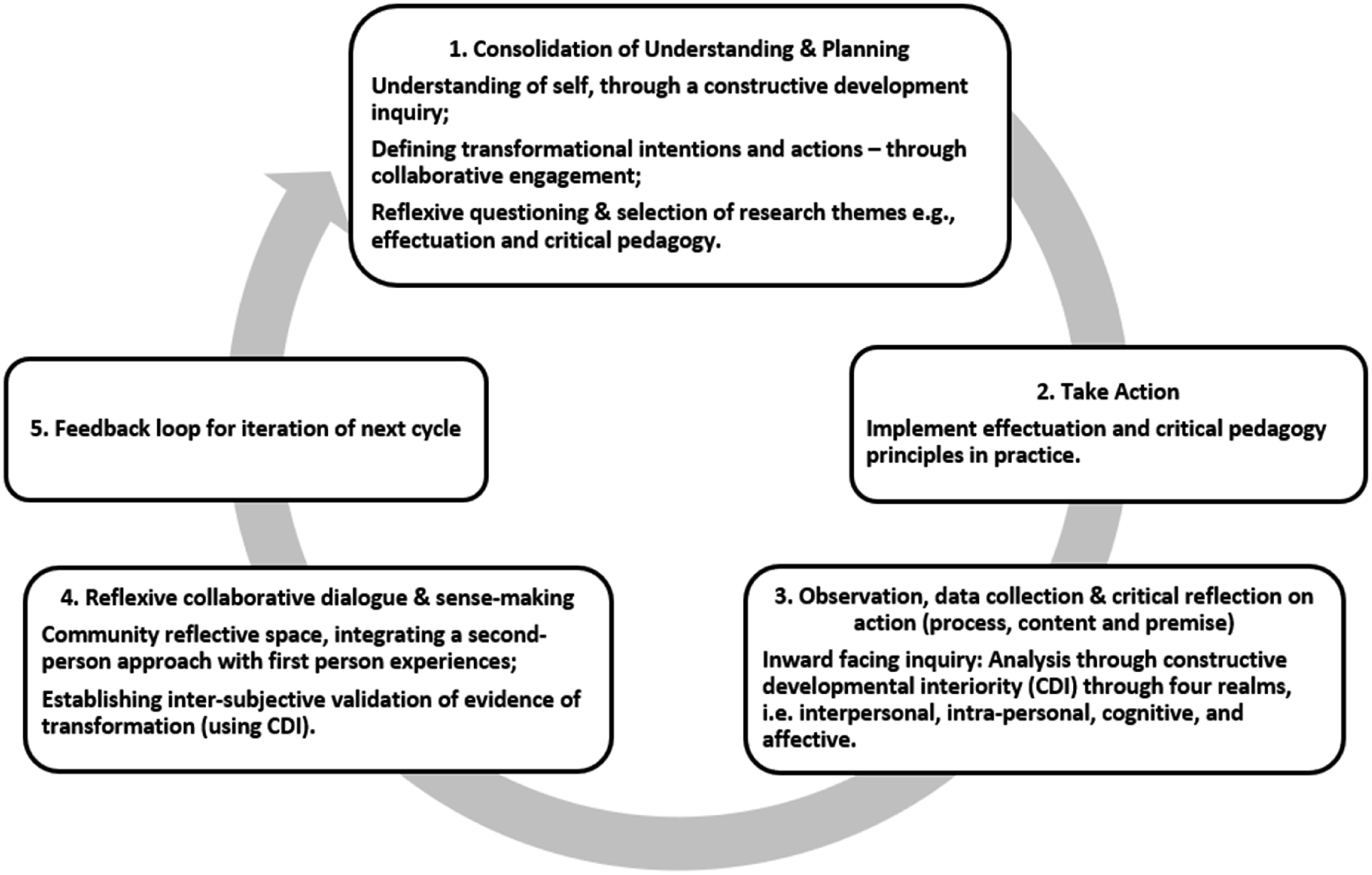
Subsequent selection of specific research themes (reported as Effectuation in the first case study and Critical Pedagogy in the second) were outcomes of an extended period (approximately twelve months) of reflexive questioning across the community. As for any outcome generated through reflexive action research, the research focus emerged through collaborative dialogue and sense-making organised here in weekly group research sessions (Doyle, 2016). The beginning of this discernment phase focused on aligning each practitioner-researcher’s developmental goals with elements new to their professional practice as identified through collaboration across the community.
An important element of the process was the work of individual practitioner-researchers focussing on interiority or inward-facing inquiry. Furthermore, in reflexive collaboration, each researcher within the community was challenged in the sense of both research quality (Gearty and Marshall, 2021) and research trustworthiness (LaBoskey, 2004) to go beyond description of development towards demonstration of development as evidenced through experience. Across the phases of the research, therefore, developmental reflexivity was in evidence, where the community addressed a range of elements of research context, engaging deeply and consciously through shared personal and first-person experiences (Bradbury, 2022).
Diagramatically, our Action Research cycle based on Constructively Developmental Interiority is outlined in Figure 1. Both inward-facing reflective inquiry and reflexive collaboration elements are central to the cycle.
The ART of Effectuation through CDI
One case demonstrating the use of ART and our practical CDI framework was employed to recognise, analyse, and frame the constructive-developmental impact of effectuation on practice, from a first-person perspective. The research was conducted by a practitioner through first-person action inquiry (Coghlan & Brannick, 2014), with focus on the subjective lived experience (Magrini, 2012) and impact upon professional practice.
Effectuation is a non-predictive decision-making logic of control in uncertain situations, that begins with given means and is a set of principles and criteria to generate and select between possible outcomes that can be created with means (Sarasvathy 2001; 2008). Effectuation contrasts with causation, which is a goal-oriented way of knowing (Read et al., 2011). The transition of effectual entrepreneurs to causal reasoning has been recognised by Sarasvathy (2008) as not made easily. However, there was a gap to identify why this transition is difficult, how to make or support the transition and also research the reverse move from causation to effectuation. The transformational transition to effectuation from causation was identified and experienced as an adaptive challenge that required more than engaging in new technical practice(s) (Kegan 2009) but fundamental transformational changes in interiority. This was reflected by changes in paradigmatic assumptions (Brookfield, 2017) evident across the four realms.
The research was conducted in the context of mentoring and training entrepreneurs on start-up and accelerator programmes, as well as teaching under-graduate and postgraduate university students and participants on student development programmes. The constructive-developmental impact and the contribution to professional practice of moving from a causal to effectual way of operating and being was examined.
Applying effectuation to mentoring and training corresponded to consciously applying a new approach – putting effectuation into practice. It was experienced as an adaptive challenge. Adaptive change is about transforming mindset, beliefs and advancing to “a more sophisticated stage of mental development” (Kegan and Lahey, 2009: 29). It is an internal change “from the gut”, linking the head to the heart, resulting in specific behaviours where the heart and behaviour work instinctively together (Kegan and Lahey, 2009: 224). Kegan and Lahey (2009) recognised that adaptive changes in mindset take time and are not “evenly paced” (Kegan and Lahey, 2009: 317). They do not happen quickly because change is an “evolution of mental complexity” and is a gradual process. However, one may create the constructive developmental conditions for change for transformation to occur. These conditions include, for example, a “bridging environment” with the appropriate balance between challenge and support, (Kegan 1994: 294). This applies to the testing and operationalising processes in action research cycles with a heightened awareness, deep reflection, learning about learning i.e. meta-learning from observable data pertaining to the research process, content and premise (Mezirow, 1990).
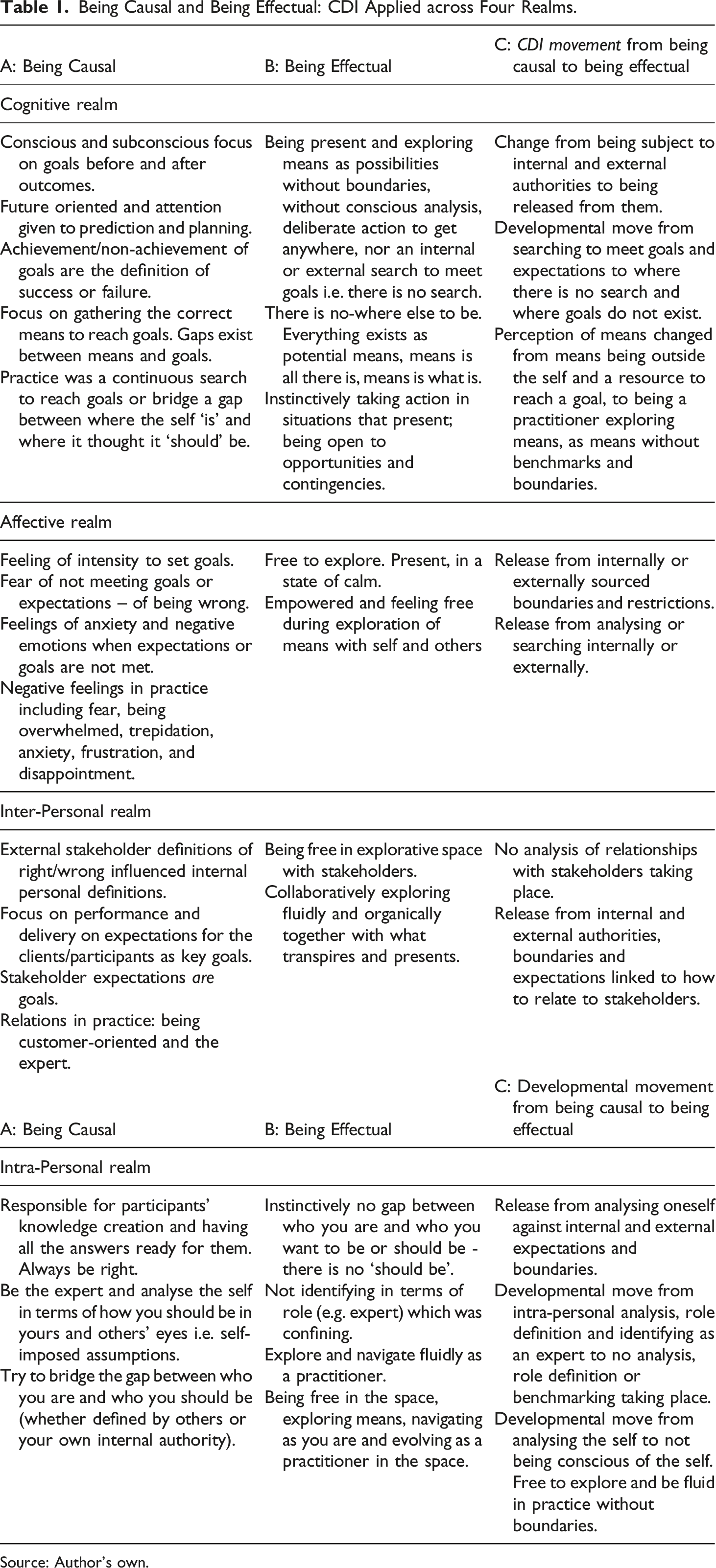
ART through a CDI lens generated insight as to the nature of the challenges, how the transition was made and its impact. Impact was identified by analysing development of interiority across the four realms i.e. cognitive, inter-personal, affective and intra-personal (Drago-Severson, 2011; 2016; Kegan, 1994; 2009). Analysis of the developmental movement charted internal and external data that indicated changes in practice from an initial classification of unconsciously causal to consciously effectual as effectuation was habituated. Over time the classification changed from unconsciously effectual as the usefulness of effectuation in practice was internalised. Transformation was evident in assumptions changing from states of unconscious immunity to change, to consciously immune (Kegan and Lahey, 2009). This was experienced as consciously being released from underlying third-order paradigmatic assumptions (Kegan, 1994; Brookfield, 2017) and causality, which were impeding the adoption of effectuation principles, to being unconsciously released and being effectual (Kegan and Lahey, 2009).
The adaptive challenge of effectuation stemmed from causal-based practice being common in professional practice and may be considered by practitioners as the legitimate way of operating. This is due to the strength of the practitioner’s attachment to goal-orientation identified as being due to paradigmatic assumptions (Brookfield, 2017) that linked goals to success, avoiding failure and protecting professional identity. The research also demonstrated how actively engaging with effectuation, complexity, and uncertainty theories highlighted causal logic may be framed as restrictive and limiting, particularly in a VUCA world (Berger & Johnston, 2015). So too, attachment to goals may be comparable to attachment to practices, which restrict transforming mindsets about global issues, also representing an adaptive challenge.
When being causal the practitioner is in a continuous internal search to meet externally- or internally-set benchmarks. Being causal entails being in pursuit of a specific right answer, chasing a goal or ‘ideal’ situation, a continuous search ‘for’ something, - situations to be different, to be better or that the place to be ‘should’ be somewhere else or different. Therefore, one may never be there, get there - and there is conflict within oneself and experienced in the realms. Even when one goal or benchmark is attained, another is usually put in its place.
Being Causal and Being Effectual: CDI Applied across Four Realms.
Source: Author’s own.
This contrasts to shifts that are technical in nature (Kegan and Lahey, 2009) which are changes in behaviour, technical changes of acquiring skills, learning information or knowing more (Kegan, 1994, 2009), as well as some conscious cognitive shifts which are not transformational. Elements aligned with substantial true transformation became evident analytically when applying the CDI lens. Being effectual was experienced ultimately when effectual practice became internalised – when there were significant and deep constructive developments evident in all four realms resulting in a holistic transformational change and experiencing effectuation as a way of being. An intermediate phase of putting effectuation into practice (over several months) linked the adaptive shift from being causal, to being effectual.
Being effectual was experienced as existential inner freedom to be and explore in practice. It may be described as a state of no boundaries and capacity to explore in practice without intra-personal or cognitive analysis or benchmarking, and emancipation from internal or external search for something, to get somewhere or be different. Being effectual is an absence of, and release from, causality. In linking this experience to related research, being in an effectual state was akin to the subjective experience of Csikszentmihalyi’s psychological ‘flow’ or ”optimal experience” (2014: 215). An excerpt from the learning journal (15th March 2019) reflects this experience as: “… I felt like I navigated and curiously explored in that space fluidly without any conscious or deliberate thinking on my part. I was not trying to be anyone or get any where. I was seeing what I was seeing, curiously probing and asking questions, hearing, commenting, getting ideas, being prompted by ideas as they arrived on the table, while watching others being prompted by ideas. There was no deliberate thinking involved. Everything that I was saying or doing was all happening naturally and organically. I was so alert and not distracted by an ‘ideal’ or best practice or getting to a result. The discussion was fluid and dynamic. I was just acting, aware of the situation around me and curiously navigating with what was happening …”
While techniques, skills and tools - such as effectual logic and operating effectually - are useful, the lived experience was that effectuation experienced as a way-of-being was profound, emancipative, empowering and professionally transformative. It was experienced as existential inner freedom which may be considered akin to a post-modern way-of-knowing (Berger, 2005; Kegan, 1994) to support development of mental complexity for navigating in modern and post-modern VUCA environments (Berger & Johnston, 2015). It represents an alternative construction of how to see and be in the world.
While the research was focused on effectuation through action-inquiry in mentoring and teaching practice, the CDI approach may also be applied broadly to other practices – ways of operating and being. The approach may also be applied to other professions and practices, resulting in different phenomenological and constructive-developmental experiences of interiority categorised into the four realms by practitioners.
The research reports on how one practitioner underestimated how self-created constructs, external authorities, subjective internal authority about goals, expectations and beliefs about ‘right and wrong’ and intra-personal realms were lenses impacting their view of the world, thereby offering highlights on why and how ART through a CDI lens may have an explicitly transformational focus and impact.
The ART of critical pedagogy through CDI
The second case in which the CDI framework was employed was in the implementation of a Critical Pedagogy in a third level institution by a university lecturer. The research was conducted using first person, educational emancipatory action research (Carr & Kemmis, 1986) and the context of the research was a developmental DBA with a stated objective of transformational change in the complexity of the researcher’s sense-making to a qualitatively different stage. Intentional focus on the constructive development capacity in the cognitive, interpersonal and intrapersonal realms by comparing third and fourth order stages of development (following Kegan, 1994) framed the adaptive challenges and changes necessary for transformation.
The research provided a lived experience of implementing the propositional theory of critical pedagogy (e.g. Freire, 1970; Dirkx, 1998; Giroux, 2011) analysed through the lens of constructive-developmental theory (e.g. Kegan, 1994; Baxter Magolda, 2003; Berger, 2012) and interiority (Shani and Coghlan, 2019; 2021). Critical Pedagogy is a developmental pedagogy and explores social and structural concepts of power, control and inequality through critical content, democratic dialogue and critical thinking. It calls for the lecturer to share power in the classroom and facilitate the inter-subjective creation of new knowledge in a democratic, pluralistic classroom environment.
By its very nature, implementing Critical Pedagogy provides adaptive challenges as it requires the lecturer to transcend their own self-concept and resist contextual and relational forces to assimilate to normative notions of the role of lecturer, the student/teacher relationship and what constitutes knowledge. According to Torbert (2004) transcending the self-concept is the key to transformation but for most, a deeply internalised need to appear independent, competent, and knowledgeable interferes with showing the necessary vulnerability to permit transformation. Knights and Clarke (2013) found that those involved in academic work are particularly susceptible to intra-personal and inter-personal insecurity because of the visibility and idealised role assigned them. The importance of how they are perceived by others impacts the ability to overcome these insecurities and behave in line with their espoused values.
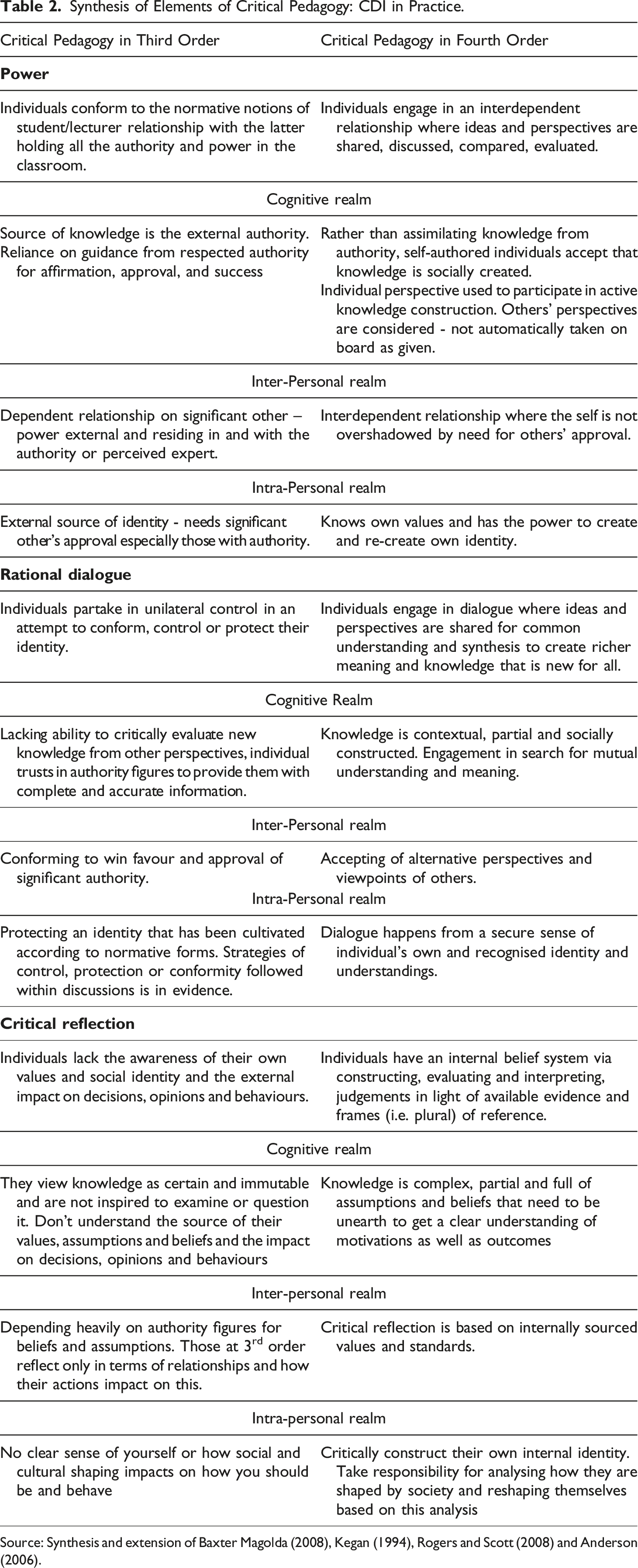
Synthesis of Elements of Critical Pedagogy: CDI in Practice.
Source: Synthesis and extension of Baxter Magolda (2008), Kegan (1994), Rogers and Scott (2008) and Anderson (2006).
The comparison of third and fourth orders is particularly useful given the respective focus of third order on the maintenance of relationships, the concern of status, and living up to external expectations, and fourth order on the individual’s separation from these tight bonds with others in developing their recognised separate perspective (Kenofer, 2013).
The research highlighted the challenges and resistance to change, and that implementing critical pedagogy through a third order developmental complexity would not conform to the tenets of critical pedagogy. Interestingly, a seemingly participatory democratic classroom was in evidence in one phase of the action research cycles conducted. It revealed itself in the analysis of data collected via an imbalance of power and use of ‘unilateral control’ as students and lecturer clung to normative notions of student-teacher relationships, power structures and instrumental attitudes to the transfer of knowledge. An excerpt from the researcher’s reflective journal (from 28th January, 2018) noted: “When Mary O’ asked that question on agency workers’ rights I said we would discuss it later. I did that because I didn't know the answer - and although I'm sure there was somebody in the room who knew the answer, I was not willing to ask. This is my big assumption showing up again - protecting my expert persona.”
Despite espoused values of equality, the researcher’s motivations to maintain power and control afforded by their authority and expertise won over. The researcher’s own paradigmatic assumptions about their professional identity and value proposition demanded that students judged their lecturer’s expertise as superior. This came to light during reflexive questioning within the weekly Community of Inquiry session. The researcher’s own paradigmatic assumptions about their professional identity and value proposition demanded that students judged their expertise as superior. An excerpt from the researcher’s reflective journal (16th November, 2017) read: “In our discussions today in the community of inquiry, I realized that I don't want equality. I've worked too hard to build up my knowledge and expertise and if I'm equal to the students - what value am I bringing to the role?
This reflection was not surprising as in third order developmental complexity (evident in Table 2) an individual’s assessment of their role and how they are perceived by, and connect to, others are important influences of the sense of self.
The findings from the research indicated that Critical Pedagogy could be both the means to, and the output of, development. In this case, a hidden developmental expectation was that those implementing Critical Pedagogy are ‘self-authored’ (Kegan, 1994) as it demands a rethinking of the teacher-lecturer role, and the teacher/student relationship, in order to truly release the power for learning and knowledge-creation to become a “student among students” (Freire, 1970:62). But it was also the means to development by providing adaptive challenges to transcend normative ideas of power and control in teaching.
Intentional consideration of interiority through first person action research provides insights into perceptions of internal and external experience. We know that experience and meaning-making are intricately linked and our experience is shaped by our sense-making system (Kegan, 1982). ART through CDI is an intentional consideration of the complexity of the researcher’s sense-making. It provides a practical framework to identify and generate meaningful data to analyse transformation and distinguish between qualitative change in sense-making complexity as opposed to increased information, skills or technical changes. In this case it did not allow the researcher to mislead themselves that what looked like Critical Pedagogy was indeed the desired developmental pedagogy.
Discussion and conclusions
Pressing global eco-social challenges demand transformations within energy, economic and organisational systems, and across these systems. Increasingly, action research targets these challenges (Fazey et al., 2018; Trajber et al., 2019; Jorgensen and Stephens, 2022). A call for action research for transformation (ART) has been both shared and widely supported (Bartels & Friedman, 2022; Bradbury et al., 2020). While the call for transformation targets global movements, our research contends that large-scale transformation begins and aligns with individual constructive developmental interiority, and is evident where substantial shifts in individual practice, behaviour and understanding occur (Shani and Coghlan, 2019).
The current study contributes to ART from the perspective that eco-social challenges require adaptive rather than technical transformation where “to create the new knowledge and skills to address the problem, the existing system itself may need to undergo change. Everyone involved may need to work in new ways, often making fundamental changes to their values, beliefs, habits, ways of working, or ways of life” (Heifetz and Linsky, 2004: 35). The cases indicate that fundamental transformation of the individual may be achieved through deliberate adaptive action research organised within a developmentally reflexive community of inquiry. Through such engagement and questioning of deep-rooted assumptions, adaptive shifts may occur, revealed via “data of consciousness” (Shani and Coghlan, 2019: 519) or orders of consciousness (Kegan and Lahey, 2009). The CDI approach reveals that such data are open to interpretation given the variation in capacities for sense-making i.e. that sense-making is revealed in constructive development capacity (or stage of development). Reflexive collaboration helps in identifying the capacity in action e.g. interpreting meanings from data, and also in prompting and supporting perspective shifts.
The depth of reflection necessary for substantial understanding, learning and transformation to take place is widely emphasised, despite the significant oversimplified, superficial understanding of reflective practice that can assume it is simply a matter of pausing for thought from time to time (as noted in Thompson and Thompson, 2018). Coghlan and Brannick (2014) echo Argyris (2003) in explaining that along with the core cycle of action research, a second cycle of reflection occurs and “It is the dynamic of this reflection on reflection that incorporates the learning process of the action research cycle and enables action research to be more than everyday problem solving. Hence, it is learning about learning – in other words meta-learning” (Coghlan & Brannick, 2014: 25).
In applying CDI, framed around the four realms of experience, we propose a practical means to identify and organise data from action research cycles that serve as meaningful reflection learning, and meta-learning. The developmental reflexivity involved in both first- and second-person perspectives lends itself to transformation of individuals within the community of inquiry. Since our approach frames first-person data within the broader collaborative reflexive approach, we see it as contributing methodologically by outlining a process for enhancing the quality and validity of first-person action research through collaborative developmental reflexivity (Bradbury, 2022).
To address substantial global challenges, there is consensus that hegemony in political and economic systems must give way to new ways of acting and thinking such that power structures are transformed (Kenner, 2019; Dorninger et al., 2020). Rethinking current structures and systems calls for the development of bottom-up processes (in addition to top-down options) of collaboration to re-frame and replace obsolete and damaging systems (Balázs & Pataki, 2018; York et al., 2021). For individuals engaging in such change, a capacity is required to recognise the limitations of current systems, and their inherent assumptions, and to construct and contribute to new processes and structures. A blind spot is acknowledged in “‘internal’ or ‘personal’ spheres of transformation” that is argued to explain the implementation gap between available knowledge on effective climate mainstreaming and its translation into radical change (Wamsler and Osberg, 2022: 1). Reflexive collaboration within CDI-based action research is a means to target this gap.
Engaging to transform in the context of CDI requires independence of mind beyond meeting the agendas of others along with individual willingness to question one’s own and others’ values, assumptions and habits. Such independence corresponds to a specific type of developmental complexity, or a complex interiority, beyond the stage where individuals rely on the opinions or agendas of others (implicitly or explicitly) for directing their actions. Such emancipatory, liberating capacities are not fully developed in approximately one-half to one-third of adults, based on large samples across a variety of comprehensive measures (Helsing et al., 2008; Kegan, 1994). It would be erroneous to assume that individuals necessarily possess such capacities, or have reached such a stage of awareness of the development state of their interiority i.e. of how they make sense and act on the inner and outer data they experience. As the cases indicate it is simply insufficient to consider climate or eco-social challenges as beyond the realms of individual transformations which may demand fundamental transformation of worldviews, that can be made visible through CDI via action research.
The two case studies demonstrate the challenge of development even with expressed intentional commitment to transformation - which was thwarted by initial over-alignment of the sense of self with the beliefs of others. Case One demonstrated the challenges experienced in abandoning causal practices, due to the attachment to goals and their links to right and wrong and a constructed (perceived) external pressure that considered causality as the only legitimate way of operating. Being effectual involved awareness and release not only from underlying (third-order) assumptions evident in all four realms of interiority but also from the internal and external authority of goals, expectations, and beliefs of ‘right and wrong’ as subjective constructs. When analysed from our CDI perspective, a range of adaptive changes that took place were identified in terms of experiences of thinking, feeling, relating to others, the concept of self, professional identity and holistically how to be in practice. The research demonstrated that while the experience when operating effectually was impactful, the internalisation of effectuation - being effectual - had more profound transformational impacts.
Case Two revealed the researcher’s struggle with implementing the propositional theory of critical pedagogy. ART through our CDI lens allowed for an intentional consideration of the complexity of the researcher’s sense-making and their stage of development. There was evidence of the researcher operating at a third order capacity where the focus was on conforming to external expectations, maintenance of relationships and concern for how one is perceived by others (Kenofer, 2013). Despite the desire to provide an environment conducive to self-directed learning, the researcher did not yet have the developmental capacity to let go of the power and control constructed from accumulated authority and expertise. Once the substantive developmental shift occurred, the researcher could take their identity as an object of reflection and recognize how it was embedded in a system of values, ideologies and external expectations.
Thus, the practical contribution of the research, evident from the cases, lies in its advance towards bridging exterior action in the practice context with interior action evidenced across any or all of the four realms identified in ways that allow for the integration of first-person reports and reflexive collaboration into everyday routines of practice and research. Both cases report interiority-based data offering evidence of substantial transformation across very different contexts and focusing on ostensibly two unrelated themes.
The conceptual contribution of the research lies with our constructive-development basis for ART resulting in our introduction of CDI. Substantial transformation, such as in the cases reported here, is revealed in paradigmatic and assumption changes that are both unique yet highly complex. The practical framework suggested for reporting aspects of interiority via four realms (cognitive, inter-personal, intra-personal and affective) provides a means of organising the complexity of the experience of transformation through this expansive classification. While the approach relied on first-person accounts, regular and systematic debriefings within a community of researchers, facilitators and research supervisors served several valuable purposes. Each debrief involved thorough discussions based on data reported, that enhanced the skills of data collection and produced questions about the nature and extent of insights prompted and generated by the data, representing capacity building across the group, allowing for ‘sharpening of instruments’ (Mann, 2005). Considerable efforts were devoted to providing sufficient richness in the data to substantiate claims of transformation, grounded in first-person experiences of ‘before’ and ‘after’ states and relations.
The two cases of transformation reported are simply two cases. However, both studies provide inspiration to practitioners considering how to recognise, frame, organise, and undertake deliberate transformations in their own context. Each case study must be approached with caution, guided by the understanding that contextual factors likely shaped the outcome. Understanding the specific context of any desired transformation is relevant to creating appropriate foundations for success. When individuals identify gaps where transformation could be most impactful, they are invested in both investigating the gap and in how it might be narrowed. While not the focus of this paper, the process of identification itself is an important phase in the development of the action research cycles that led to the selected focus on critical pedagogy and effectuation, respectively. Directly addressing issues relevant to global challenges of sustainability are an option for the approach here.
While research on community action research (CAR) discusses the importance of cooperation (Senge and Scharmer, 2001), the reflexive collaboration here was vital in amplifying the potential of first-person action research. Contributory aspects of co-operation include enhancing the quality of research through developing and contesting understandings, avoiding isolation of researchers and sustaining necessary commitment to transformation – each of which increased the likelihood of delivering transformation. Over time the intellectual partnership of the cohort yielded challenging interactions about which experiences aligned with transformation not only by necessity, but sufficiently. In brief, when transformation was evident, it was grounded in data from across the four aspects of interiority that revealed differences between employing techniques (or putting skills into practice) and internalisation of new assumptions associated with updated identities.
In conclusion, addressing global challenges requires a transformation of current structures and systems and individuals involved in this change need the capacity and independence of mind to move outside the current ways of thinking and acting. CDI addresses the gap in ‘internal’ spheres which is preventing available new knowledge and evidence translating into actual radical change. It provides a framework for individuals pursuing intentional transformation to identify and record constructive developmental shifts, while recognising the need for community support and challenge through collaborative developmental reflexivity groups.
Footnotes
Declaration of conflicting interests
The author(s) declared no potential conflicts of interest with respect to the research, authorship, and/or publication of this article.
Funding
The author(s) received no financial support for the research, authorship, and/or publication of this article.
