




Abstract
Empowerment and participation are promoted as critical factors in meaningful development processes; however, action-oriented researchers face challenges in fostering genuine empowerment and meaningful participation within traditional funding cycles and research timelines. This case study illustrates a participatory methodology employed by researchers in partnership with one Honduran non-governmental organization (NGO) to conduct ‘practical’ participatory evaluation with rural Honduran youth. Through collaborative autoethnography, two components of this methodology are identified and described. The first component – ‘foundational elements’- includes the NGO’s culture of transformative participation and the organization’s attention to synergies in the insider/outsider identities of research partners. The second component includes the ability of the research team to leverage this foundation for the participatory evaluation with rural youth. Importantly, this ability was grounded in and shaped by long-term, trust-based relationships between research partners. These relationships were the catalyst for success in this participatory initiative, connecting the ‘foundational elements’ identified to the collaborative outcomes experienced. Overall, this case study contributes to current and ongoing scholarly discussions on how to facilitate meaningful participation and capability expansion in research and evaluation contexts.
Introduction
International development scholars have long promoted empowerment and participation as key factors in facilitating development (Clark et al., 2019; Lopez-Fogues & Melis Cin, 2018; Sen, 1999). In particular, there is a focus on transformative participation that brings about meaningful change in communities engaged in development processes. For scholars aligned with the Capability Approach (CA), empowerment and participation are critical mechanisms to expand freedoms that enable people to choose lives they value and to pursue and achieve well-being. However, action-oriented researchers continue to grapple with how to effectively and meaningfully incorporate these core tenets of the Capability Approach into study designs and research programs (Martinez-Vargas et al., 2022; Walker & Boni, 2020). Given the complexities of fostering genuine empowerment and participation in research and evaluation processes, especially in settings where people have experienced systemic disempowerment and marginalization, case studies can provide instructive examples of both successes and challenges in achieving theoretical ideals.
This case study describes how a foundation of empowerment and participation fostered by one Honduran non-governmental organization was leveraged by researchers to enable a participatory evaluation of youth-specific programming in remote areas of Honduras. We show how empowerment through what Cousins and Whitmore (1998) refer to as ‘transformative participation’ has been intrinsic to this NGO’s program theory, fostering an organizational culture of emancipatory participation. This program design laid the groundwork for what Cousins and Whitmore (1998) refer to as ‘practical participatory evaluation’, as rural youth were accustomed to meaningful engagement in formal research processes. Furthermore, the NGO’s partnerships with youth and external researchers, built on complementary insider/outsider identities, allowed for synergisms in the evaluative research process. This case study illustrates a participatory methodology in which long-term, trust-based partnerships, paired with long-term emancipatory programming (i.e., programming that moves beyond the provision of basic services or skills-based training and instead focuses on enhancing freedoms through genuine empowerment and meaningful participation), acted as a catalyst for meaningful engagement in practical participatory processes. Acknowledging opportunities for further growth in our own participatory practices, this case study contributes to current and ongoing scholarly discussions on how to facilitate meaningful participation and capability expansion in research and evaluation contexts.
We begin by reviewing empowerment and participation as priorities in international development research and capabilitarian scholarship. We clarify the distinction between ‘practical’ and ‘transformative’ participation before describing the research partnership and activities that grounded this case study. We highlight key insights arising from this collaborative research process, including how the research team built on the organizational culture of transformative participation and navigated layers of insider/outsider identities to effectively facilitate the practical participatory evaluation, as well as opportunities to further align this study with the ‘participatory cosmology’ proposed by Martinez-Vargas et al. (2022). Throughout, we reflect on how the challenges of participatory capabilitarian research can be mitigated through trust-based partnerships with locally-embedded, development-oriented organizations. This collaborative work can be used to guide other action-oriented researchers who seek to establish partnerships – or “solidarity alliances” (Martinez-Vargas et al., 2022, p 9) – that support genuine empowerment and meaningful participation through research and evaluation.
Framing our Case Study: Insiders, Outsiders, and Distinct Forms of Participation
The term ‘participation’ gained prominence in development rhetoric during the late 20th Century, with practices such as Participatory Rural Appraisal (PRA) and action-oriented participatory research, including Participatory Action Research (Chambers, 1994; Fals-Borda, 1987; Frediani, Peris, et al., 2019). While the terminology of ‘participation’ was new, there had been a long-recognized need to “give ‘the poor’ a voice and a choice” in development processes (Cornwall, 2006, p. 62). Critical voices from the colonial era had highlighted the ineffectiveness of indirect rule as a development strategy, leading to the formation of international aid organizations (Cornwall, 2006). Ongoing criticism of top-down approaches to development work and aid provision saw a shift toward ‘community development’ in the 1950s, including community-based organizations and self-help groups in low- and middle-income countries (Cornwall, 2006; Holdcroft, 1984; Leal, 2007). Meanwhile, grassroots movements were emerging in post-colonial settings, with historically marginalized groups claiming greater ownership over opportunities and resources (Freire (1970) being a poignant example).
Central to these precursor movements was the distinction between ‘insiders’ and ‘outsiders’ of development processes, and an understanding of power asymmetries that have historically governed their relations. Participation scholars protested traditional approaches to development that characterized insiders as ‘objects’, or passive recipients of aid, and outsiders as the ‘subjects’ of development (Fals-Borda, 1987; Joshi, 2020). Fals-Borda (1987) called for a conversion from a subject-object to a subject-subject relationship, with insiders and outsiders playing valuable yet distinctly different roles in bringing about social transformation. Similarly, Chambers (1994) acknowledged differing strengths, limitations, roles, and responsibilities of insiders versus outsiders by highlighting the capacity of outsiders to elicit and extract information and the capacity of insiders to share participatory and emancipatory spaces.
In international development studies, ‘empowerment’ and ‘participation’ have been characterized as buzzwords: gaining popularity while remaining poorly defined and frequently misapplied (Cornwall, 2006; Frediani, Peris, et al., 2019; Hammock, 2019; Leal, 2007; Unterhalter, 2019). Critics suggest that, in some cases, these terms have been co-opted to embellish project descriptions and make paternalistic initiatives more palatable. Indeed, scholars have identified issues with the tokenistic application of participatory methods, rather than genuine engagement with participatory methodologies (Biggeri et al., 2019; Cooke & Kothari, 2001; Hickey & Mohan, 2004). Further, some scholars have problematized the participation movement itself, suggesting that it simply repackaged old ideas and that the ongoing involvement of ‘outsiders’ in development processes reproduces unequal power relations (Cooke & Kothari, 2001; Cornwall, 2006; Hickey & Mohan, 2004; Leal, 2007). Importantly, these critiques highlight how a liberal application of the rhetoric of ‘participation’ to development efforts without careful attention to power asymmetries among those involved could reinforce the status quo. However, the participation movement can alternatively be understood as the convergence of concerns and ideas held by diverse stakeholders who cared to see development processes generate transformative social change (Chambers, 1983; 1994).
One such group of stakeholders are scholars engaged in human development and capabilities discourses, building on Amartya Sen’s Capability Approach to development (CA). This development theory takes an ‘agency-oriented’ approach to development processes (Biggeri & Ferrannini, 2014, p. 60), prioritizing the values, preferences, and choices of those involved. Broadly focused on well-being and human flourishing, the CA has been applied across demographics and settings (UNDP, 2020). Definitions of ‘insider’ and ‘outsider’ are understood to be context-specific, representing “different positional objectivities” (Martinez-Vargas et al., 2022, p 9), while the shared goal of both ‘insiders’ and ‘outsiders’ is to expand freedoms that people experience to choose lives that they value.
Capabilitarian scholars have noted that effective applications of the CA are necessarily grounded in participatory approaches, including the empowerment of groups that have been historically marginalized (Alkire, 2002; Frediani, Clark, et al., 2019; Martinez-Vargas et al., 2022; Unterhalter, 2019). As Hammock (2019) states, “the issue for advocates of the capability approach is not whether there should be participation; the issue is what kind should there be [and] how might it be effective?” (p 39, emphasis added). In this regard, Martinez-Vargas et al. (2022) recently called capabilitarian scholars to engage in ‘participatory cosmology’ where participation is not confined to specific methods nor approaches to data collection. Rather, this cosmology is an orientation to the research process as a whole. Within this cosmology, researchers and community members collaborate on every aspect of the research process, from identification of the research questions to study design, data generation and analysis, creation of research outputs, and knowledge dissemination. Alongside Walker and Boni (2020), Martinez-Vargas et al. (2022) argue that this “shared authority” is a form of epistemic justice that centralizes those who are typically placed on the margins of knowledge creation processes.
In the midst of the various debates surrounding participatory approaches, Cousins and Whitmore (1998) have offered a useful distinction between two types of collaborative inquiry: practical and transformative. According to these scholars, the primary function of ‘transformative’ participation is to “empower members of community groups who are less powerful” (Cousins & Whitmore, 1998, p 6). Transformative participation is intended to generate social change through ‘conscientization’, collaboration, and critical reflection; all of which lead to collective empowerment. Meanwhile, the primary function of ‘practical’ participation is to “support program and organizational decision making and problem solving”. Practical participation integrates key stakeholders with the intention of enhancing the direct relevance, ownership, and utility of research or evaluation findings. While their primary functions are distinct, Cousins and Whitmore (1998) note that these two approaches also overlap: transformative effects can feed into practical applications of research and evaluation findings; practical effects can generate further emancipatory outcomes.
Case Study Overview
Honduran Research Partner: FIPAH
La Fundación para la Investigación Participativa con Agricultores de Honduras (FIPAH) 1 is an NGO that strives to enhance the viability of rural livelihoods and improve well-being in remote Honduran communities. To these ends, FIPAH conducts participatory agricultural research with smallholder and subsistence farmers. Farmer-led research teams, known as Comités de Investigación Agrícola Local (CIALs), collaborate with FIPAH’s staff of agronomists to implement small-scale field trials, through which CIAL members identify the most effective seed varieties and production strategies for their unique hillside growing conditions (Classen et al., 2008; Humphries et al., 2000, 2008; Dodd et al., 2020).
FIPAH’s programming strategy emerged from a participatory methodology designed by Dr. Jacqueline Ashby and team at the International Center for Tropical Agriculture (Spanish acronym: CIAT) (Ashby et al., 2000). On a technical level, studies and evaluations have shown the effectiveness of FIPAH’s CIALs in improving seed varieties and expanding sustainable agricultural practices, with positive implications for livelihood stability and food security (Humphries et al., 2005, 2008, 2015). Moreover, by leveraging social capital within each CIAL to pool resources, FIPAH’s CIALs have acted as effective savings groups, providing loans to CIAL members and managing loan repayments (Humphries et al., 2000). Most notably, through adaptations to the original CIAL methodology, FIPAH’s CIALs have driven social transformation, circumventing elite capture (Classen et al., 2008; Humphries et al., 2000), and elevating the status of women (Classen, 2008; Humphries et al., 2012). 2 The active participation of women – who self-describe as futuristas – is particularly notable, challenging deeply held gender norms that traditionally exclude rural women from agricultural activities (Humphries et al., 2012).
FIPAH’s participatory agricultural research with youth
While FIPAH’s CIALs originally focused on adult farmers, FIPAH found that rural youth were also interested in participating. With an inclusive and voluntary membership model, FIPAH incorporated these youth into existing adult-CIALs during their initial years of operation (1993–1999). Throughout this time, staff noticed that youth participants exhibited distinct assets, interests, and needs from their adult counterparts. While youth had fewer material resources to contribute to CIALs (e.g., land, agricultural implements, savings), they also tended to have fewer responsibilities immediately associated with agricultural productivity (e.g., feeding and supporting a family). Additionally, staff noticed that youth participants were less risk-averse and more open to experimentation. Moreover, youth expressed greater interest in livelihood options apart from agriculture and had more energy to explore diverse livelihood opportunities.
Seeing the transformative potential of investing in formative development opportunities for rural Honduran youth, FIPAH launched a youth-CIAL program in 2000. 3 FIPAH partnered with a local educational institution to implement youth-CIALs in both school and community settings. Their goal in conducting participatory agricultural research with youth was to integrate young people into creative problem-solving activities that addressed local development challenges and provided an alternative to outmigration (Dodd et al., 2020; Wyngaarden et al., 2022, 2023). Subsequently, FIPAH facilitated other formative development opportunities, providing loans and scholarships for formal education, vocational training in the trades, as well as business management and microenterprise development. FIPAH diversified youth programming based on interests expressed by participants and opportunities available through local inter-organizational partnerships. While FIPAH’s staff observed successes in this programming, they had not formally evaluated this work prior to the participatory program evaluation described herein.
Collaborative Participatory Program Evaluation with Youth
In late 2017, Honduran and Canadian research partners collaboratively initiated an evaluation of FIPAH’s youth-CIAL program in its two operating locations (Jesús de Otoro, Intibucá and Yorito, Yoro). FIPAH staff recruited five youth leaders from the study locations to be part of the research team (10 members total, including youth leaders). In mid-2018, this team of Honduran and Canadian researchers, FIPAH staff members, and youth leaders launched the first stage of the participatory evaluation.
The research team collectively articulated the evaluation questions, formulated the study design, and developed research tools for both quantitative and qualitative data collection. Senior members of the research team trained the youth leaders to expand their capabilities in both quantitative and qualitative data collection techniques. Youth leaders then led the data collection process. Youth researchers were also trained in videography techniques as a creative evaluation output that would document the experiences, insights, and reflections of former youth-CIAL participants. The first stage of data collection occurred from May-October 2018.
The research team determined that a second stage of data collection could broaden and deepen the evaluation. This second stage, led by a Canadian graduate student, included a 3-month period of in-person collaboration between the graduate student and research team members in Honduras (September-December 2019). During this time, the student worked primarily with youth leaders to interpret initial findings and conduct follow-up research. Throughout the study, senior members of the research team provided support, supervision, training, and guidance to youth leaders and the graduate student.
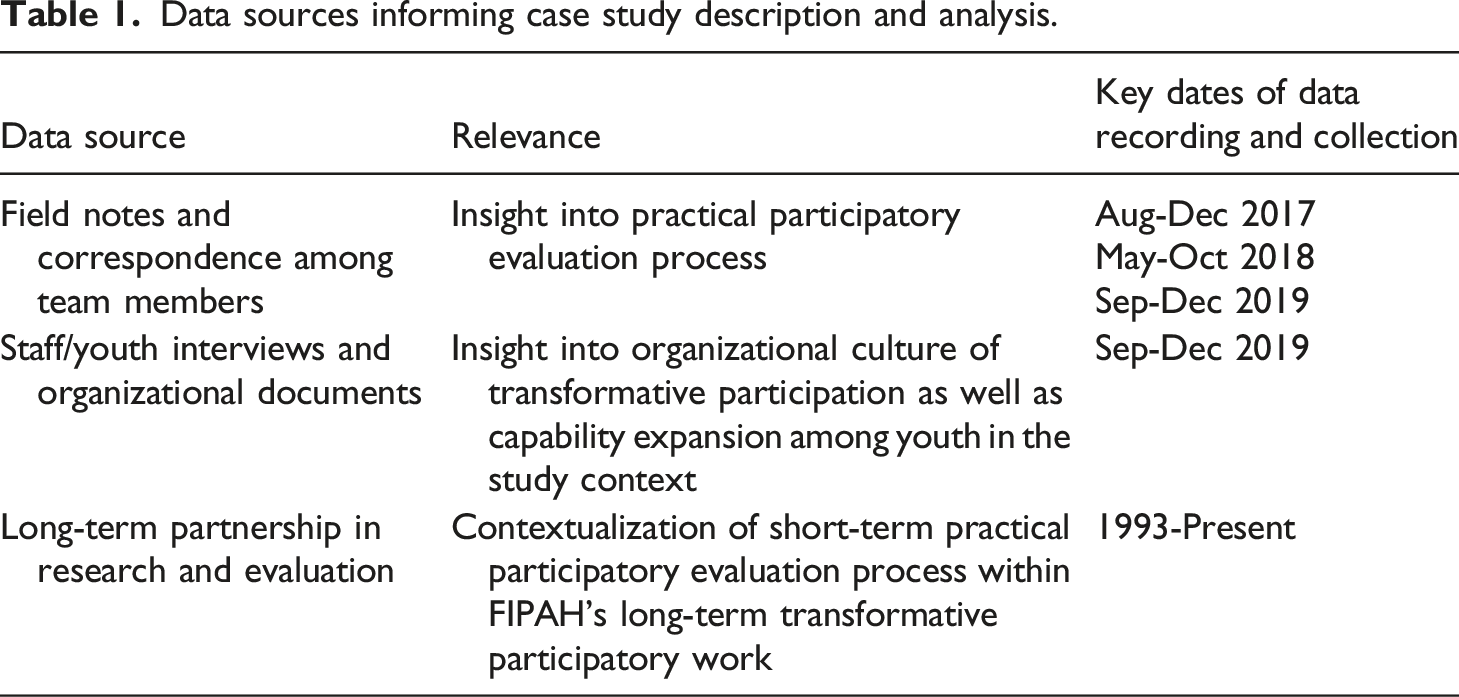
Data Sources
Data sources informing case study description and analysis.
Foundational Elements for Successful Participatory Research
Organizational Culture of Transformative Participation
In alignment with the CA (Frediani, Peris, et al., 2019), FIPAH’s programming approach employs genuine (rather than tokenistic) participation as a strategy for empowerment. The CIAL methodology was designed to integrate rural populations as co-owners of development processes (Ashby et al., 2000). Working alongside FIPAH staff, CIAL members decide on agricultural issues to address as a team (e.g., crop productivity, pest or disease resistance, drought tolerance) and implement comparative field trials that test options for addressing these challenges in their unique agroecosystems. The effectiveness of each CIAL depends on the full participation of its members. Consequently, emphasis is placed on training and empowerment through participation to enhance each member’s capacity to take ownership of each aspect of the field trials (Ashby et al., 2000).
While adult-CIAL members were already engaged in agricultural livelihoods, FIPAH recognized that youth-CIAL members may have aspirations for their lives apart from agriculture. In order to provide meaningful livelihood support to a heterogeneous population of youth, and empower these youth to have agency in their livelihood decisions (Lopez-Fogues & Melis Cin, 2018), FIPAH employed participatory methods to identify which capabilities youth participants wanted to expand, both within and beyond agriculture. For example, FIPAH conducted formal surveys among youth-CIAL participants to determine preferred trades for training and certification. FIPAH staff also learned about preferences and priorities among youth by spending time with program participants, asking questions, getting to know them as individuals, and enabling youth to take initiative in their CIALs. This programming decision reflects the capabilitarian assertion that “ordinary people are more than capable of articulating a ‘good’ form of life and identifying capabilities they have reason to value” (Frediani, Clark, et al., 2019, p 7). When reflecting on their work with youth, FIPAH staff identified participatory program planning as critical to program effectiveness and broader social transformation. One staff member stated: With young people, the first thing we have to do is to know their [individual] contexts. Yes, to know what their aspirations are, their desires […]. Otherwise we are going to treat [each] young person the same as everyone else, [but each young person] is very different. [We have to] know the reality [in which each] young person lives. It is very important to know their resources, their abilities, […] so that, in the future, this young person can be successful. If we have a [youth] project, we have to see that way of life. If we do not do it, we are going to fail. (Female program facilitator, Yorito)
Results from the participatory evaluation with youth-CIAL members are presented in detail elsewhere (Wyngaarden et al., 2022). The findings illustrate three distinct pathways through which participation in FIPAH’s youth programming was transformative, facilitating genuine forms of empowerment among participants. Respondents described building confidence and self-esteem through the program’s inclusive environment, aligning with power within, as presented by Miller et al. (2007). This form of power focuses on internal capabilities, which facilitate a person’s agency, including self-worth and self-knowledge. Youth-CIAL members felt that their CIAL teams made meaningful contributions to community development and that, despite being youth, they came to be seen as community leaders. They indicated that women and men served in rotating leadership roles, giving each person a chance to guide the CIAL. Miller et al. (2007) described the ability to build solidarity and establish common ground as power with, and emphasized its importance in taking collective action. Furthermore, youth-CIAL participants shared that FIPAH’s program provided opportunities to discover and pursue personal vocational interests. According to Miller et al. (2007), these forms of capability expansion denote power to, which enables individuals to direct their own lives. Further to the evaluation findings, FIPAH staff, such as the program facilitator quoted below, shared observations of tangible program impacts: FIPAH’s work has allowed young people to improve their knowledge, to have better options, to be able to improve their crops, to generate other activities, to generate greater resources, which is generally why people migrate – for better living conditions, housing, education, health. And through FIPAH there are many cases of people who have made the most of [their] resources (Male program facilitator, Yorito).
FIPAH uses participation as an emancipation strategy in all programming, empowering rural youth and adults to have greater ownership over livelihood trajectories and greater stability and satisfaction in livelihood outcomes. Their work aligns with core principles of the CA to build individual agency (power within and power to) and nurture collective agency (power with) in order to enhance meaningful engagement in development processes (Frediani, Peris, et al., 2019; Miller et al., 2007). Additionally, as noted, this work aligns with Cousins and Whitmore’s (1998) ‘transformative participation’; focusing on individual and collective empowerment to generate social change. Previous studies of FIPAH’s adult-CIALs have demonstrated that FIPAH’s approach to programming appeals to individuals who want to participate – to be empowered – and are willing to put in the work – to take action – in order to address local development challenges (Classen, 2008; Humphries et al., 2012). Importantly, FIPAH’s use of participation as an emancipation strategy has remained consistent across space and time, creating an organizational culture that facilitates social transformation and enables program innovation (e.g., new initiatives with youth).
FIPAH’s program theory developed, in part, from the organization’s views on best practices for rural development, particularly in centralizing voices that are typically marginalized in knowledge creation processes (Martinez-Vargas et al., 2022). Their approach aligns with the CA’s focus on expanding peoples’ capabilities so that they experience greater freedom to pursue lives that they value and experience well-being (Clark et al., 2019; Lopez-Fogues & Melis Cin, 2018; Sen, 1999). Arguably, FIPAH’s program theory also developed out of necessity: there are considerable gaps in support from government agencies and other NGOs in these remote communities, and FIPAH itself has limited resources to offer these communities. FIPAH’s strongest resource is dedication to walking alongside community members in the short-and long-term, helping build local agricultural systems and connecting program participants to other capacity-building opportunities of interest and value. Investing in transformative participation is a pragmatic strategy through which FIPAH builds local capacity to address complex rural development challenges, nurturing collaboration with rather than fostering dependency on the organization and through this, supporting broader community development processes.
Synergistic Partnerships Based on Insider/Outsider Identities
One way that FIPAH nurtures collaboration in conducting participatory research is through the organization’s careful attention to insider/outsider identities and associated power asymmetries. Early critics of international development practice portrayed clear distinctions between ‘insiders’ and ‘outsiders’ of development processes (Chambers, 1994; Fals-Borda, 1987); however, FIPAH acknowledges complexity and nuance in different ‘insider’ and ‘outsider’ affiliations, aligning with perspectives presented by capabilitarian scholars (Frediani, Peris, and Boni 2019). Recognizing that each individual and group brings different knowledge and experience to community development work, and that synergistic partnerships can expand the quality and scope of their work, FIPAH builds “solidarity alliances” (Martinez-Vargas et al., 2022) with actors who have shared goals regarding sustainable rural development and hold ‘insider’ knowledge in areas that complement their own.
Through their work with youth-CIAL members, FIPAH recognized that youth are ‘insiders’ to – experts on – their own livelihood preferences and career aspirations, while FIPAH staff are mostly ‘outsiders’ to this knowledge. Meanwhile, staff members are ‘insiders’ to program development strategies and have resources and skills associated with program implementation. Both parties hold power in some aspects of rural development and lack experience and knowledge in others. FIPAH recognizes that these power differentials can be “articulated strategically” (Frediani, Peris, and Boni 2019, p 109) in participatory program planning. By collaborating with youth in programming decisions, FIPAH designed programming that is both appealing to join and viable to implement. One staff member noted: It may be that from our perspective, as FIPAH, we say, “young people need access to resources, they need land, they need seeds.” But young people are thinking that they want to start a business to repair cell phones or to repair computers. So in some cases we are not visualizing those opportunities or those ideas that young people have. So the most important thing here would be to consider what are our young people thinking in the communities? Why are they inactive in some cases? […] Why is it that [in other cases, they] have no interest in what is happening around them? Or is it that they have other ideas beyond that, [which] we still cannot understand? (Female coordinator, Yorito).
As illustrated above, FIPAH staff are dedicated to understanding and working alongside program participants – sharing power – in order to address development priorities that are defined by participants. Beyond participatory program planning, FIPAH also integrates youth voices into program implementation by hiring youth as researchers, field facilitators, and staff members. These hiring practices demonstrate alignment between FIPAH’s commitment to program design that is informed by youth and their ongoing goal of facilitating rural livelihood opportunities for youth. Furthermore, these hiring practices illustrate how FIPAH blurs the line between program participants and program implementers. While FIPAH recognizes and honours different insider/outsider identities and associated power asymmetries, the organization also understands that these identities change over time and through experience. By engaging these processes of change through empowerment, participation, partnership, and hiring practices, FIPAH creates room for transformation, rather than reproduction, of power relations between community members and organizational staff, which is a common concern in participation scholarship (Frediani, Peris, et al., 2019; Lac & Fine, 2018; Leal, 2007).
The other synergistic partnership associated with this case study is FIPAH’s partnership with Canadian researchers. These Canadian researchers are ‘outsiders’ to the identities that FIPAH staff hold as agricultural scientists engaged in participatory research with rural Honduran communities. FIPAH holds power as an ‘insider’ to these communities and is well-practiced in navigating their cultural and contextual layers. Furthermore, FIPAH is well-connected to other development and research institutions in the Global South, with extensive experience navigating institutional partnerships in Honduras and other parts of Central America. Meanwhile, Canadian researchers hold ‘insider’ identities in Canadian research institutions. They are able to navigate the cultural and contextual layers of academia in the Global North, and can access a different audience and set of resources than their Honduran research partners.
The partnership between FIPAH and Canadian researchers is built on personal relationships grounded in mutual care, respect, and trust, which are recognized as key components of successful participatory and community-engaged research (Nelson & Dodd, 2017). Rather than coming together solely when funding opportunities arise, these research partners, through genuine care for one another and shared dedication to sustainable rural development, continue collaborating outside of traditional project funding cycles and research timelines. Their commitment to mutual collaboration ensures that each partner takes the lead when they hold ‘insider’ knowledge and takes a learning posture when they hold ‘outsider’ status. Naturally, their personal relationships also enhance each partner’s dedication to ensuring that research projects are designed to be mutually beneficial. This partnership stands out from other research partnerships in its longevity, depth, and persistence through various seasons of FIPAH’s organizational development and various stages of Canadian researchers’ careers. 4
When the participatory evaluation with youth-CIAL members launched, FIPAH’s partnership with Canadian researchers and their meaningful integration of program participants into research and evaluation processes were well-established organizational practices. Throughout the years, FIPAH’s attention to power asymmetries and to the complementary nature of insider/outsider identities has facilitated collaborative work that is mutual and respectful, as each stakeholder contributes their unique insider knowledge to a shared task. In the context of participatory evaluation with youth-CIAL members, FIPAH’s partnerships with rural youth and Canadian researchers has functioned synergistically to enrich the knowledge generation process and enhance the reach of FIPAH’s story as well as the stories of their program participants.
Leveraging ‘Foundational Elements’ to Conduct ‘Practical’ Participatory Evaluation
We attribute the successes of the practical participatory evaluation with youth-CIAL members to the ways in which the research team was able to leverage FIPAH’s well-established partnerships with rural youth and Canadian researchers, and build from FIPAH’s organizational culture of transformative participation. In the early stages of this evaluation, Canadian researchers recognized their ‘outsider’ identities in relation to the study communities and the lived experiences of youth-CIAL members. FIPAH provided critical insight into the capabilities already present among youth in this context, which Hammock (2019) identified as a key factor in facilitating meaningful participatory research. FIPAH also acted as a bridge between external researchers and rural youth, helping both groups recognize and navigate the power dynamics present within their relationship – a common challenge in effective participatory research (Frediani, Peris, et al., 2019; Lac & Fine, 2018; Leal, 2007) – in order to build trust and maximize the quality of their collaboration within research timelines. A key example of FIPAH’s role in navigating power dynamics was in helping determine appropriate compensation for youth members of the research team. While youth leaders were interested in participating in the evaluative research process, the opportunity cost of their involvement was acknowledged from the start. The team recognized that sustaining youth involvement would require financial compensation for their time, while expanding the depth and breadth of their participation throughout the process would require non-financial investments, such as training. FIPAH helped assess these opportunity costs to establish compensation agreements that were appropriate, fair, and sustainable for all parties. These conversations were revisited and renegotiated throughout the evaluation process in response to shifting project timelines and circumstances of team members.
As noted, during the first stage of the evaluation, five youth leaders were recruited who were seeking employment in their home communities and were interested in expanding their capabilities in formal research processes. Aligning with FIPAH’s hiring practices and attention to insider/outsider identities, youth leaders were contracted as experts on their own lived experiences and representative stakeholders for other youth-CIAL members in their communities. Youth leaders were equal contributors to the research team, helping shape the research goals, objectives, and data collection tools, and helping recruit participants through existing relationships and social networks. They also provided critical ethnographic insights into experiences in youth-CIAL programming. Capability expansion among these youth in quantitative and qualitative data collection was immediately applicable to the data collection process. After conducting data collection, youth leaders led a research team meeting to share their preliminary analyses. Furthermore, they used training in videography techniques to develop creative evaluation outputs.
Two youth leaders (one from each study location) were also employed during the second stage of the study, furthering their engagement in the research process. As noted, they worked closely with the Canadian graduate student to interpret and expand upon study findings. Youth leaders acted as key informants, explaining their data collection process, providing additional details into the research context, and offering interpretive insight into the preliminary findings. One youth leader co-facilitated stage two data collection, playing a key role in establishing rapport and building bridges between the Canadian graduate student and the Honduran interviewees. Reflections from this young woman provide insight into the genuine sense of ownership that youth researchers felt over the evaluation: I feel happy to have been part of all of this because I know that I was able to help demonstrate the great value that the project has had in these communities, and to show that someone's life can be changed when they are given the opportunity to acquire new knowledge and put it into practice in their professional lives (Female youth leader, Jesús de Otoro).
FIPAH’s groundwork in empowerment and participation enabled youth leaders to integrate fluidly into the research team. Since youth-CIAL members were accustomed to participating actively in formal research processes, Honduran and Canadian researchers were able to focus on collaborating with youth leaders in pragmatic, rather than emancipatory, ways. Taking a ‘practical’ approach to the participatory evaluation streamlined the research process and enhanced youth contributions to ongoing development processes, as the focus of the evaluation process from the beginning was to support FIPAH’s organizational decision-making regarding youth programming. 5 Additionally, engaging in ‘practical’ participatory evaluation further mitigated power asymmetries between research team members, as research team members were seen as equal contributors, offering complementary knowledge and skills to the research and evaluation process. Moreover, the role of youth as researchers helped minimize the power asymmetries that can be present between researchers and study participants (Hoffmann, 2007), as they collected and co-generated data with study participants: their peers.
While the depth and breadth of youth involvement in this participatory evaluation align with many aspects of the participatory cosmology proposed by Martinez-Vargas et al. (2022), there are gaps between our work and these theoretical ideals. In particular, there were opportunities to go further in collaborating with youth leaders on in-depth data analysis and accompanying youth leaders in the completion and dissemination of videos as evaluation outputs. Initially, these gaps were not for lack of collaborative vision. However, as the project evolved, so did the realities of its completion (i.e., time and resource requirements) as well as the life circumstances of research team members. In later stages of the study, there were moments where dedicated accompaniment of youth leaders could have enriched their participatory capabilities and facilitated their contribution to evaluation outputs, but FIPAH staff and Canadian researchers had time and resource constraints that limited this accompaniment. In other moments, accompaniment was available, but youth leaders had other commitments. And yet, as a group of diverse stakeholders who desire to see development processes generate transformative social change, it is worthwhile to continue engaging in, reflecting on, learning from, and improving our participatory research and evaluation processes.
Conclusion
This case study illustrated a methodology that facilitated and enhanced the meaningful participation of youth leaders as equal partners in a practical participatory evaluation that informed broader community development processes. This participatory methodology was comprised of two core components: 1) ‘foundational elements’, including an organizational culture of transformative participation and a synergistic partnership model; and 2) the ability of the research team to strategically leverage this foundation to conduct ‘practical’ participatory evaluation with rural youth.
To build this participatory methodology, it was critical to acknowledge foundational empowerment work as an essential component of the participatory research and evaluation process. Commencing decades before the participatory evaluation with youth-CIAL members was initiated, FIPAH’s history of transformative participation created the conditions whereby a participatory evaluation was immediately embraced. Long-term investment in youth empowerment through participatory agricultural research and participatory program planning also ensured that youth-CIAL members were well-positioned to make meaningful and practical contributions to this participatory evaluation. Furthermore, acknowledgement of differing insider/outsider identities enabled youth leaders and other members of the research team to exercise power in complementary ways, contributing their unique knowledge and perspectives to the shared task. Importantly, youth leaders were viewed as equal partners in designing and conducting the participatory evaluation, contributing their experiences and knowledge to not only enhance the quality and depth of the participatory evaluation, but also strengthen community development processes. The ability of the research team to leverage these ‘foundational elements’ was dependent on long-term, trust-based relationships among team members that operated outside of traditional project funding cycles and research timelines. These relationships were the catalyst for achieving mutual benefit among those involved in the participatory evaluation.
Although the methodology we employed aligns with many principles of meaningful participation currently promoted in scholarly discussions, we acknowledge that it was not without its tensions and challenges. For example, we could have better integrated youth leaders into in-depth data analysis and dissemination of evaluation findings. While this case study serves as an example of how a combination of ‘foundational elements’ and research team capacity can mitigate common challenges in conducting participatory evaluation with youth in remote settings, our team still faced constraints (e.g., time, resources) that limited the depth of participation among some team members at various stages of the participatory evaluation. With these experiences in mind, we invite other practitioners and scholars to critically engage with how this methodology could be employed, enhanced, and integrated into a ‘participatory cosmology’ in other settings.
Footnotes
Acknowledgements
The authors gratefully acknowledge the contributions and support of FIPAH staff members and youth leaders from Jesús de Otoro and Yorito who were involved in data collection and preparation of transcriptions for analysis.
Declaration of conflicting interest
The author(s) declared the following potential conflicts of interest with respect to the research, authorship, and/or publication of this article: Esmeralda Lobo Tosta, Veronica Zelaya Portillo, and Paola Orellana have received or currently receive salaries from La Fundación para la Investigación Participativa con Agricultores de Honduras (FIPAH).
Funding
The author(s) disclosed receipt of the following financial support for the research, authorship, and/or publication of this article: This work was supported by the Social Sciences and Humanities Research Council of Canada (892-2017-3017).
