




Abstract
The use of vlogs is promising in participatory action research (PAR) that aims to enhance the health and well-being of citizens. Vlogs have the potential to reach a wide audience, transcending the local scale of PAR. This article aims to explore the value of co-creating vlogs by investigating two exploratory studies involving adolescents and women from disadvantaged neighbourhoods. We reflected on the co-creation of vlogs by community members and professionals. The results show that co-creating vlogs enabled meaningful engagement of citizens living in vulnerable circumstances and promoted shared learning. Community members who were not involved in the vlog creation were critical of the vlogs. However, watching the vlogs stimulated discussion and reflection. Therefore, dissemination of vlogs in a setting guided by a professional seems to have the potential to facilitate shared learning. Despite the popularity of vlogs, this study highlights the need to carefully consider the use of vlogs in relation to a study’s aims and to respond to (ethical) concerns.
Keywords
Introduction
Participatory action research (PAR) is increasingly recognised as an appropriate approach to use to enhance the health and well-being of citizens living in disadvantaged circumstances. PAR has the potential to empower citizens regarding issues that affect them by engaging them in shared learning and action in an attempt to co-produce better worlds (Bradbury et al., 2019; Cornwall & Jewkes, 1995; Khanlou & Peter, 2005). The research outcomes are often local and therefore generalisation and scalability of outcomes are generally low (Greenhalgh et al., 2016). There have therefore been calls for strategies to scale the outcomes of PAR to a wider population level. It has been argued that digital media could play a role in increasing impact beyond the locality of projects (Lunch & Lunch, 2006).
Within PAR, creative qualitative research methods (e.g. creating drawings, photo-collages and videos) are often used. Creative methods give participants the opportunity to share in a less text-based manner their own stories instead of answering researchers’ questions (Kara, 2015). Moreover, they provide room for different types of knowledge, like embodied knowledge and emotions, and facilitate reflexive processes (Abma et al., 2019). Vlogs, in addition, are considered promising regarding scaling outcomes to a wider audience and thereby might transcend the local characteristics of PAR. In this article, we reflect on two small-scale exploratory cases, which are nested in two larger PAR studies that were done in Amsterdam, the Netherlands, one about the digital inclusion of women and one about health promotion with adolescents from disadvantaged neighbourhoods (Dedding et al., 2017; Lems et al., 2019, 2020)
Promises of vlogs
A vlog or video blog is a regular record of thoughts, opinions or experiences that takes the form of a short video and that people put online for other people to watch and comment on. Vlogs are usually about niche interests, ranging from exchanging advice on make-up to discussing personal (health) problems, and are aimed at a specific target group (Lutkenhaus et al., 2019). Creating a vlog does not necessarily require expensive equipment or professional (editing) skills. Although some successful vloggers have professional teams and equipment, often a smartphone is used to record the video and editing is kept basic. In 2018, 400 h of videos were uploaded on YouTube every minute (Smith, 2019) and a large proportion of these were vlogs.
Co-creating vlogs is a form of participatory video – an often-studied, popular participatory methodology used to engage people in disadvantaged situations (Adams, 2010; Gubrium et al., 2014). It is the collaborative process of creating videos that incorporates art, storytelling, poetry, music and/or drama and that aims to document and involve participants in (social) issues, reveal hidden social relations, communicate knowledge and stimulate collective action (Benjamin-Thomas et al., 2018; Lunch & Lunch, 2006; Milne et al., 2012; Roberts & Lunch, 2015).
Several promises of participatory video are documented which may also apply to co-created vlogs. First, participatory video destabilises hierarchical power relations by providing ‘a practice of looking “alongside” rather than “at” research subjects’ (Kindon, 2003: 142). Participatory video might help citizens in vulnerable circumstances to articulate knowledge, lived experiences and skills. This process could reinforce shared learning between the community members, researchers and policymakers involved. It may, therefore, also be considered to be a powerful approach to use to create collaborative action in response to the things that have been learned (Bradbury et al., 2019). Moreover, participatory video stimulates individual learning about the topic at stake.
Participatory videos might also help to create action beyond the research setting because they enable viewers, such as peers and experts, to learn vicariously. Vicarious learning, a term originally coined by Bandura (1962), means learning by observing the behaviour (verbal and non-verbal) of others (via video). Videos can become tangible outcomes for those involved in the participatory process and for researchers, which contributes to the dissemination of research (Koningstein & Azadegan, 2018; Lunch & Lunch, 2006). The dissemination of the outcomes of PAR projects, including participatory videos, is, however, usually challenging, time consuming, costly and outside the scope of the research (Abma et al., 2019). This could limit the impact beyond their immediate context and potential to support transformational action.
In our increasingly digital society, in which time and place have different dimensions, vlogs seem to have more potential to reach a wider audience than more traditional videos. Research analysing the content of successful (commercial) vlogs, for example, the beauty vlogs of Zoe Sugg, which have over 11 million followers (Berryman & Kavka, 2017), shows that professional vloggers are able to establish an imaginary interpersonal relationship (Sakib et al., 2019). Vloggers want to be authentic; they are ordinary people speaking in their own language in their own environment (Morris & Anderson, 2015) and are able to ‘cement ties of intimacy’ (Berryman & Kavka, 2017). Such successful examples contribute to the promise of the role vlogs could play in transcending the limited spread of PAR beyond the local context.
So far, however, research about the potential of vlogs to reach a wider audience and transform health and social well-being has mainly focused on professional vloggers, also called ‘influencers’ or ‘YouTubers’ (Jawad et al., 2015; Nour et al., 2017; Sakib et al., 2019). The optimism that such vlogs raise about their potential to reach a wider audience may well be dependent on the types of vloggers studied. Moreover, generalisation of results is difficult since, as far as we know, most studies are conducted in a controlled (experimental) setting using fictional vlog characters or scripted vlogs. The effect of non-professional vlogs in the real world is unknown. We only know from research in the field of patient participation that vlogs made by and for patients might enable vicarious learning among patients (e.g. Chen et al., 2018; Huh et al., 2014).
Creating synergy between participation and communication
We noticed that the promise of vlogs resonated with policymakers and researchers in our PAR projects; they spoke enthusiastically about the idea of co-creating vlogs with citizens to engage them in intervention/policy development. Co-creating vlogs was labelled as a ‘nice, easy, shareable and quick solution’ to improve the health and social well-being of disadvantaged communities, as illustrated by the following quote from a pitch drafted by professionals
1
: We are going to offer the children to make the best, most cool, the most creative, the most amazing tutorial. […] This vlog goes immediately viral because they are making it in their own style and their own language. […] It is approachable, simple, accessible, you get participation. […] you build a bridge between information the municipality wants to share and the people who find it really, really complicated.
We mostly found that critical reflection on the use of vlogs was lacking. We addressed this research gap by conducting two exploratory studies nested in two larger PAR projects that aimed to improve the health and well-being of citizens from disadvantaged neighbourhoods in Amsterdam, the Netherlands. Combining the cases is of added value to critically reflect on the use of vlogs in two seemingly radically different groups: ‘digital natives’ and ‘digital newcomers’. Analysing such seemingly diverse cases made it possible to compare the findings and provide deeper insights into the use of vlogs in research. The first project concerned adolescents from a disadvantaged neighbourhood. Adolescents are considered to be ‘digital natives’; 86% of Dutch adolescents have a YouTube account and 71% of young people aged under 18 create YouTube movies (Nelis & van Stark, 2019). The second project focused on women with a non-Western background and with minimal digital skills. These women are considered to be ‘digital newcomers’. Although it seems unlikely that this latter group would create vlogs, because of their minimal digital skills, YouTube is an important source of information for these women because the content of YouTube is less text-based and the medium is relatively easy to use (Goedhart et al., 2019). We study these cases in this article with the aim of exploring the value of co-creating vlogs with citizens from disadvantaged neighbourhoods for PAR projects. We will reflect on the promises of vlogs for the following aspects: (1) facilitation of engagement, (2) promoting (shared) learning and (3) reaching out to the wider community to support action beyond their immediate context (Box 1). First, we briefly describe the cases and their context. Facilitation of the engagement of citizens living in vulnerable circumstances: Creating vlogs is popular, fun, and entertaining No need for high literacy level to participate Facilitation of (shared) learning among citizens involved, peers, policymakers, and researchers: Co-creating vlogs reinforces individual learning about substantial matters Co-creating vlogs reinforces shared learning among those involved Co-creating vlogs produces tangible outcomes that facilitate vicarious learning for a wider audience, including peers and policymakers Facilitation of dissemination to a wider audience: Vlogs are popular, appealing, and fun YouTube is a familiar media among citizens in vulnerable circumstances Vlogs are quick and easy to make and there is no need for professional (editing) skillsBox 1. Promises of vlogs.
Context of the cases
Case 1: The co-creation of ‘Healthy Lifestyle vlogs’ with adolescents from disadvantaged neighbourhoods
The aim of this ‘Healthy Lifestyle vlog project’ was to gain insight into adolescents’ daily reality and perspectives on health and health promotion and, on the basis of these insights, to design health promotion that better fits their perspectives and needs. According to the findings of a previous PAR project (Lems, 2020; Lems et al., 2019, 2020), co-creating vlogs seemed an appropriate way to reach this aim. The underlying assumptions were that making vlogs is a popular, active and fun way to (1) engage adolescents, (2) stimulate healthy living, (3) facilitate shared learning between adolescents, researchers and policymakers and (4) critically reflect on opportunities for future healthy lifestyle interventions.
The Healthy Lifestyle vlog project, commissioned by the City of Amsterdam, was organised in cooperation with a local youth media organisation (conducted between May and September 2017). Twelve adolescents, aged between 12 and 25 (15.8 ± 3.4) with mainly a Surinamese or Antillean cultural background, took part. The group, guided by a media coach, was stimulated to create vlogs in order to learn what health promotion should look like according to adolescents and to motivate other adolescents to work towards adopting a healthier lifestyle. The adolescents were free to choose the form and topics of the vlogs. Eight vlogs for peers and one vlog for policymakers were created (Figure 1(a)). In the final session, participants showed the vlogs to the researcher (EL) and three peers (invited by the participants) and this was followed by a discussion about the vlogs and a reflection on the making process. Content of the vlogs.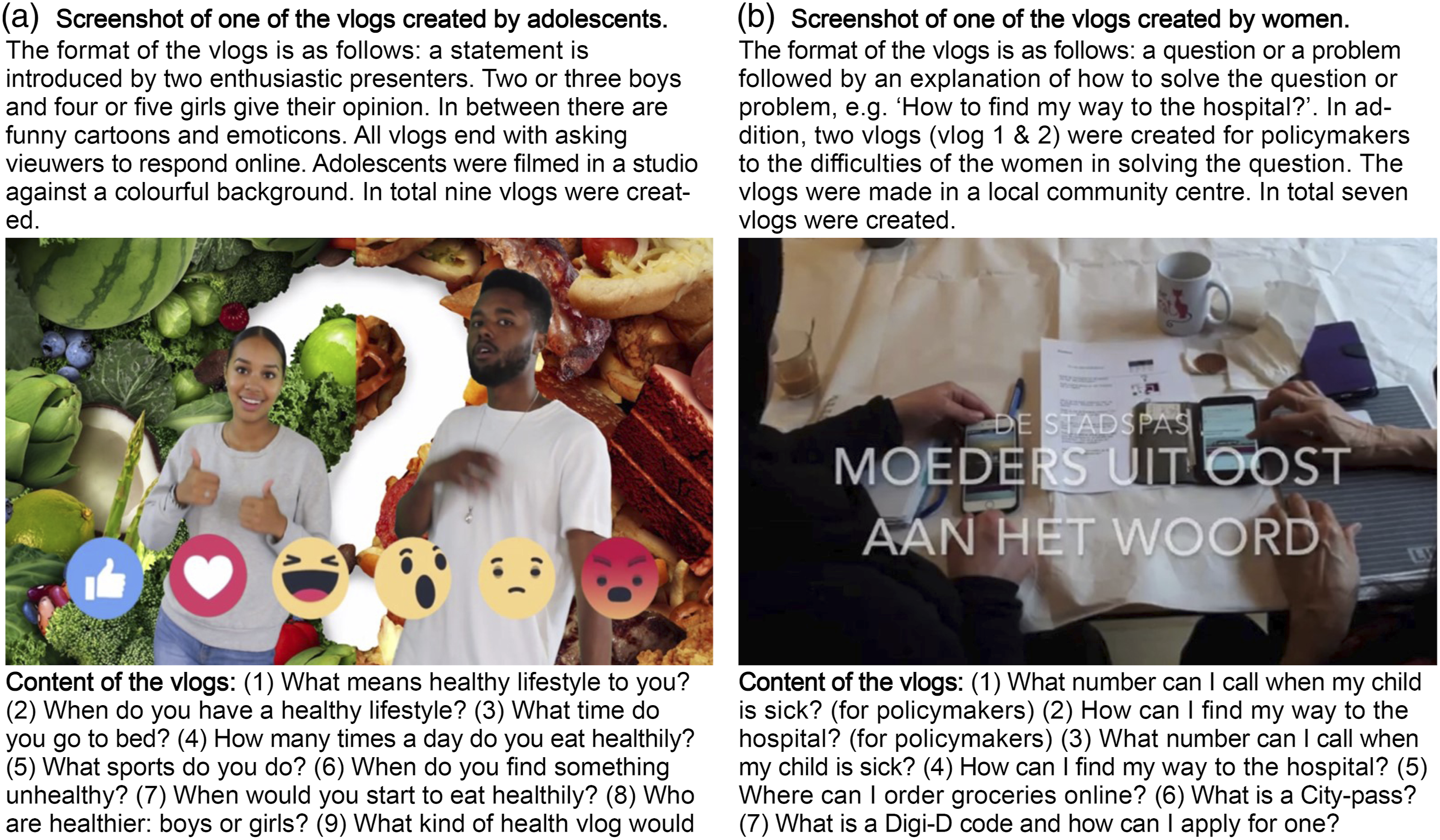
Case 2: The co-creation of vlogs about digital skills with women from disadvantaged neighbourhoods
This project aimed to gain insight into how women could use vlogs to improve their digital skills. On the basis of previous findings (Dedding et al., 2017, 2021; Goedhart, 2021; Goedhart et al., 2019), the underlying assumptions were that (1) vlogs are a familiar medium, (2) vlogs reduce the effects of having limited language skills and (3) vlogs can promote shared learning between women, policymakers and researchers. Moreover, the vlogs have the potential to be used by other women from disadvantaged neighbourhoods.
The project, commissioned by the City of Amsterdam, was organised in close cooperation with two community centres (conducted between November and April 2018). In two 6-week projects, five and seven women participated, respectively, from a wide range of non-Western countries, among others India, Iraq, Morocco, South Korea, China, the Philippines, Bulgaria, Turkey and Syria. Most women had minimal Dutch language skills. The projects were guided by a researcher (NG) and supported by a volunteer or an Arabic-speaking colleague. Seven vlogs were created based on the women’s questions about the digital world (see Figure 1(b)). In the final sessions of both groups, the vlogs were presented to the commissioners of the City of Amsterdam (n = 3) and the involved volunteers (n = 6), and, with the participants, they reflected on the making process and on the vlogs.
Method
This article brings together data from two small-scale participatory explorative studies wherein adolescents (case 1) and women (case 2) from disadvantaged neighbourhoods co-created vlogs. In addition, we organised reflection sessions with community members who were not involved in the co-creation of the vlogs (‘viewers’) and professionals (health workers, social workers, school staff, volunteers and policymakers).
Data collection
Reflection on the vlog co-creation process with the involved stakeholders
The data of the vlog co-creation process was combined and re-analysed for the purpose of this article. The following data were used: Field notes of the co-creation sessions (case 1: n = 3; case 2: n = 13) and process evaluation sessions (case 1: n = 1; case 2: n = 2) Semi-structured interview with two vlog creators (case 1) Logbooks of the researchers (NG/EL) Vlog content of both cases (Figure 1)
Reflection on vlogs with community members
To evaluate the adolescents’ vlogs (case 1), two ‘popcorn evenings’ were organised at a local community centre. Six girls (aged 13–17), all from families with a Moroccan background, attended the first session. Three boys (aged 15–18) from families with, respectively, a Moroccan, Surinamese and Turkish background, participated in the second session. In both sessions, after a warm-up exercise, two vlogs were watched and discussed. To start the discussion, we asked questions such as ‘Do you want to share this vlog?’, ‘Why (not)?’, and ‘What did you learn from the vlogs?’
The women’s vlogs (case 2) were evaluated in five digital skills training sessions with seven women from various non-Western backgrounds. In each session, approximately 15 min were spent watching and reflecting on the vlogs; questions similar to those used in the adolescents’ evaluation sessions were asked.
Reflection on vlogs with professionals
The vlogs (process and product) were also evaluated with the commissioners in an interview (case 1: n = 2, case 2: n = 1) using open questions, for example, ‘What did you learn from the vlogs?’ and ‘How are these vlogs useful?’. Furthermore, the vlogs from both cases were shown to policymakers, health workers, school staff, social workers and volunteers. For case 1 the vlogs were shown in two dialogue sessions (Lems, 2020). We asked professionals for their opinion on the vlogs, asking questions such as ‘What surprised you?’ ‘What did not?’, and used the vlogs to start a discussion about how to better reach adolescents with a low SEP. The vlogs from case 2 were discussed during ‘Digi Challenge 2019’, an event for professionals working on digital inequalities in Amsterdam.
Data analyses
We used Atlas.ti to analyse the data. Two researchers (NG and EL) were involved in the coding process. The initial analyses were inductive. Themes were identified by means of basic content analysis codes. The codes were discussed and grouped into broader higher-order categories. For the final analyses, we related the codes to the promises of vlogs (facilitating engagement, enabling shared learning, and allowing a reaching out to the wider community) as described in the introduction. Repeated review of the data, coding by two researchers and seeking the peer consultation of the research team on content and possible projections and blind spots of the researchers enlarged reflexivity and reduced researcher bias (cf. Berger, 2015).
Ethics
This study adheres to the Code of Ethics for the Social and Behavioural Sciences involving human participants as accepted by the deans of social sciences in the Netherlands. It was emphasised that participation was voluntary and anonymous and that participants could withdraw at any time without any consequences and without giving reasons. Women and adolescents participating in the evaluation sessions gave written consent. The consulted professionals gave oral consent. A passive parental informed-consent strategy was chosen for the participating adolescents because the project did not involve sensitive topics and the adolescents were not exposed to any risk. Parents were informed in a letter about the research beforehand. All participants received a small gift as compensation for their time.
Results
In the following section, we first reflect on the co-creation process and then on the potential of the vlogs to reach a wider community and invoke action. We make a distinction between the ‘creators’ and the reflections of the adolescents and women not involved in the creation process, called ‘viewers’.
Facilitating engagement – drivers and concerns
Most of the women were eager to join the digital skills project as they wished to improve their skills. Making a vlog was certainly not what drove them to join these meetings, though, since the challenges they faced because of their limited digital skills were acute: In the first session Raja entered the community centre with a letter from the police in her hand. In the letter it was stated that she had go to a website to check whether her key, which she lost two weeks ago, was found. Raja did not understand how and asked me [**] for help. (Field notes, case 2)
At the start of project, many of the women stressed that they would not participate if their faces were shown in the vlogs. Dilara, for instance, asked whether she could improve her digital skills without being filmed. She explained: ‘That [vlogging] is for youth, I don’t like that. Not everybody has to see this [pointing to her face]’ (Field notes, case 2). Moreover, some of the women were concerned about their limited Dutch language skills and were not willing to speak in the vlogs. We discussed their concerns with them and looked for solutions. We decided to film hands rather than faces and to alleviate language concerns by distributing roles in front of and behind the camera.
While the women considered digital skills to be an important topic, the healthy lifestyle topic was not seen as at all interesting by the adolescents, which made recruitment of them more challenging. A media coach from a local youth media organisation, who had experience in social vlog projects involving adolescents from the neighbourhood, arranged the recruitment. He found the recruitment for this ‘Healthy Lifestyle vlog project’ a lot more challenging than for his other work. The start of the project was postponed several times as there were simply not enough adolescents willing to join. According to the media coach, the main reason why adolescents did not want to join was a lack of interest in the topic. Ridge, one of the creators, believed that the topic was the main reason why his peers hesitated to join: ‘They are just not into that [healthy lifestyle]’ (Interview, case 1). Another significant barrier to joining for adolescents was potential reputational damage; talking about healthy lifestyles in a vlog is considered ‘uncool’, as illustrated by the following conversations with two boys: Eva [EL]: ‘Why do you think many youngsters do not want to join this project?’ Randy: ‘They [adolescents] are afraid to be put online’. Ashwin: ‘I think teenagers do not want everyone to see it [the healthy lifestyle vlogs]; it has to do with your image. If you say that you are very healthy, that is not good for your image’. (Field notes, case 1)
So, unexpectedly, it was not the adolescents, the ‘digital natives’, but the women who were more eager to join a vlog project. The topic was key to recruiting the women into the project, and by considering the women’s needs and wishes, the fact that the project involved making vlogs did not lead to their exclusion, although this required significant adjustments of the format. However, the fact that vlogs would be made during the project discouraged the adolescents from taking part in a PAR project precisely because they would reach an audience beyond the research setting.
Shared learning between participants, researchers and policymakers
Co-creating vlogs enabled learning among the involved women and adolescents about the topic at stake. The learning among the women was, however, more specific than the learning among the adolescents. To make vlogs, the women first needed to learn some ICT skills. They learned from the instructions that were given, but also from each other: Selin shows to Ayash how you can find the route to the hospital on Google maps and says: ‘It’s your turn now’. Ayash looks uncertain, but after a few encouraging words from Selin she starts. Sometime later she proudly shows the screen to me [NG] and says cheerfully: ‘Correct, right?’. (Field notes, case 2)
The women also explained that making vlogs together stimulated them to talk in Dutch, which they usually find difficult. Some women used a translation app, which was an app that some of the women did not know existed, to express themselves. Meyra said proudly, ‘[I did] a lot of talking and explaining, very good’ (Field notes, case 2). The learning continued after the co-creation sessions – the women found the vlogs helpful for practising their digital skills at home. Esila explained: ‘Because you can watch it [the vlog], you don’t forget it’. Dewi added: ‘It [the vlog] is important to remember things’ (Field notes, case 2).
The adolescents highlighted that they gained insights into each other’s ideas. They discussed (un)healthy behaviour and the boys in particular indicated that they do not usually do that. For example, Aswhin, one of the vloggers, reflected on the fact that he never takes any water with him when he goes out and nor do any of his (male) friends, because it could harm his image: ‘It is a girls-thing to always carry a bottle of water’ (Field notes 1, case 1).
After the project had ended, some of the adolescents questioned the effect of the vlog co-creation on their lifestyle, since changing unhealthy behaviour is difficult. During an interview, Eva (EL) asked whether Ridge and Sabina believed the vlog creation contributed to lifestyle changes. Ridge explained: ‘At that moment we have thought about it [healthy lifestyle], but you don’t know what happens next’ (Interview creators, case 1).
Where co-creating vlogs enabled the women and adolescents to learn about the topic at stake, it also helped them to articulate and/or show what is important to them. This provided insight into their lived experience. For example, the co-creation of the vlogs with the adolescents revealed insights into their norms regarding food consumption. In one of the vlogs, the adolescents answered the question ‘What do you consider unhealthy?’. Dennis answers: ‘If you eat too much junk food. McDonalds and KFC in one day. I think that is too much. But sometimes I do it, I don’t look like that [eating too much], but I really eat a lot [junk food]’.
In the same vlog, Romano says: ‘If things make you stressed out: chick problems [relational problems with girlfriend], or troubles at school’.
These examples show that these adolescents’ norm regarding food consumption is very unhealthy: it is only considered unhealthy if you eat junk food more than once a day. Moreover, these examples show that health not only includes physical health but also social well-being. Health promotion vlogs, according to several adolescents (vlog 9), should address more than health, for example, make-up, beauty, fashion and extreme sports. Moreover, adolescents wish to be able to relate to the vloggers. Dennis (vlog 9) says: ‘I want to watch somebody who is not fit [having a healthy lifestyle] yet, instead of watching somebody who is already fit’.
Co-creating vlogs also gave insights into how the adolescents’ daily (disadvantaged) reality influences their possibilities for health promotion. Some adolescents, for example, challenged the assumption that vlogs can support them to live more healthily: At the end of the evening I [EL] ask whether vlogs are a good way to reach adolescents with health promotion. Immediately, there is discussion. Someone shouts, it is not, since not everybody has Wi-Fi at home. I [EL] ask why. Randy and Ashwin explain that they know some boys who have no Wi-Fi because of their religion. The media coach responds and says that some youngsters have no Wi-Fi because of lack of money. Nobody disagrees, the discussion stops. (Field notes, case 1)
This comment shows that poverty is a sensitive topic, and this can easily be overlooked in health promotion.
In case 2, the vlogs provided detailed insights into the struggles that women face online, for example, the difficulty of selecting the right search terms to find the phone number of a hospital (vlog 1, Figure 1(b)). Co-creating instructional vlogs helped to understand how women’s daily (disadvantaged) reality impacts the opportunities for them to improve their ICT skills, as most women had no laptop or tablet at home. Even though we arranged for the women to have access to laptops, they preferred to practise on their own smartphone: Dilara: ‘I think I would like to practise on my phone next week since then I can practise at home as well’. Eslem: ‘Yes, at home as well. I need to practise a lot’. (Field notes, case 2)
In the following session, the women only used their own smartphones. This caused difficulties. Websites that are designed especially for citizens with minimal digital skills to practise logging onto digital services turned out not to work on mobile devices: Eslem: ‘It is too small, look!!’ Nicole [NG]: ‘Yes, it is small. I know. Let’s see whether we can zoom in’. [I [NG] try to zoom in on the phone of Eslem, but do not succeed] Eslem: ‘I have my glasses on and I still can’t see it. What should I do now?’ (Field notes, case 2)
In the discussion that followed, the women highlighted that trying to use this website was not motivational; it was useless as they could not use it easily on their phone. This shows how even highly motivated women are limited regarding their opportunities to learn digital skills and how such services do not match their financial situation. Websites like the one the women tried to practise on are not designed to be used on a phone because it is assumed that users have access to a computer.
What was learned from the vlogs by the involved policymakers?
In case 2, the involved women, volunteers and policymakers watched the vlogs together at the end of the project. The women were eager to show their vlogs to the policymakers: On the road to the City Hall, Hafsa explains that she is excited, and a bit nervous, to show her vlogs to the policymaker. She proudly highlights that she had arranged a babysitter for her youngest son, who normally joined the vlog creation sessions, to make sure she could join the whole session and there was no need to worry about her son. (Logbook, case 2)
During the session, the commissioners and volunteers were enthusiastic about the insightful content. After one of the sessions, a policymaker said the vlogs gave him a detailed insight into the daily struggles of the women and how they use the internet: You really see what happened. For example, you actually see how people [women] find information. These vlogs tell you more than paper. Policymakers often only think in their paper tower […]. If I search for something on the website of the City of Amsterdam, I almost use scientific search terms, while these women use the search term: ‘how can I find my way to the hospital’. This will produce different results. (Field notes, case 2)
Although the commissioners in case 2 were positive about the vlogs because of their insightful content, the commissioners in case 1 were not very enthusiastic as the vlogs did not meet their expectations. They believed that the vlogs were not motivational for other adolescents and some had expected the vlogs to be like the vlogs of professional lifestyle vloggers: ‘I have to say, I am not impressed by the delivered vlogs. Everything that they [adolescents] would like to see in a vlog is not reflected in the actual vlogs’. (Commissioner, case 1) ‘These are not real vlogs, such as “I haven’t been eating sugar for a week and I feel this and that”’. (Interview, case 1)
So the commissioners were either happy with the insightful content or disappointed by what they saw as the low potential of the vlog as a ‘nice, easy, shareable and quick solution’.
Creating action beyond the research context
Wider online dissemination
After the project had ended, the vlogs of the adolescents were posted on the Facebook page of the local media organisation and the vloggers were asked to share their vlogs on social media. After 2 months it became clear that the vlogs had hardly been viewed and had not been shared by the vlog creators. By May 2020, one of the adolescents’ vlogs had been viewed 904 times and the other vlogs less than 20 times on Facebook. The vlogs were also posted on the YouTube channel of the Amsterdam Healthy Weight (City of Amsterdam) targeting professionals; on average, the vlogs had 25 views. In case 2, only two vlogs were posted on YouTube, in December 2019. The link to these vlogs was included in a provocative information sheet designed for volunteers and professionals working with citizens living in vulnerable circumstances. By May 2020, one of the vlogs had been viewed 30 times and the other six.
The adolescents and women, including those who were involved in the creation process and those who were not, did not believe that it was possible to share the vlogs with a wider public online. Many reasons for this were given by the adolescents. First, although the adolescent viewers who evaluated the vlogs lived in the same city as the vlog creators, they could not or did not wish to identify with the vloggers, and this identification is key to motivating people to keep watching vlogs. Some girls (of Moroccan descent) living in the New-West neighbourhood explained that they did not like the fact that all of the vloggers were from the South-East neighbourhood (with mostly a Surinamese, Antillean or African background): Eva [EL]: ‘What do you think about the vlogs?’ Shara: ‘There should be more Moroccan adolescents in the vlogs […]. It should be more mixed [in culture].’ (Reflection session, case 1)
In contrast, adolescents from the same neighbourhood and with the same ethnicity as the vloggers did identify themselves with the vloggers. They agreed that the vlogs are enjoyable to watch because they know the vloggers, as Destiny highlighted: ‘It is nice because you see opinions from someone you know’ (Field notes, case 1).
Second, according to the adolescents not involved in the creation process, the vlogs were not sufficiently funny; humour is considered important, as illustrated by Aicha: ‘Just for that one boy I would watch it. He is funny’ (Reflection session, case 1). The other vloggers were not seen as funny.
Third, the vlogs did not seem like ‘real’ vlogs according to most of the adolescents, and therefore they would not share the vlogs among friends, as reflected in the following quotes: Mehmet: ‘He [one of the vloggers] is really nervous […] This is distracting. Normal vloggers are not nervous’. (Reflection session, case 1) Nhora: ‘The answers of all the youngsters seem fake, they look like they feel “I have to say something now”’. (Reflection session, case 1) Karima: ‘The background is fake. [...] The background is too messy, it is not nice to watch’. (Reflection session, case 1)
In addition, the vlog creators were not completely satisfied with their own vlogs; some creators said that they found the vlogs somewhat boring and not professional after watching their own final vlogs. Ridge explained: ‘They are not as gangster as normal’. Some others mentioned that the vlogs are a bit boring because they were filmed in a studio. This was not their initial plan, but other plans such as vlogging in the school canteen and at a healthy BBQ failed.
Last, the vlogs were not perceived as having educational value. None of the adolescents believed the vlogs are informational: Eva [EL]: ‘Did you learn anything from the vlog?’ Abdel: ‘This is just an opinion. An opinion is not enough’. David: ‘You need an expert. But that is boring’. (Reflection session, case 1)
The women were less critical about the co-created vlogs; however, they also thought that it was not easy to share the vlogs. Though the women often said that the vlog were ‘nice’ and ‘good’, none of the vlogs, according to the viewers, were sufficiently informational, since they did not show the separate, small steps they needed to take to solve an (online) problem: ‘[I need a] movie with practical steps’. The low educational value of the women’s vlogs could be explained by the difficulties they encountered in the co-creation process. Some women had poor Dutch language skills, which made it difficult to make understandable educational vlogs. Also, just showing their hands did not contribute to the quality and likeability of the vlogs.
Dissemination on a local scale
While the vlogs did not seem appropriate for wider online dissemination to the community, watching the vlogs in a controlled setting, like a welfare centre, with the guidance of the researchers, did stimulate (self-)reflection. In the reflection sessions, the vlogs acted as a conversation starter, generating discussions about healthy living in the neighbourhood and underlying causes of unhealthy behaviour. For example, after watching a vlog titled ‘What does a healthy lifestyle mean to you?’, the boys explained that many children like sports but are sometimes prevented from taking part in them because their parents live on social welfare and cannot afford sports equipment. The boys suggested that the municipality should therefore invest in places where children can play sports for free instead of investing in making vlogs.
Watching vlogs with the women triggered self-reflection. Imena said, after watching a vlog about Digi-D (a security code issued by the government of the Netherlands): ‘I’ve heard, if you go to the [computers in the] library and you fill in your password, that is not safe when somebody sits next to you’ (Reflection session, case 2), which triggered a discussion about the safety of online communication. The women also highlighted that the vlogs inspired them or motivated them to start practising their digital skills. The women recognised the struggle of the women who appeared in the vlogs: Dilara: ‘We need to learn more, but others [women] need to learn more as well. That is nice to’. Ayash mentions: ‘I realize I need to learn more as well, only my children and husband do it [using the computer]’. (Field notes, case 2)
The vlogs were thus able to be productive as part of local dissemination sessions, but certainly did not lead to the things that had been learned during the PAR project spreading far and wide beyond it.
Discussion
The reflection on the promises of co-creating vlogs with citizens from disadvantaged neighbourhoods highlights the potential to engage citizens from such neighbourhoods and to enable shared learning among these citizens, professionals and researchers. The creation process and the final vlogs provided policymakers and other professionals with insights into the lived experience of citizens living in disadvantaged circumstances, such as how only having access to a mobile phone severely limits women regarding their (digital) learning opportunities, especially if websites designed to develop relevant skills do not take such realities into account. The vlogs of the women in particular show stories which can create ‘affective engagement’, that is, they invoke empathy with what is expressed (Abma et al., 2019); this empathy could work as a catalyst for taking action. This is an advantage of ‘participatory vlogging’ compared to most forms of participatory video, which are often scripted (Walsh, 2016). An advantage of vlogs over other creative ‘offline’ (non-recorded) methods is that vlogs can show skills, or a lack of skills, which is often hard to capture in a photo or a written story. So, if topics are strongly related to skills, for example, digital skills, vlogs can provide researchers and other professionals with a deeper understanding of the local contexts and the daily reality that participants face (Koningstein & Azadegan, 2018; Volpe, 2019).
The results show that reaching out to the wider community is challenging. Even sharing vlogs in neighbourhoods within the same city proved to be problematic for the adolescents. This might be explained by a lack of identification with the vloggers. The adolescents who were not involved in the creation process did not identify themselves with the vloggers, but such identification does tend to contribute to the relationship between viewers and vloggers (Lee & Watkins, 2016). In contrast, the women who only viewed the vlogs did recognise themselves in the vlogging women, even though they lived in different districts. This difference might be explained by the fact that the adolescent viewers and vlog creators had different ethnicities, while the ethnicities of the women were more similar, and the differences between them less noticeable, because faces, and sometimes even their clothes, were not visible (because the women did not wish to show their face online). This shows the need to pay careful attention to diversity to improve identification with the vloggers.
The vlogs of the adolescents were perceived as unprofessional and lacking authenticity, while analyses of successful vloggers show that authenticity is key (Berryman & Kavka, 2017; Sakib et al., 2019). Making an easily sharable authentic vlog turned out to be harder than imagined. Making vlogs is a profession; popular vloggers spend a lot of time and money to be successful in striking the balance between attracting viewers, producing valuable content and authenticity. Professionalisation of vlog production in PAR can, however, cause tension, as the co-created vlogs should capture the daily reality of citizens and typically consider topics that are not fashionable, exciting or popular.
Despite the rather negative appraisals regarding wider online dissemination of the co-created vlogs, our study showed that watching the vlogs together facilitated discussion and contributing to shared learning. This suggests that the dissemination of vlogs is valuable in a controlled setting, such as in schools and community centres. Further work is required to explore this potential.
Conditions for successfully co-creating vlogs in PAR
The reflection on the vlogs thus shows that vlog co-creation is promising for engaging citizens and promoting (shared) learning. A potential risk of using vlogs in PAR, however, is that the focus – because of the characteristics of vlogs (popular, fast, fun, shareable) – shifts away from participatory objectives (engagement and shared learning) towards a focus on the end result. In case 1 there was a tight budget, detailed planning and an outside facilitator, while in case 2, the planning was more flexible and the researcher coached the vlog creators herself and had more freedom to follow the pace of participants and to make adjustments to the project. Being in charge of the vlog co-creation process as PAR researcher also helped to reflect and keep an eye on the participatory principles continuously. The researcher (**) first took time to build rapport and was sensitive to the participants’ needs. For example, only vlogs were made of the women’s hands to ensure privacy. Cultivating sensitivity to such needs helped to give the women space to share their stories and make vlogs that spoke to their interest 2 . Furthermore, as scholars have noted before, short time frames may restrict the opportunity to uncover valuable information and insights (Abma et al., 2019; Lenette et al., 2019).
Another condition for co-creating vlogs is to carefully consider ensuring inclusivity, anonymity and confidentiality. Although this applies to all (participatory action) research, ensuring that these ethical principles apply in participatory vlog projects may need special attention because of the visual and ‘shareable’ characteristics of vlogs. The environment in which the vlogs are co-created might be safe, but mutual respect is not one of the core principles of online social media platforms. Negative comments about the vloggers might harm those involved (Volpe, 2019). In addition, ensuring anonymity and confidentiality is difficult as soon as vlogs are shared (online). Ensuring anonymity may also conflict with the aim of creating ‘shareable’ end products. For example, in case 2, at the request of the women only their hands were shown, but seeing a vlogger’s face clearly contributes to a vlog’s credibility (Huh et al., 2014).
Lastly, in a participatory vlog project, just like in other research, the question ‘What’s in it for them?’ should always be carefully considered and discussed. Within the current vlog hype, the use of vlogs in research is encouraged by policymakers who see co-creating vlogs as a ‘quick win’ to tackle inherently complex inequalities regarding health and well-being. We found that it takes time to create a trusting and respectful relationship with participants and to get acquainted with each other’s practical needs and motives, which are central elements of producing the vlogs. Too much focus on a high-quality end product could result in participation that becomes instrumental and tokenistic and overshadows the value of shared learning.
Conclusion
Our study shows the potential of vlogs within PAR to meaningfully engage with citizens who are living in vulnerable circumstances. The co-creation of tangible products facilitates shared learning, provided that the process is guided by the participatory objectives rather than the outcome. While vlogs are often labelled as ‘nice, easy and quick solutions’ that create a synergy between participation and action beyond their immediate context, our research indicates that it is difficult to create synergy between the participatory objectives and the aim of reaching wider publics. The directions of travel that emerged, especially towards policymakers, were different than we expected. The question of scaling PAR among citizens living in vulnerable circumstances therefore remains a pressing one. This research indicates that to reach the wider community and evoke action, vlogs could be disseminated in more local ways that could be guided by participants or a professional. Spreading of vlogs locally in this way proved to be valuable in the two cases studied and is a more promising focus for further research than buying into a dream of vlogs that are created at the margins and go viral.
Footnotes
Acknowledgments
We would like to thank all the adolescents and women for their enthusiasm in the co-creation of vlogs and for sharing their thoughts and opinions. Also, we would like to thank the involved community centers for their support. Data were collected as part of two larger research projects both commissioned by the City of Amsterdam. The contents of this manuscript are the responsibility of the authors and do not necessarily reflect the view of the funding body.
Declaration of Conflicting Interests
The author(s) declared no potential conflicts of interest with respect to the research, authorship, and/or publication of this article.
Funding
The author(s) disclosed receipt of the following financial support for the research, authorship, and/or publication of this article: This study is supported by City of Amsterdam.
