




Abstract
In recent years, there has been a growing interest in using co-creation approaches, with academics and partners working together to create research and interventions to achieve impact. Action research typically starts with the question ‘how can we improve this situation?’ and then co-creates knowledge with and not on or for people. This approach contrasts with conventional approaches in which academics create knowledge and then disseminate it to users via conferences, reports etc. The co-creative approach involves a shift in academics’ thinking and approaches. The success of co-creation depends on the academic shifting from being self-focussed and independent to being other-focussed and interdependent. In this paper, we outline the theoretical background that has informed our thinking and practices related to knowledge mobilization, and our novel relational approach. We illustrate our approach using two co-created projects, focused on enhancing early literacy and supporting mothers with substance use problems. We hope that this will help others consider when it may be appropriate to use a co-creative approach and how to engage in this co-creation process, including awareness of common barriers and benefits.
There has been a growing interest in knowledge mobilization (KM), in which academics and partner organisations work together to co-create knowledge that can have a positive real-world impact. Prior to this, impact was generally achieved by ‘dissemination,’ with academics creating research project reports or workshops for potential knowledge ‘users’ (Lavis et al., 2003). Although this model has been successful in dissemination and is time efficient, it presents challenges. For example, the passive translation of findings involves a one-way flow of knowledge from scholarship to practice. Consequently, the research may not reflect the ‘real world’ context, thus not be readily applicable to practice. Recent models of KM involve identifying partners at an early stage and working together to co-create knowledge at every stage of the research process. There are several advantages in this approach, such as increased relevance of applied research and established pathways to impact. There are also several challenges to be overcome. A key challenge involves researchers moving from an ‘independent’ approach to research and KM to becoming more ‘interdependent’, focussing on relationships with others. In this paper, we provide an overview of general literature around co-creation, then narrow the focus by outlining Markus and Kitayama’s (1991) theory of self-construal as a framework for understanding co-creation. We then describe two projects illustrating our approach. We discuss the practicalities of setting up partnerships and reflect on how the theory has informed our thinking. We describe our personal experiences including benefits and challenges of this approach to help others consider their approach to knowledge mobilization.
Action research, co-creation and working in partnership
Effective action research bridges the conventional disconnect between mainstream scholarship and practice by generating solutions to problems (Meyer, 2000) and producing practical knowledge that people can use in their everyday lives (Reason & Bradbury, 2008). Action research can take several different forms, all of which share a strong focus on relationships and researching with rather than on participants (Bradbury, 2015). The three key principles of action research are that: the self is relational and interconnected with others, systems seek wholeness and we are embedded in systems, and practical contributions make a positive difference (IBID).
We view co-creation as a type of action research at the interface of science and practice in which the interests of both practitioners and academics have equal weight and benefits. Co-creation uses a multi-directional approach in which academic and practice partners come together to learn and use their collective knowledge to effect real world change (Boyte, 2014; Saltmarsh & Hartley, 2011). This approach is important as there is limited evidence that research is creating impact outside the academy (Bhattacharyya et al., 2009). Therefore, this collaborative, partnership approach is increasingly viewed as improving the rigor of research, increasing its relevance to community needs and interests, and extending its reach into new fields for community benefits (Balazs & Morello-Frosch, 2013). As Pepler noted: “sparks fly at the interface of science and practice that ignite new questions, new methods, new interpretations, and new directions” (2016, p. 44).
Co-creation is a relational process. It is only effective when positive relationships are formed between individuals. Researchers in this area have reflected on this process, using a variety of terms. For example, ‘relational space’ focusses on co-creation providing an appropriate ‘container’ where high quality interactions and positive interpersonal relationships between people can be established (Senge et al., 2006, 2007, 2008). These relationships then form the basis of research. It is also termed “relationality”, with a focus on the ‘space between’ individuals rather than on individuals’ skills, interests and values (Bradbury & Lichtenstein, 2000). Regardless of the differing terms, co-creation typically involves: openness, respect, inspiration, support, safety, proximity, and friendship (Bradbury-Huang et al., 2010). At the heart of co-creation, these lead to innovation and mutual learning.
Generally, two types of learning occur in co-creation – “learning about” partners and “learning from” partners (Inkpen & Currall, 2004). “Learning about” a partner enhances relational understanding and creates a foundation for trust. It can also enhance understanding of what the partner organization wants and needs from a collaboration. According to Inkpen and Currall (2004)co-creation requires trust. Each partner is reliant on the other and each partner could experience negative outcomes if the partner proves untrustworthy. Thus, to achieve effective co-creation, repeated interactions between partners are necessary to create trust. “Learning from” a partner involves learning about the techniques, skills and approaches that they use. This is a key element of action research, with a focus on recognizing and valuing multiple ways of knowing (Balazs & Morello-Frosch, 2013; Corburn, 2005; London et al., 2011; Yosso, 2005).
London et al. (2018) developed a theory of co-created research being like ‘weaving’, with the warp symbolizing the formal structure underlying the collaboration (e.g., systems of accountability). These remain relatively stable throughout the collaboration. The weft is the dynamic process of partners working together to share knowledge, plans, and resources to the project. Both a clear structure and a dynamic process are required for successful co-creation. Our paper builds on this framework as a guide for reflection on roles and approaches to co-creation. To be truly dynamic, we must be aware of and responsive to each person’s knowledge and “learn with” each other. This process must function within the formal structures we find ourselves in (which may operate outside of our own organization). Our approach provides a framework for researchers and partners to consider how best to achieve this and, in turn, how to achieve effective co-creation.
Self-construal: Independent and interdependent selves
According to Markus and Kitayama (1991), we can construe the self in one of two ways: as an independent or an interdependent self. Each of us has both an independent self, which generally operates separately from the social context, and an interdependent self, which is deeply connected with the social context. Personal characteristics and background can impact which self is typically used.
Although we tend to use one form of self regularly according to expectations of culture, gender, and/or context, we use both selves in navigating through life. The self that is active at a given time will shape our values, behaviours, task choices, and views of others (see Table 1). In terms of values, the independent self values being heard, influencing others, and being unique; whereas the interdependent self values relationships, adjusting to others, and fitting in with the social surroundings. For behaviours, the independent self focusses on personal needs, thoughts and feelings; whereas the interdependent self focusses on roles and relationships, is conscious of others, and aligns behaviours with others. Task choices are also different: the independent self aims to be unique, express itself, and promote personal goals; whereas, the interdependent self aims to belong, align, and promote others’ goals. Finally, the independent self views others as important for social comparison and self-appraisal; whereas the interdependent self views relationships with others as defining the self and essential to tasks at hand.
A summary of Markus and Kitayama’s (1991) self-construals and how this relates to the conventional and co-creative researcher.
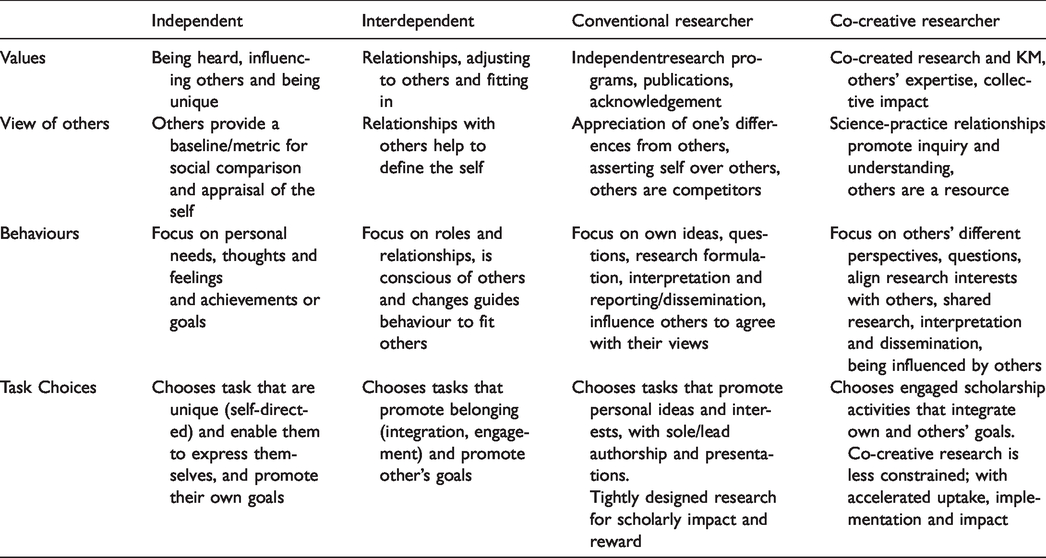
Markus and Kitayama’s model suggests that our culture, gender, social class and ethnicity can impact our preferred ‘self’, which we use most frequently due to socialization and cultural expectations. Those from Western countries, higher socio-economic status (SES), and White ethnic groups, especially men, tend to favour the independent self. In contrast, those from Eastern countries, lower SES groups and minority ethnic groups, especially women, tend to favour the interdependent self (Markus & Conner, 2013. Diverse experiences (e.g., being rewarded for one type of behaviour) may lead individuals to implicitly favour a certain type of self and find it easier to work within it; however, the other self can be activated when required.
Research, knowledge mobilization and self-construal
As university-based researchers, we are generally encouraged to use our independent selves. We are rewarded for developing unique research programmes, publishing as first author, and influencing others to our way of thinking. Researchers who primarily operate on the basis of an independent self may tend to use conventional methods of research development and KM. They tend to design studies based on their own knowledge and experience and evaluate and report the findings through their own understanding of the field. These researchers tend to share their research findings and potentially influence both research and practice through academic publications and events (e.g., conferences).
To participate in authentic co-created research and KM, we need to engage our interdependent self in which we value our partners, their goals, and our relationships with them; adjusting our ideas and taking different perspectives into account. Those who use an interdependent approach may be more likely to engage external partners in the early stages of projects to collaborate in designing, implementing, and interpreting research. When partner organisations are involved from the beginning of research, they can contribute to dissemination by sharing how and where knowledge can have impact.
Applying the self-construal model to research and KM does not imply that one approach is better than another. Researchers can move between these two approaches, both of which have merits and challenges. For example, conventional research projects on important basic processes may be faster and easier to run. This form of research may be more valued by researchers’ institutions and publishers. With this conventional approach, university-based experiments and interventions are often not designed considering real world complications. Without partners involved in the research design and implementation, the uptake and implementation of new knowledge may have limited impact on practice. This limitation may not be substantial for basic research; however, for research that has real-world implications, co-creation processes may smooth the way for KM for impact.
There are also challenges in conducting interdependent research. There may be less funding available for these research projects, as well as increased administrative challenges, such as compensating non-academic colleagues. It may take significant time and effort to recruit partners, develop trusting relationships, arrange meetings, ensure that different voices are heard, and consider different approaches to research and KM. While these co-creative processes are valuable, extended time is needed to reach a mutually agreed on research plan, gather and analyse data, and begin dissemination. With the extended time and effort in interdependent research, the typical indicators of academic success (e.g., publications and presentations) do not appear on curriculum vitae as quickly as with independent research. Because this time lag can impact promotion/tenure opportunities, it is likely to be a barrier for early career researchers. Nevertheless, this type of interdependent research has a high potential to offer innovative perspectives, with a direct impact on practice.
An essential difference between independent and interdependent approaches to research is that the latter depends on relational processes. The researcher must build trusting and respectful relationships with partners to even begin discussing the research and its import to practitioners. In the following sections, we describe two collaborative projects in which we moved from being independent to interdependent researchers and created deeply collaborative relationships with community partners that enabled the research and strengthened the impact of knowledge mobilization. We discuss the evolution of these relationships and projects in terms of the context, project, barriers and outcomes. While many accounts of co-created research showcase successes, we agree with London et al. (2018) that it is vital to report challenges and tensions experienced in these projects and how they were resolved. We hope that these honest stories will inform both researchers and practitioners, who are considering a move into interdependent research relationships.
Stoke Reads Mindset Toolkit
This project developed organically between the first author and Janet Cooper, a speech and language therapist at Stoke Council. We met serendipitously at an external meeting and through informal discussions we identified a common concern around low literacy levels in the city. The Council was developing a city-wide project with a focus on phonics to enhance children’s literacy in preschool and the first year of school. As a researcher, I was interested in using a motivational framework to encourage growth mindsets in children to enhance their belief that they can grow their intelligence. Growth mindsets have been linked to improved learning behaviours (Dweck, 2000). We realised that by combining these approaches and our expertise we could have a stronger impact on literacy. In developing this project, we had the conventional ‘push’ from the university to move knowledge to active practice, as well as ‘pull’ from our partners who were keen to work and learn with us to create new knowledge and practices.
The Council and the University decided to co-fund a PhD student to run this three-year project and Nicholas Garnett was recruited to this role. Over a series of meetings, researchers and the council identified the key aim to co-create a toolkit for teachers to promote a growth mindset in Year 1 children. This toolkit was based on research by Dweck (2000) indicating that children can either see their intelligence as a fixed or malleable trait. A malleable ‘growth mindset’ leads to positive educational behaviours as it encourages children to take on challenging learning tasks and persist following failure. We decided to provide this toolkit to teachers to use in conjunction with existing materials and workshops on promoting literacy. We expected this dual approach to have a more powerful impact than either would have alone, by focussing on developing both skills and motivation.
The extant ‘Stoke Reads’ project was already running a city-wide literacy network which met regularly to share successful strategies and challenges. The researchers became part of this network, attending monthly meetings and becoming involved in network activities. This existing infrastructure created a space in which relationships between researchers and educators could develop. Although memoranda of understanding existed between organisations, the relationships between individuals were what drove this project forward and helped maintain momentum. These relationships among a small group of people with energy, passion, and expertise moved the project from ideas to reality.
To be as inclusive as possible, we invited all teachers involved in the Stoke Reads project to be involved in co-creating the toolkit. We used our complementary expertise to design an intervention based on the research, but also drew from teachers’ classroom knowledge and experiences. The toolkit was co-created by eight individuals: two teachers, two speech and language therapists, two main researchers, and two supporting researchers.
During the process of co-creation, it was important that everyone had a voice and that everyone’s expertise was valued and respected. It was particularly important to consider the balance of power. Traditionally, universities and community organisations experience a disparity in social, economic, and political power (Benneworth, 2013; London et al., 2011). This power may be reflected in individual relationships in which people may ‘‘speak past’’ each other, for example using language and terminology that is unintelligible to the other (Baum, 2000; Prins, 2005). We recognised the hierarchies inherent within the group and worked to ensure that everyone felt able to express his/her ideas without fear of judgement. To do this, we used a community of practice approach, with which we came together to learn and highlighted multiple voices and perspectives as a strength (Lave & Wenger, 1991). This approach created trust and safety in sharing knowledge, practice, existing tools, providing constructive feedback. The trusting relationships provided a platform for open dialogue and critical thinking, which was vital to ensure that we developed the best possible toolkit. We found that using our interdependent selves was the best way to create a community of practice. It meant that we were attuned to the group and focussed on each other which created a positive inclusive environment and allowed us to work well together.
Initially, the core group met and discussed general ideas around theory, existing practice, and the best way to disseminate a toolkit. Many previous interventions to promote growth mindsets have been delivered in a time-limited way by researchers, either in person (Blackwell et al., 2007) or online (Paunesku et al., 2015). We were keen that our toolkit be delivered by teachers as a way of drawing on their knowledge and creating a lasting change in school culture.
After the initial face-to-face meetings, through an iterative process, we co-created a 24-page toolkit. For example, the academics proposed a section in the toolkit about putting the theory into practice. The teachers put forward ideas for activities and together we developed a general structure for the content. These ideas were then collated and sent to the group for further feedback. Using our interdependent selves guided us to focus on each other’s perspectives and build the trust required to engage in the co-creative process. While we as researchers had experience co-creating within our own field, this was the first time we had co-created with teachers in taking ‘research into practice’. Similarly, the educators on the team had not previously co-created with academics in taking ‘practice into research’. We focussed on inviting contributions and constructive feedback at every stage. With our focus on knowledge mobilization, the complementary expertise of a range of individuals came together to form a toolkit that was better than any of us could have created independently. Because of this interpersonal focus, we believe that the best ideas were the ones that formed the final version of the toolkit.
There were, however, some challenges to this interdependent approach. Firstly, it was more time consuming than if we as academics had independently developed a toolkit, sent it for review from teachers, and used feedback to develop a final draft. The time commitment was a challenge both for researchers and educators. University lecturers are more stressed and time pressured than those in many other roles in the UK (Kinman & Wray, 2013) and UK teachers work on average 54.5 hours per week and 93% believe that workload is a serious problem in their school (Higton et al., 2016). Therefore, it was a struggle to ensure that we made time for the project and worked closely with each other. Indeed, many teachers had said they wanted to be involved in co-creation but were unable to due to work commitments. The project persisted despite this time pressure due to strong interpersonal relationships and a shared commitment to solving a problem in our community. Without this collective commitment, we believe that it would have been easy for the project to fail.
By using an interdependent approach, we have created a rigorous research programme across many schools which is generating a large dataset and enhancing the program evaluation. We also believe that the toolkit is also being much more widely used than it would have been had we designed it without the input of the schools. Therefore, the co-creative approach was the ideal way to achieve the aims of the research and knowledge mobilization.
Breaking the cycle
Breaking the Cycle (BTC) was one of the first Canadian early identification and prevention programs for pregnant and parenting women using substances and their young children aged 0 – 6 years (http://www.mothercraft.ca/index.php?q=ei-btc). With funding from the federal government, BTC was initiated in 1995 to enhance the development of substance-exposed children by addressing maternal addiction problems and supporting the mother-child relationship through a comprehensive, integrated, cross-sectoral model. To address the complex challenges of mothering and substance use, BTC has delivered services through an interdependent model with nine partner agencies representing child welfare, addiction treatment, health, corrections, and children’s service sectors (Pepler et al., 2014). Through a single access model, these partners combine programming in a synergistic manner to offer integrated addiction counselling, parenting intervention, street outreach, health, and medical services. Services include: addiction medicine, a pediatric clinic, and a fetal alcohol spectrum disorder assessment clinic, mental health counselling, child care, family violence intervention, and case management/service coordination (Pepler et al., 2014). As an infant and child mental health centre, BTC offers child development services, including screening, assessment and intervention, as well as parent-child counselling, all at one downtown location, with complementary home visitation services.
Research partners have been included within BTC since the initial meeting to discuss the needs of highly marginalized substance using pregnant and parenting women. From the beginning, Margaret Leslie, the Director of Breaking the Cycle, recognized the importance of embedding researchers in program development and evaluation. As the researcher, I, second author was embedded in the program with my graduate students. We have learned to walk beside the BTC staff to develop research that meets their emerging needs and insights. From an interdependent perspective, we recognized that the research depended on trusting and mutually respectful relationships both between researchers and BTC staff, as well as between the researchers and women participating in the programs. With this foundation, we slowly built toward high scientific standards with a research program that was rigorous enough to receive federal research funding for a longitudinal study. We were able to compare outcomes for BTC and another treatment program for mothers with addictions (Espinet et al., 2016). Over the past two decades, the research has continually informed programming: for example, an interpersonal violence prevention program was initiated after we found that almost all women had experienced violence in relationships (Pepler et al., 2014). Conversely, the programming has informed research: we are now pursuing research on the neurodevelopment of children exposed prenatally to alcohol.
There were significant ethical and procedural considerations in co-creating research on the experiences of children and their mothers who use substances. From both clinical and research perspectives, we were committed to creating safety for participants. We recognized that safety and trust form the essential foundation for women to respond honestly on the research questionnaires. Because most of the women had experienced trauma, they were generally not trusting. We addressed this challenge by collaborating with BTC staff because they were the critical bridge between us, as researchers, and the women. The staff helped mothers understand the purpose of the research and the protections built into the research (e.g., confidentiality). They also assured women that their participation or decision not to participate would not impact their treatment, nor would their specific data be used in court. The staff introduced the research project to the women and gathered consent. In this way, we were able to promote a sense of safety for the women. The deep research-practice collaboration enabled this challenging research to proceed through adjustments. For example, the researchers had envisaged that it would take about a month to engage the women in the treatment and research; however, clinicians recognised it as a much longer process with trust taking time to build. We as researchers learned that the research could only proceed in pace with the women’s engagement and progress. This knowledge came through close working relationships with our partners at BTC.
From an interdependent perspective, we wanted the research and practice to be integrated, with open knowledge sharing. Therefore, we built a memorandum of understanding and consents to permit the flow of information between the clinical and research files so that clinicians could benefit from ready access to the research measures. We accomplished this by inviting clinicians to gather some of the research assessments, especially early in women’s experiences within BTC. We also included dual ownership of the research data in the consent form so women were aware that clinicians would have access to the data, consistent with our goal to integrate research and practice.
At the beginning, there was a substantial gap between the areas of expertise of the clinicians and the researchers. We began to close the gap by having monthly clinical seminars in which research was presented and discussed for its clinical applications. In addition, researchers and students were included in bi-weekly clinical team meetings in which families were discussed with BTC and partner representatives. In this way, we were able to continue co-creating and improving both knowledge and practice in supporting substance using women and their young children.
The numerous benefits of working alongside clinicians and practitioners have come from being able to conduct meaningful research with vulnerable children and women within a naturalistic setting. Clinicians and practitioners have a deep understanding and novel questions about developmental processes and change through their interventions. We were able to learn about these because clinicians encouraged BTC women to participate in focus groups to highlight their experiences in and recommendations for the programming. Because interventions are designed to accelerate and promote development, this context at BTC provides an opportunity to study the processes of change through interventions to identify mechanisms that underlie development. It is also exciting to explore diverse pathways through treatment to understand how the treatment works and for whom.
BTC has been the subject of external evaluation since its inception in 1995 (Moore et al., 1998; Motz et al., 2006; Pepler et al., 2002, 2014) and has been the focus of numerous research initiatives. BTC is a highly documented project with significant practice-based knowledge transfer activities regionally, nationally, and internationally over the past 25 years. We have developed and disseminated resources, workshops and presentations, publications. Through the interdependent research we have demonstrated: the efficacy of the comprehensive and integrated program model for pregnant women and mothers using alcohol and other substances, enhanced birth and perinatal outcomes for infants of alcohol and substance-involved mothers who are engaged earlier in pregnancy and enhanced developmental outcomes of prenatally exposed children. enhanced maternal relationship capacity that is linked to the relational approach within BTC in which respectful and supportive relationships are modelled at every level, including between the staff and researchers.
With the interdependence of research and practice, BTC has received numerous recognitions, including being identified by the United Nations Office on Drugs and Crime (UNODC) as an exemplary program serving pregnant and parenting women with substance use problems, and their young children.
Stepping into interdependent and relational space
Even though these projects are vastly different, there are common processes that underlie successful KM in both. The KM process is necessarily relational and relationships were the foundation of the success of both projects. We have learned that some of the critical relational processes are as follows.
Relationships drive the project and enable problem solving and persistence
Co-creative research cannot occur without positive relationships between individuals. There needs to be a shared passion for a project, because the personalities and interpersonal styles of people involved are what move ideas to reality and ensure that the project does not falter when challenges occur. Using our interdependent selves and focussing on the needs and points of view of others has helped us create positive relationships which have enabled the projects to thrive. Although time consuming to develop, these relationships have formed the foundations of future projects and proposals. For example, in Stoke Reads, the main project led to subsequent projects exploring early literacy and also led to further grant proposals. In BTC, the interpersonal violence prevention program, Connections, developed in response to research findings is now being disseminated and researched within 34 communities across Canada. Our experiences highlight the need for universities to recognise that the time commitment in early stages of co-created research can be very fruitful for future work.
Finding common objectives and creating trust is essential
Members of the research and partner teams in both projects needed to work collaboratively to find common ground and outline objectives that were important to both sides. Even with the best relationships, if the partners disagree fundamentally about the necessary outcomes or methods, the project will not be successful. Therefore, common interests, honest sharing of opinions and reflecting and valuing the ideas of others were vital for the projects to progress. These relational processes highlight the issue of trust between members of the team. In Stoke Reads, trust was required to ensure that all members of the team felt able to give feedback to ensure that the best ideas formed the final toolkit. In BTC, trust was required to allow researchers and clinicians to share data and work together to promote positive outcomes for mothers and their young children.
Relationships should be considered at all levels
As outlined above, positive interdependent relationships between the researchers and practice partners are vital, but it is also important to consider relationships with participants in the research. For example, in Stoke Reads positive relationships between the core team and teacher-users of the toolkit increased uptake. In these cases, we as researchers used existing relationships between our practice partners and our research participants as a gateway to building our own relationships. As participants trusted the practice partners, they were open to potentially trusting us as researchers. In turn, we recognized our strong responsibility to ensure that we did not betray this trust and built positive relationships and were therefore deserving of this trust. Similarly, in BTC, creating trusting relationships with mothers was vital to the success of the project. This involved considering their previous experiences and needs and holding regular focus groups to understand their perspectives.
Co-creative research and knowledge mobilization depend on trust, respect and safety
The importance of safety in co-creative projects cannot be overstated, this comes from trust and respect. Trust derives from positive and open relationships. If people do not trust each other then they are unlikely to share their ideas, give feedback and be open to true collaboration. In order to build this trust, it is helpful to rely on the interdependent self which is focussed less on influencing others to our way of thinking and more on really understanding others’ views and experiences. It is also important in the early stages of a co-creative process to discuss potentially contentious issues such as data ownership, intellectual property and publication. These open discussions ensure that partners understand how their ideas will be used and ensure that there are no misunderstandings in the long term. Respect is also vital for co-creation. Both researchers and practice partners bring expertise to the table, and respect for the different domains of knowledge and experiences is vital. If researchers and partners are not able to respect these different views, then co-creation will not be possible. Only when researchers and partners truly trust and respect each other will there be safety to openly discuss and develop projects that are truly co-creative and interdependent.
Actions
In order to meet these critical processes, there are several actions which universities, academic and partner staff could take. Some universities have systems whereby partners who are interested in working with academics can be ‘matched’ with researchers. However, this approach is passive. It assumes that the partner will take the initiative and that the relationship needs no further support. To move beyond this passive level of support at the university level, coaching, funding and time should be made available to researchers to build relationships with partners to scope out possible research projects. Support could come both in the initial connection between the partner and the researcher as well as ongoing mentoring in KM processes. Support could also involve co-funding of PhD studentships as a foundation for future work, as was successfully used in the Stoke Reads project. This support should be made available to researchers at different career stages, not just those who are well established, to allow them to follow their interests into co-creative work. Early meetings between researchers and partners would allow both partners to come to an agreement on common objectives and ways of working. There should also be recognition that at times it may not be possible to find common ground to work on a specific project and that it is better to halt the project in these early stages than push forward with a project which cannot succeed. It is also vital that the university recognizes co-creative research. This recognition can come through promotions and tenure criteria, buy-out, and equal weighting of co-creative projects with more conventional types of research, especially considering the time needed for authentic co-creation.
For academics and partners to promote trust, respect, safety and consideration of relationships at all levels, they should be encouraged to use their interdependent selves. This support may be delivered through explicit training about different approaches and how to create safe spaces. This approach to training could mirror the ubiquitous leadership training programmes that typically teach people to use their independent selves. In contrast, however, this leadership training would add value with a strong relational focus to promote reflection and understanding of the interdependent approach.
At the beginning of projects, academics and partners should be encouraged to discuss not just the content of the project but how best to create a safe space. This step comprises a deliberate and mindful activity that encourages partners to take time to recognize each other’s expertise and realities rather than focusing on their own. This recognition could be achieved by partners asking themselves questions such as ‘What might respecting the other look like?’ and answering both for themselves and for their partners before coming together to discuss these questions together to create genuinely safe space. Developing an understanding of and engagement with the other can enable researchers to recognize the deep expertise that partners have in working with on the ground and knowing the gaps in understanding and practice. Similarly, when partners develop a research-positive culture, they may become more open to using evidence-based knowledge to enhance their organizational effectiveness (Pepler et al., 2017). Trust will look and feel differently to different individuals so it is important to define what it looks and feels like to people in each new project and how it can be achieved.
It is also important to continually reflect on the relationship as it progresses. Before beginning the project, it is important to articulate the focus, way of working and shared goals. There are likely to be tensions: for example, the researcher may be focused on rigor while the practitioner may be focused on feasibility. It is important that both parties use their interdependent selves and are open to compromise and discussion. As the project progresses it is important to reflect regularly on the processes. For example, researchers and partners can check in to determine: Is the project working for both parties? Is the project progressing in a way which is satisfactory to both? Are the power differentials becoming more prevalent as the project continues? Finally, a positive end of the project is also vital to ensure that both parties can achieve their goals of report writing, sharing data, implementing new knowledge, and leave a strong collaborative base for potential future work.
Our paper has built on the metaphor provided by London et al. (2018) of ‘weaving’, with the warp symbolizing the formal structures and the weft symbolizing the dynamic process in which partners work together to share their knowledge. Our paper builds on this metaphor as it provides an approach to help both practitioners and researchers to consider how to create a dynamic ‘weft’ between people within their respective formal structures. It encourages academics and partners to consider which ‘self’ is active and which should be engaged. This approach may set the tone for a more successful collaboration. It may also help people reflect on why certain projects are less successful or to understand why challenges arise in a project. We assert that the success of the projects reported here lay in part from our explicit attention to using our ‘interdependent’ selves through the projects.
We believe that this approach to co-creation enables researcher-partner collaborators to overcome challenges that arise. For example, take a common situation in co-created research in which there is an early misunderstanding when planning the research. When discovered, this means that the project cannot be delivered in the initial form that was imagined (e.g., it may take longer, have fewer participants etc.). Those using an ‘independent’ self may feel frustrated that the other has ‘let them down’ and thwarted their plans and goals. The shortfall may feel quite personal and is likely to lead to conflict and blame between partners. In contrast, those using an interdependent self may be more likely to see that both parties may have had a role in the misunderstanding. Even if this is not the case, they may be able to reflect and consider that challenges are common in any organization and look for a way to move forward. This approach is likely to feel less personal and lead to communication focussed on solving the issue to mutual satisfaction.
Our unique contribution is that in our interdependent approach, relationships are placed at the core of the process and provide the scaffolding for the research to take place. Previous research has explained different roles in co-creation such as change agent, knowledge broker, reflective scientist, self-reflexive scientist, and process facilitator (Wittmayer & Schäpke, 2014). Others have indicated how vital relationships, trust and equality are to action research (Meyer, 2000). Our approach moves beyond roles to relationships and explicitly asks ‘how can we do this effectively together?’ while providing an approach to help achieve this. We contend that balance between the researcher and practice partner is essential so that the project should not be led by one or the other. Our approach offers a way of thinking, not a ‘process’ with definite roles and stages. It is dynamic and not easily conceptualised because it is based on the dynamic processes among people within the project and their relationships. With this approach, we recognize that both people and relationships develop through the process. This approach not a ‘recipe’ but a deliberate, mindful approach and encourages us all to consider our relationships and how to create safe spaces for projects to take place.
Conclusion
In conclusion, the current paper has explored how moving from an independent to interdependent self has helped us develop novel research programmes with a positive real world impact. Despite the challenges of KM we have described throughout this paper, we believe that the opportunities in this relational co-creative approach highlight the value of dedicating time and resources for this approach to research planning, implementation, interpretation, and dissemination. When partners are involved in the full process of knowledge mobilization from imagining the research through dissemination, uptake and implementation of new tools and programmes, there is remarkable potential for the research to lead to real world change for impact. The impact arises because the research and knowledge mobilization products have been developed through an interdependent approach to overcome real-world challenges, which means they are more likely to remain current for longer. In comparison to independent research, the process of interdependent research and knowledge co-creation allows researchers to collect a large sample of data from a wide variety of participants, leading to greater confidence that the project will result in a positive impact. Because knowledge and solutions created using this approach are context dependent, it could be argued that these approaches are only able to facilitate local change, not large-scale change ( Koshy, 2010). This is, however, not the case. For example, consider large-scale public health problems such poor diet and low levels of physical activity. These have often been tackled by ‘one size fits all’ interventions, often designed and implemented ‘top down’. The limited success of these interventions may be linked to the complexity of ubiquitous, yet diverse, problems. Therefore, tailoring interventions and developing localized solutions can help overcome large-scale societal issues at the community level (Finegood et al., 2011). We hope that these examples provide information and generate enthusiasm among those considering stepping into interdependent and relational space to co-create for knowledge mobilization and impact.
Footnotes
Declaration of conflicting interests
The author(s) declared no potential conflicts of interest with respect to the research, authorship, and/or publication of this article.
Funding
The author(s) received no financial support for the research, authorship, and/or publication of this article.
