




Abstract
Design as a creative way of framing and solving problems is considered an essential business capability in an innovation era. Organizations with design capability can improve the lives of their customers, stakeholders and employees by creating valuable products, services and experiences. Design-led innovation is a framework that assists organizations to develop design capability for creating a better future as well as profitability. However, implementing design-led innovation requires support. This article presents insights from an action research extended to design innovation catalyst. The catalyst’s aim was to facilitate implementation of design-led innovation in an Australian Airport Corporation to develop design capability. To date, this extended role of action researcher as design innovation catalyst has received limited attention. Therefore, the purpose of this paper is to present insights from the experience of the action researcher as a design innovation catalyst. This paper contributes conceptual and practical insight into the research design, action research cycles and critical reflection of an action researcher operating as design innovation catalyst.
Introduction
Design offers a way of framing and solving problems to create a better future (Simon, 1969) and is considered an essential business capability in an age where innovation is necessary (Muratovski, 2015). The Design Value Index 2016 confirms that organizations that use design to innovate outperform rivals (Rae, 2016). Ultimately, as Buchanan (2015) states, the outcome of design capability within organizations is to improve the lives of customers, stakeholders and employees who daily interface with a particular organization. Buchanan’s perspective considers the journey toward design integration not just a matter of profitability, but of creating a better future for generations to come. However, the challenge remains (and is particulary relevant for organizations that wish to adopt design), how is design capability developed.
The research landscape lacks contributions that reveal how design becomes integrated within the fabric of an organization as a new way creating and capturing value. Such a gap in knowledge determines that a researcher in this space must move beyond the traditional boundaries of organizational research toward flexible and context orientated inquiries. Within the design research society there is recognised need to promote diverse and impactful new modes of research that integrate deeply into the design process (Dorst & Hendriks, 2007). However, context bound and flexible approaches to organizational research such as action research have faced critique from positivist sections of the design society – even while conceptual affinity between the two fields is acknowledged (Silverman, 2015; Swann, 2002).
The purpose of this paper is to explore the extended role of action researcher as design innovation catalyst. To date this extended role has been utilized in numerous studies seeking to build design capability in organizations, and in such contexts as aged care (Nusem, Wrigley, & Matthews, 2017), manufacturing (Doherty, Wrigley, Matthews, & Bucolo, 2015; Krabye, Wrigley, Matthews, & Bucolo, 2013), mining (Townson, Matthews, & Wrigley, 2016), collaborative consumption (Garrett, Straker, & Wrigley, 2017), and the automotive industry (Bryant & Wrigley, 2014). These studies involved partnerships between action researchers as design innovation catalysts and Australian small to medium enterprises that were facing respective innovation challenges. The outcomes of the studies above emphasized reporting on the journey of the organizations involved to strengthen the conceptual legitimacy of design-led innovation (DLI) – or a third-person inquiry. To date there has been limited evaluation or reflection upon this extended role of action researcher as design innovation catalyst to benefit the research community – second person inquiry (Torbert, 2001). It is to this research gap that this article responds by providing new knowledge from a second-person inquiry of action researcher as ‘catalyst’. The first author undertook a period of 18 months embedded within an Australian Airport Corporation (AAC), working in partnership with stakeholders to develop design capability.
Background
It is important from the outset of this article to establish four key concepts that are in a state of interplay throughout this article. First, DLI is a framework with particular focus on developing design capability. In this context, design is viewed explicitly in a practical sense as a way of thinking and doing, underpinned by abductive reasoning that can be learnt and therefore applied to solve problems (Dorst, 2011). Second, the design innovation catalyst (at times shortened to ‘catalyst’ throughout the article) is an expert of DLI who demonstrates, engages and coaches an organization in their journey toward design capability. Third, action research provides an action-orientated inquiry (Bradbury, 2015) that is harnessed to deepen intellectual efforts to understand and improve knowledge of DLI as an emerging field, while simultaneously developing design capability within the partnering organization. These three concepts interplay and form the basis for this inquiry, but remain conceptually distinct. The fourth concept is the role of the action researcher as an active shaper of collaboration (Huzzard, Maina Ahlberg, & Ekman, 2010). The role of the action researcher is extended by that of the design innovation catalyst. Enriching the current practice of action research will be the focus of this article.
Design-led innovation
In an increasingly competitive and uncertain world, the ability of an organization to innovate becomes a means not only for growth, but also survival. DLI as a framework is intended to support the learning and consequent application of design across an organization. Implementation of DLI has been observed to positively influence firm innovation performance by aiding the realization of new possibilities (Wrigley, 2016). The DLI framework is illustrated in Figure 1 and is comprised of the ‘external’ and ‘internal’ spaces of organization, intersected by ‘operational’ and ‘strategic’ activities. According to Bucolo, Wrigley, and Matthews (2012), moving through the framework involves three key phases. These phases are:
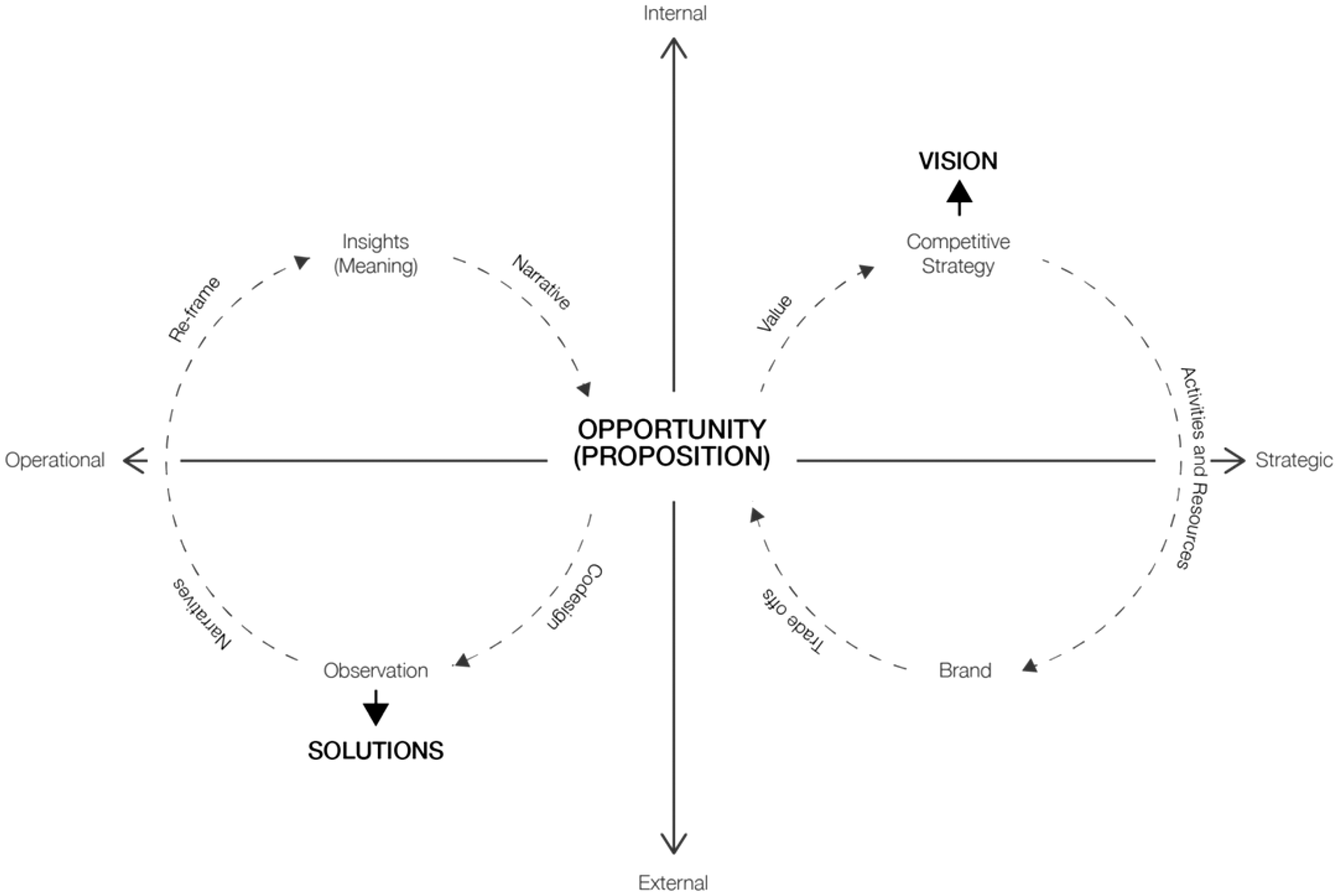
Design-led innovation framework.
Gathering customer insights from customers and stakeholder that reveal deeper latent needs;
Proposing future orientated solutions that capture value from these customer and stakeholder insights, prototyping and testing solutions with stakeholders and;
Shaping strategy that leverages the value unlocked by future orientated propositions – these propositions being grounded in customer and stakeholder insight.
Organizational context for action research
Airports operate and grow upon the strength of reputation. The reputation of being a fast airport with excellent passenger experience attracts customers to do business at that location. Innovation becomes a necessary activity to take leadership and continually improve operations to maintain good reputation in an industry that is concerned by rankings and awards. Profitability matters aside, airports play a crucial role as the enabler of mobility on which modern society has become highly reliant. There is much to be learnt from organizations which operate under the associated pressures of high reliability status such as airports (Chivers, 2014).
The AAC engaged the design innovation catalyst to implement DLI as a new approach to creating and capturing value. At the time, the design innovation catalyst was beginning doctoral research in the field of DLI and entered the AAC. The action-orientated inquiry allowed the design innovation catalyst to work within the AAC for a period of 18 months. Three cycles of action research occurred, with each cycle corresponding to an industry project (see Figure 2). Semi-structured interviews and focus group discussion provided the catalyst greater visibility within the organization and opportunities to involve a greater number of participants with DLI, a strategy described by Agostinone-Wilson (2012). Further, data generated as an outcome of action were captured in field notes and a reflective journal kept by the catalyst to capture, monitor and assess the participants’ growing sense of awareness (Brodsky, 2008). Additional details of each project can be viewed in Appendix 1.
Each cycle of action research corresponded to the tasks set out by Wrigley (2016) as crucial to the role of the design innovation catalyst. Wrigley (2016) states the catalyst must; ‘dissect' (understand the organization); coach DLI enabling employees to ‘learn' design, and; ‘integrate' DLI before concluding the embedded period within the organization. Therefore, action research cycle one sought to ‘dissect’ the AAC context; action research cycle two sought to coach and ‘learn’ DLI with AAC employees, and; action research cycle three sought to ‘integrate’ DLI as an accepted way of working across the AAC.
Design innovation catalyst
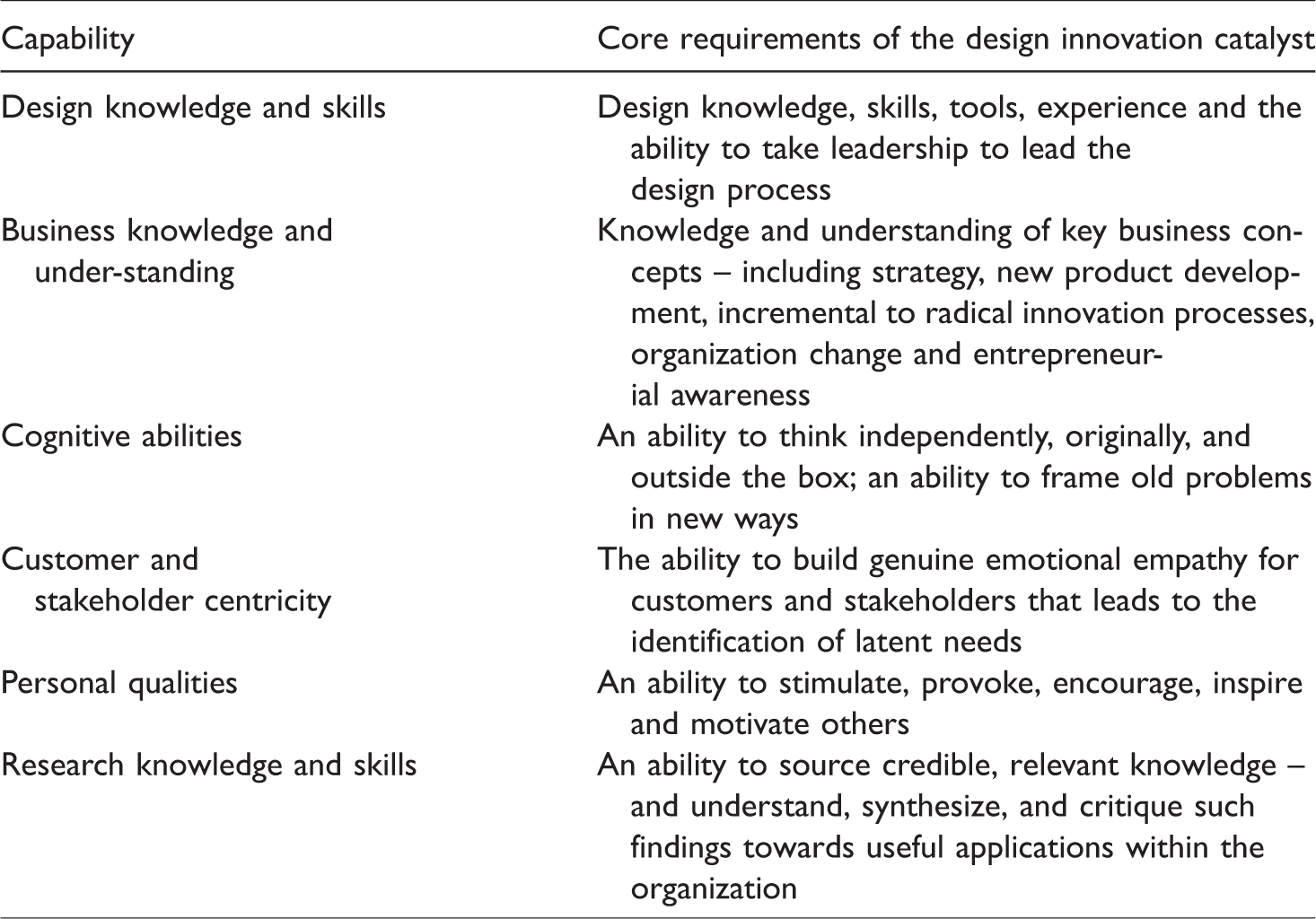
To facilitate the journey of organization to adopting DLI, the design innovation catalyst described by Wrigley (2016), becomes vital to guiding an organizations’ progression toward design. The design innovation catalyst coaches the use of design methods and skills. Further, the catalyst works with an organization’s employees and stakeholders to complete real projects. The catalyst operates between business and design to translate abstractions of research and the realities of practice into value for the organization. The framework for the design innovation catalyst (Wrigley, 2016), mirrors that of DLI in that there is an underpinning axis for related contexts intersected by activities (see Figure 3). The catalyst must traverse academic and industry domains while undertaking teaching and learning activities. Such a role requires a pragmatic attitude and a set of capabilities that promote adaptability. Wrigley (2016; 2017) further describes the capabilities and practice required to fulfil this role which can be viewed in Table 1.
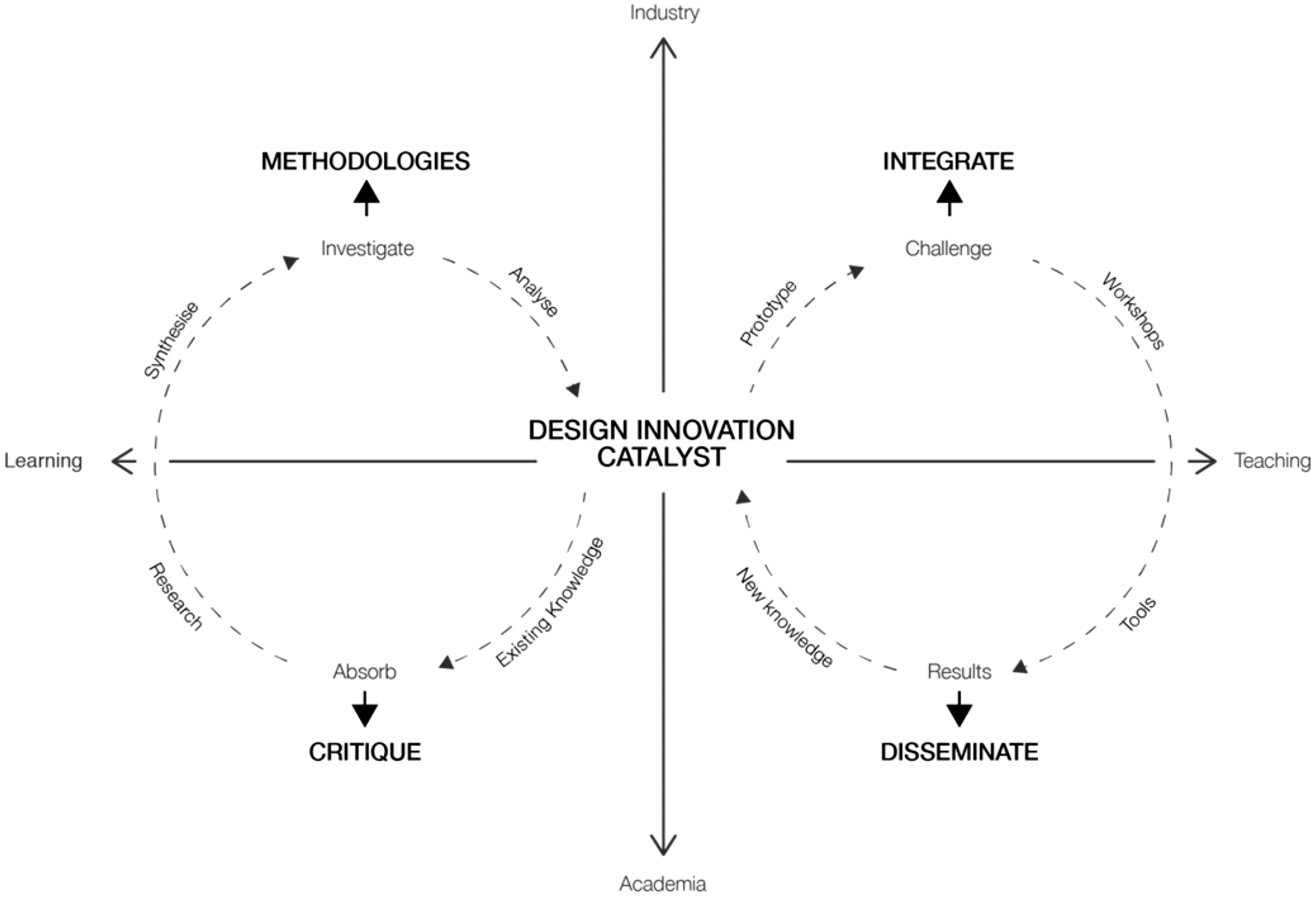
Extended role of action researcher as Design innovation catalyst framework.
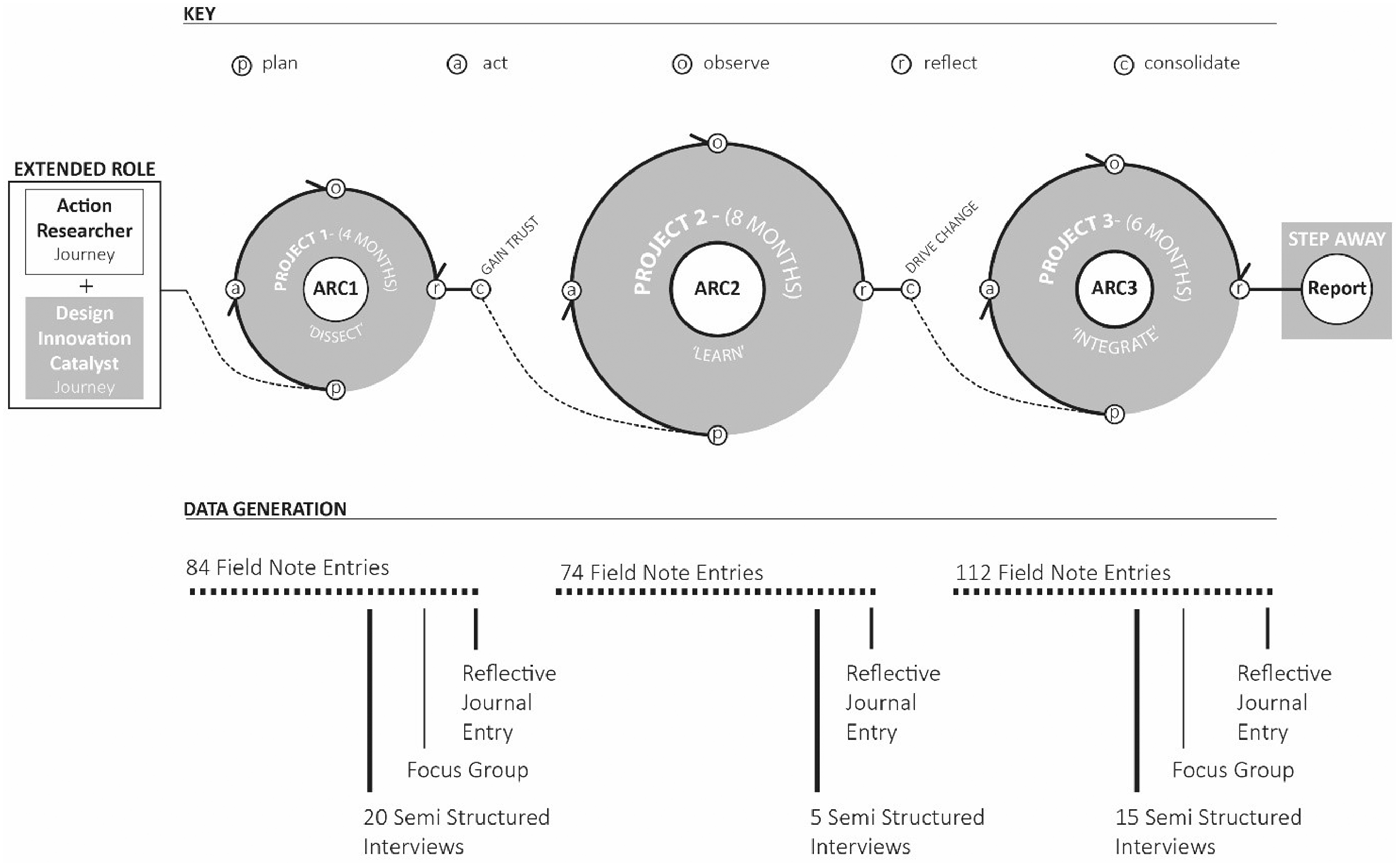
Design innovation catalyst framework.
Design innovation catalyst capabilities.
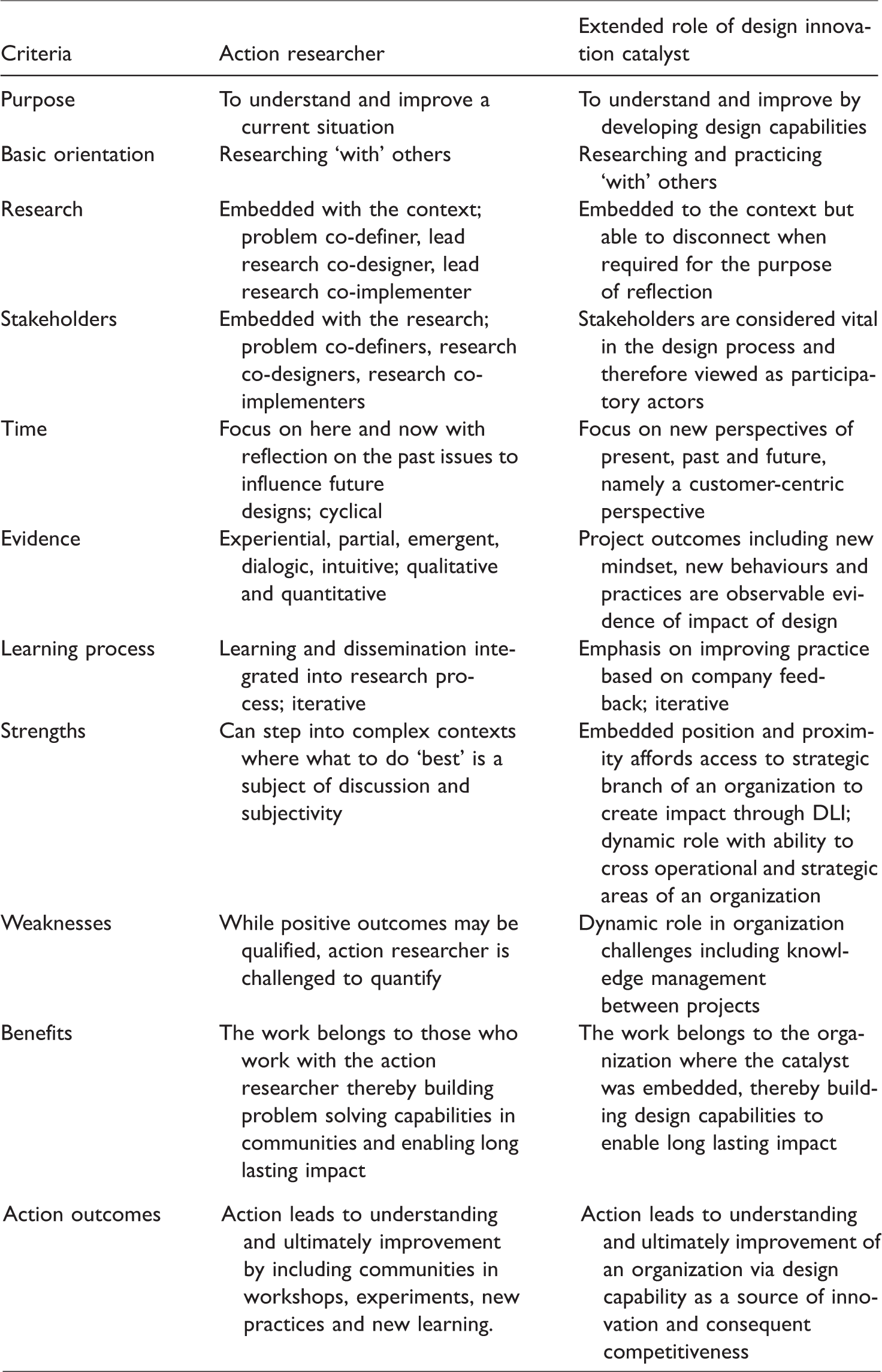
An intersection with the capabilities of an action researcher and the design innovation catalyst can be determined as both roles concern understanding and improving situations encountered (Bradbury, 2015). However, there are also unique nuances between the two roles. The defining characteristics of an action researcher can be conceptually extended by that of the design innovation catalyst. This extension can be viewed in Table 2.
Extending the action researcher and design innovation catalyst.
Action research cycle (ARC) 1 – understanding the AAC and building trust
ARC1 challenged the design innovation catalyst to understand and describe the AAC from within, to develop rapport with stakeholders and employees, demonstrate DLI and convince the organization of the framework’s value. Getting to know the employees within the corporation was the first step. As noted in the catalyst’s written reflections, ‘The first cycle consisted of learning about the organization’. The key task for me was to ‘understand and make sense of the value chain, pick up aviation lexicon and place myself in contact with various stakeholders across the business’ (Reflective Journal). While interview and focus-group discussion belong to ethnographic domains of research inquiry, the catalyst chose to apply these research methods as a formal way of meeting employees within the corporation. Interviews were conducted across senior management, middle management and operational levels from all of the nine departments. These interviews also increased the visibility of the catalyst and the mandate to implement DLI across the organization.
This first round of interviews occurred in addition to day-to-day activities such as attending meetings, lunches and informal staff activities. The catalyst even joined the AAC football team in order to meet a diverse range of employees. This unconventional channel outside workplace activities provided opportunities for the catalyst to meet with senior management and advocate the possibilities of DLI for the organization. Similarly, the focus group discussion brought together members of the business development team in which the catalyst was based to discuss innovation and current perceptions of design. A mix of formal research methods and informal engagements with employees proved crucial in building a solid foundation for later learning and integration of DLI within the organization.
One of the challenges for the researcher in the cycle 1 was to gain a deeper understanding of the organization – the culture, processes and vision of the AAC while retaining a design mindset. This was one of the notable tensions of the role of action research as catalyst. Having a concise elevator pitch was necessary to ensure all contact with employees and stakeholders added to the aim of developing design capability. Many approaches were tried including such as, ‘I am helping your organization innovate by engaging with customers not just spreadsheets', to ‘I am here to help your organization realise its vision to be world best by implementing design as a new way of innovating'. In addition, the design catalyst had to withstand critique from employees who questioned the qualitative and participatory nature of DLI. For a data-driven organization like an airport operating in a high-reliability setting, the notion of asking passengers how they liked to travel was deemed by some as an uncertain practice. The catalyst had to be resilient to overcome such critique especially given their short history with the organization.
Two critical factors emerged here. First the catalyst was advocating a design-led approach to innovation which differed to the predominant data-driven approach of the AAC. Second, the catalyst was not a full-time staff member of the AAC, instead a ‘researcher from a university’. Building trust for the catalyst and DLI as a framework was therefore identified as a priority during ARC1.
During ARC1, one of the key observations by the catalyst was that discussing the benefits of a design-led approach to innovation was not sufficient to create interest in DLI. A demonstration of DLI within a project was required. This insight is consistent with experiential learning theory identified by Beckman and Barry (2007) as part of the foundations of design thinking. Project 1 was created in an opportunistic manner with an interested AAC employee who was eager to know more about DLI. The project involved limited financial risk for the company, a short timeline and involved a trusted business partner of the AAC. The project sought to understand under what conditions, passengers did and did not engage with money exchange services within the airport terminal, in order to shape new services that would increase the performance of the AAC business partner. Instead of using sales data to suggest new services, the catalyst demonstrated to interested stakeholders how design methods could be used to involve customers as co-creators of new monetary exchange services. One AAC stakeholder who worked closely alongside the catalyst describes some of the challenges of undertaking DLI: The most challenging element [about this project] was gaining the ‘trust’ from colleagues and [the retail partner] that this [design-led] process would actually work. Most people are numbers driven and have not done this type of research before. As a result it was a bit of a challenge to help people fully understand why we would do this project this particular way, and why we didn’t need a massive number of responses from passengers. (Participant)
Action research cycle (ARC) 2 – teaching and learning DLI
ARC 2 sought to build upon the trust gained in cycle one. In the catalyst’s own words, ‘Action Research cycle 2 consisted of the “core” of DLI project work. Building upon the successful platform of AR1, AR2 sought to promote the full possibility of DLI’ (Reflective Journal). The platform to coach a broader range of employees on how to apply DLI occurred during Project 2 (see Appendix 1). Project 2 was assigned to the catalyst and involved a diverse range of AAC departments and an external software consultant. This project had a budget, a strict timeline and therefore required financial evaluation and approval from the AAC. The catalyst’s role within Project 2 was to coach employees DLI – to gather deep customer insights using design methods, facilitate the development of future-orientated propositions by reframing (a design activity) and then to evaluate current AAC strategy. This coaching occurred through work in small teams with two to three AAC employees and the catalyst. The tools, methods and approaches of DLI were experienced together in workshops and at the airport terminal with passengers. Employees and stakeholders were also encouraged by the catalyst to use design methods in other projects.
During Project 2, it became clear that the AAC had not yet considered a unified digital business strategy and various departments were conducting digital value creation in silos. The absence of a digital business strategy and the information that various departments were conducting separate digital value creation was reframed as the second opportunity to demonstrate the value and possibilities of DLI with employees. However, instead of just demonstrating DLI, the catalyst emphasised participation, coaching employees on how to gather insights themselves, reframe propositions and shape a digital strategy during their own practice. This coaching occurred closely with three key senior corporation leaders; the Manager of Research and Innovation; the Manager of Business Development, and; the Senior Manager of Strategic Planning and Development. The Senior Manager in particular was a gatekeeper to gaining top level support for DLI as an appropriate way of innovation within the corporation. If the Senior Manager believed in DLI and was able to articulate the framework and its potential organizational contribution to colleagues, then the catalyst felt as if critical progress was being made. Fortunately the Senior Manager was eager to shape future services and products around the AAC's customers’ needs and desires, but was without a framework or the resources to do so.
The catalyst seized this opportunity to demonstrate how DLI could support the organization’s ambitions to become passenger-centric. Top down support was later achieved, with a mandate from the CEO and Senior Management Team to launch Project 2 to market. The solution involved a world first service that would create value for the AAC and its customers. The breakthrough nature of Project 2 also aligned with the AAC’s vision to be innovative – creating valuable evidence that DLI could help move the corporation toward a position of leadership within the international aviation industry. Further, the act of co-creating a digital strategy benefited the organization as described within the design innovation catalyst’s reflection, ‘As part of the production of this strategy, the term ‘digital’ was defined. This activity required confidence to define what such a term would mean to [the Airport’s] own vision and future operation’ and, ‘this is a healthy activity for the organization and developed discourse regarding new concepts, technologies and social trends’ (Reflective Journal). The catalyst felt at this moment that the planning and execution of interviews and focus group discussions would have slowed the momentum of Project 2. Instead, daily events were documented through field notes, for example, ‘[Business development] stakeholders are reading more widely about innovation, purchasing innovation books and sharing interesting online articles via email with each other. This did not occur during ARC1’ (Field Notes, 21/11/2013). Later these notes were expanded upon as part of the protocol of participatory observation. The catalyst also engaged in reflective journal writing to support a growing internal awareness of the events that were unfolding in the AAC, for example the catalyst reflects: [In ARC2] there was a clear increase in the use of ‘innovation’, ‘passenger experience’ and, ‘customer needs and wants’ within the general language of the business development team. I took this as a sign that my project-orientated approach to coaching DLI was having a positive impact. (Reflective Journal)
Action research cycle (ARC) 3 – integrating DLI
ARC 3 began after 12 months of inquiry within the AAC by the catalyst and built upon learning and success of previous projects. Project 3 sought to design a passenger transfer system between the domestic and international terminals of the AAC. Cycle three differed from the two previous cycles in this period, as the catalyst was not a project leader. Instead, the catalyst was brought into Project 3 to observe events and the actions of the Manager of Business Development and Senior Manager of Strategic Planning and Development who were both participants in Project 2. In particular, the catalyst was seeking to observe how these two managers applied DLI in their own practice. The Manager of Business Development played an important role in questioning technology and efficiency driven approaches to Project 3 by operationally orientated stakeholders, ‘Any technology or potential service was met with an evaluation built on the following small but powerful questioning, “Does the customer need or want this, will this improve our the customer’s experience?”’ (Reflective Journal). It became clear that the two senior managers were able to articulate what DLI was and openly advocate this framework to colleagues, but considered themselves to be project managers rather than implementers of DLI. Following this realisation, the catalyst and senior managers amended the brief for the Manager of Research and Innovation to include activities related to DLI, such as gathering customer insights and reframing propositions. This structural change coincided with the position’s vacancy following the recruitment of the previous Manager of Research and Innovation to a gulf airport – and prior to the appointment of an incoming Manager. This recruitment was viewed by the catalyst as evidence of external acknowledgement of the AAC improved innovation performance following the success of Project 2.
The next priority during ARC3 was to create a set of tools and co-creation workshop formats that could be repeated in future projects to ensure that DLI remained an evidence based practice, not just a mindset, a vulnerability described by Dong (2015). The catalyst applied design tools and methods to the airport context. These methods and tools during Project 1 and 2 included design narratives; touch point timeline tools; persona design tools; customer interview approaches and workshop formats. Following the appointment of the incoming Manager of Research and Innovation, the catalyst coached this new employee intensely for a period of one month on DLI and the tools and methods and their application. This coaching process included numerous rounds of gathering customer insights and reframing exercises.
After 18 months engagement with AAC, the design innovation catalyst had become a familiar face within the corporation, with regular invitations to industry events and opportunities to act as a representative for the organization. This acceptance also presented challenges as the catalyst was becoming part of the corporate culture. Semi structured interviews and a focus group discussion were repeated across the organization during the final months within the AAC in order to gain insight on AAC employees’ perceptions of DLI. The foci of these methods regarded how DLI had been adopted by employees and a reflection of the events of the last 18 months within the AAC. In addition to these methods, field notes and reflective journal entries were continued to maintain a day-to-day account. This mix of ethnographic and participatory observation methods allowed the catalyst to build a richer perspective to the story of change witnessed within the AAC. Ethnographic methods allowed a form of feedback between catalyst and AAC employees as to what extent design capability was being developed. The findings were that knowledge and skills of DLI had been developed in a small number of employees through engagement with the catalyst – but not across the entire organization, something that Bucolo (2016) proposes can take many years to occur. As the catalyst notes, ‘DLI is being used to negotiate complex problems concerning multiple airport stakeholders while maintaining core passenger and customer-centric values’ (Field Notes, 13/02/2015). While this change may only manifest in the actions and language of a select few employees – the impact of that change can spark new fortunes for an entire organization. This type of design leadership is described by Bucolo et al. (2012) as an important organizational gap to fill. The Senior Manager of Strategic Planning and Development earlier identified as a gatekeeper to the broader acceptance of DLI due to their position of seniority, demonstrated the following understanding of DLI: I think design-led innovation really starts with the customer — deep customer insights — really understanding the customer, the user, before you jump into an innovation or a solution. So to really understand what the deeper needs - that goes one step further than asking through market research what the poor areas are and what needs improvement. This goes one step beyond. So asking what is behind - important — why do people behave as they do, or what would they like to experience or see. (Participant)
Critical reflection – extending action researcher as ‘catalyst’
Criteria set by Bradbury (2010) provides a valuable reference point for critical reflection on the quality of this inquiry. The criteria; significance, reflexivity, actionability and methods and processes are applied to evaluate the quality of this study. There is also value in deepening the conceptual position of ‘catalyst’ as an extension of action research by briefly touring the chemical phenomena associated with the term. As Bradbury notes, the quality of action research can be determined by the extent to which the action researcher places themselves in a reflexive role as an agent of change (2010). An agent of change (which incidentally is the precise chemical definition of catalyst), is placed into an environment where two pre-existing elements are reacting ineffectively. The first pre-existing element encountered in this study was the organizational culture and processes within the AAC. These elements geared the AAC toward mitigating risk and smartly following industry leaders. The second pre-existing element was a recent mandate by senior management to take leadership by innovating successfully. Within the AAC new approaches to innovation were required to take leadership, hence a turn to design.
In a chemical reaction, the catalyst is introduced as an additional energy source that accelerates a reaction to the point of creating value. While the design innovation catalyst brought a fresh perspective unconstrained by existing organizational processes or culture, it was gaining trust from the AAC to implement DLI that provided a platform to accelerate the development of design capability. Gaining trust in this extended role of action researcher as catalyst was a somewhat delicate task. First the catalyst had to be accepted into the organization – to be recognised and ‘fit in’ to an existing cultural and procedural status quo. To enter a company and simply disrupt all structures (social and procedural) would place the catalyst as an outsider and be counterproductive to greater ambitions of the developing design capability. For this reason this learning in particular is significant and must be factored into future research applying a similar methodology.
The catalyst must also make explicit their intention to challenge prevailing standards - to implement DLI as a new source of innovation that is customer-centred, rather than the prevailing linear and efficiency driven approaches. In this sense the catalyst must be sensitive to identify the existing status quo, while visible and resilient enough to be a change agent who implements methods and tools of design that are actionable even after the catalyst has departed the AAC. In this back and forth between sensitivity and resilience, enormous energy is exerted to continuously sense the organization’s perception and use of design, then identify what following actions should be undertaken to further develop design capability. The learning of ‘show not tell’ as an outcome of Project 1 within the AAC in particular provides actionable insight. A shared practice of DLI with catalyst and organizational stakeholders must be the primary mechanism for developing design capability. Discussion about design only achieves interest, experiencing the possibilities of design is where true learning takes place. Projects that are design-led and undertaken by both catalyst and organization can be the meeting point in which experiencing design takes place. While the specific methods applied within each project will be determined by the context, a procedural perspective of how to develop design capability is contributed – namely, ‘show not tell’ and experience the possibilities of design together as the primary mechanism for developing design capability.
These insights are integrated into an enriched design innovation catalyst framework. Figure 4 builds upon the work of Wrigley (2016) to extend the role of the action researcher by contextualizing where and how actions occur during the course of research seeking to develop design capability. The key actions of build trust, drive change, scale knowledge and consolidate new knowledge take place in associated parts of the framework. These parts of the framework represent various contexts in which the action research extended to catalyst must negotiate. Key actions provide greater clarity to the role of the action research when developing design capability through an extended position as design innovation catalyst. These key actions also assist in shaping a designerly approach to action research proposed by Silverman (2015).
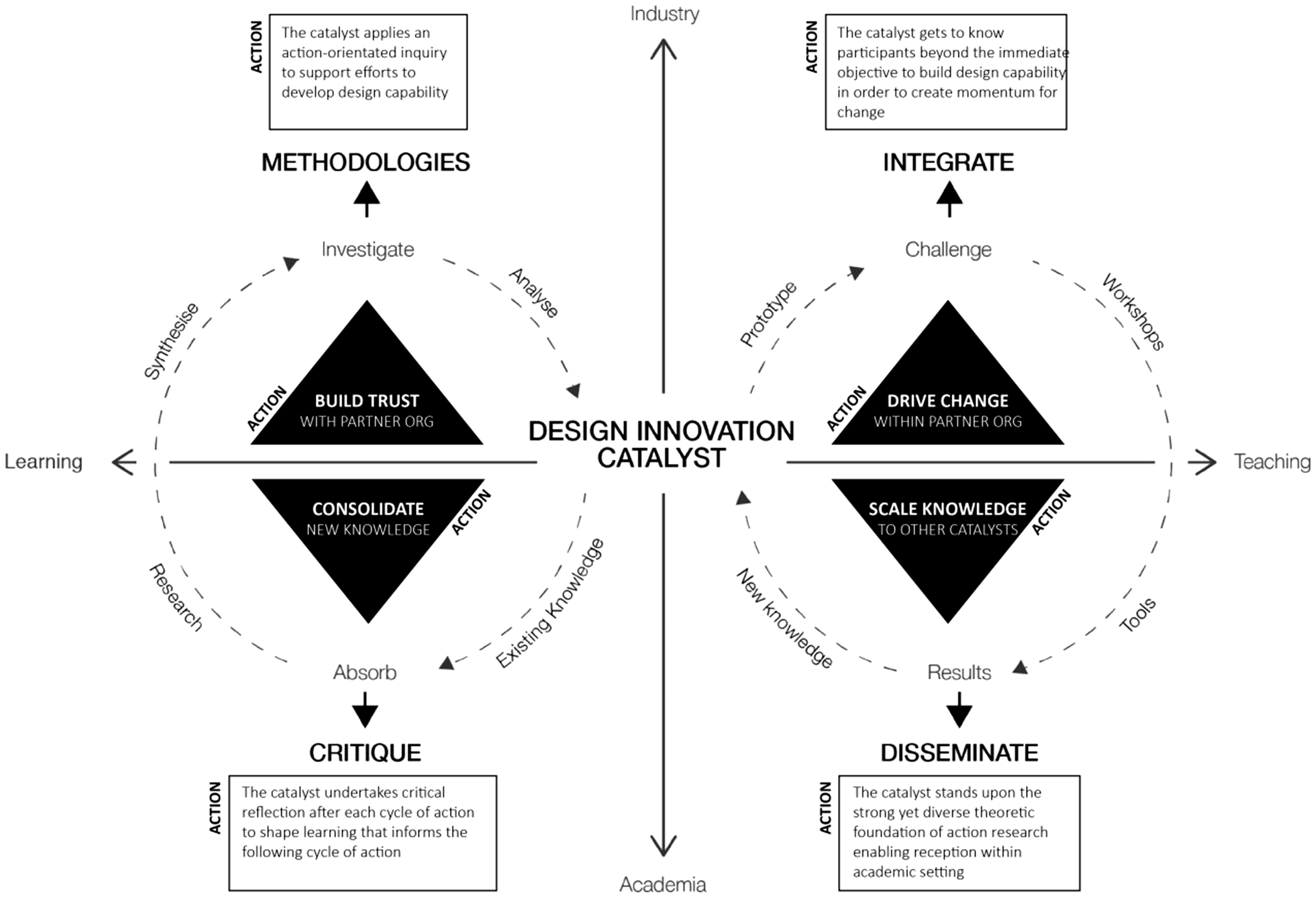
Design innovation catalyst framework – annotated to include key actions by action research as design innovation catalyst.
Conclusion
Design is now considered an essential business capability that assists organizations to adapt to changes in technology, society and the marketplace. Consideration of how design capability is developed in organizations is therefore a relevant area of inquiry. The notion of ‘how to’ develop design capability demands an action orientated inquiry, with emphasis on creating practical knowledge that is accessible and repeatable. A design innovation catalyst is an expert in the implementation of DLI as one approach to developing design capability who extends upon the foundations of action research. The catalyst develops design capability with staff within an organization, rather than act as an outside observer. However, the specific actions and learning objectives of an action researcher extended as a ‘catalyst’ have been implicit to date, with greater emphasis placed on the outcome of organizations who develop design capability. This article has contributed a set of key tasks and learning objectives for the design innovation catalyst to achieve when developing design capability within an organization – namely ‘show not tell’ to build trust and interest, and experience the possibilities of design together as the primary mechanism for developing design capability.
Footnotes
Declaration of conflicting interests
The author(s) declared no potential conflicts of interest with respect to the research, authorship, and/or publication of this article.
Funding
The author(s) received no financial support for the research, authorship, and/or publication of this article.