




Abstract
A successful transition to school is critical for both short- and long-term academic and social success. Understanding children’s transition experiences, including their academic and social experiences, is essential for identifying the social-emotional competencies needed to support a successful transition. While much of the existing research on school transitions has been conducted in Western contexts, there is a significant knowledge gap due to differences in cultural values and schooling systems between the East and West. This study examines the transition experiences of children in the eastern context of Hong Kong, focusing on their academic and social experiences, with the aim of identifying how social-emotional learning (SEL) could facilitate a successful transition. Interviews were conducted with 38 primary one and two students from four primary schools in Hong Kong. For triangulation, focus groups were also conducted with parents (n = 17) and teachers (n = 15). Findings revealed that children’s transition experiences were multifaceted, encompassing both positive and challenging aspects. Positive experiences included forming friendships, engaging in a variety of learning experiences, achieving academic success and receiving support from both parents and teachers. However, these were accompanied by diverse academic and social challenges. The findings underscore the importance of early SEL, including enhancing children’s growth mindset, emotional understanding, self-awareness, social awareness, social skills for building friendships, conflict resolution and emotional regulation. The implications of these findings are discussed.
Keywords
Introduction
The move to primary school is one of the key milestones in children’s lives, bringing both opportunities for growth and challenges to navigate (Tobin et al., 2022). Successful transition requires different social and emotional competencies of children to navigate through various academic, emotional and social challenges (Li and Lau, 2019). Though some children find the transition to primary school to be exciting and enjoyable, many children find it challenging and distressing (Wong and Power, 2019). Past studies focusing on transitions have mostly focused on the move to secondary school and university (Graham et al., 2016; Postareff et al., 2017), with less research on children’s initial transition to primary school. Moreover, much of the existing research has been based in Western contexts. Not much is known about the transition experience in Eastern contexts. This is a critical gap given differences in cultural values and schooling systems between the East and West. The present study, therefore, extends the field by looking into the transition experiences of primary school children in the eastern context of Hong Kong, focusing on the academic and social experiences they encountered. This study focuses on children’s academic and social experiences during their transition as research evidence has shown the significance of the impacts of these two dimensions on long-term school success (Mascareño et al., 2014; Wilson et al., 2007). This study also contributes to understanding how social-emotional learning might facilitate a positive transition experience.
Transition to school: Multiple and Multi-dimensional Transitions (MMT) Theory
According to the Multiple and Multi-dimensional Transitions Theory (Jindal-Snape, 2023), transitions are not isolated events but rather multiple and multidimensional processes involving shifts in identity, relationships and roles. These transitions encompass psychological, social, cultural, spatial, and educational adaptations driven by changes in context, interpersonal relationships, and evolving identities. In the case of young children transitioning to primary school, the theory suggests that they experience multiple transitions due to various reasons, such as changes in peer, teacher and family relationships, developmental progression towards greater independence and differences in organizations and their pedagogical approaches as well as implicit cultures. These transitions can evoke a mixed feelings of both excitement and anxiety for the child and those around them, necessitating ongoing support (Jindal-Snape et al., 2023).
A successful transition can increase the likelihood of positive social, emotional and academic outcomes, setting the foundation for later school success (Hirst et al., 2011). Research has shown that a positive experience during this critical transition period is predictive of later school achievement. Children who have positive early school experiences tend to enjoy school more and subsequently attain more adaptive academic and social outcomes (Cook and Coley, 2017).
The transition to school is a significant period, presenting both opportunities and challenges for children. Academically, while children are offered diverse learning opportunities that expand their skill set and perspective, they also must adapt to new learning styles, work independently, manage more homework and assessments. Socially, this transition provides opportunities to form new relationships with peers and teachers, while adjusting to various expectations (Chan, 2010). Meta-analytic studies indicate that children’s early academic adjustment significantly influences their subsequent academic performance and long-term educational outcomes (Mascareño et al., 2014). Moreover, social adjustment in the early grades predicts future adaptation and academic success (Wilson et al., 2007). Hence, whether children can manage the academic and social challenges during the transition has important implications for long-term school success.
Academic and social challenges for children in Hong Kong
In Hong Kong, the transition to primary school presents unique challenges to children due to the distinctive education system, societal expectations, cultural norms and socio-economic context. The education system in Hong Kong is structured into three main stages: kindergarten, primary school, and secondary school. Although kindergarten (ages 3–6) is not compulsory, over 90% of children attend by age three, driven by high parental expectations and the introduction of free quality kindergarten education in 2017 (Yim, 2017). Children enter primary school after kindergarten, which spans 6 years (Primary 1 (P1) to Primary 6 (P6)) for children aged 6–12 years. Secondary school also lasts 6 years (Secondary 1 (S1) to Secondary 6 (S6)), serving ages 12–18 years.
The transition from kindergarten to primary school introduces significant changes as the learning environments and curricula of kindergartens and primary schools differ significantly. Kindergarten emphasizes play-based pedagogy and avoids formal assessments, aligning with the Kindergarten Education Curriculum Guide 2017, ‘Joyful Learning through Play, Balanced Development All the Way’ (Hong Kong Special Administrative Region Education Bureau, 2017). In contrast, local primary schools adopt a subject-specific approach, characterized by regular tests and examinations. This shift to a more formal, assessment-driven education involves increased academic demands, including full-day classes and more homework, requiring children to develop greater self-efficacy and academic skills (Chan, 2010).
To support children’s transition, various activities are organized, including visits to primary schools, discussing primary school life with children, and conducting classes in a primary school-like setting (Chan, 2010). Some schools also offer summer programmes to strengthen children’s subject knowledge in Chinese, English and Mathematics.
One major challenge for children in Hong Kong during school transition is adapting to a more demanding academic environment with increased expectations (Chan, 2010; Wong, 2015). Hong Kong’s education system is characterized by a ‘drilling to learn’ culture, which often leads to increased workloads through homework, test drilling and exam preparation (Tsang, 2016). Indeed, children have often been found to struggle to meet teachers’ expectations and missed opportunities for play-based learning (Wong, 2015). Moreover, as education is deeply valued in Chinese culture, parents have tended to have higher expectation for their children’s academic performance (Tao and Hong, 2014), increasing stress for children who have difficulty adjusting to the heightened demands.
Another key challenge children face during their transition is forming new relationships with peers and teachers. The ability to establish and maintain friendships is therefore an important social-emotional competency. However, there is growing concern about children’s social-emotional competence in Hong Kong. First, due to the low birth rate, single-child families are prevalent, causing children to be the spotlight for parents and grandparents, potentially leading to overindulgence and self-centeredness (Chong, 2013). Second, Hong Kong’s long working hours result in many parents relying heavily on domestic helpers as primary caregivers (Ng and Leung, 2018). This may inadvertently promote dependency, hindering children’s social-emotional development.
Significance of social and emotional learning (SEL)
Social and Emotional Learning (SEL) is the process through which students acquire the knowledge, attitudes and skills, to develop healthy identities, manage emotions and achieve personal and collective goals, feel and show empathy for others, establish and maintain supportive relationships and make responsible and caring decisions (CASEL, 2023).
Different social and emotional competencies are needed for children to successfully navigate the transition to school. Academically, children have been expected to pay attention, follow teachers’ instructions, persist with studying and homework, and maintain a growth mindset in response to tests and examinations (Campbell and Stauffenberg, 2007). Emotion regulation is particularly important, which involves the capacity to control impulses, avoid distractions and resist temptations in sustaining academic engagement (Zhoc et al., 2020). Moreover, it includes the ability to up-regulate one’s emotions to stay motivated when encountering setbacks (Zhoc et al., 2018).
In terms of social relationships, children who can cooperate and communicate well tend to have positive interaction with peers and teachers, facilitating positive academic and social adjustment (Corcoran et al., 2018; Wang et al., 2024). However, children who find it difficult to control their emotions and are impulsive, have been found to exhibit more aggressive and disruptive behaviours, which can lead to social problems (Spinrad et al., 2006). To successfully cope with the transition, children need to understand themselves, identify and manage their emotions, express their feelings in a constructive manner, regulate their behaviours and develop healthy relationships with others (CASEL, 2023).
The present study
While the move to primary school is inherently challenging, the education system together with the embedded cultural values and contextual factors in the eastern context of Hong Kong may pose different challenges to children in transition. During this period, children may experience adjustment difficulties, which are manifested in under-achievement, behavioural and even psychological problems that may emerge in and last beyond the first year of the primary school (Griebel and Niesel, 2002).
A successful transition to school requires children’s cognitive, social and emotional resources. This study aims to examine the transition experience of children in the Eastern cultural context of Hong Kong, focusing on academic and social experiences of children, thereby revealing the social-emotional learning needed by children for their successful transition and optimal functioning in primary school. This study is guided by three key research questions:
(i) What are the transition experiences of children transitioning to primary school?
(ii) What are the academic and social experiences of children during their transition to primary school?
(iii) What are the implications of these findings for the social-emotional learning needs of children to support a successful transition?
Methods
Participants
Four primary schools from different districts in Hong Kong participated in the study. All of them were government-aided, co-educational schools with similar characteristics.
The schools agreed to participate in an intervention programme (which included a summer orientation and 12 social-emotional learning lessons) that aimed to facilitate children’s transition to primary school by enhancing their social-emotional competencies. Before the programme’s implementation, interviews were conducted with 38 children randomly selected by the participating schools (19 primary one (P1) and 19 primary two (P2) children; 16 males (42%) and 22 females (58%)), aged between 6 and 8 years old. The interviews involved both P1 and P2 children to achieve a more comprehensive understanding with P1 children described their immediate transition experiences, while P2 children reflected on their experiences from the previous year, leveraging their greater developmental maturity. Insights from these interviews informed the design of the 12 SEL lessons, which were incorporated with case studies drawn from real experiences shared by children, providing a basis for meaningful discussions. To triangulate the children’s perspectives, four teacher and four parent focus groups were conducted, involving 15 class teachers and 17 parents of P1 and P2 children from the four schools. Ethical approval was obtained from the University, and consent was sought from all participants, including the children’s parents.
Data collection procedures
This study employed a qualitative research design, incorporating semi-structured interviews with children and focus groups with teachers and parents. This approach facilitated data triangulation, enhanced the reliability of the findings and provided insights from multiple stakeholders, thus offering a more holistic understanding of children’s transition experiences.
Children’s interviews
Individual face-to-face interviews were conducted with children in a private room setting at schools, with each session lasting for approximately 30 minutes. The interviews were conducted by a member of the research team, who was an experienced kindergarten educator. To foster a sense of familiarity, the interviewer spent time interacting with the children before the interviews, creating a comfortable environment for them to share their feelings.
Informed consent was obtained from the children and their parents or guardians. At the beginning of each interview, the researcher explained the purpose of the study using simple and age-appropriate language to ensure the children understood what the study involved. It was emphasized that participation was entirely voluntary, and they have the right to withdraw from the interview at any time without any consequences. To confirm comprehension, researchers also asked children to explain their understanding of the study in their own words.
We acknowledge that power dynamics may have been present in conducting children’s interviews, as the interviewer was an adult and not part of the school teaching team. However, having teachers conduct the interviews was not a feasible alternative due to their busy schedules. Moreover, children might have been reluctant to share their feelings openly with their teachers, who hold a significant position of authority over them. Given these considerations, having a member of the research team conduct the interviews was deemed the most appropriate.
The interviews were guided by a topic framework developed by the research team based on existing literature and pilot experience to ensure age-appropriateness. While P1 students were asked about their current transition experience, P2 students recalled and shared their experience in the previous year. The objective was to better understand the transition experience of children, including the academic and social challenges they encountered. The interview questions were piloted with a small sample of children, and feedback from this pilot study was used to refine the questions, ensuring they were age-appropriate and easy to understand. All interviews were audiotaped and later transcribed. Sample questions in the topic guide included:
How do you feel when you think about going to school?
What do you think about your academic study?
Have you ever experienced any academic difficulties or frustrations so far?
Do you have friends in your class? What do you usually do with your friends during recess?
Have you ever had any social problems? What was the last time you had conflict with your classmate(s)? What was it about?
Parents’ and teachers’ focus groups
The parents’ and teachers’ focus groups were conducted in meeting rooms at the schools. At the start of each session, the researcher provided a detailed explanation of the study’s purpose and the participants’ rights, ensuring that all participants were fully informed. It was emphasized that they had the right to withdraw from the study at any time without any consequences. The interview questions were the same as those designed for children but were appropriately revised to gauge the views of parents and teachers. The focus group discussions were audio-recorded, and transcripts were subsequently produced based on the recordings to facilitate analysis.
Data coding and analysis
Thematic analysis was adopted to identify themes and patterns across the data set to address the research objective, following the principles of consensual qualitative research (CQR) – generating codes and domains, constructing core ideas and undertaking cross-analysis (Hill et al., 2005). The research team, comprising three academics with expertise in educational psychology, school and early childhood education, conducted the analysis in three phases.
During the first phase, two researchers (one with a PhD in Educational Psychology and one with a master’s degree in early childhood education) read all the transcripts thoroughly to familiarize themselves with the data. Initial codes and domains were generated independently based on recurring patterns that emerged from the transcripts. Within each domain, categories were developed to help organize the data, with coding criteria to ensure consistency (Table 1).
Domain, categories, coding criteria.
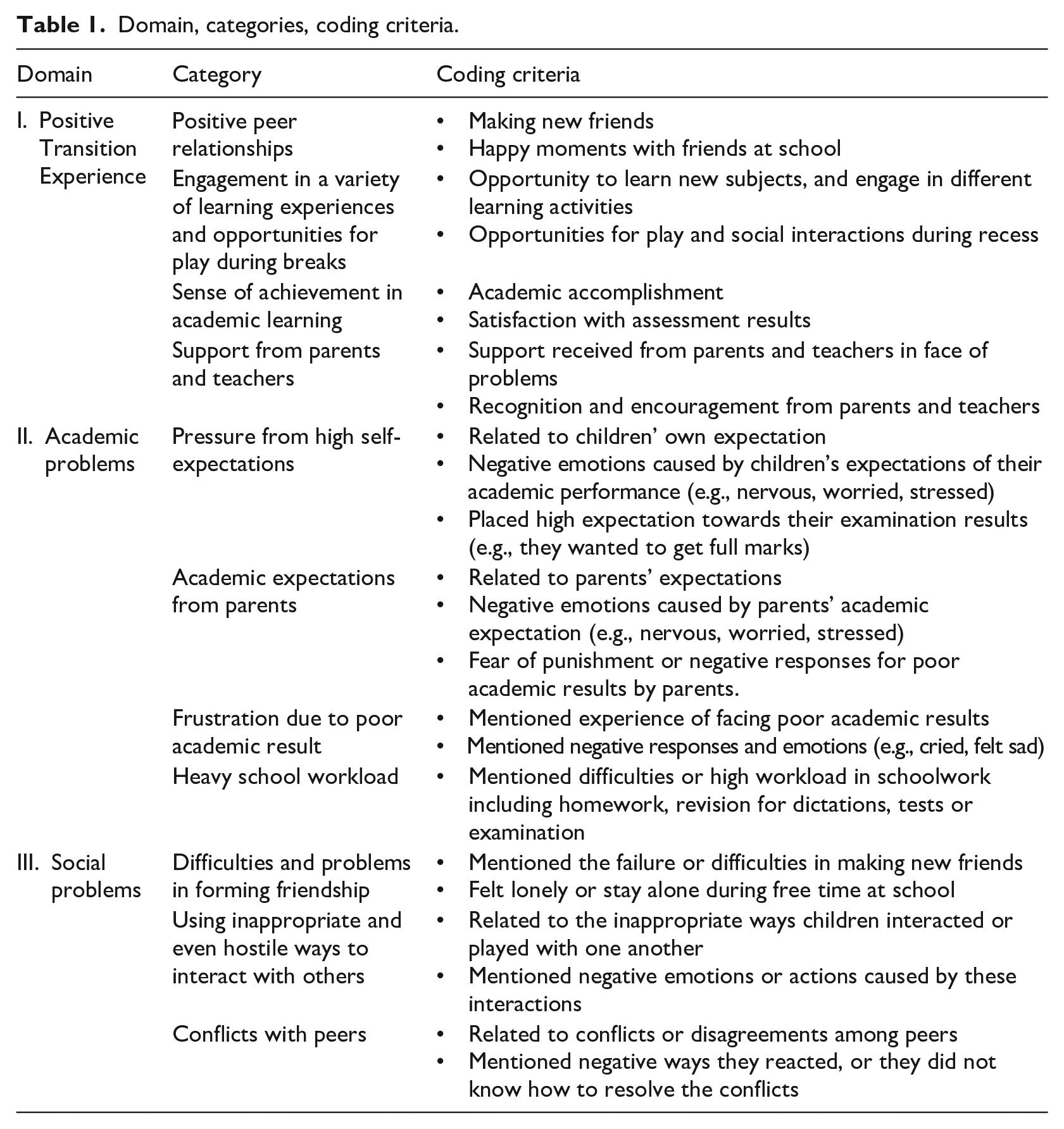
Next, the two researchers convened to develop a consensus on the domains and categories that addressed the research objectives. Discrepancies were discussed to make adjustment through a cross-analysis. In the final phase, the categories were reviewed to determine whether they could be supported with corresponding examples from the data. Refinements were further made to address any discrepancies.
Findings
The study revealed varied experiences among children transitioning to primary school, including both positive and negative aspects. While some children faced challenges and difficulties, many shared positive feelings and experiences about the transition. Findings were organized into three main themes: positive transition experiences, academic problems and social problems.
Theme 1: Positive Transition Experience
Subtheme 1: Positive peer relationships
Children frequently expressed enjoyment at school, often connecting this to positive peer relationships. They described happy moments with friends, especially during recess and sports. These positive social experiences were key factors contributing to a successful school transition, motivating children to attend school.
‘The best thing I love about my primary school life is that there are so many children with whom I could make friends. .’ – P1 boy - School A
‘Some children played basketball with me during recess, and we had so much fun playing together.’ – P1 boy - School B
Subtheme 2: Engagement in a variety of learning experiences and opportunities for play during breaks
Children expressed joy in learning new subjects such as computer, music, physical education and religion, while actively engaging in diverse learning experiences. They especially valued play time during breaks, which involved enjoying physical activities, games with friends and exploring the new school environment like the library.
‘I like going to school because we can have breaks, go to the playground. . .or the library. Once, our whole class rushed up (to the library) together.’ P1 boy - School B
‘I love school life in Primary One—it’s fun and nice. On Fridays, we can play MINECRAFT and games; in the hall, there’s so much to see and do. On Thursdays, we have activities in the English room, and on Wednesdays, we watch movies in the music room. I enjoy singing in music lesson.’ P1 boy - School A
Subtheme 3: Sense of achievement in academic learning
Children expressed a sense of accomplishment in academic learning, expressing satisfaction with their examination results and progress. These contributed positively to their overall transition experience and motivated future learning.
‘I’m happy! I really enjoy going to Chinese class. I find both Chinese and English very easy to learn. I’m also really good at math’ – P2 - School A
‘Well. . .I’m relatively good at math because I studied it before. I don’t have to worry about my math skills, so for exams and assessments, I can get high scores easily.’ – P1 boy - School C
Subtheme 4: Support from parents and teachers
A positive transition was particularly evident when children perceived strong support from parents and teachers. Praise from adults was described as a significant motivator, encouraging children to persist in their study. Additionally, the presence of caring adults who provided reassurance and encouragement helped children face challenges positively during the transition.
‘The teacher often praises me because I am well-behaved in class. They say I pay attention in class and keep my eyes on the teacher, which makes me very happy. . .’ – P1 boy - School D
‘At that time, even if the teachers weren’t satisfied with my results, my mom would still say, “Wow, how did you do that? Well done!”’ – P1 girl - School A
Theme II. Academic problems
The prevalence of stress caused by academic problems was found among children during the transition period, as they had to adapt to new learning styles and forms of assessments that were markedly different from their kindergarten experiences. Anxiety levels increased especially for those who were unable to meet the academic expectations. The following four sub-themes arose in the analysis of the data around academic challenges faced by the children:
Subtheme 1: Pressure from high self-expectations
Children had high academic expectations, leading to increased stress during the transition. While most considered academic results very important, some felt satisfied only when they achieved full marks. They felt anxious and worried about the failure in achieving their targets.
‘I expect myself to get 98 marks or full marks of 100. I will feel unhappy if I get below 98 marks.’ – P2 girl - School A
‘I am very stressed now, I’m afraid I couldn’t get full mark in my English test. If I couldn’t get a full mark, I will be very upset. So, I can’t be lazy and need to study every week, even on Saturdays.’ – P1 girl - School B
Subtheme 2: Academic expectations from parents
Another source of children’ academic stress stems from academic expectations of parents. As reflected in the student interviews, parents frequently demanded and reminded their children to work harder for good results. One child shared that he only received praise from parents with full marks. The tension and fear of potential consequences or punishments for poor results heightened stress during the transition.
‘I felt stressed by my parents since they always expect me to get more than 90 marks from the assessments.’ – P2 girl - School A
‘I: When was the last time that you were praised by your parents?’ ‘When I got full marks (in an assessment).’ – P2 boy - School C
The parental pressure on children was corroborated by teachers. Indeed, parents tend to worry about whether their children can keep up with the academic standards of the school.
‘Actually, it’s the parents who make the children feel that it’s important to achieve good grades. . .first graders do not even have any concept on pass and fail. . .the concept on what is considered good or bad result is taught by adults’. – P1 and P2 teacher - School B
‘During transition, instead of children, it’s usually the parents who are more anxious, worrying that their children are not able to keep up with their academic studies. It really makes us crazy!’ – Parent - School B
Subtheme 3: Frustration due to poor academic results
Children said they felt frustrated and stressed when examination results fell short of expectations. Some found it difficult to handle academic failure. Those with lower coping abilities experienced negative emotions, affecting their self-image, motivation and interest in learning.
‘I will go back (home)to cry if I fail in assessment, but I won’t let anyone know. . .’– P1 girl - School A
‘I felt sad for getting very poor exam result in Chinese. . .I felt worried because I might not be promoted for the poor exam results.’ – P2 girl - School B
Subtheme 4: Heavy school workload
Long working hours due to heavy homework load and a condensed learning schedule in primary school was another factor that induced children’s stress. This reduced their opportunities to play and relax compared to kindergarten.
‘My sister and I also have lots of homework, sometimes we work till very late and sleep even later than our parents. That was really a hard time for us.’ – P1 girl - School B
‘I need to go tutoring centre after school to do assignment and revision in order to get good results in examination’ – P2 girl - School D
Parents expressed concern over the heavy school workload, including extensive homework and frequent dictations. One parent noted that children tend to procrastinate in completing their homework.
‘There’s a lot of homework and dictations. It’s quite frequent to have dictations, which usually involves long passages to memorise.’ – Parent - School B
‘The study hours are long. Since a lot of time is already spent at school, children feel bored and stressed to continue study after school.’ – Parent - School C
Theme II. Social problems
Negative experiences with peers created school adjustment difficulties for children during the transition. While some shared their positive experience with friends at schools, some struggled to build and maintain friendships due to limited social skills. Three sub-themes emerged: (1) difficulties and problems in forming friendship, (2) using inappropriate and even hostile ways to interact with others and (3) conflicts with peers.
Subtheme 1: Difficulties and problems in forming friendship
Children struggled to make friends in the new school environment, leading to feelings of disconnection and loneliness. Many found it difficult to develop friendships, as some lacked social skills and were reluctant to initiate conversations or interact with others.
‘I just go to the toilet and eat during recess, I prefer staying alone in the classroom, I don’t like to go down and play with others’ – P1 girl - School A
‘I don’t play with others, I just eat on my own during recess.’ – P1 girl - School C
Teachers expressed concerns about children’s social skills. As one teacher observed, children were often passive in building social circles, frequently sitting alone in the classroom without interacting. Similarly, another teacher noticed self-centred tendencies among children, as reflected in their reluctance to share toys in the classroom.
‘Children are not active in building their own social circle. For example, during break, it’s common to see children just sitting in the classroom, not doing homework or playing with others. . .simply sit in the classroom doing nothing.’ – Teacher - School D
‘Children in my class are not very good at sharing and tend to be self-centred. For example, there are some toys in the classroom, but some children just play on their own, unwilling to share with others.’ – Teacher - School B
Subtheme 2: Using inappropriate and even hostile ways to interact with others
Children described instances where peers interacted in hostile or socially inappropriate ways, hindering friendship formation and maintenance. For example, children complained about classmates’ inappropriate behaviours such as kissing others, making fun of others, or pulling clothes, showing the need to strengthen children’s self-regulation and ability to express emotions appropriately.
‘I dislike four children in my class. One always disturbs me during lessons, two of them love laughing at me and teasing me about my capability to finish homework. The last one whom I dislike always steals food from others and puts it into my drawer.’ – P1 girl - School A
‘They always come to kiss my cheek and hug me, and sometimes they pull my uniform and try biting it. . .I don’t like that very much.’ – P1 girl - School B
Both teachers and parents opined that some children used inappropriate ways to interact and build friendships with others, such as playing tricks on others or making nicknames for others.
‘Some more aggressive ones even use scissors to cut others’ hair. . .they appear to be controlling and malicious. . .but actually, deep down, they really want someone to play with them.’ – Teacher - School D
‘In fact, a child wanted to play with his classmates, but they called him a fool. He was upset by this and immediately reacted by screaming.’ – Parent - School D
Subtheme 3: Conflicts with peers
Some children struggled to resolve conflicts and regulate emotions effectively, creating further tensions. Examples included exclusion from playground activities, toy-related fights and arguments during play. Unable to resolve the conflicts, some reacted by refusing to communicate or maintain friendship.
‘There was a classmate who kept on putting his hand on my desk and I told him not to do so. Then he came and argue with me during recess in the classroom. . . .we were no longer friends anymore from that on.’ – P2 boy - School A
‘I had quarrels with my friend since she mixed up our colour pencils, then we argued and didn’t talk to each other for few days.’ – P1 girl - School B
It was acknowledged by teachers that it is common to have conflicts among children.
‘There are always conflicts. There is a classmate who always plays tricks on classmates, taking away books and food from others.’ – Teacher - School A
‘Sometimes conflicts arise among children, and they may argue. Children usually handle these situations by reporting them to the teacher. There have also been instances where a child’s toy was snatched by someone, and the child responded by using a pencil to stab at that person.’ – Teacher - School B
Discussion and conclusion
The aim of this study was to examine transition experiences of children in the Eastern cultural context of Hong Kong, with the goal of identifying how SEL could support a successful transition. A successful transition to primary school is a pivotal milestone in a child’s educational journey, laying the foundation for future learning and development. Findings revealed that children’s transition experiences were diverse, encompassing positive and challenging aspects. This study shows the importance of early social-emotional learning to help children better navigate the academic and social challenges they encounter, thereby facilitating a successful transition and optimal functioning during the early stage of school life.
Overall, these findings align with Jindal-Snape’s (2023) Multiple and Multi-dimensional Transitions (MMT) Theory, which conceptualizes transitions as encompassing psychological, social, cultural, spatial, and educational adaptations driven by changes in context and interpersonal dynamics. The transition experiences reported by children in this study reflect these dimensions, demonstrating the interplay between forming new social relationships with peers and teachers and adapting to changes in the new learning environment; particularly within a ‘drilling to learn’ culture characterized by homework and regular assessments. This process is further influenced by Chinese cultural values, where parents traditionally place high emphasis on academic performance. Children who navigate these transitions successfully experience personal growth, gaining confidence, independence and a sense of accomplishment in their academic achievements while enjoying school life with positive social experiences. Those children who struggle to adapt face negative emotions such as stress, anxiety and worry. The MMT Theory underscores the importance of providing ongoing support to address these challenges.
One key finding of this study was the presence of positive transition experiences, which highlights the multifaceted nature of children’s journeys during this critical period. Many children highlighted the joy of forming positive peer relationships, engaging in a variety of learning experiences and feeling a sense of achievement in academic learning; factors that fostered a successful transition. Support from parents and teachers further played a crucial role, with praise and encouragement strengthening children’s psychological resources to face challenges positively. These findings suggest that supporting school transitions requires not only direct interventions for children, but also fostering a supportive environment through the involvement of parents, teachers and peers (Wang et al., 2024).
Addressing academic challenges
The study indicates that during the transition, children’s academic stress stemmed from their high self-expectations and external pressures, especially from parents. Many children felt frustrated due to poor academic results and heavy workloads. Indeed, academic stress tends to be high in Asian societies, such as South Korea, China and Japan (Ang and Huan, 2006; Choi et al., 2022). For example, in South Korea, children are often under pressure from parents and teachers to achieve academic excellence (Choi et al., 2022). Similarly, in Hong Kong, academic success is associated with family pride within the Chinese culture, with underachievement often perceived as parental failure. This can prompt some parents to push their children to do better, which creates a source of stress for children (Eisenberg et al., 2009). Moreover, within collectivist Chinese culture, people tend to attach great weight on others’ evaluations. To avoid parental disapproval, children strive to meet expectations by working hard (Xu et al., 2022).
To help children manage academic challenges, there is a clear need to strengthen their growth mindset, broaden their understanding of school success and enhance their abilities in emotion regulation (Haimovitz and Dweck, 2017). A growth mindset refers to the belief that intelligence and abilities are malleable and can develop through effort (Dweck, 2000). Children tend to perceive academic failure as evidence of their low ability. Fostering a growth mindset, therefore, can help children to embrace failure as part of learning. It is important to encourage children to recognize individual differences and set realistic self-improvement goals aligned with their developmental stage (Elliot et al., 2015). Additionally, expanding children’s understanding of school success beyond academic performance to include social contributions (helping classmates, volunteering, building friendships) to the wellbeing of the classroom, school and community promotes a positive learning environment (Illinois State Board of Education, 2023; King et al., 2024), Finally, supporting children’s emotional regulation skills (stress management, mindfulness, positive self-talk) can help them to manage academic pressure and frustrations). Effective self-regulation can aid academic performance through improved focus, impulse control and motivation (Zhoc et al., 2022).
A growth mindset is important for children and parents (Kim et al., 2024). Parents with a growth mindset better understand and accept their children’s academic failures as integral to learning (Haimovitz and Dweck, 2016). Instead of focusing solely on outcomes like grades, these parents appreciate their children’s efforts, supporting persistence and long-term success.
Addressing social challenges
Some children faced peer-related difficulties during transition. Positive peer relationships can foster social connection and motivate children’s engagement in school (Juvonen et al., 2012). Lack of friendships or negative social interactions are associated with lower engagement and poorer academic performance (Wentzel et al., 2012).
Our study suggests that some areas need strengthening to facilitate children’s social relationships at school. A key developmental task during the transition to primary school is learning to build and maintain friendships. Early development of social and emotional competencies, including self-management, social awareness and interpersonal skills is essential. Children should have opportunities to practice initiating conversations on topics they know about (playground or family experiences) and engaging in cooperative play through sharing and taking turns. Given that some children in our study demonstrated inappropriate social behaviours, it is crucial to support the building of prosocial behaviours, such as supporting peers who feel left out or bullied and showing sympathy. Additionally, it is equally important to help children understand why some behaviours are unacceptable (hurting or teasing others) and the consequences of these actions.
Finally, addressing peer conflicts effectively requires helping children appreciate individual differences and recognize positive qualities in others. Developing children’s understanding of others’ feelings and perspectives is crucial. The ability to identify and label the emotions of oneself and others forms a core foundation for this understanding. Alongside constructive conflict resolution strategies, children should acquire emotion regulation strategies to manage negative emotions (e.g., sadness, anger and disappointment). Self-calming techniques for anger management can be particularly valuable for resolving conflicts and encouraging positive interactions.
Limitation and directions for future research
One limitation of this study is that the sample was drawn from only four government-aided, co-educational primary schools. While these represent a significant segment of Hong Kong’s education system, the findings may not fully capture children’s experiences in other types of schools (government, Direct Subsidy Scheme (DSS), 1 private independent or international schools), which differ in their governance, funding, curricula, and student demographics. Future research could include a broader range of school types to gain a more comprehensive understanding of children’s transition experiences across diverse educational settings.
This study adopted a qualitative approach, which provides rich, in-depth insights into children’s experiences. This limits any generalizability of the findings. Future research could complement qualitative methods with quantitative surveys, involving a larger sample of parents, teachers and children to identify broader trends (Wang et al., 2024; Wang and King, 2024). A mixed-methods approach could enhance the diversity and representativeness of the sample, while preserving the depth of qualitative analysis.
Conclusion
SEL has been widely promoted and implemented in the US and Australia (CASEL, 2018; Department of Education and Training, Australia, 2019). However, in Hong Kong, SEL has only been introduced in a fragmented and limited manner. The study reported here highlights the critical need for early SEL in Hong Kong, cultivating a growth mindset and various social-emotional competencies that help children navigate academic and social challenges during their transition to primary school. Early SEL is crucial for supporting a positive transition and fostering positive early school experiences, which are associated with long-term school success (Cook and Coley, 2017).
