




Abstract
Early childhood education is regarded as key to help ensure long-term positive outcomes for children, and high-quality provision crucial for long-term developmental outcomes. However, how settings are inspected for the quality of their services varies substantially across countries. In England, the inspection body Ofsted has been heavily criticised for its high-stakes sanction-oriented approach to inspections. This study aimed to understand what makes a high-quality setting from the point of view of early years managers, and how they experience the inspection procedure, including any challenges faced, and ideas for a different inspection framework. Interviews with 21 managers resulted in three main themes: (a) key elements of the learning environment and resources for child development, (b) key organizational aspects, and (c) moving forward. Managers recognize the need for an inspection system but are dissatisfied with the current approach. They suggest a model where more advice and more prolonged engagement with the setting results in a supportive relationship that develops staff, in line with a low stakes, advisory-oriented model.
Introduction
Early childhood education is regarded as key to help ensure long-term positive outcomes for children (Amadon et al., 2022; Bakken et al., 2017; Gorey, 2001; McCoy et al., 2017) as well as for long-term economic benefits, which has been demonstrated by the widely known Heckman curve (Heckman, 2000; Rea and Burton, 2020). According to the latter, investments in early childhood education and health are linked to positive long-term economic outcomes. Studies have also shown that the issue of quality of early childhood education provision should not be minimized; higher quality settings facilitate positive outcomes in children’s development and learning (Burger, 2010; Bakken et al., 2017; Camilli et al., 2010) but the association between early education and long-term developmental outcomes is more apparent when high-quality is present, and weakens in low quality settings (Cadima et al., 2023). This is partly due to the difficulties in measuring quality of early years provision effectively, as a number of dynamic factors need to be taken into account in addition to those normally included in standardized testing; the changing ability of the teachers to continuously scaffold and the goodness of fit between these skills and the curriculum, need to also be taken into account, beyond well-known process and structural variables (Burchinal, 2018). It is undeniable that we should strive for higher quality of provision, for both immediate and longer-term results in all areas of development and for society in general; in support of this, studies from low- and middle-income countries, for example, show that low quality education contributes to prevent social mobility and economic development (e.g., Neuman and Okeng’o, 2019; Spaull, 2015). In the western and westernized world, extensive research has been conducted over the past two to three decades on issues of quality in early childhood education. Standardized measures of quality have been developed and widely adopted to assess quality of early years settings and examine the links between these and various outcomes for children, including socioemotional development, learning and cognition, and communication and language (Burchinal et al., 2011). Consequently, recommendations for what should be considered a high-quality setting have been outlined, which are research informed. For example, a review by Mathers et al. (2014) shows that four key dimensions should be considered when assessing quality of provision for under 3s: the stability of relationships with sensitive and responsive adults, play-based activities where children guide their own learning, support for communication and language and opportunities to move and to be physically active. The review also highlights essential ingredients for these high-quality measures to take place, including knowledge and capable practitioners supported by positive leaders, low turnover of staff, favorable ratios, secure and safe environments, and engagement with families. Another review covering the effects of early childhood education on developmental outcomes suggests that high-quality childcare is associated with benefits for children’s development, especially for children from disadvantaged backgrounds, with sufficient evidence to suggest that effects are not culture-specific (Melhuish et al., 2015).
Despite this substantial body of knowledge and empirical evidence on what constitutes high quality early childhood education and care, inspection systems around the world vary on how they approach the process of appraising the quality of early years provision, and they often do not rely on objective measures of quality which have been tried and tested in research, nor on widely regarded principles of pedagogy. Simeonova et al. (2020) reviewed inspection practices in Europe and concluded that they are situated somewhere within a continuum between high stakes sanctions-oriented inspections and low stakes advisory inspections, depending on issues such as governance arrangements, statutory powers of the inspectorate (including powers of sanction), the forms and frequency of inspection visits, the level of emphasis on school self-evaluation and action planning for improvement, and availability of support services for the schools. As a conclusion, the authors highlight Ireland, among the analysed countries, as an example of balance between the demands of accountability and support for schools and teachers.
England, on the other hand, has a high stakes sanction-oriented system (Simeonova et al., 2020), where an independent body inspects all education settings—the Office for Standards in Education, Children's Services and Skills (Ofsted). This is a non-ministerial department that reports to Parliament. Before Ofsted, inspections were carried out by Local Education Authorities, however, under the Education (Schools) Act 1992 of the government of Sir John Major, Ofsted was created to respond to the issue of variable inspections between authorities, among other challenges. Over the years, Ofsted has been the subject of significant controversy for a number of reasons including: alleged lack of qualification or experience in schools by some inspectors, alleged lack of clarity around individual inspectors’ judgments, as well as lack of objectivity and rigor in inspections, of placing undue stress and pressure on the teaching workforce and for over-relying on numeric data rather than the quality of the education process and pedagogy, or wellbeing of children and staff. Because of this, in 2019 a new Education Inspection Framework (EIF) was introduced which sets out how Ofsted undertakes inspections. Later in 2023 and 2024, additional changes were made to the Ofsted inspection framework, including modifications to the process of inspecting settings during inspection visits, updated guidance on the focus of inspections, as well as on the conduct of inspectors, and updated regulations regarding the timing of inspections. For example, inspection visits have shifted their focus from heavy reliance on data and documentation provided by the setting, to a more qualitative observation of premises with a preoccupation to understand the provision in practice, more holistically. Inspectors are now more focused on the experience that children have while attending a setting, how the early years curriculum is embedded in the provision and what an average day looks like for children with different needs. Safeguarding, leadership and policies in place are also part of the focus, for example, inspectors will look for Pediatric First Aid certificates, and any other safety checks. A recent initiative called “The Ofsted Big Conversation” brought together representatives of Early Years Childcare Providers and Ofsted across the country to provide a communication forum where providers can discuss common areas of concern or themes they seek further clarification on, to a representative from Ofsted, and receive a timely response, somewhat opening up the dialogue between practitioners and inspectors.
However, despite these changes, inspections are still performed in one single visit, with little pre-warning, but inspectors may follow-up with managers after the visits. The essence of the process as a high-stakes inspection process, rather than a supportive appraisal with facilitation, has not changed recently, and reports of significant stress to managers and their teams are still popular in the various media. According to the Inspectors’ Handbook, settings are rated as Outstanding, Good, Requires Improvement or Inadequate. In the early education sector, Ofsted will look for evidence on: (a) overall effectiveness, (b) the quality of education, (c) behavior and attitudes, (d) personal development, and (e) leadership and management. Safeguarding is key to the grading process, as well as the extent to which the provision follows the Early Years Foundation Stage framework (Ofsted, 2024).
Across countries, and despite differences in inspection frameworks, there seems to be a general recognition that some form of appraisal of the quality of provision delivered is necessary, ensuring accountability, regulating practice, and providing direction (Simeonova et al., 2020). What this looks like in practice may vary, but the lived experiences of the main actors in the field may be essential to inform future models of inspection/appraisal. The purpose of this study was to examine first-hand opinions, ideas, and attitudes of managers of non-domestic early childhood education settings in England (nurseries and pre-schools) toward Ofsted inspections. The purpose was to understand what makes a high-quality setting from the point of view of practitioners, and how they experience the inspection procedure, including any challenges faced, even if rated high-quality. The study also sheds light on potential ways forward, if a radical change to the Ofsted inspection process was to be undertaken, from the managers’ perspective. To this end, the following research question was formulated: how do managers of non-domestic childcare providers in England view the inspection process of these settings, undertaken by Ofsted?
Methodology
This study follows a qualitative approach, appropriate to its goal of gauging subjective views (Roulston and Choi, 2018). One-to-one interviews were conducted with nursery and preschool managers, with the intention of illustrating subjective experiences of the Ofsted inspection process, which are unique and non-generalizable, whilst reflecting relevant experiences of this important group of stakeholders in early childhood education.
Sampling
Participants in this study were 21 managers of non-domestic early childhood education settings, from a variety of regions across England. A purposive sampling technique was adopted, where managers were contacted from the publicly available list of operating settings, looking to obtain a range of settings reflecting different regions and Ofsted ratings. All participants who consented to a one-to-one interview were included in the sample. Recruitment has ended where ongoing data analysis showed saturation of meaning, with a total of 21 participants; this is compatible with empirical research showing that 16–14 interviews is the ideal range to reach meaning saturation point—the point where issues are fully understood and no further dimensions, nuances, or insights can be found, beyond purely coding saturation, which can be reached with approximately nine interviews (Hennink, et al., 2017). Participants were based in settings rated “Outstanding” (n = 8) or “Good” (n = 12) and Requires Improvement (n = 1) by Ofsted in their latest inspection and participants had been involved in those inspections. The sample aligns well with the Ofsted grade prevalence nationally: 96% of settings have been judged “good” or “outstanding” in 2022, with only 2% rated with “requires improvement” (Ofsted, 2023). All settings were private group-based providers (private companies, often partially funded by the government for a set number of hours for some families), which was expected given that these represents the majority of childcare provision in England—almost two thirds of settings are private of voluntary run (charities).
Data collection
Online one-to-one semi-structured interviews were conducted with participants, which were recoded and transcribed automatically via Microsoft 365 software. The interview schedule was developed with a focus on eliciting extended views on the current Ofsted procedure, lived experiences with concrete examples, and suggestions on ways forward to potentially improve the inspection process. At the start of the interview questions about the setting were asked to obtain a better picture of the type of provision, such as years of experience of the manager, number and qualifications of staff, and number of children on roll. The interview schedule was checked by two early years teachers who provided feedback on wording and format, including nature and timing of prompts, where appropriate.
Data analysis
Braun and Clarke’s (2019) Reflexive Thematic Analysis (RTA) technique was used to analyse the interview transcripts. This involved a series of iterative steps that elicit a progressively deeper familiarization with text data, combining content and meaning into categories or themes that reflect a novel understanding of the narratives, yet one that encapsulates the views of the group of participants. We conducted this process jointly.
Ethics
The study received full ethical approval from the host institution where it was based. This included a commitment to retain confidentiality of data, including participants’ and settings’ names. These were replaced with an individual code, in accordance with pseudonymization. Participants were provided with an informed consent letter which they signed and returned by email to the researchers, before the interviews were scheduled. Two main ethical issues were of concern to the team in this study: first the potential for personal information about the children, their families or the setting to be made available in a manner that could identify them. To mitigate this, participants were asked to avoid names or any other identifiable information during the interview process, both in writing and verbally. Additionally, audio recordings were deleted after transcription. Transcriptions were carefully checked for any identifiable information before final storage in safe institutional servers. Secondly, there was the potential for a social desirability effect in participants responses. The interview schedule included moments for checking-in the congruence of the participant, where the interviewers reflected on what was said for clarification, in accordance with good practice in qualitative interviewing, and maintaining sensitivity and connectedness; to ensure this, interviewers were experienced.
Results
The purpose of this study was to gauge the views and lived experiences of managers of non-domestic early childhood education settings regarding the process of inspections carried out by the inspection body in England—Ofsted, as well as to ascertain possible ways forward toward a fairer inspection procedure, from the managers’ point of view. To this end, one-to-one interviews were conducted with 21 managers.
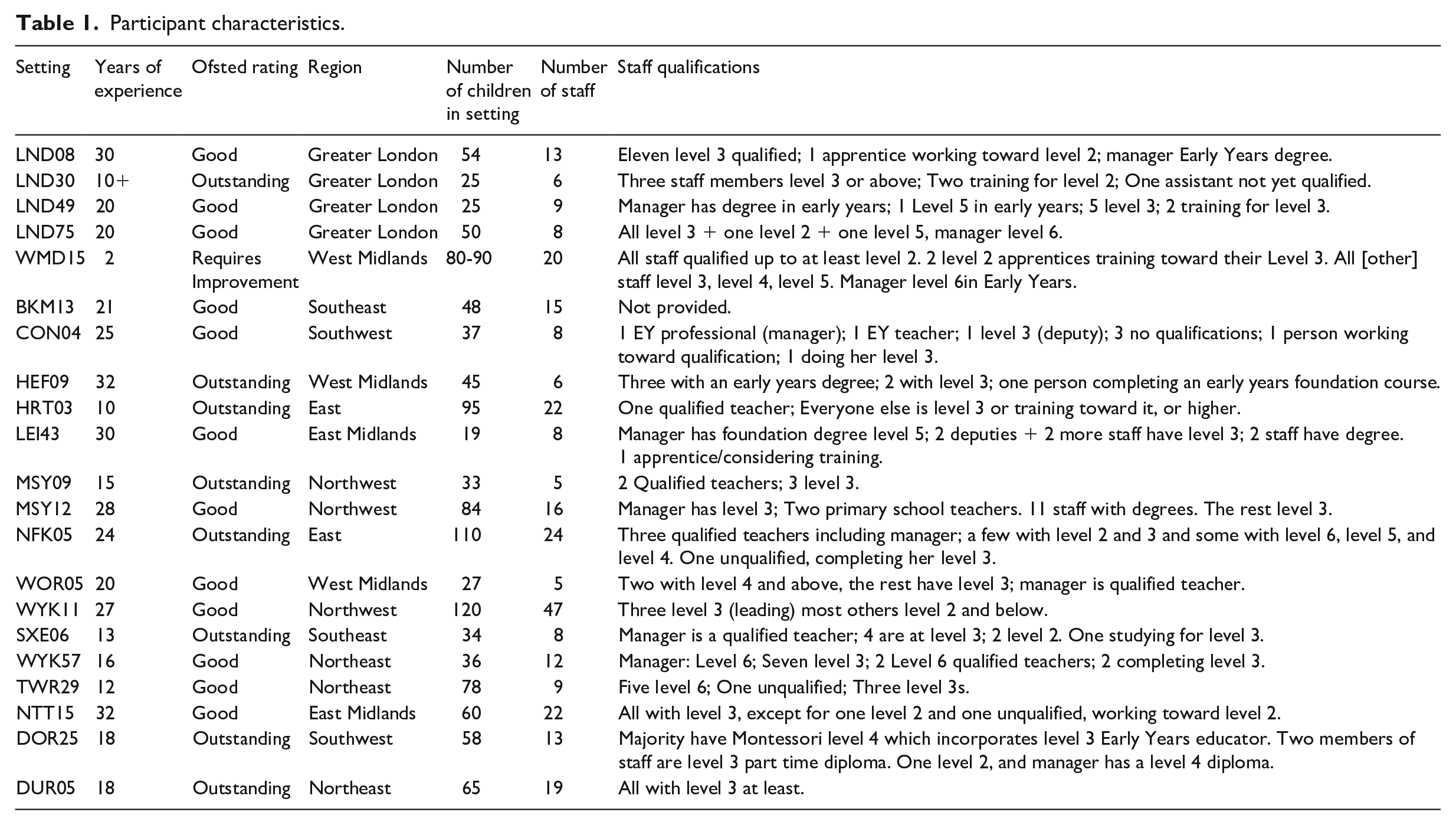
Table 1 shows participant characteristics, including region, Ofsted rating, experience, number of children in setting, staff numbers and qualification level. It is important to note that, in England, staff do not need to be qualified to work in an early years setting. Qualification levels in England are: level 2 for completion of secondary diploma (GCSE), level 3 for A-level qualifications (post-secondary exams), level 4 for higher education certificates (foundation level), level 5 for higher education diplomas, level 6 for degree with honors, level 7 for a masters’ degree and level 8 for a doctorate. Many early years settings use temporary bank staff as needed to comply with required Ofsted ratios, and therefore the number of staff reported here refer to non-bank staff. Ofsted ratios in early years are a minimum of 1:5 for 2-year-olds, 1:3 for under 2-year-olds and 1:8 or 1:13 for 3-year-olds and above, depending on staff qualifications.
Participant characteristics.
Results obtained from the reflexive thematic analysis conducted show three main overarching themes, reflecting the managers’ lived experiences of and opinions on the inspection process: (a) key elements of the learning environment and resources for child development, (b) key organizational aspects, and (c) moving forward.
Each one of these themes contains more specific sub-themes, which in turn congregate the 47 codes used to cluster participants’ quotes, reflexively. Table 2 provides examples of the coding process adopted, exemplified with participants’ quotes.
Illustration of the coding process across themes and sub-themes.
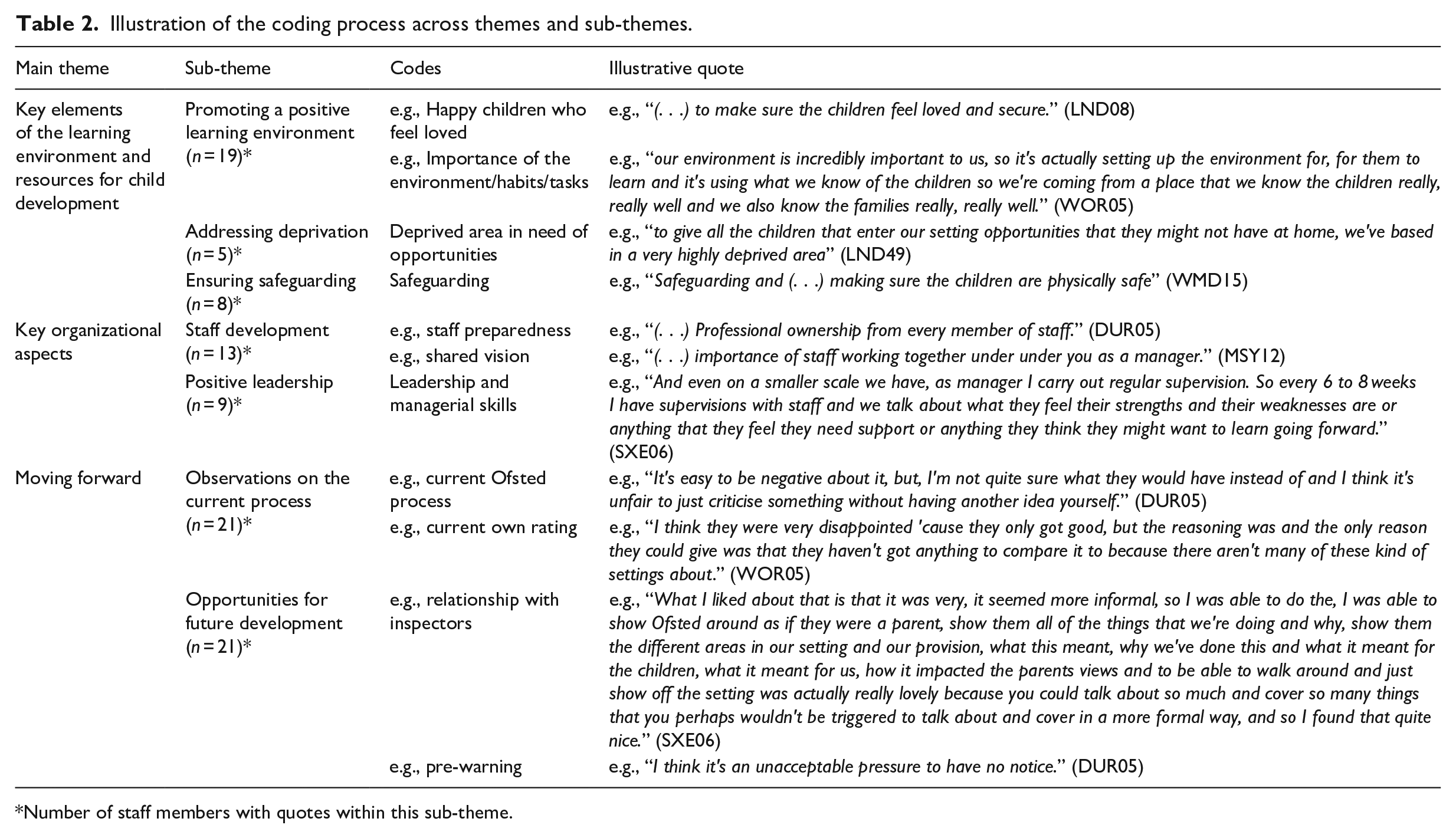
Number of staff members with quotes within this sub-theme.
Key elements of the learning environment and resources for child development
Key elements of the learning environment and main resources for child development were identified by the interviewed managers as: promoting a positive learning environment, addressing deprivation and ensuring safeguarding.
Managers (n = 19) consider that a key element of their vision for a high-quality early childhood education setting is promoting a positive learning environment, referring to various elements that contribute to this. For example, ensuring children are happy, seems to be a priority for many:
My vision is, happiness, comfort, you get you get if the child is happy, you're all perfect. They're well fed, good sleep and, they they feel like home. That's what I, my environment is like their second home. (LND75) The most important thing to us is having a, a quality provision where the children are happy and safe, pretty much. (WYK57) (. . .) but overall that the children have a really lovely time they're engaged or enjoying what they're doing, the learning comes as a result of that. (DUR05)
Linked to promoting a positive learning environment, many managers (n = 5) mentioned the key role played by the setting in ensuring children face as many opportunities as possible to develop and flourish in line with their potential, especially as many come from deprived backgrounds and/or neighborhoods (sub-theme addressing deprivation):
it's about making sure that children within this community, within the community of [place] achieve the best outcomes possible that that they want to achieve and making a difference to their lives, really knowing that we are in an area of high deprivation within [place] and within the country as well, and so it's really about ensuring we open doors for children and give them the skills that they need to achieve whatever they want to achieve, really. (WYK11) (. . .) So for example, some children don't have as great an experience as others, we're a very mixed class, we have some children who are referred to us from their health visitor because (. . .) their family may have a keyworker involvement. (SXE06)
Tightly linked to the above, ensuring that children always feel and are safe, is considered a priority for several managers (safeguarding) (n = 8):
safeguarding here is a, is a massive piece of work for us. Erm, so we have a very high number of children we've got [?] about. I think it's 78% of our cohort we currently have some, some kind of safeguarding concerns about, UM. So yeah, so I think for us safeguarding is really at the front of our minds and it feeds into our environment (NFK05) at our staff meetings our designated safeguarding lead will do quizzes and and updated information, I've just been writing down that there's a (. . .) and a domestic abuse (. .), so I need to look at those so very hot on safeguarding. (LEI43)
Key organizational aspects
The main organizational elements identified by managers as key for effective provision were mainly staff development (n = 13), which all managers mentioned, and positive leadership (n = 9). Specifically, managers mentioned the need for staff to have a shared vision for the setting, to be well trained and prepared and to collaborate effectively:
To have a team that gels and and works well and also what's important to us is having a whole team a feeling of a whole team. So although we've got that separation of little house and big house areas it's one big team and people do swap (. . .), it helps the children, but it also helps each other respect what the other teams do (DOR25) I think my staff are very good, but the ladies that are doing their Level 3 at the moment, I don't think that Level 3 is giving them the underlying knowledge that they need to have an experience, it's giving them a qualification, but it's not given that knowledge and experience. (LND49) Staff, really important (. . .), I don't always look at qualification and look at if they're the right person, because having the right people is the most important thing I think (LEI43) whatever I learn to do, I try that they learn to do as well. All my staff is qualified to to run the almost the the provision without me (MSY09)
Few managers mentioned the key role of their own position as leaders, including taking an active role in the day-to-day tasks needed to run the settings, as well as leading by example:
the way I describe my leadership is that you know I'm quite hands on. I do get involved and like to have the relationship with the families so that you're really aware of any issues and picking things up and also having just like an open-door policy (WYK11) as a leader and modelling those behaviours I think is really important and kind of, you know, walking the talk (NFK05)
Moving forward
Managers expressed several possible ways forward in relation to fairer inspection procedures, by highlighting observations on the current process (n = 21) but also opportunities for future development (n = 21). Views on the current Ofsted process include derogatory observations related to the lack of qualification and/or expertise from some Ofsted inspectors, the short and limited nature of the inspection window, often within 1 day and/or without warning of more than a day, the unnecessary pressure placed on staff and leadership, the evaluative nature of the inspection and the potentially arbitrary nature of the judgments. All managers reflected on some or many of these challenges:
My personal view is you're going to come here one day, I don't think you can see what we do in the whole year, or in the one time in three to four years, and we do so much and it's only judged on one day, I think that is a bit too harsh (LND75) I know we need to be regulated, but I don't think this is the right way. I think testing you, it's like they they cannot really get a good view of what happens in a preschool setting by coming in for three or four hours every five years, they can't. (. . .) and they don't ask the right questions to get the answer to that either. And they don't know about things like how many of our members of staff would drive around to somebody else's house at 8:00 o'clock at night (. . .) to deliver something they don't understand (. . .) (CON04) I think it's completely random about the quality of the inspection. You get totally dependent on the inspector and their views and their attitudes, and if they like the structure that you have in place, then they're positive. (NKF05)
Within observations on the current process, many managers (n = 9) also reflected on positive aspects of the current process:
I do actually work for Ofsted. I do think the new framework is actually a much better reflection of what goes on within settings and the focus is teaching and learning. And that's got to be right. And I move away from thinking about data all the time. (WYK11) I think the current one was still looking at, uh, erm, documents and forms and things like that and and so the the new one is not looking at that that much. I think in, I think the way that they they put it across is not clear in the current one. So if you look into the framework and what Ofsted requires, you don't have to have so much paperwork at all, which is what we already don't have. (MSY09)
All managers shared ideas as opportunities for future development, expressing their understanding of what the inspection process could instead look like. These included a more prolonged inspection visit and/or more frequent visits, continued support, rather than a judgmental narrative, and the need for ongoing supportive relationship with inspectors; some suggested this could be part of the work conducted by Local Authorities, as these have more knowledge of the resources available and needed in each area. Managers also suggested having more ratings between “Good” and “Outstanding,” for more differentiation, the need for an accountability or regulatory system for inspectors who are currently not made to respond directly to a particular body or institution for continuous development and supervision. Lastly, managers suggested the whole process should be more like a supportive discussion with the setting, rather than an evaluation, based on relationships, including with parents, rather than on data. Some examples of these ideas are presented here:
And to rate a setting will be through the parents probably rather than spend time talking with the staff, you should talk with the parents and see you know, are you getting what you want and things like that? And no, no, just based on on one busy day, maybe they just need to collect a specific, uh, things maybe just a a report from a member of staff or report from a parent, or you know something like that where they just say, where they can answer some questions that they that they're looking for or you know if they ask to the staff, it's like when they do a 360 or something like, that when they, staff makes an evaluation of the manager or or things like they could be looking at those things. (MSY09) I think the HMI model was much better before Ofsted kind of became Ofsted, so when I first was inspected, uh, a long time ago we had HMI inspectors come in who had a specialism in that field, and they were accountable for their comments because they had to give advice. (NFK05) I didn't really like it then, but it used to be the Local Authority that inspected you and you had one person and they came in quite often. I think that would be a, a more fair way to do it and a better, a much better sort of all around view of your quality of education. (WYK57)
Discussion
The purpose of this study was to understand what makes a high-quality early education setting from the point of view of practitioners, and how they experience the inspection procedure, including any challenges faced and ideas for what inspections should look like. The study sheds light on potential ways forward, if a change to the Ofsted inspection process was to be undertaken, from the managers’ perspective.
Results from the one-to-one interviews conducted with managers show three main themes, emerging from their narratives: (1) key elements of the learning environment and resources for child development, (2) key organizational aspects and (3) ideas for moving forward.
Between them, managers have relatively similar views of what is considered key to promote learning and development, with the elements of safeguarding, happiness and wellbeing of the children being very central in their narratives, particularly when referring to children from deprived backgrounds. Previous studies on perspectives of early years practitioners on early years pedagogy and quality have shown that qualifications and preparedness of staff have been seen as key to elicit positive outcomes (Brock, 2013). This was also mentioned in the current study as a key element of high-quality provision by early years leaders; managers refer to staff professional development as a key organizational element to ensure high-quality provision. A study by Cottle and Alexandre (2012) showed that practitioners’ understandings of “quality” are influenced by government orientation. This may help interpret the results of the current research, where managers largely reflected on aspects of quality that have been highlighted in policy and guidance, including when referring to the quality of staff and pedagogy.
Managers also referred to being able to provide an environment that elicits wellbeing and learning. Recent research by Forrester et al. (2022) shows that early years practitioners consider that policy in England focuses too much on literacy and numeracy outcomes, leaving little time for staff to engage in elements of “understanding the world” regarded as equally important for child development. This resonates with the views of managers in the current study, who privileged happiness and wellbeing as a key element of high-quality provision. To successfully achieve those elements of high-quality provision for learning and development, managers mentioned the key role played by staff development but also by their own positive leadership. Mistry and Sood (2012) compared the perspectives of inexperienced and experienced early years staff in positions of leadership concluding that most feel the need to develop a better insight into their own practice through observation of various leadership styles in different contexts. Managers in the current study also recognize the importance of supervision and staff development. The issue of supervision has been widely discussed in policy and research; Soni (2019) interviewed early years professionals and concluded that the idea of supervision is very much focused on the managerial function, including safeguarding of children, but there is a recognition of the potential for supervision as a reflective space and as support for staff. This is clearly an area deserving of further research and policy development. A study by Aubrey and colleagues in 2013 showed that early years’ leaders acknowledged the importance of standing back and reflecting on their practice, and the need to increase self-understanding and alternative routes to problem-solving. Despite the relatively outdated nature of that research, the current study suggests that the importance of staff development is still seen as crucial for managers.
When asked about Ofsted and inspection procedures in general, managers recognize the importance of inspections, but seem mostly dissatisfied with the current process. Few managers mentioned the improvements made in the latest changes adopted in the Inspection Framework, including one manager who worked for Ofsted. Indeed, recent tragic events, including the death of Ruth Perry, a headteacher who took her own life after a period of great stress allegedly related to Ofsted inspections, contributed to the changes implemented in the current framework. Inspectors now have a greater concern for wellbeing of all staff and should actively look to speak to other members of staff, rather than the manager only. The move away from focusing almost solely on data, toward a deeper engagement with the teaching process, is generally well received. However, staff refer to elements of the current inspection system as highly challenging, including the pressure and stress that the workforce is put under during inspections, the limited nature of the inspection visits and the lack of support and advice.
Managers provided ideas for a different framework for inspections. An idea shared for many of the interviewed managers is that of a more advisory-oriented inspection, involving various periodic visits and prolonged engagement with a setting, by a specialist in the field who understand the context (e.g. local authority) and the unique challenges of each community. These suggestions are much more aligned with low-stakes advisory-oriented inspection framework as suggested by Simeonova et al. (2020), rather than the current high-stakes sanction-oriented. Such an approach would require a radical change of the inspection system, procedure and policies, but has the potential to integrate elements of supervision and staff development, engagement with parents and the community, aligned with a bioecological approach to child development, which is widely recognized as key for promoting holistic developmental outcomes (Bronfenbrenner and Ceci, 1994; Hayes and Filipović, 2018). Such an approach would address the challenges highlighted in recent literature related to the “datafication” of early years education, including its potential to undermine the very foundations for children’s personal development and learning (Roberts-Holmes and Bradbury, 2016). A bioecological approach to development sees the whole child within a system of relationships and environmental influences dynamically and uniquely interacting to influence development (Bronfenbrenner and Ceci, 1994). A low-stakes advisory approach also has the potential to provide more accurate judgments of the “real” quality of the settings; the standard definition of “quality” traditionally put forward in policy and some research can be contested and, arguably, may be regarded as misaligned with children’s outcomes: for example, Blanden et al. (2017) found that although children’s outcomes are related to the nursery they attend, this cannot be predicted by staff qualifications and Ofsted ratings. Reinforcing this argument, Moss (2016) explains that understanding of quality are necessarily saturated with judgments and pre-conceived ideas, they cannot be value-free, because the context plays a significant role in shaping these definitions. Similarly, Albin-Clark and Archer (2023) explain how this attempt to enforce a definition of “quality” creates an audit culture, with consequences in professional identity. As Moss (2015) posits, there are alternatives to normalization and control, rooted on democracy, emancipation and potentiality; we argue that this approach is well aligned with the view expressed by managers in this study, and compatible with a collaborative low stakes approach to improving the quality of provision.
Recent development in policy around inspections by Ofsted has seen a change in the outcome of inspections: settings are no longer given a one-word rating result, but the final report cards will still reflect those ratings, and the nature of the inspections remains unchanged.
It is important to note that the study does not include children’s centers (nurseries in deprived areas) and maintained nurseries, which have a different funding system. However, the views expressed reflect important trends and needs, from the point of view of settings representing most providers; additionally, other types of settings remain under the same inspectorate, and so it is likely some or many of these reflections will be common to all or most.
In summary, this study provides a current account of the perspectives of managers in non-domestic early years settings regarding Ofsted inspections. Managers refer to children’s safeguarding as a key element of their work, in line with Ofsted guidance, but also highlight the importance of wellbeing and happiness as the most important developmental outcomes. Recent changes in the Ofsted framework move away from a heavy focus on school readiness to a more nuanced understanding of quality, more aligned with managers’ views of the need to promote holistic development. However, inspections are still perceived as sanction-oriented, placing undue pressure on staff, and failing to gauge the real quality of the education and care provided. Instead, managers envision an ideal inspection procedure where advice, support, and prolonged engagement are key elements for success, aligned with a low-stakes advisory oriented framework, as well as with more democratic understandings of “quality” (Moss, 2015).
Footnotes
Declaration of conflicting interests
The authors declared no potential conflicts of interest with respect to the research, authorship, and/or publication of this article.
Funding
The authors disclosed receipt of the following financial support for the research, authorship, and/or publication of this article: This work was supported by the Froebel Trust under Grant number RCH-AP-00154-2019.
