



Abstract
This paper presents findings from our project entitled ‘Diversity in Unity: Developing an anti-racist framework within Froebelian pedagogy’. We apply an ethnography by proxy approach informed by the work of Jones and Okun on colonial and decolonial habits. Drawing from two nursery settings in England and Scotland, we engage with the methodological practice of classification and wonder to propose more open-ended ways of attuning to the complexities of de/coloniality at play. Based on our data, we propose that these frameworks allow deeper engagement with the precursitivities of race/ism and may facilitate practitioner commitments and confidence to pay continuous attention to how play can liberate children from racialised ways of knowing and being known. Our research reveals how children, even in symbolic play, replicate and resist colonial habits such as exclusion, perfectionism and power hoarding. Through the lens of Froebelian pedagogy, which values free play as a space for the authentic expression of ideas, we explore how practitioners can attune to these precursivities of racialisation and exclusion. We argue that by being critically reflective of these often subtle dynamics, practitioners are better equipped to challenge ingrained colonial patterns and support more inclusive, liberatory play environments for children. Our study concludes by reflecting on the challenges and opportunities presented by such an approach, offering a roadmap for educators to engage in sustained anti-racist and decolonial practices in early years settings.
Introduction
This article represents the fourth part of a tetralogy on anti-racism and decolonialism in early childhood education (Tembo and Bateson, 2022, 2024a, 2024b) in which we share insights from our ethnography-by-proxy approach towards nurturing de/colonial habits in Froebelian play pedagogies in England and Scotland. This project sought to consider whether Froebelian environments and practices might offer a unique example of and provide affordances for anti-racist care and education, led by and within children’s play. We also intended to utilise decolonial fields of scholarship to consider how the historically-present characteristics of whiteness continue to shape power relations in children’s play. We open this paper by summarising the previous three articles that have informed the final research stage of this project, following which our methodological section addresses our rationale for ethnography-by-proxy and details our analytical approach. At this stage, we present the findings of this study, including pre-observation reflections from staff, observational vignettes of children’s play and post-observation focus group discussions. Our coda reflects on this process as a whole to consider what new ways of knowing – or otherwise – have been set in motion as a result of this project.
Background to the project
As detailed in Tembo and Bateson (2022), our desire to address the role of anti-racism and decolonialism stemmed in part from an epistemic ‘colour avoidance’ in early childhood education that has frustrated progress on racial inequalities. Despite the plethora of evidence that skin-colour awareness shows up in children as young as 3 months old and then steadily develops to reflect children’s intuitive understanding of the material inequalities between white communities and those of colour (Derman-Sparks and Ramsey, 2011; Quintana and McKown, 2008) there remains a pronounced aversion in culturally ‘white’ societies to seeing young children as racially aware (Gaine, 2005). This aversion is maintained as successive governments perpetuate the myth of equality of opportunity (Lazenby, 2016) while simultaneously being fed by long-habituated protrusions of the Romantic and colonial belief in the ‘innocence’ of young children (Dahlberg et al., 2007).
However, ahead of any inquiry into how such issues might shape interpretations of children’s play, we felt compelled to scrutinise our relationship as Black and ‘white’ authors writing about race. This preparatory work was vital for three reasons: firstly, to mitigate against any abuses of (white) power that might, consciously or not, have been affecting our collaboration; secondly, to clarify our own epistemological and ontological positions and unsettle those individualised ways of knowing which reinforce essentialist racial identities; and thirdly, stemming from this, to acknowledge and liberate in ourselves what is known within the literature about the multiplicitous nature of childhood identity itself, and lean into ‘methodological immaturity’ (Gallacher and Gallagher, 2008) as an ethical praxis. As we signal (Tembo and Bateson, 2022), children enact multiplicities of being and becoming both in their ‘individual’ bodies and as they continuously create, disrupt and adjourn alliances with others.
This initial groundwork established our intentions to address anti-racism in young children’s play. In our second and third papers (Tembo and Bateson, 2024a, 2024b), with the support of the Froebel Trust, we situated our focus within English and Scottish contexts and in relation to the principles of Froebelian pedagogy. We demonstrated that early childhood policy and practice have routinely adopted a ‘nothing to see here’ attitude. This denial is further ingrained today by the stoking of a culture war to distract from economic stresses in which ‘woke’ academics and activists are pitted against ‘normal people’ to polarise and weaponise public opinion (see Tembo and Bateson, 2024a: 4). Where individual settings have taken proactive approaches to race equality – often at risk of castigation – they have typically limited themselves to diversifying picture books, dolls or tokenising non-white cultures through enhanced but isolated engagement with festivities such as Chinese/Lunar New Year or Diwali. The Equalities Act 2010, which defends against discrimination on the grounds of ‘protected characteristics’ and is typically enforced through legal action by individuals against another person or organisation, places a statutory duty on nurseries to act where they see explicit acts of racism against children or families. However, as mentioned above, this likely results in reactive rather than proactive intervention in majority white nurseries and is therefore likely to look past encounters where the affects and effects of race are heavily felt, though left unspoken (Tembo, 2021).
For our own conceptualisation of racialisation, a focus on explicit racism lends itself to ‘closing the stable door after the horse has bolted’. Instead, we are more interested in the precursive habits that enable children’s innate colour awareness to morph into exclusionary and discriminating behaviours. In our third paper, we turned to Jones and Okun’s (2001) characteristics – reconceptualised as habits – of white supremacy culture as signposts for considering how colonial norms (perfectionism, urgency, defensiveness, individualism) might always-already affect children’s play encounters. Absent in application to early childhood education, they allowed us to become attuned to the broader, less visible, cultural habits that continually inform how children relate to each other. Akin to poet and activist Guante (2020), taking seriously the affects of colonialism as ever-present shifts our gaze towards the ocean, not the shark. We term such precursive foretellings play colonialities, signifying the capacities (here, of children) to either exclude or appropriate otherness in order to disempower it, consciously or not. At the same time, we agree with Froebel (in Lilley, 1967) that play, when fully liberated, is rich in expressing children’s inner lives, significations and relational assumptions.
The final section of our literature review worked through the affordances offered by Froebelian pedagogy. As a generative reading, we argued that Froebelian pedagogy’s unique emphasis on free-flow play theoretically provides unrivalled environments in which children’s authentic ideas about the world can surface, unadulterated by didactic learning pathways. Froebel (in Lilley, 1967: 50) himself wrote that ‘wisdom is shown when one educates oneself and others in freedom and self-awareness’. Consequently, children and adults in Froebelian communities have great potential to be, feel, test, reimagine and create diverse ways of becoming and relating – outside of mainstream education’s neoliberal parameters (Mccafferty, 2010; Roberts-Holmes and Moss, 2021) and habits (Jones and Okun, 2001). At their best, practitioners can tune into, guide and affirm these fluidities in ethical resistance to those singular ways of being and knowing which underpin racialisation. When these play habits and facilitative interventions promote the disruption of fixed identities and power relations, we term them play decolonialities. As we have previously argued (Tembo and Bateson, 2024b), Froebelian principles champion practice which is highly observant of the human, post-human, political and ecological entanglements of children’s lives. The fact that, in Scotland, Froebel has now entered the mainstream, while it gains traction on the margins in England, supported our belief that its affordances for anti-racist and de/colonial practice should be brought further into the spotlight and scrutinised.
Methodology
Ethnography by proxy
Ethical approval for this research project was granted by The Froebel Trust. Our research design is informed through ethnography by proxy (Plowman, 2016), which engages practitioners participating in data collection and production. We selected this for four reasons – each of which was concerned with the long-term replicability and integrity of inquiry-based praxis for settings beyond our research sample and timeframe – a key aim of our work.
Practitioners’ in-depth knowledge of children and families
Firstly, we recognise that practitioners have close knowledge of children and families and the nuances of their lives, histories and play in ways that we, outside researchers, do not. This enables more meaningful insight into how verbal and non-verbal play may be developing colonial or decolonial habits that might otherwise be overlooked without the benefit of knowing the children over time. Practitioners are therefore understood as a key part of the child’s assemblage of relations with the capacity to co-facilitate affordances in their being and becoming. Of course, practitioners themselves are situated within wider webs of knowledge, power, and societal structures that affect their perspectives and actions (Webb, 2009). These include institutional policies, dominant pedagogical frameworks and personal experiences that influence how they interpret and support children’s play. Their embeddedness in both the intimate dynamics of the setting and the larger educational and societal contexts positions them as mediators of cultural transmission and transformation. Consequently, practitioners are not neutral observers but active participants in either reproducing or challenging colonial narratives through their everyday interactions, curriculum choices, and relationships with families.
Enhancing observational practice
Secondly, ethnography by proxy allows us (as it would do managers) to understand better how practitioners conceive and relate to these ideas through their own observational practice in everyday contexts. As practitioners are routinely engaged in observational practice within early years settings, they are ideally placed to understand how certain norms and habits are being absorbed and applied in real time.
Recognising practitioners as agents of change
Thirdly, our approach recognises practitioners as experts and agents of change (Elfer et al., 2011; Newman and Woodrow, 2015). Their role here is particularly important when implementing alternate ways of knowing, being and doing. Practitioners are often at the forefront of these initiatives, responsible for integrating anti-racist and decolonial perspectives into pedagogical approaches including interactions with children and engagement with families. As such, their input and involvement in the research process are critical to ensuring that the findings are not only relevant but also actionable in everyday practice. The acknowledgement of practitioners’ expertise reinforces their capacity to lead and sustain such efforts in their settings.
Facilitating community-led anti-racist initiatives
Finally, our approach gives settings agency in how they introduce their commitment to anti-racism with families and communities who have varied experiences, hopes and sensitivities. We recognise that each early years setting has its own unique cultural and social dynamics, and practitioners are best placed to navigate these in a way that resonates with the families they serve.
Necessarily, there are limitations to this approach. Individual practitioners, while aligned to a Froebelian pedagogy, have differing expectations and understandings of children and childhood. We sought to mitigate against this in part through an initial online meeting to introduce the framework, ethics and data procedure. Practitioners asked about how narrowly to use the classifications given in Jones’ and Okun’s framework (see below) and space was deliberately made for debate about their delineations. We emphasised that, rather than seeking uniformity, we viewed different perspectives as generative and valued their diverse voices. There would be no ‘wrong reflections’ within the data, as our post-observation focus group would facilitate further understanding about how practitioners had arrived at their initial conclusions and give scope for further reconsideration.
Participants
We conducted our research with two settings, one in England and one in Scotland, which self-identity as Froebelian. Each setting was selected through an initial general call-out and then finalised through discussion to ensure that they would provide good comparators for the study. One is a small, majority-white, private setting in southern rural England, where three white British practitioners care for 18 children. Here, two staff and 11 children (none of colour) contributed to the research. The other is a medium-sized, state-run city-centre setting in Scotland, where 14 staff from across Europe, Africa and Asia care for 56 children of diverse nationalities, racial groups and ethnicities. Here, five staff (three white, two of colour) and 25 children (17 white, eight of colour) contributed to the research.
Across both settings, we did not focus on ensuring participants were proportionally or equally represented by race, but rather allowed staff and families to self-refer for participation. Our primary focus was on the staff’s capacity for critical, reflexive observation informed by decolonial frameworks and a minimum congruence of Froebelian experience and commitment. This is consistent with an epistemological position (Tembo and Bateson, 2024b), which does not seek to classify perspectives by narrow, colonial categories of race. However, there is no doubt that another study focussing on entanglements between the racial identity of participants and their observations and experiences could make a valuable contribution to the literature. The invitation to participate in both settings went out to all staff and families. We do not have data on why anyone may have chosen not to participate.
Framework and data gathering
Seven practitioners across both settings were invited to conduct observations of children’s everyday play during the nursery day. Before the research, practitioners completed a questionnaire asking about their baseline understanding of Froebelian pedagogy and race within ELC and their own settings. We then met them online as one group to introduce the framework, ethics and data procedures. They were asked not to provide any out-of-the-ordinary stimulus to children. We did not limit researcher-practitioners in terms of their ability to interact with children during their observations as they would during any typical nursery day. However, ultimately all of the observations provided to us were conducted at arms-length. We gave practitioners a full list of Jones and Okun’s ‘white supremacy characteristics and antidotes’ (which we re-term colonialities and decolonialities), as shown in Table 1, but did not go into depth about what they or others might understand by these terms – in order to allow for more open-ended interpretations. We specified that they did not need to code children’s play or feel restricted to these descriptors.
Our rendering of Jones and Okun’s (2001) colonialities and decolonialities, for practitioners.
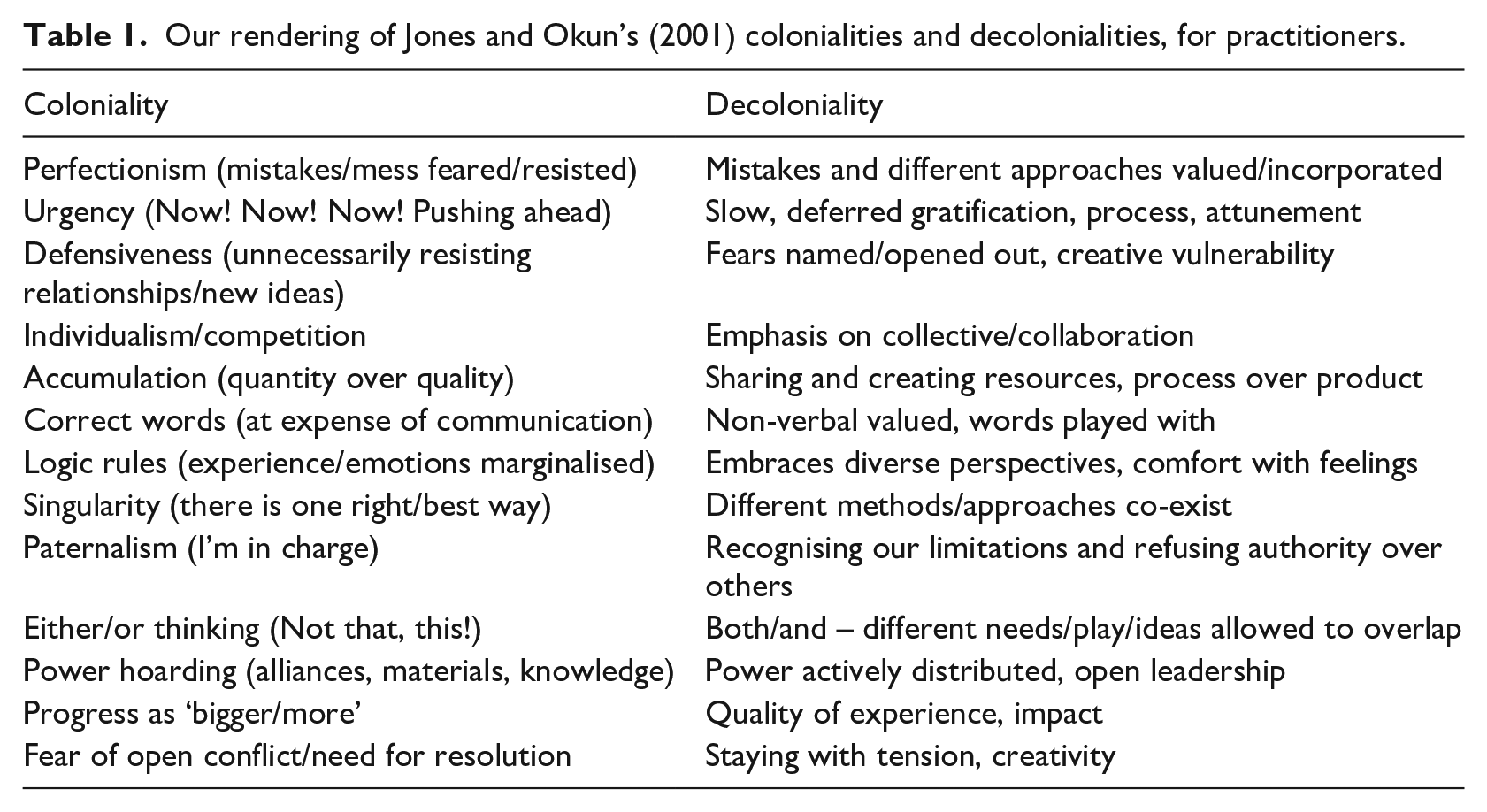
Mindful of accessibility, we considered reducing Jones’ and Okun’s list but decided that this would preclude practitioners’ more positively entangled and complex analyses. We took care to explain that we anticipated both coloniality and decoloniality would likely be present in the play they observed. In offering this framework, our aim was not to narrow practitioners’ focus so much as to provide an opening for reflexivity about the value or otherwise of thinking-with a de/colonial perspective and about the tensions they might experience in the moment of observation.
Twenty-one unstructured observations were conducted over 6 weeks. They typically lasted between 10 and 20 minutes each. Following the observation phase, we spoke to practitioners to learn about their experience of conducting observations, their analysis of what they were seeing, their reflections on their role and responsibilities and whether they now perceived any additional affordances within Froebelian principles that might further support anti-racist and decolonial practice.
Ethical Issues
Practitioners gave informed consent and gained consent from families to participate – and we reminded practitioners of their obligations under local child safeguarding policies and the Equalities Act 2010. We also reinforced the ethics of making children aware that they were writing about their play, and to their duty to respond to signals from children which suggested withdrawal of assent to being observed. In consent forms for families we included the following assurance:
We do not intend to analyse children’s expressions or play choices through negative or scarcity lenses. . . We recognise that we are all on a long-term learning journey of growth and change in relation to racial equality. We hope that this research will provide much to celebrate and build on as well as be (non-judgementally) reflective about.
We also encouraged practitioners to contact us with any queries or discomfort, particularly those related to ethics.
Our focus on coloniality and decoloniality raises inherently complex ethical questions about how adults interpret children’s play and, more broadly, the values and habits that we might wish to cultivate. Homo oeconomicus – the individualistic, competitive subject – remains dominant in educational systems shaped by neoliberal logic, which prioritise ‘(id)entity’ (Davies, 2021) and favour neurotypicality (Manning, 2016). Without doubt, this economic framework, entrenched in early childhood and societal systems (Roberts-Holmes and Moss, 2021), undermines the possibility of nurturing the communal ethics and relational values that a decolonial approach calls for. Ethically, our position is to unsettle and disrupt these colonial influences, advocating instead for approaches that honour children’s existing modalities of being and becoming-otherwise (Bohlmann and Hickey-Moody, 2013; Jones and Duncan, 2013; Stockton, 2009). It is of course crucial that we remain vigilant about the potential risks of this endeavour. However, it is equally important to advocate for other ways of knowing and explore how decolonial practices can be introduced and sustained within the early years of education. We interpret this tension not as a limitation but as an invitation to innovate, critically reflect, and build new paradigms of learning, being and doing that are more just and inclusive. While complex, the research offers an opportunity to co-create knowledge with practitioners, children, and families in ways that may have long-term transformative effects.
Analysis and presentation of data
Aligned with the decolonial commitments informing this project, we approached the analysis phase with a strong ambivalence towards traditional coding practices. Near ubiquitous as an analytic practice, coding involves looking for patterns which relate to the overall focus of study (Saldaña, 2012). MacLure (2013) questions the colonial relationship between the researchers and subjects here, where ‘researchers code; others get coded’. It is further problematic because it places determinate meanings onto data, shoring up knowledge and interpretation as fixed. Maclure asks that researchers hold space for the unresolvable nature of data that cannot be easily classified as ‘this’ or ‘that’. Given that in our previous work we have privileged the liminal nature of identity and self (Tembo and Bateson, 2022), we here seek to overcome determinacy by modelling plurality in interpretation, just as children continuously dissolve and remake worlds within their play. It is also for this reason that we have chosen not to seek additional (let-alone exhaustive) information on each child’s socio-material or other backgrounds. In part this would have been impractical, though we have trusted that pertinent aspects of children’s worlds came through in our dialogue with practitioners. More importantly, however, we want to avoid the temptation to narrowly determine interpretations of children’s play choices by pre-reified racial, class or other determinants. This is not to deny that such factors have influenced the play that was observed, but we do not want to cast a narrow, overly classificatory and biocentric (McKittrick, 2021) light on experiences which, at this age, we wish to figure as largely liminal, fluid and dynamic.
With each of the observations, as shown in the following section, we see children playing through colonial habits in one moment, before shifting towards other ways of being in the next. Our analysis does not intend to fixate on either, but rather hold space for the complexities and movement between both – attuning to what MacLure (2013) describes as classification and wonder. We analyse practitioner-researchers’ feedback through a similar lens, attentive to and welcoming of the movement and uncertainty in their sense-making as they narrate their engagement. Rather than wanting to fix conclusions about practitioners’ perspectives, this enables us, and them, to inhabit Gallacher and Gallagher’s (2008: 512) invitation into methodological immaturity. This liminal way of knowing affords practitioners (as we do children and play) more transformational Deleuzean assemblages of meaning in responsive, dialogical communities of practice (White, 2015).
Interpreting the data
Pre-observation reflections
In their responses to our initial questionnaire, practitioners broadly aligned themselves with commitments to tackle racism. They understood racism in generally comprehensive terms as both othering predominantly non-white people based on skin colour and direct discrimination. When asked what enables racism, participants spoke to a ‘lack of education’, ignorance and unconscious bias, media stereotypes, inherited family attitudes, a zeitgeist culture of ‘acceptance’ rather than genuine interest in difference, and in some individuals a deficit of emotional or psychological capacities (e.g. to empathise with non-white experience). There was very limited mention of systemic inequalities or the intentional marshalling of social/neo-colonial capital against Black and racially minoritised people by white economic or political groups (Bourdieu, 1986).
When asked ‘Do you consider race, racism or anti-racism to be important considerations in your everyday practice with children?’ all agreed that it was in theoretical terms. Fewer than half, however, cited explicit strategies to address this, with those who did speaking generally of ‘modelling’ inclusion and ‘valuing difference’. While unprobed, our close reading of the discourse here is that difference was held to be a characteristic possessed by non-white children and families, rather than universal, though one respondent wrote of their commitment to ‘value and celebrate the lived experiences and cultural heritage of everyone in the community’. This response matters from our standpoint, informed by Derman-Sparks and Ramsey (2011), that in white majority communities it is especially vital to bring difference into the open to disrupt the hidden discourse of a white monoculture. At the same time, practitioners reflected the tension here between whether to positively discriminate in their care of non-white families or to foreground a spirit of universal inclusivity.
A minority of practitioners nominally referred to the UK and Scottish non-statutory guidelines for ELC alongside the Equality Act 2010 as guiding their practice on equalities. Yet these were not cited in ways that suggested deep engagement with or influence by these documents – and indeed our previous writing argues that ELC guidance on anti-racism is at best marginal (Tembo and Bateson, 2024a). Rather it depends, in practitioners’ responses, on personal investment and the individual’s ‘moral compass’ as to whether anti-racism is emphasised. Welcomely, two practitioners, Maria and Devon (both pseudonymised), wrote of their limitations in knowing how or whether to act. Pertinently, Maria said:
This is an area that I am aware requires work, as policies are insufficient unless we reflexively examine our deep-held conceptions, which are moulded through our own experiences. Certainly, for me, I have never experienced adverse treatment or abuse on the basis of my skin colour, so it is hard to claim to understand the impact or importance of anti-racist policy, as I have never needed it. I do, however, acknowledge that simply encouraging acceptance of difference and recognising culturally significant celebrations is not enough. A complete respect for diversity must be practised.
Devon inferred anxiety about being overly interpretative of race as a potential factor in children’s play:
I don’t approach every situation consciously thinking, ‘How is this interaction supporting/challenging racial stereotypes and/or promoting a diverse cultural, racial, gender-inclusive practice’.
Having conducted their research, this anxiety came up more widely in post-observation discussions, as practitioners worried about the dangers of misinterpreting actual children’s play. This concern supports our own readings of the nuances of the observation data, which we will now set out – and shapes the future framework we recommend in our conclusion. Rather than bolstering anxiety, however, we will suggest that this uncertainty is generative.
Vignettes of observed play
In presenting our findings we have chosen to reflect on just two vignettes in depth. This is because they both afford a density of interplay between colonial and decolonial habits and highlight a vital contrast which plays out across our wider analysis of the two settings. They are also indicative of the two sets of observations. Specifically, the urban, multi-racial setting routinely presented observations in which conflict and colonial habits sat close to the surface, while in the rural, majority-white setting harmony and collaboration appear to prevail. However, as we will argue, this potentially masks a more complex and paradoxical picture. All children’s names have been randomly pseudonymised to maintain anonymity. We have maintained the original formats of the observations.
Vignette one
The first encounter occurs between Adrian, Riyan, Darcie and Evan, around role play and construction, and takes place in the first of our settings – a racially diverse, yet still majority white, city-centre setting.
Adrian is making a construction. Riyan [non-white] joins the space ‘It’s the Millenium Falkin [sic]; I am a storm trooper’ says Adrian. ‘Me too’ says Riyan. Darcie is at the sink and comes over to have a look. She places a foot on one of the blocks. Adrian moves towards her with his arm held out. ‘You can’t come in’ and shoots at her with his hands. Riyan says ‘Yeh, only for storm troopers. Let’s make a barricade’. Adrian jumps off and gets a big block and places it upright. Riyan grabs another and puts it aside. Darcie moves around in an attempt to get in at other side. They both shoot at her with hands. ‘It’s not for babies. Get off’ They both block her with their bodies, arms held out. Darcie says ‘No’ and walks around to the front, where there is another gap. ‘The bad guys are coming’ says Riyan. They move to where Darcie is going to make an attempt to climb up. And shoot at Darcie again. Evan enters the room. He says to me (the practitioner) ‘what are you doing?’ I say “just watching. He observes what’s happening for a bit. Adrian is saying to Darcie ‘It’s not for babies, we don’t want you on’. Evan turns to me ‘I don’t think she is a baby. I think she is a toddler. Or maybe a small child’. He watches for a bit longer. Darcie has wandered to the other side of the room. Evan asks, ‘Please can you help me with this block?’. I say, ‘I think you can do it’, and he pulls one out, and it lands with a thud. He places it near where Darcie is standing. She climbs on top. He gets another and places it next to the first block. Darcie steps over. She walks to and fro for a bit and then walks out of the room. Riyan and Adrian run out of the space, saying ‘Let’s go get her’ They are shooting each other and into space. They run into the garden, but Darcie went the other direction.
We read this observation through a fractal lens of competing, entangled habits – less clearly colonial or decolonial with repeated reading. Initially, informed by Jones and Okun’s colonial habits, we pick up on Adrian’s language and body gestures in relation to Darcie (Adrian moves towards her with arm held out. ‘You can’t come in’ and shoots at her with his hands) as an act of power hoarding. Looking back a moment on the timeline, however, it is clear that Adrian is also playing with inclusion here, his on-the-surface exclusion of Darcie marked out by an implicit sharing of power with Riyan. (We note that Riyan actively claims power – ‘Me too’). Adrian then co-opts Riyan into producing a boundary which creates an ‘us’, reified but nonetheless collective, by virtue of rendering Darcie ‘other’ (‘You can’t come in’). It is an act subsequently shored up or symbolically expressed through a hoarding of resources (‘Yeh, only for storm troopers. Let’s make a barricade’).
In so doing and being, Adrian and Riyan seemingly foreclose more fluid assemblages. Yet this is also a case of symbolic play. In shooting at Darcie, she has immediately become more-than her literal self – a figural representation with potential agency in their play story. Paradoxically, then, there is an enveloping of Darcie at the same time as she is excluded. Whether this is incidental, or a further habit of paternalism, or is an offer (albeit in an objectifying form) of genuine inclusion in a high-value game is hard to say definitively. We question whether there is an invitation for Darcie to join in.
Meanwhile Darcie, either understanding herself as integral to the play or refusing the role she has been cast in, attempts her own (second) active claim on it (Darcie moves around in an attempt to get in). Being younger and less verbal, this communication is seemingly not attuned to or simply ignored – but other interpretations are possible. Perhaps Adrian and Riyan welcome this development as a counter-offer in the scenario they have created. The observant practitioner, we hope, would know Darcie well enough and (as this Froebelian participant did) wait long enough to deduce from her body language whether there was, indeed, some equality of play occurring – or just outright (and perhaps habitual) exclusion. What is clear is that to the outside observer or reader this cannot simply be pronounced upon in any superficial manner. Children’s play is too complex. This, and the efficacy of the approach, is well illustrated in the following remarks from a Toni in the post-observation focus group:
I kind of struggled with. . . fitting the habits to what I was seeing, I think that’s why it took me a long time to get going. . . we were having a lot of conversations around it. . . In the end I found I was taking a complete step back, and it’s only now that I can see where these elements are coming from.
It is, perhaps, of still further interest in this observation that Adrian and Riyan choose to bestow the bad guys’ power on themselves by becoming Storm Troopers yet at the same time displace its negative virtue (‘bad’) onto their symbolic enemy, Darcie. Regardless of Darcie’s experience, this is a deft manoeuvre which arguably shows off the vigour and inventiveness of an accumulation habit (children can have it all, and render the things which don’t fit comfortably as ‘externalities’) – but perhaps also their ability to contain ‘both/and’ thinking (I can be X, but also non-X).
What is more apparent, however, is that when Evan arrives the play resorts to a clearly non-symbolic (i.e. literal) exclusion (‘It’s not for babies, we don’t want you on’). Bad guys, we assume, belong in a different semiotic category to babies, signifying a foreclosure of any equal role for Darcie. It is not surprising, then, that Darcie withdraws at this point. It is hard to deduce what prompts this shift, unless we admit that – potentially inclusive or not – there is a colonial refrain ever-present in the underlying habit of Adrian and Riyan’s play here. Having expected Darcie to play ‘by the rules’, Adrian is put out that she persists in trying to actually climb into the construction. She is, in this moment, going beyond the acceptable ‘logic’ (to lean on Jones and Okun again) of Adrian’s symbolic affordance.
Such encounters, we know from experience, might be seen in any nursery where free play occurs without continuous adult intervention. What is notable is the space Evan assumes in this environment to share his own view and provoke thought with disruptive wondering (‘I don’t think she is a baby. I think she is a toddler. Or maybe a small child’). Is this observation made directly to Riyan and Adrian? Is it made in lieu of practitioner intervention – or is it enabled by the practitioner’s holding back – a pillar of Froebelian pedagogy? The practitioner-observer is not neutral here in her rendering of the observation. She interprets Evan’s use of the blocks as a counterfoil to Darcie’ experience with the Stormtroopers, seeing them as an offering – intentional acts of repair. Evan, in seeming contrast to the predominantly colonial habits displayed by Adrian and Riyan, attends to the non-verbal (‘He watches for a bit longer’). He shares resources, considers diverse perspectives and does not seek definitive resolution (he does not e.g. judge Adrian and Riyan’s choices) but rather makes the tensions visible and stays with them. Yet, for her part, Darcie has become disengaged. Perhaps the game has been too excluding, so she leaves the room.
We are left wondering: at what points might a non-researching practitioner step in here? What symbolic offerings or dissonances might have been amplified to help Adrian and Riyan consider their habits without bringing them out of their play? Were Darcie’s contributions ignored, or not? There is an apparent imbalance of power with age, language, gender all in the mix, but also complex envelopments and affordances. What of race? Adrian and Riyan, we know, have darker skin and mixed heritage, while Darcie is white. They are, in this sense, in a minority in the setting and their alliance, in this moment, is possibly empowering for them both. Not knowing for sure, how does this nuance feed into the practitioner’s responsibility to offer space or intervention?
In our follow-up focus group, prior to analysis, the observing practitioner, Jess, reflects on the tension for her, as a Froebelian, in knowing when and whether to step in:
I’m curious, how did you feel about your role. . . it looks like a very pure observation – you didn’t intervene in what was happening. . .
And generally I try not to in my practice, I try and . . . you know, I wonder if I might have stepped in before if I hadn’t tried to record so meticulously what they were saying – might I have posed a wondering question? – but in some ways it was actually quite good not to, and just see how it developed – and I think actually in all the cases there was some kind of resolution, either by the original antagonists or by others.
So it sounds like actually letting things play out revealed stuff that was quite helpful in the relationships?
Not always, you know I think that’s the trouble with colonialism, people don’t always see what they’re doing – it’s so ingrained, unless there’s an intervention then potentially these behaviours will just keep repeating and repeating.
As Jess perceptively considers, the trouble with colonialism centres around its habitual presence within everyday encounters. Whether practitioners should step in requires attunement to the sensibilities of the play encounter – one only gained through a deep understanding of the children that affords them the capacity for resolution while simultaneously remaining attentive to the sedimentation of colonialities that might foreclose other, more equal, ways of being and becoming.
Vignette two
A majority of the observations from the larger, more socially diverse city nursery involved – as above – goodie and baddie play, and our analysis of them echoed similar complexities, contradictions and affordances. By contrast, a majority of the observations from the small, rural setting documented largely harmonious and inclusive play encounters. Doubtless there are differences in practice and environment, but we also postulate a connection between more diverse settings and a greater degree of creative tension experienced on the surface of children’s play. Following Gaine (2005), however, we do not assume that this necessarily leads to a higher degree of sustained disharmony, but rather greater affordances both for tensions becoming entrenched on the one hand and for working them ‘up and out’ on the other. With this theory in mind, we lean now into a contrasting vignette, representational of the near all-white rural setting, in which seemingly harmonious play nonetheless belies a similarly complex picture. Here we meet Calvin, Freya & George playing at making pretend hot chocolate in the garden.
‘I’m playing with Freya and we are having hot chocolate’.
‘So I’m the Nanny’.
Freya walks across the playground to the water butt. She fills up the teapot she is holding with the water from the butt. On her return she tells Calvin, ‘I filled it in. This is the hot chocolate, Nanny. I got the hot chocolate’. Freya pours the ‘chocolate’ into the pan.
Calvin picks up a stick and starts stirring the liquid in the pan. Freya copies his actions. Together they stir the ‘hot chocolate’. ‘Mix, mix, mix’, sings Calvin, ‘I mixing too!’ says Freya.
George, who has been observing from the sidelines, picks up the teapot, goes to the water butt and fills it with water. He returns with a full teapot and pours it into the pan, ‘That’s enough, G’ Freya says to George. The pan is full to the brim with water. ‘I’m sharing’, George says to Freya and Calvin and then he goes back to the water butt to refill the teapot. On his return, hands Freya the teapot, ‘Here you go’. ‘Thanks, G’ (Freya)
This pattern continues for a few more round with Calvin, Freya and George taking it in turns to go to the water butt to refill the teapot and pouring the water into the pan while the remaining two stir the hot chocolate.
At one point Freya suggests they are, ‘Nannies in a café’.
‘You can’t have any! It’s not ready yet’. Freya says to a passing child
‘You need to make it faster!’ Calvin says to Freya and George
All three children start stirring the mixture faster. Calvin starts singing, ‘Mix, mix, mix. . .mix, mix, mix’. Freya and George join in with him.
‘It’s ready!’ exclaims Calvin
Freya pours the liquid into a cup that George is holding, ‘Mmmmmmmmm’. She refills the cup and hands it to Calvin, then she fill[s] a cup for herself. ‘Mmmmmmmmmmmmmmm’ they say together. ‘I like hot chocolate’ (Freya) ‘Me too’ (Calvin)
Freya shouts, ‘Who wants hot chocolate? You can have some now! Hot chocolate, get your hot chocolate here!’ Freya, Calvin hand out cups of hot chocolate while George goes back and forth fetching more water. This interaction lasted for around 10 minutes and was replayed over the next few days whenever we went into the playground.
At a surface level, we see various actively decolonial habits at play here. Power is distributed, the play is unhurried, focussed on process over product, and there is a high degree of non-verbal attunement between the children, over and above narrow significations and ‘worship’ of language (as Jones and Okun describe it). It is a deep, wallowing moment replete with relationality and rich in imagination development.
And yet, against this background, one or two moments of striking colonial habit flash into view. ‘That’s enough’, Freya declares about George’s water collecting (displaying paternalism, in Jones and Okun’s framework). ‘You can’t have any!’ she continues a moment later to another child – who is described as ‘passing’ by the researcher (might they have joined in?). Nonetheless, Freya excludes them as she demonstrates resource-hoarding and plays with perfectionism (‘It’s not ready yet!’). However, these colonial offerings soon evolve into alternatives – the water is to be shared, counters George, and Freya seems to accept this, while in ‘You can have some now!’ we see glimmers both of gifting and paternalism (perhaps two sides of one coin, as in anthropologist Mauss’ (2002) The Gift).
It is apparent, then, that Freya is rehearsing herself, staccato-like, within these tensions. Indeed, we are told that in the following days the children ‘replay’ the scenario several times over. From one perspective, this supports Bruce’s (2017: 13) assertion that ‘[play] enables children to face life, deal with and face situations, work out alternatives, change how things are done’. At the same time, in this setting, or at least in this assemblage, we see George and Calvin either ignore, redirect or placate Freya’s colonial experiments. As a result, the differences in view, control and desire among the children both included and possibly excluded are largely kept in check – bursting out, with Freya as catalyst, but then quickly (too quickly, perhaps) resolving, lost or obscured.
In contrast to our urban setting and first vignette, then (where the practitioner perceives coloniality but doesn’t step in), we wonder if there are more opportunities for practitioners to trouble the play? To bring to the surface that which never quite finds its target – in this case, Freya’s colonial experimentation. Could the adult introduce or signal a greater diversity of resources or imaginative possibilities – disrupting the either/or singularity of the perfect and totemic hot chocolate? Might they productively wonder with children (within the imaginative frame of play) about the roles they are inhabiting (servant, nanny, quality controller), or perceived mistakes (‘Why is the water too full?’)? Could they playfully bring into focus the children’s different values and approaches to the task – or delve further into experiences of hot chocolate itself and the presumably diverse stories behind children’s real-world experiences of it? This reading is echoed by Derman-Sparks and Ramsey (2011: 62), who argue that practitioners everywhere, but especially in white majority settings, have a duty to:
Develop authentic identities based on personal interests, family history, culture and [children’s] interconnections, rather than on White superiority [i.e. the presumed commonality and normativity of experience]. . . Overemphasising the differences between groups and, conversely, ignoring the differences within groups, is one way that racism polarises people.
At the same time, these and other writers give limited credit to the affordances of playfulness, the working out, the fluidity which children are often already engaged in – between the colonial and decolonial. The adult rush to repair may obscure a plasticity which, given due attention, space and responsiveness – as Froebelian thinking attempts to do – has the potential to afford both children and the adults alongside them vital ways to reconfigure power, identity and ultimately race. In both play vignettes we have presented here, and the many others shared with us by researching practitioners, it is clear that children are alive with questions about these things. Froebel (in Lilley, 1967: 51) writes:
The child who gives the appearance of being good is often not intrinsically good, that is, does not want what is good of his (sic) own choice or out of love or respect for it. [Conversely] the child who seems rude of self-willed is often involved in an intense struggle to realise the good by his (sic) own effort.
In so arguing, Froebel asks practitioners to do away with judging children like Freya or Adrian as either right or wrong, good or bad, developmentally healthy or unhealthy. Instead he figures childhood as continuously replete with potential for all manner of actualisation, wherever children – and perhaps adults too – are supported to play deeply and attentively.
In our follow-up focus group, the practitioner in this rural setting, Caroline, gives voice to the tensions we observe in the data. They initially reflect that ‘the children were very capable of resolving this without me’ but moments later they add:
For this child, if they continue life with these attitudes, where is it going to go? So I do need to challenge that. . . I could foresee that they could very easily in a different situation exclude somebody because of the colour or their skin, or because of their difference.
She concludes by musing on the double-edged nature of Froebelian practice in this context:
One of the things we’ve struggled with is the Froebelian principle of taking children where they’re at, their lived experience, when it’s in quite a sphere of white British middle class. . . We can’t just allow things to happen, we do need to provide experiences. . . but we don’t want to offer something that’s tokenistic.
This perceived tension betrays, perhaps, a common Froebelian anxiety and, we would argue, misapplication of Froebel’s theories. Froebel cautions that ‘It is only if this threefold form of its expression – unity, individuality, diversity – is recognised that the essential character of anything can be completely known’ (in Lilley, 1967: 59). Children, as we have seen, are very commonly able to actualise unity, individuality and diversity, and to move between them adeptly and playfully. However, to re-cognise and master these interrelationships (I, we, other) requires triangulation: an external hand or eye. Froebel continues:
It is of course easier for [children] to have an answer given by someone else but it is far more valuable and stimulating for them to find it out for themselves. . . [so] we should rather put them in the way of finding answers. . . (Lilley, 1967: 126)
Putting children in the way of finding answers does not require practitioners to have the answers. It exudes trust and freedom, and Froebel clearly invites practitioners to wonder with children, to follow and evince how we can be transformed by their vital ways of being and knowing. It does, however, ask adults to hold on to a sense of that higher unity, sensing when to hold back, affirm or disrupt in ways that continually make space for the question of how we integrate – play, fully.
Coda
Are there new opportunities for everyday practice springing from this?
. . .Just being part of this project has opened up lots of conversations where we’re looking more in depth at our practice – not only how are we teaching children about diversity and inclusion, but are we challenging them. . . like the child who feels it’s got to be their way, to say ‘Your voice is important but so is this person’s. . . everyone’s voice should have an equal footing. . .’.
In this paper we have sought to model a way of knowing that goes beyond skin-deep accounts of how racism shows up in early childhood. As the reflection from Naomi above speaks to, the production of a framework that would better enable us to grasp the sea in which we swim might offer a productive line of flight, a raft, from which to make sense of things. Viewed through Jones and Okun’s habits, these observational vignettes offer glimpses into children’s lives in ways that reveal the complexities of play – full of indeterminacy and complexity – while remaining ethically situated. Our intention in this project has never been to impose causality between children’s play and colonial habits, nor have we sought to establish the ‘good’ or ‘bad’, but, with Stewart (2007: 11), we have promoted attunement to encounters that are ‘always, first, both powerful and mixed’. Didactic interventions do not welcome such complexity, but dialogical ones do. We remain mindful that privileging not-knowing in this way can breed anxiety, yet we hope it may offer fertile ground for thinking-otherwise.
For practical reasons our study is limited in scope. We anticipate that future research might build on this inquiry and offer further insights. In terms of implications for practice, firstly, this body of work enables a deeper engagement with the precursitivities of race – an avenue of inquiry that we previously identified as in need of wider engagement. As a complement to, rather than in competition with, the existing body of scholarship attentive to explicit acts of racial discrimination, this work offers an avenue into the cultural habits that underpin and may disrupt sedimentations of power in children’s play encounters. Secondly, we have demonstrated the value of Jones’ and Okun’s framework, a model that could be used with consistency across different nursery settings – Froebelian or otherwise. Our hope is that such a framework will enable a pedagogical commitment and confidence among practitioners – ideally in open partnership with families – to pay continuous attention to the ways that play can ultimately liberate children from racialised ways of knowing and being known.
Our arms-length approach (both in this study and as we envisage our subsequent resources will be used) is not without ethical tensions. It asks settings to not only be willing to be unsettled but also to be on the front line in the current culture wars by naming their commitment to exploring issues that remain portrayed as divisive. Conversely, where future participating settings may prioritise harmony (or its edifices) for community or financial stability, we risk subtle accommodations of the resistance to seeing children as racialised. We weigh such risks, however, against the implications of not doing this work – for stasis in the face of racism only maintains the status quo. Ultimately, we believe that crafting more decolonial habits of being in the world is an affirmative gesture made in the name of solidarity and subversion against the long history of racism.
Footnotes
Acknowledgements
We thank the Froebel Trust for their support in awarding us this research grant to pursue this work.
Funding
The authors disclosed receipt of the following financial support for the research, authorship, and/or publication of this article: This project is funded by The Froebel Trust (grant number RCH-AP-00265-2021-G), a company limited by guarantee (company number 7862112) and a charity registered with the Charity Commission of England and Wales (charity number 1145128) whose registered office is at Clarence Lodge, Clarence Lane, Roehampton, London SW15 5JW
