




Abstract
Internationally, there is a growing interest in both intergenerational practice and outdoor learning opportunities such as those provided in Forest School settings. This participatory action research project, planned by a university researcher and early years educators working together as co-researchers, set out to investigate intergenerational practice in an urban outdoor environment with children aged under 5 years, and older adults. The focus was upon interactions, knowledge exchange and benefits. Data from forest diaries, interviews and observations was analysed thematically, resulting in the development of four main themes relating to different forms of participation and their value for those involved: affective participation, collaborative participation, learning through intergenerational participation and challenging participation. This study contributes to the body of knowledge that highlights the value of intergenerational activity and suggests that opportunities should be sought to involve older adults in the lives of young children within early childhood education, particularly within informal outdoor places such as Forest School.
Keywords
Introduction
Intergenerational practice
Intergenerational practice involves bringing members of different generations together to engage in formal or informal activities and aims to promote relationship building for the benefit of all age groups (Dutton, 2018; Jarrott et al., 2021). Elements of intergenerational practice have been evident for decades (Generations Working Together, 2019). For example, interventions emerged in America during the 1960s to tackle social and demographic issues (Rosebrook, 2002), and the practice permeates curricula such as Te Whariki in New Zealand (Nicholls, 2004). Furthermore, charitable organisations such as The Beth Johnson Foundation (2022) and Ready Generations in England (2024), Generations United (2024) in America and Generations Working Together (2019) in Scotland have been established to promote intergenerational activity. Yet, research is lacking, particularly in England (Lyndon and Moss, 2023).
Intergenerational practice, sometimes referred to as intergenerational programmes or interventions, is becoming increasingly more common globally. This practice can involve members of different generations of the same family learning together (familial practice) or members of different generations of unrelated people coming together (non-familial practice). The present study is an example of non-familial intergenerational activity.
Many intergenerational programmes have focused upon mental health benefits for older adults (Hernandez and Gonzalez, 2008; Murayama et al., 2015; Park, 2015), including for those with depression or in care homes, to address social isolation and to reduce stereotypical assumptions of various age groups. In children, intergenerational activities seem to promote improved behavioural self-regulation and greater social acceptance (Femia et al., 2008). Additional benefits of non-familial intergenerational activities include improved attitudes of young children towards older adults, enjoyment, improved social well-being, meaningful engagement and transmission of knowledge amongst generations (Gualano et al., 2018; Park, 2015; Skropeta et al., 2014). While research exists which indicates the benefits experienced by both young children and older adults, much of the evidence base focuses primarily on the experiences of older adults, possibly because much of this work began in the field of gerontology (Canedo-Garcia et al., 2017), rather than education.
Given that attachment to adults who are not the child’s parents can help facilitate resilience in children (Catalano et al., 2004), intergenerational practice could provide opportunities to support child development. Additionally, Vygotskian theory suggests that children’s learning is enhanced through interactions with a more knowledgeable other; however, the direction of the interaction does not matter (Tudge and Winterhoff, 1993), suggesting that interactions may inspire learning across generations, including where adults may learn from a knowledgeable child.
Challenges can arise when engaging in intergenerational practice, including tensions between modern and traditional values or learned practice. For example, use and understandings of terminology evolve over time and between generations leading to potential tensions and misunderstandings (Strom and Strom, 2015). Similarly, the life skills and experiences of different generations have the potential to contribute to tensions. In an Early Years context, issues such as safeguarding, and the associated policies and procedures, may be unfamiliar to older generations or different to their own experience. Similarly, teaching approaches have changed significantly over time. Although this can cause some discomfort and resistance (Rodd, 2006) as change can be unwelcome, adults working together in a supportive environment may benefit from experiencing and learning from such conflicts given that discussing practice can challenge thinking and promote ideas.
The earliest intergenerational intervention programmes involved sedentary activities with the elderly in care homes, such as sharing experiences or storytelling (Gigliotti et al., 2005), possibly reflecting general cultural expectations about the age and physical ability of the older adult participants in those interventions and as well as ease of arranging an activity in limited space. However, as the road to intergenerational activity and learning widens (Mannion, 2016) and warnings about sedentary behaviour being a hazard to health are prevalent (World Health Organisation, 2016), focus on intergenerational activity has shifted toward diverse activity, including more physical alternatives. Despite this, evidence-based research among community-dwelling older adults is needed (Peters et al., 2021) and examples are yet to be studied within the Forest School environment.
Nature-based/outdoor learning and Forest School
Nature-based learning practices are often incorporated into Early Years settings because of well-established associations with improved wellbeing, opportunities for play, increased creativity and social development (Johnstone et al., 2022). Indeed, children have had outdoor learning at the heart of their education and care since Froebelian times, and early education continues to be inspired by Froebelian principles today (Alcock et al., 2018).
Nature-based learning encompasses a range of techniques and educational philosophies and refers to learning which takes place through nature-based or nature-incorporating activity (Jordan and Chawla, 2019). Some nature-based practices are more child-led and holistic in focus than others.
Forest School is a form of nature-based learning that typically follows six principles: takes place repeatedly over a prolonged period of time; takes place in a natural space like a woodland; is intended to be child-centred; enables children to take properly assessed and supported risks; promotes holistic development; and is run by qualified practitioners. Beyond simply facilitating learning, Forest School practitioners aim to support children as they develop emotionally and socially (Forest School Association, n.d.). FS activities also offer children opportunities to develop physically (Dabaja, 2022) and to develop social and cooperative skills by working together and showing mutual empathy (Coates and Pimlott-Wilson, 2019).
Forest Schools can take many different forms depending on the geographic location, the age of the participants and the practitioner’s specific approach. Often, Forest School sessions start and end with a meeting around the fire circle (or equivalent gathering space), and time in between is freely available to participants to choose the activities in which they would like to engage. Some children opt not to engage in activities at all and instead use the time to quietly relax or socialise with others. During a Forest School session, the role of the practitioner(s) ensures the safety of participants and builds trusting relationships with the learners and the environment.
While nature-based intergenerational activities are common, they are under-researched. Some studies have considered benefits of intergenerational gardening practices (Jakubec et al., 2021; Mayer-Smith and Peterat, 2016; Sobko and Chawla, 2020) and family nature clubs (D’Amore, 2016), while beach schools, another placed-based education approach, are becoming a popular way to engage different generations, though research is sparse.
To the best of our knowledge, this article is the first exploration of the reciprocal benefits of participation in intergenerational Forest School practice and offers new insights into the perspectives of practitioners as co-researchers, and of children, in development of findings.
Methods
Participatory action research
Participatory action research (Chevalier and Buckles, 2019) involves researchers and practitioners working alongside each other as co-researchers, disrupting the power dynamics typical in most forms of research.
This participatory action research project hinged upon co-production with pre-school practitioners. All practitioners were involved in various stages of the research from co-production of the questions to data analysis and interpretation during Research Circle work (Persson, 2009). Only one practitioner chose to be named in this paper. A separate practitioner article was co-produced outlining the participatory ways of working (Heslop and Gregory, 2021).
The pre-school setting that served as the site for this research is a non-profit cooperative based in a city in the north of England, providing for children aged from 6 months to 5 years. The setting’s ethos encourages children and practitioners to participate in decisions that affect them, mirroring the ethos of participatory research. Practitioners in this setting had been taking young children into a woodland site for Forest School for over a year prior to this study.
Six Early Years practitioners from this setting served as co-researchers and were involved in the research design, data collection and analysis to varying degrees, Table 1 gives details about the qualifications and experience of these practitioners.
Co-researcher information.
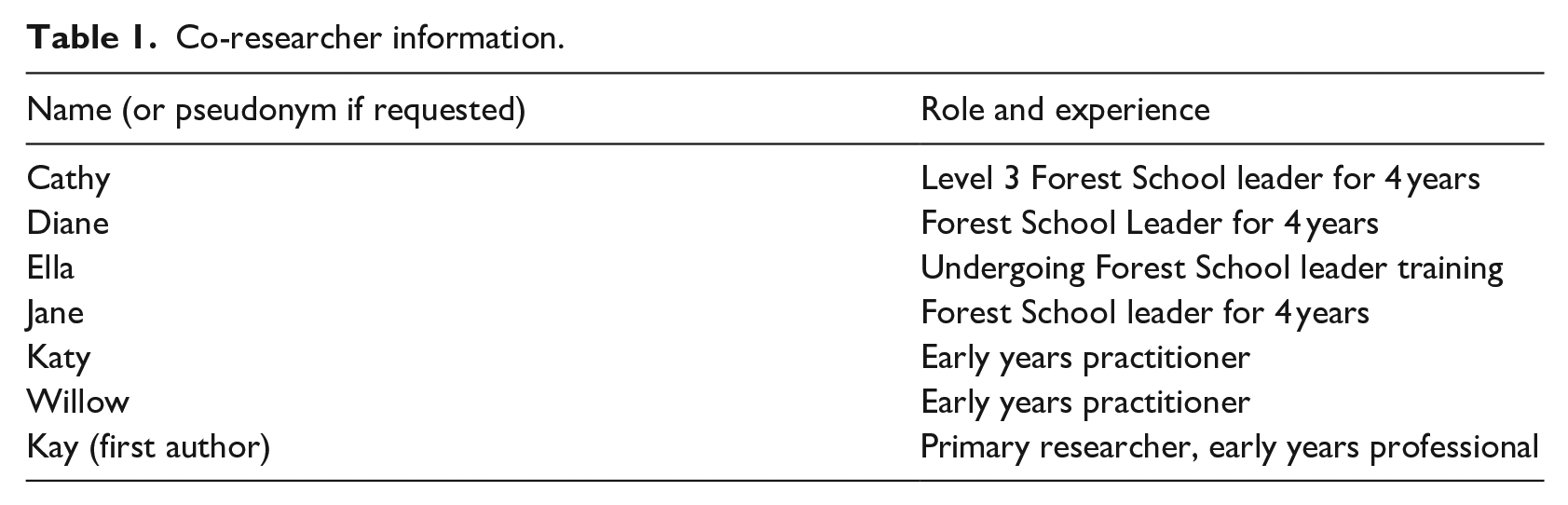
The Forest School activities took place in an off-site, public woodland reached by a short mini-bus drive from the pre-school. The children attended Forest School 1 day each week. Each of the co-researchers was required to carry out their usual role within the woods, which included planning, caring for the children and observing during the sessions. Sessions began with reflection on the previous week’s learning and decision making after which time the group proceeded to their favoured location where the children led the learning depending upon their own interests.
The six practitioners, along with Kay, met in research circles (Persson, 2009) alongside this activity, which created a safe space where relationships could be formed, ethical considerations discussed, research planned and data analysed. The children contributed by sharing ideas for weekly activity plans.
Participants
In addition to practitioners, participants included 12 young children (age range: 3 years 8 months – 4 years; see Table 2) and two older adult volunteers (Emily, aged 70, and Isobel, aged 75, pseudonyms). Emily was a retired primary school teacher. She became aware of the research because her grandchild attended the setting, but her grandchild was not involved in the study. Isobel was a retired health visitor and was known to one of the setting’s practitioners. No additional requirements were asked of children outside of everyday activity.
Child information.
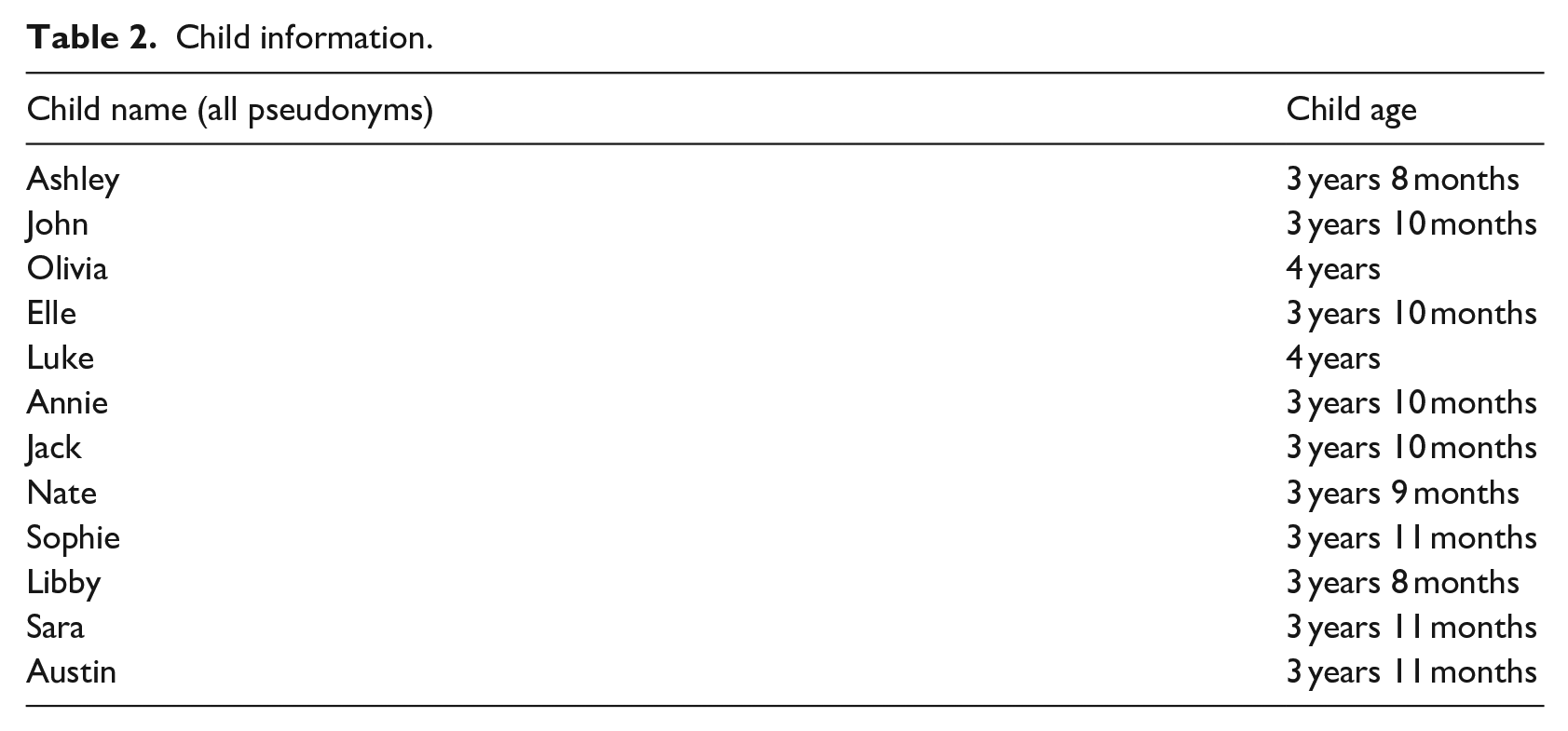
The recruitment process for older adult volunteers involved an application for the post (to ensure suitability for the role), completion of a medical form (for safeguarding and information sharing in the field) and an initial interview. They were invited to participate in research circles to analyse data, but they both declined.
Data collection
Data were primarily collected across a 6-week phase of fieldwork. The same children and older adults went to Forest School 1 day per week across this period with three practitioners. The practitioners (also known as co-researchers for this study) were known to the children, as they were their standard pre-school practitioners. Participant observation took place while at the Forest School site, and additional research activities, including research circles and floorbooks, were used alongside the fieldwork. Interviews were conducted with the older adult volunteers before and after the fieldwork phase. These data collection activities are described in depth below.
Research circles
Research circles were held monthly during the 18-months of the project except for during the 6-week fieldwork phase when they were held weekly to allow for timely discussion. Each research circle had a flexible agenda, determined by participants. Co-researchers shared progress to date, discussed observations using photographs as prompts, and discussed the children’s floorbooks. The research circles following the fieldwork sessions were electronically recorded and transcribed, and other research circles were minuted; these notes were incorporated into the data that were analysed (Munn-Giddings, 2012). Co-researchers maintained a personal reflective diary, which informed discussion during the research circles.
Participant observation
Kay and the co-researchers served as participant observers; as trained Early Years practitioners, they were used to recording evaluative observations. Where possible, these were contemporaneous notes made in diaries, although some were written up soon afterwards, as advised by Cohen et al. (2011), given that memory fades. Photographs were taken to support observations, and some videos were recorded of interactions which informed research circle discussions.
Floorbooks
After Forest School, once back in the pre-school setting, the children recorded their memories, thoughts and stories from the session with their practitioners, in floorbooks. Floorbooks, developed by Warden (2015), link well to the visual methodologies of Anthamatten et al. (2012) and the Mosaic Approach (Clark and Moss, 2011) which aim to understand and listen to the views of children and determine what is important or troubling to them. The use of visual methodologies, those employing photographs and recordings (Mitchell, 2011), had been considered at the outset of the project. Research Circles were used as a forum for exploring this data. One reason for this is that some parents were happy for the photographs and recordings to be used in the Research Circle, and in pre-school, but not for them to be shared with a wider audience. Practitioners/co-researchers were able to discuss the observations in the Circle, thus ensuring anonymity for those families, and only permitted relevant photographs were then used to illustrate findings, so respecting everyone’s views.
Interviews
Kay and Diane (co-researcher) conducted interviews with the older adult volunteers before the start of the fieldwork phase to ascertain their motivation for taking part in the project and to offer an opportunity to ask questions. Semi-structured interviews were also conducted after the fieldwork phase. With consent, these interviews were recorded and transcribed. The older adult volunteers accepted an offer to keep a paper-based reflective diary from the start of the project, and the diaries became an aide memoir for later interviews.
Ethics
Ethical approval was obtained from Sheffield University (number 004007). All adults involved, including the older adult volunteers, had Disclosure and Barring Service (DBS) checks in place. Such criminal background checks are used in England, Wales and Northern Ireland to help employers to recruit more safely by identifying individuals who are not supposed to be around children. The pre-school setting also created an updated volunteer policy and risk assessment for the research. Parents were given information sheets and asked to complete consent forms on behalf of their children. Children were included throughout, from learning about research, to giving assent to their drawings being used for dissemination purposes (Dockett et al., 2013). Respecting Articles 3 and 12 of the United Nations Convention on the Rights of the Child (BERA, 2024), practitioners observed the children and checked regularly with them to ensure they were still happy to participate.
Children whose parents did not consent to their participation in the study, and those who chose to opt out of sharing their drawings or vignettes, were not excluded from any activities as a result. All photographs and videos used in the research were taken using the pre-school cameras and stored at the pre-school. The pre-school’s policies and procedures were followed, for example in relation to safeguarding.
Data analysis
Data sources included field notes from observations, transcriptions of the research circles during the fieldwork phase, floorbook entries, notes from the co-researchers, and transcripts from interviews with the older adults. Analysis occurred in two stages. First, Kay and co-researchers worked together during research circles to engage in collaborative sense-making, ensuring that observations made were interpreted accurately from different perspectives in relation to answering the research questions. All researchers wrote memos of initial ideas from these early conversations (Silverman, 2014). These ideas informed the initial list of codes which became relevant in the second phase of analysis.
Thematic analysis of the data sources was conducted by Kay and one co-researcher, Diane, and subsequently shared with members of the research team for clarification (Bazeley, 2013). Each data source was systematically revisited in turn and key words and phrases relevant to the research questions were highlighted with coloured pens in open coding. These codes were arranged into candidate themes in an inductive approach (Burnard et al., 2008) where codes were developed from the data rather than pre-existing theory. Candidate themes were discussed and refined amongst co-researchers, and the final four themes were agreed and written up.
This participatory action research project sought to answer the following research questions: What is the impact of engagement between older adults and young children in an urban Forest School environment? What are the benefits of integrating different generations within an urban Forest School environment (for adults and children)?
Findings
Theme 1 – affective participation
This theme captures how Forest School was an informal, unhurried outdoor context that allowed motivated older adults and young children to come together in a calm environment, which was mutually beneficial to all. Prior to the fieldwork phase, the children expressed no concerns (although as educators, the research team were aware that concerns could have emerged) and offered supportive suggestions about preparing the older adults for the research and keeping them safe. The co-researchers had some initial fears, wondering how, or if, engagement would happen. The older adult volunteers, meanwhile, seemed to share in the same excitement the children felt:
. . .this is the ideal opportunity. . .I’m quite enthusiastic about things. . .it’s an opportunity to play and to explore with children outside. . .without having the ultimate responsibility (but you do still feel responsible). (Emily, pre-fieldwork interview)
Intergenerational activity occurs in a ‘place’ (Mannion et al., 2010: 8), and this place, the Forest School, enthused both volunteers. They were intrigued by the novelty of the situation and were willing to share their time and skills. Despite this enthusiasm, both participants also had concerns. Isobel shared that, ‘I can’t walk as far as I could at one time. I’m a bit more restricted. . . but it’ll be fine. . . I love the outdoors’. However, it cannot be assumed that all older adults would have the same motivation to overcome potential challenges. Isobel was excited to get involved but said she had faced some opposition from friends who ‘thought I was crackers going in the forest for 6 weeks’, suggesting that the older population is not homogenous in their dispositions and experiences just as children are not (James and Prout, 2015).
The children engaged with the older adults quickly, which surprised the co-researchers as they expected the children to be more hesitant. Cathy said, ‘the first thing that struck me is that the children just seemed to integrate’, and Willow agreed, saying ‘it was interesting that [the children] don’t see [the older adults] as any different to us, and [are] still going to them for support and guidance’.
Throughout the 6 weeks of fieldwork, co-researchers recorded many emotions experienced by the young children, including distress, happiness and determination. The following vignette details the negotiation of difficult emotions between an older adult volunteer and a young child, demonstrating how the older adult supported the child to problem solve:
Jack quietly continued to create the spider house independently. Then disaster struck. Someone accidentally stood on the structure and Jack’s tears flowed. Needing reassurance, Jack looked towards Isobel for support. Isobel calmly acknowledged his upset and suggested they could rebuild it, saying ‘do you want me to help you?’ Jack nodded. . . paused. . . the tears stopped. . . and Isobel sat alongside Jack as he calmly reconstructed it. ‘But’, said Isobel, ‘could this happen again? What could we do to prevent it happening again?’ Jack suggested writing ‘a flag to tell people what it is and keep off’. He drew a ‘spider’ on his flag. On completion, Jack smiled, and looked pleased by his achievement. Co-researcher Jane reflected upon this incident stating ‘I was really proud of him today. . . making progress’.
This scenario might suggest that both the older adult and the materials available to Jack affected his actions and subsequent satisfaction and suggests that sociomaterial approaches (Fenwick, 2015) are relevant with the merging of human influence and non-human objects and places.
Once the older adults were introduced to the Forest School, the practitioner co-researchers noticed an overall feeling of ‘calm’ and a lack of hurry developing in the group, which influenced activity. Diane stated, ‘I can’t quite explain it but there was a sense of calm and tranquillity brought to the group by [the older adults’] involvement’. Emily spoke about the fact that she could take her time during everyday activity, something which she attributed to getting older. She argued that, in comparison, ‘young parents (or teachers) always need to rush’ given their many other responsibilities.
Emily reported that she felt ‘totally relaxed’ and ‘more patient’ with the children, partly because she knew that she did not have ultimate responsibility for them. Fisher (2016) argued that successful interactions between adults and children take place when they are in a relaxed environment where there is no agenda to follow; this idea is echoed in Clark’s (2022) slow pedagogies. So, with extra-interested adults to connect with the children, and the freedom of the natural environment (James et al. 2016; World Health Organisation, 2016), children had more opportunities to interact with others and learn in an unhurried way. This inter-relationship between environment and perspective from the older adults has potential implications for practice, as when older adults work alongside young children in this way, it affords the practitioners time to observe, reflect and see their children through the eyes of others.
Theme 2 – collaborative participation
This theme encompasses that when older adults and young children collaborate in varying ways over a prolonged period of time, in a calm, non-formal, urban forest school environment, respectful, trusting relationships can develop.
Trust seemed to be key for reciprocity. Observations from Kay and the co-researchers, together with the reflections of children and older adults, shed light on the varied nature of the interactions and how the frequency and quality of the interactions developed over the 6-week period of the research. In turn, firm bonds formed between the children and older adults. For instance, evidence of collaboration and relationship building occurred between Jack and Isobel, who Jack took a strong liking to:
Jack handed Isobel a large stick-like branch saying, ‘hold my tree please’. Despite co-researcher Jane reflecting ‘I can’t believe that Jack gave his tree to someone else’, Isobel did as instructed, standing patiently for over ten minutes in the same spot. When reminded about Isobel by co-researcher Diane, Jack returned to her, saying ‘thank you for holding my tree’. Co-researcher Jane reported that Jack giving Isobel his stick was a ‘massive deal. . . he must really trust her ‘cos it’s so not like him’.
On another day, when Isobel was busy with other children, Jack interacted with Emily. Ella, one of the co-researchers, overheard Jack saying to Emily, ‘I want to go to the Bat Den. . .come on Emily, are you coming?’ To which Emily replied, ‘I’ll come with you. . .come on’ as they ran off together.
Co-researcher Jane indicated that the interest and trust shown by Jack towards Isobel and Emily was unusual for him, as he did not usually ‘bother with new people’. Instead, Jack demonstrated an immediate connection with Isobel and Emily, which the co-researchers attributed to his own positive experiences with his grandma. It’s possible that Jack’s immediate and growing trust of the older adults could be explained by research which suggests that 4-year-olds do not fully understand the requirements for trusting someone, but that they could identify traits from others’ past behaviours (Vanderbilt et al., 2011). This aligns with the co-researchers’ view that Jack’s positive experiences with his grandma contributed to his rapid relationship and trust with Isobel and Emily. If the trust was there, as he knew he could rely upon his grandma, then this could have contributed to him greeting and interacting with the new older adults so eagerly.
As the interactions between the children and the older adults increased, so did the bonds. By Week 4 there was spontaneous hand-holding and informal pet names given to adults by some children. For example, Elle called out, ‘let’s go Emmy’, to Emily as she urged her to join in an activity. By Week 6, boundaries were starting to be pushed during play because of growing familiarity. An example of this occurred when children climbed onto Emily as she pretended to sleep at lunchtime and Emily remarked that she felt ‘a full member of the team’. Consistent with Fisher’s (2016) research, the interactions were supported by the relaxed atmosphere, the developing trust between the participants and the desire for mutual interaction. While the children initially appeared to trust and welcome the older adults, the consistent approach over several weeks enabled more in-depth interactions and bonds that may not have been observed after one or two sessions, mirroring suggestions that regularly occurring sessions are preferable to one-off activity (Martins et al., 2019).
It must be remembered that simply bringing individuals together in an appropriate environment does not necessarily create optimum learning opportunities as the formation of valuable, equal and respectful relationships is key to supporting development. According to Eichsteller and Holtoff (2011), trust is essential within effective social pedagogical relationships, and this takes time to develop. This relational pedagogy which underpins the Reggio Emilia philosophy (Malaguzzi, 1993) and draws upon the principles of constructivism and socio-cultural theories (Papatheodorou and Moyles, 2009), develops communities of learners where adults and children can grow whilst learning together.
Theme 3 – learning through intergenerational participation
The findings we developed suggest that in an informal outdoor context such as Forest School, when young children work alongside older adults and where trusting relationships have developed, both parties learn reciprocally. When these three unrelated generations worked together there were no tensions noted, while learning and skills development were apparent for all groups. We focus here on what young children learned from older adults and how children served as teachers. Not only did knowledge exchange happen in different directions (from child-to-adult, adult-to-child), but some of the exchanges would not have occurred without the older adults and young children working together in this context. Reflections within this section from co-researchers, the generation between the young children and older adults, show how they, too, learned and benefited from the experience.
There were numerous examples of explicit and tacit knowledge-sharing. For instance, within Forest School, a trolley was available with various tools and gadgets on. Children independently selected their chosen tools. Jack asked for a ‘scraper’ tool, picked it up, and began to use it. Observing this, Isobel realised that Jack did not know the correct name for the tool.
Would you like to know the real name for that?
Yes
It’s a rake.
It scrapes very well. . . you try
What do you want me to do?
Scrape the leaves.
OK, I will rake the leaves (modelling the correct use of the word and effective use of the tool – pulling back rather than pushing forwards, then return the rake to Jack)
Two weeks later, Jack collected a rake from the trolley, named it correctly, and demonstrated its use to his peer, John. In this context, knowledge exchange was facilitated by a range of factors. The older adult involved, who was not a teacher, had the time, skill, and insight to teach and support Jack in a sensitive manner, as well as having tacit knowledge (i.e. the ability to name and use the tool correctly). Furthermore, she skilfully positioned him as the leader of the activity. Thus, Jack was able to internalise the learning (Dalkir, 2011; Vygotsky, 1978), build his knowledge and subsequently utilise it in a confident manner. Biesta (2013) explains that a teacher is not solely someone in a professional role but can be someone who ‘has indeed taught us something [or] revealed something to us and that thus we have been taught’ (p. 457). The older adults were allowing the learning to be revealed, rather than didactically teaching. Such non-professional yet expert and nurturing older adults are discussed in Egersdorff et al., 2024. Despite MacKinder (2015) stating that all adults in Forest School should be trained, these older adults were not Early Years or Forest School trained yet played a pivotal role. As the older adults in this research project were selected for their interest in, and affinity with, children, this observed benefit may not occur with all adults.
Of further interest here is that the practitioners, the generation between the older adults and the young children, also learned from the experience. The practitioners noted that by observing their children working with other adults, they learned more about them, sometimes leading to adapt their own practice. Ella said that she, ‘. . .felt inspired by [older adults’] knowledge and what they have to offer to both myself and the children’. Yet, in research, consideration of three generations working alongside each other in a participatory way is rare. Yasunaga et al. (2016) discussed three generations working together but did not consider the experiences of the third generation. Van der Ven (2004) highlighted the tensions of three generations working together, although their work was familial rather than non-familial like the present study. Within this group, the three generations worked well together and no tensions between the generations were noted.
Children also served as teachers, and some of this knowledge-sharing related to new skills and safety. For example, when Emily was learning how to use tools, Libby advised her to ‘remember the Kelly kettle is hot’. Emily later reflected that she was inspired by the young children and their knowledge and competence and how she learned new skills and language, such as the Kelly kettle. The presence of the older adults afforded the children opportunities to teach and to be experts in their environment.
The children were scaffolding the older adults’ learning within the zone of proximal development (Vygotsky, 1978), akin to the research of Spiteri (2020) which outlined how parents learned from their children in relation to environmental sustainability. Davis-Unger and Carlson (2008) explain how for teaching to happen, there must be a recognition that there is a difference in knowledge between yourself and the learner. The children in this setting appeared to identify the needs of the older adults and readily advised or supported them to develop their knowledge. Despite Elwyn et al. (2007) suggesting that knowledge-sharing is not a natural act and Knight et al. (2014) stating how reciprocity is lacking in intergenerational projects, neither of these issues appeared to be the case here. Instead, both young children and older adults were eager to share ideas and knowledge with each other.
Theme 4 – challenging participation
This theme captures the idea that in an informal, calm outdoor context such as Forest School, where older adults and young children choose to collaborate in varying ways over time and build trust, they motivate each other to embrace challenge and overcome anxieties.
The presence of the older adults seemed to inspire children to adopt strategies to deal with problems, while the older adults adopted strategies because of their engagement with children. Whenever the older adults were afraid or unsure of what to do or were invited to do something they deemed dangerous, they articulated their thoughts aloud, and this appeared to enable the children to consider alternative actions or to coach them to succeed. For instance, at lunch time 1 day, Isobel sat on a log and ate a picnic lunch with the group. Afterwards, due to a little stiffness, she tried to stand up, but was unable to.
Excuse me everyone, I have a problem (The children looked at her).
I can’t stand up. Can someone help me please?
Oh dear, what can we do?
The children problem solved while Isobel sat patiently, and she later reflected:
. . . There was one time when I’d been sitting a while, and I must have been cold, and I could hardly get up and Elle pulled me up from the front and Jack gave me a great thump in the back to push me up [laugh]. . .and that worked quite well!
Isobel was honest with the children about the difficulty she was facing, yet the situation was not treated as a deficit, but rather a problem that needed to be solved. Isobel admitted that, ‘Had I been with friends I might not have admitted that I couldn’t stand up’.
Emily also faced challenges, and she knew her limitations and gently explained these to the children, thereby extending their understanding of diverse abilities. An example of this occurred in Week 5 when Olivia tried to persuade Emily to cross a fallen log. She replied, ‘I’m not very clever at balancing any more’ to which Olivia offered, ‘Shall I show you again?’ and ‘hold my hand’ then demonstrated log crossing to her, with arms outstretched. Emily politely declined, and the children accepted her rationale.
The co-researchers were pleasantly surprised that, when challenges arose, the older adults were not perturbed. Isobel and Emily competently sought solutions, often involving the children and appeared to demonstrate an intrinsic motivation to push themselves to achieve. The children accepted and accommodated limitations, therefore contributing towards an ethos of mutual care and respect. The Forest School principles encourage learners to take appropriate risks within the environment (Forest School Association, n.d.) which are developmentally relevant, and this context allowed participants of all ages to challenge themselves, and to reflect upon those challenges to identify the learning gained.
Limitations
There are several potential limitations to this study. First, this was a small-scale study, which was based in one setting in the north of England. Researchers and practitioners from very different settings might find it difficult to transfer the findings of this study to their own context. However, conducting exploratory research on an understudied topic such as older adults interacting with young children in Forest School settings paves the way for further novel work in this area, so any limitations to the transferability of the present study’s findings should not be seen as a weakness. Secondly, the two older adults who volunteered for this study were retired from professional backgrounds, and they had an interest in working with young children. While we see this as a strength in respect to the data collected, we feel it is also important to acknowledge, as findings may differ with the involvement of other older adults without this interest.
Despite these potential limitations, the use of PAR and implementation of research circles that spanned the lifetime of the project and incorporated reflective diaries, floorbooks from participants and robust recording of all meetings increased the reliability of the data and the rigour of the project.
Discussion
Through thematic analysis, we developed four themes to reflect the types of participation between children and older adults in an intergenerational Forest School programme: affective participation, collaborative participation, learning through intergenerational participation, and challenging participation. The children seemed to benefit from the unhurried, calm atmosphere within the Forest School. Existing research has detailed the value of the Forest School environment (Coates and Pimlott-Wilson, 2019); however, the co-researchers observed some unexpected behaviours within some children which they attributed not only to the Forest School but to the presence of the older adults. This ‘assemblage’ (Mannion, 2019: 1) of people and place affected these children. While some children may have had prior positive experiences with older adults, others may not. The findings from this research suggest that projects such as these may provide the opportunity for young children to have new experiences with, and learn from, older adults not related to them.
These findings have implications for future research. First, the implementation of a research circle can provide a useful network for research and should be considered by researchers and practitioners. Engaging practitioners in research can be meaningful as they have insights into their setting, professional background and children and can act as a bridge between academia and practice (Pascal and Bertram, 2012; Leggett and Newman, 2019). However, careful planning is essential for trusting bonds to develop so learning can occur and anxieties can be overcome.
Early years practitioners, and education practitioners in general, should consider how they can embrace all-age learning within informal outdoor contexts. Intergenerational activity can teach children new perspectives and enable children to teach others. Bringing older adults and young children together also impacted upon the third generation: the practitioner/co-researchers. Acting as facilitators, or a ‘bridge’ between these two age groups, the co-researchers provided a safe environment, freeing the older adults of significant responsibility for the children. Meanwhile, the older adults inspired and challenged the co-researchers. Practitioners wanting to implement intergenerational Forest School practice will need to plan and acknowledge the possible challenges, time needed and the various ways they can support these intergenerational interactions.
However, it is essential not to coerce children to engage with adults as they will interact in their own time, and their views should be respected. Some of the children within this project eagerly engaged with older adults from the outset, but this was not the case for all children. This has implications for other intergenerational projects, particularly for example where nurseries join up with care homes for older adults. Taft (2015) highlights how adults tend to retain power in intergenerational situations, so caution is needed here; however, this is less of a concern when operating within the Forest School ethos.
Finally, the small-scale, exploratory work presented here helps pave the way for further work evaluating intergenerational practices of all kinds with adults who have life experiences beyond working in professional roles with young children. Future work should focus upon the perceived benefits and challenges of engaging in intergenerational Forest School practice with adults who have limited experience with young children.
Conclusion
This study contributes to the body of knowledge that highlights the value of intergenerational activity and suggests that opportunities should be sought to involve older adults in the lives of young children within early childhood education, particularly within informal outdoor places such as Forest School. An investment in well-planned intergenerational relationships, where older adults and young children choose to engage with each other, is key to spontaneous knowledge exchange and subsequent learning for both age groups. Furthermore, non-formal places, such as the urban Forest School environment, afford a relaxed atmosphere, and it is there where trust, essential for reciprocity in opportunities for challenge, can grow. In addition, the middle generation, the practitioner co-researchers, can benefit by learning new perspectives, developing their reflective practice and enhancing their professionalism.
Footnotes
Acknowledgements
Grateful thanks to co-researchers and participants for sharing their time and insights. Without the unwavering support of Diane Gregory this research would not have taken place.
Declaration of conflicting interests
The authors declared no potential conflicts of interest with respect to the research, authorship, and/or publication of this article.
Funding
The authors received no financial support for the research, authorship, and/or publication of this article.
