




Abstract
Using a cross-sectional design, this study explored attachment insecurity and disorganization (assessed using the Strange Situation Procedure) in 90 toddlers (aged 14–24 months) with and without autism traits and assessed the associations between autism traits (severity and profiles) and both developmental level and attachment classification. Our findings showed no significant differences between the rates of attachment insecurity or attachment disorganisation among toddlers with, and toddlers without, autism traits. However, among the toddlers with autism traits, those with a disorganised attachment were more likely to have autism traits of greater severity. While greater autism trait severity was associated with attachment disorganisation, it remains unclear whether this association is the result of children with autism traits having higher rates of attachment disorganisation or whether autism traits are being misinterpreted as attachment disorganisation indices.
Introduction
According to Bowlby’s (1969) Attachment Theory, the parent-child attachment relationship is a bond between a child and their primary caregiver (usually the mother) that helps keep the child feeling safe and nurtured (Bowlby, 1969). This bond develops through repeated interactions between the child and caregiver during the child’s first months and years of life. These early interactions allow the child to form representations (i.e. internal working models) of the caregiver (Cassidy, 2016). Bowlby’s work informed that of Mary Ainsworth, who conceptualised the attachment relationship in terms of three primary attachment patterns (secure, insecure-resistant, and insecure avoidant) based on her observations of mother-child interactions after separation in cross-cultural situations and her laboratory-based Strange Situation Procedure (SSP; Ainsworth, 1967; Ainsworth, 1979).
The SSP, measure of attachment, comprises eight, three-minute episodes involving situations designed to evoke infant distress and activation of attachment behaviours (Ainsworth, 1979). The SSP episodes involve separations and reunions between an infant, their caregiver, and a ‘friendly’ stranger. While the SSP is designed to evoke moderate distress, it is designed to do so in a way that resembles daily life situations (i.e. the infant being separated from the parent for a short period). The behaviours infants display during these episodes, particularly during the two separation and reunion episodes, are used to inform the determination of the infant’s attachment patterns (Ainsworth, 1979). In 1986, a need for a fourth category, disorganised/disoriented attachment, was recognised (Main and Solomon, 1986).
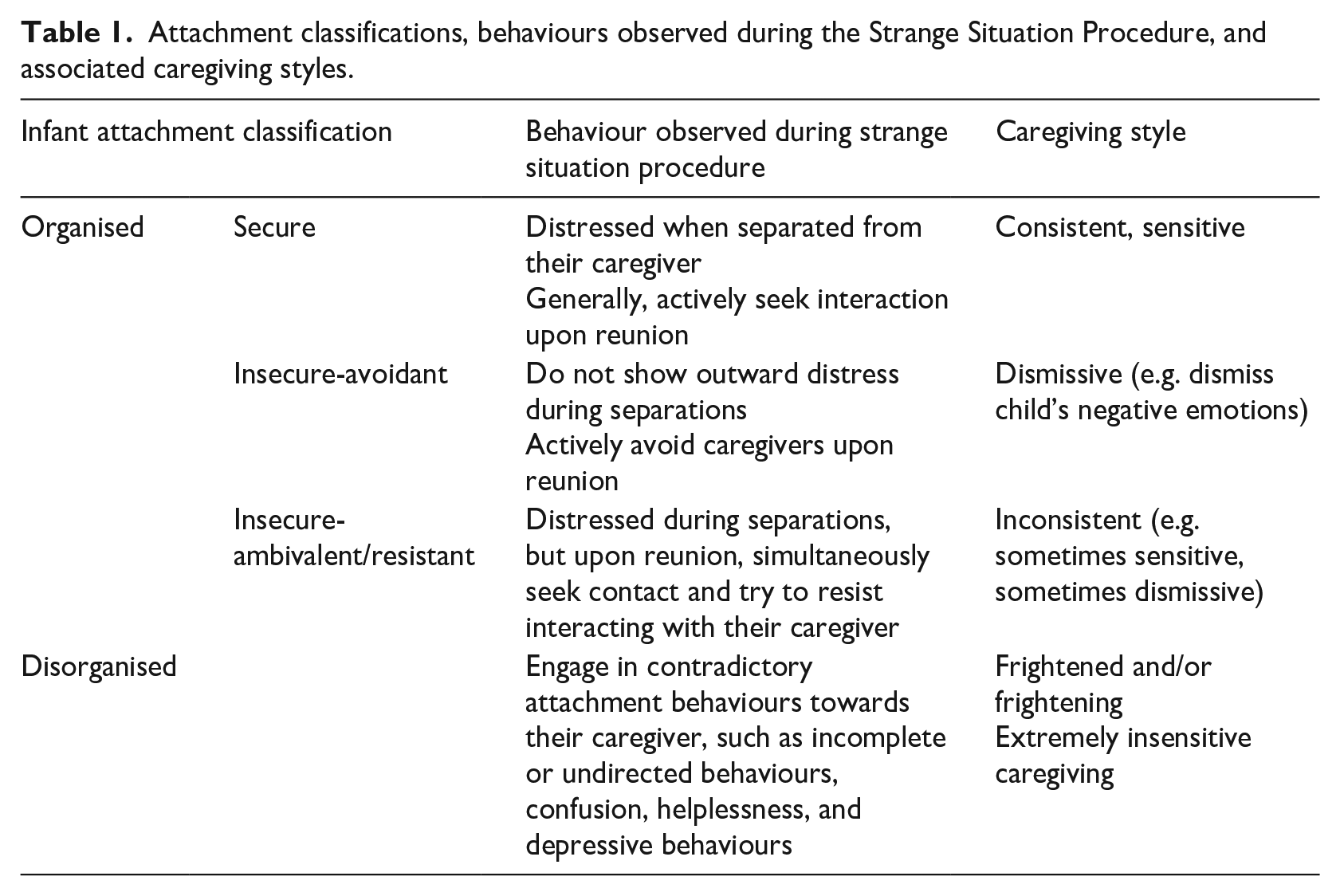
A secure parent-child attachment relationship typically develops due to consistent and appropriately sensitive caregiving, while insecure attachments often result from dismissive or inconsistent caregiving (Ainsworth et al., 1978). Both secure and insecure attachment styles are considered ‘organised’ attachment styles as they indicate that the child has a consistent strategy for relating to the caregiver during times of distress (Ainsworth et al., 1978; Main and Solomon, 1990). Disorganised attachment styles tend to emerge in the context of exposure to extremely insensitive, frightened and/or frightening caregiving (Granqvist et al., 2017). Infants with disorganised attachment styles have been observed to respond in inconsistent, disoriented, or fearful ways towards their caregivers in times of distress (Granqvist et al., 2017). Research indicates that compared to infants with insecure and disorganised parent-child attachment relationships, securely attached infants tend to show greater positive affect, better emotion regulation (Cooke et al., 2019), and superior academic achievement (Ranson and Urichuk, 2008). See Table 1 for a summary of attachment styles, behaviours observed during the SSP, and caregiver characteristics associated with different attachment styles.
Attachment classifications, behaviours observed during the Strange Situation Procedure, and associated caregiving styles.
Autism spectrum disorder (ASD) is a life-long neurodevelopmental condition characterised by impairments in social communication and interaction, and restricted, repetitive behaviours, interests and/or activities (American Psychiatric Association, 2013). Once considered an attachment disorder (American Psychiatric Association, 1980); a number of studies have concluded that children with ASD can, and often do, for secure attachment relationships, although at a slightly lower rate (40%–60% versus 60%) (Cibralic et al., 2018; Rutgers et al., 2004; Teague et al., 2017). There is, however, a slightly higher proportion (22% vs 15%) that develop disorganised attachments (Cibralic et al., 2018; Kahane and El-Tahir, 2015; Rutgers et al., 2004; Teague et al., 2017). While infant attachment patterns are established in the first year of life and are typically observable and stable from around 12–18 months (Fraley, 2002), only one study has explored the prevalence of insecure and disorganised attachment patterns among children younger than 24 months of age with ASD (Martin et al., 2020). In this study, Martin et al. (2020) assessed parent-child attachment relationship quality using the standard version of the SSP in 95 parent-child dyads (mean child age = 15.1 months; SD = 0.4). The 95 dyads consisted of 56 children classified as having an elevated likelihood of receiving an ASD diagnosis (sibling with an ASD diagnosis) and 39 children considered to be at a low risk of receiving an ASD diagnosis (sibling without an ASD diagnosis). The authors then re-assessed the children when they were 36 months of age to gather information about whether they went on to be formally diagnosed with ASD. Results indicated that children who were originally considered at an elevated likelihood of receiving an ASD diagnosis and later received an ASD diagnosis (n = 16) were more likely to have been classified as having an insecure parent-child attachment relationship than both children who were considered to be at an elevated likelihood of receiving, but did not receive, an ASD diagnosis (n = 40) and children at low risk of receiving an ASD diagnosis (n = 39). The study found no statistically significant differences in the proportions of children in the three groups who displayed a disorganised attachment pattern. Given that only one study has examined rates of attachment among children under the age of 2 years with ASD, and that this study yielded results that stand in conflict with the bulk of evidence from the wider ASD literature, further studies in this younger age group are required.
An additional limitation of the research examining parent-child attachment relationships among children with autism traits is that there has been minimal focus on the exploration of associations between specific autism phenotypes (e.g. presentations characterised by heightened levels of social affect difficulties or by restricted and repetitive behaviours) and attachment classifications. There is evidence from studies with children across a range of ages to suggest that greater autism trait severity is associated with attachment insecurity and a range of associated factors (e.g. poorer parent-child interaction quality, fewer prosocial responses to caregivers, lower cortisol responses to being separated from their caregiver, and attachment disturbances; Teague et al., 2017). The association between autism phenotypes in young children and attachment, however has, to our knowledge, only been explored in one study (van IJzendoorn et al., 2007). In this study, van IJzendoorn et al. (2007) examined associations between attachment and scores on the Autism Diagnostic Observation Schedule (ADOS-G; DiLavore et al., 1995) Social Interaction Subscale in a sample of 21 children with ASD diagnosis (age range = 16.6–41.6 months, M age = 28.4 months, SD = 4.9). These authors found that when controlling for developmental level, better social interaction abilities were associated with higher levels of attachment security (using a dimensional security score), but there was no significant association between social impairment and classification of attachment disorganisation (using a dimensional disorganisation score). Since the van IJzendoorn et al. (2007) study, the ADOS has been adapted to include the Restricted, Repetitive Behaviours (RRB) scale as part of its diagnostic algorithm. The RRB scale encompasses behaviours such as repetitive movements and unusual vocalizations. No study to date has examined the association between RRB severity and attachment classification in young children; it would be appropriate to do so given that many behavioural signs of ASD measured by the RRB scale can resemble the behavioural features of a disorganised attachment pattern (Capps et al., 1994; Coughlan et al., 2019) and may therefore impact coding using observational tools such as the SSP. Understanding the associations between autism phenotypes (Social Interaction versus RRB) and attachment may lead to more informed use of the SSP coding system when applied to children with autism traits.
A final area that is not currently well understood is that of the relation between developmental level among young children with autism traits and attachment classifications. Children with ASD diagnosis have higher rates of developmental delay, with prevalence rates ranging between 11% and 98% (Bougeard et al., 2021; Chen et al., 2022), compared to approximately 8.5% in the general population (Shan et al., 2022; Zablotsky et al., 2023). Research has also found that older children (over the age of 2 years) with ASD diagnosis and comorbid developmental delay experience greater levels of attachment insecurity and disorganisation (Teague et al., 2017). As yet, no studies have examined the association between developmental level and attachment in young children showing autism traits. Research in this area would help clarify factors that contribute to attachment insecurity in young children exhibiting autism traits and provide information about whether developmental delay needs to be taken into consideration when coding attachment using observational schemes, such as the SSP, in children showing autism traits.
Current study
Taken together, while the balance of available evidence suggests higher prevalence of attachment insecurity and/or disorganisation among children with ASD diagnosis and links between autism traits (severity and profiles) and attachment insecurity, most studies in this area have been conducted with children over the age of 24 months (Cibralic et al., 2018; Kahane and El-Tahir, 2015; Rutgers et al., 2004; Teague et al., 2017). Only two studies have examined attachment and autism traits in children aged 24 months or younger (Martin et al., 2020: mean child aged 15 months; van IJzendoorn et al., 2007: mean child age 28 months) and both studies produced results that stand in conflict to the majority of research undertaken with older samples. Given these discrepant results, and the limited number of studies conducted with toddlers (age range 12–24 months), further research needs to be undertaken to better understand patterns and correlates of attachment insecurity and disorganisation in toddlers with autism traits.
To address these gaps in the literature, we examined rates of attachment insecurity and disorganisation in toddlers showing autism traits (aged 24 months or younger) compared to toddlers without such traits and explored associations among autism traits (severity and profiles), developmental delay, and attachment classifications in toddlers showing autism traits. Assessing for ASD is possible in children as young as 12 months (Lord et al., 2012a), however, diagnosing ASD prior to age 2 is often not recommended. In the current study, given that the children in the sample were younger than 2 years of age, a formal ASD diagnosis was not provided. The term ‘autism traits’ was therefore used to represent children who presented with autism traits but were not formally diagnosed with ASD. Our study tested two key hypotheses, each informed by the bulk of available evidence (given the limited research with children 24 months or younger the bulk of evidence comes predominantly from studies of older children): (a) that higher rates of attachment insecurity and disorganisation would be observed in toddlers with autism traits compared to toddlers without autism traits; and (b) that among toddlers with autism traits, greater autism trait severity and developmental delay would be associated with attachment insecurity and/or disorganisation, RRB would be associated with attachment disorganisation, and social impairment would be associated with attachment insecurity.
Method
Participants
Participants were 90 mother-toddler dyads (child M age = 19.20, SD = 3.02, range = 14–24 months) referred to a community-based behavioural clinic located in a highly populated, urban, and ethnically and linguistically diverse area of Sydney, Australia. Twenty-two percent of children who were eligible to be assessed for externalising behaviour (i.e. were 18 months and older, n = 50 children) had behaviour that fell within the clinically significant range (based on the Child Behavior Checklist [CBCL]; Achenbach & Rescorla, 2000). Fourteen children (15.4% of the entire sample) had autism traits (based on ADOS-2 results, see measures section for further details; Lord et al., 2012b). Of these 14 children, two had autism traits that fell within the low concern range, two had autism traits that fell within the mild-to-moderate concern range, and 10 had autism traits that fell within the moderate-to-severe concern range. The percentage of children in the sample with autism traits was higher than the percentage of diagnosed with autism spectrum disorder observed in the general population (Maenner et al., 2020). This is likely due to the sample having been recruited from a behavioural clinic as children with autism have been found to have high rates of externalising behaviours (Ogundele, 2018). Table 2 includes the demographics of the sample and shows that there were no statistically significant differences (measured at the p = .05 level) between children with, and children without, autism traits for child age, child sex, maternal age, maternal marital status, or primary language spoken at home.
Demographic information and scores on main study variables.
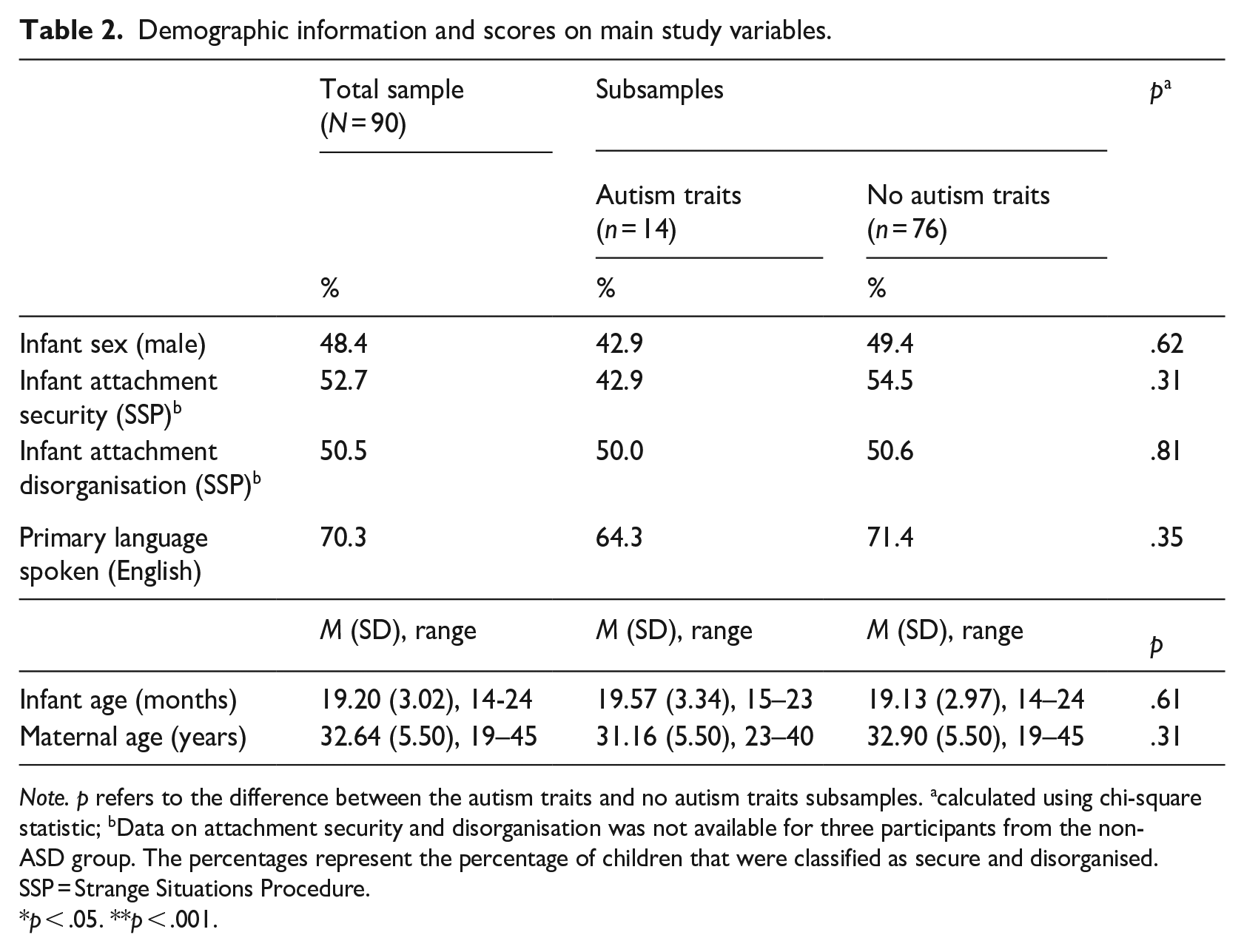
Note. p refers to the difference between the autism traits and no autism traits subsamples. acalculated using chi-square statistic; bData on attachment security and disorganisation was not available for three participants from the non-ASD group. The percentages represent the percentage of children that were classified as secure and disorganised. SSP = Strange Situations Procedure.
p < .05. **p < .001.
Procedure
The study was approved by South Western Sydney Local Health District Human Research Ethics Committee (project number HREC/18/LPOOL/72). Participants in this study were recruited for a wider Randomised Control Trial (RCT) assessing the efficacy of attachment-based parenting interventions on child behaviour (the Karitane ‘My Toddler and Me’ study; Australian New Zealand Clinical Trials Registry, 12618001554257; Kohlhoff et al., 2020). This study used data from the baseline assessment time point of the RCT.
All families who participated in the RCT were referred to the Sydney based clinic by a primary health care provider (e.g. General Practitioner, Paediatrician). On referral to the clinic, families of children aged 14 to 24 months were informed of the details of the study by a member of the research team and asked the following two questions: (a) Do you have concerns about your child’s behaviour, and (b) Do you have difficulties managing your child’s behaviour? Families who answered ‘yes’ to any one of the two questions were invited to participate in the study. Families were excluded from the research if the mother did not speak English, had an intellectual disability, or had a psychiatric condition that may have prevented her from participating in or completing the treatment and/or assessment measures. All participating mothers provided written, informed consent for themselves and their children prior to completing baseline assessments. The baseline assessments comprised a clinical interview, observational and questionnaire-based measures, and a developmental assessment. The research team aimed to complete all baseline assessments within a 2-week period.
Measures
Demographics
The demographic form included the following information: child’s date of birth and sex, and mother’s date of birth, parents’ relationship status, and languages spoken in the home.
Clinical interview
The clinical interview included asking questions regarding the presenting problem, family history, child medical history, positive child factors, and previous treatment.
Autism spectrum disorder screening and assessment
Two standardised measures, the M-CHAT-R/F (Robins et al., 2014) and the ADOS–2 Toddler Module (Lord et al., 2012a) or the ADOS-2 Module 2 (Lord et al., 2012b), were used to assess for traits of autism. As described above, the M-CHAT-R/F was used to screen all participants for autism traits, and for those children who screened positive’ for autism traits, the ADOS-2 was subsequently administered.
M-CHAT-R/F
The M-CHAT-R/F is a parent-report measure used to screen for risk of ASD in children aged 16–24 months (Robins et al., 2014). It comprises an initial 20-item parent-report questionnaire containing questions regarding the child’s current skill levels, and a 20-item follow-up questionnaire that is administered by a professional. The follow-up is administered only if a child scores “positive” (score > 3) on the initial parent-report questionnaire. Scores of > 2 on the follow-up questionnaire indicate that further diagnostic evaluation is needed.
ADOS-2
For participants who screened positive on the M-CHAT-R/F for autism traits, the ADOS-2 (Lord et al., 2012a; Lord et al., 2012b) was administered by a research-reliable ADOS assessor and coder. The ADOS-2 is an observational measure that examines communication, social interaction, play, and restricted and repetitive behaviours through a series of tasks that are presented to the child in a naturalistic social interaction. The ADOS-2 comprises five modules (Toddler Module; Module 1; Module 2; Module 3; and Module 4) with the module administered being dependent on the child’s age and language ability. In the current study, of the 14 children who screened positive on the M-CHAT-R/F, 13 were administered the ADOS-2 Toddler Module and one child was administered ADOS-2 Module 2. The Toddler Module comprises 11 primary activities and four secondary tasks, while Module 2 comprises 14 primary activities that divide into two domains: Social Affect (SA) and Restricted, Repetitive Behaviours (RRB). Higher scores on the ADOS-2 (total score and domain scores) indicate higher autism trait severity.
Developmental assessment
The Mullen Scales of Early Learning (MSEL; Mullen, 1995) is a validated, clinician administered, standardised developmental assessment suitable for use with children aged birth to 68 months. The MSEL comprises five scales (Gross Motor, Visual Reception, Fine Motor, Expressive and Receptive Language) that assess cognitive, verbal, and non-language abilities. Scores are summed to make up an overall ‘Early Learning Composite’ score. Higher scores on the MSEL indicate greater cognitive abilities.
Parent-child attachment relationship
The Strange Situation Procedure (SSP; Ainsworth et al., 1978) is an observational laboratory procedure comprising eight, three-minute episodes designed to intensify an infant’s attachment behaviours by exposing them to situations that evoke distress but are also similar to situations they may be exposed to during daily life (i.e. being separated from their parent for a short period of time). Based on observed infant behaviours during the episodes, with an emphasis on two separation and two reunion episodes, the infant is first classified using a three-way classification system and assigned one of three organised classifications: (a) secure (category B; infant displays distress when separated from their parent and actively seeks interaction upon reunion); (b) insecure-avoidant (category A; infant does not display outward distress when separated from their parent and actively avoids their parent upon reunion); and (c) insecure-ambivalent/resistant (category C; infant displays distress when separated from their parent, but upon reunion with their parent, they simultaneously seek contact and try to resist interacting with their parent).
Subsequently, the same eight episodes are coded for disorganised/disoriented attachment (category D; infant displays contradictory attachment behaviours towards their parent during separation and reunion episodes, such as incomplete or undirected behaviours, confusion; helplessness, and depressive behaviours). If disorganised behaviours are present and exceed a specified threshold (i.e. ratings greater than 5 out of 8), the disorganised classification becomes their primary classification.
All SSP assessments were video recorded and later coded by experienced SSP coders (SSP trainers from the University of Minnesota) using the standard SSP protocol, abstracted from Ainsworth et al. (1978). Coders were masked to all study variables, including autism trait status, and they were unaware that some of the children in the sample had autism traits. Inter-rater reliability for attachment classification was 86% (k = .78, p < .001, n = 30 videos).
Analysis
Data were analysed using SPSS, version 26 for windows. Chi-square tests were conducted to compare rates of attachment insecurity and disorganisation among toddlers with, and toddlers without, autism traits (hypothesis 1). Independent samples t-tests were conducted to compare the severity of autism traits and level of developmental delay between toddlers with secure versus insecure attachment classifications, and between toddlers with organised versus disorganised attachment classifications (hypothesis 2). The first t-test included attachment security (0 = secure, 1 = insecure) as the grouping variable and overall autism trait severity, RRB severity, SSA severity, and developmental level as the test variables. The second t-test was identical to the first except that attachment disorganisation (0 = organised, 1 = disorganised) was the grouping variable. Hedge’s g and 95% confidence intervals (CI) were also calculated (Lenhard and Lenhard, 2016). Hedge’s g was chosen as an effect size measure due to a small sample size. Cohen’s classification of effect size magnitude was used to interpret results where g < 0.19 = trivial/negligible effect, g = 0.20 – 0.49 = small effect, g = 0.50–0.79 = moderate effect, and g > 0.8 = large effect (Cohen, 1988).
Results
Table 2 shows the demographic characteristics and attachment classifications for the whole sample (N = 90), toddlers with autism traits (n = 14), and the toddlers without such traits (n = 76). There were no significant differences between toddlers with, and toddlers without, autism traits in terms of demographic variables (p > .05). There were also no significant differences between groups in terms of the proportion of toddlers with insecure [X2 (1) = 1.02, p = .31] or disorganised [X2 (1) = .05, p = .81] attachment classifications.
Table 3 shows the results of the independent samples t-tests. Among the toddlers with autism traits, there were no significant differences between those with secure, and those with insecure attachment classifications, in terms of autism trait severity, SA severity, RRB severity or developmental level. Effect sizes were small for SA severity (g = 0.4 95% CI [−0.6–1.5]) and developmental level (g = 0.3 95% CI [−1.3–0.7]), moderate for autism trait severity (g = −0.6 95% CI [−0.4–1.7]). Though not significant (p = .08) a trend was observed between RRB severity and attachment insecurity, and the effect size was large (g = 1.0 95% CI [−0.0–2.1]). Toddlers with a disorganised attachment classification showed significantly greater autism trait severity than toddlers whose attachment classification was not disorganised (p < .05), with a large effect size (g = −1.3 95% CI [0.1–2.5]). No statistically significant differences among groups were found for RRB severity, SA severity, or developmental level, although trends were identified for SA severity (p = .05) and developmental level (p = .06). The effect size for RRB severity was moderate (g = −0.7 95% CI [−0.3 – 1.8]) while large effect sizes were observed for SA severity (g = 1.1 95% CI [10.0–2.2]) and developmental level (g = 1.0 95% CI [−2.2–0.0]).
Scores on main study variables for the total ASD sample, the secure vs insecure subsamples, and the organised versus disorganised subsamples.
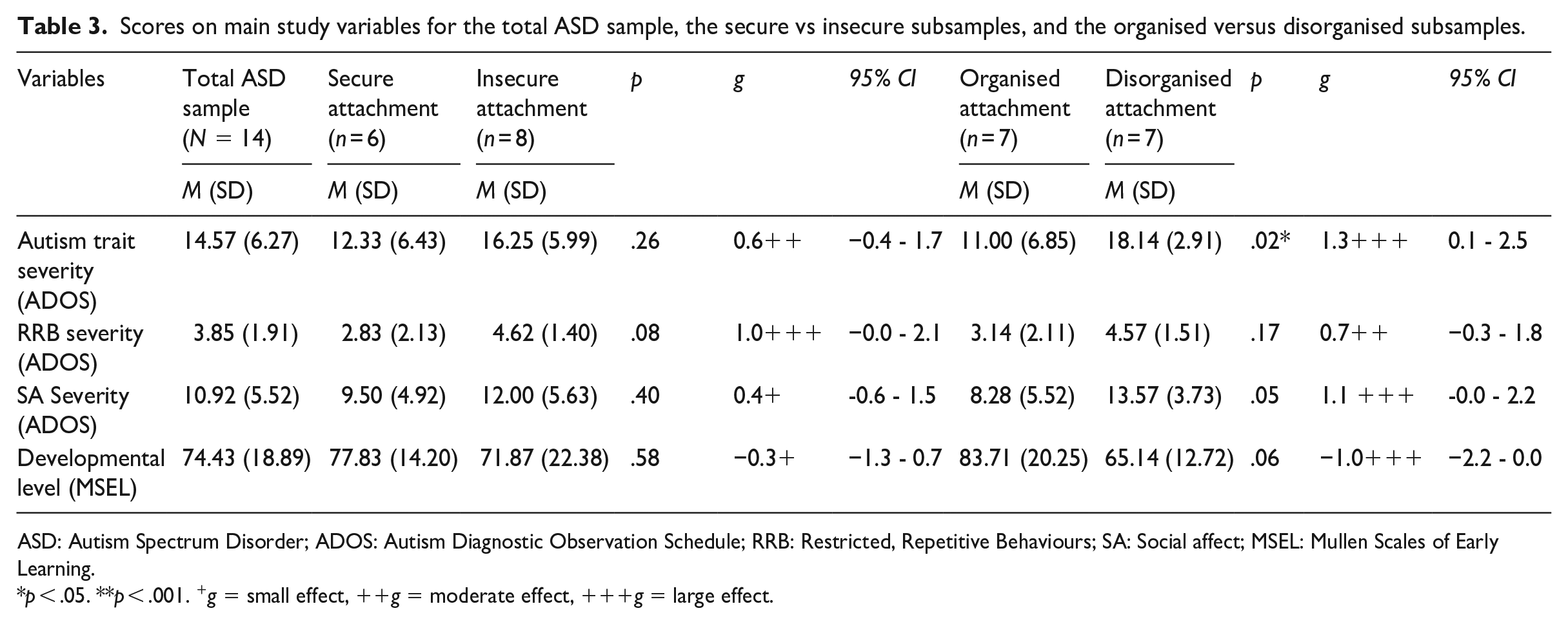
ASD: Autism Spectrum Disorder; ADOS: Autism Diagnostic Observation Schedule; RRB: Restricted, Repetitive Behaviours; SA: Social affect; MSEL: Mullen Scales of Early Learning.
p < .05. **p < .001. +g = small effect, ++g = moderate effect, +++g = large effect.
Discussion
This study examined the rates of attachment insecurity and disorganisation in toddlers with and without autism traits and assessed the association among autism traits (severity and profiles), developmental delay, and attachment in toddlers showing autism traits.
The first finding, contrary to our first hypothesis, was that no significant differences in rates of attachment insecurity and disorganisation were observed between toddlers with and without autism traits. This finding contradicts most previous research showing greater rates of attachment insecurity and disorganisation in older children with ASD diagnosis (Cibralic et al., 2018; Rutgers et al., 2004; Teague et al., 2017). This result does, however, partially support the results of the one study conducted with younger children (Martin et al., 2020), which showed no statistically significant differences in attachment disorganisation for younger children with and without ASD diagnoses. Together with Martin et al. (2020), our findings lend support to the argument that the previously observed higher rates of attachment disorganisation in children with ASD diagnosis could be the result of the age at which children in previous studies participated in the SSP and/or the use of modified versions of the SSP. Higher rates of intellectual disability and challenging behaviours found in children with ASD diagnosis have often been used as the justification for using older samples and modifying the SSP. Although these justifications are reasonable, modifying a standardised attachment measure may compromise the validity of the measure and impact outcomes (Teague et al., 2017). Martin et al. (2020) did, however, find a significant difference in attachment insecurity between children with and without ASD diagnosis, such that children who had an ASD diagnosis were more likely to be classified as insecure. A possible explanation for the discrepant finding regarding attachment insecurity is that the current sample comprised toddlers with clinically significant externalising behaviour while Martin et al.’s (2020) did not. Further, Martin et al. (2020) examined children who had received an ASD diagnosis while the current study examined children with autism traits. Further research needs to be undertaken to solidify these findings and determine whether parallels exist in community samples of young children with and without autism traits.
The second major study finding, in line with our second hypothesis, was that autism trait severity was positively associated with attachment disorganisation and that the effect size for the association was large. This finding is consistent with past research with older children with ASD diagnosis (Teague et al., 2017) and with one study conducted with younger children (van IJzendoorn et al., 2007). This suggests that young children with autism traits are more likely to form disorganised attachment patterns. It is also possible, however, that due to overlap between autism traits and the behavioural features of a disorganised attachment pattern, the observational attachment coding system used in this study may not be reliable when applied to children with autism traits. In other words, the question remains as to whether children with autism traits are in fact more likely to develop disorganised attachment patterns, or, if there is something about the SSP coding system that means that autism traits are being misinterpreted as indicators of disorganisation. In favour of the first possibility, Coughlan et al. (2019) recently analysed the notes that Mary Main (the original discoverer of the disorganised attachment classification), made about coding attachment in children with ASD and concluded that it is possible to distinguish ASD symptoms from attachment disorganisation indicators on the SSP. Coughlan et al.’s (2019) analysis indicated that the frequency and timing of the child’s behaviours were important when attributing the behaviour to ASD or attachment disorganisation. Odd facial expressions, for example, were considered indicators of a disorganised attachment if they occurred directly upon reunion and were not observed throughout other episodes. In contrast, behaviours such as toe-walking, hand flapping, and full body circulatory motion were regarded as autism specific behaviours. While Coughlan’s analysis suggests that the SSP coding system should be able to accurately distinguish between features of ASD and disorganisation, it is of course likely that in practice, not all SSP coders will be able to accurately make these distinctions. Having information about a child’s ASD diagnostic status prior to SSP coding may be of assistance, but given that the average age of ASD diagnosis is now 60.48 months (van ’t Hof et al., 2021) and the SSP is conducted with children aged 12 to 18 months, this may not always be possible. Because of the obvious complexities and potential for autism traits to be mistaken for disorganisation, and vice versa, this is an area in which further research is needed. In any case, these findings indicate that autism status and/or traits may need to be considered when assessing attachment using the SSP, and that it may be beneficial for SSP coders to gain an understanding of autism traits and how they differ from attachment disorganisation indicators.
In addition to showing an association between ASD symptom severity and attachment disorganisation, our study also identified a trend, with large effect sizes, for associations between attachment insecurity and RRB, attachment disorganisation and social impairment, and attachment disorganisation and lower developmental level. While these results did not reach statistical significance, the sample size was small and the large effect sizes indicate that significant results may be found in larger samples, highlighting an important future research direction. The trends do, however, stand in contrast to our hypothesis that RRB would be associated with attachment disorganisation and that social impairment would be associated with attachment insecurity. The trend also differs from van IJzendoorn et al. (2007) findings that social impairment was associated with attachment insecurity. Possible explanations for the discrepant findings include: (a) the van IJzendoorn et al. (2007) study was conducted over 10 years ago and used an older version of the ADOS to assess autism traits (Dorlack et al., 2018); and (b) the van IJzendoorn et al. (2007) study used dimensional attachment security scores, based on SSP subscales, while the current study used SSP categories. To our knowledge, this was only the second study to examine the association between autism trait profiles and attachment classifications in children under the age of two. While the small sample size limits the interpretability, and the cross-sectional design precludes conclusions regarding causation, the observed trends towards significance for the associations between autism trait profiles and attachment insecurity and disorganisation suggests that there is an association between autism trait profiles and attachment classifications in young children with autism traits.
Strengths, limitations, and future directions
This study had several limitations. First, only a relatively small proportion of the current sample had autism traits. Due to the COVID-19 pandemic, recruitment of participants ceased early. With a larger sample size (and thus greater power), the various trends identified in this study may have reached statistical significance. The results do, however, reveal some important patterns and present pilot data that can inform future research with larger samples. Second, the cross-sectional design means that conclusions regarding the direction of causation between variables cannot be made. Third, the current study did not examine known predictors of attachment security (e.g. maternal sensitivity, parental emotional support, and positive attitude; De Wolff and Van Ijzendoorn, 1997; Deans, 2020). Future research would benefit from assessing other factors that may contribute to the parent-child attachment relationship in toddlers with autism traits. Fourth, the MSEL was used to assess development. While the MSEL is a valid measure it has not been updated or re-standardized since 1995. The MSEL was chosen for this research project as it continues to be used widely in research studies, especially those focused on children with autism traits (e.g. Whitehouse et al., 2021), it’s suitability for use with young children, and its short administration time. Future research would, however, benefit from using more up to date measures such as the Bayley Scales of Infant and Toddler Development—Fourth Edition (Bayley and Aylward, 2019) or the Battelle Developmental Inventory—Second Edition (Newborg, 2005). Fifth, the M-CHAT-R/F was used to screen children for autism traits. Recent research has found the M-CHAT-R/F to have reduced sensitivity leading to false negatives (Sturner et al., 2022). Thus, it is possible that some children with autism traits may have been missed in the current study. Future research would benefit from using a more sensitive screener or administering the ADOS to all participants. Sixth, SSP coders were masked to all study variables, including autism trait status, however, distinguishing between autism traits and disorganisation indices can be challenging (Coughlan et al., 2019; Levy et al., 2020) and it has therefore been suggested that it is important for coders to be informed regarding autism diagnosis prior to coding so that they can take this into account when coding (for examples see Koren-Karie et al., 2009; Levy et al., 2020). Another perspective, however, relates to the fact that autism traits during toddlerhood can be unstable, often not resulting in an autism diagnosis (Benedetto et al., 2021). As a result, it is possible that by having information about a child’s autism trait status, coders may misidentify disorganisation indices as autism traits. In the current study, in line with the latter perspective, a decision was made to not inform the SSP coders of the children’s autism trait status. It is of course possible that by not being made aware of individual children’s autism traits, the SSP coders may have misidentified autism as disorganisation, or vice versa—and this could have impacted the overall codes. This is a complex issue, and one that requires further exploration and research. Future empirical studies are needed to determine whether knowledge of autism traits (rather than autism diagnosis) has an impact on coding the SSP.
Despite these limitations, the study had a number of strengths including the fact that it provides the first preliminary data relating to associations between attachment, RRB behaviours, and developmental level in toddlers with autism traits, and as such, will play an important role in improving understanding of factors that contribute to attachment categorisation in toddlers with autism traits. A further strength was the use of the standard SSP protocol, which is an advance on previous studies that used adapted versions of the SSP or used the infant version SSP with older children (Capps et al., 1994; Koren-Karie et al., 2009; Rozga et al., 2018).
Conclusion
In conclusion, this study suggests that rates of attachment insecurity and disorganisation do not differ between clinical samples of toddlers with and without autism traits and that greater autism trait severity is associated with higher rates of attachment disorganisation. It is unclear, however, whether the association between autism trait severity and attachment disorganisation was confounded by autism traits (e.g. hand flapping, spinning) having been mistaken as signs of disorganisation during SSP coding. Further research is needed to provide clarity regarding this matter as it has implications for clinical interventions and SSP coding.
Footnotes
Declaration of conflicting interests
The authors declared no potential conflicts of interest with respect to the research, authorship, and/or publication of this article.
Funding
The authors disclosed receipt of the following financial support for the research, authorship, and/or publication of this article: This work was conducted as part of PhD research undertaken by Sara Cibralic and funded by the Australian Government Research Training Program Scholarship.
Ethics approval and consent to participate
The study was conducted in accordance with the Declaration of Helsinki and approved by South Western Sydney Local Health District Human Research Ethics Committee (project number HREC/18/LPOOL/72). All participants provided informed consent prior to participation.

Data Sharing
Data available upon reasonable request.