




Abstract
This phenomenological study aimed to develop a framework integrating play into preschool curriculum based on educators’ lived experiences using play-based methods. Fifteen educators from 12 centers were interviewed using theoretical sampling. Data analysis revealed nine pathways linking play types, educator roles, and learning objectives. Results culminated in a comprehensive framework elucidating how educators actualize educational goals through play.
Introduction
Today, the characteristics of playful learning (Hirsh-Pasek et al., 2020) and their importance in promoting children’s developmental and academic skills (Pyle et al., 2017) have led many countries across the world to exploit play in childhood curriculum. Western and American viewpoints are theoretical, and practical pioneers in this field in some countries have acted on these viewpoints. However, the findings of different studies (As Al-Qinneh and Abu-Ayyash, 2022) show that the application of these approaches, regardless of the socio-cultural characteristics of that community, has not been very successful in implementation and has caused a gap between the designed and implemented curriculum (Rentzou et al., 2019).
Although play can be considered a universal trait of all children, the method and type of children’s play are different based on the socio-cultural characteristics of each society (Brooker, 2010). For example, Rao and Li (2009) showed that the term “eduplay,” due to its alignment with Chinese culture, forms a better view of meaningful play experiences in children.
The Iranian Education Organization, drawing from the Western perspective’s Montessori approach, implemented “play and learning,” the largest play project in the history of its preschool system. This implementation was not very successful in practice and was abandoned (Abdolmaleki, 2020). To fill this gap, in this study, we developed a model for integrating play into the preschool curriculum based on educators’ lived experiences. Many studies have shown the importance of identifying the lived experiences of educators in play-based curriculums (Aras and Merdin, 2020). Over the years, preschool educators have many lived experiences establishing a link between the curriculum, play, children, and their parents by the socio-cultural context of their classes in Iran. This study examined educators’ lived experiences using play-based methods to provide practical strategies for understanding play-curriculum relationships in the Iranian preschool context compared to other countries. It had two key objectives:
- Examine educators’ lived experiences using play-based methods to determine how performances formed and identify educator roles and learning objectives.
- Create a framework for play in preschool curriculum based on educators’ experiences.
Literature review
Play in the preschool curriculum
Play-based curriculum is founded on the belief that play is the most appropriate method for teaching young children (Frost et al., 2012). While the difficulty and ambiguity that the two concepts of play and curriculum have in defining the purpose of implementation, and the role of the teacher in its types, make understanding and interpreting the relationship between them fraught with complexities (Hedges and Cooper, 2018; Parker et al., 2022; Wood, 2013). On one facet of this relationship lies the realm of play, where the lack of a definitive and explicit definition has sparked a juxtaposition. It places the concept of play in a dynamic interplay between child-led and teacher-led styles, each accentuating distinct educational objectives (Pyle and Daniels, 2017). Alongside that, the complex relationship between play and children’s learning has led to the formation of divergent perspectives ranging from separation to integration between play and learning (Pramling Samuelsson and Björklund, 2023). On the other side of this relationship is curriculum, where the dynamism of the concept of curriculum and its goals has led to the contrast of two approches: child-centered curriculum versus teacher-directed curriculum (Veraksa et al., 2023).
In this study, Zosh et al.’s (2018) spectrum perspective on play, encompassing child-directed, teacher-directed, and mutually directed play, was employed to explore the relationship between play and learning. Child-directed play involves unguided activities, while teacher-directed play is planned for specific learning goals. Mutually directed play integrates both child and teacher input, encompassing guided play and co-opted play. Abdolmaleki et al. (2021) describe the varying roles teachers play in each type of play, from non-interventional to managerial. Trawick-Smith (2012) extends this perspective with three approaches: trust in play, emphasizing natural developmental benefits; facilitated-play, where teachers enhance play alongside children; and learn-and-teach-through-play, which separates play from learning, allowing targeted skill and concept instillation in children.
In the application of play in the curriculum, Edwards and Cutter-Mackenzi (2011) showed that by integrating play and intentional teaching in the form of three types—open-ended play, modeled play, and purposefully-framed play—in combination in the curriculum, environmental skills learning can be shaped in children. Rao and Li (2009) also stated that eduplay, due to its emphasis on the educational value of play considered by teachers and parents and its alignment with the Confucian perspective, can demonstrate the functional interaction of play and learning in the early childhood curriculum in China. In Australia, Fleer (2018) believes that the playworld with emphasis on imagination and the active role of teachers and children creates a dynamic relationship between play, learning and cultural contexts in the children’s curriculum. Regarding types of play and the role of teachers in play-based learning, Pyle et al. (2017) in reviewing 168 articles in the field of play-based learning showed that research focused on developmental learning emphasizes the use of free play and the passive role of the teacher, while research focused on academic learning emphasizes teacher-directed and mutually directed play and the active role of the teacher. Bubikova-Moan et al. (2019) in an international study showed that teachers expressed a wide spectrum of states from highly participatory to non-participatory in the process of children’s play in the classroom.
Efforts to apply play in the curriculum with emphasis on reforms include PlayWorld (Fleer, 2018), eduplay (Rao and Li, 2009), Working Theories (Hedges, 2021), and Purposeful Play (Teo et al., 2018), A Theoretical Framework of Playful Learning and Pedagogy (Kangas and Harju-Luukkainen, 2022). Most of these studies emphasize a particular type or types of play in combination with teaching children, and we hve identified no studies which comprehensively understand the relationship between different types of play, play goals, and the teacher’s role in children’s play. This study identifies the relationship between types of play, play goals, and the teacher’s role within the framework of a play-based curriculum model.
Play in early childhood education in Iran
The history of the establishment of kindergartens in Iran dates back 90 years. From 1933, when the first preschool curriculum was developed, to 2023, various perspectives on the concept of play in kindergarten have been reflected in notable documents in 1970, 2003, 2008, and 2009 (Organization for Educational Research and Planning, 2016). In most of these documents, play was only mentioned as one of the teaching-learning methods in the written curricular documents, and the educators did not actually implement it in their classrooms (Abdolmaleki et al., 2021). In the latest and most important document on play in Iran, the ‘Play and Learning’ project, policymakers sought to make play a large part of the children’s educational program in preschool education (Ministry of Education of Iran, 2019).
This project, based on the Montessori approach, is limited to equipping children’s educational centers with toys appropriate to developmental and academic issues in a place called “playroom” (Abdolmaleki, 2020). Despite the expansion, support, and emphasis of the Ministry of Education, this project did not have much success in practice. The present study aims to design a model of play integration into the preschool curriculum using the phenomenological approach.
Research questions
- What type of play does a preschool teacher do in their daily schedule?
- For what purposes do preschool teachers consider each play-type appropriate?
- What roles do preschool teachers perform in each play?
- What does a framework that depicts the relationship between “curriculum” and “play” based on the lived experiences of preschool educators look like?
Method
This research was carried out using a two-stage phenomenological qualitative research method. The basis of phenomenology is the simplification of individuals’ experiences to achieve a holistic nature or essence (Creswell, 2013). Educators have unique experiences of using play in the curriculum according to socio-cultural characteristics. In the phenomenological approach, by interpreting these lived experiences of educators, one can find common points or a common semantic system that connects the lives of the individuals involved (Connell, 2003). This intersubjective system can lead us to a common pattern of educators’ lived experiences for using play in preschool classrooms. In the present study, hermeneutic phenomenology (Creswell, 2013) has been used.
Participants
The potential population in this study was preschool educators in Tehran. Purposive and snowball sampling was used to determine the number of coaches interviewed (Patton, 2014). The present research sample was selected among educators from different parts of Tehran who (1) were currently teaching in a preschool center, (2) had a teaching experience of 5 years or more in play-based centers, (3) had an associate degree, (4) had obtained a coaching degree from the Ministry of Welfare or Education, and (5) were willing to participate in the study. Based on the theoretical sampling method and reaching theoretical saturation in the present study, 15 educators from 12 children’s educational centers were interviewed.
The range of educators from 12 districts of Tehran, who had teaching experience between 5 and 11 years, shows their demographic diversity and a wide range of different experiences in the field of using play in their classes.
Procedures
In the first part of the research, semi-structured in-depth interviews were used to collect data. Using an interview protocol (Patton, 2014), the interview process focused on the educators’ explicit classroom approaches to their perceptions and experiences in using play. Interviews with instructors were conducted in their own centers, and the time for in-depth interviews for each instructor varied between 50 and 70 minutes.
In the second phase of the research, video elicitation interviews (Haynes-Brown and Shannon-Baker, 2021), were used to collect data. Educators’ routine classroom play-based activities were discreetly recorded with cameras placed in non-disturbing areas, and the videos were provided to educators 5 days before the video extraction interview. During this interview, educators watched the videos, noting times, parts, and behaviors representing play types, roles, and goals. The interview duration with educators ranged from 70 to 130 minutes.
Data collection and analysis
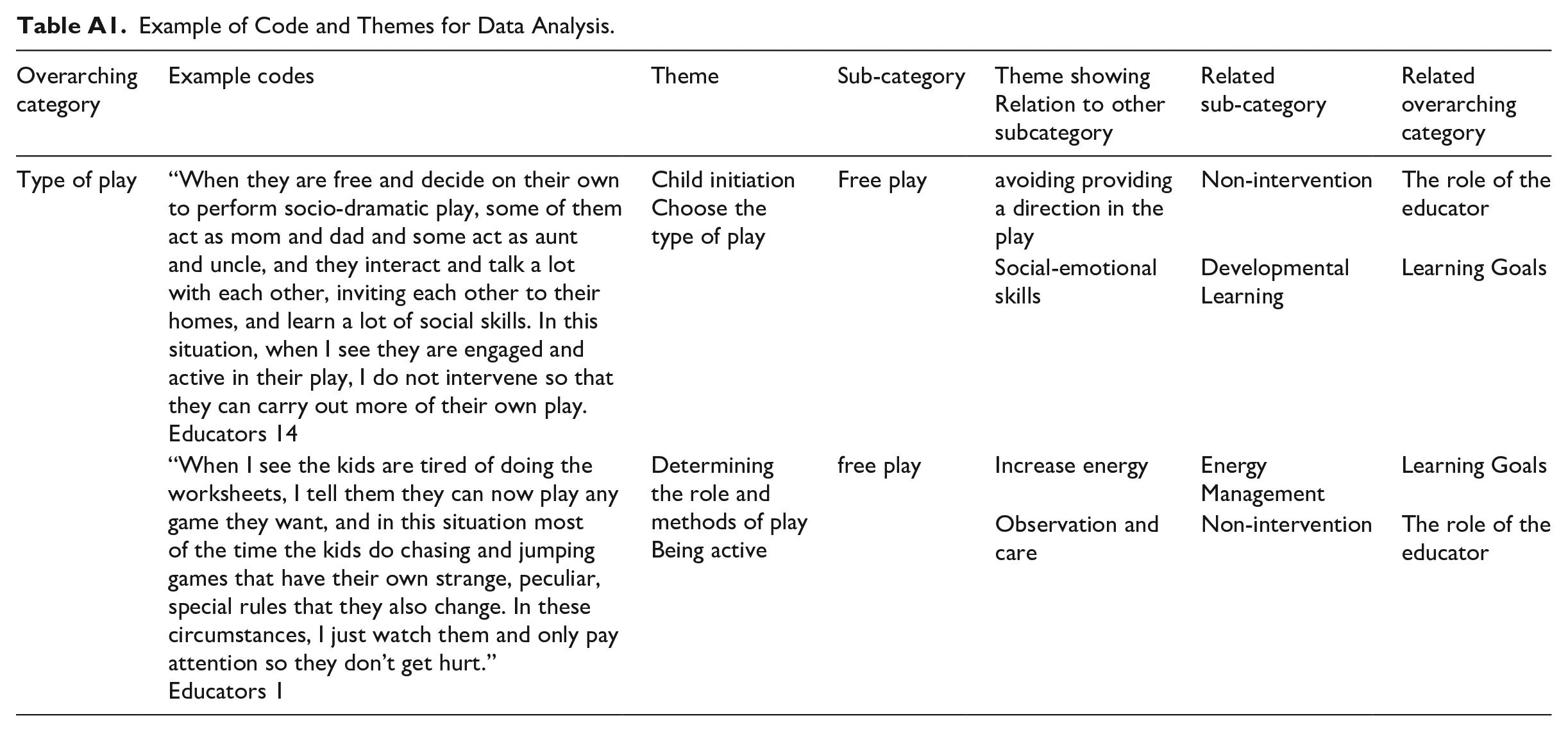
We employed the Colaizzi (1978) analysis method to analyze data from both semi-structured and video elicitation interviews. This involved analyzing transcriptions of structured interviews (comments) and video extraction interviews (actions) for each educator. This analysis was developed based on “anticipated categories or types of responses/actions that may arise in the data yet to be collected” (Saldaña, 2015: 120). In this regard, we considered, as pre-determined overarching categories, the findings from prior research on various types of play in the learning process (Edwards and Cutter-Mackenzie, 2011; Pyle et al., 2017), the instructor role in the play (Abdolmaleki et al., 2021; Wood, 2014), and learning objectives (Pyle et al., 2017; Trawick-Smith, 2012; Wood, 2014). After determining these three main categories, subsets were identified in each category. Subcategories within each overarching category were discovered through an inductive process and underwent continuous refinement during the data analysis period. For example, for overarching category of play types in alignment with other studies (Edwards and Cutter-Mackenzie, 2011; Pyle et al., 2020) our data led us to three main categories of free play, guided play, and teacher-directed or structured play. A similar process was carried out for the two other determined categories. For example, if learning objectives were mentioned, they were placed under the “Learning Goals” category. We remained open to the possibility of identifying new components. For instance, within the “Learning Objectives” category, we discovered the subcategory of “Energy Regulation” which was not covered in the foundational research models of Trawick-Smith (2012) and Wood (2014). The identification of these new subcomponents is rooted in the cultural and social context. Table A1 in the Appendix provides an example of our coding process.
After extracting these sub-categories we analyzed interview transcripts and video elicitation transcripts, employing an inductive thematic analysis approach. This method aimed to investigate the educators’ viewpoints regarding the mutual impact of the type of play on the role an instructor is playing, as well as how Learning Goals of teachers through play effects the instructors’ role and kind of play they chose. In other words we wanted to determine if there were any connections between these three main categories and their respective subcomponents. Our deep analysis indicated that these components were interconnected in the form of pathways. By combining these three main components into exploratory pathways, we created a framework for the application of play in the curriculum at a higher level.
The accuracy of interview analysis findings was assessed using the peer-review method (Creswell and Miller, 2000). A comparison with researchers’ analyses revealed 90% reliability among evaluators, with remaining coding differences resolved through discussion.
Results
The research findings are divided into two parts. In part one, we analyze findings related to various play types, the educator’s role, and the purpose from the educators’ perspective. In part two, we present a play integration model in the preschool curriculum based on our participants’ responses.
Part one: play types
Types of play in the daily schedule
Educators used a variety of play in their daily routines. The educators’ first mentioned play type is free play (10 educators), characterized by children making independent decisions based on their interests. For example, the educator (Code 11) said: “On odd days, we allow children to choose from the materials provided in the classroom and play with them in any way they like.”
The second most prominent play type, as per educators’ input, was structured play (15 educators). In this play, the educator designs or selects the play based on the learning objectives, and the children must follow the provided instructions. In this regard, the educator (Code 6) stated: ‘To teach the directions, I asked children to randomly select a card from the bag and move it on the chessboard on the floor according to the directions on that card’.
The third play type mentioned is guided play (12 educators). Here, educators create learning situations with specific goals in mind, tailored to children’s interests or experiences. For instance, an educator (Code 1) designed play based on children’s visit to a fire station. She stated: ‘After coming back from the fire station, I asked the children to change the classroom to the fire station and play different roles in their own way’.
Learning goals of teachers through play
Educators utilize various play types for distinct goals. In their experiences, the educators referred to the role of free play in developmental (nine educators), creativity (eight educators), and energy management goals (six educators). According to educators, in free play, children develop developmental skills by having the freedom to interact directly with the environment and its tools. For example, in the field of learning cognitive skills, Instructor Code 4 stated, ‘The children play with toys when they are free, alone or by their friend. They try and make mistakes to understand how they work’. Educators saw pretend play as a foundation for sparking new ideas and fostering creativity. In terms of creativity, an educator (Code 11) said: ‘One of the children wanted to play with a doll with his friend. But there weren’t enough dolls. He came and made a doll for himself with a Lego toy and played’. The educators also believed that free play was effective in controlling a child’s energy by engaging their mind and especially their body deeply. Educator Code 7, for example, explained: ‘When I take kids to the yard to play, they jump up and down freely. They yell and scream freely. That makes them stay calm’.
In expressing their experiences, the educators referred to the role of guided play in achieving developmental (8 educators), creativity (7 educators), and academic goals (10 educators). They believed that the educator starts the play with the goal of promoting developmental skills and allows the children to continue the game in their own way. In terms of learning sensory-motor skills, educator Code 8 described: “To strengthen my children’s small muscles, I gave them play dough and told them to make whatever they like with it and then tell me what they made.” The educators believed that guided play encourages creativity by creating opportunities for children to begin to construct ideas and implement them in their own way. In this regard, the educator (Code 10) said: “In the ‘lightning play’ when I asked the children to make whatever they like, they made shapes on the wall that I never thought possible.” The educators also believed that, in the process of guiding play, opportunities to learn academic concepts are developed by creating the educators’ scaffolding. In terms of learning verbal skills, the educator (Code 5) said: “In the play of serious and funny sentences, I first said a few sentences about my socks, then I asked the children to say their own sentences about their clothes.”
In their experiences, the educators referred to the role of structured play in achieving academic (14 educators), developmental (11 educators), and energy management goals (10 educators). Educators believed that by determining the play based on the learning goals and implementing it based on the rules and methods of the play, we can create an environment for learning academic skills. In this regard, the educator (Code 13) stated that in “basket play,” “The kids had to keep the basket on their backs and take the balls with two circles drawn on them from the ground and put them in the basket on their backs.” The educator (Code 12) believed that by determining the play and explaining the play method to the children, they can create the context for learning movement skills. “I asked the kids to simply play hopscotch on these lines and do not step out of lines.” Also, the educator (Code 9) believed that in “step on the chair” play, children were physically involved and this play could affect on their energy. “To calm the playful kids, I told them to put the chairs together and take turns moving up and down the chairs,” she said.
The role of the teachers in play
Educators take on various roles during different play types. Nine educators supported the idea of non-interference during free play, emphasizing the importance of creating the environment and letting children choose their activities independently. For instance, one educator (Code 1) said: “On Sundays and Tuesdays, I prepare things before the kids arrive. When the kids come, I let them play whatever they like, and I do not say what to do and mostly I watch and record their plays.”
In their experience, ten educators supported their interactive role in the guided play process. Code 9 believed that in guided play, educators initiate the activity and let children continue based on their interests. The educator is actively involved in the play process and supports the child’s independence. She said, “After giving the children pictures of the animals and other equipment and talking about them, I asked the children to build their own animal farm on their own or together, and then I asked them to explain to me how to make it.”
Thirteen educators, in expressing their experience, supported their managerial role in the structured play process. Educator Code 5 believed that during structured play, the educator designs and selects the play based on the learning objectives and explains the rules of the play to the children. She explained, “In the ‘geometric shapes’ play, children have to move around the classroom, and whenever I say the name of any geometric shape, they quickly put a foot on the geometric shape on the floor of the classroom; wherever they make mistakes, I tell them.”
Part two: Play integration model
Framework for play in the preschool curriculum
To create a play-based learning framework, interviews were analyzed to identify play types, educator roles, and learning objectives. The logic behind each play type determined associated objectives and roles. This elucidated the relationships between play types, educator roles, and learning goals.
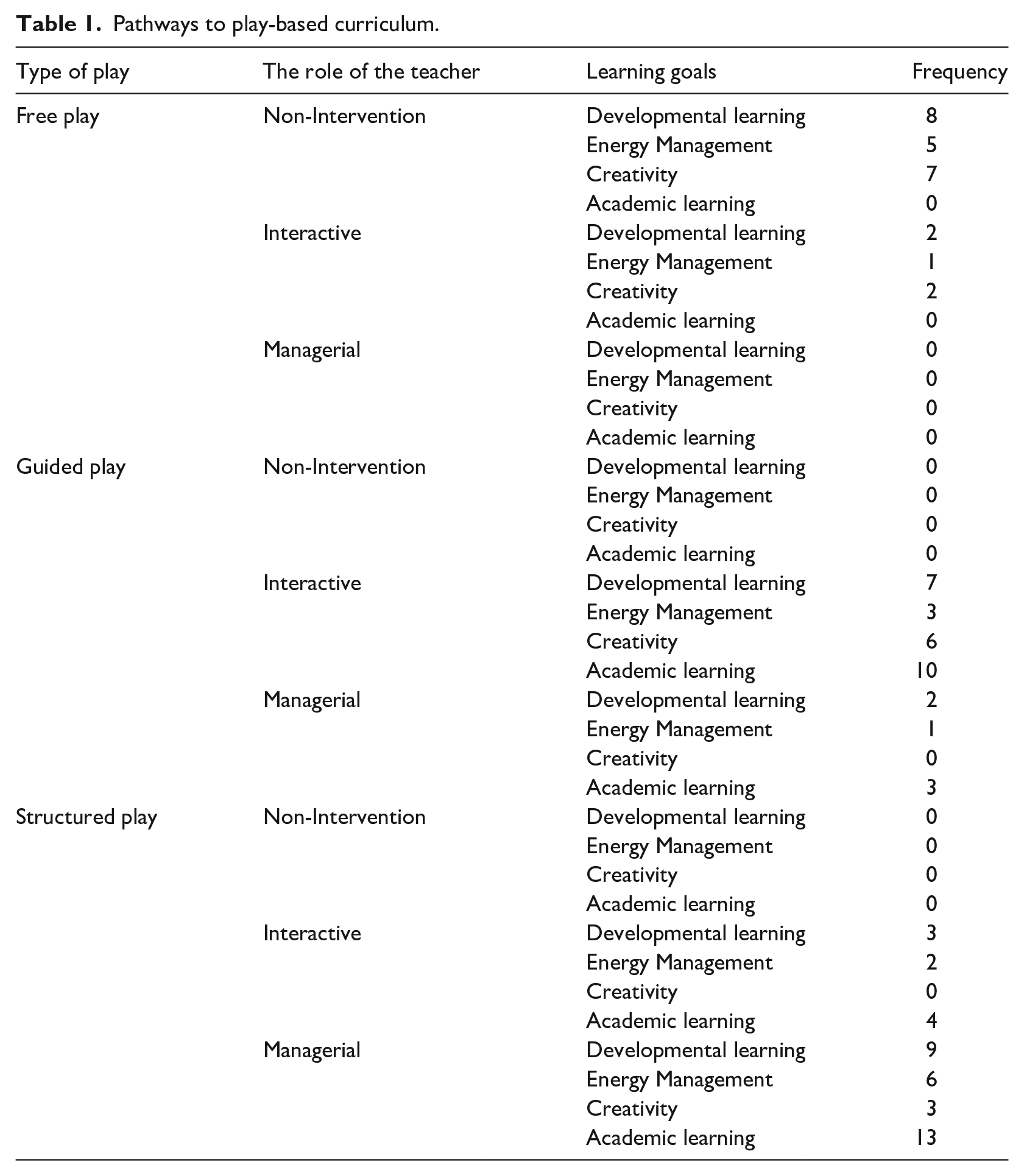
Combining the types of play, the teacher’s role in the play, and the learning goals, led to the identification of nine pathways. Each pathway connects the type of play with the role of educators in the preschool learning goals. In this process, the less frequent pathways (less than 3–4 times) in the sample of play experiences expressed by the educators were deleted from the study (Table 1).
Pathways to play-based curriculum.
Play pathways
The nine identified play pathways show how educators’ play types link both their role in the play and their learning goals (Figure 1). Together, these pathways provide a comprehensive framework for the application of play in the preschool curriculum.
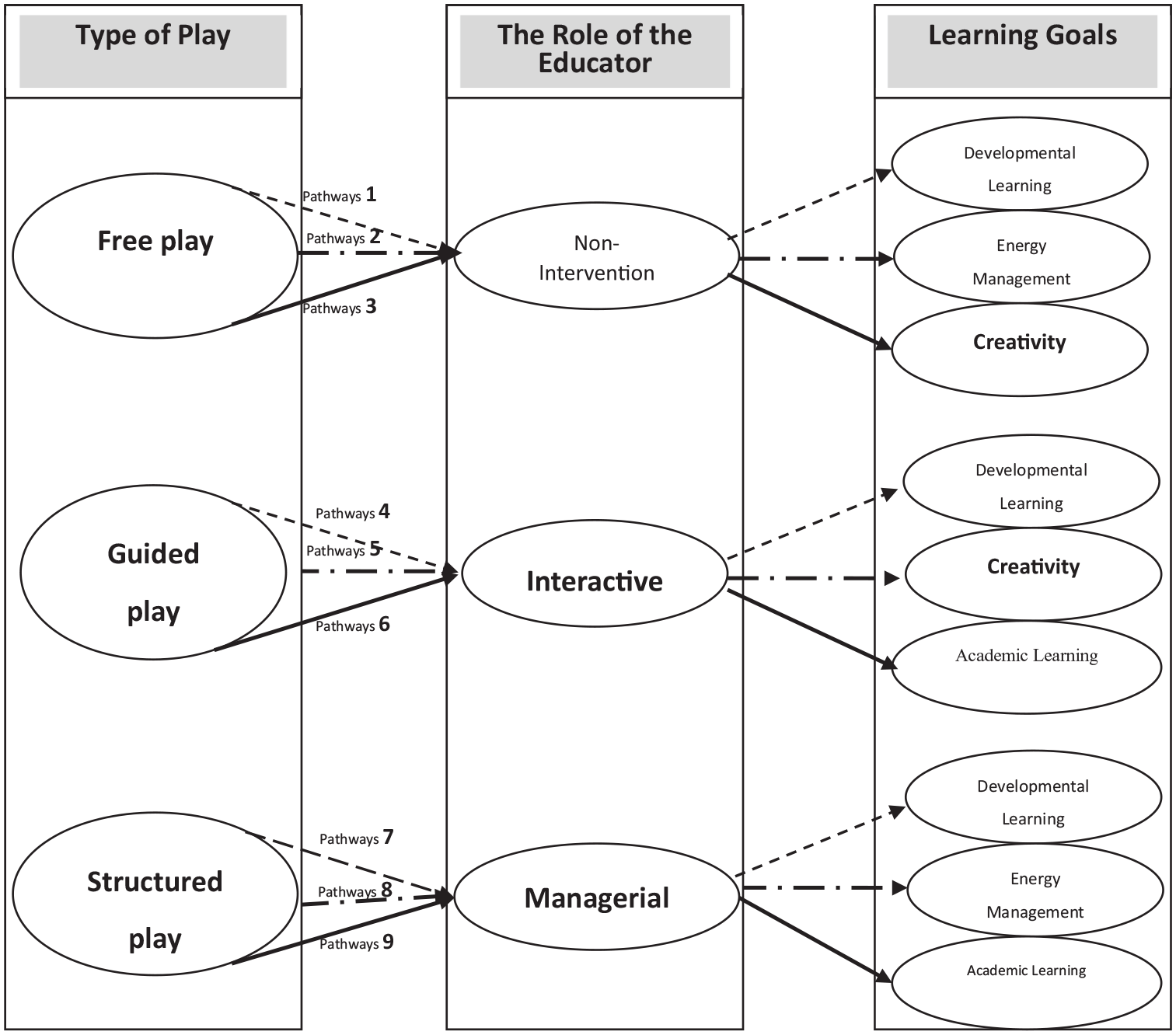
Play application framework in the curriculum.
Pathway 1: Free play + non-intervention + developmental learning
Free play and non-intervention, targeted growth learning by enabling student choice (eight educators). As Code 14 said, it facilitates social skills: “When they play ‘socio-dramatic play’ they communicate and invite each other over.” Minimal educator interference preserves motivation. In this regard, Code 14 believed that in free play, the educator’s intervention reduces the motivation of children to continue the play process:. “In this situation, when I see that they are involved in their play, I don’t interfere. Therefore, they can play more.” Fredriksen (2012) supports this path, stating educators provide natural learning through play by supplying materials without interfering.
Pathway 2: Free play + non-intervention + energy management
The non-intervention role of free play was a strategy to target energy management during the play process (five educators). The educators used the opportunity of free play as a strategy while children were very active and engaged in controlling their energy. Code 7, for example, believed that “Children jump over the hoops and play with each other when they are free to play. They’re running out of energy.” In free play, the educator supported the play process by the least interventions, and children had an opportunity to play in their own way. Code 10 added, “When the kids get bored, I tell them to play whatever they like. They get very excited and seem to be refreshed.” This path aligns with Aras (2016), who found free play before learning raises attention and learning effectiveness per educators.
Pathway 3: Free play + non-intervention + creativity
Free play gives children the opportunity to explore, build, pretend freely. and develop their creativity skills (seven educators). For example, Code 12 stated, “One of the kids built a tunnel for himself with Lego. Then she put it in a sand tray. She dumped a lot of sand on it and said, this is my tunnel.” In free play, the educator, with minimal involvement, supported the play and helped children implement and manipulate their ideas and thoughts in their own self-made play with safety and independence. Code 4 stated, “One of the children built a tunnel in the sand tray with Lego and poured sand on it and said that cars pass through here.” This path aligns with Thiessen et al. (2013), who found free play fosters creativity through discovery, curiosity, independence, and experimentation, suggesting that adult involvement limits unexpected responses.
Pathway 4: Guided play + interactive + developmental learning
In guided play, the educator starts play and involves the children. Then, through interaction and considering children autonomy, they provide the context for learning development skills (seven coaches). Regarding the role of guided play in promoting children’s social skills, Code 2 said, “I started the ‘restaurant dramatic play’ by adjusting the classroom environment. They continued to play and interact with each other.” In guided play, the educator provides the context for the children’s developmental skills through guiding their explorations and learning with open-ended questions. For example, Code 2 said, “I slowly approached children and asked, what food do you prepare to give to the customers? They said we make carrot soup and milk. Again, I asked, how do you make this food? Can you explain it to me?” The fourth path aligns with Palma et al. (2014), who found educators can improve children’s motor skills through planning, scaffolding, and guiding play, representing guided play.
Pathway 5: Guided play + interactive + creativity
In guided play, the educator provides opportunities for children to develop creative skills through the situations, and they provide support for children to be independent in changing play and pursuing their interests (six educators). For example, Code 6 said, “As the children in my class are interested in building a house, one day I gave them wooden and plastic blocks and said: let’s build the kindergarten you like together.” In the guided play, the educator communicates with the children in a timely manner and creates more opportunities for them to engage their minds, providing a context for thinking in a new way. In this regard, Code 6 stated: “I asked two of the children who were responsible for the construction of the kitchen to explain the process. Then I said, ‘Do you think it is possible to build this gas stove in another way?’.” This path has been identified by Zosh et al. (2017), who stated that guided play gives children the opportunity to participate and think in a new way by creating a mental plan.
Pathway 6: Guided play + interactive + academic learning
This path was noted by ten educators. In guided play, educators initiate and structure play catering to interests to provide academic learning contexts. To teach the concepts of narrow and wide, Code 8 stated, “I approached one of the children and said: How can you change the bridge, so that this big car can pass?.” In guided play, the educator interacts with children based on their observations during the play. By entering the play and providing feedback and suggestions, the play process enriches their learning of academic concepts. To teach the concept of “Large and Small” in the guided play, Code 10 stated: “As a buyer of clothes, I participated in the children’s play and asked them to sell me shirts for my older and younger sons.” This path aligns with Fisher et al. (2013), who showed educators scaffold children’s learning of geometric shapes through dialogic inquiry in guided play.
Pathway 7: Structured play + managerial + developmental learning
In structured play, the educator designs or selects the play activity to achieve the developmental goals for each age group in the curriculum (nine educators). Based on performing the “Umbrella Play” in developing cooperative and motor skills in her experiences, Code 8 stated: “The kids had to all take parachute handles together and at the same time move the handles to throw the balls out of the parachute.” In structured play, the educators supervise the play implementation process by directly intervening in the children’s play so that the children move forward according to the rules of the play. In this regard, Code 11 described her experiences as follows: “When the kids were not carrying the ball properly, I told them they should play like this because they did not play it correctly.” Sharp et al. (2012), found teachers directly instruct skills in teacher-directed play by providing learning contexts based on objectives.
Pathway 8: Structured play + managerial + energy management
In structured play, by designing and selecting motor play, the educator physically engages children to manage their energy, especially in gross motor skills (six educators). “Children get a lot of energy from the rhythmic action they play in the classroom every morning,” said Code 3, “so l ask [them] to run whenever music is playing and stop when it is cut. They have a lot of energy after this play.” In structured play, by monitoring the proper performance of the play, she engaged the children more in the activity of the play to achieve the goal of regulating energy. Code 5 said, “First I do the motor play myself, and then I ask kids to move their legs and arms like me.” This experience is expressed from the viewpoints of play theory of relaxation (Henricks, 2015).
Pathway 9: Structured play + managerial + academic learning
In structured play, the educator determines the play based on the learning goals. She tries to achieve the children’s learning goals by explaining the rules of the play and managing its process, monitoring for correct performance. “I asked the kids to build a train from one side to the other side of the class by putting cards with similar sounds together,” said Code 9, who sought to teach language skills through structured card play. In structured play, the educator is directly present during the play. Code 15 added, “I told the kids if they did not fit the pieces in the play according to the model, this is wrong, and you have to put it like this to make that model.” The last path aligns with Stebler et al. (2013), who found structured play motivates children and improves math achievement since they use math skills during play.
Discussions
The purpose of the present study is to develop a framework for the application of play in the curriculum based on the preschool educators’ lived experience. The phenomenological method was used as a general research guide. Through analyzing interview data, we designed a model of integrating play into the preschool curriculum. The model identifies nine relationships between play types, educator roles, and curriculum learning objectives.
Our framework suggests that despite different perspectives on the relationship between play and the curriculum (Trawick-Smith, 2012; Van Hoorn et al., 2014), educators can utilize the identified pathways to integrate play into the curriculum in a variety of ways according to learning objectives. Three play types aligned with those described in Trawick-Smith (2012) and Edwards and Cutter-Mackenzie (2011) were identified. Pyle and Daniels (2017) believe that different types of play in the play-based learning process, provide different opportunities for children to achieve the educational and developmental goals of the curriculum.
While the current framework uses a variety of play to achieve different curriculum goals, educators use more structured play and less free play in their daily programs. Emphasizing the preschool period mainly as a preparatory period for school (Abdolmaleki, 2020), makes Iranian parents value educational play that emphasizes learning different concepts and skills (Shahidi, 2010). Synodi (2010) emphasized in some communities, one or more types of play are emphasized in accordance with cultural conditions.
Although the identified roles in different play paths are consistent with the roles presented in learning approaches based on Wood (2014) and Abdolmaleki et al. (2021), one of the notable findings is the great emphasis of the educators on more active participation and learning objectives in this play. The reason for this issue is rooted in two areas. First, the cultural context of Iranian society in which reliance on centralized power in the way of life and following the guidance of others is emphasized and considered important (Nejati, 2011). Second, according to parents, playing without the presence of educators only serves to fill the child’s time and is not worth learning (Abdolmaleki et al., 2023).
Each of the play-based pathways in our framework provides the ground for achieving the goals of the curriculum. Trawick-Smith (2012) believes that the educator can apply any of the play approaches in the curriculum based on their goals in the daily curriculum, as each approach emphasizes a specific type of play.
In most research on play-based learning (Pyle et al., 2017), developmental goals can be achieved through free play (Catalano, 2018) and guided play (Palma et al., 2014). However, along with these two play types, the present study emphasizes the importance of structured play in promoting developmental skills. The reason is Iran’s pre-school education system’s emphasis children achieving developmental and educational standards (Organization for Educational Research and Planning, 2016). Types of play that are designed by the teacher and lead to learning developmental skills and imagination in children (Shahidi, 2010) are preferred.
In the present study, educators use play to regulate energy in children. The emphasis on this goal of play in Tehran can refer to the limited movement space for children in apartments and special rules that restrict children’s ability to drain their energy. Therefore, these conditions increase stress, emotional silence, and aggression in children (Babai Siahklorud, 2021). As a result, parents expect preschools to meet this need. Additionally, preschools’ emphasis on teaching large amounts of content can increase stress and fatigue in children through repetitive practice. In this situation, educators use play as a means of relaxation and energy renewal for children.
Pellegrini and Holmes (2006) also stated that free play before learning activities increases children’s attention and learning effectiveness.
This framework shows that despite the commonalities in the characteristics of play among children all over the world, the socio-cultural characteristics of any society (such as Iran) means that each society has its own structure for the use of play in the early childhood curriculum (Rao and Li, 2009; Synodi, 2010). Most of these differences between communities can be seen in the way different types of play and the method and purpose of are valued play.
Research limitations
The findings of the present study were based on the lived experiences of selected preschool educators in Tehran; therefore, the generalization of these findings to other geographical contexts is limited. In addition to this limitation, it is suggested that future research examine the alignment of the stated framework with the performance of educators in other geographical areas in Iran and express their similarities and differences with the presented framework.
Conclusion
This study aimed to create a framework for determining the relationship between play and the curriculum appropriate to socio-cultural characteristics. The developed framework is innovative, practical, and based on the real practices of educators in applying play to socio-cultural contexts. The special feature of these findings was the identified pathways. Each pathway, through links between play types and curriculum goals, provides teachers with suggested instructions for using play in the curriculum based on the type of play, their role in the play, and the learning objective.
Footnotes
Appendix
Example of Code and Themes for Data Analysis.
| Overarching category | Example |
Theme | Sub-category | Theme showing Relation to other subcategory | Related sub-category | Related overarching category |
|---|---|---|---|---|---|---|
| Type of play | “When they are free and decide on their own to perform socio-dramatic play, some of them act as mom and dad and some act as aunt and uncle, and they interact and talk a lot with each other, inviting each other to their homes, and learn a lot of social skills. In this situation, when I see they are engaged and active in their play, I do not intervene so that they can carry out more of their own play. Educators 14 |
Child initiation Choose the type of play |
Free play | avoiding providing a direction in the play | Non-intervention | The role of the educator |
| Social-emotional skills | Developmental Learning | Learning Goals | ||||
| “When I see the kids are tired of doing the worksheets, I tell them they can now play any game they want, and in this situation most of the time the kids do chasing and jumping games that have their own strange, peculiar, special rules that they also change. In these circumstances, I just watch them and only pay attention so they don’t get hurt.” Educators 1 |
Determining the role and methods of play Being active |
free play | Increase energy | Energy Management | Learning Goals | |
| Observation and care | Non-intervention | The role of the educator |
Funding
The authors received no financial support for the research, authorship, and/or publication of this article.
