




Abstract
A child’s vocabulary ability may be influenced by many different factors in their home environment. The present study focused on supportive aspects in home environments and the relation to children’s vocabulary size through an online study where 166 parents of children aged 47.63 months (range 33.7–59.9 months) responded. Children’s home literacy environments were positively associated with children’s vocabulary size. Aspects of the home environment such as the parents engaging in teaching colors, and letters and talking about daily activities showed a positive association with vocabulary size. Print book reading was important, but the number of books the parents read did not seem to be associated with vocabulary size, rather whether the parent was engaging in dialogical reading and discussing the books, explaining the content, and relating the content to the life of the child mattered. Digital media (screen media and digital games) did not show a positive association with vocabulary, regardless of content or parents’ joint media engagement. Watching screen media showed a negative association with developing vocabulary. This association was, however, ameliorated when positive influences and activities in the home literacy environment were present.
Keywords
Introduction
A child’s vocabulary development is influenced by many different factors in the home environment. Some fundamental aspects include the quality and quantity of parent’s child-directed talk (Madigan et al., 2020; Sundqvist et al., 2022) which may be realized through parent-child activities in the home environment (Carroll et al., 2019). Research has shown that engaging in supportive cognitive and literacy activities with children can enhance their language development (Alroqi et al., 2023; den Bosch and Duch, 2017; Medawar et al., 2023). Conversely, a negative impact of screen media use on children’s language development has also been demonstrated (e.g., Alroqi et al., 2023; Madigan et al., 2020; Medawar et al., 2023; Zimmerman et al., 2007) particularly when children use screens in isolation (Ewin et al., 2020; Medawar et al., 2023). The present study focused on investigating how the vocabulary size of 3 to 4-year-olds Swedish children was related to their screen media use and parent-child activities in their home environment.
Parental talk and child’s vocabulary size
Children’s vocabulary develops rapidly during the preschool years (Arterberry et al., 2007; Dicataldo and Roch, 2022; Hanson et al., 2021). A recent meta-analysis singled out parental input as a crucial environmental factor in children’s development of language skills (Anderson et al., 2021). One important reason is that the parent’s child-directed talk in the home environment scaffolds the child’s learning since the interaction will be adapted to the child’s abilities and experiences (Rowe, 2012). As the child developed, different aspects of the parental interaction became more important, and for a toddler, the diversity of vocabulary input was more important. In contrast, for a preschool child, the parent’s use of decontextualized language such as narrative and explanations was more important for vocabulary development (Rowe, 2012).
Home literacy environment
Children’s home literacy environment (HLE) encompasses parental-child activities that promote their literacy and language skills (Burgess et al., 2002). Decontextualized parental language activities in the home environment were particularly beneficial for vocabulary development (Rowe, 2012). These activities go beyond print book reading and include storytelling, drawing, playing games, and, more recently, using digital media for educational purposes (e.g., Courage et al., 2021; Dore et al., 2020; Neumann, 2018). The recent explosion of digital media has changed the context of children’s home literacy environment (Kucker, 2021). Today, parents also introduce digital media to teach their children new concepts and words (Courage et al., 2021; Dore et al., 2020; Neumann, 2018). These interactive activities between parents and children in the HLE have been shown to positively impact the child’s language size (Carroll et al., 2019; Medawar et al., 2023; Rowe, 2012). Interaction that scaffolds learning in a variety of activities by being attuned to the child’s level of understanding has been shown to be most effective in promoting learning (Rowe, 2012; Tamis-LeMonda et al., 2004, 2018). The scaffolding may for instance take place in activities aimed at teaching the child new concepts such as colors, shapes, letters, or numbers by explaining and supporting the child step by step (den Bosch and Duch, 2017; Tucker-Drob and Harden, 2012). Such scaffolding is important when learning new cognitive concepts as well as an important predictor of language development (Shriver et al., 2020).
Reading is another common parent-child activity and in Sweden, 40% to 55% of 3 to 4-year-olds are read to daily (Swedish Media Council [SMC], 2023). Reading usually leads to rich verbal interactions that have a positive impact on early language development (Hanson et al., 2021; High et al., 2000). When reading to a child, research has shown that it is important to actively interact with them and to make sure they understand and learn from books and book reading activity (Zimmerman et al., 2009). It has recently been shown that the HLE of children younger than 3 years of age was positively related to child language development while use of screen media on the other hand showed a negative impact on child language development (Alroqi et al., 2023; Medawar et al., 2023). Use of digital media influenced child language negatively not only for infants and toddlers but also for older children (Madigan et al., 2020; Romeo et al., 2018) as well as longitudinally. Time spent using digital media at 9 months predicted time spent using digital media at 2 years, which in turn predicted vocabulary at 5 years (Sundqvist et al., 2023). Hence, it is important to explore the nature of this influence.
Digital media and learning
In contemporary society, children’s use of screen media is widespread, and this trend is particularly pronounced in Sweden, where official guidelines regarding children’s screen media consumption are absent. Swedish Media Council (SMC, 2023) has conducted a survey describing how children aged 3 to 4 use screen media. The children’s use of screen media that exceeds one hour daily varies between, watching TV 55%, watching YouTube 25% to 30%, and playing digital games 20%. The absence of official guidelines for children’s screen media use contributes to differences in the amount of time spent engaging with screen media and extends to the contexts and content of media use that children are exposed to. Context and content of screen media use are important aspects influencing the relative positive or negative impact of screen media (Alroqi et al., 2023).
The context of how screen media is used is of great importance and by actively engaging with the child during screen media use, through scaffolding interactions, learning from screens is supported and enhanced, this has been termed joint media engagement (JME; Ewin et al., 2020; Hassinger-Das et al., 2019). JME has been associated with positive outcomes, including enhanced interactions in younger children (Withheld et al., 2022), increased attention and responsiveness (Barr et al., 2008), and increased transfer of learning (Heimann et al., 2020). In contrast, the solitary use of screens has been shown to be negatively associated with language development (Medawar et al., 2023). Other findings pointed to an age-related distinction. In the case of infants, there was a significant association between JME and vocabulary. Conversely, for toddlers, the foremost negative predictor of vocabulary was the duration of screen time, with JME not exhibiting a positive influence in this age group (Alroqi et al., 2023).
The content and quality of digital media also vary greatly. The theory of the four pillars of learning suggests that quality screen media should (a) support active manipulation of ideas, (b) use engaging contexts that keep children’s minds on task, (c) make connections to the child’s life, and (d) provide a socially interactive context (Hassinger-Das et al., 2019; Meyer et al., 2021). Studies showed that well-designed video content like “Sesame Street,” can improve cognitive, literary, and social outcomes for children aged 3 to 5 (Barr and Linebarger, 2017; Hassinger-Das et al., 2019; Meyer et al., 2021). The same is true with pedagogical content in digital games that are well-designed and address the four pillars of learning (Meyer et al., 2021). Parents may be guided in choosing well-designed programming for their children by rating sites (e.g. commonsensemedia.org) where content is coded according to several different aspects such as educational, prosocial, or violence by expert independent coders (Coyne et al., 2022)
Children’s language learning is a complicated process and there are several actions parents can take to support their child. Parent-child activities within the HLE are important for the development of language and literacy skills (Medawar et al., 2023), that might also be attained through screen media JME focusing on the relevant content (Ewin et al., 2020).
Aim and hypotheses
What are the associations between the home literacy environment, child’s digital media use (watching screen media and playing digital games) and the developing vocabulary of 3–4-year-old children?
Our hypotheses were:
Home literacy environment is positively associated with vocabulary size.
Time spent using digital media is negatively associated with vocabulary size.
The expected negative association between digital media experience and vocabulary size is ameliorated by the content and the context in which screen media is used as well as the home literacy environment.
Method
Participants
Responding parents
Two hundered seventy-two parents of children aged 33–60 months living in Sweden commenced filling out an internet questionnaire. The inclusion criteria in the current study were children born in 2018–2019 (3–4 years of age) with Swedish-speaking parents. The final sample consisted of a total of 166 parents (82% mothers, 18% fathers) who in addition to the inclusion criteria also completed the questionnaire in whole and correctly answered all three quality control items, which were evenly dispersed throughout the survey. The average age of the parents was 36.1 years (SD = 4.6, range 24–51). The parents stated their highest educational degree as follows: High school/vocational school: 21%; University: 77%, Missing 2%. This is higher than average for this age group in the area in Östergötland, Sweden where on average 57% have a university education. The home environment in which the children were raised, in Östergötland, Sweden, was predominately high to middle-class households.
Child
The children in the current sample (N = 166) had a mean age of 47.6 months (SD = 7.3, range: 33.7–59.9 months), 76 (46%) girls. All but one child attended preschool regularly, with a mean of 33.2 hours a week (SD = 8.7). Most children had one sibling (52%), 27% of children had no siblings, 21% had two siblings or more.
Data collection
An anonymous digital survey, administered through an online survey platform (www.qualtrics.com) was shared with parents via Facebook parental groups, parental websites, or word of mouth/flyers during 2 months in the spring of 2022. The parents were informed that they would take part in a study with questions regarding screen media and literacy practices and the child’s language development and asked to focus on one of their children and informed consent was obtained. This study includes children born in 2018 and 2019.
Instruments
The survey consisted of questions covering demographic data, technology use, home literacy environment (STIMQ 2), and language development (SECDI). The media survey originates from the Media Assessment Questionnaire (MAQ, version 2; Barr et al., 2020).
Vocabulary size
To achieve reliable and internationally comparable vocabulary data a Swedish version of the MacArthur Communicative Development Inventory, The Swedish Communicative Development Inventory III (Eriksson, 2017) was used to assess productive vocabulary. The vocabulary production checklist contains 710 frequent Swedish words, and parents reported which words they have heard the child say. The total number of reported words is the vocabulary score. The inventory is aimed at children up to 48 months of age, but the vocabulary subtest shows acceptable results up to 5 years of age (Tonér and Nilsson Gerholm, 2021). This is a commonly used measure that has good validity and reliability with test-retest reliability close to or above 0.90 (Berglund and Eriksson, 2000).
Media assessment questionnaire
The media questions were developed by the Comprehensive Assessment of Family Exposure Consortium 2 (Barr et al., 2020). The questions are translated, adapted, and used in several languages, Swedish being one of those.
Parents completed the media questionnaire focusing on their child’s daily screen media use and the analysis focused on two activities that take place via screen media on any device: (1) Watching screen media and (2) Playing digital games. For each activity, the parent estimated how long, in hours and minutes, the child spends with an activity during a typical weekday and typical weekend day. They also answered questions regarding joint media engagement. For each activity, a weekly measure was calculated where the time for weekdays was multiplied by five plus the time of the weekends multiplied by two. The parents’ JME was assessed through an adapted version of the Valkenburg scale aimed at analyzing how parents mediate their children’s media access using three different forms of mediation, social, restrictive, and instructive (Valkenburg et al., 1999). The subscale, instructive mediation, assessing how the parents use JME was used in these analyses. The parents were asked to grade the likelihood of their instructive mediation on a Likert scale from ‘never’ to ‘always’ (1–5) from which a mean value was calculated. Examples of questions are “How often do you explain the motives of the TV characters” or “Point out why some things actors do are bad?”
Parents were asked about their children’s favorite video program/digital game and this content was coded according to Coyne et al. (2022). The ratings were obtained using the scores from the website Common Sense Media (2024). The website is part of a non-profit organization where the rating is performed by professionals using the coding scheme based on several different criteria such as diverse representations, positive role models, or drinking, drugs, and smoking. We will focus on the theoretically important constructs of Educational Value, Positive Messages (prosocial content), and Violence and Scariness and each program/game given as a rating from 0 to 5 for each construct. We were able to code 60% of the content, 47% were shows dubbed to Swedish and consequently already had existing coding and 13% were Swedish shows that were coded according to similar programming on the website. The new coding of the original Swedish content was accomplished through analysis and comparing the Swedish content to previous coded programming on the website. For example, the Swedish version of “Sesame Street” is called “Fem myror är fler än fyra elefanter” and was given the same coding as “Sesame Street.” The remaining 40% were not able to be coded as parents had stated a whole channel/streaming service or stated that it varied and not a specific program.
The content of the digital games was coded in the same manner. We were able to code 68% of provided games, and the remaining 32% were imprecise for instance “game with numbers” or just stating “apps” or “Xbox.”
Home environment questionnaire, STIMQ-2
STIMQ-2 is a survey aimed at measuring parenting activities and behaviors in the home environment important for the child’s cognitive, linguistic, and reading development (Dreyer et al., 1996; Mendelsohn et al., 2011; Cates et al., 2023). STIMQ-2 is a 49-point scale for assessing cognitive stimulus in the home environment for the ages 36–72 months (Mendelsohn et al., 2011). The internal consistency of the STIMQ-2 is good, and Cronbach alpha has been reported to be in the interval of 0.86−0.93. The survey was translated and back-translated for the present study in cooperation with the original authors. Two subscales were used, focusing on parent’s reading to the child (READ) and parental involvement in child development (PIDA). Items within the READ scale assessed how often activities that include reading take place such as the number of print books in the home (e.g., “How many books altogether do you have at home that you read to your child?”), the quality (e.g., “Do you ask your child questions about the pictures in books and try to have a conversation, e.g., what is that called? What color is it?”) (Cates et al., 2023). Max score on READ was 22 (Sub-scores for Quantity = 9, Quality = 5, Concept = 4, and Diverse Content = 4). Items within the PIDA scale assess how often parents participate in activities concerning learning with their children and the quality of these. Max score on PIDA 15. Examples of questions in the PIDA scale include: “Do you play games in which your child matches written letters with sounds?” or “Do you teach your child to recognize shapes?”
Ethics
The present study was conducted according to guidelines laid down in the Declaration of Helsinki. The caregivers were informed of the study and asked to confirm that they consented to participate. No identifying information was obtained, and the survey was online and anonymous. The surveys used have been approved by the Swedish Ethical Review Authority, Uppsala.
Statistical analysis
An initial partial correlational analysis revealed variables of interest to the dependent variable vocabulary. These variables were used as predictor variables in the subsequent regression and consisted of HLE (PIDA, Book reading) and time spent using screen media (watching and playing). Initial analyses also explored outliers in the data set and examined the relations of these variables to age and gender, respectively. Children with a vocabulary count of less than 25 (n = 7) were defined as outliers and removed from further analysis. Subsequent, hierarchical regression models were constructed to examine each hypothesis. The first steps included intercept and background variables, reducing the variance that could be accounted for by the predictor variables of interest, examined in the following steps. All analyses were conducted in R version 4.2.2 (2023-10-31 ucrt; R Core Team, 2022) and standardized regression coefficients were obtained using the lm.beta R Package (v.1.6-2; Behrendt, 2022). A significance level, α = 0.05 was used.
Results
The section is organized with descriptive data of our included variables, followed by a partial correlation for age. After that, two hierarchal regressions predicting the vocabulary scale are presented.
Vocabulary
The mean vocabulary score was 76.05 (SD = 16.48) and showed a significant increase with age (Table 1). The mean vocabulary test scores fall within the typical percentile variation for the age under study.
Descriptive statistics and correlation to age and vocabulary for variables examined.
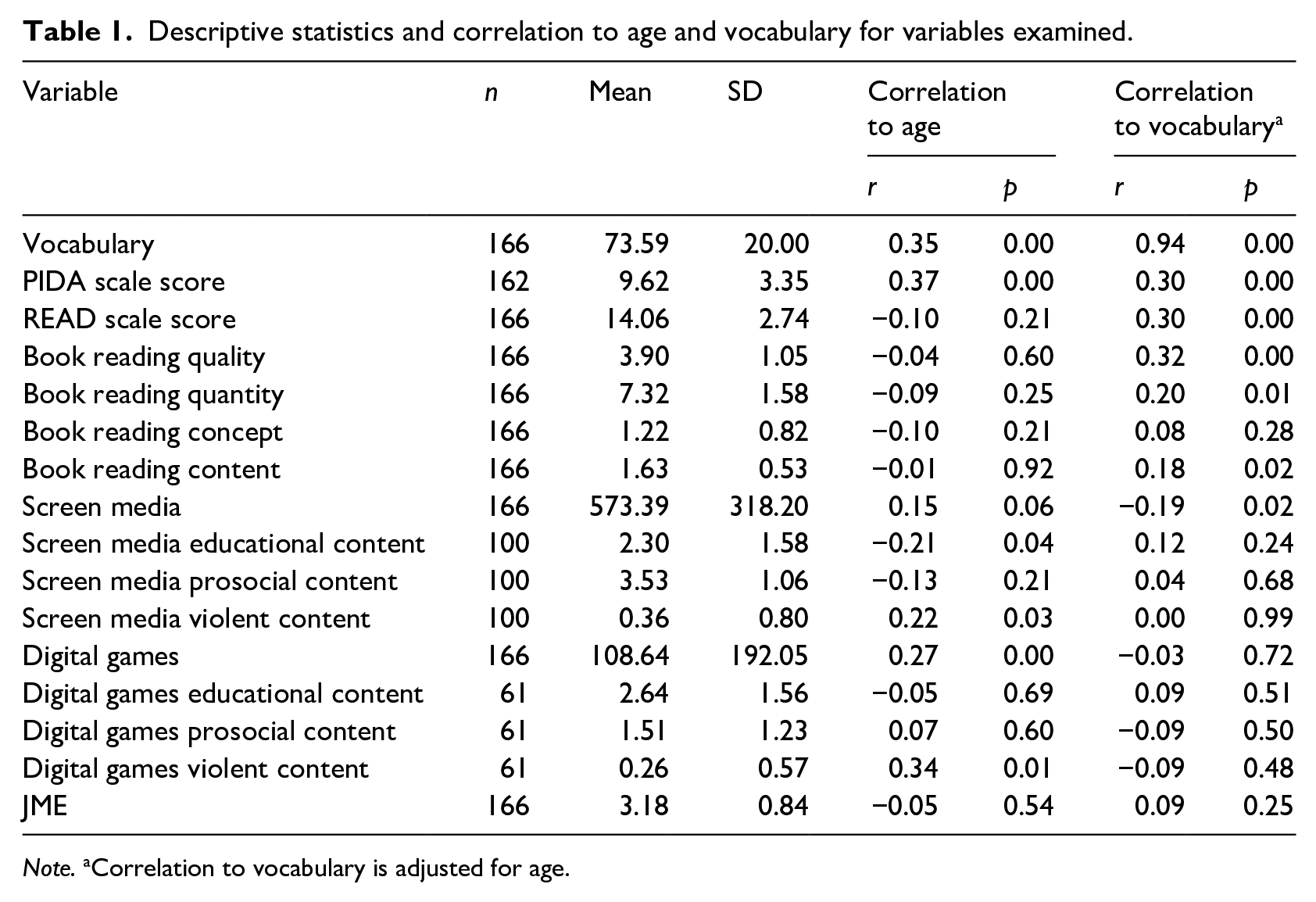
Note. aCorrelation to vocabulary is adjusted for age.
Home literacy environment
PIDA showed a significant increase with age but READ did not (Table 1). As we were interested in different aspects of reading, the sub-scores were also analyzed. Quality of Reading and Quantity of Reading showed variability in scores. Content and Concept of Reading showed little variability and will not be included in further analysis.
Screen media questions
On average, the children watched 1 hour 22 minutes of screen media per day (SD = 44 minutes). All except one child watched screen media daily (min 4 minutes − max 3 hours 20 minutes). It was less common for children to play digital games (53%).
The children’s content was coded according to what the parents stated was the child’s favorite screen media content as well as their favorite digital game.
The parents’ use of joint media engagement, measured with Valkenburg’s instructive scale, resulted in an overall mean of 3.2 (SD = 0.8).
Associations
The children did not differ with regards to gender on any of the variables, except that boys were reported to play games with more violent content (p = 0.04). A partial correlation, adjusted for age was estimated with all relevant variables to the dependent variable vocabulary (Table 1). Screen media, that is total screen use (watching and playing) weekly showed a significant negative association with vocabulary, but since watching and playing displayed different correlations it was decided to use the variables separately instead of the combined total screen media use (Table 1). Due to the low number of coded screen media/digital games content, we could not add the content variables to the subsequent regression.
Regression
We built two different hierarchal regression models to answer the study’s three hypotheses. Predictor variables for the first regression model were theoretically chosen to entangle the possible effect of HLE on the child’s vocabulary outcome, that is hypothesis 1 as well as shown associations in the initial correlational analysis The first step included background variables: child age and gender, parental SES (education used as a proxy), and hours spent in preschool/week as well as the intercept. The second step included aspects of the HLE: PIDA, and quality and quantity of READ. Each step of the model brought forth significant contributions to the prediction of the vocabulary score. As evident from the adjusted R2, step 1 explained 19.7% of the variance of the vocabulary score while HLE in the second step added an additional 16% (ΔR2) of the variance in vocabulary. The final model was significant, F(7, 143) = 11.3, p < 0.001.
A second regression model focused on hypotheses 2 and 3 and analyzed the effect screen media and digital games had on vocabulary and the possible ameliorating effect of the HLE on the association. The model included the same background variables as the first regression while the second step now focused on the time spent with screen media and digital games and the third step included the possible mediation of the HLE; PIDA and quality and quantity of READ, as well as JME. Each step of the model brought forth significant contributions in predicting the vocabulary score. As already evident from the initial model the adjusted R2 in step 1 explained 19.7% of the variance of the vocabulary score, while screen media and digital games use in the second step explained an additional 3%.
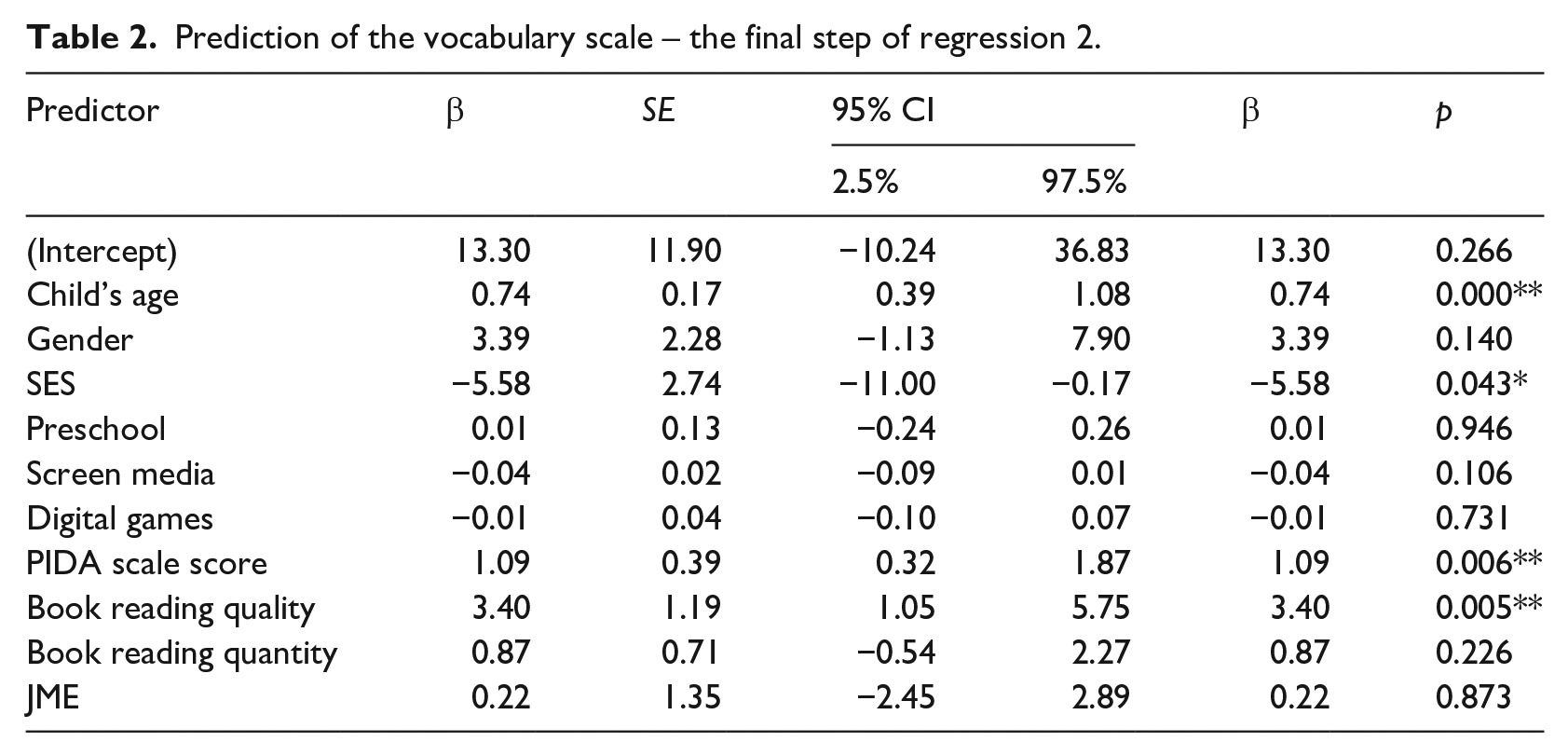
The final step, intended to analyze if the HLE and JME will mediate the effect of screen media use and digital games, accounted for an additional 15%. The final model (Table 2) was significant F(10, 140) = 8,24, p < 0.001, and explained a relatively large portion of the variance (adjusted R2 explaining 33% of the variance).
Prediction of the vocabulary scale – the final step of regression 2.
Discussion
Child vocabulary size is influenced by various factors within the home environment, including their exposure to screen media. Notably, child engagement with screen media exhibited a negative correlation with vocabulary size. Conversely, parent-child interactions in the home literacy environment, such as teaching the child concepts like colors, letters, shapes, and fostering interaction skills during pretend play, demonstrated a positive association with their vocabulary development. The quantity of print books read by parents did not significantly impact children’s vocabulary growth; rather, it was the quality of the reading experience that made a difference. This quality was characterized by active engagement with the child, discussing the content of the books, expressing emotions related to the characters, and explaining words encountered in the books. Importantly, the negative influence of screen media on vocabulary was mitigated when combined with more positive activities in the home literacy environment such as playing with the child and incorporating teaching about letters and numbers into the game or active engagement with the child during book reading.
Positive influence of home literacy environment on vocabulary
Consistent with previous studies of younger children (Alroqi et al., 2023; Medawar et al., 2023) and our first hypothesis the results showed that the home environment accounted for an important aspect of preschool children’s vocabulary learning.
The activities in the home environment contributed to a significant prediction of a child’s vocabulary size even though the preschoolers in this study attended preschool (on average 33 hours/week). We explored various aspects of the Home Literacy Environment (HLE), revealing that not all aspects showed a positive connection with development of vocabulary. Surprisingly, the number of books read was not as critical as how the parents engaged with the child during the reading process. This decontextualized interaction during joint book reading was identified as the essential factor fostering vocabulary growth, consistent with prior research (Rowe, 2012; Tamis-Lemonda et al., 2014; Zimmerman et al., 2009). Several previous studies have examined and pointed to print book reading as an important aspect of the toddlers developing vocabulary (Hanson et al., 2021; Medawar et al., 2023). However, similarly, to Şimşek et al. (2021), the results of the present study showed that just reading the words in a book without interacting, explaining, and connecting the content of the book to the child’s lived reality was not a significant predictor of vocabulary. It appears to be that decontextualized interaction (Rowe, 2012) within the joint activity of book reading is the essential factor. It is this activity that provides support for the child’s construction of meaning and thus for vocabulary learning (Rowe, 2012; Tamis-Lemonda et al., 2014; Zimmerman et al., 2009). This is consistent with the result of the present study where the most important aspects associated with a child’s vocabulary was how the parent read books to their child which is the quality aspect of the subscale of reading.
In this group of preschoolers, it was not the number of books that the child listened to that was important to vocabulary growth, but rather the decontextualized and dialogical interaction that occurred while reading. In the present study, it was not the sheer quantity of books read to children but rather the depth of engagement, which enriched the vocabulary-building process. This result might be worth considering in light of the increased use of eBooks by preschoolers (SMC, 2023), as parents may equate a child’s solitary use of eBooks with the same benefits resulting from interactive reading with a parent. In dialogical reading, the parent scaffolds a child’s learning through questions and interactions (Rowe, 2012; Tamis-Lemonda et al., 2014) and this parental scaffolding is absent when a child uses an eBook alone. The use of joint media engagement when using eBooks is an area that warrants further study.
Another important aspect of the HLE was measured through questions regarding pedagogical activities between child and parent. Examples of this would be questions regarding the parent trying to teach new concepts such as letters, telling time, shapes. These were activities attuned to the child’s present abilities and aimed to teach a new task and focused on decontextualized parental talk explaining or describing new concepts to the child. Recent studies of HLE in younger children have focused on books and parental attitudes toward reading (Medawar et al., 2023) or diary bases measured (Alroqi et al., 2023) and found a relationship to vocabulary. The aim was instead to ask about certain cognitive and language-stimulating activities that they would engage in with their child. We were interested in the activity and not the tool the parents use, they may use a tablet to teach letters, or they may use a pen. In these instances what was of importance was that the child and the parents are interacting, and the focus is on supporting the child’s learning step by step. The data suggested that parents who spend time with the child trying to teach new concepts and thus interacting with their child also support developing vocabulary.
Negative impact of screen media on vocabulary
The second hypothesis was partly confirmed. There was a difference in the association to vocabulary between watching digital media and playing digital games. Digital games did not show any significant positive or negative relation to vocabulary. Time spent watching screen media was associated with lower vocabulary scores. The children in this study spent on average 11 hours a week watching screen media and playing digital games, but the variation was very large, some used almost no screens, and some spent up to 35 hours a week with screens. Parents often seemed unaware of the specific content their children were consuming and were often vague and answered with a general streaming service or a channel.
The parents’ choices regarding children’s screen games were clearer and most parents were aware of the specific game the child played. The child’s favorite digital games were most commonly educational, about for instance numbers, letters, or shapes. Nevertheless, the use of digital games did not appear to support the child’s developing vocabulary.
A home literacy environment ameliorates the negative effect of screen media
The present study’s third hypothesis was partially confirmed as some parent-child activities within the home environment alleviated the negative influence of screen media on vocabulary. While watching screen media alone negatively predicted vocabulary, when considering other aspects of the home literacy environment in the regression analysis, the negative effect of screen media was no longer significant. The study showed that parental activities, particularly the quality of book reading and parental involvement in developmental activities, mediated screen media’s impact on vocabulary. Just as previously, the significant factor is the dialogical reading, not the number of books the parents read to the child. As children show difficulty in learning from solitary screen media use and since this is reduced by joint media engagement, we predicted a positive association between JME and vocabulary (Ewin et al., 2020). Since children tend to struggle with learning from solitary screen media use, a positive effect of joint media engagement was anticipated. However, contrary to previous studies, the data did not reveal a positive association between joint media engagement and vocabulary (Ewin et al., 2020). Several factors might explain this discrepancy, including the specificity and extent of parental joint media engagement and the content children were exposed to (Dynia et al., 2021).
Alroqi et al. (2023) found that toddler’s educational media content did not show a positive association with the child’s vocabulary. We did not find a positive association between educational content and vocabulary. The non-significant association we found could however be accounted for in that many parents were unaware of what content their child was watching. The reason for this most certainly warrants further study.
Limitations
The present study had some limitations. Initially, we intended to incorporate measures of content within both screen media and digital games into the regression analysis. However, this was not feasible due to parental impreciseness when describing content. Many parents were not aware of their child’s favorite screen media content, which may suggest that the content was not pedagogically oriented. The role of parental choices in media content warrants further investigation. Parental choices regarding child media content are an important aspect for further studies. Another limitation is the lack of diversity in the sample, with a higher educational level than the average population. It is possible that the lack of association between the number of books read and single association with dialogical reading is one issue that may be derived from the sample we have examined. Since most parent read to their children, there was less difference, and the large difference was instead if the parent used dialogical reading. Additionally, the absence of guidelines in Sweden regarding screen media usage led to a broad variation in how parents utilized screen media, making the data intriguing but less diverse socioeconomically.
Conclusion
Children’s home literacy environment was positively associated with the development of vocabulary. Aspects of the home environment such as parents engaging in teaching the child colors, and letters and talking about daily activities showed a positive association with developing vocabulary. Book reading was important, but the number of books the parents read did not seem to be associated with vocabulary growth, rather the parent engaging in dialogical reading, discussing the books, explaining the content, and relating it to the life of their child appeared to enhance vocabulary. Previous studies have shown a positive association between the parents’ joint media engagement and pedagogical content to language development, but this was not evident in the data. Digital media showed varied associations with child vocabulary. Although children in this sample mostly played educational digital games there was no positive association with child vocabulary nor was there a negative correlation. Watching screen media was negatively associated with vocabulary. The negative association of screen media was, however, ameliorated by other positive influences in the home literacy environment.
Footnotes
Declaration of conflicting interests
The authors declared no potential conflicts of interest with respect to the research, authorship, and/or publication of this article.
Funding
The authors disclosed receipt of the following financial support for the research, authorship, and/or publication of this article: This research was supported by a grant from the Swedish Research Council for Health, Working Life and Welfare (2020-00229).

Data availability
Data will be made available on request.