




Abstract
Families engage in a range of cultural practices in their everyday lives that shape children’s early literacies. Given the growing number of children who are living outside the country of their birth or their parents’ birth, more research is needed to highlight the under-recognised literacies of young children shaped by their family cultural practices and immigration experiences. This year-long qualitative study in an Aotearoa New Zealand playgroup explored how newly settled families worked to sustain their cultural practices and supported their young children’s understandings of new cultural norms in the context of immigration. Qualitative data collection methods included participant observation in the playgroup and photo-elicitation and semi-structured interview conversations in family languages. Findings highlight family aspirations and tensions regarding children’s participation in family cultural practices over time, sustaining family languages once children transitioned to school, and notions of belonging. Family participation was integral to interpreting children’s meaning-making in the playgroup, including how children flexibly navigated language differences and unfamiliar cultural practices. This study highlights the importance of learning from families about the linguistic and cultural resources young children draw on to represent, communicate and belong in a new country.
Families engage in a range of cultural practices in their everyday lives that shape children’s early literacies (Gregory et al., 2004). However, cultural practices that differ from dominant norms may be under-recognised in educational settings as sources of valuable literacies in early childhood (Souto-Manning and Yoon, 2018). Deficit views of family linguistic and cultural practices that do not align with school-sanctioned literacy practices have persisted in curriculum, policy and pedagogy that promote monocultural Eurocentric, English-dominant approaches (Auerbach, 1989; Avineri et al., 2015; Dyson, 2015; García and Otheguy, 2017). Researchers have long argued for the linguistic and cultural resources of families to be recognised in educational settings as assets children draw on to make sense of their worlds (González et al., 2005; Heath, 1983). When family cultural practices and knowledges are valued, children’s languages, literacies, and identities can be affirmed in the official curriculum of early childhood education and schooling (Hetaraka et al., 2023; Paris, 2012; Si‘ilata et al., 2023; Taylor et al., 2008).
Families who are newly settled negotiate familiar and new cultural practices that inform who they see themselves and their children becoming in a new country (Campano et al., 2016). Family immigration experiences encompass networks across multiple homelands, shaping literacies that transcend geographic, linguistic and cultural borders (Orellana, 2016). Given the growing number of children who are living outside the country of their birth or their parents’ birth, more research is needed to highlight the under-recognised literacies of young children shaped by their family cultural practices and immigration histories. This article highlights a year-long multilingual qualitative study in an Aotearoa New Zealand playgroup that explored the following questions: How do newly settled families work to sustain their cultural practices and support their children to navigate cultural norms in a new country? How do their efforts shape children’s early literacies? The following section describes the early childhood context of the study, a community playgroup.
Playgroups in Aotearoa New Zealand
Playgroups in Aotearoa New Zealand offer an early childhood setting for parents and adult family members to participate alongside their children. Playgroups provide a space for social and learning opportunities specifically through play, are typically set up and run by parents in a community space, and may focus on a specific philosophy or language (Ministry of Education [MoE], 2017a). The Auckland playgroup where this study took place was available three mornings per week. The playgroup was managed by a larger organisation with an appointed playgroup leader, and families attended voluntarily with no fees. The playgroup sessions were relatively unstructured except for weekly ‘mat times’, occasional scheduled outings and special events, and a daily morning teatime. The benefits of playgroups as a support system for families to gain knowledge and skills to support their children have been well-documented in research (McLean et al., 2017). Much less common are playgroup-based studies highlighting the knowledges and cultural practices of families that support children’s learning (Fleer and Hammer, 2014).
The official bicultural early childhood curriculum of Aotearoa New Zealand, Te Whāriki (MoE, 2017b), is anchored in a commitment to Te Tiriti o Waitangi, the founding document of the nation and bicultural treaty between Māori as tangata whenua (Indigenous people of the land) and the British Crown. Te Whāriki supports a vision for ‘children from all backgrounds to grow up strong in identity, language and culture’ (MoE, 2017b: 7) and espouses that ‘children’s learning is located within the nested contexts and relationships of family, community, and wider local, national, and global influences’ (MoE, 2017b: 60). While Te Whāriki also includes the expectation that children will have access to the languages and cultural practices of both treaty partners, the pedagogies of whānau Māori ‘families, including extended family members’ have historically been excluded from the pedagogies of educational settings (Skerrett and Ritchie, 2018: 47). Systemic monocultural dominance perpetuates ongoing inequities and limits possibilities for bicultural belonging in English-medium early childhood education (Chan and Ritchie, 2019).
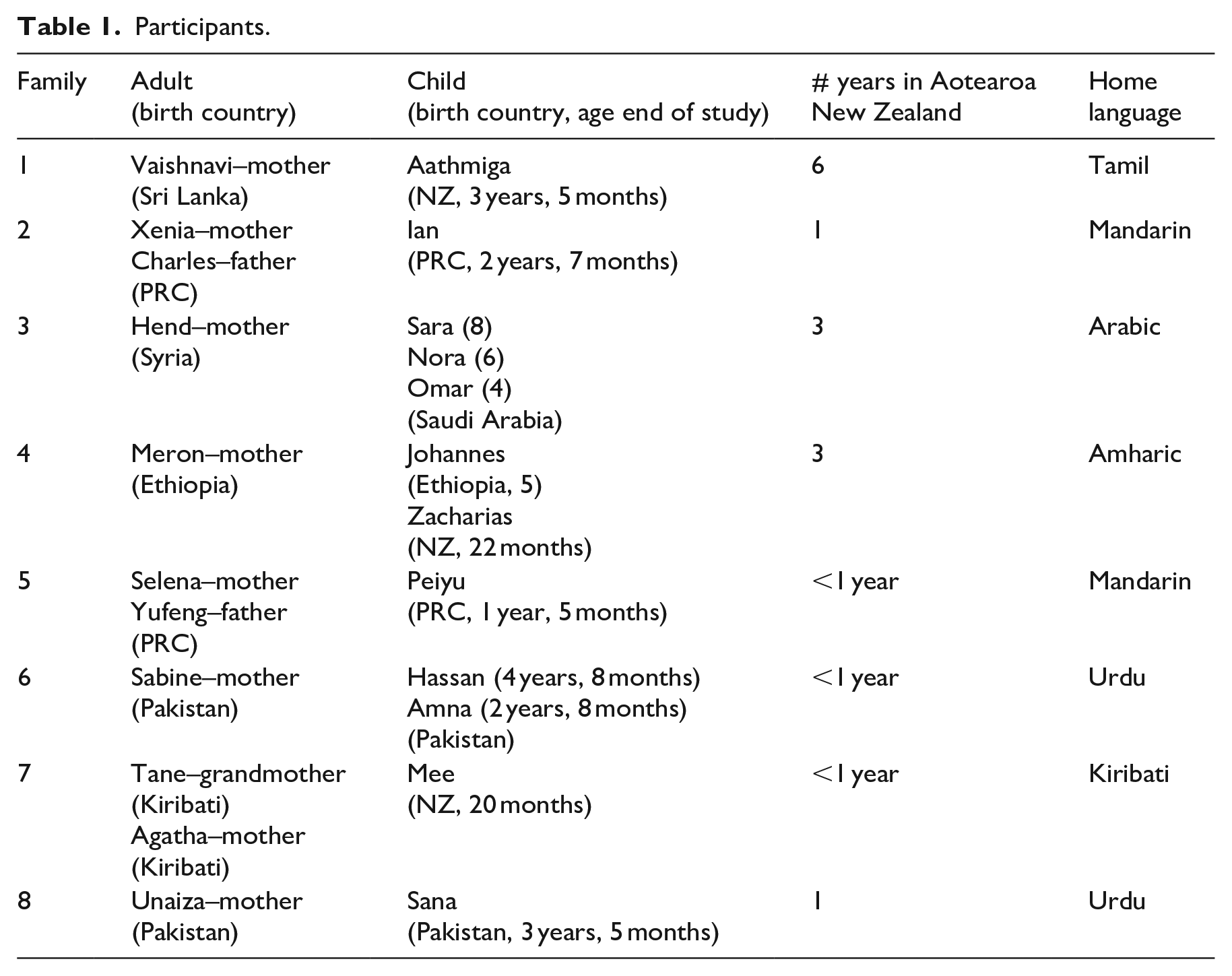
The playgroup in this study represented a microcosm of the superdiversity of Auckland. Auckland is the largest city in Aotearoa New Zealand, where over 160 languages are spoken (Royal Society of New Zealand, 2013) and approximately 40% of residents were born overseas (Spoonley, 2015). Ranging from less than 1 to 6 years of residence in Aotearoa New Zealand at the beginning of the study, the newly settled families identified with multiple national origins, spoke multiple languages, had varied socioeconomic and immigration statuses, and had ties to two or more nation-states (Vertovec, 2007). The following section summarises the sociocultural theoretical notions and literature underpinning the study.
Theoretical lens and literature
Families have unique knowledge, skills and routines that they draw on to thrive and to respond to changing circumstances in their everyday lives. These ‘funds of knowledge’ represent the sustained and changing cultural practices within families over time that support family and individual well-being (González et al., 2005). Souto-Manning and Yoon (2018: 104) argued ‘Funds of knowledge are household-situated cultural practices. They are ways in which families make sense of and in the world, drawing on their histories, and building on their assets’. Family cultural practices are unique to the everyday responsibilities, constraints and desires of the people within families and continually shift with their social, cultural and political realities across multiple contexts and generations (Gutiérrez and Rogoff, 2003; Rios-Aguilar et al., 2011).
Family funds of knowledge align with the theoretical orientation of literacy as a socially and culturally embedded practice (Street, 1984). Literacies are expressed across multiple modes and for varied purposes to communicate and represent particular meanings (Kalantzis and Cope, 2012; The New London Group, 1996) and encompass technological networks that extend across geographical borders (Lam and Warriner, 2012). Young children communicate and represent in multimodal ways (Kress, 1997), weaving together movement, gesture, gaze, touch, visual, auditory, linguistic and other modes to express their intended meanings, and in the use of digital media alongside their families (Marsh et al., 2017). Central to this study is the recognition that early literacies flourish in the everyday cultural practices of families long before children begin schooling, mediated by the important people in children’s lives (Gregory et al., 2004; Kenner et al., 2007).
This study builds on research that highlights children’s literacies shaped by their family’s linguistic and cultural resources, in the context of immigration. Compton-Lilly et al. (2019) highlighted interactive transnational literacy practices of young (im)migrant children and families across various media and argued these practices were funds of knowledge that shaped children’s transnational awareness and cosmopolitanism. Ghiso (2016) documented how young emergent bilingual children who identified as Latino/a, enacted literacies of interdependence reflective of care work that supported family and community well-being at their local laundromat in New York City. The children used photography in their writing to explore their transnational identities in a neighbourhood space that affirmed their families’ values and cultural practices. Orellana (2016) described the transcultural, translingual and transnational literacies of school-age children in an after-school club in Los Angeles, shaped by their family immigration histories from different countries and their interactions with one another.
In Aotearoa New Zealand, educational researchers have documented the early childhood education experiences of children and families from (im)migrant and refugee backgrounds, exploring notions of identity and belonging (Guo, 2017; Mitchell and Bateman, 2018; Mitchell et al., 2020; Rameka et al., 2023), funds of knowledge (Cooper and Hedges, 2014; Si‘ilata, 2019) and parent perspectives (Archard and Archard, 2016; Kindon and Broome, 2009). In a community-based qualitative study with Congolese families, Mitchell and Ouko (2012) found that parents wanted early childhood educators to see them as partners who could explain cultural values and experiences and act as interpreters for their children. The present study aims to privilege the interpretations of the families in order to broaden conceptualisations of early literacy.
More research is needed to understand children’s early literacies in the context of immigration by privileging families as experts in their children’s lives. Tobin et al. (2013: 19) referred to preschools as ‘the most salient sites where the (im)migrant’s culture of home meets the culture of the host society’, signalling the immense potential of learning from newly settled families in early childhood settings. Rather than directly asking families about specific literacy practices, this study focused on the everyday cultural practices families worked to sustain and navigate in a new country. This approach was taken to avoid narrow interpretations or misrecognition of children’s ways of representing and communicating. The playgroup setting allowed for observations of children’s participation in the playgroup alongside family members, and the multilingual qualitative design provided space for families to communicate perspectives in their home languages. These aspects of the study were critical to avoid reproducing ethnocentric definitions of early literacy through my researcher lens.
Positionality
The movement of people across borders is not equal. As a monolingual English-speaking American of European descent, my positionality aligned with the educational cultural norms my family encountered when we emigrated to Aotearoa New Zealand in 2017. Throughout the research process, I experienced a persistent tension that I might reproduce the institutional bias that has privileged my family’s cultural practices for generations, sheltered by my cultural, class and racialised experiences as a student, teacher, and parent.
Method
Newly settled families whose data are highlighted in this article chose pseudonyms and pronouns for themselves and their children (Table 1). Before their enrolment, I engaged in the collective activities of the playgroup for approximately 2 months to establish trusting relationships. The playgroup leader, Matavaha, a Tongan-born-and-raised mother and grandmother who raised her four children in Aotearoa New Zealand, encouraged families to speak in the languages of their homes. Matavaha approached ‘newly settled’ families who lived in the country for 10 years or less with a study invitation during this time.
Participants.
Data collection
Data collection comprised qualitative methods of participant observation and semi-structured and photo-elicitation interview conversations (Saldaña and Omasta, 2017). I engaged as a participant observer in playgroup sessions three to four hours per week over approximately 35 weeks. Attending to my relationships with families was intertwined with recording fieldnotes focused on children’s meaning-making supported by the interpretations of the parents/grandparent.
Families participated in two to three interview conversations that were spread across several months, each between 60 and 75 minutes long. In the photo-elicitation interview conversation, families talked about approximately 10 self-selected photos of people, places and things that were significant to them. Some newly settled families opted not to share photos due to concerns regarding their immigration status. The parents/grandparent also participated in two semi-structured interview conversations. The first was designed to understand family cultural practices that were important to sustain and the family’s transition to a new country. The final interview’s purpose was to share transcripts to confirm translations and interpretations of what families shared in the first two interviews.
Most interview conversations were conducted in the languages of family homes. In total, 20 interviews were led by translators and conducted in Amharic, Tamil, Arabic, Mandarin, Kiribati and Urdu. I engaged in all of these interviews as an attentive listener and the conversations were seldom interrupted for English translation. The positionalities of the translators intersected with the participants in one or more ways beyond language. For example, translators in several pairs had the same religious affiliation as the families, sometimes attending the same temple, mosque, or church. Translators transcribed interview conversations, privileging meaning rather than word-by-word translation and transcripts were shared with participants for their approval. The cultural expertise of the translators invited interpretations that my subjectivities may have misrepresented (Jacobs and Marea, 2019).
Data analysis
Although sociocultural theoretical constructs influenced my research lens, I did not apply preconceived categories or codes to the data. During initial data analysis, transcripts were coded line by line and field notes by single observations to identify the most frequently occurring codes. Initial codes with similar content were combined into broader concepts. All concepts were defined to analyse larger sections of data through focused coding. New codes were added with each new piece of data collected and compared with existing concepts so analysis remained open to new insights. These processes overlapped to identify patterns across the data set, to inform subsequent phases of data collection and analysis and to identify themes (Charmaz, 2014). In the following section, I highlight findings from two overarching themes, Everyday Ways of Knowing, and (Be)longing.
Everyday Ways of Knowing
Everyday Ways of Knowing represents knowledge embedded in everyday family cultural practices connected to important people, places and artefacts, as well as the ways families navigated new practices across cultural, linguistic and geographic borders. This theme consists of two subthemes: (1) Recognition of family knowledges and (2) Early literacies across multiple modes, languages, and cultural practices.
Recognition of family knowledges
Families emphasised children’s knowledge related to significant people, places and artefacts in their lives. Meron emphasised the importance of her family’s participation in their Ethiopian church community:
When we go to church, we learn about being spiritual and that is like food to life. As we eat injera [Ethiopian bread] for the physical body, studying holy scripture is same to our spiritual life. When we go to church, we listen to mass and various holy books are read to us. (Interview, translation from Amharic, 27 September 2018)
As Meron spoke in Amharic during the photo elicitation interview, she shared the family Bible with a bookmark tucked inside. Zacharias kissed an image of Jesus on the bookmark. His mother explained:
The young one understands about religion, for example, such things like kissing the Bible and other holy books and pictures of saints. When I do my prayer, he always asks to give a kiss to the prayer book. (Interview, translation from Amharic, 27 September 2018)
Zacharias participated alongside his family at church and at home as he learned to ‘read’ the images of the Bible, and other texts significant to his family.
The parents/grandparent were integral to recognising and interpreting family knowledges that children embodied at the playgroup (Jacobs, 2022). Tane and her granddaughter, Mee, began attending the playgroup after returning from the Pacific Island nation of Kiribati, where Mee lived with her grandparents for 7 months. Mee regularly sang the same song to dolls before lying them down to sleep. At 15 months old, Mee knew how to carefully hold and shush the baby, gently patting the baby’s chest as she sang. Tane explained that the song she sang, chosen for Mee to teach her when to sleep, was from the Kiribati island where Mee’s mother was born (Fieldnotes, 12 September 2018).
Like Mee, many children played the ways of their family homes, drawing on their languages and cultural practices (Jacobs, 2022). Aathmiga storied herself as Krishna, a Hindu deity, when playing with another child who spoke Tamil at the playgroup. Vaishnavi interpreted Aathmiga’s desire to be Krishna as a reflection of the stories, music, dance and artefacts connected to the family’s everyday Sri Lankan Tamil Hindu practices at home and temple (Fieldnotes, 6 June 2018).
Family knowledges extended beyond household-situated practices to multiple settings of significance to families, in Auckland and overseas. The navigation of new practices, often discussed and supported by parents/grandparent at the playgroup, also shaped new ways of knowing.
Early literacies across multiple modes, languages and cultural practices
Families engaged in everyday ways of knowing across multiple languages and cultural practices, as well as modes and media. Families noted when their children were trying out new, everyday ways of knowing. They explained how children were learning to understand cultural practices in a new country. Tane explained why she sat behind Mee’s chair during ‘morning tea’:
Tane: She’s not used to chairs because back home in the islands, there are no chairs or table. She’s new to the table and chair. That’s why I sit beside. That’s why she knows how to do both. And she can now speak two languages. We laugh, she seems to be translating. She is learning both now! (Fieldnotes, 26 September 2018)
Sabine noted how she supported Hassan and Amna to understand why some foods offered at playgroup conflicted with their family’s Muslim practice of only consuming halal foods:
They have also come to understand much about halal and haram. Many birthday parties are arranged here so that’s why I tell them that we cannot eat cake or any other food items that are not halal. Now they have come to understand it and they do not insist on eating something. (Fieldnotes, 21 June 2018)
Parents/grandparent also learned alongside their children about cultural norms at the playgroup. Unaiza led paper poppy wreath-making at the playgroup in recognition of Anzac Day (remembrance day for soldiers who died and served in WWI). Sana busily folded the red tissue paper as she listened to her mother talk about the day with other parents in English and Urdu. After singing a waiata (song in te reo Māori) with playgroup families gathered around a memorial display at the school, Sana laid a wreath with the other children. Unaiza, who aspired for her children to grow up practicing Islam in Aotearoa New Zealand, watched Sana carry the wreath and said, ‘This is how we can become New Zealanders. We can be who we are and we can show respect for the history of New Zealand’, acknowledging the historical significance of the day and her family’s participation (Fieldnotes, 26 April 2018).
Young children also demonstrated sociolinguistic competence as they drew on their full communicative repertoires at the playgroup. One day at the playgroup, I incorrectly referred to the striped animal-print tracksuit Ian was wearing as a ‘cheetah’. Ian left for a moment, retrieved a plastic tiger from a nearby shelf, and returned to place it in my lap. In this moment, Ian demonstrated sophisticated sociolinguistic competence by interpreting my confused statement in English, recognising I did not understand Mandarin and communicating meaningfully by retrieving the plastic tiger to support my understanding of big cats! (Fieldnotes, 15 May 2018).
Hassan used a combination of words in Urdu and English, facial expressions, and intonation and gestures towards the traditional festive clothing he was wearing to invite me to celebrate Eid, the Muslim celebration that marks the end of Ramadan. Hassan excitedly led me outside to look at the sky, pointed towards the clouds, and exclaimed ‘PARTY!’ Sabine was alongside, visibly proud of her young son’s efforts to communicate the significance of Eid and the family’s plans to celebrate. Sabine explained that the time of Eid is determined by the position of the moon (Fieldnotes, 14 June 2018).
The sociolinguistic and transcultural flexibility of young children was also enhanced by family use of digital media. Families shared how they stayed in touch with family living overseas through social media apps such as Facebook, WhatsApp, Instagram and WeChat. Many of the families engaged in video chats or FaceTime with loved ones on a weekly, and sometimes daily, basis. Yufeng described the connection it created for his mother in China and her grandson, Peiyu:
Through direct video calling. . .she feels much relief about missing her grandchild. Because watching a motional video is totally different from looking at the pictures or listening to the voice only. The form of multimedia significantly helps to shorten the distance. (Interview, translation from Mandarin, 16 February 2019)
Digital connections also provided a platform for families to counter dominant discourses about their home countries. When Hend described how her parents wanted to return to Syria from Saudi Arabia, the translator (name withheld to protect confidentiality), who also attended the family’s mosque, suggested it was not safe:
Translator: Really? But it’s not safe there. Hend: No. Things have really settled in Aleppo. Every couple of days my relatives are uploading photos of their gatherings and dinner parties. (Interview, translation from Arabic, 14 June 2018)
Digital connections allowed families to sustain family relationships, participate in the social, cultural and political contexts of multiple nations, and expand their funds of knowledge locally and globally with their young children alongside them.
(Be)longing: Being and Longing
The theme (Be)longing highlights the tension of engaging in the widely privileged practices of Pākehā (New Zealanders of European descent) culture in Aotearoa New Zealand, especially with regard to raising children. The tension between being and longing acknowledges the aspirations families had for settling in a new country while sustaining what was dear to them from the places they left, and the inevitable pull between the two. This theme consists of two subthemes: (1) The central importance of language/s and (2) Change over time in family cultural practices.
The central importance of language/s
The playgroup provided a linguistic space where families felt comfortable to speak in the languages of their homes. Selena shared how Matavaha supported her to navigate the tension of ‘fitting in’:
When we are at the playgroup, Matavaha told me that it is okay to speak to Peiyu in our mother tongue. She has been encouraging us. At the beginning, I was worried that everybody has to speak English otherwise you are not fitting in. But then later I realized that speaking Chinese does not mean you are not blending in. When you reflect, you will understand that Chinese language including ancient Chinese poetry is beautiful. I don’t feel embarrassed talking about it and see myself as different. (Interview, translation from Mandarin, 17 October 2018)
Families discussed their efforts to keep speaking to children in the languages of their homes, while acknowledging the inevitable pull of English. Parents expressed the importance of their family language to sustaining cultural practices:
And, we would try to keep speaking Mandarin in our family. I think this is something we, Xenia and I would keep, maybe for years and even longer. Because, Chinese culture is quite different from the western culture. And we also know there are some good parts in both of the cultures. So, we are trying to keep some- the cultures that we had, and also, want Ian to be proud of that kind of culture. To like him to be - first, a bilingual; second, an international person. (Interview with Charles, 5 April 2018)
Parents recognised that the influence of English would grow as children approached school-age:
We know after 3 years she [Aathmiga] will definitely speak in English so we thought okay we will speak in Tamil at home. (Interview with Vaishnavi, 15 May 2018)
Parents worried both about the possibility of language loss and English language competence, especially in anticipation of the transition to an educational setting without them. Xenia expressed concern with Ian learning English and being able to communicate in Mandarin once he went to kindergarten:
I’m very concerned about language Ian can’t understand. They said he has time to fix it and there are teachers who speak Chinese but they want kids to speak English because they want the kids to get engaged with others. (Fieldnotes, 5 September 2018)
Sabine attended playgroup to protect her home language:
The truth is that I have not been able to adjust myself till now. My son was enrolled in a Kindy but I didn’t let him go there because I felt that he would totally forget Urdu. If I come with him, then he will not forget it. I don’t want him to forget Urdu. Children tend to forget their first language. (Interview, translation from Urdu, 21 June 2018)
Parent aspirations and efforts to sustain their home languages extended to supporting children to learn to read and write. For Meron, sustaining the Amharic language in her children’s lives, including learning to read and write, was necessary for 5-year-old Johannes to stay connected to Ethiopia, his birthplace and her homeland:
When he turns 6, the Ethiopian Amharic school is available. I’ll take him to the Amharic classes and make him study Amharic. Speaking can be learnt from parents at home and the school is good for strengthening his Amharic. In addition, I want him to know how to write and read in Amharic and, God willing, I would like to take him to Ethiopia. (Interview, translation from Amharic, 25 June 2018)
Hend explained the importance of her children learning Arabic to nurture and sustain family relationships:
She knows how to write, but it’s easier and more fluent for her in English, but I tell her no, look Sara. I tried to explain to her about the future that if you don’t practice and put in the effort then you won’t excel in this area and you will make excuses and you won’t understand me anymore when I speak to you in Arabic or even with Grandma. (Interview, translation from Arabic, 6 November 2018)
Parents worked to sustain the languages of their homes beyond oral language and aspired for their children to be both bilingual and biliterate. These efforts were anchored in their desire to strengthen connections with family members abroad and within their homes, as parents anticipated dominant cultural practices would change family practices over time.
Change over time in family cultural practices
The parents/grandparent in the study reflected on how their cultural practices would change over time, shaping family relationships and children’s sense of ‘home’. Vaishnavi expressed how attending temple would change over time for Aathmiga:
Sujatha (Tamil co-researcher/translator): What is the most important cultural practice for you? Vaishnavi: Going to temple. I think, as the child grows here, the temple visits will reduce. They will give the excuse of class and exams. (Interview, translation from Tamil, 11 December 2018)
Charles wondered if Ian would embrace his family’s Chinese culture and history growing up in a new country:
He will be influenced not only by us two but by every aspect of his life. But that is the life in New Zealand and what he will grow up as. Of course, I hope that he will be willing to accept Chinese culture or history because I want to teach him about what I consider as good. I have gained and discovered a lot from it, at least to me, so I hope to some extent, he can understand me. I am not asking him to follow my path but at least he can say ‘Oh, that is the way my dad lives and learns’. (Interview, translation from Mandarin, 7 November 2018)
Hend acknowledged that her children might struggle with making sense of their family’s immigration history and where they belong:
Maybe it’s [Aotearoa New Zealand] my other home, it’s my other homeland. This thing might be difficult really. It’s going to make us confused before it makes the kids confused. Where am I going to belong to afterwards? New Zealand, Syria, where? Sara from now is confused like ‘am I Syrian or Saudi?’ She was born there and she remembers her childhood there so it is actually difficult. (Interview, translation from Arabic, 6 November 2018)
Parents/grandparent understood that sustaining their family cultural practices and languages contributed to well-being in a new country, to family relationships abroad, and their children’s understanding of ‘home’ in multiple places.
Discussion
This study contributes to playgroup-based scholarship that shows what can be learned from families when they participate in early childhood settings alongside their children (Fleer and Hammer, 2014). The findings concur with research that suggests families who are newly settled in Aotearoa New Zealand want to contribute to their children’s early childhood education experiences and act as interpreters for their children (Mitchell and Ouko, 2012). The data show that the parents/grandparent in the study wanted to attend the playgroup to sustain their languages and cultural practices and to support their children to better understand and navigate new cultural norms. As this study shows, the participation of newly settled families in the playgroup provided space for them to ‘prioritise these values and hold the essential cultural knowledge to engage in such bilingual and multilingual interactions’ (Mitchell and Bateman, 2018: 389) with their children, strengthening a sense of belonging for both.
The presence of families at the playgroup was integral to interpreting children’s meaning-making and their interpretations amplified children’s early literacies (Souto-Manning and Yoon, 2018). Positioning family languages and cultural practices as central to understanding early childhood literacies can disrupt the ‘indiscriminate erasure of children’s language strengths’ (Dyson, 2015: 201) perpetuated by monocultural conceptualisations of early language and literacy (Avineri et al., 2015). Although the parents/grandparent were not asked directly about family literacy practices, they shared insights about family knowledges embedded in children’s play and their aspirations for children to speak, read and write in their home languages. However, families were aware that their funds of knowledge might not be given power and status in English-medium educational settings in Aotearoa New Zealand (Rios-Aguilar et al., 2011).
Funds of knowledge were also shaped by accessible and multiple digital media connections to homelands, shaping digital literacy practices as young children participated alongside their families (Marsh et al., 2017). These interactive and receptive multimodal communicative practices across geographic borders are described by Compton-Lilly et al. (2019) as transnational literacies that give rise to transnational funds of knowledge. Digital media were essential for families to stay connected in ways previous generations were not able to. While the ways young children in the study engaged with digital media may seem ubiquitous, their growing awareness of the places from which their families emigrated was supported through the everyday digital connections to ‘other languages, cultural messages and perspectives that contribute to expanded ways of thinking’ (Compton-Lilly et al., 2019: 12). Valuing children’s transnational funds of knowledge may contribute to a greater understanding of children’s ‘transcultural dispositions and competencies’ in early childhood education and schooling (Orellana and D’warte, 2010).
The young children in this study navigated multiple languages and unfamiliar cultural practices, suggesting implications for early childhood research and pedagogy in a time of accelerated transnational connectivity and mobility. The complex understandings of young children who traverse linguistic and cultural differences between family/home and education settings are important to validate as critical to global citizenship. Orellana and D’warte (2010) argued for educators, policymakers and literacy researchers to recognise different kinds of ‘head starts’ that privilege social and cultural experiences that shape skills ‘conceivably better aligned with the broad, transcultural, and flexible literacy skills that will be demanded in their futures’ (298). Broader notions of early literacy need to be taken up in educational research and policy to officially sanction transcultural competencies and dispositions as critical literacies for all children.
Althoughwestern educational institutions have begun to shift policy to recognise linguistic and cultural diversity, inequitable power relations and a persistent monocultural status quo narrow the scope for languages and literacies to be reclaimed and sustained (May and Sleeter, 2010; Paris 2012). As superdiversity increases with (im)migration, the ongoing impacts of colonisation and marginalisation of Indigenous peoples, limit privileging of Indigenous and minority ethnic group knowledges (Spoonley, 2015). Disrupting monocultural dominance is essential to widening the scope for early literacies anchored in family cultural practices. Glasgow and Rameka (2017) emphasised foregrounding Māori and Pacific infant and toddler caregiving to sustain traditional cultural practices and to expand pedagogical repertoires across early childhood settings. Si‘ilata (2019) argued for wider recognition of literacies represented in Indigenous cultural practices: ‘…for Māori and Pacific peoples, storying or storytelling was an important languaging practice, well before stories were written into books. It is often through storying and remembering stories that tikanga or cultural knowledge is shared’ (13). In Aotearoa New Zealand’s education system, validating transcultural dispositions and competencies aligned with obligations to Te Tiriti o Waitangi, requires reconceptualising literacies from Māori worldviews (Hetaraka et al., 2023).
This bicultural imperative also suggests implications for the enactment of Aotearoa New Zealand’s early childhood curriculum, Te Whāriki (MoE, 2017b), and transitions to schooling (Skerrett, 2018). Chan and Ritchie (2019) stressed the importance of newly settled families having opportunities to make bicultural connections with local histories and places significant to Māori and to engage with te reo Māori (language) and tikanga Māori (cultural practices) in early childhood education. Mitchell et al. (2020) described how ‘walking and storying the land’ (14) within ECE communities strengthened bicultural belonging, and created possibilities for children from immigrant and refugee backgrounds to connect with their homelands. Future research could explore young children’s transcultural dispositions and competencies in education settings that normalise the languages, histories and cultural practices of both founding partners of Te Tiriti o Waitangi to understand how these critical early literacies intersect with culturally sustaining pedagogies (Paris, 2012) and bicultural belonging (Mitchell et al., 2020).
The present study has limitations. Engaging in multilingual research as a monolingual researcher limited my interpretations at the playgroup (see Jacobs and Marea, 2019) as did my unfamiliarity with aspects of the larger societal context of Aotearoa New Zealand as a new immigrant. Additionally, with the exception of visiting two family homes, most interactions with families took place at the playgroup. The context of family homes would have enhanced my understandings of how family cultural practices shaped children’s early literacies. Ethical considerations of some families’ early hesitancy to participate due to immigration status, informed my decision to carry out the research at the playgroup unless the home context was preferred by families.
Early childhood settings and schools that regard families as knowledge holders (Si‘ilata et al., 2023) are well-positioned to value the complexities of belonging for newly settled families and their children and their flexible navigation of linguistic and cultural borders (Mitchell and Bateman, 2018; Rameka et al., 2023). Literacy, narrowly defined, is dismissive of the transcultural and transnational realities of children’s lives (Compton-Lilly et al., 2019; Jacobs et al., 2021) and the competencies and dispositions shaped by their lived experiences (Orellana, 2016; Orellana and D’warte, 2010). Legitimising the early literacies of young children in the context of immigration requires educational research, policy and practice to regard the funds of knowledge of newly settled families as assets their children draw on to make sense of their lives in a new country. Learning from newly settled families is essential to understand how young children communicate, represent and belong, shaped by the multiple places they call home.
Footnotes
Acknowledgements
This study was made possible through a Research Fellowship with the Marie Clay Research Centre, University of Auckland. Many thanks to the children, families, playgroup leader and the translators/interpreters who contributed to this study. Thank you to the Auckland Kindergarten Association and the public-school leaders and staff who supported the research at the community playgroup. The University of Auckland Human Participants Ethics Committee reviewed and approved this study: reference 2017/020365.
Declaration of conflicting interests
The author declared no potential conflicts of interest with respect to the research, authorship, and/or publication of this article.
Funding
The author disclosed receipt of the following financial support for the research, authorship, and/or publication of this article: This work was supported by the Faculty of Education and Social Work, University of Auckland [Project 3715752].
