




Abstract
Young children in many parts of the world are spending more time in formal education and care settings. As children have the right to be heard on matters that affect them, their views about the early childhood environments they inhabit, need to be included in the process of placemaking. Early childhood environments have the potential to shape a child’s identity, sense of belonging and inclusion. This research sought children’s ideas about their early childhood setting, with the view to informing the design of a new inclusive centre. Researching with children aged three-to-five, from a low socio-economic ethnically diverse suburb, multi-modal data were generated in three phases: child-led photo-taking tours; photo elicited interviews; and interview elicited drawing. Findings showed a preference for the outdoors, along with places for hiding, safety, cleanliness and authentic rather than ‘fake’ resources.
Introduction
Children in many societies are spending an increasing amount of time in formal education and care settings (Australian Institute of Health and Welfare [AIHW], 2021). Early childhood environments are therefore significant in shaping children’s identities, belonging and inclusion. Research exploring children’s views then is of importance for policy-makers educators and planners (MacNaughton and Smith, 2008). Additionally, the United Nations Convention on the Rights of the Child (UNCRC, 1989), states that even the youngest children have a right to be consulted in matters that affect them to improve their learning environments, wellbeing and the quality of their lives. Too often young children have been positioned as vulnerable, incapable or ‘citizens-in-the-making’ (Clark, 2010; Langford, 2010) despite them being competent meaning makers in their own lives (Smith and Kotsanas 2014). They provide unique insiders’ perspectives as they form relationships to place, offer valuable insights and challenge adult agendas (Ergler et al., 2015; Jeanes and Magee, 2012; Koller and Farley, 2019; Tay-Lim and Lim, 2013). Incorporating children’s views recognises their right to influence placemaking within their environments (Markström and Hallden, 2009; Theobold et al., 2015).
Participatory methods of research with children were used in this study to investigate inclusive placemaking possibilities (Clark, 2010). As researchers we did not wish to position the children as objects of the research (Mason and Danby, 2011; Qvortrup et al., 2009). Instead, we recognised the children’s agency, rights and expertise. We sought ideas about what they might imagine in planning and designing a new inclusive early childhood centre (Ergler et al., 2015; Koller and Farley, 2019). The research was commissioned by an early childhood centre owner interested in giving voice to the children’s design and placemaking ideas. This research will inform the designing architects, planners and builders, giving the children a voice. The authors are early childhood university-based researchers with experience in inclusion at university and centre levels. Author two is an inclusion consultant for the new centre and invited author one to join the research because of her experience with inclusion and researching among children. A research report has been submitted for use by funders and architects and will be discussed with the organisation Advisory Board.
This research brought together belonging, identity and inclusion as essential concepts for placemaking and being ‘in place’. Our working understanding of belonging as knowing ‘where and with whom you belong’ was drawn from The Australian Early Years Learning Framework (Australian Government Department of Education, 2022: 6). When belonging is foregrounded, all children, educators and families feel they are important and valued members of the group. Identities are shaped by a child’s sense of belonging and inclusion in a place (Strong-Wilson and Ellis, 2007). We have conceptualised inclusion as a process, dynamic and continually evolving in practices where respect for difference is enacted in place, in word and in action (Watson, 2017). Respecting and accommodating diversity is not seen as an ‘add-on’ when the need arises (Graham et al., 2021) but as everyday practice. When inclusivity is made visible to children and families representations of language, culture, ability/disability and gender, are evident, with belonging nurtured (Nemeth, 2021). For all children to be included, exclusions must be identified and addressed at the design phase (Jeanes and Magee, 2012; Merewether, 2015). Making visible and addressing any barriers to inclusivity that exist, or evolve as placemaking unfolds, is important for the participation of all (Pivik, 2010).
Placemaking with children
Placemaking is a cornerstone of this research and is the ‘participatory act of imagining and creating places with other people’ (Derr et al., 2018: 2). It concerns itself with meanings people attribute to ‘place’, which in human geography refers to the environment in which somebody lives and acts, and of which they make interpretations (Raittila, 2012). Placemaking with children involves connecting children’s social sites of belonging with other spheres they encounter in their everyday lives (Denov and Akesson, 2013). It is something we all do as we sustain, question and create knowledge about place. Although more often viewed as the concern of architects, designers, planners, engineers, builders and managers, placemaking extends beyond the physical as a site of conflict, interpretation and meaning (Sanchez, 2011). It is about the connections and sense of community in creating a place for oneself, including the relationships among people within places (Denov and Akesson, 2013). Research with children about placemaking has shown that children have definite opinions about where, how and with what and who, they play.
Young children have been shown as active place makers in research across various settings including schools, hospitals, early childhood settings and neighbourhoods (Greenfield, 2004; Koller and Farley, 2019; Merewether, 2015; Rogers, 2012; Rogers and Evans, 2007). They demonstrate a knowing and caring about the environments they experience. Children’s thoughts about places they inhabit need to be valued as equal to adults’ (Madden and Liang, 2017). Children have been shown to be place makers from birth, imagining and creating places with others (Derr et al., 2018; Fischer, 2020). Research with children about the places they inhabit, has made visible how capable children in expressing their views and sharing their lived experiences with others (Gallagher, 2004; Smith and Kotsanas, 2014; Watson, 2017).
Placemaking has the potential to construct meaning that shapes a sense of belonging and identity for children (Strong-Wilson and Ellis, 2007). In early childhood contexts, children have shown that they value places to be social (Greenfield, 2004; Koller and Farley, 2019; Merewether, 2015; Rogers, 2012; Rogers and Evans, 2007), which can facilitate building of identities shaped by relationships (Clark, 2007). A critical part of children’s identities and self-hood is having and being friends (James, 1993). A child’s self-identity is also linked to their sense of place identity (Clark, 2010). Places can fashion narrative for children about who they and where they come from, offering children multiple meanings about themselves and others.
In placemaking research in early childhood settings in Australia, Iceland, Sweden and the United Kingdom, children have voiced a preference for being in outdoor places that allow them to enjoy a sense of freedom, less formality and minimal adult involvement (Clark, 2007; Einarsdóttir, 2005, 2014; Merewether, 2015; Markström and Hallden, 2009; Norodahl and Einarsdottir, 2015). Places that were more ‘open’ in relation to space, equipment, educators’ attitudes and routines where they had greater choice over materials, location and playmates were preferred (Rogers and Evans, 2007; Stephenson, 2002). Additionally, children have voiced a desire to have less adult control (Corsaro, 2009; Koch, 2018) to enjoy places where they can be hidden but can watch what is going on (Fleet and Britt, 2011). Secret places in their early childhood setting are valued by some children, where they feel safe and unseen but know that adults are present (Colwell et al., 2016). Places position children in particular ways, and can offer a sense of autonomy, if they can create the perception of minimal adult surveillance, contributing to a child’s identity formation (Rogers, 2012). When asked about activities and equipment, children in the USA and Norway voiced a preference for ‘play’ objects that were flexible, allowing for play in multiple ways, and ‘real’ rather than play/pretend object substitutes, often designed to meet basic developmentally appropriate milestones (Nicholson et al., 2015; Sandseter, 2007). Too often, adults in creating places, position children via a deficit discourse rather than a strengths-based one (Nicholson et al., 2015).
Alongside a preference for outdoors, children in Australian early childhood settings have described a desire for physical challenges in their environment; places to move, slide, swing, run, climb or jump (Merewether, 2015). In recent times there has been a tendency to construct risk adverse places for children, controlled by safety standards, regulations and close supervision, however this has been argued to potentially impact children’s activities and choices (Brussoni et al., 2012). Despite an undisputed need for safety and security in early childhood settings (Clark, 2010), there is value in risky play (Sandsetter, 2010) and children have expressed feelings of enjoyment and achievement as they master new and challenging tasks. The balance between safety and risk highlights the need for children’s voices (Allin et al., 2014; Kandemir and Sevimli-Celik, 2023). Advocacy for risky play in safe environments with intentional educators in Australia and in Europe points to the benefits to a child’s becoming identity, wellbeing, learning and self-esteem (Higginbottom et al., 2023; Nikifiridou, 2017).
This study contributes to the research body as it involves children’s voices being heard by adults; architects, designers, managers and builders, to enhance equity, and inform design and building decision-making processes, too often controlled by adults (Birch et al., 2017).
The study
This research aimed to build understandings of children’s experiences and ideas about what might create an inclusive early childhood centre, a place and space where they all want to be, with the view of informing the planning and design of a new early childhood setting.
The following research questions guided this study
What do young children most value in their current play space?
What is important to young children when place making?
The research took place in a suburban early childhood centre in Sydney, Australia. The families of the children are immigrants from Lebanon, noted for national post-traumatic stress disorder from wars, but also for valuing family and meeting in large family groups (Shaweesh and Greenop, 2020). The suburb is marked by high unemployment, low incomes and education levels, and a lack of internet access (Glenn – the Census Expert, 2018). Many pre-school aged children have English as a second language (48.9%) with some not fully proficient in English (6%). The suburb had 7.5% of children regarded as ‘vulnerable’ on two developmental domains at school commencement in 2018 and 18.4% in 2021 compared to a national figure in 2021 of 11.4% (Commonwealth of Australia, 2019, 2022). The 26 children in this study were aged between 3 and 5 years old. Four children had diagnosed disabilities. Our conversations with the children focused on place, not on disability or family background. We interviewed one girl with Autism, one boy with selective mutism and several children with speech and language delay. The children came from Muslim and Christian religious backgrounds. An appreciation of the complexity of this diverse community is often not visible in wider educational systems that continue to privilege the more advantaged (Comber, 2011: 343). Historically education system and the places they inhabit, have made little provision for difference but have instead focused on sameness and assimilation (Watson, 2017; Welch, 2018).
Methods
Qualitative research (Clark, 2011) was employed and participatory methods (Tay-Lim and Lim, 2013) were drawn on to research with the children, drawing inspiration from the Mosaic Approach (Clark and Moss, 2011). Data generation involved multi-modal communication methods (Clark, 2011). The three phases of data generation were: 1) Child-led photo-taking tours; 2) Photo elicited interviews and 3) Interview elicited drawing. The research took place over a two-week period with 4 day-long visits to the centre. There was a purposeful intention not to attempt to interview all the children in the classroom, as we wanted the children to take the lead in decision-making.
Research approval was granted by The University of Newcastle, Australia (approval H-2020-0155). Families received written information statements and a visual information booklet with photos of the researchers was created and distributed to parents and staff as an introduction for the children. Verbal assent was sought before all interactions with children. All research was conducted in view of centre staff and confidentiality was maintained by using pseudonyms in reporting.
After a day spent getting to know the children, those interested were asked to take photos of the places they liked the most in their centre, with a view to draw out potential ‘deep and interesting talk’, unforeseen meanings and interpretations (Lapenta, 2011). Interviews were conducted with pairs of children using their own photos as stimulus. Photos from the internet of other contexts, inclusive playgrounds and facilities were also presented in the interviews (e.g. wild nature spaces, wheelchair swings etc.) to encourage children to think outside the current context, to imagine different spaces. As the spoken word is not always the preferred or most informative way of expression for children (Clark et al., 2005), four pairs of children who remained engaged, were then invited to draw their ideas. We discussed with the children their contribution to planning the new space, explaining the role of an architect, and how their ideas would be passed on.
Children were enthusiastic about showing us around their centre, generating 387 photographs with 40 discarded as adult photos or unusable (e.g. hand over lens). Table 1 shows our first coding for photos only and the children’s priorities indicated by the number of photos. A short description indicates the type of photos that were mostly taken:
Children’s photographs.
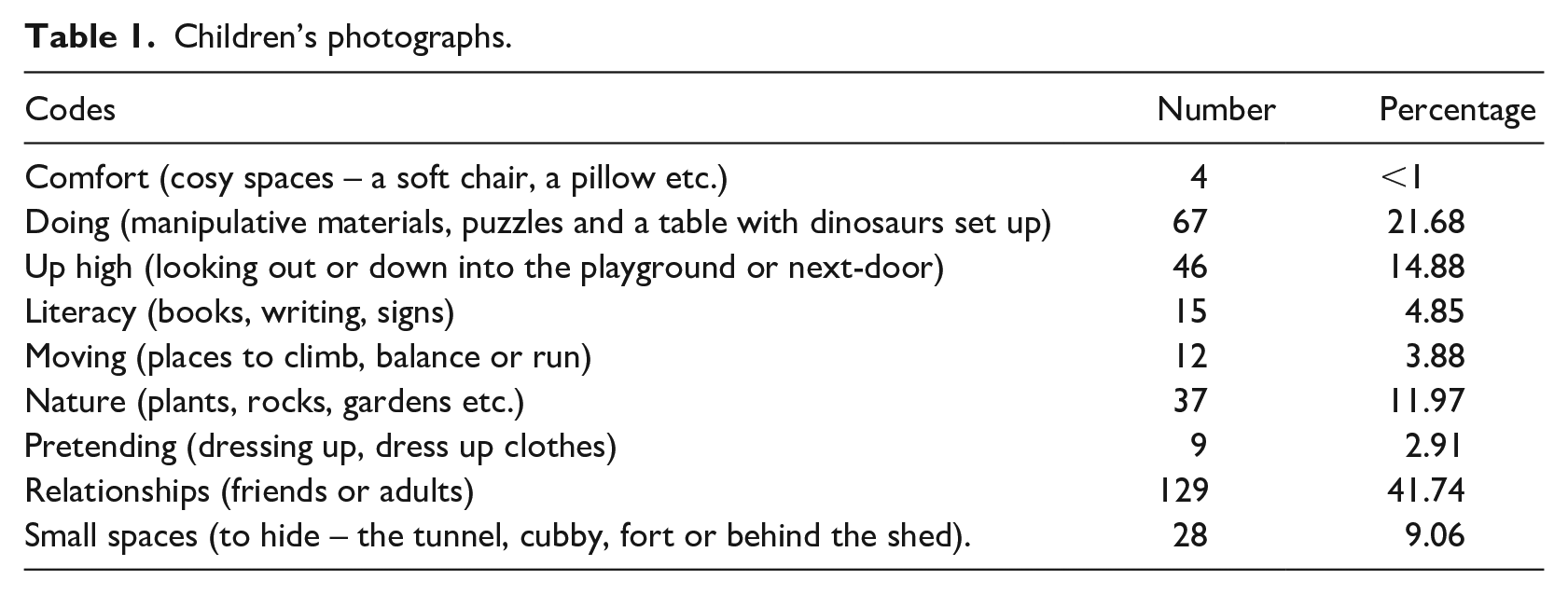
Following coding, the photos were printed and sorted into small paper bags accordingly (Table 1) for the interviews. Photos were used to elicit discussion and we began by asking the children to choose a bag (code) and look at the photos and talk about their favourite place in the centre. After discussing their photos, the children were invited to talk about the internet photos of other play places. Interviews were audio recorded, transcribed and later analysed. Six interviews were conducted in pairs chosen by the children. Those who displayed the most interest and engagement in the conversations were invited to stay a little longer to ‘draw-and-talk’ their imagined play space ideas.
A thematic analysis of the three data sets was employed to identify patterns of meaning through a process of data familiarisation. Theme development and revision generated initial themes followed by reviewing, refining, then defining and naming final themes (Braun and Clarke, 2006). Sixteen codes were reduced into four themes: Places for relationships; Places that are safe and clean; Places for movement and privacy; and Places for becoming.
Findings and discussion
The children in this study through their photo taking, conversations and draw and talk demonstrated their interest in and desire for people and relationships in the current and imagined places. Places that allow for the children to be social were highly valued. While this finding has been highlighted before in research, along with the preference for outdoor place spaces, in this research we found an interesting focus on safety and cleanliness as well as some attention to the way places make children feel about themselves, their identity and becoming.
Places for relationships
The number of photos of people taken by the children highlighted the significance of people and relationships for them. Asked to take photos of places, photos of people were the most numerous (42%).
Karim and Osman clearly articulated the importance of friendship:
Who do you play tips with Osman?
Him. (pointing to Karim)
Him. And who do you play tips with?
Him. Yeah, very good. We’re actually very close friends.
The children talked about playing tips. Osman clearly articulated his relationship with Karim. The use of the word ‘close’ perhaps alludes to a relationship that continues outside the early childhood setting. Highlighting a people-place dyad, place can be defined by the social interactions that ensue in a location (Denov and Akesson, 2013). Friendships in early childhood bring a sense of belonging as children develop their social identities and interdependencies (Konstantoni, 2012). Children’s first friendships, outside of the family context, are often accomplished in the social and educational context of the early childhood setting (Theobald et al., 2017), creating meaning for all children about themselves and each other (Derr et al., 2018). In developing a sense of place children come to know that they belong, or don’t. Developing a sense of place is linked to a sense of belonging (Brillante and Mankiw, 2015). When a setting is inclusive, it will plan for diversity in the relationships that are created in place, facilitating friendships where all children can play independently alongside peers exploring the environment and experiencing successes and failures (Teel, 2011). Playing with and learning from peers in shared places and activities is considered pivotal for a child’s cognitive growth and development (Bodrova and Leong, 2006).
The children wanted to discuss their social/cultural connections to their neighbourhood and families, illuminating the interconnected nature of the local community. The children have close family ties in a diaspora community involving inter-generational living arrangements and geographic proximity to friends and family (Shaweesh and Greenop, 2020). Place can be conceptualised as site of activity and interactions, placemaking representing relationships among people within places (Denov and Akesson, 2013)
Omah and Nahla discussed their closeness to cousins:
You like to play with your cousins too.
Yeah.
Yeah? What are your cousins’ names?
Abdullah and Latifa.
Where do you most like to play with them?
I like to play so with my sister – my sister Latifa and my friend Hamid.
Do you play with them when you’re not at [centre name]?
I see them.
A strong appreciation of friends, family and togetherness in this community was voiced by the children. These ideas about family and friends within placemaking are valuable for those considering the design of a new inclusive early childhood centre.
Places that are safe and clean
Discussions of safety and cleanliness were prominent in children’s conversations, highlighting the concern that the prioritising of safety and sensory experiences by adults in early childhood, could be at the expense of children’s desire for risky play, risk-competence learning and socio-cultural values.
The tree, it’s too dangerous.
Because I can’t climb up it. Because I might fall down.
You couldn’t hang on?
No, because he was scared of the tree.
Yasser is clear about avoiding danger and not climbing. Alan reinforces his fear. Children’s ideas about place and what they can do are impacted and limited to some extent by what adults decide they are allowed to do, how they can use a place and where they are allowed to go. One educator was frequently heard exhorting the children to be careful and expressed her dislike of the newly installed grass hill. There is emerging recognition that over-emphasis on children’s safety can be the detrimental for children (Brussoni et al 2012; McFarland and Laird, 2018; Sandseter, 2007). Risky play such as climbing to heights, jumping, running tumbling, rolling, balancing and hiding, allows for play that affords children numerous challenges, to test their boundaries, while facilitating the development of problem solving and creativity (Grady-Dominquez et al., 2021). Adults can be overprotective regarding outdoor environments though, inadvertently undermining engagement (Allin et al., 2014; Kandemir and Sevimli-Celik, 2023). However, adults who are intentional in their safety and risk conversations with children can help to develop risk awareness and competence (Higginbottom et al., 2023).
Placemaking is not just about the physical environment but the activities and interactions within.
The cleanliness of activities was a concern of some of the children. As this research took place just after the first Covid 19 lockdown in Australia, the children had a heightened awareness of hygiene safety; washing hands and using sanitisers. Several children expressed dislike of the sandpit as it made them or their shoes dirty, and others told us that their mothers would be upset if they got dirty.
All the children interviewed disliked an internet photo of a child stepping into a muddy puddle.
You get all muddy and splashed.
Yeah, but pigs do that.
Would you like to have some puddles at [centre] that you could splash in?
No.
Why not?
Because otherwise, my mum doesn’t let me.
Many children were observed to leave their shoes on while playing in the sandpit. They talked about it as being dirty. Keeping clean seemed to be important to the children, whether it was because of the ongoing discourse of hygiene due to Covid 19, or due to embedded traditions which have shaped their ideas about cleanliness. Influenced by a religious and cultural belief system based on physical and spiritual cleanliness and purity, the children demonstrate how they understand and follow these practices (Kuscular, 2008; Osim and Eteng, 2021). Sensory and/or messy play has long been assumed valuable in early childhood education in Western countries, promoted as assisting in language, social, and cognitive development (Howie, 2016). Young children are encouraged to experience and manipulate water, sand, mud, rocks, stones, vegetation etc. as a way of getting closer to nature and for sensory development. The idea that all children want, need or benefit from sensory/messy play is somewhat challenged by the voices of the children in this study (Brooker, 2005). Educational choices in curriculum, activities and design developed collaboratively with the local community values, including principles of health and hygiene could provide a more inclusive early childhood place (Arthur et al., 2015).
Places for movement and privacy
As with previous research findings most of the children expressed preference for places outside where they could ‘play tips’, go in the tunnel, and run around, which was also reflected in the photo tallies. Yasser described the outside playground as a park and expressed a sentiment that was shared by most of the children.
“The best thing about the park, we run around, and then we climb down, and then we go to the cubby house, and then we go play hide and seek in the tunnel”.
In both the photographs and the interviews, the children exhibited a wish for doing things, being mobile, being up high and moving around, being free to move, free to see, observe or ‘spy’ without being seen and free from the direct and constant surveillance of adults. The second storey of the cubby house was also well photographed, a place where they could see and observe not only across the centre yard but also into the neighbouring backyards. A place that could be described as a ‘retreat’, to look upon the world outside from one’s own place (Hart, 1979).
I love it because if we’re playing tips, they won’t really see us because right there [in the tunnel] you could just bob down. Also the tunnel is nice, because when we’re playing tips they’ll just go past.
They won’t see you, if they’re there you could go because you’ll see the shadow on the ground.
In the cubby house there’s a place where there are all toys that they [adults] won’t even see one bit there.
The children expressed a preference for places where educators’ rules and routines and planned activities were minimised, along with greater choice and the perception of being ‘unseen’ (Merewether, 2015; Stephenson, 2002). They spoke of hiding places; small, enclosed areas, private or secret places away from constant adult supervision like the tunnel in the middle of the yard, where they could make themselves less accessible to adults, with the intention of enjoying the hidden spaces with friends (Aminpour et al., 2020); Skånfors et al., 2009). Although these places might be seen as hiding or secret from adults, they are only separated from the adult world by invisible barriers that the children can create (Colwell et al., 2016: 412). Photographs were taken of a closed storage shed door and the small laneway in front of it, from which the children were banned. One child expressed a desire to know what was inside the shed. Yassar and Alan discussed a range of options for hiding spaces. In discussing the garage Yasser was determined about going in.
I hide in the garage.
Is the outside
In the cubby house.
In the tunnel.
Yeah, they’re all good places to hide.
A further conversation with Alan showed that going in the garage may have been imaginary:
Are you allowed to go inside there?
No. You can’t and they close it and they don’t allow you to close it.
Why not?
Because otherwise the teachers won’t find you.
What would happen then?
That means you can’t get out. Then your mum comes and they can’t find you.
Developing a sense of place and belonging, involves the ability to exercise agency, ownership, control, and to some extent freedom from adult intrusion and direction (Brillante and Mankiw, 2015; Wood, 2014). The children creating a sense of being hidden in the tunnel or inside the garage was an example of this. Places that enabled children to have privacy, within the noise and business of the centre, allowed them to be observers and actors in the space (Clark, 2010). Out of sight play places designed with or spontaneously created by the children with flexible and movable equipment could be considered in the planning process for the new centre as the incorporation of flexible materials that have creative scope allows children to create their own unique secret places (Colwell et al., 2016).
Places for becoming
The children voiced ideas about using ‘real’, not pretend objects, as part of their becoming in this place. Young children are often given smaller or replica objects to play with. The children labelled pretend objects as ‘fake, they saw the pretend objects as less than the real, possibly they felt positioned as ‘younger’, not yet ‘grown up’ or fully capable.
A craft activity in the playground was met with the comment:
What does Miss Terri do?
She’s teaching people how to do ice cream. Fake ice cream.
In response to another photo Aziza referred to the dolls in a water tray:
If these were real babies would you put them in the water like that?
No they’re fake.
In the photo the dolls were being pulled up by the hair, submerged in the water and they had soap all over their faces. The dolls as ‘pretend babies’ did not need gentle or special treatment as they were not real. In the craft activity fake ice cream was identified as the product of the task. The children gave the impression they did not appreciate the fake. Osman in another interview expressed his disregard for the plastic tools available in the centre, saying that he had helped his dad to build a house with a real hammer. He conveyed a sense of his own competency in using the real object and a disregard for the fake.
Increasingly, a trend for simulated, synthetic and developmentally constrained early childhood spaces/places, particularly in urban areas, has led to advocacy for more natural environments as appropriate for children’s well-being (El Sayed, 2017). The children in the discussions wanted objects such as ‘real’ tools, ‘real’ equipment and activities, also noted in the imagined draw and talk findings below. Yasser commented that he had used the hammer and didn’t hurt his finger. In contrast to his concerns about tree-climbing, Yasser might have been casting doubt on adult choices that children will be safe and satisfied with plastic tools. His views aligned with one of Sandseter’s risky play categories, where she advocates that young children should be learning to use ‘dangerous’ but real tools (Sandseter, 2007). She found that children viewed the use of real tools, such as knives, axes and saws, as exciting, and not scary, or dangerous at all. Children are constrained by what adults provide for them in places. If educators declared objects dangerous and risky, they are removed or declared in need of closer supervision. Higginbottom et al. (2023) however found that risky play did not increase the chance of serious injuries.
Draw and talk – children’s imagined place
Osman imagined beyond his experiences in the centre and voiced the idea of ‘real’ equipment in a new playground. He had strong opinions about adding real tools and equipment to the design of the new centre. Figure 1 below shows Osman’s imagined playground that included a real kitchen/cafe outside to prepare food. He was very sure about his preferences for the new building. His discussion during his drawing revealed his interest in being a chef; desire for a pond; and for an electric car. It is possible that he wished to recreate a typical Lebanese-Australian backyard which may include cultural connections to Lebanon – a Saj (convex metal griddle to bake flatbread and Lebanese pide); a mangal (barbeque); and a firn hatab (wood-fired oven) (Shaweesh and Greenop, 2020).
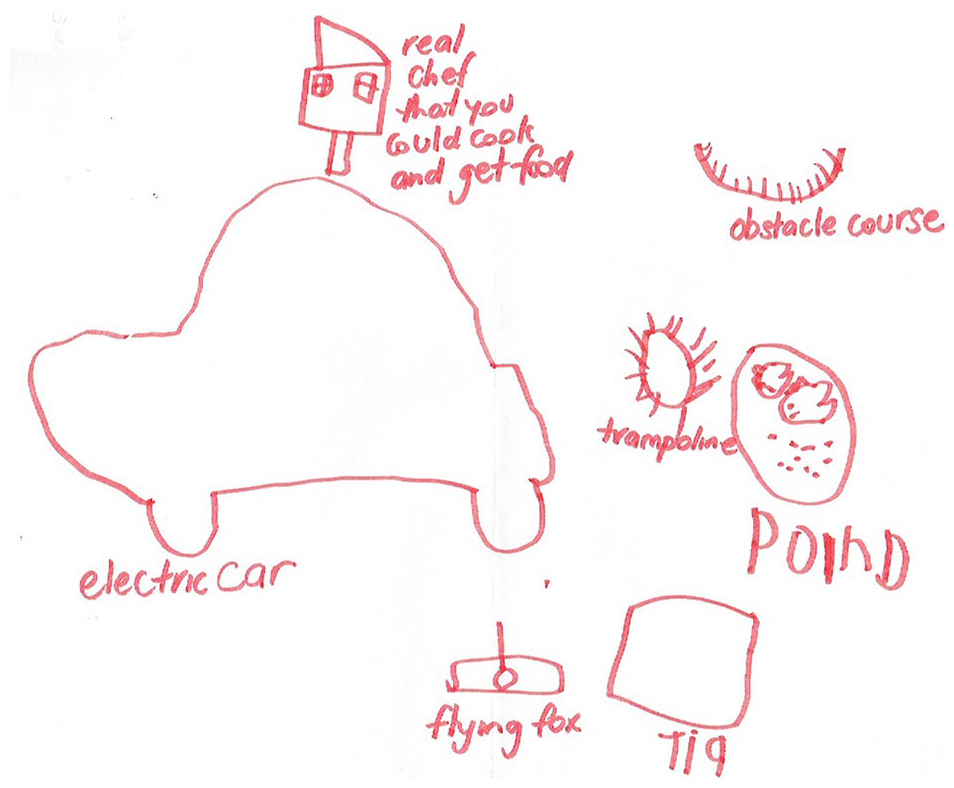
Osman’s imagined playground.
In another example of a ‘draw/talk’ conversation Wafiya was focused on climbing and reimagined the ‘Jack-and-the beanstalk’ story to suit her own preferences (Figure 2). She imagined giant flowers with leaves that would be strong enough to hold her friends as they climbed.
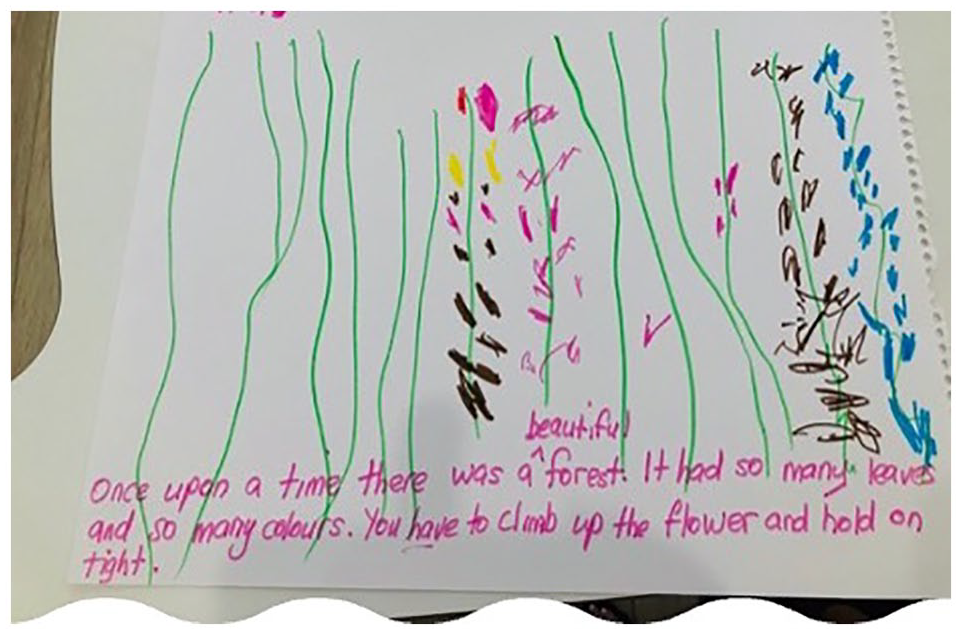
Wafiya’s flower climbing.
Conclusion
As part of a placemaking process this research sought children’s ideas about their current early childhood setting, with the view to developing contextually relevant ideas for a new inclusive centre, alongside designing architects, planners and builders. The children’s photos, interviews and drawings revealed their ideas and priorities for placemaking.
Relationships were paramount to the children. As people and places create meaning, they were inseparable to the children both within the centre and outside in their family and community. Places articulate children’s understandings about themselves and others, contributing to their identity. If children’s voices are to be heard, their relationships and connections to place can make a valuable contribution to design decisions. The children declared a preference for outdoor places where they could move and run. Spaces where they could observe, while not always being observed. Out of sight secret play places where flexible resources could be incorporated allowing children to create their own unique private places. The children’s conversations provided an insight into their ideas about safety. The children’s focus on secret places highlighted that child-created places provide children with a sense of control, choice and risk competence. Potentially prioritising adult contrived safety, in placemaking design for children, could be at the expense of valuable risky play and growing abilities of children to perceive and manage risk. The children voiced a request for real things rather than ‘fake’ in their placemaking. Early childhood environments have traditionally been created as places for children to address what adults perceive as their needs - artificial spaces with child-like representations of what is imagined as the real world. Children recognised this ‘fakeness’ and in this research, there was a request from children for places that are more real.
In this setting, cultural values influenced the children’s ideas about many aspects of placemaking including cleanliness, safety and community. Culture was embodied in the way the children talked about themselves in this place and the activities on offer. The cultural and community values of the local Lebanese diaspora (Shaweesh and Greenop, 2020) need to be thoughtfully considered in the design. For a new centre to be inclusive it should address the diversity of children’s experiences and voices. Incorporating culturally appropriate ways for children to exercise some autonomy and build social connections inside and outside the centre would see designers incorporating spaces that could be manipulated and sensitively adapted to community values, avoiding a one size fit all. Resisting the temptation to create places with children that are built on only Westernised philosophies, that are often standardised and potentially exclusionary, provides some promise for a more authentic approach to inclusive placemaking in early childhood education.
Limitations
This was a one-centre study. We did not have the opportunity to talk to all children in the group due to many months of delay due to Covid restrictions and the limited duration of our stay in the region. We do not claim generalisability.
