



Abstract
This study probed praising among preschoolers in natural settings and investigated their developmental changes. In study 1, teachers in preprimary educational facilities answered queries about the frequency and described episodes of praising among preschoolers. The results indicated that children approximately 3-year-old commonly praised friends, primarily in situations of playing. In study 2, teachers responded to questions on the aspects and circumstances of praising among preschoolers. The findings revealed the developmental trend that 5-year- old preschoolers praised the processes used by their friends more than 3-year-old children. Five-year-old preschoolers also praised their friends more than 3-year-old children in competitive team game situations.
Introduction
Children commonly praise their friends and receive praising from friends. An observational study in a kindergarten indicated that a child praised a friend, and the child who received praising praised the friend who offered the first praise (Hatch, 1988). A practical study on cooperative play in a kindergarten indicated that 5-year-old children said “great” and applauded a friend who performed well in a role in a dramatic play (Fujitsuka, 2019).
Praising friends is both commonplace and important because it positively influences children. A practical study on using structured group encounters in a kindergarten reported a case of a child gaining confidence and attempting activities because of the approval expressed by friends (Yoshimura and Ueda, 2017). Additionally, an observation study on praising by children in a kindergarten suggested that smiles and warm eye contacts were popular reactions to receiving praise (Hatch, 1988). Some studies on classroom activities at elementary schools have focused on praising among friends, including positive peer reporting, peer praise notes, and tootling, and have indicated that praising among friends is effective in reducing the number of critical events (Morrison and Jones, 2007), increasing social involvement (Moroz and Jones, 2002), and enhancing the score of non-violent relationships (Ikejima and Matsuyama, 2016). These studies have indicated that the motivations, emotions, and communication skills of children are positively affected by praise from friends.
However, praising among friends has not been adequately elucidated, especially in natural settings. In past studies about praising, researchers have primarily focused on adults as providers of praising such as experimenters, teachers, and parents (e.g. Floress et al., 2018; Gunderson et al., 2013; Kamins and Dweck, 1999). On the other hand, researchers did not regard children as providers of praising. These studies have hence addressed praise from authority figures (Kakinuma et al., 2022). A few studies have discussed praising among friends but most such investigations were centered on settings created by teachers and researchers, for instance, positive peer reporting (e.g. Morrison and Jones, 2007). Some studies have indicated episodes of praising among friends in natural settings (e.g. Fujitsuka, 2019). However, praising was not the focal interest of these studies.
It is thus necessary to further investigate praising among friends with a focus on natural settings. The lack of such research could negatively affect classroom activities such as positive peer reporting, peer praise noting, and tootling. For example, Cihak et al. (2009) indicated that children were encouraged to discover the prosocial behaviors of their friends and write tootle cards. It was observed that the incidence of disruptive behaviors decreased during the activity but returned to near baseline levels afterward. This result could be explained that positive behaviors would be difficult to maintain without a given framework because it may not be normal for children to praise the prosocial behaviors exhibited by their friends. Children may be able to sustain their behaviors after the tootling activity if a researcher selects a common target of praise in natural settings. Another study reported that children sensed increased anxiety about failure after the activity which required them to deliver particular praise words about the athletic performance of their friends, for example, the posture, speed of approach run, or leg movements (Kobayashi et al., 2019). Children would probably use simple words such as “Great” or “I feel good” to evaluate their friends and express their emotions in natural settings. The specific praising could force students to attend to the details of their friends’ performances and students could thus feel nervous after the activity. Studies that offer knowledge on praising among friends in natural settings could help teachers develop classroom activities and contribute to the development of children. Therefore, the present study purposed to clarify praising among friends in natural settings, probing aspects such as the frequency of praising among friends, and situations in which children lauded their friends.
Additionally, this study was centered on verbal praising by preschoolers in Japan (one- to 5-year-old children). We focused on preschoolers because in Japan, the participants of most previous studies on praising among friends were elementary school students, and a review of praising among friends in Japan revealed no study on praising among preschoolers (Aoki, 2021). Very little is known about praising among preschoolers. Another reason for the focus on preschoolers relates to the structure of early childhood education in Japan. Praising one’s friends has been observed in other countries (cf., Fujitsuka, 2019; Hatch, 1988), but in Japan, praising one’s friends seems to occur more frequently because the guidance for the course of study in kindergartens indicates its importance as part of in one’s friends’ good points and accepting each other (Monbu kagaku shou, 2018). Other countries’ courses of study also describe the importance of one’s relationship with one’s friends. For instance, the framework of early childhood education in the United Kingdom (Early Years Foundation Stage; EYFS) discusses positive friendship with peers (Department for Education, 2021), and the curriculum of early childhood in New Zealand (Te Whāriki) emphasizes developing social skills for friendship and empathy and having regard for ones friends (Ministry of Education, 2017). However, they do not discuss identifying friends’ goodness and receiving praise from them.
Verbal praising was chosen for this study because of the popularity of this style as the means for preschoolers to praise their friends. People use several channels to express positive evaluations through verbal feedback using words such as “Great” or “Well done” as well as nonverbal reactions such as smiling or high-fives. The expression of positive personal emotions toward someone or something through phrases such as “I like this” is also praising. Moreover, writing messages in notebooks, and awarding objects such as badges, candies, money, or privileges to do/not do something is used as praising. However, verbal praising appears to be the most common channel for preschoolers because verbal statements can be delivered immediately, on any occasion, and do not need any preparatory items. It might seem that verbal praise is difficult for preschoolers due to their limited verbal skills. However, in praising one’s friends, it is necessary to produce a complicated utterance such as “Your painting is really nice because the color you used was impressive.” It is enough to say “Good” and “Great” to express one’s feelings for the friend’s work. A study of language on emotional states in peer play indicated that “Cute,” “Good,” and “I like it” are common emotional-state words used by three-, four-, and 5-year-old children (Iwata, 2015), and these are basic words for preschoolers in playing. Thus, we considered it feasible to focus on verbal praising in this study.
As stated above, this study aimed to indicate the frequency of verbal praising among preschoolers and situations in which praising occurred in natural settings. To this end, the present study tested two comprehensive hypotheses. First, it was assumed that the frequency of verbal praising among preschoolers increased gradually, particularly after the age of 3. An observation study showed that children could engage in brief conversations with friends by 30 months (Hay, 2006). A study focusing on the interactivity of conversations indicated the popularity of non-interactional utterances in two- and 3-year-old children and reported that interactional utterances became popular in four- and 5-year-old children (Yamamoto, 2003). Further, an experimental study of the number of utterances used during pair play found that pairs of 4-year-old children produced much more speech than pairs of 3-year-old children (Fukada et al., 1999). Some praising may provide one-sidedly; however, most praising seems to happen during interactional communication. From these developmental tendencies about communication, it is expected that the amount of verbal praising among preschoolers increases around the age of 3 years.
The second comprehensive hypothesis posited the gradual expansion of situations and the aspects of verbal praising among preschoolers. Children must focus on their friends to praise them. However, their understanding of others is limited. Hashimoto and Matsunaga (2006) asked preschoolers and elementary students what they liked about their friends and classified their answers into seven categories such as personality, ability, emotion, behavior, appearance, and possession. The answers of 3-year-old preschoolers included two categories but the responses tendered by four- and 5-year-old preschoolers encompassed five categories. This finding suggests that early-stage preschoolers can find the virtues of their friends in limited situations and aspects and become more able to discover goodness in their friends in numerous situations and aspects as they grow older.
Study 1
Study 1 intended to overview verbal praising among preschoolers such as the frequency, situations, aspects, and personal relationships. This elucidation was vital to testing the two comprehensive hypotheses.
Method
The study utilized a web research company to recruit teachers who worked at pre-primary educational facilities in Japan. One hundred teachers agreed to answer the questionnaires. However, four teachers were taking leave from work, and ultimately, 96 teachers (87 females and nine males) participated in the study.
The questionnaire defined praising at the outset: Here, the definition of praising is to convey a positive message to others by using a verbal message such as “Great/Good.”
The first section queried the frequency of praising to clarify developmental changes in praising among preschoolers, participants were asked for the frequency with which they witnessed praise among preschoolers. Participants answered the frequency of praising they had witnessed in preschoolers by age: between children of the same age (one-, two-, three-, four-, and 5-year-old children), and between children of different ages. Participants were accorded 11 options; (a) none, (b) once a year, (c) once a half year, (d) once every three months, (e) once a month, (f) twice or three times a month, (g) once a week, (h) three or four times a week, (i) once a day, (j) several times a day, and (k) I cannot answer this question because I have a few relations with that age of preschoolers. The second section required participants to register their experiences of witnessing episodes of praising among preschoolers in the past month. This section was designed to collect episodes of praising among preschoolers. Participants who had seen preschoolers praising each other reported such episodes via a free description that incorporated the number of preschoolers in the reported occurrence and their ages. The last section asked participants to fill in information about themselves such as their age, teaching experience, and the current class with which they were charged.
The research aims, methods, questionnaires, and procedures to obtain participant consent were reviewed by the appropriate ethics committee of the first author’s institution. The approval number of this study is 2020-2. All statistical analyses were performed using SPSS (version 23) and R (version 4. 2. 0).
Results and discussion
Frequency of verbal praising
Regarding the first comprehensive hypothesis that is the frequency of praising among preschoolers increases gradually, the frequency of praising was examined. Figure 1 indicated the result of the frequency of praising among preschoolers. There were 11 options, however, Figure 1 presented the frequency of each option except for k). The sums of the frequencies of praising among preschoolers at least once a day, which included (i) once a day and (j) several times a day, were: 20% for 1-year-olds, 25% for 2-year-olds, 36% for 3-year-olds, 50% for 4-year-olds, and 57% for 5-year-olds. It is not common for younger preschoolers to praise verbally and receive verbal praising from friends. However, praising their friends verbally becomes the daily communication of older preschoolers aged four and five. The first hypothesis is thus accepted: the frequency of verbal praising increases gradually among preschoolers, especially after the age of 3. The results evinced a similarity to the trends reported in past studies on communication among preschoolers, for instance, Yamamoto (2003), and Fukada et al. (1999). Verbal praising is a part of verbal communication, then, there is a similar developmental trend as the development of speech.
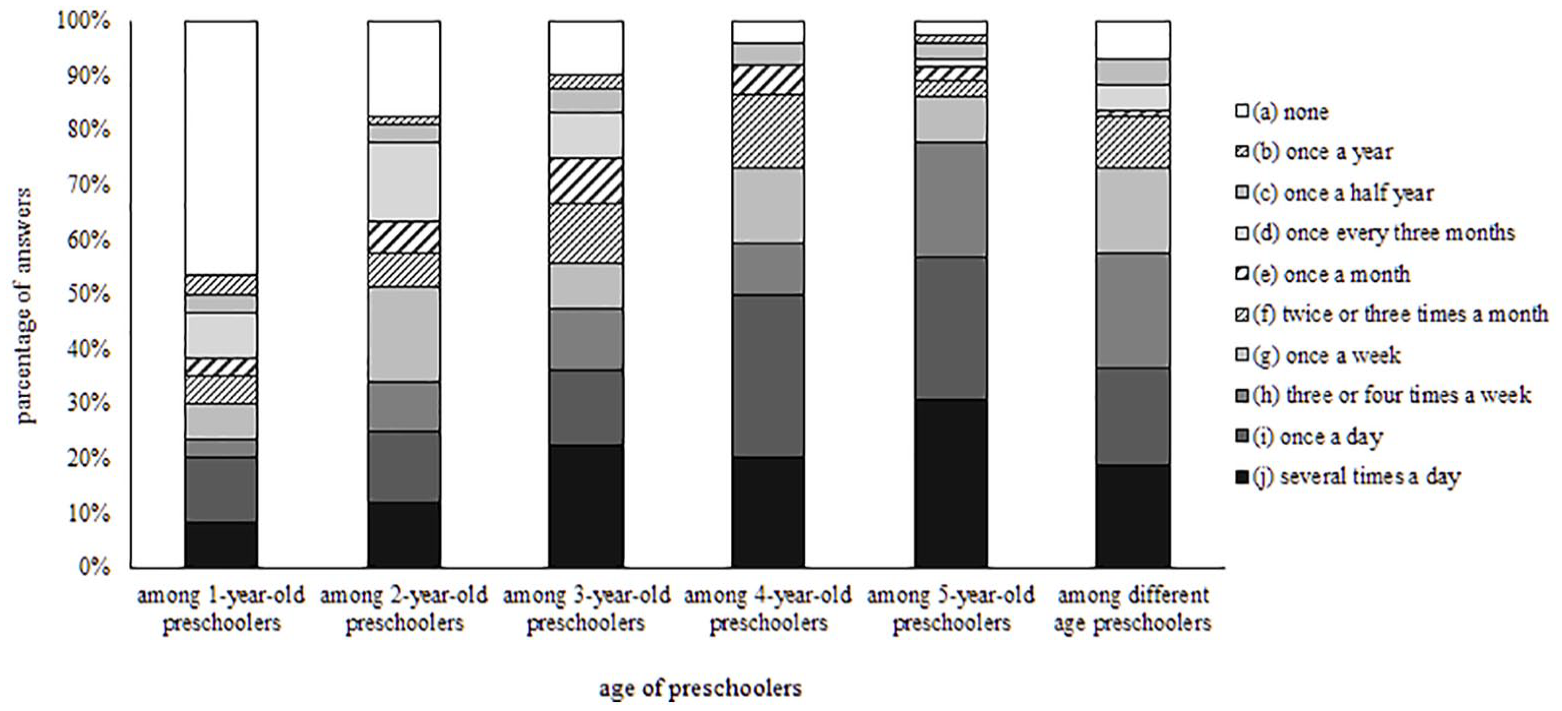
Frequency of verbal praising among preschoolers.
Situations of verbal praising
The second comprehensive hypothesis was about the gradual expansion of situations and aspects of praising among preschoolers. This hypothesis was tested through the free descriptions of respondents, which were analyzed to comprehensively apprehend praise among preschoolers. Seventy-five participants answered “I have seen praising among preschoolers in the past month” and 72 participants described the episodes they had witnessed. Of the 72 participants, 19 incorrectly registered the number of preschoolers engaged in incidences of praising, and 53 episodes were ultimately analyzed.
Each described episode was independently classified by two coders. After the coding was accomplished, the coders and the first author discussed the results, addressed the differences in coding outcomes, and decided on the final coding.
To screen data, all episodes were checked they were episodes of verbal praising among preschoolers or not. To check the types of praising, the described episodes were divided into three categories: (a) verbal, (b) nonverbal, and (c) uncertain. The rate of concordance between the two coders was 92.5%. To check the relationships of praising, episodes were divided into two categories to determine the praising associations: (a) among preschoolers, and (b) not among preschoolers. The rate of concordance between the two coders was 83.0%. The 53 analyzed episodes included 10 episodes that did not occur among preschoolers, two nonverbal praising episodes among preschoolers, and six uncertain style praising episodes among preschoolers. Thus, 35 episodes were analyzed.
Situations of praising were divided into four categories: (a) play setting, (b) daily living situation, (c) other, and (d) uncertain. Play setting was defined as children playing with activities such as drawing, creating products using toy blocks, and rope jumping. Whether the play setting was a free play period or a guided play period was not considered. Daily living situations were described as children doing actions related to life habits such as tidying up, eating a meal, or changing clothes. The category other was designated as a morning or afternoon homeroom scene, the arrival or departure of the children from school, and practicing an activity for a school event. An episode of praising that happened in the interval that switched play settings to daily living situations was also classified into this category. The label of uncertain was assigned to episodes that included objects of praising such as appearance and possessions but were unclear about the praising situations.
A total of 22 episodes were designated (a) playing settings, four episodes were grouped into (b) daily living situation, nine episodes were positioned in (c) other, and zero episodes were labeled (d) uncertain. The rate of concordance between the two coders for the 35 episodes was 82.9%. A chi-square test was conducted and the results indicated a significant difference (χ2 (3) =31.40, p < 0.001). A binomial test was performed to determine the differences between categories. The binominal test was repeated six times and the Bonferroni method was applied to control the significance level. The results indicated that the frequency of episodes classified as (a) playing setting exceeded incidences designated as (b) daily living situation and (d) uncertain. The frequency of episodes grouped as (c) other was also more than the occurrences of (d) uncertain.
Settings related to playing represented the primary situations for praising among preschoolers. These results corresponded with some studies reporting praising among friends when children were playing (e.g. Fujitsuka, 2019; Hatch, 1988). Preschoolers perform actions similar to their friends and undertake identical activities such as making something or playing games. Such situations are beneficial for the discovery of the positive attributes of their friends because they can share goals with friends and compare their outcomes and performances to the tasks accomplished by their friends. Thus, most episodes of verbal praising among preschoolers were categorized as occurring in settings dedicated to playing. Notably, however, preschoolers praised their friends also during daily living situations such as eating lunch or tidying up toys. The nine episodes classified into the other category were also interesting and involved praising clothes or loud speech in drama practice for the school production. Preschoolers share play times in their facilities as well as other periods such as performing routine tasks. Thus, verbal praising occurs naturally in such circumstances. The results also indicated the necessity of comprehensively researching numerous situations to understand the phenomenon of praising among preschoolers.
Aspects of verbal praising
The confirmation of the second hypothesis also entailed the analysis of aspects of praising, which were grouped into five categories: (a) outcome, (b) process, (c) knowledge and idea, (d) appearance and possession, and (e) other. The outcome was defined as praise in response to the production of excellent results, for instance creating an outstanding item, performing well in a sport, tidying things up, and being kind to others. Episodes incorporating both aspects of outcome and process were classified to the aspect of the outcome if the researcher were able to determine that the praising was primarily intended for the outcome. The process was characterized as praising for practices such as always working hard and keeping practice. Episodes that encompassed both process and outcome were classified as a process if the researcher could ascertain that the praising was mainly intended for the aspect of the process. The dimension of knowledge and idea was identified as praising the information offered, such as knowing something well or presenting a good plan. The feature of appearance and possession was denoted as praise for clothes, hairstyles, or possessions. However, this aspect was categorized as an outcome if the researcher was able to determine that the objects were made by a child. The category “other” was assigned to praise for a reason that could not be classified as the aspects described above as (a), (b), (c), or (d). The rate of concordance between the coders for the 35 studied episodes was 71.7%.
Of the studied events, 25 were categorized as (a) outcome, nine were classified as (b) process, and one was assigned to (d) appearance and possession. A chi-square test indicated a significant difference (χ2 (4) =66.0, p < 0.001), and a binominal test was conducted to ascertain the difference between categories. The binominal test was repeated 10 times, and the Bonferroni method was applied to control the significance level. The results revealed that the frequency of (a) outcome exceeded the aspects of (c) knowledge and idea, (d) appearance and possession, and (e) other. Additionally, the frequency of (b) process surpassed the incidence of the aspects of (c) knowledge and idea, and (e) other.
The study found the outcome to be the main aspect of verbal praising. It is easy to praise friends by focusing on an excellent outcome because success can be tangibly registered in such instances. It may be difficult for children to notice and praise by verbal other aspects such as process and knowledge because these do not indicate excellence as expressly as outcomes.
The personal relationships of verbal praise
The investigation of the number of preschoolers in one episode disclosed that 28 episodes included two preschoolers, four encompassed three preschoolers, and one involved four preschoolers. Two instances of praising entailed all members of a class appreciating one preschooler. Of the 28 praising episodes between two preschoolers, 22 happened between children in the same grade, three involved an older child praising a younger child, one evinced a younger child lauding an older child, and two occurrences happened between children of different ages but the ages of the praise provider and receiver were unknown. These results evidenced that 62% of the praising episodes occurred between two preschoolers of the same grade. It seems easy for preschoolers to focus on the behaviors of friends during a one-to-one interaction. Further, a basic school survey conducted by the Ministry of Education, Culture, Sports, Science and Technology (Monbu kagaku shou, 2021) indicated that classes commonly comprise preschoolers of the same age. Thus, verbal praising occurs primarily between two preschoolers in the same grade.
Study 2
Study 1 was an exploratory study. It was thus necessary to investigate the details of praising among preschoolers in study 2. Study 1 probed the comprehensive hypothesis that the frequency of praising among preschoolers increases gradually and it was found that preschoolers aged around 3 years commonly started to praise their friends. Study 2 attended to a few specific situations and investigated developmental trends in detail.
Study 2 examined three hypotheses. The first hypothesis was related to the general hypothesis that verbal praising increased with development. Study 1 found that the playing situation represented the main situation in which preschoolers praised their friends. Preschoolers also praised their friends in conditions of daily living. The facts evidenced the first hypothesis of the second study that praising was more frequent in playing situations than in daily living conditions because playing situation is a common situation for praising among preschoolers. In terms of developmental differences, the frequency of praising would increase with development only in conditions of daily living because preschoolers learn about behaviors of daily living at the early stages of preschool education and could be unclear what is good and not good.
The second hypothesis of study 2 was related to the comprehensive hypothesis that praising expands with development. Study 1 indicated the four aspects of praising but did not clarify developmental trends. Therefore, study 2 addressed the four aspects of praising and revealed the relevant developmental trends. The second hypothesis of study 2 stated that praising for the outcome as well as appearance and possessions exhibited high frequencies because they were conspicuous. Possessions and activities are familiar targets for three-, four-, and 5-year-old preschoolers as social comparisons (Mosatche and Bragonier, 1981). Hence, preschool children find these aspects easy as their focus for praising. On the other hand, the aspect of the process increases with development because it requires cognitive skills such as remembering the efforts and activities of friends as they perform an action.
The third hypothesis of study 2 was also associated with the comprehensive hypothesis that praising expands with development. Study 1 indicated the general frequency of verbal praising but did not point to the frequency of praising in specific situations such as lunchtime as a daily living situation and making something as a play situation. Thus, study 2 focused on the frequency of praising in specific situations and indicated developmental trends. The third hypothesis posited that the frequency of praising would be stable in each play setting. However, the frequency of praising would increase with development in each daily living situation. As with the first hypothesis, early preschoolers learn about appropriate behaviors during daily living conditions. Hence, it is difficult for them to find praiseworthy conduct and praise their friends in any type of daily living situation. However, they praise their friends as they develop.
Method
This study was conducted in Japan with 137 teachers charged with three-, four-, and 5-year-old preschoolers at pre-primary educational facilities in Japan. Study 1 revealed that verbal praising friends was common after age three. Hence, the participants of study 2 were teachers charged with three-, four-, and 5-year-old preschoolers. Some teachers did not check the confirmation box that signified their agreement to answer the questionnaire and did not enter the grade of the students they supervised. After eliminating such responses, this study targeted 96 teachers (93 females and three males) who had appropriately agreed to participate. The teachers were recruited through their facilities.
This study was conducted in a city with 10 zones, each with three different types of pre-primary educational facilities: Hoikusho, Youchien, and Nintei kodomo en. Three facilities were randomly selected from the same area. The researcher requested 33 facilities, of which 30 accepted the invitation to participate in the research project. After obtaining the due permission, the researcher asked about the number of teachers who could respond to the questionnaires and subsequently brought or sent them the survey by post. The percentage of return of filled questionnaires was 74.86%.
In the first section, the questionnaire required participants to answer the grade in charge, whether for three-, four-, or 5-year-old children. They answered every question about preschoolers who were in the same grade, and who were in the grade that teachers supervised, because most praise occurred between two preschoolers in the same grade. The questionnaire further defined praising in the same manner as study 1.
In the second section of the questionnaire, participants answered queries about the frequency of praising about four aspects; (a) outcome, (b) process, (c) information, and (d) appearance and possession. The outcome was defined as praise for the achievement of excellent results in tasks such as creating a product, a physical activity, tidying up, or showing kindness to others. The process was identified as a praising course such as trying hard and continuing practice. Information was designated as praise for offering information, for instance, providing knowledge on a topic or presenting a good idea. The last aspect concerned praising for appearances, hairstyles, and possessions. Participants responded to the questions that followed according to five options, whose criteria were indicated: (a) almost never (from once a year to never witnessed), (b) occasionally (once every six months to once every three months), (c) sometimes (one to three times a month), (d) frequently (one to four times a week), and (e) always (more than one time a day).
The third section required participants to register the frequency of praising among preschoolers in each studied situation. A total of 24 situations were collected from study 1 and from past investigations of the contents of play among children (e.g. Ito, 2006; Kubo and Iwamoto, 2014): (a) play period (general), (b) daily living situation (general), (c) morning homeroom, (d) afternoon homeroom, (e) free play period, (f) guided play period, (g) tidying up, (h) preparing clothes, (i) performing classroom duty, (j) lunch time, (k) creating personal work sharing the same theme with friends in a free play period, (l) creating a single task in collaboration with friends during a free play period, (m) playing competitive individual games with friends during a free play period, (n) playing competitive team games during a free play period, (o) finding the same item such as an insect individually with friends during a free play period, (p) finding an item such as an insect in cooperation with friends during a free play period, (q) performing a scene and a story in cooperation with friends during a free play period, (t) achieving personal work during a guided play period, (s) creating a task in cooperation with friends during a guided play period, (t) playing competitive individual game with friends during a guided play period, (u) playing a competitive team game during a guided play period, (v) finding the same item such as an insect individually with friends during a guided play period, (w) finding an item such as an insect in cooperation with friends during a guided play period, (x) performing a scene and a story in cooperation with friends during a guided play period.
In the fourth section, participants answered on the frequency of the 24 situations mentioned above in the third section. The same option as that in the second section is provided for answering regarding the frequency of each situation.
In the fifth section, participants answered regarding the amount of conversation for each situation. The response options range from (a) very little to (e) very much (or from very few to many).
The final section of the questionnaire concerned participant responses to queries about themselves, for instance, their teaching experience, age, and the frequency with which they praised their students.
This study was comprehensively reviewed by the ethics committee of the first author’s institution, including its aims, methods, questionnaires, and procedures for obtaining participant consent. The approval number of this study is 2021-3. All statistical analyses were performed using R (version 4. 2. 0).
Results and discussion
The development of verbal praising frequency for general situations
The investigation of the first hypothesis that praising was more frequent in playing situations than that in daily living circumstances addressed two general situations: the play period (general), and the condition of daily living (general). A mixed design two-way analysis of variance (ANOVA) was conducted to this end. The results of ANOVA (3 (grades) × 2 (situations)) showed there was no interaction effect (F (2, 93) = 0.11, p = 0.900). There was a significant difference in situations (F(1, 93) = 10.35, p = 0.002, partial η2 = 0.10), and no significant difference in grades (F (2, 93) = 0.24, p = 0.788).
The hypothesis that verbal praising was more frequent in playing situations than in conditions of daily living was supported. Study 1 indicated the focal significance of playing situations over conditions of daily living for the praising of friends by preschoolers. Study 2 implied the same trend. However, no interaction effect was observed. It is difficult for preschoolers in the early stages of pre-primary education to perform all daily living tasks such as changing clothes or eating. These behaviors must be learned. A study of living habits found that 11.2% of 3-year-old preschoolers used chopsticks properly, and 35.1% of them brushed their teeth on their own (Iwasaki, 2021). These results suggest that preschoolers would find it difficult to praise friends in daily living situations because they are still learning the behaviors of daily life. However, more than half of the 5-year-old preschoolers have learned such behaviors (Iwasaki, 2021). Hence, it is not surprising for 5-year-preschoolers to perform their daily living tasks, and praising friends for such natural tasks would no longer be valuable.
The expansion of aspects of verbal praising
A mixed design, two-way ANOVA was performed to analyze the second hypothesis that praising for the outcome as well as appearance and possessions are commonly noted in all preschool grades and that the praising process increases with development. The results of the ANOVA (3 (grades) × 4 (aspects)) revealed the interaction effects (F(4.99, 227.24) =3.56, p = 0.004, partial η2 = 0.07), and significant difference in aspects (F(2.50, 227.24) =20.89, p < 0.001, partial η2 = 0.19). No significant difference was found for grades (F (2, 91) = 1.51, p = 0.226). The simple main effect for grades was significant in the aspect (b) process. Holm’s post hoc comparison indicated that 5-year-old preschoolers more frequently praised their friends (b) process than 3-year-olds. A marginally significant difference was also noted between 5-year-old and 4-year-old preschoolers (p = 0.053). Figure 2 illustrates the average frequency of praising during every studied situation. The simple main effect was significant in all grades. The post hoc comparison indicated (a) outcome = (d) appearance and possession >(b) process = (c) information for 3-year-old preschoolers. The post hoc comparison for four- and 5-year-old preschoolers indicated (a) outcome >(b) process = (c) information = (d) appearance and possession.
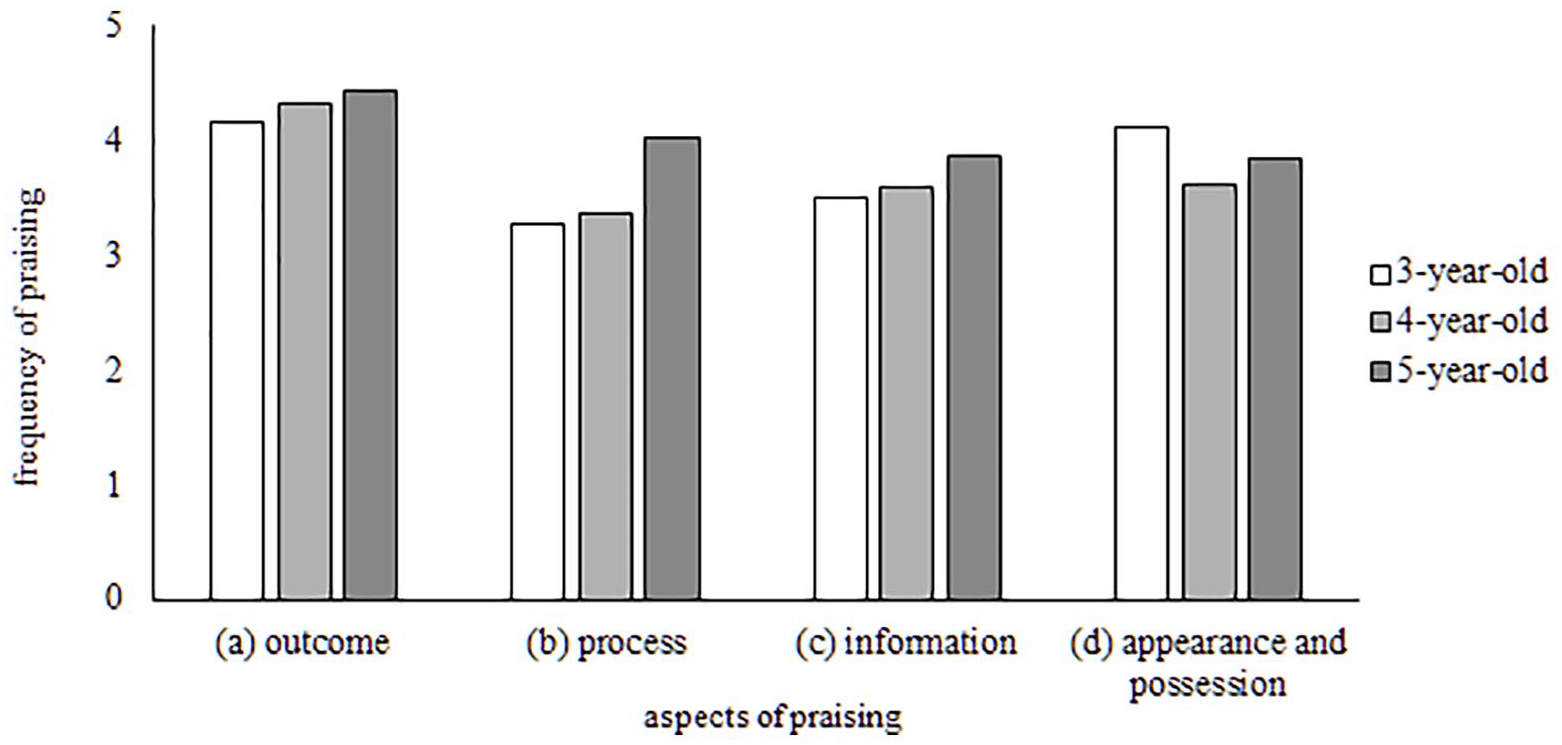
Frequency of verbal praising for each studied aspect.
The hypothesis that verbal praising for a process increases with development was supported. Other aspects such as outcome and appearance encompassed hints that help children determine the virtues of their friends. On the other hand, the process does not offer such lucid cues for praising: it merely shows a progress level. For instance, practicing a task or trying harder does not directly indicate excellence, unlike the aspect of the outcome. In addition, preschoolers must remember the past behaviors of their friends when they praise the process and it is difficult for preschoolers to combine past and present. For instance, a study on types of explanation indicated that a lesser percentage of 4-year-old children alluded to future and past events to elucidate the present reactions of a character in a story than the proportion of five- and 6-year-old children (Lagattuta, 2007). This result relates to both the attribute of process and to cognitive skills.
The expansion of verbal praising situations
Some participants wrote “We do not have this situation” for (c), (d), (f), (i), (r), (s), (t), (u), (v), (x), and (i), and these situations were eliminated. Situations (e) and (f) denoted a paired item querying the frequency of praising in typical playing situations. However, situation (f) was deleted because participants answered as noted above and thus, (e) was also deleted. Therefore, the study attended to 10 situations: (g), (h), and (j) were deemed daily living situations, and (k), (l), (m), (n), (o), (p), and (q) were considered free playing situations. ANOVA was conducted to analyze the third hypothesis by confirming the number of situations for which the instances of praising increased or decreased with development. The ANOVA (3 (grades) × 10 (situations)) evinced a significant interaction effect (F (10.26, 451.58) =2.47, p = 0.006, partial η2 = 0.05) and difference in situations (F (5.13, 451.58) =10.71, p < 0.001, partial η2 = 0.11). No significant difference was observed for grades (F (2, 88) = 0.39, p = 0.679). The simple main effect for the grade was significant for situation (n) playing competitive team games in a free play period. Holm’s post hoc comparison indicated that the frequency of praising by 5-year-old preschoolers during situation (n) exceeded the incidence for 3-year-old preschoolers (F (2, 88) = 3.77, p = 0.027, partial η2 = 0.8). The simple main effect for grade approached significance (p = 0.060) for (m) playing competitive individual games during a free play period. Exploratory post hoc comparisons indicated the same trend as (n).
The third hypothesis posited a stable frequency of praising in playing settings and assumed that praising would increase in situations of daily living with development. A developmental difference was noted in playing situations, and no difference was found in situations of daily living. Thus, the third hypothesis was not supported. Play encompasses numerous activities including creating something, playing house, and sports. Some of the activities are common to all preschool grades, and some are popular for only one grade. These developmental changes in playing appeared to affect the result that an age-linked trend was found in playing situations.
General conclusion
The present study addressed praising among preschoolers. Study 1 overviewed verbal praising among preschoolers. Study 2 investigated the results of study 1 in detail. The results of the two studies are summarized here and the potential applications of the study outcomes are highlighted to facilitate the design of classroom activities such as positive peer reporting.
Study 1 revealed that children did not usually verbally praise their friends in the early stages of preschool. However, praising became common at around age three. These results suggest that classroom activities such as positive peer reporting are not suited to one-, two-, and perhaps even 3-year-old preschoolers. Some pre-primary educational facilities have attempted to institute positive peer reporting for preschoolers (e.g. Yoshikawa and Otomo, 2020) but such activities should be planned to be accepted and natural, especially for preschoolers aged less than 3 years because they could find it strange to perform unfamiliar tasks.
Both studies 1 and 2 indicated situations of praising friends, and showed that it is common for preschoolers to praise playing settings rather than in daily living situations. Preschoolers engage in approximately identical activities in play settings. It is easier for them to compare their performances to their friends in such situations than doing different activities. Hence, they can notice the competencies of their friends, which makes it normal and accessible for preschoolers to discover strengths and praise their friends in play settings, especially in the early stages of preschool.
Studies 1 and 2 found that preschoolers praised the outcomes, processes, knowledge and ideas, and appearance and possessions of their friends. The process was not found to be a standard aspect of praise for 3-year-old preschoolers but the frequency of praising for the process increased with development. A previous praising study focused on adults as providers used some praising phrases such as ability, effort, process, person, and outcome. These categories did not indicate the aspects of praising. Nonetheless, they alluded to concepts similar to the aspects registered in the current study. The aspect of praising for process in this study is similar to the previous study’s reporting of effort praise in statements such as “I can see that you worked harder than most people on this test” (Koestner et al., 1987) and process praise such as “You must have tried really hard” (Kamins and Dweck, 1999). Preschoolers also emphasize the same aspect when they praise their friends, but such praising is not as common as adults think. Teachers may want preschoolers to praise their friends’ processes and may offer examples of praising a person’s process. However, such may not fit preschoolers because it is difficult to focus on internal aspects such as skills.
Two limitations of this study must be acknowledged. First, this research could not specify the effects of praising among preschoolers, for instance, motivation, emotion, and communication. This investigation yielded basic data on praising among friends but did not succeed in proving the effects of praising friends and receiving praise from friends. The determination of such effects could help improve pedagogic interventions. For instance, if receiving praising from friends is effective to make children happy, teachers could initiate a special activity of praising friends when they thought their class required a positive emotional boost.
Second, all data for this study were reported by teachers. It seems difficult to question preschoolers about the frequency of praising friends and the aspects of their praise. Nonetheless, there are methods of obtaining data from preschoolers. For example, the behaviors of preschoolers could be observed in kindergartens or laboratories. These observational studies are important for expanding to other styles of praise, such as facial expressions and clapping one’s hands. It could also be beneficial to record conversations among preschoolers. These studies that focus on preschoolers are also helpful to improve teachers’ intervention in the classroom.
