



Abstract
The purpose of the study was to better understand the phenomenon of exploring early mathematics through book reading. The study centers on Head Start and lays on Bronfenbrenner’s bioecological framework). Two sub-questions guided the qualitative single case study of six Head Start adult participants (teachers, parents, administrators): (1) What are Head Start participants’ experiences in exploring early mathematics through picturebooks? and (2) What do Head Start participants say about exploring early mathematics through picturebooks? Findings showed that participants expressed interest toward exploring early mathematics through picturebooks. Picturebooks were commonly used in the classroom but also accessible for families. Participants provided evidence of mathematics practices and discussions around mathematics in the school and in the home. The participants’ sayings and experiences in exploring early mathematics through picturebooks aligned with child development and contexts of learning, two cornerstones of Developmentally Appropriate Practice (DAP), but potential obstacles emerged. Implications for researchers and practitioners are discussed.
Introduction
Early childhood is a critical phase of development. From birth to 8 years old, young children develop at a fast pace, highly influenced by their environments and our society (Bronfenbrenner and Morris, 2006). As formal school starts once the child is 5 years old in the U.S., children’s daily experiences vary drastically depending on their home and school environments or “circles of influence” (Brendtro, 2006: 163). Accounting for these circles of influence is critical to assure equitable opportunities for all children. The latest version of Developmentally Appropriate Practice (DAP National Association for the Education of Young Children [NAEYC], 2020), a framework widely used in early childhood settings (Brown and Lan, 2015)), recognizes their importance. Initially focusing on child development, DAP has expanded to also consider children’s social and cultural contexts of learning and the intentional decisions adults (e.g. teachers, caregivers, parents, family members, administrators, etc.) make to guide children’s learning. The latest statement (NAEYC, 2020) emphasizes that all social, cultural, and historical contexts should be considered—the context of the child, but also those of the family, the educator, the school setting, the community, etc. Hence, the current DAP lays out three core components: child development, contexts of learning, and intentional teaching.
The DAP framework has also evolved to respond to the increasing focus on academics. For instance, there is now a consensus that early mathematics and DAP are not mutually exclusive (Clements et al., 2017; Fowler, 2017). Numerous articles have reported the benefit of endorsing five main areas of mathematics—numbers and operations, geometry and spatial sense, early algebra, measurement, and data analysis (review in Day-Hess and Clements, 2017)—as endorsed in programs such as Head Start (U.S. Department of Health and Human Services, 2020). The literature has also widely reported that early mathematics should be explored in both homes and schools. In the classroom, teachers should provide a balance of adult-guided and child-centered activities to fully nurture children’s interests in early mathematics (Early Childhood STEM Working Group, 2017; Fowler, 2017; NAEYC & NCTM, 2010). In the home, young children’s natural curiosity toward mathematics (Baroody and Wilkins, 1999) can be nourished through everyday situations, games, books, and puzzles (Fisher, 2016; Kleemans et al., 2012; LeFevre et al., 2009). In other words, both the home and the school environment play a critical role in the development of the child; both offer learning opportunities for the child. In both contexts, a strategy to balance early mathematics and DAP consists of integrating mathematics with picturebooks (NAEYC & NCTM, 2010). Several studies have investigated the use of picturebooks with preschool-age children, in both classrooms (Hojnoski et al., 2016; Jacobi-Vessels et al., 2016) and the home (Barnes and Puccioni, 2017; Hojnoski et al., 2014; Purpura et al., 2021), emphasizing factors influencing the learning outcomes, such as the book itself, but also the child, the reader, and their interactions as they explore the book together (0’ Rear et al., 2022). However, in the context of DAP, both advantages and obstacles seem to emerge.
Advantages of integrating mathematics with picturebooks include its alignment with the child-centered philosophy of DAP as picturebooks can stimulate children’s engagement with mathematics (Hojnoski et al., 2014, 2016; Jacobi-Vessels et al., 2016). The phenomenon also positions well with intentional teaching, as picturebooks provide a context to scaffold and support mathematics learning in both the home (Anderson et al., 2004) and the school (Jacobi-Vessels et al., 2016)). Indeed, a brief intervention, where caregivers are provided with picturebooks with embedded mathematical language content for 4 weeks, has been shown to support children’s mathematical language and numeracy skills (Purpura et al., 2021). However, obstacles may interfere with maintaining a balance between early mathematics and DAP as picturebooks are read. For instance, a book, even with a clear focus on mathematics, may not be sufficient to stimulate young children’s mathematical thinking; prompts from the reader are necessary (Elia et al., 2010). Depending on the questions raised during the read-aloud, the exposure to early mathematics will therefore differ (Anderson et al., 2004, 2005; Hojnoski et al., 2016). Overall, high-quality book reading, involving interactions between the reader and the child(ren) and questions of high cognitive demand, may be arduous to achieve in both the school (Hojnoski et al., 2016; Wasik et al., 2016; Zucker et al., 2021) and the home (Anderson et al., 2004; Barnes and Puccioni, 2017; Hojnoski et al., 2014). Also, the contexts of learning—social but also cultural—are a key element of the DAP framework. However, the lack of a diverse representation of characters in children’s literature (Koss, 2015) could reinforce the stereotype that mathematics is not for all. This conundrum is even more relevant in the context of Head Start, which primarily serves children of color (Office of Head Start, 2018).
To ensure that all children would benefit from exploring early mathematics through picturebooks, one must better understand the phenomenon to avoid any unintended consequences. A child may be offered different experiences whether the read-aloud occurs in the home or in the school. Hence, both contribute to the pool of experiences children receive, that could lead to unintended consequences. The perspectives of adults contributing to experiences children receive while attending Head Start, rarely reported in the literature, are especially relevant, pointing to the significance of this study.
Present study
The purpose of the study was to better understand the phenomenon of exploring early mathematics through picturebooks from the perspectives of Head Start adult participants (teachers, parents, administrators), all in a position to influence the learning opportunities a child receives while attending Head Start. Hence, our study lays on Bronfenbrenner’s framework (Bronfenbrenner and Morris, 2006) recognizing the influence of nested systems on child development. Bronfenbrenner’s framework is especially relevant in the context of our study; Head Start was built on a similar model of nested systems, influencing the development of a child, Urie Bronfenbrenner being a co-founder of Head Start (Brendtro, 2006). In our naming adult participants, we lump together parents, teachers, and administrators because we are focusing on the opportunities available for the children attending Head Start, whether these opportunities occur at home or at school. Our first layer of analysis involved two specific activities participants experienced in exploring early mathematics through picturebooks: they read a picturebook aloud to a child or a class, or they reviewed a picturebook with the intent to read it to a child or a class. Our second layer of analysis focused on the participants’ overall sayings, that is, their overall perspectives regarding the phenomenon of exploring mathematics through picturebooks, as well as any other thoughts they may have that would contribute to a better understanding of the phenomenon. Hence, we sought to answer the following research questions (RQs):
RQ1. What are Head Start participants’ experiences in exploring early mathematics through picturebooks, as they read aloud or reviewed a selection of picturebooks?
• Which of the five early mathematics areas emerge throughout these experiences? • How do their experiences align with DAP?
RQ2. What are Head Start participants’ overall sayings about exploring early mathematics through picturebooks?
Methodology
Theoretical framework
Our study of the phenomenon of exploring early mathematics through picturebooks lays on Bronfenbrenner’s bioecological framework (Bronfenbrenner and Morris, 2006) recognizing the personal characteristics of individuals and the reciprocal influences between individuals and their environmental context. By endorsing such framework and in alignment with Developmentally Appropriate Practice (NAEYC, 2020), we sought a better understanding of the phenomenon by taking into account the child but also their home and school environments.
Positionality
We are mathematics educators, advocating for teaching mathematics with understanding through a child-centered view of education, while taking into account issues of equity. We all have experiences teaching in the context of the United States. I (first author) designed the study, using my prior experiences in Head Start, and received guidance from the other authors. We all share an interest in mathematics teaching practices, particularly practices that support equitable access to and participation in high-quality learning opportunities among students.
Study design
Our study was a qualitative single case study of a Head Start center situated in the southeastern region of the United States. The center comprised a classroom serving three- to 5-year old children. Two administrators, two teachers, and two parents participated in the study, and were invited to provide background information that they would consider relevant, regarding their gender, age, race/ethnicity, ability/disability, interests, jobs, etc. To assure the confidentiality of the participants, we decided to include these pieces of information with parsimony when discussing findings.
Data collection
Data were collected between February and October 2020. Prior to the COVID19 pandemic, three adult participants experienced exploring early mathematics through picturebooks while engaging with two to five read-alouds, either in the classroom with the whole class (approximately 12 children) or in the home with their own child. Children who were read to were 3- to 5-year-olds, and attended the Head Start center. Adult participants audio recorded their read-alouds at a convenient time and location. The provided picturebooks included: More than One (Schlein and Crews, 1996), Anno’s Counting Book (Anno, 1975), Pairs of Socks (Murphy and Ehlert, 1996), How to Two (Soman, 2019), After the Fall (Santat, 2017)), How Alma Got her Names (Martinez-Neal, 2018), Benny Doesn’t Like to Be Hugged (Elliott and Wong, 2017), Just In Case You Want to Fly (Fogliano and Robison, 2019), Peter’s Chair (Keats, 1967), Emily’s Sharing and Caring Book (Senning, 2008)), School’s First Day of School (Rex and Robinson, 2016)). After the closure of the center in March 2020, five adult participants experienced the phenomenon of exploring early mathematics through picturebooks by reviewing two picturebooks on their own, More than One (Schlein and Crews, 1996)) and School’s First Day of School (Rex and Robinson, 2016).
Open-ended surveys were provided to participants to collect evidence regarding their experiences soon after they read or reviewed a picturebook through the following open-ended questions: 1. What was your overall experience? What did you notice? What surprised you?; and 2. Did you discuss any early mathematics concepts? Why / why not?).
Participants were also invited to a semi-structured interview shortly after they read aloud or reviewed a picturebook, to share their experiences. Toward the end of the interview, participants were provided with a handout, representing the five early mathematics areas, but also additional elements to consider while reading (e.g. story plot, characters, child’s engagement). The interviews were audio-recorded and transcribed for analysis.
Data analysis
Two cycles of coding were performed to assess the participants’ experiences in exploring early mathematics through picturebooks (RQ1), either as they read aloud or reviewed picturebooks (i.e. the coding of the audiorecordings of participants reading picturebooks, and the coding of the interviews of participants sharing their experiences in reading or reviewing picturebooks). For both data sources, the first cycles of coding were provisional, using two predetermined lists of codes—one on Head Start five mathematics areas (U.S. Department of Health and Human Services, 2020) and one focusing on DAP (NAEYC, 2020). For instance, the code “numbers and operations” referred to a participant’s specific experience during a read-aloud or book review related to the content of numbers and operations. The code “DAP / Child Development / engagement of a child” referred to an adult participant’s specific experience providing evidence of a child’s engagement in book reading (e.g. a child answered a question or provided a comment about the story as the adult participant was reading the book). The second cycle of coding for each data source was different. For each read-aloud, the first author counted the number of total utterances—an uninterrupted chain of spoken language issued by a given participant—as well as those related to the predetermined lists of codes. For the interviews related to the participants sharing their experiences in reading aloud or reviewing picturebooks, the first author recorded which codes emerged for each picturebook. Open-ended surveys were used to confirm or disconfirm codes that emerged from the interviews.
For RQ 2, two cycles of coding of the semi-structured interviews were performed to investigate what participants said about the phenomenon. The first cycle of coding was open-ended (Saldana, 2016); drawing from the participants’ own language for initial coding aligned well with the theoretical framework as their perspectives served as a building block of the analysis (e.g. “counting opportunities”; “I am reading anywhere”). A second cycle was performed to combine and organize codes around the themes of early mathematics, book reading, and exploring early mathematics through picturebooks, taking into consideration evidence of DAP (e.g. Numbers and operations; literacy practices). We looked for patterns across participants, but also considered individual sayings that would contribute to a better understanding of the phenomenon.
Validity and reliability of the study
To demonstrate reliability (Yin, 2017), each step of the data collection was documented. A case study protocol was used and included an interview protocol as well as codebooks for the coding of the data. We also maintained a chain of evidence (Yin, 2017) with cross-referencing between the various sources of data collected. Quotes from the participants were used to support the authenticity of the study (Whittemore et al., 2001).
Findings
In the following section, we share our findings. In order to lift up participants’ voices, we embed participants’ quotes, in double quotation marks, across our findings.
RQ1. What are Head Start participants’ experiences in exploring early mathematics through picturebooks as they read aloud or reviewed a selection of picturebooks?
We present hereafter the participants’ experiences in the phenomenon as they read or reviewed picturebooks, in view of the early mathematics areas that emerged from the picturebooks and the alignment of these experiences with DAP.
RQ1a. What early mathematics areas emerge throughout their experiences?
Overall, all early mathematics areas emerged as participants read aloud or reviewed picturebooks (Table 1).
Early mathematics areas that emerged as participants read aloud or reviewed picturebooks.
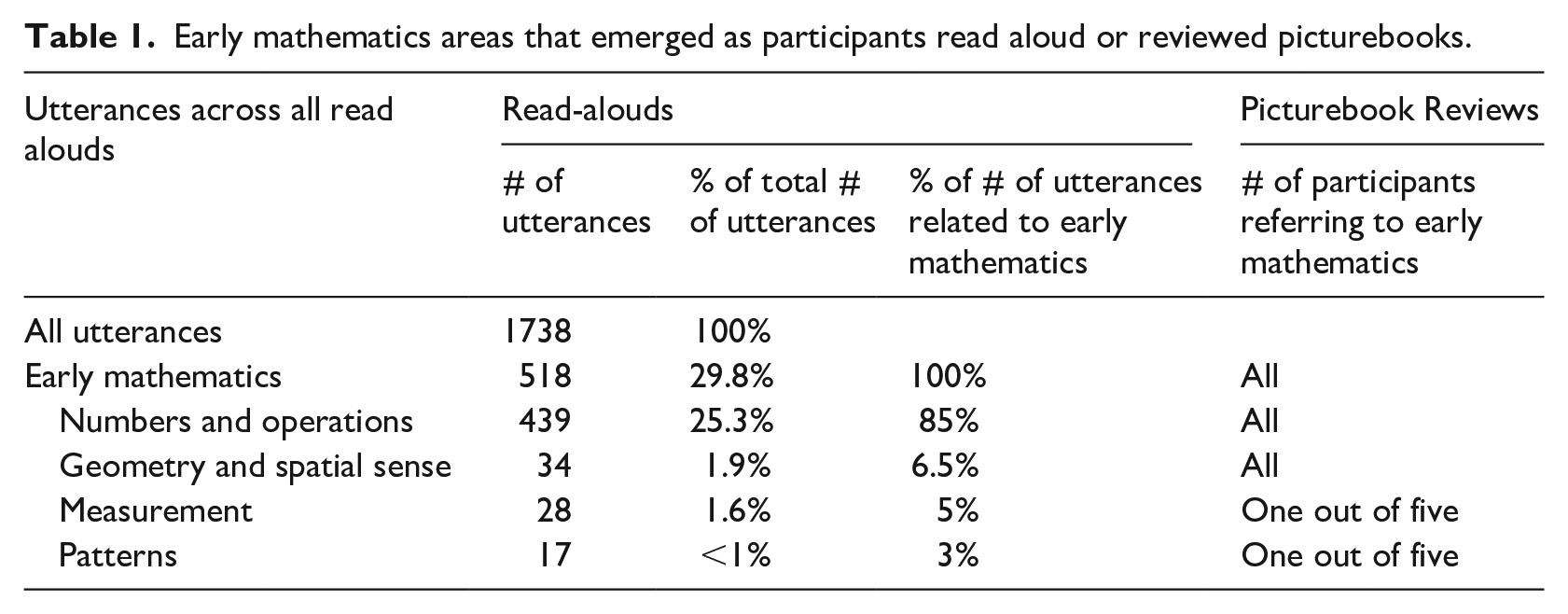
Numbers and operations was the most common early mathematics area that emerged from the read-alouds (representing 85% of the total early mathematics utterances). Those included engaging young children with: using the counting sequence; counting objects (by ones or by groups); discussing the quantity of a set; combining and separating items; comparing quantities; and discussing ordinal numbers. The area of numbers and operations also emerged as a predominant early mathematics area when adult participants reviewed picturebooks. For instance, participants mentioned that they would discuss counting items, ordering numbers, comparing quantities, recognizing numerals, and combining/separating items as they read More than One. All other mathematics areas—geometry and spatial sense, measurement, and patterns—were less frequent than the area of numbers and operations. Geometry and spatial sense mostly related to the use of spatial sense vocabulary (e.g. on, behind) as participants read aloud picturebooks. Measurement was found through references to size, height, and time in five of the 12 read-alouds. One participant referred to measurement as she reviewed School’s First Day of School. Patterns were discussed once during a read aloud and once, in the form of a brief reference to patterns, during a book review, also of School’s First Day of School.
Picturebooks as such also influenced the mathematics areas participants would discuss as they explored early mathematics through picturebooks. For instance, all participants referred to geometry and spatial sense as they reviewed School’s First Day of School (e.g. “What type of shapes make up that house?”), but none mentioned it as they reviewed More than One. Another example can be found from the read-alouds. A participant, reading two picturebooks without a mathematics focus, engaged with the areas of geometry and measurement while reading the book Peter’s Chair, and engaged with numbers and operations while reading Emily’s Sharing and Caring. In other words, there was variation across the readers and between books.
To summarize, all mathematics areas emerged from the participants’ experiences in exploring early mathematics through picturebooks, but the area of numbers and operations was predominant.
RQ1b. How do the participants’ experiences align with DAP?
To report how the participants’ experiences in exploring early mathematics through picturebooks aligned with DAP, we looked for evidence of the participants’ attention to child development, contexts of learning, and intentional teaching as they read aloud and reviewed picturebooks. An overview of the results is presented in Table 2.
DAP that emerged as participants read aloud or reviewed picturebooks.
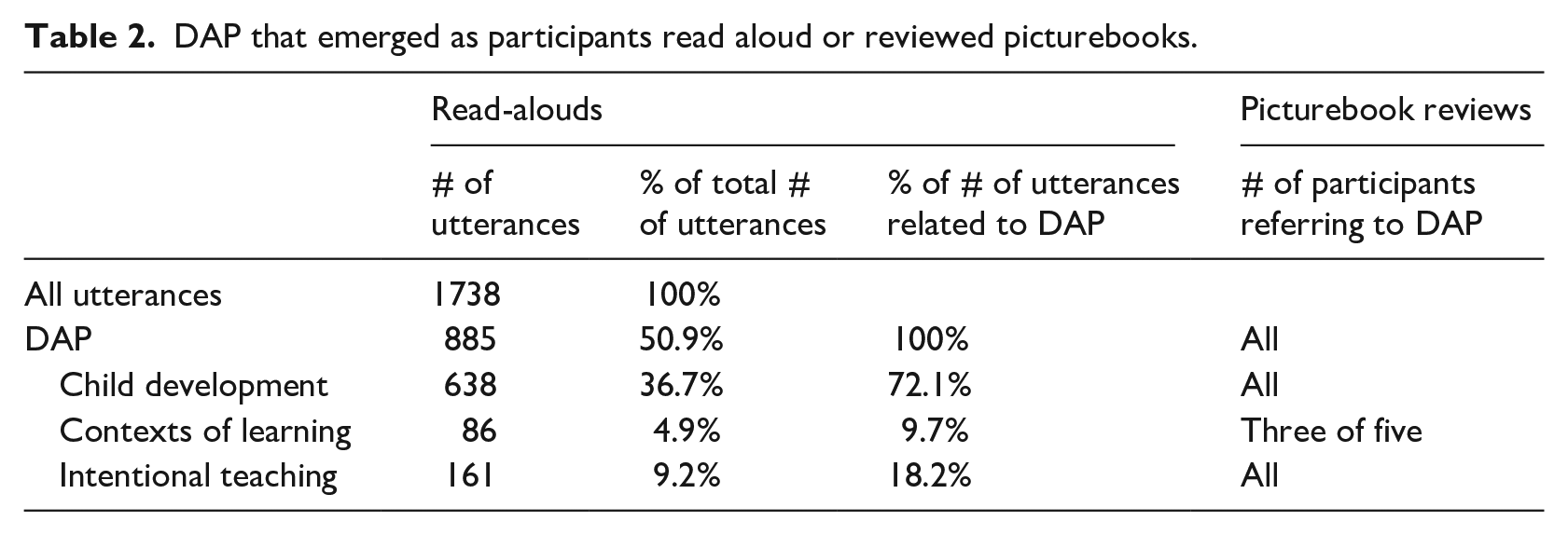
Overall, children seemed engaged during read-alouds, as a 50-50 balance was found between the children’s versus adults’ utterances across read-alouds. As presented in Table 2, attention to child development emerged from both read-alouds and picturebook reviews. Children’s statements were noticed throughout the read-alouds through teacher participants asking questions and rephrasing a child’s answers and represented about 36% of the total utterances. For example, a teacher participant asked the children how many whales could be in the ocean (“How many? What other numbers?”), as she was reading More than One, and rephrasing the number provided by two of the children (“10? You think there is 10 whales in the ocean?”; “Five whales?”).
As shown in Table 2, the attention to child development also emerged in the picturebook reviews as all five participants referred to this DAP. More than One was perceived as engaging for young children by participants, as children would be “interested” and “kind of intrigued” with a book that would “catch a child’s attention.” Regarding School’s First Day of School, participants pointed out that readers, to maintain the engagement of young children, would have to “break it down in part” or “expand math throughout the whole week” to respect preschoolers’ attention span.
Some evidence of misalignment between the participants’ experiences and attention to child development could be found in most read-alouds, through children’s statements being unnoticed. For instance, a child may provide an answer to a question raised by a teacher participant, but the teacher participant did not follow up. In other words, although the attention to child development appears to be perceived as important by participants, attention to all children may be arduous during whole-class read-alouds.
The attention to contexts of learning emerged from two lenses during read-alouds: the presence of a warm and positive social relationship between adult(s) and child(ren) and the reference to various cultural contexts. Warm exchanges were observed across read-alouds such as “I think you’re right” or “I like what you said” and represented about 5% of the total number of utterances (Table 2). Although no references to various cultures emerged from the read-alouds, most participants who reviewed the picturebooks, including two who identified as African American, pointed out the diverse representation of characters in School’s First Day of School. Participants described the picturebook as “very multicultural” and inclusive with “children with darker skin, children with lighter skin,” “kids are different colors, girls, boys,” and “one young lady in a wheelchair.” A participant appreciated the representation of a fatherly character as he reviewed More than One, mentioning that he “loved the fact that they’re sitting with their dad and reading” in opposition to a “female figure” because “sometimes that gets overlooked.”
Finally, mixed results were found regarding the attention to intentional teaching as participants read aloud or reviewed picturebooks. Overall, the attention to intentional teaching represented only 9.3% of the total utterances across all read-alouds (Table 2), as coded through three sub-codes: questions extending children’s thinking (1.6%), recall of prior knowledge (1.1%), and scaffolding (6.6%). For instance, although 365 questions emerged from all read-alouds, only 28 questions built on what the child said to extend their thinking.
By contrast, all participants referred to intentional teaching as they reviewed picture books. Participants referred to intentional teaching as they reviewed More than One, noticing, in particular, how the book connected to children’s prior knowledge and provided “an opportunity to expand learning and do some intentional teaching.” Participants also noted the richness of School’s First Day of School to scaffold mathematical areas. For example, a participant highlighted how it could be used by a teacher “to notice and go back and draw more out of the story so that they can use the book over and over again, to, um, to, to bring children’s attention to the different, um, mathematical areas.”
In summary, the participants’ experiences in exploring early mathematics through picturebooks mostly aligned with DAP. However, although participants seemed to value intentional teaching, its implementation through read-alouds was sparse.
RQ2. What are Head Start participants’ overall sayings about exploring early mathematics through picturebooks?
Participants discussed early mathematics and book reading practices already in place in the classroom and in the home that would facilitate the implementation of the phenomenon. They also shared their experiences and challenges in exploring early mathematics through picturebooks.
Classroom practices
Several practices supporting book reading and early mathematics were reported throughout the interviews. Mathematics practices involved discussing the calendar, counting, and moving songs, and hands-on activities, embedded throughout the day. These classroom practices were extended to the home, with materials sent to families. Parents received every week “a calendar with what the child is doing in the classroom” as well as follow-up activities “for instance, if they go to the grocery store to count items, to count, uh, to recognize numbers, um, any, any opportunities they have to add, um, add items together, um, they’re encouraged to do that.” Prior to the pandemic, children had access to books throughout the day at school—“there’s reading time at the school and there are books on a reading shelf, that’s one of the choices that they have during free time.” Overall, book reading occurred every day and included stories around “counting.” Books were also sent home as the program participated in “Dolly Parton’s Imagination Library,” a program sending books monthly to families. Participants also pointed to early mathematics as opportunities to talk about mathematics (e.g. “a child being able to have a conversation around either counting, uh, combining things, uh, combining objects.”). During one of her visits in the classroom, the first author observed a discussion around mathematics as children were having breakfast. One of the teacher participants took the chance to discuss wholes and parts of a whole as she served all children half of a muffin. The other teacher participant referred to that discussion later on during the day (as earlier referenced in the section on intentional teaching), as she was reading After the Fall, explaining “just like this morning, when you were talking about the muffin. The muffin was a whole muffin, right? But if you break it, how many pieces do you have?.”
Home practices
Mathematics practices involved the use of activity books (e.g. “books that I got from Five Below and they’re, um, they’re math, it’s math for three to, for ages three to four”) or the use of snacks as an opportunity to count (e.g. “count the M&Ms and then you can have them”). One participant mentioned her enjoyment of reading herself and consequently, to her child—“I am reading anywhere, anywhere I read myself, so I don’t mind reading to [child].” She also mentioned that questions should be posed during the read-aloud, “not too hard, what I know [child] would remember.” Another participant acknowledged the sparsity of book reading with her child when she said, “we don’t do much on reading.” Interestingly, she still envisioned book reading as a series of back-and-forth exchanges: “When I’m reading [child] a book, um, I have [child] engaged in the book too. So basically, um, like with the picturebooks, I asked [child] questions, um, and have [child] point out what [child] sees and stuff like that.” Evidence of discussions around mathematics was found in the context of the home as well, when a participant reported a follow-up discussion after reading More than One, about one bag of tangerines being more than one (i.e. 13 tangerines).
Participants’ experiences
Overall, participants reported a positive experience in exploring early mathematics through picturebooks. They related the positivity of their experience to the book itself, such as the presence of colorful illustrations and topics of interests for children (e.g. families, sports, trucks, etc.). Indeed, all participants agreed that, in general, picturebooks should be engaging for children and selected based on the child’s interest: “I select them according to how the children, um, respond to certain subjects. . . like, if somebody is interested in cars or if they’re showing interest in blocks or whatever show. . .[. . .] I’ll go by what their interest is, you know?” Illustrations were perceived as essential to discuss early mathematics areas, even beyond the story itself: “you can even make up a story and you can use the same picture for several different, um, ideas around mathematics.” Overall, the illustrations should be colorful as “it has to be something as a color. . . you don’t want to put up a book that’s black or white.” One participant, discussing Anno’s Counting Book, a wordless book, mentioned that “without the words, I think you get more of a response from the kids, and it encourages the teacher to ask more questions without the reading, without the words.”
Participants also appreciated the variability in picturebooks to discuss mathematics areas, as repetition was seen as critical with young children for several of the participants. For example, one participant stated, “I could take this book and I could read it from cover to cover several days in a row [. . .] Because each time that you look at it, you can have them look at it from a different angle. So, you can just do plants at one point, because you have one, two, three, you have three different types of plants in terms of the trees.” Several participants also referred to the benefit of picturebooks to support, and extend, mathematical language. Building up from More than One, a participant reported how confusing the expression “a pair of jeans” can be compared to “a pair of shoes,” and how the book could provide support to address that. Participants also saw how picturebooks provide hands-on opportunities to connect with mathematics such as “let’s count these. . . count these rectangles.”
Interestingly, one participant extended the phenomenon of exploring early mathematics through picturebooks beyond the child and envisioned it as a learning tool for teachers to become more intentional in their teaching. The participant explained that “intentionality of instruction,” a concept that teachers “struggle with the most” requires “observation” (i.e. noticing children) and “imagination” (i.e. extending the child’s learning). Exploring early mathematics through picturebooks could guide teachers, working with coaches, in noticing more opportunities to extend children’s learning.
Challenges
Participants also identified some challenges in exploring early mathematics through picturebooks. Participants reported that “some people don’t know how to, how to apply or what to say” or that “some parents don’t have patience, or some parents may not know how to incorporate or implement math” or that “people don’t really think to operate math and reading.” Such statements align with some participants not envisioning early mathematics beyond counting and referring to early mathematics as “simple stuff, like one plus one [. . .] or three minus one,” “basic like counting, um, counting, like give them a certain amount, one to five.,” while others would go further in their definition. One participant added operations such as “being able to engage in the process of either physically dividing objects or being able to track either the addition or subtraction of objects.” Another participant also included the area of geometry and spatial sense “and basic shapes to connect to the world.” Interestingly, when discussing a book rich in mathematics areas, such as School’s First Day of School, additional mathematics areas emerged from a participant, such as the comparing sizes of items. A participant mentioned that Just in Case you Want to Fly was “a little bit tricky” because children “didn’t pay as much attention to counting and objects” and tended to “more or less steer toward just the pictures that they saw.” The length of the book was also reported as a potential issue. For instance, School’s First Day of School was perceived by a participant as “too long to me and, you know, a lot of words and stuff, my son wouldn’t stay interested in it that long.”
Discussion
The purpose of the study was to better understand the phenomenon of exploring early mathematics through picturebooks, from the perspectives of Head Start participants, and through Bronfenbrenner’s bioecological framework, recognizing nested systems of influences between the personal characteristics of the child and their environmental context, such as the home and the school environments. The case study supports the endorsement of the phenomenon in view of early mathematics and book reading but also in view of DAP. However, potential obstacles were illuminated and should be considered by both researchers and practitioners.
First, participants expressed curiosity toward early mathematics and saw the potential of exploring early mathematics through picturebooks due to their colorful illustrations and range of interest topics for young children. In fact, most participants could find examples in picturebooks of early mathematics areas once they became aware of the five areas of early mathematics. As one participant said, “early mathematics deals with everything.” Those findings tie well with previous studies reporting that general picturebooks can be “mathematized” to provide young children with opportunities to explore mathematical ideas and ask questions (Dunphy et al., 2020; Fosnot and Dolk, 2001; Hintz and Smith, 2013; Hynes-Berry and Grandau, 2019). However, our findings may contrast with the report that the mathematics embedded in the story can be arduous to see and be overlooked by the reader (Dunphy et al., 2020). For instance, a participant started noticing content related to patterns and measurement in a picturebook rich in early mathematics (i.e. School’s First Day of School) while these areas were absent from the participant’s definition of early mathematics. Future investigations should focus on readers’ cognitive processes to better understand the mathematics content they see in a book as well as how they engage the young children with such content, as factors influencing learning outcomes include the book itself, but also the child, the reader, and their interactions as they explore the book together (0’ Rear et al., 2022).
Second, participants reported practices around early mathematics and book reading that could be extended to explore early mathematics through picturebooks. Picturebooks were commonly used in the classroom but were also accessible for families through “Dolly Parton’s Imagination Library.” Sending monthly books to young children through this program, has been associated with an increase in the frequency of parents reading to their child and the children’s enthusiasm for books (Conyers, 2012). In parallel, participants provided evidence of discussion around early mathematics in the school and in the home that could be used as a first step toward mathematizing a picturebook (Dunphy et al., 2020) once guidance to connect both early mathematics and book reading is in place.
Finally, the participants’ sayings about, and experiences with, exploring early mathematics through picturebooks align with child development and contexts of learning, two cornerstones of DAP. Taking into account child development through children’s interests while selecting a picturebook is a widespread practice for teachers and families (Dunphy et al., 2020), and parents’ engagement around numeracy and literacy has been related to children’s interests (Lukie et al., 2014). In other words, a favorable learning environment occurs when both the child is interested and the parent is engaged in the child’s activity (Lukie et al., 2014). In addition, participants noticed and appreciated the diverse representation of characters in School’s First Day of School, in view of race/ethnicity and disabilities. Although no discussion around cultures directly emerged from the read-alouds, this finding aligns with the latest DAP framework and its focus on cultural contexts of learning (NAEYC, 2020), and reiterates the relevance of multicultural literature to support mathematics learning (Iliev and D’Angelo, 2014). One must also point out the participants’ noticing of characters with disabilities, such as a little girl in a wheelchair playing with another girl during recess in School’s First Day of School, provide an example of the relevance of inclusive literature that goes beyond teaching about a disability (Kleekamp and Zapata, 2019). Recording participants reading School’s First Day of School to young children would provide additional evidence about the potential of the book to endorse both early mathematics and young children’s identities.
Although the study’s findings support the exploration of early mathematics through picturebooks, potential obstacles emerged and should be taken into consideration to avoid unintended consequences and prevent inequitable opportunities among young children. While participants acknowledged the potential of exploring early mathematics through picturebooks, evidence from the read-alouds showed that in practice, the phenomenon may be arduous to implement in view of DAP. For instance, noticing each individual child may be difficult while reading aloud to a whole class. Also, the recorded read-alouds present only a fraction of the learning opportunities offered to children throughout the day, but the observed intentional teaching around early mathematics was sparse throughout the read-alouds (i.e. scaffolding young children’s learning in early mathematics did not naturally come from picturebooks). Overall, no clear evidence of extending young children’s mathematical thinking was found throughout the recorded read-alouds (i.e. follow-up questions/statements building on a previous child’s sayings). Similar quality of book reading has also been reported in the classroom and in home (Anderson et al., 2012; Barnes and Puccioni, 2017; Deshmukh et al., 2019; Zucker et al., 2021). Picturebooks with mathematical content embedded in the story (e.g. Storytelling Math series) or a brief intervention as described in Purpura et al. (2021) could provide a first step for adult readers to start engaging with mathematical content as they read to their child(ren). Additionally, such findings from read-alouds aligned with the participants’ thoughts about teachers struggling with noticing opportunities to extend children’s learning, or lacking the knowledge to do so. Finally, as previously discussed, though several participants appreciated the diverse representation of characters in School’s First Day of School, children’s literature still overrepresents white, middle class, cisgender, and able-bodied characters (Koss, 2015), making it arduous to find picturebooks that empower all children around early mathematics. Also, even though a picturebook has the potential to empower young children’s identities, the role of the reader is critical to fully embrace such potential.
Limitations and implications
Even though the case study provides evidence to better understand the phenomenon of exploring early mathematics through picturebooks, the study has limitations. The study protocol had to be amended due to COVID-19 and the subsequent closing of the center. A consequence was that participants did not have the opportunity to read the whole list of picturebooks initially planned to ensure that all mathematics areas were covered. The read-alouds were audio-recorded; it might be worthwhile to video record read-alouds in future studies to examine gestures and other visual cues that could inform our understanding of the phenomenon. Finally, because the study was a qualitative study with a small sample of participants, there is a limit to the generalizations that can be made.
Nevertheless, the findings of this study can be understood as a reflective work around the phenomenon of exploring early mathematics through picturebooks. Although participants recognized that the endorsement of the phenomenon could be “tricky,” they expressed interest in it and provided thoughtful insights that have implications for future research. Two potential research pathways can be envisioned from the findings. A first pathway would focus on the child and investigate strategies to guide teachers and families in posing thoughtful early mathematics questions that stimulate children’s thinking as they read, to ensure that all children can fully benefit from the phenomenon. Studies have focused on using discussion around early mathematics during dialogic reading in the home (Hojnoski et al., 2014) and in the school (Hojnoski et al., 2016). However, the field would benefit from endorsing the Head Start model to build a strengths-based training empowering Head Start teachers and families while considering social inequities associated with living in poverty. For instance, the case study highlighted participants’ appreciation of engaging with picturebooks that provide a diverse representation of characters. Further investigation is needed to describe what a training around exploring early mathematics through picturebooks embracing such statement would look like (e.g. supporting teachers and parents in being deliberate in their book selection and learning how to select picturebooks with high potential for student learning and diverse representation of characters). A second pathway would focus on teachers. As suggested by one of the participants, the phenomenon could be used as a tool to raise teachers’ awareness in noticing and embracing moments throughout the day to support children’s learning. Studies would involve coaching and classroom observations and would provide new strategies to support teachers in their classrooms, using picturebooks as a tool.
Head Start provides a thoughtful strengths-based context in which to learn about ECE-related topics as it seeks to not only support young children living in poverty, but also to empower their families (Bierman et al., 2015). As emphasized in 0’ Rear et al. (2022), the book itself, but also the child, the reader, and how they interact all influence the learning outcomes, and our case study provides evidence to better understand these factors from the perspectives of Head Start participants, often absent from the literature. The next step should involve children—what would they say about exploring early mathematics through picturebooks? What do they like about being read to aloud by their caregivers?
