




Abstract
In studies of classroom discourse in early childhood education and care (ECEC), a dominance of the communicative pattern of initiation, response, follow-up (IRF) is shown, and a need of knowledge about extensive dialogue for meaning making is argued. In the present study, communication between children and teacher(s) in play is consider as a form educational discourse mediating language learning. The study, informed by a sociocultural perspective aims to contribute to the knowledge of pattern of establishing a pedagogical dialogue in play activities. What characterizes the communication establishing a joint play in which children come to participate in extensive dialogues is clarified through reanalyzing video-documented data from a project concerning play, learning and teaching in ECEC. The analysis implies a pattern of ICE: children initiating a play (I)—a teacher challenging the initiative (C)—children expanding the content (E). The function of challenging is understood as the critical contribution for opening for and expanding the children’s verbal participation. A conclusion of changing the follow-up from evaluating to expanding in a pedagogical dialogue is recommended to study further in different contexts.
Introduction
In an education context, children are expected to learn new skills and knowledges of which a central one is verbal communication. Verbal communication as a means of appropriating discursive tools mediates thinking, learning and self-regulation (Vygotsky, 1987). There is a link between teachers’ active involvement and young children’s participation in discussions (Cazden, 2001; Wells, 1999). Systematical support of communicative aspects, in addition to the formal ones, is stressed by van der Veen et al. (2021) as important for children’s language learning. A gap in knowledge of classroom talk is pointed out in previous research concerns the importance of knowledge of pedagogical dialogue children participate in during the first years of education (e.g. Muhonen et al., 2020; Salminen et al., 2021; van der Veen et al., 2021).
In early childhood education and care (ECEC), play has a role in learning. Verbal communication is a component for participation in play as well as a skill to develop through playing. Children’s verbal participation in play is characterized by communicating in and outside the play and/or in and out of character as well as interpreting others’ communicative actions (Kultti and Pramling Samuelsson, 2017; Ninio and Snow, 1996; Pramling et al., 2019). In addition, the turns in play may proceed quickly, and several contents may, explicitly and implicitly, be actualized simultaneously (Kultti and Pramling Samuelsson, 2017) which presumes skills in participating verbally. Therefore, the present study addresses how children’s verbal participation in play can be supported through teaching in ECEC.
Even though the teacher contributions are shown to be crucial for the progression of the communicative patterns (Rasku-Puttonen et al., 2012), there are different beliefs of how children’s learning didactically is to be organized in ECEC. As strong as the belief of learning potential of play is, as common are different understandings of the teacher’s role in play: play as an arena for children’s learning in interaction with teachers or play as children’s own activity (see e.g. Lagerlöf et al., 2019). There can also be different beliefs about who will be the one responsible for initiating and evolving a play. Play as an activity not intended to achieve some learning goals, might open for another types of communication patterns than activities with academic content in ECEC. Yet, for the same reason, teacher’s scaffolding might become less proactive, and thereby less extended exchanges might occur in play (cf. Muhonen et al., 2020). The roles can also be distributed based on verbal skills and/or knowledge of the play content for verbally communicating in and outside the play and/or in and out of character and interpreting the others’ communicative actions. Another factor playing a role for roles in play is the activity characterized by a small number of participants.
The purpose of the present study is to contribute to the knowledge of pattern of establishing a pedagogical dialogue in play activities between children and teacher(s) as a form of classroom talk in ECEC. This is addressed through the research question: What characterizes the communication in the startup of a joint play (content and direction) between children and their teacher(s) in the selected activities where children come to participate in extensive dialogues?
Research on communication patterns and dialogue in education
The pattern of initiation-response-feedback/evaluation (IRF/IRE) sequence, as a common structure for organizing classroom discourse (Cazden, 2001; Halliday, 1984; Lemke, 1990; Mehan, 1979; Nassaji and Wells, 2000; Sinclair and Coulthard, 1975; Wells and Arauz, 2006), is the most prevalent pattern even in ECEC, regardless of content and activity (Muhonen et al., 2020; Rasku-Puttonen et al., 2012; Salminen et al., 2021; van der Veen et al., 2021). It is most often the teacher who initiates and rounds up the dialogue. Monologic talk where the teacher takes up the space for talk, limits children’s development of their language use and learning (van der Veen et al., 2021) Even in classroom discourse with a dialogic character, the pattern of IRF often remains (Nassaji and Wells, 2000; Wells and Arauz, 2006).
The function of the communicative moves in a discourse characterized by IRF can be understood as relative the context (that is, education): the teacher is responsible for creating learning opportunities through teaching for specific content (Nassaji and Wells, 2000). In addition, communication in classroom tends to be teacher centered rather than occurring between the students (Cazden, 2001; see also, Lyle, 2008). Again, the context: its physical arrangements of seating—the students facing the teacher—and way of addressing the person by name instead of by the second person singular pronoun, is a factor for types of communication pattern occurring (Cazden, 2001). Another form of context: curriculum directives and assessment demands, is likewise shown as a factor in the interaction style used by teachers (John, 2009).
Concepts such as dialogical teaching approaches, dialogic exchanges, dialogical discourse, extended dialogue, educational dialogue, point out dialogical teaching approaches that support children to develop their thinking (e.g. Alexander, 2010; Muhonen et al., 2020; Wells and Arauz, 2006). For example, Alexander (2010) describes dialogic teaching as reciprocal, collective, supportive, cumulative, and purposeful. Mercer’s (2000) work on exploratory talk specifies the following as important teaching tools for student participation: recapitulation, elicitation, repetition, reformulation, and exhortation. van der Veen et al. (2021: 2) defines dialogic classroom talk as “a classroom culture in which children and teacher(s) think and talk about shared discussable topic” and which collaboratively develops the topics.
The teacher can move toward dialogical discourse by taking on the students’ responses (Wells, 1999), asking questions with several possible responses, and encouraging the students to respond to each other’s ideas (Wells and Arauz, 2006). The follow-up move is addressed in a study promoting dialogical teaching for literacy learning during the first years of formal schooling (Davidson and Edwards-Groves, 2020). The analysis shows how the follow-up move functions as a comment or an initiative for several responses instead of evaluating or giving feedback to one. John’s (2009) study focuses on the reading processes of children during the 3 first years of formal schooling. The analysis reveals three types of discourse: a teacher-framed, a student-framed, and a collaborative one. According to John, the third move in the discourse with a collaborative character provides an opportunity for challenging children’s thinking. The follow-up move as dialogue extending is seldom given by the students (Suryati, 2015).
Pedagogical dialogues in early years education
In a study of dialogic teaching in classrooms of 6-year-olds (Muhonen et al., 2020), initiation and quality of the dialogue are analyzed. The study shows teacher-initiated dialogues occurring more often than child-initiated ones. High-quality dialogues initiated by teachers are characterized by open-ended questions, scaffolding, and shared meaning making, according to the study. Dialogues initiated by children are responded by teachers summarizing and extending the content. An intervention study of van der Veen et al. (2021) in ECEC implies benefits of dialogic classroom talk, including supporting children’s oral communicative competence.
An analysis of interactional patterns of pedagogical dialogue between teachers and children at the age of six in ECEC (Rasku-Puttonen et al., 2012) reveals a pattern of IRF opening for children to demonstrate their knowledge as the most common one. The two other patterns found in the study occur only a few times and in some of the classrooms studied. These have a dialogic character with functions as supporting variation of contributions and sharing ideas initiated by the children. Even in a study focusing on classroom talk with children at the ages of three to four (Muhonen et al., 2022), IRF is identified as the dominating pattern in interaction, both in different contents and activities. The few extended exchanges occur in small-group activities. In all the four patterns showed, the leading role is played by the teacher. However, it is stated that educational classroom talk, in terms of “extended, reciprocal, and cumulative” (Muhonen et al., 2020: 16), is not found in the study. Dialogic exchanges in play are relatively uncommon and seldom scaffolded toward educational dialogue, shown even in the study of dialogic exchange in activities labeled as academic and play (Salminen et al., 2021). Yet, both the activities “can nearly equally enable dialogic sharing and joint knowledge building with young children” (Salminen et al., 2021: 11).
Theoretical frame
Investigating extensive dialogue in play activities is in the present study grounded in the theoretical premise that how people understand the world is semiotically mediated by the discursive tools they have appropriated (Wertsch, 2007) which implies analyzing verbal communication. The discursive tools children encounter and start appropriating, for example through play, are crucial for their participation and learning—that is, for the experiences they will make (Alexander, 2010; Brice Heath, 1996; Halliday, 1978; Vygotsky, 1987; Wertsch, 1998).
More specifically, understanding dialogue as contributing to children’s knowing is, in the present study, conceptualized in terms of the zone of proximal development (ZPD) (Vygotsky, 1978). This Vygotskian concept of the dynamic space between the actual and the potential level of development contains a forward-directed concept of development; learning, and therefore teaching, can induce cultural development, through the leaner interacting with more knowledged others. Play as a context for learning provides children with a ZPD since children are argued to act independently of the situation and/or change the situation first in an imaginary situation (Fleer, 2011; van Oers, 2013; Vygotsky, 1933). Children initiating content for play can act grounded in their interests and knowledge, which, in turn, means opportunities for their participation and communication with others, engaging in dialogue. However, playing something known can also narrow the development opportunities offered. In ECEC, a group of children with various experiences come together. This gives children rich opportunities for understanding something in various ways. Concurrently, (too) different understandings of something may restrict the creation of shared focus and the evolution of mutual play. That is, play may increase developmental opportunities in terms of challenges within ZPD and decrease them if characterized by reproduction (e.g. reoccurring content) or breakdowns, if challenged outside the participants’ ZPD.
Expressed in other words, ZPD provides a space for teaching. As conceptualized in play-responsive teaching, the importance of the participants—teacher(s) and children—being responsive to each other’s contributions and teaching without losing the character of play is emphasized (Pramling et al., 2019). Verbally shifting between as is and as if in teaching activities (Pramling et al., 2019; cf. Fleer, 2011) is in the context of the present study understood as opening for several knowledgeable others (see roles as discussed below)—i.e. various voices, knowledge, and experience contributing to the dialogues and thus to children’s learning. Since both culturally established forms of knowledge (as is) and imagination (as if) can be used for initiating and elaborating on a play, it is not given that the teacher is the more knowledgeable other.
From the perspective of play-responsive teaching, Nassaji and Wells’ (2000) finding of the role distribution relative to the functions of the moves becomes relevant. According to Nassaji and Wells the roles: initiator and primary knower (cf. more knowledgeable other) commonly overlap. Yet, if this is not the case, the functions of the second and third move will change. That is, when the critical contribution is given and by whom. Nassaji and Wells are arguing that the responder being the primary knower will add to the discourse becoming (more) dialogical and participation in it (more) equal:
If it is the student who is the primary knower, or if no participant lays claim to this role, there is no requirement for the teacher to perform an evaluating function in the third move. Instead, she or he can add a comment that extends the discussion or ask a question that invites a student to do so. The effect of adopting this latter strategy, in particular, is to cast the responder in the role of primary knower and thereby to create a more equal mode of participation. (Nassaji and Wells, 2000: 380f.)
Given this theoretical reasoning, empirially studying how extensive dialogue in play is established is of interest to research in ECEC and educational practice.
Content and analysis
This section presents the project within which the empirical data were generated and the analytical approach for the study.
A development and research project of teaching, learning and play in ECEC
The empirical data in the present study are generated within a development and research project aiming to create knowledge and provide in-service education of teaching, learning and play in ECEC (Pramling et al., 2019). In the project, teachers, preschool heads and children at the ages of one to five in ECEC settings located in a medium size and a large city in Sweden, participated. I was one of the ten researchers in the research group included members from three universities in Sweden.
Set-up for the three-year project of collaborative character included lectures, video-documentation of play activities and workshops for analysis (Pramling et al., 2019). The researchers gave lectures of theories on learning, play and teaching with specific focus on concepts of narrative, metacommunication, and intersubjectivity. The teachers were then asked to video-document activities in which they intended to contribute to initiating and evolving play and learning of the children through narrative, metacommunication and intersubjectivity. That is, they were expected to participate in the activities with children, opening for evolvement of a play as well as creating new play frames.
The documented activities were viewed, discussed and initially analyzed in collaboration during the workshops. Then the video-documented activities were transcribed verbatim and converted into a table with numbered turns by the researchers. The corpus of data are in-depth analyzed and reported in studies focusing on several topics in relation to play, teaching and learning (e.g. Lagerlöf et al., 2019; Palmér and Björklund, 2020; Pramling et al., 2019).
The character of the empirical data
The empirical data generated by the teachers contain different kinds of play and activities differ to their character: when it comes to time, number of participants, age of the participants, and the content of the play (Pramling et al., 2019). A common character is that the teachers, from initially not engaging in the documented activities, gradually became participants in and frequent initiators of these. Therefore, the time for the recording can explain the variety in the children’s verbal participation in the activities analyzed. Teachers’ changed participation in play throughout the project is supported by the study of teachers’ participation in a collaborative action research project (Nassaji and Wells, 2000).
When the teachers are participating in play activities, a common strategy for them accessing play is posing questions such as Who is the dad?; Is that his dog? For these the children shortly responded: I’m; Yes. However, some of the play activities stand out regarding the children’s verbal engagement in this initiating dialogue. This observation made me interested in understanding what makes children talk in children–teacher play.
Reanalysis of the data
Criteria for selection of the data to reanalyze was ongoing play activities which involved more than one child and at least a teacher. The coding of the data were inspired by the coding of classroom discourse data by Nassaji and Wells (2000) and Wells and Arauz (2006). Challenges concerning reanalysis of empirical data of play is to discern who is talking and if the play initiative is not being includied in the video-documentation.
First, the number of utterances given by a teacher and children were counted in establishing a joint play content and direction. Most of these play activities in the data consisted mainly of the teachers’ utterances and were therefore excluded. The type of content seemed to be significant for the character of the talk. When playing a familiar story, such as Goldilocks and the Three Bears, the children’s moves were mainly about responding to the teacher or saying the predefined lines, that is, reproducing talk. In a construction play, the teacher could be posing questions about the play as an initiative for joining the play and the children answering the questions posed without any extending features. That is, a pattern quite similar to the IRE.
Then the few play activities characterized by children having a minimum of half of the utterances were selected. These activities were characterized by mission/problem and play-responsive teaching. These remaining activities serve as the basis for the re-analytical focus in one pattern of pedagogical dialogue to investigate the characteristics of establishing a joint play to contributing to knowledge of children’s learning of extensive dialogues. Thereby no claims about its quantitation are done.
A sequential organization of the activities (Derry et al., 2010; Wells, 1999) is analyzed. In the analysis, conducted on a turn-by-turn basis, the utterances (actions) are understood in responsive to each other and a minimum of three consecutive actions are needed: how a play activity is initiated and responded. The utterances are analyzed in terms of participant perspective, rather than from the perspective of the analysist. The analytical tools guiding the analysis are: function of the utterances, (shifting) roles (knowledgeable others, initiator, primary knower) and the dynamic space between the actual and potential development of children, as conceptualized as the zone of proximal development (ZPD).
The analysis is presented through three play activites. In the first one (Excerpt 1), four children aged four to five and a teacher participate. The documented activity lasts 4 minutes. In the second one (Excerpt 2), a 7-minute play activity between children aged four to five and three teachers, is documented. The third one (Excerpt 3) includes four children and a teacher. The children are between 3 and 5 years. The documented activity last for 6 minutes.
This study follows the ethical guidelines of the The Swedish Research Council (2017). Pseudonyms, alternatively child/children, are used in the transcripts for the participants. Pseudonyms for the teachers are given in capital letters. There is a permission from the publishers for re-publishing the excerpts.
Findings
The analysis of the character of the communication establishing a joint play between children and their teacher(s) in which children come to participate in extensive dialogues show a pattern of ICE in the start-up: children’s initiative (I)—teacher challenging (C) the initiative—children expanding (E) the content.
Initiating—Challenging
The following excerpt includes children and a teacher (see Pramling et al., 2019: 129, for another analysis of this excerpt). The children have much room for talk in the sequence. The analysis shows how the children’s initiatives (I) are confirmed and challenged (C) by the teacher in the play with the character of a mission.
Excerpt 1 The children are playing postal workers. They ask the teacher to write a letter to them. In the message, the teacher writes that Kroko, a for the children’s familiar toy crocodile, has fallen (down). After leaving the message in a mailbox, the teacher knocks on a door.
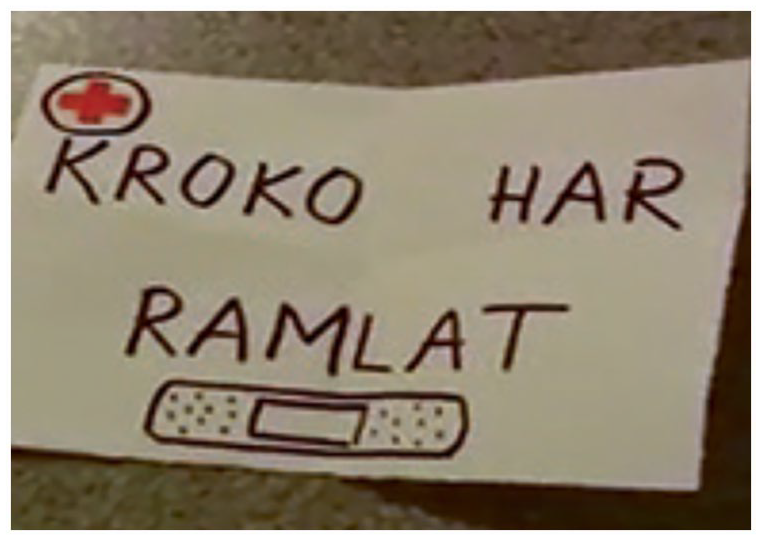
The initiative to a joint play is taken by the children. It is communicated outside the play (as is), asking the teacher to write a letter to them. The teacher’s response to the initiative is to write a note saying that Kroko has fallen down. The response not only confirms the children’s initiative but also challenges it: the note - a written text – with an open-ended character communicates a mission to solve and the use of both letters/words and pictures of a red cross and a band-aid. The challenge is offered within the imaginary framing (as if). At the same time, the teacher creates opportunities for the children handling the note with various discursive tools.
The challenge of verbally communicating written text is taken on by Maja as is when sounding out the words (turns 4 and 6). She sounds the letters of the last word. Then she turns to the teacher, explicitly asking for guidance on how to go about the sounding (reading)—she expresses knowledge of where the sounding is to start, which is critical for reading. In her response, her actual and potential levels of development are made visible. The teacher is constituted as a more knowledgeable other in the content through clarifying questions asked. The teacher’s response stated within as is:
After getting a confirmation of where to start (turn 12), Maja again communicates her knowledge of reading: that there is a reading direction to follow (turn 13). The teacher confirms the question as relevant through her response of reading direction, verbally and visually (turn 14). She then guides Maja by sounding out the word (turn 16). This provides implicit guidance for a sound Maja missed (turn 15). When the word was sounded by the teacher, Maja put the sounding together saying:
In sum, the children initiate the play content, which the teacher not only confirms but also challenges. The challenging is evolving around the mission within the play. The communication moves from as if through as it back to as if. The teacher as a primary knower in form of a reader, takes a role of a more knowledgeable other regarding reading in the play. Within the role, instead of reading the note, her scaffolding makes it possible to Maja to act as the primary knower when it comes to the accomplishing the mission. The challenge within the communicative frame makes the actual and potential level of development regarding literacy development of Maja visible. However, Disa’s acts interpreting the drawings (turns 3, 5 and 11) and using related terms:
Challenging—Expanding
In the following play called The Letter Thief, there are several children and three teachers participating (see Pramling et al., 2019: 155ff, for another analysis of this excerpt). The children have much room for talk in the activity. The analysis shows how the premise communicated by the children is challenged (C) by the teacher and expanded (E) as a response to this, by the children.
Excerpt 2 The play is initiated by the children drawing maps for finding the letter thief, a character known by the children from a board game. Maria, one of the children, is writing the letters the letter thief has stolen. The teacher joins the play by asking questions of what they are doing. The discussion directs then to the looks of the letter thief (drawn).
The child-initiated play around the character (turns 9–10) is challenged by the teacher directing the focus to (more) explicit communication (turns 11, 13, and 15). The questions posed are about how they know the sex of the figure. The teacher explicitly directs two of the questions to a particular child using the second-person singular pronoun (turns 11 and 13) and for all the children using the second-person plural pronoun (turn 15: these pronouns differ in Swedish). That is, the children are explicitly encouraged to consider various voices, knowledge, and experience. The challenge of verbally clarifying their ideas is responded to by the children explaining themselves (turns 12, 14 and 16). Whether the explanations are given within an imaginary framing or outside the play, is implicitly communicated by the children in most of the turns (9, 10, 12 and 14) in response to the questions given outside the play by the teacher. When the teacher is being explicit of the question being asked outside of play: using
The challenge given by the teacher is then also responded by a proposal of a restart of the play. Maria implicitly finishes the ongoing discussion about the looks of the letter thief by explicitly initiating a restart (turn 20). Changing the direction in a situation coming to a dead end as a way of expanding the play is also done outside the play (as is).
In sum, the initiative to a play is evolving around the character: what the letter thief looks like and being explicit on this. It is communicated both within as if (how the character looks like within the play/in the drawings) and as is (how the character looks like in the game), and implicitly whether the character is or should be looking the same or not in the play as in the game. That there are several ways of meeting the challenge of explicit communication: the children can choose whether they are talking about the character as “for real” based on the knowledge of a board game (as is) or in fantasy creating “a letter thief” (as if), gives the children the role of primary knowers of the content of the play. The challenge can also be understood as touching upon the level of development: what the children know and are able to communicate verbally (the actual level of development) and potentially how they can clarify their ideas and becoming clear whether these are given within or outside the play. That is, the “potential” zone includes taking the perspective of other. A response to the challenge given by the teacher, but also ending the uncoordinated discussion, is a restart of the play as a way to expand the play. This is understood as the children retaining the role of primary knowers. In other words, the children are showing/having agency of dealing with the contribution of the teacher.
Initiating—Challenging—Expanding
In the following activity, several children and a teacher play together (see Lagerlöf et al., 2019, for another analysis of this excerpt). The children and the teacher share the space for talk. The analysis shows a communication including initiation (I), challenge (C) and expand (E).
Excerpt 3 The play begins with some children and the teacher sitting around a table having tea; other children are also in the room. The teacher, in her role as mom, asks her children (around the table) about their day at school:
One of the children, Fanny, initiates content for the play within an imaginary framing (turn 4). The teacher in her role of mom confirms the initiative by repeating it and then reacting to it as something bad that requires further action:
The children continue communicating within the imaginary framing (as if). Linus takes on the challenge by responding with an idea of him calling somebody:
In sum, the child initiative, the teacher challenge and then expanding the play by the children as a response to the teacher’s actions evolves around a joint mission as a content of the play. The teacher responses are seen as an expression of the children as primary knowers in the play. In addition, they all appear as more knowledgeable others to each other in taking the play content further verbally and communicating within imaginary framing, as in response to each other’s acts.
Discussion
The purpose of the present study is to contribute to the knowledge of pattern of establishing a pedagogical dialogue in play activities between children and teacher(s) as a form of classroom talk. The analysis reveals a pattern of ICE: children’s initiative (I)—teacher challenging (C) the initiative—children expanding (E) the content, when establishing a joint play where children participate in extensive dialogues in the start-up. Below the findings and the contributions of the study are discussed.
ICE pattern and learning opportunities
There are similarities between the ICE-pattern and the findings conceptualized as dialogic teaching in terms of reciprocity, support, cumulativity, and purposefulness (Alexander, 2010). In addition, the findings relate to the ones in Muhonen et al. (2020), showing that the teachers as responders summarize and extend the content at hand in the interaction. The pattern of ICE also points out the importance of a discussable topic (cf. van der Veen et al., 2021)—engaging the participants in the play. The findings indicate that engaging in children-teacher play can create a space for children’s development of linguistic and sociolinguistic skills in several ways.
First, the teachers’ utterance(s) with the function as challenging, alongside the children’s utterance(s) with the function of expanding, indicate that the verbal participation of the teacher increases the verbal participation of the children.
Second, the functions of the moves regarding critical contribution are changed. In the present study, the function of the challenging (C), as a second turn, is understood as the critical contribution to opening and expanding the children’s verbal participation. It was common that the teacher as a responder started with confirming the initiative of a child. However, in these extended dialogues the response also included a challenge. This finding is in line with reasoning of Nassaji and Wells (2006), when it comes to the primary knower being the responder will contribute to a (more) equal dialogical discourse.
Third, the teacher as responder can open up for various voices, knowledge, and experience contributing to the dialogues (Pramling et al., 2019; cf. Fleer, 2011) as also shown in Rasku-Puttonen et al. (2012) Similarly, shifting between as is and as if is shown to open up for several knowledgeable others, or changes of roles, as shown in the present study. If these multiple ways for children to participate, providing them with and locating them in a ZPD—to act independently of the situation (Vygotsky, 1933)—occur mostly between one child and a teacher, it does not mean that the other children cannot be participants in terms of meaning makers, neither does it mean that they are. An aspect of collective communication in terms of challenging several children within their individual development zone is here pointed out as a potential area to develop in (play-responsive) teaching and as something to study further.
Play as an education activity in the present study occurs in small groups. Small-group activities in ECEC have been shown to be a context for extended exchanges between children and teacher (Muhonen et al., 2022), albeit not exclusively, as the present study shows. However, classroom talk in ECEC could move closer to the character of educational talk (cf. Muhonen et al., 2022) if a change of the E occurs from evaluating to expanding.
Conclusions
From the perspective of teachers, teaching responsive to play might be perceived as difficult to plan (cf. Salminen et al., 2021), and thereby become an uncommon form of teaching. The study points out teachers’ play skills, such as acting in unpredictable activities, as skills to highlight in research and in educational practice. The study contributes to emphasizing teaching responsive to play as a skill to practise (cf. Pramling et al., 2019 and Nassaji and Wells, 2000) showing how teacher participation in play develop as a result of teacher-research collaboration.
The study can be considered to offer a pedagogical contribution in form of good practice (Rasku-Puttonen et al., 2012; Wells and Arauz, 2006): through the focus on the initial functions of extensive dialogue for how to develop teaching responses to play—a practice with a multifaceted character. The indicative findings have potential to contribute to teachers’ understanding of the phenomena, the value of participating in play, and explicitly showing how that can be done since play is commonly considerad as a teaching-free-space and teaching as a teacher-activity (cf. functions of initiation (I) and evaluation/feedback (E/F).
The findings indication that how, when, and about what the teacher verbally participates matter, need to be understood within the frame of the study. The delimited context and a small number of activities showing the pattern of ICE can offer a pattern to study further, for example quantitatively and in mainstream ECEC with complex language ecologies (cf. Kultti, 2022). In addition, the piece of knowledge the study indicates can be further studied in relation to the IRF pattern and pedagogical dialogue in child-teacher joint activites, in and outside the context of play.
Footnotes
Funding
The author disclosed receipt of the following financial support for the research, authorship, and/or publication of this article: This research work was funded by a grant from the Swedish Institute for Educational Research (Skolfi, 2016/112), which is gratefully acknowledged.
