




Abstract
This paper discusses the innovative research method of using body-worn cameras for capturing speech and experiences of 3- to 5-year olds in English early years settings. The strengths and weaknesses will be discussed in this multiple case study approach to capturing the quality of speech from young children (n = 43). Adopting an interactionist theoretical framework and viewing the project through an interpretive paradigm, it is asserted there is the necessity to capture data in a way that is naturalistic and ethical at all times. It is argued that that in order to gain a full and deep understanding of young children’s lives, the use of body-worn cameras is pivotal in gaining the data that may not exist otherwise. It is therefore argued throughout this paper that although both strengths and weaknesses exist that weaknesses should be overcome and accommodated in order to enhance future research.
Introduction
Capturing authentic, naturalistic and realistic data when working and researching with young children can be challenging. As a result, when working within Early Childhood, it is sometimes necessary to approach data collection in an innovative manner. In recent times, there has been a move within the English Early Years landscape to utilise digital devices to aid in the observation and research process (Bruce et al., 2015; Schuck and Kearney, 2006); however, some warn that these observation methods should be used with caution (Palaiologou, 2016; Pink, 2007) from both an ethical and a logistical perspective.
This paper reports on a doctoral study that aimed to establish if the quality of young children’s speech and language was affected by the quality of the play and learning environment in which the children were engaging. In order to capture children’s language, and to observe the environment which they were engaged in, 43 children, aged between 3 and 5 years old, were equipped with body-worn cameras. This research method was an effective way of gathering rich and naturalistic data however it was not without its perils and pitfalls.
Singh helps to frame the concept of this paper perfectly by recognising that, in any study: . . . limitations are normal, it is statistically abnormal to do a limitations-free study. Furthermore, by explicitly stating the limitations of our work, we are really doing a service as such an act stimulates new research and provides us a chance to gain a better understanding of the world. (Singh, 2015: 4)
It is the stimulation of new research that this paper strives to assist with. By sharing the strengths and weaknesses of utilising body-worn cameras, it is hoped that this will assist further research projects and help to ‘gain a better understanding of the world’.
Context
The study aimed to assess speech and language of children between the ages of 3 and 5 years old and to ascertain if their utterances differed depending on which environment they were playing and learning within.
This study was undertaken in four different settings that had an Early Years unit, and that were based in England. The participatory settings were selected at random; however, there was a need to fulfil certain requirements. The requirements were that each setting followed the English early years curriculum, the EYFS (DfE, 2017), and that they used an indoor classroom, an outdoor classroom and a forest school site regularly. A total of 43 children were equipped with body-worn cameras in order to assess their speech and language within these three different environments. The environments in which children’s speech and language were analysed were indoor classrooms, outdoor classrooms and forest schools/natural environments. For the purposes of this study, the definition of an indoor environment was that which provides ‘instructive learning environments and routines’ (Siraj-Blatchford et al., 2002: 12) within the confines of an enclosed, indoor environment. An outdoor classroom is defined, for the purpose of this study, as an extension to the indoor environment (Isaacs, 2012) and tends to be, although is not necessarily, attached to the indoor classroom so that children can flow freely between the two environments (McArdle et al., 2013). This tends to be the model that English settings adopt (Boyd and Hirst, 2015). The third environment, the forest school, or natural environment, is defined as that which is naturally occurring, using natural resources and that which fosters a relationship with the natural world (Wellings, 2012).
As the study aimed to analyse the quality of utterances in these different environments, it was necessary to capture data in a naturalistic and non-obtrusive manner. It was therefore decided that in order to capture both the utterances of the children and the environment in which they were playing, body-worn cameras would be the best tool. Children could then play and learn, across all three different environments, uninterrupted and without maleficence.
Literature
It is recognised that in order to capture the lived experiences of children, it is often necessary to undertake observations (Robson, 2011). Within the English Early Years curriculum, there is a statutory duty for practitioners to carry out observations, with the purpose of observation being necessary to: . . ..understand their level of achievement, interests and learning styles, and to then shape learning experiences for each child reflecting those observations. (Department for Education (DfE), 2017: 13)
More often than not these observations are undertaken by a practitioner following a particular child, recording their play and learning, and documenting this either manually, or more frequently, through the use of technology. This also has been the approach when undertaking observations for research purposes. Cowan (2014) asserts that the use of video recordings is particularly beneficial when working with young children, in that the recordings can provide ‘a temporal and sequential record, offering information about an event as it unfolds moment-by-moment whilst preserving the simultaneity and synchrony of interaction’ (p. 6). There are obviously benefits therefore of adopting this approach when observing within the context of Early Childhood; however, it is also noted that the approach is not without its difficulties. Silverman (2017) discusses the complexity of using video recordings when analysing data once this data has been captured however there does not appear to be much written about the complexity of actually capturing the data in the first place, when using body-worn cameras as research instruments. The literature review that follows will therefore explore this further.
Benefits of using video cameras within research with young children
Although Beauchamp et al. (2019) assert that using video cameras as a research tool with young children is complicated, it is also recognised that there are many benefits of using this innovative method to capture the true voice of the child. Burris (2017) acknowledges that by using a body-worn video camera with children, it allows a combination of audio and visual data to be collected from one device and allows us to see what children are doing as well as hearing their utterances. It is argued therefore that this method of data collection promotes a naturalistic method of data capture.
Parsons et al. (2021) recognise that body-worn cameras also have the advantage in that they are able to capture self-talk, something that is not always easily observable within a busy Early Years environment. It is therefore asserted that cameras such as these are crucial for capturing the nuances and finer detail of what children are saying whilst engaged within environments. It is noted that this is especially useful when children are playing and learning within a spacious environment, such as the outdoors or within a forest school. Lloyd et al. (2018) talk of using body-worn cameras with young children, particularly in outdoor environments, and recognise the benefits of such. They note that the cameras enable data to be collected which provides rich detail of engagement and vocabulary used, which would not be possible with more traditional narrative approaches to observation. Lloyd et al. (2018) also assert that practically it is more advantageous to use body-worn cameras when children are outdoors, as it means that the observer does not need to follow a child around to gain a true record of their activity and language usage.
It is argued that using body-worn cameras within research with young children is not purely a benefit from a practical perspective but also from an ethical perspective and this will be discussed further in the section that follows.
Ethical considerations
It is recognised that the ethics of using body-worn cameras with young children needs special consideration. Parent’s permission needs to be sought prior to any observations of children (British Educational Research Association, 2018; EECERA, 2015); however, it is argued that this is insufficient in isolation. It is suggested (Nolan et al., 2013) that children should be acknowledged as having the same rights and protection that is afforded to adults. Christensen and Prout (2002: 482) refer to this as ‘ethical symmetry’, meaning the relationship between the researcher and the participants should be the same regardless of whether the participant is a child or an adult; however, it could be argued that the ethical considerations should be heightened when researching with young children due to the vulnerability issues that come from researching with the young (O’Reilly et al., 2013). It is also important that this parental consent is not explicitly referred to when discussing research with the children. Harcourt and Conroy (2009) believe that children can be led to feel that the choice to participate has been taken from them, if they are aware that parents have already consented. It is therefore important that this is not used as leverage. Also it is worth noting that although parents often provide informed consent at outset, as do the children, this consent is insufficient in its own right. This is even more so when using body-worn cameras due to the potential intrusive nature of the research method. It is therefore argued that ethical consideration should be made throughout the research process, rather than just at the outset (Harcourt and Sargeant, 2011; Marsh et al., 2016). Ongoing consent should be sought and, as Dockett et al. (2012: 248) state, this should therefore be referred to as ‘process consent’. It is therefore asserted that each time the body-worn cameras are fitted, the children should be reminded of the research and consent obtained again, before beginning the recordings. Christensen and Prout (2002) suggest that a dialogue with the children should be ongoing throughout the research process to confirm consent throughout. This dialogue and therefore this process consent should become an intrinsic aspect of the research process when using body-worn cameras.
It is also essential that ongoing assent is obtained from the children concerned and children should be aware that they can withdraw at any time. Assent has different definitions in the world of research with children, with Ford et al. (2007: 20) defining assent as ‘agreement obtained from those who are not able to enter into a legal contract’ and Cocks (2006: 258) referring to assent as a process which requires the researcher to be ‘vigilant to the responses of the child’. A combination of these two definitions was felt to be appropriate for a project of this nature. It is important that permission was sought from these children as participants and this permission should not be purely their permission in one off spoken assertions but also being aware of their responses, and emotions, throughout the whole process. The child should have it explained at the start of every recording session, in an age appropriate manner, that they do not have to take part and they can withdraw at any time. If any child shows an element of distress during research, then they should be permitted to withdraw.
The issue of power
The issue of power should always be considered in research (Mauthner, 1997), and it is recognised that is unlikely that this issue can be overcome completely (Palaiologou, 2012). However, to minimise this, it is argued that a familiar adult should be used to communicate the process of using cameras with the children. When taking Vygotsky’s (1962) theory of shared meaning and understanding (intersubjectivity) into consideration, it is necessary that the process is explained to children in a manner that is in line with their realms of understanding. It is asserted that this can enhance the children’s understanding. It is likely that the familiar adult will have the detailed knowledge of the individual children’s ability to understand concepts and language and should therefore be able to explain the process in a more appropriate fashion than an outsider, with no prior knowledge of the children’s abilities. Dockett and Perry (2011) believe that this familiar adult can also help to gauge assent as this adult is also more able to spot signs of distress and discomfort.
It is also argued that it is important to give consideration to the children who are not given devices, and who are not participatory in the research, to ensure that there is no differentiation and non-maleficence (O’Reilly et al., 2013). There is a plethora of articles written about the ethical protection of children who are directly involved in research (Christensen and Prout, 2002; Nutbrown, 2010); however, it is argued that it is equally as essential to consider the ethics of the children who are involved by default; those who are indirectly involved by just being present at the same time. Previous personal research has highlighted this to be an issue (Richardson, 2019), with children noticing that they have not been included in the research project.
Privacy and consent
Using body-worn cameras, when researching with young children, can cause complications with regards to privacy and consent. It is not possible to completely control the level of detail that is collected, not necessarily containing it purely to the research topic when engaging with these data collection methods. It is recognised that it may be possible that data are collected, and conversations are heard, that children did not intend to share (Skovdal and Abebe, 2012). This can cause a moral dilemma for the researcher; the issue between confidentiality and the obligations around safeguarding (Keddie, 2000). If a child, either participant or non-participant, was to divulge something that may put them in a position of risk, then the researcher has the moral obligation to pass that information on. There therefore needs to be caveat to the confidentiality and privacy disclaimer and this should be explained to all children prior to each recording. Jamison and Gilbert (2000) suggest a way to overcome this dilemma by viewing children as being capable participants in the research process however, at the same time needing protection.
Flewitt (2006) considers how participants in research using cameras can feel heightened anxiety due to feeling out of control whilst engaged in the research process. It is therefore imperative that this balance of privacy, capability and the need to safeguard be carefully managed and reacted to appropriately by the researcher. This indicates the need for a particular skill set to undertake a research project involving young children and body-worn cameras and projects such as this should be managed with caution and care.
The challenges of the use of body-worn cameras with young children
In addition to the ethical challenges and considerations around the use of body-worn cameras, there also exists issues around the use of the technology itself. Burris (2017) recognises the limitations to include the fact that the cameras are not able to recognise the facial expressions of the participants and this therefore can lead to gaps in data. It is argued that this makes it crucial that a researcher is present when data collection is ongoing to ensure a context is available at data analysis stage.
Another ‘unique weakness’ of this method of data collection (Burris, 2017: 228) is data not being captured due to the children turning off the cameras throughout the session, with Burris (2017) reporting that young children are particularly keen to turn cameras on and off during a recording. Although this interrupts the natural flow of data collection, it is argued that this is the child’s opportunity to enact their ethical rights to withdraw. It may not be that this switching on and off is a conscious decision, and more of a fascination with the technology; however, it is their right to not be recorded at any given time and therefore should be respected as such. This is an area that could be an area of further investigation in subsequent studies.
Literature review conclusions
Although the points above mean that researching using body-worn cameras can be complex and require thoughtful planning and consideration, it needs to be recognised that this does stop this research method from being an innovative way of collecting insightful and rich data. The section that follows will discuss how this particular study set out to use these cameras as a data collection tool.
Methodology
This study adopted an interpretive stance and was constructed around a theoretical framework of interactionism. Interactionism (Tomasello, 2003) is the belief that development occurs through interaction with others, interaction with the environment and the co-construction of knowledge being borne from these interactions. Thinking beyond interactionism in the human sense, Forman (1998) believes that the environment is crucial to aid a child’s development and goes so far as to say that environment is the third teacher when encouraging children’s learning. What is important to note therefore is that interactionism is the basis of the theoretical framework, and this is interactionism with regards to interactions with environments as well as interactions with others; adults and peers alike. This research required deep levels of investigation into the environment in which children were immersed and it is this that needed to remain central to this project as it progressed. The use of cameras within these environments was therefore pivotal to this investigation.
This project was undertaken using multiple case studies. Although it is recognised that case studies can be conducted using either a qualitative or quantitative approach (Gerring, 2006; Yin, 2014), this research was qualitative in nature. This is seen by Stake (1995) as the natural option for those embarking on a case study. The qualitative approach was of particular relevance as I, as the researcher, was participating in the setting’s activities whilst the research was being carried out, and was therefore involved within the environment (Stake, 2000). The study, in a separate phase, also collected views and opinions around the use of the environment to promote speech and language and it is asserted therefore that overall the qualitative approach was the most appropriate for this research.
Methods
All children within the 3- to 5-year age group, within four settings, were offered the chance to partake in the research. The aim was to capture audio observations of the children’s speech, and to analyse the quality of the speech. Those who chose to (n = 43), and had ethical approval to, were equipped with a recording device, a body-worn camera, and the devices were left recording throughout the whole session (around three hours). A random sample of speech was then selected, and a vignette of 50 words was transcribed verbatim and analysed from each recording using a widely used speech analysis calculation, Type/Token Ratio analysis (Richards, 1987), to assess the quality of the vocabulary used. The rationale behind this recording being undertaken throughout the whole session was that it was hoped that the children would not be influenced by the presence of the recording devices, they would forget about their existence, and the results would therefore not be impacted upon as a result. It is recognised that the Hawthorne effect can occur (Dickson and Roethlisberger, 2003); participants can behave differently when they are aware that they are being observed, or listened to in this case, and the aim from the procedure was that this effect was minimised.
The audio observations were undertaken by adopting an ‘ecological approach’ (Fawcett, 1996: 13); alternatively known as the ‘naturalistic approach’ (Richardson, 2019), meaning the whole situation was taken into account with as little interference in said situation. It was possible to gain contextual information as I adopted the role of ‘observer as participant’ (Johnson and Christensen, 2008: 214) and by being present at each ‘observation’. Journal notes were also kept at each observation to record this contextual information for analysis if needed. Rinaldi (2005: 20) asserts that listening to children involves ‘listening not just with our ears, but with all our senses (sight, touch, smell, taste, orientation)’ and by being present and keeping journal notes this deep level of ‘listening’ could be undertaken. These journal notes recorded points such as the weather, any particular instructions given by the lead practitioner, any factors that changed the dynamics of the session and anything else that was thought to be potentially important throughout the session. The purpose of these field notes was also to record data such as whether activities were child-led, adult-led or otherwise. By collecting detailed contextual information, it was possible to record and analyse speech affordances. Ayala (2016: 881) describes these affordances as the ‘significance of the coupling between organism and environment’ and it was crucial that the purpose of the children’s speech and how this was influenced by what was occurring was recorded, by way of note taking, alongside the audio recordings captured on the body-worn cameras.
This ecological approach enabled the research to be undertaken in a manner that was easier to remain unbiased (Mukherji and Albon, 2010) although Robson (2011) argues that this is difficult to achieve completely as the nature of the research results in attendance over a number of weeks, leading automatically to a situation of involvement and familiarity. Although I attended each session where observations were undertaken, the lead practitioner, the trusted adult, was tasked with equipping the children with their recording devices initially, with the aim of keeping the children reassured and comfortable. As discussed earlier O’Reilly et al. (2013) assert the need for children to assent to being party to research, and by involving the lead practitioner in this process and explaining the research, the children were able to display assent and engage in the research happily. When the cameras were fitted I ensured that all children were told what was happening, why they were being asked to help and what I would do with the data, doing so in a way that was appropriate for the age of the child. I told them. . .
I go to a big school for grown ups and I have to write a long book about how children play and what they say when they are playing. The cameras are going to help me with that and show me where you are playing and I will be able to hear what you say whilst you are playing. I won’t tell anyone what you say unless I hear you say something that might mean you are in danger. For example if you say that you are going to go home and drive daddy’s car then I would have to tell somebody
This explanation was used on every visit, and was supported by the lead practitioner to ensure that the vocabulary used was within the realms of understanding (Vygotsky, 1962) for the group of children concerned. Children were content with this explanation, not questioning this further or asking what the cameras were for at any point during the study. They did not ask to see back any of the footage or to hear what had been recorded and as such were not involved with the selection of vignettes for analysis. It is hoped that this showed a comfort in the research process and the procedure would have been adapted if it was felt otherwise in line with ethical considerations.
It was recognised that other means of data collection could have been used; however, body-worn cameras were the observation tool of choice as they were felt to be the least obtrusive, would be able to collect speech recordings at the same time as observing the environment in which the children were engaged and would therefore provide the most valid data. Previous research in this area had used audio recording devices (dictaphones) (Richardson and Murray, 2016) and had caused problems with regards to the obtrusiveness of the devices. Although it is recognised that any device that is utilised will have an element of obtrusiveness, it was felt that body-worn cameras would be the least noticeable; there would be no wires restricting play and by using chest harnesses children’s play could continue unaffected.
Mukherji and Albon (2010: 114) recognise that data collection by using recording devices or cameras can result in data that is counterfactual due to the fact that children may act ‘differently’ due to the presence of the device. As mentioned previously, the aim of this research was that children’s speech was as naturalistic as possible and that it remained unaffected by the observation procedure. To ensure that the children were acclimatised to the body-worn cameras, a pilot was undertaken, and at that one visit the cameras were fitted and set to record but the data was not utilised in the research. This habituation was to aid the children with the idea of the cameras being utilised, to ensure that the reliability of the data was enhanced and also to erase any technical complications at outset (Ellis et al., 2021). Each camera was numbered and allocated to the same child each week to enable patterns to be identified if need be. The pilot identified that the children did remain aware of the devices early on in the session but soon became acclimatised and, as the session continued, were able to play without reference to the cameras. This highlighted the need for the vignettes of speech to be selected from later on in the recording, when children were habituated to the devices as much as possible. If time allows further habituation visits would have been beneficial to eradicate this further.
Findings and discussion
From the 43 children who took part in this research, a total of 177 possible recordings could have been obtained across different environments. Figure 1 shows the success of these recordings.
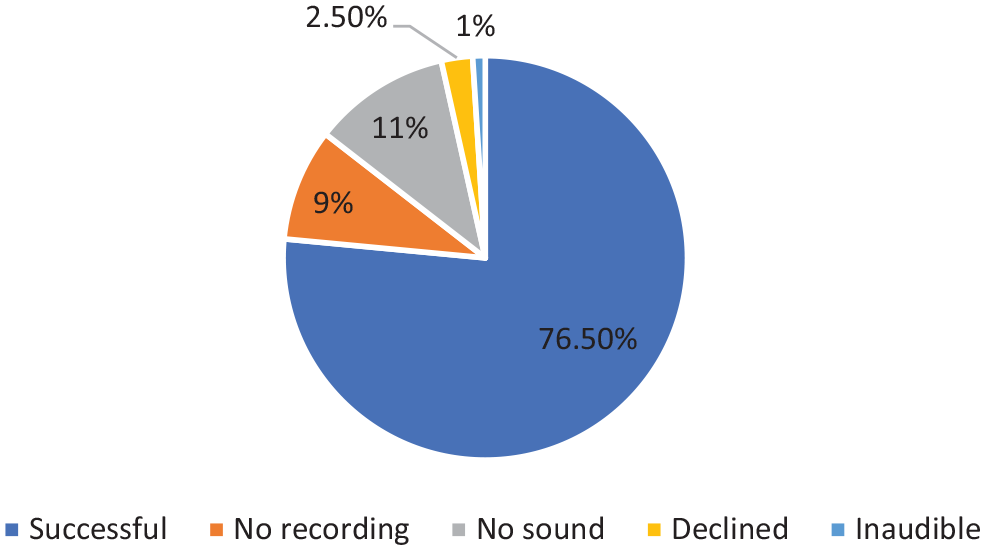
Results of body-worn camera recording opportunities.
The chart above illustrates that 76.5% (n = 136) of the recordings were successful and, conversely, 23.5% (n = 41) were unsuccessful due to various reasons. These reasons and the implications of this will now be discussed further.
As shown in Figure 1, a small amount (n = 5) of children asked for the recordings to be stopped or to have their cameras taken off and in line with ethical considerations their wishes were respected immediately. Previous research had used dictaphones for data collection and it was noted that children remained aware of their presence throughout the research process (Richardson, 2019). These body-worn cameras were attached to children by the way of a chest harness, after piloting with the devices identified this to be the least cumbersome way of equipping the children. As a result, the body-worn cameras appeared to capture children’s speech in a naturalistic manner. When accessing the footage, the children were, in the main, engaging in their environment without reference to the devices.
Although Mukherji and Albon (2010: 114) assert that children behave ‘differently’ when they aware that they are being observed, this was not felt to be the case in this study. Saying that, some children did retain an awareness of the cameras on odd occasions, with comments being made such as:
Come here. Look, I’ve got a camera. Its turned on. I want to press the top button. I’ve got it on. How do I do it? Can you do it for me? Can you press mine J? I got it. You have to press the buttons. Let’s go.
If you stand up I can see you. Stand up and say cheese. We’re not allowed to touch the buttons. C look. Look what I’ve got.
It is likely to be this awareness of the devices that prompted 9% of the recordings to fail (n = 13) as children were heard, and seen, pressing buttons and turning off the recordings. They displayed an awareness of how the devices operated, as indicated above and also with comments such as:
My camera has gone wrong. Yes. It’s meant to flash. It’s meant to flash. Yes. OK. I’ll ask her. . .
Why is yours off? Why is your camera off?
It is recognised that, however naturalistic research aims to be, it is likely that there will always be an element of awareness from the participants (Kindt, 2011), and ethically this is sound (Cocks, 2006: 258). To retain the naturalistic character of research with body-worn cameras, it is suggested that vignettes for analysis be selected when children are fully immersed in their play. By ensuring vignettes of speech are selected for analysis when the children did not appear to be conscious of the cameras, this ensures that the excerpts remain as naturalistic as possible.
It was noted that the body-worn cameras worked very successfully when in normal use, capturing where children were engaged in the environment and capturing what was being said by the children and those around them. The 76.5% success rate is an indication of this achievement. It is, however, essential that recordings were transcribed as soon as possible after capturing the data to ensure that the memory of the session was as clear as possible and could be used to recollect voices, situations and contexts. As mentioned previously, the cameras pick up speech from all of the children within the vicinity and it is therefore necessary that only the speech from the participant child is transcribed and analysed. The advantage of being present when recordings are captured is that an awareness was gained of how children spoke, and their voices could then be identified when listening back to the recordings. Being present when the observations were undertaken was extremely useful as this gave the wider picture and was able to assist in analysis. It is recognised that if relying solely on body-worn camera footage it is only possible to see the situation through the eye of the lens (Emmison et al., 2012). Being present, and by being able to view the activities that the children were engaged in helped in transcription and helped to give context to the recordings. If at times a child’s speech was hard to decipher, then the context could assist with this and give meaning to the language. This ensured that the speech samples were accurately allocated to the child concerned. The level of detail that was obtained from both what was said and from watching back the footage was way beyond what would have been possible from a purely narrative observation and was extremely positive in this regard. There was a very small number of recordings that were inaudible (n = 2); however, it is asserted that this would be likely to be significantly higher if not present when recordings were made.
One significant issue that occurred with the recordings, as shown in Figure 1, was that there were 21 opportunities (11%) where no sound was recorded. A picture was captured but the sound recording failed. This technology issue was coupled by a problem which was caused by the weather. At a habituation visit, it was a wet day with persistent rain. The body-worn cameras are supplied with waterproof cases for instances such as this and these cases were therefore fitted. These cases did not impact on what could be seen; however, they did impact on the recording of sound. The microphone on the cameras was completely blocked by the waterproof casings and therefore no voice recordings were captured at all on that occasion. The main purpose of the cameras was obviously to record speech so this was a major issue. This highlights an aspect of complexity that Silverman (2017) could have been alluding to when discussing the use of video recordings for research. Luckily though, throughout all data collection visits other than this pilot visit, the weather was fine and rain did not impact on recordings; therefore, the lack of sound can only be attributed to technology failings. One week was particularly hot however and children were playing with hose pipes. They were told to ask for their cameras to be removed before engaging in wet-play. Both the wet weather pilot session and the water play session highlight the limitations of the body-worn cameras. If the data are collected purely for visual analysis, then this would not be an issue however in this instance, where sound recordings were required, this was a problem. At the time of writing, the technology has not advanced to overcome this problem and future studies would therefore need to consider this issue in their research design.
Although there were weaknesses identified with this research process, it was possible to record young children’s utterances and at the same time see where they were playing. This opportunity allowed a detailed analysis of speech which, in turn, enabled an assessment of whether there was a correlation between the environment in which they were engaged and the quality of their speech. The study found that there was indeed a correlation between the quality of the environment and the quality of children’s utterances and found that the outdoor environment was that which yielded the higher quality speech. It is argued that it would not have been possible to reach this conclusion without the use of body-worn cameras as the intricacies and detail would have not been captured through narrative observation alone.
Conclusion
The table below summarises the strengths and weaknesses identified through this research project of using body-worn cameras with young children
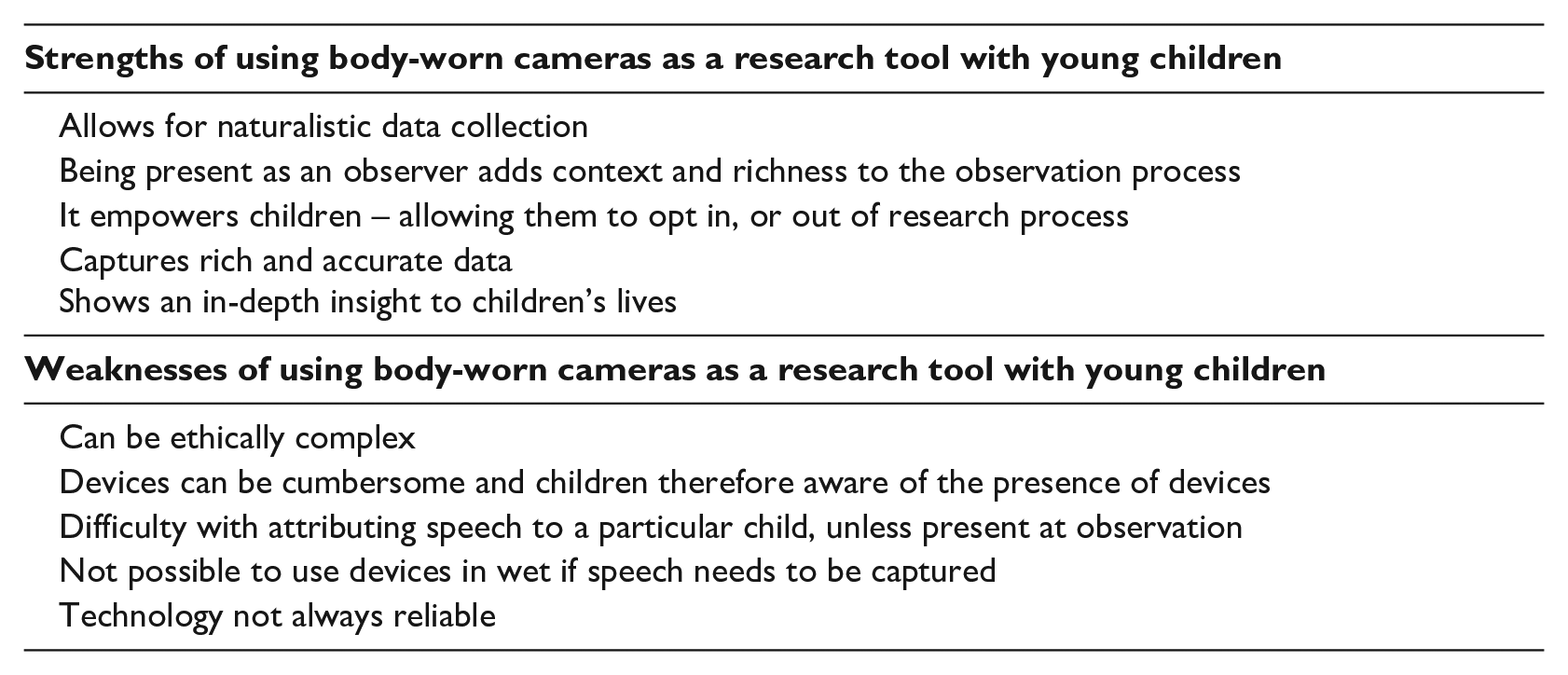
The table above highlights that, although using body-worn cameras as a research tool with young children is not without weaknesses, they are an extremely useful research method which can provide a depth to the data that may not exist otherwise. This innovative research method enables a naturalistic approach to observation which can give an insight to young children’s lives like no other. The pitfalls of using such an innovative approach can hinder the process; however, it is argued that, as a result of the discussions throughout this paper, these obstacles can be overcome and accommodated accordingly into the research process. As Singh (2015: 4) states, discussing these limitations in this paper will hopefully assist with the stimulation of ‘new research and provides us a chance to gain a better understanding of the world’.
Footnotes
Declaration of conflicting interests
The author declared no potential conflicts of interest with respect to the research, authorship, and/or publication of this article.
Funding
The author received no financial support for the research, authorship, and/or publication of this article.
