




Abstract
The term “the value of the child” was coined by economists in the context of demographic transition and fertility, emphasizing economic and cultural aspects. However, the scope of the value of the child was confined to a cost-benefit analysis. The “social value of the child” is a comprehensive concept that encompasses the economic, psychological, social, and cultural value of the child. Contextual knowledge of childhood was emphasized with the emergence of the sociology of childhood, taking into account the diversity of children’s lives affected by cultural and institutional contexts across the world. This essay offers a synopsis of the social value of the child and the social construction of the value of the child in the global south. The global south represents the complex socio-cultural context of the majority world, wherein modern or global theories of childhood originating in the global north are contested. This brief article concludes that studies emphasizing the value of the children in the global south should investigate the intricate and relevant interconnections between the psychological, familial, and religious value of the child, all of which contribute to the social value of the child.
Keywords
Introduction
Children and childhoods are linked to several interconnected social phenomena comprised of complex theoretical constructs, such as motherhood (Collett, 2005; Teodorescu, 2017), infertility (Dyer, 2007; Greil et al., 2011), and gender (Lorber, 2011; Osmond and Thorne, 2009). A comprehensive picture of childhood is a mosaic of meanings that may be studied and connected through interdisciplinary and holistic perspectives. Social studies of children and childhood (also known as the sociology of childhood) is an interdisciplinary research field established in the early 1980s by sociologists, anthropologists, historians, and other childhood researchers (e.g. James et al., 1998; Prout and James, 1997; Qvortrup, 1994). Childhood studies’ theoretical and empirical contributions gradually acknowledged and strengthened the conception of children as social actors in their social context (James, 2007; James and James, 2012; Mayall, 2002). By emphasizing contextual knowledge of childhood and taking into consideration the diversity of children’s lives impacted by cultural and structural contexts throughout the world, the development of the sociology of childhood effectively created a place for childhood within sociological discourse (Holloway and Valentine, 2000; Prout, 2011; Wells, 2009).
The western model of childhood, promoted as a global model by international organizations, treaties, and laws, was unable to address the widely varied experiences of children and models of childhood in the global south. Discourses on the socially constructed child challenged the Eurocentric construct of “normal childhood,” and reconceptualized children and childhood in various social and cultural contexts (Prout and James, 1997; Nieuwenhuys, 2013; Prout, 2005; Punch, 2003; Qamar, 2021; Qvortrup, 1994; Woodhead and Montgomery, 2003). Child-rearing practices are as diverse as worldwide cultures, shaped by the conception and status of children in different cultures. Child-rearing practices also revealed the perceived value of children, the transactional nature of parent-child relationships, and parents’ social networks that provide them with material and strategic resources (Bühler, 2008; Montgomery, 2009; Smørholm, 2016; Vlassoff, 2011).
Parenting, families, gender roles, and childcare practices are examples of interrelated social realities that may be employed to understand children and childhoods in a variety of contexts. The statuses of socially constructed children, who are not “universal” children, should be recognized in empirical studies that employ the contexts of children’s lives and analyze how the children are situated in those contexts (Kjørholt, 2004). Social constructionists study people in their social and cultural contexts, where they construct and interpret their social realities. Hence, children and childhoods should be studied in connection with the statuses of children, as well as adult-child relationships in their social and cultural contexts (Brysk, 2004; Montgomery, 2009; Prout and James, 1997). The social value of the children in society is informed by their social status, adult-child relationships, socioeconomic conditions, the flexibility of livelihood strategies, evolving conceptions of children and childhood, and corresponding childcare practices. My focus in this essay is on the social value of the child in the global south linked to the paradigm of “the socially constructed child.” I present here a glimpse of the social value of the child, and the interconnection between the social meaning of children and the value of the child. I include the conception of a “socially valued child” linked with the socio-cultural nexus of norms and values related to the child and childcare culture in the global south. Recognizing the need for the theories of the value of the child grounded in local contexts, this essay outlines a preliminary conceptual framework for studying children’s lives in their sociocultural context.
The value of the child: A brief background
Lancy (2014) identifies two types of a “valued” child that he termed as cherubs and chattel. In modern western societies, children are perceived as vulnerable and innocent. They are protected and nourished. Parents spend a lot of money on their children’s upbringing. The value of the child for the parents is connected to the emotional value and the pleasure of having children. Lancy termed these children as expensive little cherubs. The other type of children that Lancy discussed are chattels. The chattels are valued as property or commodity who are invested to pay back in the future. The chattel discourse portrays a child as economically valuable to the parents. In this respect, children are seen as chattels in economic theories. Economic theories that were focused on a “cost and benefit” analysis of the children for the parents influenced the broader view on the social value of the child informed by fertility theories. These theories were later expanded to include cultural perspectives on the value of children for parents, particularly when children contribute to the family’s cultural heritage. Children, on the other hand, build relationships, form families, and contribute to society by expanding their social network (Guo and Dalli, 2016; Montgomery, 2009; Smørholm, 2016).
The work of Zelizer was a significant contribution to the understanding of the social value of the children. She pointed to the importance of the historical shift and related change in the value of the child in the USA during the early period of industrialization. She suggested that the social value of the child is about giving meanings to the parents’ lives. Referring to child labor, she mentioned transformation in the economic and sentimental value of the children in the early 20th century as, “the price of a useful wage-earning child was directly counterposed to the moral value of an economically useless but emotionally priceless child.” (Zelizer, 1985: 82). Zelizer shows how the contemporary family has drastically changed from an economic unit where children were important assets in contributing economically, to a “sacred family” where children have a non-economic but emotionally highly valued status. Children are offered care and love and they, in return, give emotional satisfaction, instead of economic support. This trend shifted radically from children’s paid labor to non-economic, educational, and learning activities of the children in the middle of the 19th century. Policies related to children were designed to ensure a healthy and productive child, eliminating child labor and the economic value of the children. Middle-class parents used to provide their children with financial assistance to support their “unproductive” children, and the provision of education was seen as necessary for child wellbeing. 1930’s legislation to eliminate child labor and implement compulsory education promoted a “non-productive” childhood with an emotional and sentimental value that was taken as a non-economic definition of the child, what Zelizer termed as “economically worthless” and emotionally “priceless child.” Although historians differ over the dating of sentimentalization of childhood (see Mortimer, 2003); usually eviction from child labor and growing attention toward the child’s need for nurturance and protection was seen as sentimentalization of childhood. With an exclusively emotional value of the child, the expectation of being economically useful was turned down and the child was moved from an exchange framework (an economic investment with a return) to a privileged status supported by the modern notion of “ideal childhood” (as stated in UNCRC, 1989) where children were protected from the necessary expectations of economic return (Montgomery, 2009).
Zelizer’s (2002, 2005) later work provides an understanding of children’s work in systematically and dramatically changing contexts. She examines children’s contribution to social relations and social production through their participation in family livelihood. In this perspective, children may be seen as economic and social actors simultaneously engaged in economic activities and social interactions. Hence, a paramount consideration should be given to the presentation of children and their status in the socio-cultural and economic context of the family (in particular) and the society (in general).
Theory of the value of the child (VOC)
The concept of the value of the child was first employed by economists in the context of demographic transition and fertility, emphasizing economic and cultural factors in changing the value of the children (Jensen, 2009). In fertility theories, the anticipated benefits of having children are significant but contested predictors of fertility-related behavior, alongside biological causes, controlled contraception, and chance births (Kohler, 2010; Margolis and Myrskylä, 2011). In economic theories of fertility, the benefits and costs of having children determine fertility-related decisions (Nauck, 2014). Caldwell's (2005, 1982) theory of intergenerational wealth flow proposes that the economic value of the children is directly and positively related to fertility level. In the fertility transition, the cost-benefit analysis and insurance value of the children have played a key role. A bottom-up (younger to older generations) wealth flow determines the economic value of the children and higher fertility levels, whereas children are seen as an economic burden, resulting in low fertility levels.
The cost-related conceptualization of children, and the economic value they have for their parents establish a “calculated” value of the child that overshadows various other aspects of the value of the child in diverse cultural contexts. The value of the child (VOC) theory broadened economic theories of fertility to a multilevel analysis, emphasizing the importance of children to their parents in varied socio/economic contexts. Researchers began to consider the child as having the potential to alleviate uncertainty in people’s lives, improve martial cohesion, and provide insurance value (Friedman et al., 1994; Nauck, 2014). Among the socioeconomic and psychological perspectives on the costs and benefits of having children, the VOC theory offers a multidisciplinary perspective on the value of the child in various societies. The theoretical underpinnings of VOC theory developed by Hoffman and Hoffman (1973) presented an alternative explanation for the value of the child by bridging the gap between dominant economic and fertility theories, as well as psycho-social and cultural aspects of the value of the child. The theory analyzes the value of the child at both the individual and societal levels, and it offers an explanatory approach to a child-focused definition of fertility (Nauck, 2014). Several investigations were done in different cultures using various methodologies in this respect. These studies formed the basis for the theory of the value of the child, which encompassed the child’s social, family, psychological, and economic value (Arnold and Fawcett, 1975; Hoffman and Hoffman, 1973; Hoffman and Manis, 1979; Nauck, 2014). These studies recognized three categories of the value of the child. The economic value of the child refers to the material benefits of children, their contribution to the domestic economy, and the old-age support they are expected to offer to their parents. Parents’ joy, pleasure, satisfaction, and sense of fulfillment are seen as psychological or emotional value of the children. The social or normative value of a child is the value of a child as a status-giver and a means of family formation, which includes parental status, social recognition, family lineage, and the continuance of family values and traditions (Hoffman and Hoffman, 1973; Kagitcibasi, 1996; Nauck, 2014; Trommsdorff et al., 2005). Nonetheless, in developing countries, children’s economic support is embedded in the family’s cultural and economic contexts, which vary according to socio-cultural diversity. Cross-cultural studies conducted in the 21st century stepped beyond fertility-related decisions to the questions about child-bearing and intergenerational relationships and brought to light various dimensions of the value of the child in different societies (Mareš and Možný, 2005; Nauck, 2001).
Some studies (e.g. Hollos and Larsen, 1997; Kagitcibasi and Ataca, 2005) support the general findings of a decrease in the economic value of the children with increased socioeconomic development of society. However, in societies where supporting parents in old age is a cultural norm (reinforced by religious and moral values) increased socioeconomic development may not decrease expectations of old-age support. A comprehensive contextualization of the findings, in this case, may unearth the social meaning of old-age support and the cultural significance of the value of the children for parents. Another significant finding shows that with the progress in socio-economic development, the child’s economic value decreases while his or her psychological value increases (see Kagitcibasi and Ataca, 2005; Yang, 1988). Such findings, however, cannot disregard the conceptual links between the various value of the children. Regardless of socioeconomic development, children may have economic and emotional value for their parents while also combining family and spiritual value in specific socio-cultural contexts.
The social value of the child
Both the child’s “presence” and “absence” affect individuals and families, and both discourses can be useful in determining the value of the child. According to studies on the socio-cultural impacts of infertility in women’s lives, the absence of children is an external manifestation of infertility connected to reproductive role failure and disrupted social norms (Dimka and Dein, 2013; Podolska and Bidzan, 2011; Whiteford and Gonzalez, 1995). Several studies in non-western contexts report the consequences of childlessness among women and couples, revealing fears of loss of status, role failure, social stigmatization, economic and marital insecurity, and women being marginalized as “the evil eye” possessors, witchcraft, and contagious evil because of their jealousy of children and their mothers (Bhatti et al., 1999; Feldman-Savelsberg et al., 2002; Koster-Oyekan, 1999; Nahar, 2010; Nahar and van der Geest, 2014; Pashigian, 2002; Qamar, 2018; Sami and Saeed Ali, 2012).
Children continue to be a communal priority in traditional communities (of the global south), as they are a significant part of the larger social order. How does a child contribute to the well-being and social position of the family in the community? This broader question excavates the social meanings of fertility, pregnancy, birth, and infancy shifting the focus of economic and demographic theories on the value of the children to the social value of the child. Hence, the effects of the absence of the child in the family become the indicators of the social value of the child. In this sense, the concept “social value of the child” is more comprehensive than the concept “the value of the child.”
This article is based on research I conducted in the pro-baby context of the global south, and I use the term “social value” as a broad term to situate children and families in the social and cultural institutionalization of childhood. Children form families, develop relationships, and enhance socioeconomic status (in collectivist cultures). Recognizing cultural values as a component of society’s socioeconomic system (Trommsdorff, 2015), I describe the familial value of the child as a nexus of the social, cultural, and economic value of the child. Based on my research on the social value of the child in non-western pro-baby contexts (Qamar, 2016, 2017, 2018), I will focus specifically on the following key aspects of the value of the child.
The social value varies in terms of content and meaning providing a contextual understanding of children and childhoods. It is complex, multifaceted, and interconnected, including the religious, familial, economical, and psychological aspects of the value of the child. As described earlier, the research on the value of the child describes the social value of the children in terms of their capacity to give parental status, form families, and maintain family continuity. These studies find that economic and familial values constitute the social value of the child. The key questions, however, are: How do the economic and familial values relate to each other? What impacts do children have on parents’ access to social networks and resources? How does the continuation of kinship and transmission of family norms and values (including the socially prescribed role and family structure) protect the socio-economic interests of the family? These questions raise awareness of the interdependence of familial and economic interests that establish the social value of the children. On the other hand, in addition to presenting the value of the children’s “presence” in the family, the multidimensional and interconnected normative perspective on the social value of the children highlights the repercussions of the “absence” of the children which disrupts the larger social order. Hence, the birth and death of a child become significant in the contexts where the social value of the child is anchored in interconnected values that make them precious and priceless.
In the 20th century, mainstream psychological theories of childhood and “natural” mother-infant attachments impacted postwar Western countries’ childcare practices and emotional value of the child (Bowlby, 1988; Vicedo, 2011). In modern societies, where children are not supposed to contribute to economic activities or domestic work, they have an emotional value but a higher cost as parents bear a financial burden, particularly through spending on their education (Bugge, 2006; Jensen, 2009). The 20th century’s emphasis on mass schooling also led to a shift in the value of the child. Children were seen as fragile and innocent beings who need to be protected and nourished. Parents spend a lot of money on them, not necessarily with a “payback in future” (old age support) thinking, although they gain emotional satisfaction and pleasure. Under the influence of this romantic ideology, children were taken out of the labor force and sent to school to get education. Children’s economic value progressively declined, and education was promoted as a platform for investing in a child’s moral, political, and economic future (Abebe, 2008; Cunningham, 2005; Qvortrup, 1994). However, in non-Western contexts, children did not lose their economic worth and they were expected to contribute to the family economy and care for the parents. Montgomery (2009:67) highlighted this: “Outside the West, however, children can still be seen as an economic investment with a specific return, whether this is that they should go to work as soon as they can contribute to the family, or whether, in the longer term, they are expected to look after parents in their old age, thereby guaranteeing a safety net for the elderly”
African context is one of the examples from the global south where children ensure the socio-economic wellbeing of their parents. They contribute to several domestic chores including looking after their younger siblings, allowing parents to do productive work. They are helpers, a source of happiness, and social security for their parents. They hold emotional and economic value for the parents (Abebe, 2008; Antoniou, 2007; Chant and Jones, 2005; Punch, 2001; Qamar, 2014). To be more specific, social value is theoretically determined by the social construction of children and childhood in various socio-cultural contexts, and it encompasses all aspects of the value of the child that contribute to the psycho-social and economic well-being of the parents and family. This broad yet interwoven perspective situates the social value of the child as the nexus of the psychological, familial, and religious value of the child (Figure 1).
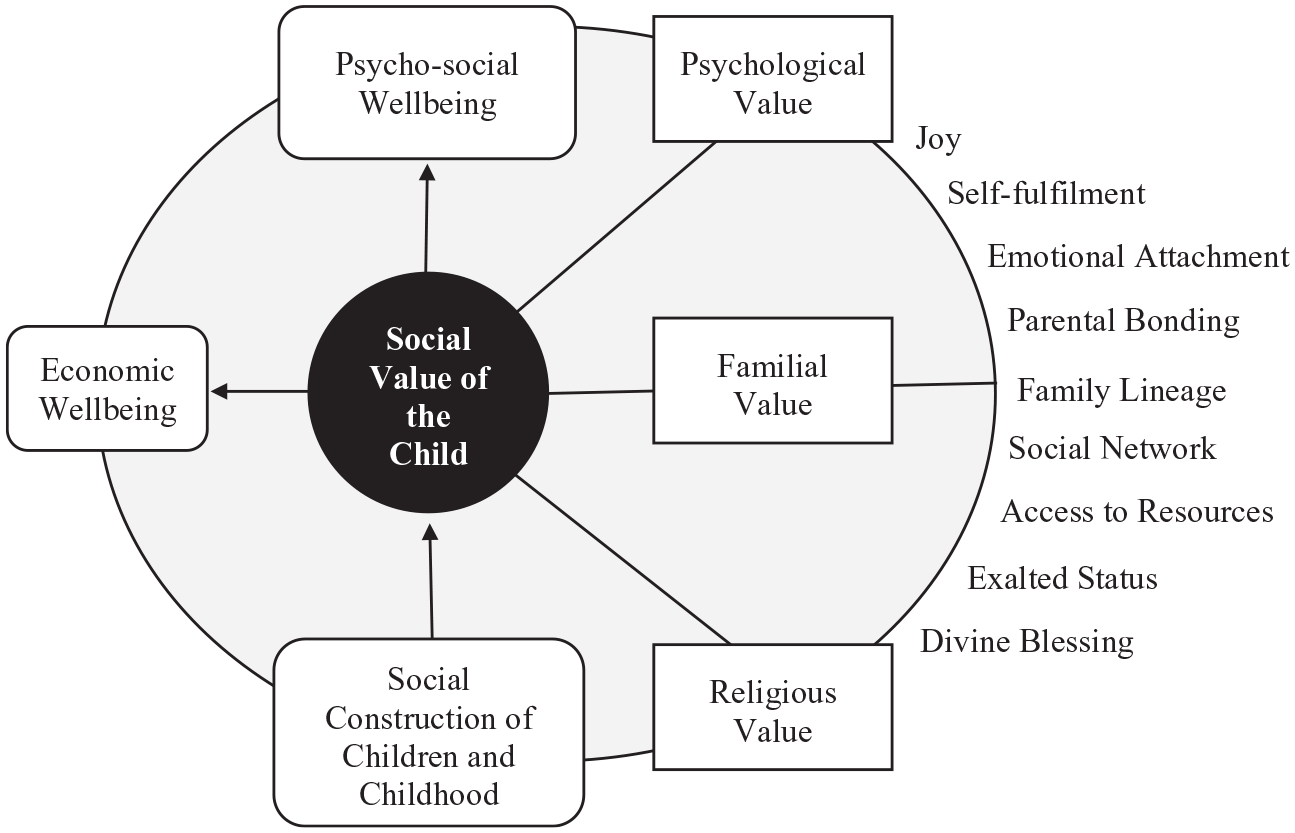
Social value of the child-key conceptual connections (derived from Qamar, 2016, 2017, 2018).
Discussion
As shown in Figure 1, the social value of a child is a holistic construct that includes the psychological, familial, and cultural value of the child. In a specific socio-cultural context, the social value of the child reflects the economic and psycho-social well-being of the parents. All facets of the child’s social value are interwoven and rooted in the social construction of children and childhood.
The psychological value of the child
Parents dedicate time to childcare in modern and wealthy countries (especially in the Western world) to satisfy their emotional attachment to their children. As a result, the value of the child for parents is mostly psychological and serves the purpose of personal gratification (Kagitcibasi, 1996; Kim et al., 2005). The emphasis on emotional gratification leaves little room for the parents’ broader familial and societal objectives. However, in undeveloped countries where children participate in the domestic economy and support their parents in old age, the children are seen as social capital as well as a source of emotional gratification. Ethnographic studies in the global south revealed children and childcare practices embedded in cultural contexts, and the researchers frequently constructed images of children that differed from those formed by psychologists and medical professionals. Hence, the so-called universalization of attachment and parenting style theories is no more a “sacred cow” (Lancy, 2014; LeVine and Norman, 2008).
Love and attachment to children do not always adhere to romantic discourses on childhood (i.e. child as innocent, cute, fragile, angel). For example, corporal punishment to discipline children in some countries (Pate and Gould, 2012) does not always undermine or invalidate the psychological value of the children to their parents. It is a socialization practice aimed at fostering obedience, submission, and discipline in children (Sorin, 2005). “The disciplinary power that parents and teachers exercise is a mode of socializing the child into a “good” adult. . . and discipline and obedience are two perceived traits of a ‘good’ child that help children grow into successful adult members of the society” (Qamar, 2021: 35–36).
Multiple caregivers bathe, nurse, hold, carry, and co-sleep with children in Bhubaneswar (West India). They ignore the children’s cries and whatever negative feelings they may have. This is a purposeful childcare practice based on the belief that the attention may put them at risk of “the evil eye,” which is believed to damage valuable items, people, or animals (Seymour, 2001). Hence, the emotional value of the children for parents is not independent of their concerns for their children’s safety and future participation in society for the social well-being of children, parents, and families. Children contribute to the parents’ psychosocial well-being by providing parental status, strengthening marital bonding, and securing parental future.
The transactional nature of parent-child relationships is constructive and successful, revealing children’s social value and active participation in families (Bühler, 2008; Montgomery, 2009). Childcare practices create a reciprocal parent-child relationship, developing an emotional and social attachment, in a number of different ways, ranging from the economic usefulness of the children to the parent-child relationship and a “safety net” in old life (see Bühler, 2008; Kabeer, 2000; Kagitcibasi, 1996; Sam, 2001; Vlassoff, 2011).
Children can actively influence the lives of others and make their presence visible in their social networks by forming relationships between people (parents, grandparents, and other extended relationships), extending their social network, and gaining access to social resources that are ingrained in social relationships (Bühler, 2008; Gottlieb, 2004; Smørholm, 2016). In pronatal non-western collectivist and patriarchal context, the absence of a child is perceived as a loss of social status, power, control, and security. For example, studies conducted in India and Pakistan discovered that childlessness has several negative psycho-social repercussions that ultimately lead to distress and desperation destroying the psychological and social wellbeing of the couple (Bhatti et al., 1999; Mehta and Kapadia, 2008; Mumtaz et al., 2013; Qamar, 2018; Sami and Saeed Ali, 2012; Satheesan and Satyaranayana, 2018). In these countries, the pro-baby behavior and desire to have children is anchored in the socio-cultural and economic context, wherein fertility determines the success or failure of the members of the society. Hence, in this context, the child’s contribution to psycho-social well-being should be interpreted as the psychological value of the children, which is closely related to the positive psychological and social experiences of the parents leading to the social construction of wellbeing.
Familial value of the child
Recognizing children for the continuity of kinship and family identifies the familial value of the children and their fundamental roles in the families (Montgomery, 2009). In the global south children’s participation in domestic chores is part of socialization processes aimed at qualifying for assigned and desired social roles in the family. With the changing livelihood strategies, particularly in developing countries, children are seen as participants in the socio-economic wellbeing of the parents and the family. Participation of children in household tasks, for example, is an important feature of family life in agrarian societies, alongside schooling. Children are raised in this context as “interdependent persons” with socioeconomic value and a reciprocal relationship with the family. Hence, the cultural meaning of children’s economic value is entwined with their familial value (Abebe, 2008; Abebe and Kjørholt, 2009; Antoniou, 2007; Pribilsky, 2001; Punch, 2001; Qamar, 2014). Similarly, religious inspiration persists in some cultures for children to help with household chores and to support their parents in their old age. Their participation in household chores and supporting their parents is regarded as a means of earning blessings in this world and the world to come (Chant and Jones, 2005; Mishra et al., 2005).
Children have historically been used to extend families and social networks. Breastfeeding by multiple women was a practice in medieval Arab culture to extend social networks by extending family relationships and therefore strengthening tribal power (see Altorki, 1980; Gil'adi, 1999; Joseph and Naǧmābādī, 2003). Researchers have revealed the broad social and political meanings of breastfeeding, referring to it as a milk-bonding and milk-kinship practice aimed to extend familial and social networks (see Parkes, 2001; Yeo, 2003). Walati Muslim women (in Mali, for example) become milk-mothers by nursing other children and establishing kin relations, therefore extending their social network and receiving social support (Cleaveland, 2000). Children as “social capital” can create social relationships and provide access to resources and networks through converting relationships into other forms of capital. Children’s capacity to build relationships is considered in relation to their importance in forming families and establishing access to social and economic resources (Bühler, 2008; Leonard, 2005).
The Religious Value of the Child
The religious value of the child is an important motivation for having children; however, it is rarely addressed in research on the value of the child. In Ubuntu theory (African theory to raise children and make families), the spiritual significance of the children is related to the ancient religious belief system. The child is considered a member of the spiritual realm composed of Gods and ancestors. The status of the children encourages fertility and reproduction as spiritual affirmation and fosters familial fidelity, obedience, respect for older generations, and interconnectedness (Mugumbate and Chereni, 2019; Nolte and Downing, 2019). In Sub-Saharan Africa and Indian cultures, children are seen as divine blessings. The presence of a child brings divine/ancestor blessings to the family. Children create connections between their parents and the divine/ancestors, extending the family bloodline and insuring its immortality. Hence, childcare practices are seen as sacred/religious actions of caring for a divine blessing. In contrast, the absence of children in the family represents a lack of ’blessings,’ which might lead to a ’curse.’ (Keller, 2007; Sam et al., 2008; Saraswathi and Ganapathy, 2002; Smørholm, 2016). Perceiving children as a blessing is linked to their contribution to wealth creation through the expansion of social networks and access to resources. In Muslim societies, for example, the concept of blessing, or “Baraka” (in Arabic), refers to ’preciousness’ in many different ways. The concept of blessing in Muslim cultures is linked with human prosperity with a sense of divine favor enclosing physical, psychological, and economic well-being (Demi̇rel and Sahi̇b, 2015; Geertz, 1971).
Perceiving children as Baraka (blessing) acknowledges their contributions to domestic chores, the companionship and comfort they offer to their parents when they are old or sick, the joy they provide to their families, the continuation of family lineages, and their parents’ elevated positions. The concept of a child as a Baraka interlinks social, economic, familial, and psychological rationales for having children that yield love and care for children. The emotions toward a child are also a part of feelings toward the religion that connects the emotional value of the child to the religious value of the child, whereas the notion of “blessing” itself includes the economic, familial, and emotional value of the child constituting a socially valued child.
Conclusions
In human societies, the desire to have children transcends beyond the ’natural’ aspect of the value of the child linked to animal instinct (pro-creation). It is based on the psychosocial construction of the value of the child. Parents want children to complete their families, while families function together as a social entity. Participation of children in the domestic economy is a survival strategy as well as a socialization strategy for community inclusion. In this context, the cultural and economic features of pro-baby societies are determined by the social value of the child. Hence, studies focusing on the value of the children in various societies should look into the complex and important interconnections between the cultural, psychological, and family value of the child, that eventually shape the social value of the child. Childhoods are not universal, and global theoretical models are incapable of producing the requisite knowledge of children’s lives that is anchored in contextual sensitivities and complexity. Academics must investigate the meanings and impacts of children’s “presence” and “absence” in people’s lives to appreciate the intricate and comprehensive construction of the social value of the child. This may be accomplished by enhancing applied research using interdisciplinary approaches and theoretical and methodological triangulation.
Limitations of the study
This article discusses my research on the social value of the child in a patriarchal pronatal society of a traditional non-western context. The theoretical discussion presented here may be relevant in comparable contexts. However, the findings might be useful for studying children and childhood in the global south.
