



Abstract
In a marketplace of ideas where theories can act as substitutes, theorists seek to persuade peers to engage with their theories. Given this critical role of persuasion, how do theorists do so? To address this question, the current study adopts a pragmatist perspective and employs the Toulmin model of arguments to examine how Oliver Williamson persuaded his peers to engage with transaction cost economics. The study unpacks how Williamson structured his arguments, introduced new constructs and language, and employed analogies and metaphors to foster a consensus, giving rise to an epistemic community. The study highlights that not only do values influence how arguments are crafted and evaluated, but also appealing to them plays a key role in persuasion. In doing so, the study considers both the rational and non-rational aspects of theorizing and persuasion. Finally, the study discusses the significance of argumentation in the context of AI and theorizing in strategic management.
Introduction
In a marketplace of ideas (Mill, 1859), persuasion plays a key role—theorists develop theories for problems they deem important and try to persuade peers of the goodness of their theorizing (Bhardwaj et al., 2025a; Ketokivi et al., 2024; Mahoney, 1993; Popper, 1999). Theorists who are successful in their efforts at persuasion increase the likelihood that their theories will flourish (Hambrick and Chen, 2008; Kuhn, 2012 [1962]). Theorists who are unable to persuade their peers to join them find that their theories tend to be forgotten and fade away (Geddes, 2003; Lakatos, 1980). Consequently, persuading others to pursue a theory and obtaining a consensus among them lies at the heart of scientific activity (Bauer, 1992: 48–49; Laudan, 1978; Solomon and Ziman, 1994).
Since theories can act as substitutes to explain the same phenomenon (Laudan and Leplin, 1991; Van Fraassen, 1980), the task of persuading peers of the goodness of their theory poses a significant challenge for theorists. For example, organizational boundaries can be explained using theories of power and efficiency, among others (Santos and Eisenhardt, 2005). Evidence alone does not suffice for the purpose of persuasion as it is often open to interpretation (Ziman, 1968). Indeed, evidence in favor of transaction cost economics (TCE) can be seen as being consistent with other rival theories (Mantere and Ketokivi, 2013). In some cases, a sufficient level of evidence cannot be obtained to adjudicate between competing theories (Oliver, 1988).
If evidence alone does not suffice or is not available, how do scholars persuade their peers to choose their theory over a rival? Addressing this question has become especially urgent in the age of AI, where Large Language Models can generate theories at a relatively low cost and compete for scholarly attention (Felin and Holweg, 2024; Rathje et al., 2024 Tranchero et al., 2024).
In this study, I maintain that attracting peers to work on a theory requires scholars to develop and present a system of evidence, assumptions, knowledge claims—arguments—that persuades others of the theories’ goodness as well as its potential fruitfulness (Ketokivi et al., 2024; Kuhn, 2012 [1962]; Toulmin, 2003). The language and values invoked by these arguments play a critical role in attracting peers (Barnes and MacKenzie, 1979; Bouwmeester, 2013; Brønn, 1998). In this sense, both the rational and non-rational play a role in persuading peers to pursue a theory (Bhardwaj et al., 2025b; Laudan, 1986; McKenzie, 1979; Sayer, 2011)—appeals to language and values have no rational basis per se. Here, rational is to be understood in a narrow sense of defensible epistemic reasons (Popper, 1994: ch. 8; Reichenbach, 1938).
Peers who are attracted to a theory become members of an epistemic community that seeks to further advance and refine it (Bauer, 1992; Kuhn, 2012 [1962]), and in doing so, furthering the consensus regarding its goodness. The ultimate test of the goodness of a theory is when it attracts managers and practitioners to act on it, that is, employ it to solve their problems (Peirce, 1923; Shapiro, 2010). At the same time, the existence of a persuasive theory does not imply that other theories do not, or should not, exist, thereby permitting pluralism (Mahoney, 1993; Nigam and Guerra, 2023). Pluralism ensures that although consensus regarding a theory can be reached among a particular community, other theorists can construct arguments in favor of an alternative theory. In turn, these arguments also rest on an appeal to the rational and non-rational. The presence of multiple theories can spur discussions and debate that contribute to the growth of knowledge (Lakatos, 1980; Mahoney, 1993; Mill, 1859). In this context, rejection of one theory in favor of another, or attempts at falsification, are prevented by appeals to the weakness of evidence and the like (e.g. Mayer, 2009; Oliver, 1988).
For example, Oliver Williamson’s work on TCE was sparked by an anti-trust case (Mahoney and Nickerson, 2022; Williamson, 1975). TCE offered an alternative to the dominant theory of the time that maintained firms vertically integrate in an effort to become monopolies. Specifically, Williamson developed persuasive arguments (rooted in efficiency) for why firms vertically integrate by proposing and advancing new constructs such as asset specificity and opportunism. His argumentation attracted other scholars to pursue and further advance and refine his theory (Macher and Richman, 2008). Eventually, TCE attracted and persuaded anti-trust policy makers to overturn their previous policy positions (Shapiro, 2010). Currently, falsifying instances are simply explained away by attributing them to poor research design, poor operationalization of key constructs, weak evidence, and the like (Mayer, 2009).
That said, alternate theories accounting for vertical integration continue to exist and thrive (Santos and Eisenhardt, 2005). Even peers who were steeped in the tradition of TCE developed alternatives to it, which, in turn, has furthered the development of the field (Nagle et al., 2024; Zenger et al., 2011). Some of these theories appeal to similar non-rational premises (e.g. efficiency) while others diverge (e.g. power). These premises are non-rational because the choice of one over the other lacks defensible epistemic reasons. Communities holding different non-rational premises find their differences hard to reconcile, which inevitably leads to theoretical plurality (e.g. theories of efficiency vs theories of power; see Ketokivi and Mahoney, 2020). Certainly, the field of strategic management is better off as a consequence (Akerlof, 2020; Mahoney, 1993; Nigam and Guerra, 2023).
The remainder of this study is organized as follows. I begin with a brief review of Toulmin model of arguments and link it with pragmatism. I then draw lessons from TCE, specifically Oliver Williamson’s work, on how to develop new theories. I trace how Williamson carefully developed his theory and structured his arguments to persuade peers. I highlight the role an appeal to values and invoking the non-rational played in his argumentation and explain why he was ultimately unable to persuade sociologists while being successful with economists. I close with a discussion and implications for research in strategic management including the attempts for using of AI to theorize.
Reviewing the relevant literature on models of argument and pragmatism
Scientists persuade each other about the goodness of their theories using arguments grounded in rational and non-rational premises (Feyerabend, 1993; Kuhn, 2012 [1962]; Toulmin, 2003; Weinstein, 1990; Ziman, 1968, 1978). In fact, theorizing involves engagement with peers whereby good conversations lead to the development and refinement of arguments that undergird theories (Bhardwaj et al., 2025a, 2025b; Leone et al., 2021; Mahoney, 1993). Such engagement—provided it is honest and genuine—is critical for strengthening arguments (Popper, 1994). The Toulmin model is among the most widely adopted approaches to understand the structure of arguments (Bouwmeester, 2013; Ketokivi et al., 2017).
To elaborate, the Toulmin (2003) model is a general framework that can be employed to organize and structure the content of an argument in service of engagement with others. The argument is constituted by a system of elements that aid in making it persuasive (Ketokivi et al., 2024; Tippett, 2009 see also Peirce, 1.559). 1 Ultimately, the strength of the argument and how persuasive it is to others is predicated on its weakest element.
Elements of the argument
The elements comprising an argument are grounds, warrants, backing, claims, rebuttals, and qualifiers (Toulmin et al., 1979: 25–27; Figure 1).
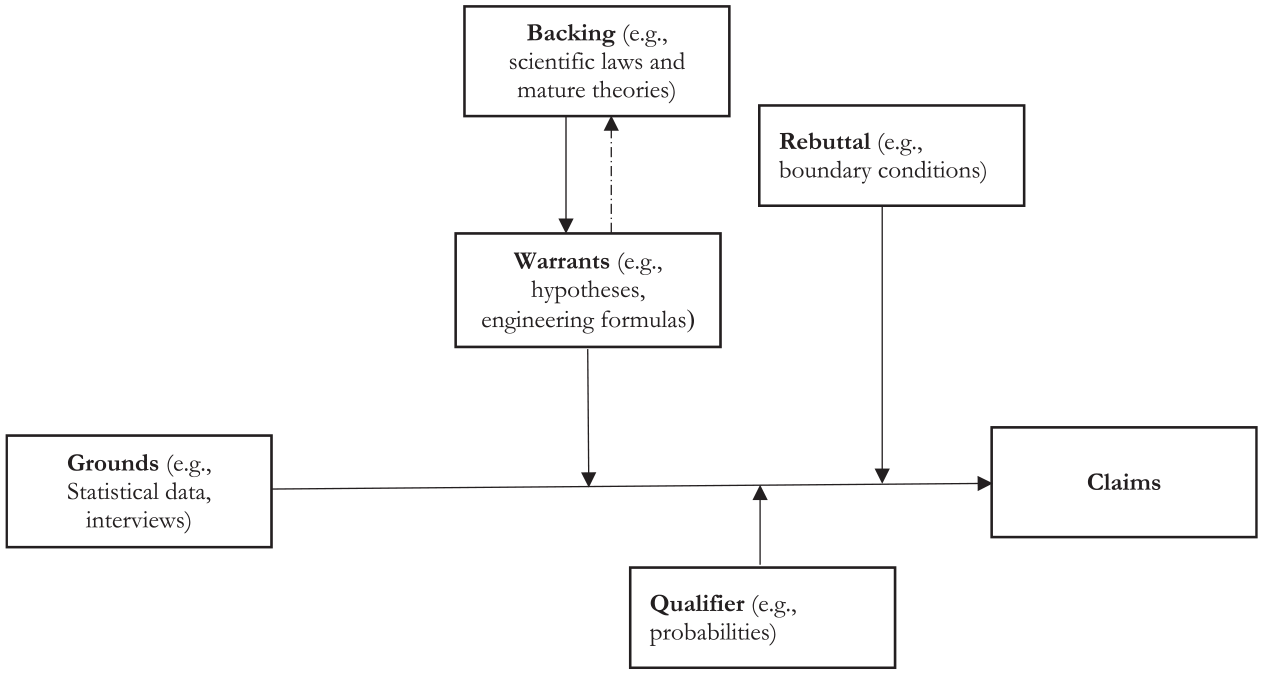
The Toulmin model.
Grounds are the starting point of arguments and can take the form of statistical data, (experimental) observations, and so on (Ketokivi et al., 2017). Trivial as this may sound, what constitutes grounds can be contentious for several reasons. First, the veracity of grounds is critical. For example, if the instrument being used to record a measurement is flawed, then the veracity of ground can be undermined. 2 In the social sciences, often these instruments are operationalization of constructs that can be “noisy.” Consider that measures of asset specificity tend to be noisy, which can undermine claims that the construct does not predict vertical integration well (Mayer, 2009). Second, the choice of grounds is not straightforward. For example, anomalies can serve as the starting point for grounds (Bhardwaj and Sergeeva, 2023; Richman, 2023; Sætre and Van de Ven, 2021). But, transforming an anomaly to grounds to theorize from is a choice—more often than not, especially in the case of mature theories, anomalies are not transformed into grounds that spark inquiry (Lakatos, 1980; Makadok et al., 2018; Ziman, 1968: 48–53). Scholarly backgrounds, experience, interests, values, ideologies, and interpretations influence this choice (Barnes and MacKenzie, 1979; Sutcliffe, 1994; Waller et al., 1995). Third, and relatedly, observations are theory laden (Hanson, 1958: 19). Consequently, in as much as the choice of grounds is predicated on observation, what constitutes grounds is affected by choice of theory.
Claims are the destination of arguments. Put differently, the elements of an argument are arranged to provide support for its claim. There are several features of a claim that are noteworthy. First, the strength of a claim is a direct function of the strength of the other elements of an argument. Consequently, the strength of a claim can vary (Toulmin, 2003). For example, weak grounds can undermine claims (and instances of counterclaims or “falsification”). Second, claims are directed at generating a consensus. In the context of science, the acceptance of a claim need not be universal—what is accepted within one epistemic community can be challenged or dismissed by another (Kuhn, 2012 [1962]). Put differently, claims (and arguments) are field dependent (Bouwmeester, 2013). Third, and relatedly, the evidentiary standards buttressing a claim can vary across epistemic communities. Furthermore, to some extent, even these standards are a matter of consensus (Bauer, 1992; Ziman, 1968). For example, strictly speaking, there is no particular justifiable epistemic reason why a p-value of less than 0.05 is said to be statistically significant other than there is somewhat of a consensus around it. This value changes across different fields (e.g. physics). Similar examples exist in qualitative research across different communities concerning expectations of coding, number of cases, interviews conducted, and so on.
Warrants bridge grounds to claims and can take the form of hypotheses and propositions. In other words, warrants are authorizing steps for a claim. Warrants are often abduced (Mantere and Ketokivi, 2013; Walton, 2005), which makes them fallible and amenable to revision. Several other considerations are also relevant. First, warrants are substitutable—theorists can abduce multiple warrants to account for the same phenomenon. Consider that several different warrants can be advanced to explain (predict) organizational boundaries, with the choice of warrants being influenced by a host of background factors such as membership of an epistemic community (Ziman, 1968: ch. 3). The legitimacy of warrants then naturally varies from community to community and might even be incommensurate (Kuhn, 2012 [1962]; Santos and Eisenhardt, 2005). For example, sociologists as an epistemic community might deny efficiency motivations as an explanation for a managerial decision to vertically integrate. Second, peers are more likely to accept or accord legitimacy to a warrant if it meshes with their training, biases, and experiences (Ketokivi et al., 2024; Waller et al., 1995). In other words, an epistemic community is more likely to converge on an agreement concerning a warrant if its content matches the cognitive schema of its members. At the same time, peers might resist warrants that do not match their cognitive schemas (Akerlof, 2020). As such, epistemic communities are organized around warrants, which offer a sense of stability. Organizing around warrants also implies the development of language and conventions associated with proposing and assessing it.
Backing is the general body of accepted knowledge and beliefs around which there is a consensus, or in Kuhnian terms, a paradigm (e.g. RBV, TCE) that authorizes the use of warrants. Here, paradigm refers to “the constellation of beliefs, values, techniques, and so on shared by the members of a given community” (Kuhn, 2012 [1962]: 174). Backing can aid theorists in the vexing task of identifying potential research questions—observations that “violate paradigm-induced expectations” constitute new puzzles to be solved (Kuhn, 2012 [1962]: 53; see also Toulmin et al., 1979: 235). In this sense, while backing can enable theorists to “see” anomalies, which sparks theorizing (Heckman and Singer, 2017; Sætre and Van de Ven, 2021), it also restricts the range of grounds and questions that theorists can engage with (Kuhn, 2012 [1962]: 37). Thus, the choice of backing, which is often non-rational and can involve invoking tacit knowledge (Polanyi, 2012 [1958]), is key in demarcating the scope of empirical phenomenon they can “see” (Hanson, 1958; see also, Sutcliffe, 1994). Backing has several noteworthy attributes. First, backing is more abstract than theory and serves as a fertile soil for developing warrants. Second, since there is a consensus around the content of backing, it is typically not challenged by members of an epistemic community. That said, those who are not members of an epistemic community might choose to challenge a backing, and by implication, any warrant associated with it. This rejection does not necessarily require a rational basis—it can be a matter of imprinting and interests (Barnes and MacKenzie, 1979; Kuhn, 2012 [1962]). Third, backing contains within it the ontological and epistemological premises that the warrant must adhere to. For example, using a TCE backing implies adhering to the premise that economic agents are boundedly rational, and the choice of governance structures entails a comparative assessment along the lines of efficiency (Ketokivi et al., 2024; Williamson, 1985).
Qualifiers indicate the reliability of claims advanced by theorists (Toulmin et al., 1979: 85–90). Qualifiers can be used in many ways. First, qualifiers can indicate confidence in the reliability of a claim. For example, a statement “G, so probably C,” indicates that the claim is likely reliable. In statistical terms, p-values are used as qualifiers. A p-value greater than a certain threshold (e.g. 0.05) around which different epistemic communities have different conventions indicate a claims’ reliability and influences how persuasive a claim is. Second, qualifiers can be used to indicate conditionalities—a claim might be seen as valid only if it meets a certain (pre-specified) condition. Such claims are often made when a prediction is involved. For example, a theorist might qualify an expectation of a firm to vertically integrate conditional on the target of the acquisition being willing. Third, qualifiers can be used to express reservations about the other elements of an argument. For example, “noise” in the grounds can undermine the strength of a claim with a qualifier indicating a theorists’ degree of confidence.
Finally, Rebuttals indicate a boundary condition or even rebut a claim altogether (Toulmin, 2003). Rebuttals can take the form of alternative claims or dismissals of a claim advanced by theorists on the basis that one of the elements is flawed (Ketokivi et al., 2024). The force of a rebuttal is influenced by its relevance to the advanced claim directly or indirectly. An alternative claim has direct relevance in that it challenges an advanced claim while a rebuttal predicated on a flaw in one of the elements is indirect. Rebuttals can also occur when the choice of backing is rejected. In such cases, the rebuttal of claim is predicated on a non-rational premise and is indefeasible (Kuhn, 2012 [1962]).
As a system constituted by the aforementioned elements that are constituted by the rational and non-rational, an argument seeks to create a consensus among researchers engaged in inquiry, which is a central concern in the pragmatist approach (Peirce, 1923; Ziman, 1968). To elaborate, pragmatists maintain that while there exists an external reality, a theorists’ ability to access it is limited and all theories are unavoidably fallible (Martela, 2015; Peirce, 1923; Scheffler, 1974). Consequently, as an ideal, pragmatist seeks to arrive at an “opinion which is fated to be ultimately agreed by all who investigate” (Peirce, 5. 407). Justice Oliver Wendell Holmes echoed this idea when he said, “The best test of truth is the power of the thought to get itself accepted in the competition of the market” in Abrams v. United States, 250 U.S. 616, 630 (1919). The intuition undergirding this idea is that in the absence of any true and tested method to obtain the truth and in light of individual interests, biases, and the like, collective engagement “weeds” out “false” beliefs (Bauer, 1992: 48–57). 3
Arriving at this consensus (also referred to as “stable belief” by pragmatists) entails honest dialectical engagement via argumentation, a process in which claims (and counterclaims) are advanced, examined, refined, revised, and in some cases, discarded (Misak, 2004; Popper, 1962). A consensus so obtained is regarded as being provisionally “true” until it is overturned by further inquiry (Peirce, 5. 589). Indeed, even Popper (1962) noted “theories that turn out to be highly resistant to criticism [are] better approximations of truth” (p. viii). Further inquiry can be sparked for a multitude of reasons, including the presence of anomalies (Sætre and Van de Ven, 2021; Walton, 2005), dissatisfaction with the current state of affairs (Sergeeva et al., 2021; Mahoney and Nickerson, 2022), and personal interests (Barnes and MacKenzie, 1979; Ketokivi et al., 2024). This fallibilistic approach toward scientific inquiries entailing argumentation is key for advancing knowledge (Bhardwaj et al., 2025b; Peirce, 1923; Popper, 1962; Toulmin, 2003; Ziman, 1968, 1978).
Considering the rational and the non-rational
By delinking knowledge claims from correspondence with reality (James, 1907), pragmatists avoid metaphysical debates and accommodate multiple theories (Mahoney, 1993; Sergeeva et al., 2022). 4 In particular, disallowing a theory to claim a monopoly on “truth” permits (and promotes) theory plurality and hence the existence of multiple epistemic communities (e.g. Oliver, 1988; Santos and Eisenhardt, 2005). This also permits the use of AI to offer multiple theories (Tranchero et al., 2024; Zhang, 2024). Regardless of the source, these theories can differ in their backings or warrants. Theories that share the same backing can be said to be proximal enough such that a comparison between them is possible on a rational basis. In contrast, theories that differ in their backing are unlikely to be comparable.
Consider that Oliver (1988) was able to compare population ecology, institutionalization, and strategic choice to explain organizational isomorphism using a collective strategy framework. This comparison was possible because the backing was similar enough—for example, all theories acknowledged the possible role of the environment in contributing to isomorphism. The choice among them was an epistemological concern that needed resolving. Consequently, a rational choice on epistemic reasons was possible. In contrast, for organizational boundaries, backing predicated on power and efficiency differ enough to irreconcilable (Ketokivi and Mahoney, 2020). The choice of backing is non-rational in that it cannot be justified on epistemic grounds including an appeal to evidence (Mantere and Ketokivi, 2013). This is, of course, where persuasion plays a role—appeal to the non-rational (e.g. values) to buttress arguments can be effective in persuading others of the goodness of claims (Bhardwaj and Sergeeva, 2023; Sergeeva and Kraatz, 2025).
At the same time, pragmatists are not relativists—they maintain that the “circumpressure of reality” forces theorists to revise their arguments (James, 1907; Zellweger and Zenger, 2023). Simply put, acting on theories should have a desired effect for these theories to be considered provisionally true and worthy, that is, acting on them must hold the potential to solve problems. Without the promise or potential for problem-solving, theories would not be worthy of pursuit (Bhardwaj et al., 2025b; Laudan, 1978; Peirce, 1923). Different forms of reasoning (e.g. abduction, deduction, induction, analogical reasoning) aid theorists to arrive at and evaluate their arguments in service of their goals, which besides problem-solving also includes persuading their peers (Ketokivi and Mantere, 2021; Sergeeva et al., 2021; Toulmin, 2003). The type of reasoning employed as well as the invocation of the rational or non-rational is a function of the element of the argument in question (please see Table 1 for key elements used to build arguments).
Key elements of the argument.
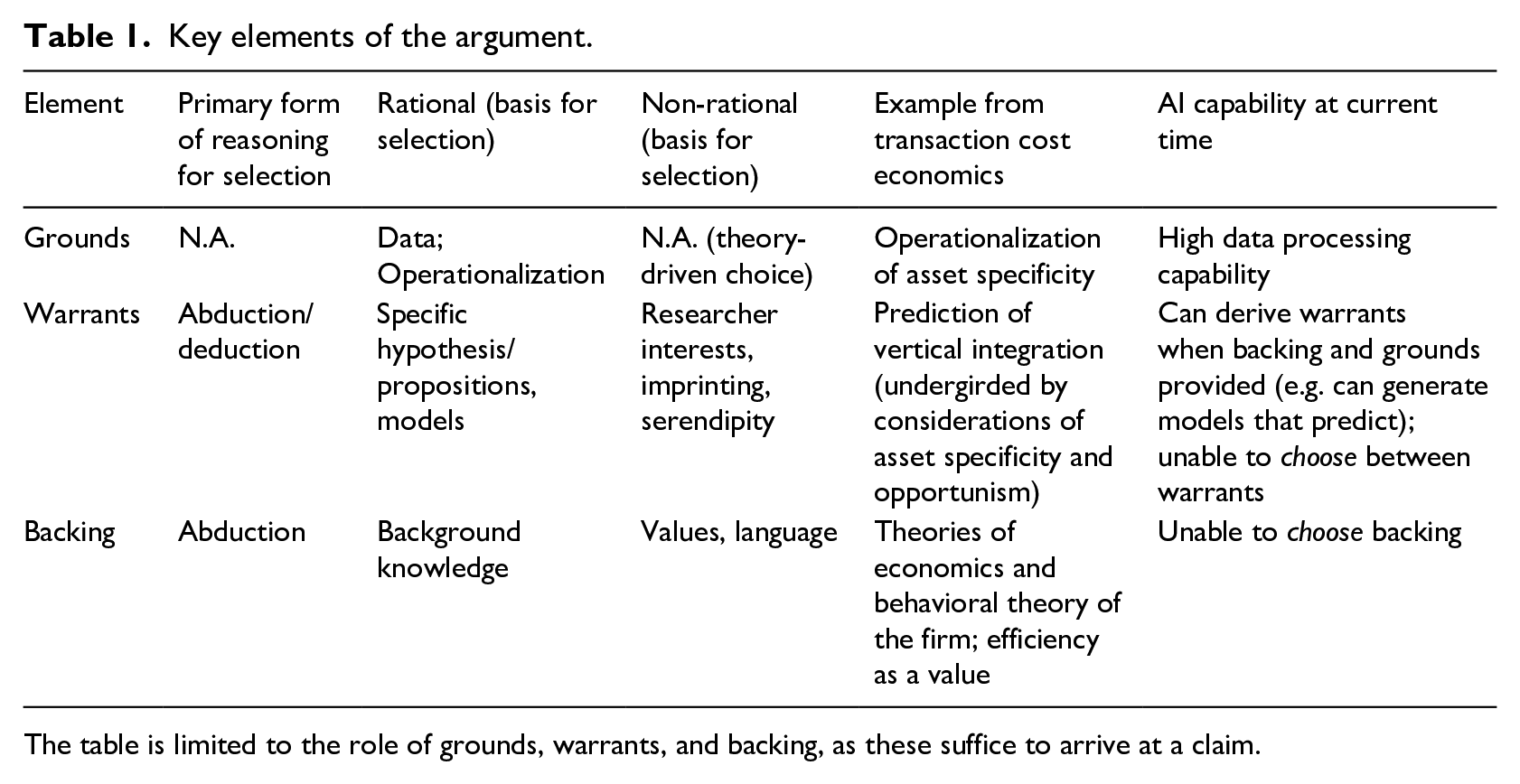
The table is limited to the role of grounds, warrants, and backing, as these suffice to arrive at a claim.
To summarize, theorists employ different forms of reasoning to develop and evaluate their theories. They seek to persuade their peers about the goodness of their theories via argumentation. Since theorists can never be certain that their theories fully correspond to reality—after all, the history of human progress is a veritable graveyard of theories once seen as being infallible—the best they can do is persuade their peers until a consensus is created. This consensus is tempered by perceived problem-solving ability, is provisional, and can be overturned by a different set of arguments (tempered by empirical contact with reality) that are more persuasive. Alternative arguments can co-exist, which, in turn, implies that multiple epistemic communities can co-exist, with none having monopoly claim over “truth.” Interaction between these epistemic communities is predicated on the degree to which they converge on the rational and non-rational.
Theorizing as argumentation
Dominant theories are notoriously hard to overturn, and often their alternatives do not receive a fair hearing. Consequently, persuading peers to consider and adopt alternative theories is a challenging task fraught with hazards and is often unsuccessful (Akerlof, 2020). In the field of strategic management, TCE as developed by Oliver Williamson is a noteworthy exception (Bhardwaj et al., 2025a; Mahoney and Nickerson, 2022). I now examine Williamson’s argumentation to persuade his peers that lead them to consider, test, and expand his theory to understand better the anatomy of a successful argument. I consider appeal to both the rational and non-rational.
Structure of the argument
In the 1970s, many scholars began to recognize the limits of neoclassical economics, which was then the dominant approach for understanding the organization of economic exchange (Williamson, 1971, 1975). According to this dominant theory, economic organization was technologically driven, and restrictive contractual arrangements were a sign of anticompetitive intent rooted in firms’ attempts at gaining market power (Williamson, 1983). Williamson (1975, 1985, 1996) was dissatisfied with this argument and maintained that it was a source of public policy errors. This dissatisfaction spurred Williamson (2014) to “examine vertical integration from a combined economics and organization perspective” (p. 131) to which insights from law were later added (Williamson, 2008, 2010). Specifically, Williamson’s theorizing was sparked by an “irritation of doubt” (Peirce, 1923: ch. 2; Sergeeva et al., 2021) concerning government action on the Schwinn vertical integration case where he had unsuccessfully argued against the dominant monopoly power theory of the time (Mahoney and Nickerson, 2022).
The crux of the Schwinn case is as follows (for details of the case and ruling, refer to United States v. Arnold, Schwinn & Co. 388 U.S. 365 available at: https://supreme.justia.com/cases/federal/us/388/365/; see also Shapiro, 2010). Schwinn was a bicycle manufacturer with a 13% share of the US market in 1961 and sold its bicycles through a distribution network of 22 wholesalers in which each was assigned an exclusive geographical territory. These wholesalers were restricted to selling Schwinn bicycles only to franchise Schwinn accounts and only in their respective territories. For imposing these restraints, Schwinn was formally charged by the US government with price-fixing and seeking market power. The government argued that there were no special or technical reasons for Schwinn to impose such vertical restraints on its franchisees (Williamson, 1996).
Williamson disagreed with this conclusion. His key insight was that organization as well as technology matter (Williamson, 1975, 1985). This key insight was a rejection of the core idea in neoclassical theory that regarded the firm solely as a production function that was technologically determined. Williamson (1985: 185–189) maintained that a firm is more usefully regarded as a governance structure and that Schwinn’s behavior was driven by efficiency and not anticompetitive considerations. In essence, Williamson argued Schwinn’s behavior would be entirely unsurprising if its intent (and outcome) was to reduce transaction costs. He thus offered an alternative plausible argument that was also consistent with the evidence (Ketokivi and Mantere, 2010). Moreover, he appealed to empirical adequacy, that is, the idea that theories must account for observations to the desired degree of accuracy of observations, which, in this case, meant accounting for vertical integration (Barrett, 1996). Empirical adequacy, of course, allows for multiple alternative theories to coexist (Oliver, 1988).
In developing an alternative explanation for Schwinn’s actions, Williamson (1985: 185–189) imported the assumption of bounded rationality from organization theory (March and Simon, 1958; Simon, 1947). He also noted from work in economics that economic agents have an economizing tendency (Knight, 1951). Williamson (1985) maintained that the condition of bounded rationality implied that customers incurred search and quality appraisal costs, which was what Schwinn was attempting to economize. In contrast, government policy makers were working from within a neoclassical economics framework that did not consider limitations on the cognitive abilities of customers and the need for managerial solutions in adapting to incomplete contracting, which requires safeguarding against opportunism (Williamson, 1979).
From economics, Williamson also drew on Coase’s (1937) and Arrow’s (1969) insight that in the presence of transaction costs, technical issues recede while how economic exchange is organized gains salience. Williamson posited that Schwinn sought to reduce its own policing costs while attempting to alleviate concerns pertaining to the diminishment of its quality image—after all, Schwinn’s image amounted to an asset-specific investment. He suggested that it was reasonable for Schwinn to impose some restraints on downstream bicycle sellers lest they act opportunistically and tarnish the bicycle maker’s image. From law, Williamson (1985, 1991 2008) gleaned the insight that court intervention in business matters between firms is rare. Rather, business transactions occur in the shadow of the law and the contract acts as a framework for parties involved in an exchange relationship.
Elements and structure of the argument
In the language of the Toulmin model, Williamson offered an alternative warrant to advance a different claim as compared to neoclassical economists (Lipton, 1993). While the latter employed the warrant of the firm as a production function and claimed monopoly motives for vertical integration, Williamson employed the warrant of the firm as a governance structure and claimed efficiency motives for vertical integration. In doing so, Williamson invoked the non-rational—the value of efficiency instead of power as a backing. Using efficiency in the backing combined with theories of law, economics, and organizations enabled him to arrive at the claim that asset specificity is the key driver for vertical integration as it reduces transaction costs (Williamson, 1988a). I now turn to unpacking Williamson’s argumentation in more detail.
Williamson sought to advance a new claim for why firms vertically integrate or impose vertical restraints. Advancing a new claim requires constructing a new system of arguments comprising new grounds, warrants, backing, and accounting for any qualifiers and rebuttals. Here, backing acts as the broad set of rational and non-rational premises theorists employ in their abductive reasoning (Mantere and Ketokivi, 2013; Toulmin et al., 1979; Walton, 2005). Yet, this backing must have some legitimacy, otherwise it will simply be rejected (Chalmers, 1980). To that end, Williamson (1988a) constructed a new backing by combining insights and language from law, economics, and organization theory and law, each of which have a well-established body of empirically evaluated consensual knowledge (see Ziman, 1968, ch. 3, on the role of consensual knowledge in informing discovery). Of course, the premise of efficiency as a value is one that economists—his target epistemic community—readily accepted (Knight, 1951).
At the same time, Williamson was careful to ensure that insights across different fields were not incommensurate or inconsistent per se (Bansal et al., 2018; Woolley and Fuchs, 2011). For example, the idea of bounded rationality (from organization theory) and contract as a framework (from law) have no inherent contradiction. The condition of bounded rationality also implies that a contract can be incomplete, which is also recognized in law. Had the insights Williamson combined been contradictory or incommensurate, his own theory would have been internally inconsistent, and hence unpersuasive.
Constructing this new backing consisting of the rational as well as non-rational enabled Williamson to posit a new construct—“asset specificity.” He conjoined this construct with a concern well known in economics, which is that human beings can be dishonest and lie. This is also a core idea in law else penalties for perjury would not exist. He chose to name this construct “opportunism.” Now, Williamson could use this as a warrant of the firm as a governance structure to argue persuasively that firms might vertically integrate for reasons other than pursuing monopolistic ends. Indeed, in TCE, asset specificity is the key driver for vertical integration and firms exist, in part, to solve the opportunism problem—the idea of contract as a “promise” is untenable (Williamson, 1985: 31–32).
Williamson also narrowed and sharpened his problem formulation by inquiring “why firms make rather than buy” instead of “why make” (Bhardwaj et al., 2025a; Lipton, 1993: 32–38; Tsang and Ellsaesser, 2011; see also Hintikka, 1996, on the role of asking astute questions in inquiries). This sharp problem formulation, which frames the question in terms of a comparative assessment based on efficiency, is central to TCE (Williamson, 1993). Williamson (1985: 189, footnote 27) employed counterfactual thinking (e.g. Lukka, 2014) to argue that in a world of unbounded rationality, Schwinn would not need to provide such vertical contractual arrangements but maintained that observed real-world contracting can be understood as managers economizing on bounded rationality and seeking to attenuate opportunistic behavior. In other words, he offered an alternative warrant and appealed to the plausibility of his argument in light of the backing he had constructed to convince his peers about its goodness (Mantere and Ketokivi, 2013).
Williamson (1979, 1991) operationalized key concepts such that his warrant would yield predictive content. Doing so, of course, is also in line with the pragmatist notion of ideas having some effect on the world (James, 1907; Sergeeva et al., 2021). Using the operationalization of asset specificity as these new grounds, the firm as a governance structure undergirded by considerations of asset specificity and opportunism as a warrant, Williamson could predict when vertical integration might occur. 5 In other words, the prediction of vertical integration became a claim. The claim could be evaluated and appropriately qualified, by, for example, p-values. The claim could also be rebutted. For example, under conditions of high asset specificity and uncertainty, vertical integration is expected unless anti-trust laws forbidding the “buy” decision are in place. Vertical integration can also be ruled out of if the other firm is owned by the state and not for sale. Repeated inductive testing of the abduced warrant largely corroborated his claim (Macher and Richman, 2008), thus increasing peer confidence in his argument (Hacking, 1983; Meehl, 1990).
Offering predictive content by operationalizing elements of the argument was a significant advancement over earlier work—Coase had offered an interesting argument, but it did not gain much traction in sparking new work. This lack of peer engagement led him to note that his argument was “much cited but little used” (in Medema, 2011: 1). Prediction, at least for economists, is a critical epistemic virtue (Friedman, 1953; Popper, 1962), absent which, they remained unpersuaded to build on Coase’s work.
Furthermore, Williamson and others were also able to indicate additional problems that could be usefully examined using the transaction cost economic lens (Dixit, 1998; Williamson, 1988a, 1988b), while constantly refining TCE. By doing so, Williamson was able to recruit new scholars to pursue and expand the scope of his argument in other contexts and fields (Bhardwaj and Ketokivi, 2021; John and Reve, 2010). At the same time, TCE’s core precepts—the backing and warrant—remained stable, which is critical for an argument to take hold and to survive (Chalmers, 1980).
Yet, arguments predicated on prediction (and explanation) are rarely enough to persuade others already enmeshed in another theory (Kuhn, 2012 [1962]). After all, persuading peers to abandon one theory in favor of another entails those peers overcoming path dependencies and bearing significant switching costs, by, for example, having to acquire a new language (Ashby and Teodorescu, 2019; Chalmers, 1980; Fleck, 1979; Kuhn, 2012 [1962]; Ma et al., 2020). Persuading others requires offering more than what the current (dominant) theory offers—it requires more than an appeal to the rational (Jones and Crow, 2017; Leng and Leng, 2020; McKenzie, 1979). To that end, I now uncover Williamson’s key moves that entailed invoking the non-rational.
Language
Language plays a key role in the development and adoption of theories (Laudan, 1990: 35). On the one hand, the language of a new theory must (to some extent) transcend the terminology of the old theory (Chalmers, 1980: 74). If the language is too similar to extant theories, concerns of lack of novelty or worse, confusion, might arise. New and useful terminology in TCE is evident with terms such as “asset specificity,” “opportunism,” “fundamental transformation,” and “selective intervention” that are typically employed as warrants to explain (predict) outcomes. On the other hand, previously established and adopted language enables peers to make connections to the new theory (Fleck, 1979: 20). Without some connection in language to old work, assimilating into a new language can be a daunting challenge and excessively increases the cost of adoption for peers.
In other words, too much novelty that untethers peers from the familiar might lead them to not being persuaded. Such concerns become especially salient when the anchor from which peers become untethered is well established and familiar. Indeed, individual peers are better off not taking risks with new arguments as such risks rarely pay off (Akerlof, 2020). To attenuate this problem, Williamson used terms like “bounded rationality” and “vertical integration” that were present in background theories familiar to his peers. Essentially, the language of theories in the backing can provide a link to the new vocabulary in the warrant. Interestingly, the continuity between neoclassical economics and transaction cost was almost excessive to the extent that Simon suggested the latter was merely the former in disguise. However, Williamson was able to convince his peers that his theory offered something new (Augier and March, 2008).
Williamson also astutely used metaphors and analogies to persuade others (Ketokivi et al., 2017; Morgan, 1986). For example, Williamson drew on his engineering knowledge to use the metaphor of transaction costs as friction to help his peers visualize how a smooth transaction might become less smooth. After all, friction “gummies” up the works, and excess friction might prevent movement. The metaphor is even more useful than it seems at the first glance—in some cases, it is important to introduce friction in a transaction to slow down processes or impede transactions from taking place (Dixit, 1998). Friction also captures the continuous nature of transaction costs. Just like the coefficient of friction, transaction costs can be high or low. Governance mechanism designers can advance designs that have built in the appropriate amount of friction (Bhardwaj and Akkermans, 2024; Ketokivi and Mahoney, 2022). For example, bureaucracies are considered to be notoriously inefficient but at least some of that is by design to prevent opportunism (Dixit, 1998).
The analogy of a firm as a governance structure provided researchers with a clear premise to reason from. An alternative analogy—organization as a nexus of contracts—offers a different warrant. Different epistemic communities organize around different warrants. In fact, rejection of a core analogy, especially when it is in the warrant, is essentially a rejection of the argument (and the theory). Consider the analogies of a firm as a production function versus the firm as a governance structure. These analogies constitute warrants that either predict or explain outcomes concerning firm boundaries. These warrants are mutually exclusive—either a firm is production function, or it is a governance structure. These two warrants, in as much as they are a bridge from grounds to claims, start from, and end, at different places.
As such analogies and metaphors play a crucial role in persuading and binding peers together (Kuhn, 2012, [1962]; Morgan, 1980). Once peers buy an argument, they can extend its boundaries. Often, doing so requires changing the grounds or employing more analogies (Sergeeva et al., 2021). Consider that Williamson (1988b) treated the question of equity and debt as if it was analogous to a “make or buy” decision, which then enabled him to shed light on how firms finance themselves. Analogies can also be extended to other fields. For example, peers have extended the analogy of a firm as a governance structure to different domains by retaining the warrant but switching grounds (Bhardwaj and Ketokivi, 2021).
That said, doing so is not without problems—translation from one field to another often gives rise to confusion because backing that is well understood in one domain might be misconstrued in another. For example, Williamson’s arguments concerning opportunism have been misunderstood in the neighboring supply chain management domain. In fact, opportunism, which is a theoretical premise, that is, part of the backing, has been misunderstood as being grounds, that is, empirical data (Zipkin, 2012). Put differently, rather than assuming that opportunism can occur, supply chain scholars treat it as an empirical fact that does occur (see Ketokivi and Mahoney, 2020, for details). Misconstruing Williamson’s argument leads to a type III error, that is, solving an incorrect problem correctly (Bhardwaj et al., 2025a; Schwartz and Carpenter, 1999)—managers do not (or should not) contract as if they are in a Hobbesian war against all as this can mistakenly fracture critical relationships (Bhardwaj and Ketokivi, 2021).
Values
Values played a key role in Williamson’s theorizing and argumentation. By values, I simply mean conceptions of the desirable (Kraatz et al., 2020; Sergeeva and Kraatz, 2025). Values shape the ontological and epistemological commitments of theorists and their peers (Laudan, 1986; Leone et al., 2021; Longino, 1983). These values are simply taken as given and do not require justification. At the same time, these very same values undergird arguments. Specifically, values legitimize backing that are invoked to construct arguments.
Peers of an epistemic community “buy into” a set of values, or, for the purpose of their theorizing, an assumption about a set of values others hold, and therefore do not question the backing. In turn, in as much as backing influences grounds and warrants, the legitimacy of invoking them is not challenged, which spurs progress (Schwab and Starbuck, 2016). For example, economists buy into the idea that economic agents value efficiency (Knight, 1951). When Williamson invoked efficiency in his backing, economists did not challenge it. To be clear, not questioning the legitimacy of backing and other elements does not indicate lack of rigor. Rather rigor is evident in more technical challenges—objections and concerns about ground and warrants usually center on matters such as operationalization of grounds, statistical choices used to justify warrants. For example, peers may express concerns about how uncertainty is operationalized in the grounds but are unlikely to question the idea that behavioral uncertainty (opportunism) matters (Mayer, 2009). Concerns of poor reasoning may also lead peers to a specific instance of a warrant but not the class it belongs to. Other peers may buy into a different set of values. For example, peers might buy into the idea that agents seek power or competence and choose to use resource dependency and competence-based reasoning to develop their warrants (Santos and Eisenhardt, 2005).
When values are incommensurate, arguments become incommensurate—proponents of different arguments simply cannot engage with each other. Consider the dialogue between Williamson and Perrow as representing organizational economics and sociology, respectively. Williamson is wedded to the idea that economic agents value efficiency while Perrow subscribes to the idea that actors value power (see Van de Ven and Joyce, 1981: 347–389). While Perrow recognized the importance of Williamson’s TCE argument, he rejected it outright without considering its merits. In fact, he acknowledged to Williamson that
to a large degree the differences between [us] do not really depend on empirical data nor the logic of the arguments, though my critique will be couched in those terms. Instead, they depend on differences in normative presuppositions or values. (Perrow in Van de Ven and Joyce, 1981: 371; emphasis added)
Perrow also noted that his counterargument would not persuade Williamson. Other attempts at finding common ground between TCE and sociology, barring a few exceptions (Bhardwaj and Sergeeva, 2023; Treas, 1993), have also not born much fruit—the underlying values used in the backing to advance arguments by either side diverge far too sharply (Granovetter, 1985).
Finally, values not only influence how arguments are structured but also how they are evaluated and justified (Longino, 1983; Reichenbach, 1938). For example, driven by a certain set of values, theorists’ peers may craft their arguments in terms of efficiency or power. They might do so because of their genuine belief that these explanations correspond to reality and may want to persuade others (e.g. see Chomsky-Foucault debate concerning power and justice). 6 Theorists may also invoke values to provide the basis on which their arguments should be evaluated, as Williamson did in advancing his efficiency-based arguments account for Schwinn’s actions.
Invoking values circumvents the underdetermination of theories by evidence thesis problem (Laudan and Leplin, 1991). While evidence alone cannot adjudicate between theories, values simply serve to attract peers who can then evaluate an argument for its internal coherence, explanatory goodness, predictive abilities, and the like, without concerning themselves about alternative arguments that invoke different (incommensurate) values in their backing. In turn, this leads to rapid advancement of the argument in terms of rigor, assuming, of course, the argument itself is sound and can withstand epistemic challenges.
Consensus
According to Peirce, truth is simply a consensus (convergence) concerning an argument among all those who engage in an honest inquiry (5.407). This conceptualization of truth as consensus reflects the scientific method as conceived by Peirce where justification is a matter of (enumerative) induction undergirded by the law of large numbers (Haack, 1976; Liszka, 2019; Peirce, 8.112). This consensus then gives rise to belief, that is, lack of doubt, which serves as a basis for action (Peirce, 1.635; 1923). Consensus can also be obtained by different inquirers independent and honestly engaging in inquiry (Peirce, 5.407, 8.12; see also Merton, 1971: 371, on convergence on similar results by independent inquirers “confirming” a hypothesis over time).
To be sure, not all who investigate would set aside their own interests or engage in honest inquiry. Yet ideally, in the long run, the aggregation of investigations will ultimately lead us to convergence (5.408)—indeed, this is precisely the role of peers (Bauer, 1992: 48–55; Harari, 2024: 103–104). 7 This convergence rests on the consensus that the outcome of the inquiry addresses the problem for which it was developed (James, 1907; Sergeeva et al., 2021; Zellweger and Zenger, 2023). Different epistemic communities organize around different warrants. Consider that peers will form an epistemic community around theories of efficiency or power—members of one epistemic community will not participate in a consensus around the other (e.g. Williamson, 1981). In fact, members of different epistemic communities might even disagree on what the “it works” test should be evaluated relative to (please see the debate between Perrow and Williamson in Van de Ven and Joyce, 1981).
While convergence around an argument and “it works” might appear fully intertwined, they can, in fact, be temporally separated. Consider that convergence around an argument might begin to build, spurring an increasing number of peers to participate in an “it works” test, until a consensus builds (Meehl, 1990; Ziman, 1968: 9). Alternatively, not enough peers might invest in testing as was the case with Coase’s work (Medema, 2011). In other words, the number of peers persuaded might be too small in number to build a wider consensus—the logic of pursuit provided by the theorist is not compelling (Bhardwaj et al., 2025b; Laudan, 1978; Ziman, 1978). The purpose of argumentation is then also to spur peers to pursue a particular line of inquiry and help generate a consensus, which Williamson did by, for example, operationalizing key constructs that yielded predictive content (Macher and Richman, 2008).
That said, even if a consensus concerning an argument becomes wide and stable, it should not be seen as corresponding to reality (Brønn, 1998; Geddes, 2003; Ketokivi et al., 2024). In some communities such as economics, persuasiveness, and hence consensus around an argument, depends on predictive ability. But arguments can predict while being patently unrealistic (Friedman, 1953). Other communities might prefer arguments that center on “lived experience” (Ellis and Flaherty, 1992; Pradies et al., 2021). This experience might be entirely subjective but might generate a consensus regarding the findings. A consensus also does not invalidate other arguments—peers employing different values and backing might even “see” the world differently. Moreover, it is entirely possible to disagree about the ranking of epistemic values as well (Kuhn, 2012 [1962]; Laudan, 1986).
Finally, consensus, no matter how wide, can dissipate. Thus, within the pragmatist framework, all arguments are regarded as being fallible (Hacking, 1983; Laudan, 1990; Peirce, 1923; see also Collins, 2014). “Experience,” as James notes, “has ways of boiling over, and making us correct our present formulas” (emphasis removed, in Haack, 1976: 234). In other words, empirical contact can break a consensus until it is achieved by pursuing inquiry again. The pursuit of consensus in the pragmatist framework that allows for disagreement adds a self-correcting feature to argumentation.
Discussion
Advancing theories in strategic management entails persuasion—theories that do not attract peers are forgotten regardless of their merit (Geddes, 2003; Lakatos, 1980; Stacey et al., 2000). Theories gain traction when peers are persuaded to test them and expand their scope (Lakatos, 1980). Consequently, crafting persuasive arguments is a critical activity in science (Brønn, 1998; Ketokivi et al., 2024). The current study sheds light on how to do so by examining how Oliver Williamson persuaded his peers to engage with TCE by appealing to the rational and non-rational and touting its potential problem-solving prowess (Mahoney and Nickerson, 2022).
Several important insights arose from this examination. First, crafting arguments is an art as much as it is a science—arguments are carefully constructed systems consisting of various elements that are interconnected in intricate ways. The entire system must cohere internally yet mesh with broader scholarly understanding to gain traction (Peirce, 1923). To use a metaphor, good arguments and theories can be seen as identifying tears in our existing fabric of knowledge—anomalies—and stretching and seamlessly repairing it. Crucially, these tears may have passed unnoticed until they were problematized (Bhardwaj et al., 2025a, 2025b; Nickerson et al., 2012). Peers then test the strength of the (repaired) fabric and stretch it by building on the theory, which then covers new empirical ground. For example, scholars stretched the fabric of knowledge by extending TCE to new empirical phenomena such as the digital economy (Nagle et al., 2024), supply chain contracting (Ketokivi and Mahoney, 2020), innovation in creative industries (Bhardwaj and Sergeeva, 2023), and regulatory arbitrage by financial firms (Marjosola, 2021), among others.
Second, this study highlights the neglected role of appeal to the non-rational, that is, the use of values and language in theory development (Barnes and MacKenzie, 1979; Laudan, 1986; Leone et al., 2021). Different theories (implicitly) rest on an appeal to different values (Bhardwaj and Sergeeva, 2023) and employ a different language (Morgan, 1986). Values can be aligned or incommensurate (Kuhn, 2012 [1962]). Incommensurate values imply that peers of these different epistemic communities do not see the same world. Arguments advanced by members of epistemic communities holding different values will therefore not be seen as legitimate. Different communities also use a different language (e.g. the meaning of the word “uncertainty” differs whether one belongs to the school of Austrian economics or decision theory), and careless use can be a source of confusion and undermine persuasiveness of an argument.
Third, arguments serve to organize epistemic communities. Members of an epistemic community share values and have a consensus on the goodness of an argument—they agree it works (Kuhn, 2012 [1962]; Peirce, 1923; Zellweger and Zenger, 2023). These members test and extend the argument—once persuaded, it is in their interest to do so. Put differently, theorists and peers of an epistemic community seek to establish a monopoly or increase the size of the community by persuading others using methods including training or making it expensive to not become part of a consensus (Akerlof, 2020). Since no scholarly community can claim an absolute monopoly on truth, it is in the interest of the strategic management community to promote and entertain multiple arguments that speak for diverse values members may hold (Ziman, 1968). To that end, plurality of arguments and theories must be celebrated rather than suppressed (James, 1907; Leone et al., 2021; Mahoney, 1993; Nigam and Guerra, 2023). Ultimately, in an applied field like strategic management, the final arbiter of if these theories work or arguments are persuasive is whether they are adopted by managers in the field (e.g. Shapiro, 2010).
Finally, in the context of burgeoning use of AI in research (Csaszar et al., 2024; Rathje et al., 2024), this study offers some food for thought. AI, specifically Large Language Models, are powerful prediction machines (Agrawal et al., 2019). However, they are unable to offer warrants (Shrestha et al., 2021; Tranchero et al., 2024; see also Felin and Holweg, 2024). The ability to do so remains uniquely human because AI is unable to engage in abductive reasoning and explain why a link exists (Larson, 2021). AI is also somewhat limited in its ability to synthesize backing in the manner Williamson did due to its inability to access tacit knowledge, which, by definition, is uncodifiable (Polanyi, 2012 [1958]; Walsh, 2017). Moreover, AI, in its current form, would be hard-pressed to invoke the non-rational, even if it were to be capable of constructing a coherent argument (Lindebaum and Fleming, 2024). Simply put, the onus for persuasion resides with the researcher, and developed properly, can serve as a basis for competitive advantage in a marketplace for ideas. This is especially true in the context of developing novel arguments as AI is fundamentally rooted in the past (Larson, 2021).
Theoretical contributions
The current study contributes to the strategic and organizational management literature in at least three ways. First, this study contributes to the burgeoning literature on theorizing (Bhardwaj et al., 2025a; Eisenhardt, 2021; Foss and Hallberg, 2017; Heckman and Singer, 2017; Leone et al., 2021) by drawing attention to the critical role persuasion plays in spurring peers to engage with and advance theories (Bhardwaj et al., 2025b; Hambrick and Chen, 2008; Mahoney, 1993). Yet, barring a few notable exceptions (Brønn, 1998; Ketokivi et al., 2017), strategic management scholars have largely glossed over its importance, focusing instead on technical matters such as endogeneity (Hamilton and Nickerson, 2003) and reasoning (Sætre and Van de Ven, 2021). While technical choices and reasoning play important roles in persuasion, they do so in service of arguments (Ketokivi et al., 2017, 2024; Toulmin, 2003). Consider that theorists abduce warrants, deduce claims, and induce backing by repeated testing (Mantere and Ketokivi, 2013; Peirce, 1923; Sætre and Van de Ven, 2021). These different elements, disparate technical choices, and reasoning are integrated together at different times into a seamless web of relationships of an argument that form a persuasive theory. Crucially, this seamless web is buttressed on appeals to the rational and the non-rational. Neglecting any aspect of this process and outcome, including the structure of arguments, the language and values appealed to, and how consensus can be fostered, reduces the persuasiveness of an argument and undermines the development of theory. To that end, this study provides a novel systems view of argumentation and its role in developing and advancing theories.
Relatedly, this study highlights that theory (insights) do not emerge from data (grounds) alone and that data cannot keep researchers honest as some scholars suggest (e.g. Eisenhardt, 1989, 2021). This misconception has also misled some researchers into thinking that more grounds (data) will enable AI to replace theorists (Manning et al., 2024). Observing grounds requires backing (prior knowledge) to be present in the first place from which warrants are derived (Hanson, 1958; Peirce in Larson, 2021: 165). Ultimately, a theory is a system of elements that are inexorably linked and dependent on each other (Ketokivi and Mantere, 2021; Toulmin, 2003). In this sense, grounds are not a stand-alone element that a theorist can “nakedly” approach without a problem in mind (Bhardwaj et al., 2025a; Popper, 1999; Scudder, 1999). Observations are problem-laden and dependent on arguments the theorist seeks to make (Ziman, 1968: 48–53). The notion of data (grounds) keeping researchers honest in service of some objective reality too is misplaced—multiple empirically equivalent arguments concerning the same “reality” can be generated (Quine, 1975; Van Fraassen, 1980). Multiple epistemic communities arise around these arguments that may, in fact, be incommensurate (Kuhn, 2012 [1962]). Because arguments are buttressed on the non-rational, data alone cannot adjudicate between them.
Second, this study highlights the importance of language in developing theories and arguments and the challenges associated with doing so. On the one hand, the new language being introduced must transcend the terminology of old theory or must be sufficiently distinct from it to not lead to confusion (Chalmers, 1980). On the other hand, the new language must show some continuity with the old theory to be understood (Fleck, 1979). Thus, in constructing a new theory, scholars must skillfully engage in constructing a web that is simultaneously new enough to be novel yet old enough to be familiar (Durand and Paolella, 2013; Grodal et al., 2021). Consequently, there are limits on how much theorists can advance the boundaries of knowledge using a new argument in one “leap” (Quine, 1973).
In the same vein of highlighting the crucial role of the non-rational, this study illustrates how analogies and metaphors play a central role in persuasion (Ketokivi et al., 2017). Analogies reveal and influence how theorists and peers view the world. Scholars belonging to different epistemic communities embrace different analogies such as firm as “production function,” “governance structure,” or “nexus of contracts.” Within a community, these analogies are not challenged; in fact, adopting a new analogy can highlight a phenomenon or problem in a new light, leading to new insights. Metaphors also play an important, if somewhat different role. Metaphors can convey meaning that may otherwise be impeded by the limits of language (Morgan, 1986). Consider the use of the metaphor of “friction” in TCE. By employing the term friction to denote transaction costs, Williamson was able to transform an abstract and difficult construct into one that can be easily visualized and readily grasped. Prudently, Williamson employed a metaphor that was simple and not complex (Morgan, 1980).
Finally, this study offers some insights to theorist and peers (Editors) concerning the rigor of argumentation and the selection of their epistemic communities. First, with regard to the former, the structure of arguments that reveals the anatomy of theories visually can aid theorists and peers alike in identifying internal inconsistencies that they might otherwise miss. For example, studies invoking TCE and power (e.g. Wang et al., 2015) are internally inconsistent because they invoke contradictory values that are not embedded in the same backing. The presence of internal inconsistencies does not entirely invalidate an argument but does decrease its persuasiveness (Laudan, 1978; Toulmin, 2003). Second, since epistemic communities are organized around arguments that are undergirded by values, theorists should be mindful of the community they are engaging with. Peers (reviewers) who hold incommensurate values are unlikely to be persuaded or even give arguments a fair hearing. In the formal setting of a review process, editors can play a vital role in directing manuscripts to peers who do not have incommensurate values. Calls for, and attempts at, interdisciplinary theorizing should also be moderated—such efforts are more likely to be successful when the underlying values of different communities cohere (e.g. McIvor, 2009).
Limitations and future research directions
By reconstructing Williamson’s (1975, 1985) development of TCE using the Toulmin model, this study unpacked how arguments are crafted to make theories persuasive. There are, however, several caveats accompanying this attempt. First, the narrative provided in this study is somewhat teleological, which underplays the more evolutionary and messy manner in which theories are advanced and prevail. For example, opportunism, which is a central tenet of TCE, was not evident to Williamson from the outset, but only came into clear focus over time (in Swedberg, 1990: 118). Future research can pay more attention to the dynamic nature of argumentation. Second, while this study explores the role of values in theorizing, a more in-depth examination is warranted. For example, consider the recent debate between Bansal and co-authors and Foss and Klein concerning the urgency of, and methods for, addressing ecological threats facing the planet (see Wickert and Muzio, 2024, for an overview of the debate). Do these debates persuade readers to change their minds or are they merely “preaching” to their respective “choirs?” Understanding better the role of values in enabling dialectical engagement can promote better knowledge production (Leone et al., 2021).
Conclusion
According to Collins (1990), “Building scientific knowledge is a messy business [. . .] science is an art, a craft, and above all, a social practice” (p. 3). In the spirit of this observation, the current study seeks to provide an approach that can aid theorists in persuading peers and building a consensus around their theories (Conger, 1998; Laudan, 1978). By doing so, this study provides a framework for dialectic engagement between theorists and peers, which is a much-desired activity for the growth of knowledge (Leone et al., 2021; Mahoney, 1993; Ziman, 1978)—after all, good argumentation makes for good science.
Footnotes
Acknowledgements
I would like to thank Anastasia Sergeeva for numerous conversations and comments for all versions of this study. I would also like to thank Mikko Ketokivi for his guidanance during the review process. Finally, I remain grateful to the review team as well as Associate Editor Oliver Alexy for their time and effort as well as for being open minded.
Declaration of conflicting interests
The author(s) declared no potential conflicts of interest with respect to the research, authorship, and/or publication of this article.
Funding
The author(s) received no financial support for the research, authorship, and/or publication of this article.
Ethical approval
As this is a conceptual study, no ethical approvals were required, and no data source is available.
