



Abstract
Despite growing interest in appointing top leaders with atypical biographical profiles, many organizations follow typical expectations of what a leader’s profile looks like and avoid deviations from such expectations. This article aims to answer why such changes to leadership atypicality can be difficult by examining a major disadvantage of atypical leader profiles—organizational reputational penalties. Drawing on institutional theory and leadership categorization theory, we propose that atypical components in a leader’s profile are met with greater skepticism and scrutiny of leadership capability from external stakeholders, thereby leading to reputation losses. We examine this argument by developing and testing hypotheses on the reputational impact of atypicality in deans’ profiles in American law schools from 1998 to 2016. Our results show that atypical attributes of a leader’s profile are negatively associated with organizational reputation across a broad spectrum of deans’ key profile attributes, including their career path, education credentials, and gender minorities. We discuss the implications of these findings for the study of organizational atypicality and reputation.
Keywords
In recent years, management scholars and practitioners have emphasized the benefits of selecting an organization’s top leader whose profile departs from traditional career paths or prototypical demographic attributes. Rationales for such leader selections include strategic novelty (Crossland et al., 2014), organizational turnaround (Nickisch, 2016), diverse perspectives (Hill et al., 2015), leadership diversity and inclusion (Gligor et al., 2021), and positive publicity (Lovelace et al., 2022). Despite growing interest in the advantages of appointing leaders with atypical biographical profiles, many organizations appear to follow typical expectations of leader profiles and avoid deviations from such expectations, as exemplified in disputes over the appointment of leaders with unconventional career paths (e.g. Vara, 2015) or white male dominance for leadership positions (e.g. Hill et al., 2015; Lee and James, 2007; Lovelace et al., 2022). This article aims to explore why such changes to leadership atypicality can be difficult by examining an organizational disadvantage of atypical over typical leader profiles—reputational losses for organizations whose leader’s profiles are atypical.
As organizational leaders are the face of the organization and people see organizations as a reflection of their leaders (Hambrick and Mason, 1984; Meindl and Ehrlich, 1987), stakeholders’ evaluations of organizations can be influenced by their perceptions of organizational leaders. In evaluating a leader’s capability, external observers rely mostly on principal components of a leader’s biographical profile because it is often not feasible for them to directly observe and interact with the leader. Recently, an emerging body of empirical research has shown the impact of a leader’s profile components, such as functional career orientation, insider or outsider standing, elite education, and racial and gender attributes, on how external observers view organizations, predominantly focusing on top corporate executives (Connelly et al., 2016; Gomulya and Boeker, 2014; Love et al., 2017).
Despite growing recognition concerning the importance of leaders’ profiles for stakeholder evaluations, the impact of such profiles on organizational social evaluations has attracted little systematic examination. Rather, existing literature has largely focused on stock market reactions (e.g. Connelly et al., 2016; Gligor et al., 2021; Lee and James, 2007) and media attention (Gomulya and Boeker, 2014) to new leadership appointments. Indeed, investor or media reactions are crucial but are one aspect of social evaluations by a broad spectrum of organizational stakeholders. Given the mounting evidence supporting the value of positive stakeholder evaluations toward the organization (see Pollock et al., 2019 and Ravasi et al., 2018 for recent reviews), the effects of leaders’ profiles on organizational social evaluations warrant further investigation.
In this article, we examine the impact of atypicality in a leader’s profile on organizational reputation, which is a core component of organization-level social evaluations (Pollock et al., 2019; Ravasi et al., 2018). Drawing on two theoretical perspectives—institutional theory and leadership categorization theory, we propose that the typicality of a leader’s profile, which we refer to as its similarity to commonly-held profiles of peer leaders, is vital in external observers’ evaluations of an organization. Institutional theory highlights the importance of normative mechanisms by which stakeholders assess organizational reputation through the lens of conformity to social standards (Love and Kraatz, 2009; Philippe and Durand, 2011; Rao, 1994; Staw and Epstein, 2000). From this perspective, when a leader’s profile deviates from pre-existing social expectations, stakeholders may develop negative perceptions of the organization, questioning the legitimacy of the leader’s qualifications. Leadership categorization theory explains an underlying cognitive mechanism by which atypicality in a leader’s profile affects evaluators’ perceptions of the leader’s capability (Lord, 1985; Lord and Maher, 1993). According to this theory, evaluators compare a focal leader’s attributes with those of prototypical leaders in a given context, and more negative ratings are likely given to those with mismatches (Carton and Rosette, 2011; Obenauer and Langer, 2019; Rosette et al., 2008). Based on these cognitive and normative frameworks of atypicality, we argue that atypical components in a leader’s profile can raise skepticism toward leadership capability and credibility among external observers and draw greater scrutiny from stakeholders, thereby negatively affecting organizational reputation.
To examine this argument, we develop and test hypotheses on the reputational impact of atypicality in a dean’s biographical profile in the context of U.S. law schools from 1998 to 2016. We focus specifically on three critical components of a dean’s profile—(1) career experiences, (2) educational backgrounds, and (3) gender and racial minority status—as meaningful determinants of external observers’ reputational assessments about the dean’s law school. This empirical context has four major advantages. First, the dean serves as the public face of a law school and plays a central leadership role in its strategic decisions and daily operations. Second, organizational reputation is probably the most important performance parameter for law schools due to its significant impact on all major stakeholders (Henderson and Morriss, 2007; Sauder, 2008; Sauder and Lancaster, 2006). Third, information about reputations of law schools is readily accessible to all stakeholders through third-party ratings and rankings. Fourth, research on organizational reputation has raised the measurement concern related to the “financial performance halo,” pointing out “that respondents simply are tracking firms’ previous financial performance, thereby leading the reputation measure to be equivalent to a measure of reputation for financial performance” (Lange et al., 2011: 179; also see Bermiss et al., 2014; Brown and Perry, 1994). Our context is free from this concern, allowing for a robust assessment of the impact of a leader’s profile on organizational reputation.
This study makes three important contributions to extant literature. First, we contribute to the literature on organizational reputation by identifying atypicality in a leader’s profile as an important source of reputation formation. Second, our study provides an explanation of why typicality persists in selecting an organization’s top leader by highlighting reputational pressures it might have to bear when its leader profile deviates from prototypical expectations in the field. Third, we extend the leadership categorization theory by broadening its reach to external stakeholders’ collective evaluations across a wide spectrum of leader profile attributes.
Theoretical background
Atypicality in leaders’ profiles
Each industrial sector or occupational field has its own social expectations about what one’s biographical profile typically looks like to become an organizational leader. Viewing organizational leaders’ profiles as social artifacts reflecting the markings of institutional circumstances at given times and places (Jeong and Leblebici, 2019), several studies have explored why and how typicality in leader profiles occurs and changes over time. For example, Fligstein (1987) and Ocasio and Kim (1999) found the existence of typicality at a particular historical period in terms of functional career paths among CEOs’ profiles in large U.S. firms. Thornton and Ocasio (1999) documented a shift in institutional logics from “publishing as profession” to “publishing as business” in the higher education publishing industry and provided insights into how a particular leader profile was more common and valued at different historical periods. Jeong et al. (2021) demonstrated how field-level transformations, such as professionalization and organizational population diversity, promoted or inhibited typicality among leader career profiles. In addition, extensive research has shown that the typical demographic profile of top corporate leaders continues to be predominantly white and male (e.g. Lee and James, 2007; Lovelace et al., 2022).
A core insight from these studies is that organizations face pressures to conform to prevailing social expectations regarding the prototypical profile of top leadership. Such expectations include conventional career paths to top leadership, standard educational qualifications, and stereotypical demographic profiles (e.g. gender or race). An important but neglected question, then, is: what happens to the reputation of an organization whose leader’s profile is atypical, as compared to those of peer leaders? Do atypical leader profiles positively influence stakeholders’ reputational assessments, or do they instead trigger negative evaluations? Or do they make no difference? We explore this issue by examining the impacts of atypicality in leader profiles on organizational reputation.
Reputational consequences of atypicality in leaders’ profiles
Studies on organizational reputation have proposed various conceptualizations of organizational reputation (e.g. Bitektine, 2011; Lange et al., 2011; Parker et al., 2023; Pollock et al., 2019; Ravasi et al., 2018). For instance, Lange et al. (2011: 155) identified three prominent definitions of organizational reputation—“being known” (generalized awareness or visibility of the organization), “being known for something, to someone” (perceived predictability of a particular outcome or behavior to a specific audience), and “overall favorability” (overall perceptions or judgments of the organization). In this study, we focus on the evaluative nature of reputation rather than favorability or affinity and define organizational reputation as stakeholders’ subjective assessments of the organization’s overall quality. This conceptualization of organizational reputation is well suited to the purpose of our study because we examine the influence of atypical leader profiles on stakeholders’ overall perceptual evaluations of the organization, rather than their familiarity with it, affinity toward it, or judgments of its specific outcomes. Several previous studies have examined the antecedents and consequences of organizational reputation as overall quality assessments (e.g. Fombrun, 1996; Gomulya and Boeker, 2014; Zavyalova et al., 2016).
With this conceptualization of organizational reputation, we integrate two independently developed theoretical perspectives—institutional theory and leadership categorization theory—to provide a comprehensive framework for understanding how reputational evaluators perceive atypicality in leader profiles. First, institutional theory views “reputation as the outcome of legitimation processes” (Rao, 1994: 30), emphasizing that conformity to socially constructed standards is a key factor in forming organizational reputation (Bundy et al., 2021; Love and Kraatz, 2009; Philippe and Durand, 2011; Staw and Epstein, 2000). Prior research provides several examples of reputational change driven by organizational conformity based on legitimacy. For example, Rao (1994) found that stakeholders’ endorsements such as certification contests enhanced organizational reputation through the process of legitimation in the American auto industry. Staw and Epstein (2000) provided evidence that firms improved their reputation by adopting widely accepted management practices such as total quality management in their pursuit of legitimacy. Philippe and Durand (2011) also found that conformity to social expectations of corporate environmental communication had a positive impact on observers’ reputational assessments of firms.
Insights from these studies point to the normative mechanism through which atypicality in leaders’ profiles can affect organizational reputation. As organizational top leaders are seen as crucial decision-makers for organizational actions and outcomes (Finkelstein et al., 2009; Hambrick and Mason, 1984), reputation-granting audiences may adjust their evaluations through a normative lens by assessing the extent to which a leader’s profile conforms to prototypical profiles in a given social context. Atypicality is here perceived as a deviation from normative pressures toward conformity (Cutolo and Ferriani, 2024). Thus, leaders with atypical profiles are vulnerable to the risk of facing stakeholders’ skepticism and legitimacy concerns in pursuit of prototypical expectations. In other words, when organizational top leaders have atypical profiles, audiences may question the legitimacy of their qualifications; develop concerns about their fitness, commitment, and capabilities; and evoke more negative perceptions than those with typical profiles. Therefore, we argue that, if this normative mechanism is in action, departure from typicality may be detrimental to organizational reputation because stakeholders are likely to react negatively to leaders’ atypical profile attributes.
Second, although it focuses on the appraisal of individual leaders rather than organizational social evaluation, leadership categorization theory provides a theoretical lens to understand the basic cognitive mechanism by which atypicality in leader profiles can affect evaluators’ perceptions and ratings of leadership. According to the theory, “evaluators compare a target person with already pre-existing knowledge structures called leadership prototypes, which reflect the average characteristics of leaders in a given context” (Rosette et al., 2008: 759). Through this comparison, a perceived match or mismatch can occur between the characteristics of the focal leader’s profile and what is considered typical for an organizational leader. Several studies have shown that leaders whose profiles align with prototypical expectations tend to be evaluated more positively than those whose profiles do not. For example, Petrenko et al. (2019: 1943) showed that firms with humble CEOs experience evaluative discounts because humility is “less consistent with the prototypical image of effective leaders (i.e. less bold, direct, strong, and masculine than prototypical leaders).” In the context of U.S. service and financial industries, Rosette et al. (2008) found that observers provide a more positive evaluation of white relative to non-white leaders since they are perceived to be prototypical business leaders and more likely to succeed. In a similar vein, Sy et al. (2010) showed that evaluators perceive Asian Americans as less-suitable leaders in Western business contexts where prototypical leaders are Caucasian Americans.
If this cognitive mechanism guides how external observers perceive a leader’s profile, their reputational ratings are likely to depend on the extent to which the leader’s profile attributes align with those of typical leaders. Atypicality can here be understood as a source of uncertainty and confusion, challenging evaluators’ existing cognitive frameworks of what is considered typical (Cutolo and Ferriani, 2024). In particular, due to the perceived mismatch with the common attributes of typical leaders, evaluators are more likely to apply stereotypical perceptions and biases to their assessments, focusing on atypical indicators. In their review of organizational atypicality, Cutolo and Ferriani (2024: 1157) noted that “Organizational objects that are atypical within a context—in terms of features, characteristics, or behaviors—tend to generate skepticism and encourage rejection by eliciting confusion among relevant audiences.” Thus, we argue that leaders who do not possess typical characteristics of a standard leadership profile may inflict reputational damage upon their organizations.
Taken together, these two perspectives suggest that audiences have prototypical expectations of what constitutes an organizational leader’s profile and provide insights into why and how atypicality in top leaders’ profiles matters for their reputational assessments. Drawing upon these insights, we develop our hypotheses about how atypicality in three key attributes of a leader’s biographical profile (i.e. career, education, and demographic minorities) can influence observers’ reputational assessments of organizations.
Hypotheses
Atypicality in a leader’s career profile
Given that career is “the unfolding sequence of a person’s work experiences over time” (Arthur et al., 2005: 178), an organizational leader’s career path constitutes the process through which the leader obtained field-specific skills, knowledge, expertise, and networks. Prior studies show that a leader’s career elements play a significant role in major organizational decisions because those prior career experiences form the leader’s frame of reference for identifying problems and solutions (Finkelstein et al., 2009). For example, using a longitudinal sample of Fortune 250 companies, Crossland et al. (2014) found evidence that CEOs with widely diverse career backgrounds and experiences are more likely to depart from prevailing industry norms and pursue strategic novelty and distinctiveness. Several studies have also shown that leaders with different functional orientations in their career paths tend to choose different strategic actions, such as R&D investments (Kish-Gephart and Campbell, 2015) and diversification (Jensen and Zajac, 2004).
Thus, due to its significant impact, stakeholders can view an organizational leader’s career path as a key factor in evaluating the overall quality of the organization. Indeed, previous studies have shown that a leader’s specific career elements, such as functional career paths, insider vs outsider standings, and prior leadership experiences, affected external observers’ evaluations of a focal organization. For example, when an organization experiences financial misconduct, stock investors tend to respond positively to the appointment of a new leader from outside the firm (Connelly et al., 2016) or with functional expertise in finance or accounting (Gomulya and Boeker, 2014). These findings suggest that investors interpret such career experiences of new leaders as a credible signal of leadership capability in restoring organizational reputation.
Focusing on organizational leaders’ career paths as a whole rather than specific career elements, we argue that atypicality in their career trajectories is a critical factor affecting reputational evaluations of organizations. When an organizational leader’s prior career path differs significantly from those of peer leaders, such atypical career histories often receive increased attention and scrutiny from key stakeholders. For instance, external evaluators may question whether the leader possesses the necessary knowledge, expertise, and experience for the job, thereby raising concerns about the legitimacy of their qualifications as the organization’s leader. Even if the leader has an impressively successful career path, such divergences from typical, well-established career trajectories commonly seen among peer leaders can lead to significant uncertainty among stakeholders. Stakeholder concerns about leaders with unconventional career paths are often observed across various fields and reported in the media. Examples include the appointment of former corporate executives (e.g. Vara, 2015) or politicians (e.g. Kiley, 2013) as university presidents, the hiring of CEOs with a lack of prior experience in the industry (e.g. De la Merced, 2012), and the selection of individuals with no player experience as head coaches of professional sports teams (e.g. Zillgitt, 2012). In our context, one of our sample deans recollected being a dean from outside the typical academic world as follows: “My unusual background as a lawyer, without tenured law-school teaching, prompted deep discussion by my future faculty about the merits of an ‘outside dean’. The University found the idea novel and delayed its decision for a year, to allow for a second year-long search. They were unsure that my background equipped me for this important University leadership role” (Parker, 2010: 122).
In contrast, if a leader’s career trajectory matches well with prototypical images of leader career profiles, such convergences can appear appropriate and legitimate in the eyes of stakeholders. Thus, leaders with typical career paths may create less uncertainty and be less likely under scrutiny regarding their qualifications as an organizational leader. Therefore, we hypothesize that the more a leader’s career path differs from those of peer leaders, the more negative reputational ratings by stakeholders are likely to be.
Hypothesis 1. Atypicality in the career profile of an organization’s top leader is negatively related to the organization’s reputation.
Atypicality in a leader’s education profile
A leader’s education profile is one of the easily observable cues to which external audiences attend while assessing qualifications and qualities of the leader. As Gomulya and Boeker (2014: 1763) pointed out, although prior educational achievement “may only be loosely linked to an individual’s competence, it is a straightforward and accessible characteristic that can easily be interpreted to signal differences in ability.” Hence, it is commonly observed that a majority of top leaders across different sectors of society are graduates of a handful of educational institutions perceived as elite schools among stakeholders (e.g. Cappelli et al., 2014; Hartmann, 2018; Morton, 2019). For instance, more than half of the CEOs in the UK’s 100 largest companies attended one of the seven prestigious universities, and almost half of the CEOs in the U.S. 100 largest companies were graduates of either Ivy League schools or another dozen elite institutions (Hartmann, 2018). Similarly, about 40% of top positions in the U.S. government graduated from one of the 12 leading universities (Dye, 1990).
Stakeholders’ perceptions of qualifications are one primary reason why elite educational attainment is a typical attribute among organizational leaders. Stakeholders and the public often view selection and training by elite schools as key indicators of a leader’s intellectual capability, cognitive complexity, and social capital (Miller et al., 2015; Sauer et al., 2010). For example, Miller et al. (2015) showed that companies led by top executives who attended an Ivy League school had higher and more sustained market valuations, suggesting that a degree from an elite school can signal those executives’ outstanding human capital. Gomulya and Boeker (2014) also found that, when firms faced reputational damage due to financial misconduct, the appointment of a CEO successor with an elite educational background resulted in more positive reactions from the stock market and the media.
Extending these findings to the formation of organizational reputation, we suggest that whether an organizational leader holds an elite educational credential can be part of stakeholders’ expectations regarding prototypical leader profiles. In particular, as key reputational evaluators are part of the elite education status structure themselves, they are likely to view elite educational attainment as more legitimate, trustworthy, and even essential (Useem and Karabel, 1986). Those stakeholders also often perceive leaders with elite educational backgrounds as having valuable social connections with other elites through strong alumni networks (Chen et al., 2009). Therefore, we expect that organizational leaders with a typical elite educational profile are likely to receive relatively less skepticism and legitimacy concerns from stakeholders about the quality of their leadership. In contrast, when organizational leaders lack such typical educational credentials, stakeholders may pay more attention to the issue and doubt their leadership capability, resulting in a less-positive reputational assessment of their organizations. In sum, viewing an elite education as one of the prototypical attributes in leaders’ profiles, we hypothesize:
Hypothesis 2. Atypicality in the education profile of an organization’s top leader is negatively related to the organization’s reputation.
Atypicality in a leader’s gender and race profile
A leader’s demographic minority status is another important atypicality factor that may influence how external stakeholders evaluate organizations. External observers often associate a certain demographic group with a prototypical image of leaders, particularly when a majority of leaders in a field belong to that demographic group. For instance, the historical underrepresentation of gender and racial minorities in leadership positions of large American companies contributes to establishing “a white male” as a leadership prototype (e.g. Gligor et al., 2021; Hill et al., 2015; Lee and James, 2007; Lovelace et al., 2022). A similar argument can be applied to state legislatures (New American Leaders, 2020) and universities (Jackson and Lee, 2017). Conversely, the dominant presence of white women leaders in the nursing sector (Iheduru-Anderson, 2020) or of sexual minority leaders in the field of HIV/AIDS treatment advocacies (Maguire et al., 2004) can lead to perceiving a distinct gender profile as part of a leader’s stereotypical image.
Prior research provides some evidence that evaluators react negatively to demographically atypical leaders. For example, research on leadership categorization theory shows that observers associate leadership roles more easily with prototypical gender and racial groups and that this implicit bias leads them to assess minority leaders more negatively (Carton and Rosette, 2011; Obenauer and Langer, 2019). Studies reported that investor perceptions to the appointment of women CEOs (Lee and James, 2007) and women directors (Solal and Snellman, 2019) tend to be negative. Sauer et al. (2010) found that stock analysts provide the highest valuation for firms led by whites and the lowest valuation for firms led by blacks, even though both black and white executives have the same prestigious educational background.
Our reasoning behind negative stakeholder perceptions of demographically atypical leaders also aligns with the role congruity theory (Eagly, 2003; Eagly and Karau, 2002). According to this theory, there is often a perceived mismatch between the characteristics typically associated with leadership roles and those typically linked to women. Consequently, this incongruity can lead to women leaders being evaluated less positively (Eagly and Karau, 2002). For instance, Gupta et al. (2018) found that women CEOs are more likely to face threats from activist investors due to investors’ susceptibility to pervasive gender role stereotypes.
Building on these findings, we propose that external evaluators negatively perceive a focal organization if its leader’s gender and race profiles are atypical. Role incongruence perceptions may hinder evaluators from associating positive leader attributes (such as intelligence, competence, and decisiveness) with atypical demographic minorities (Eagly, 2003; Eagly and Karau, 2002). Such stereotyping can lead observers to question whether a demographically atypical leader possesses the leadership qualifications necessary to achieve positive outcomes for the organization (Carton and Rosette, 2011; Rosette et al., 2008). Observers may also doubt whether a minority leader can effectively manage competing demands among various internal and external constituents and build their support and consensus. Based on this reasoning, reputational evaluators are likely to be more suspicious of organizations led by demographically atypical leaders than of those led by demographically prototypical leaders. Focusing on a leader’s gender and racial minority status, we propose:
Hypothesis 3a. Gender minority status of an organization’s top leader is negatively related to the organization’s reputation.
Hypothesis 3b. Racial minority status of an organization’s top leader is negatively related to the organization’s reputation.
Methods
Data and sample
To examine the impact of atypicality in leader profiles on organizational reputation, we compiled a comprehensive database of deans’ profiles and school reputations in the context of American law schools from 1998 to 2016. We used law schools’ reputational data published by U.S. News & World Report (hereafter, USN). The USN has annually published reputational ratings of law schools accredited by the American Bar Association (ABA) since 1990. Despite ongoing debates about the validity of the methodology that USN uses to produce its ratings, it is undeniable that “USN is by far the dominant ranker of law schools” (Sauder, 2008: 212). Prior research (e.g. Sauder, 2008; Sauder and Lancaster, 2006) and media reports (e.g. Henderson and Morriss, 2007) have documented the powerful practical influences of USN reputational ratings not only on law schools but also on their key stakeholders, such as prospective students, law firms, donors, and university officials. These studies provide strong evidence that a fall in USN ratings is likely to result in a decreased ability to attract quality students, faculty, law firms, and donors. Our study period was determined primarily based on the availability of USN reputation data.
The deanship position plays a critical leadership role in a law-school organization. Thus, law schools seek “a dean who will have the ability to serve multiple, and sometimes competing, constituencies within the law school while effectively managing the outside challenges that face their own institution and the legal education as a whole” (Neitz, 2019: 630). We collected data on deans’ biographical profiles from the Association of American Law Schools (AALS) Directory of Law Teachers. This annual directory provides detailed curriculum vitae of law faculty, including their demographic information, educational history, and academic and professional experience. In rare cases where no biographical detail was available in the AALS directory, we collected their profile information from other sources, such as school websites and LinkedIn profiles. We obtained supplementary data about law schools from various ABA publications and individual school websites. Our dataset contained 1,705 school-year observations for 154 law schools during the study period. After removing acting or interim deans, 385 deans’ profiles were included in the final data set. The dataset was unbalanced in that some schools were newly ABA-approved and added to USN rankings during the study period.
Measures
Dependent variable
The USN rankings of law schools are based on a weighted average of various quality factors in the following four categories: (1) quality assessment—quality assessment by peers and quality assessment by lawyers and judges; (2) selectivity—Law School Admission Test (LSAT) score, undergrad Grade Point Average (GPA), and acceptance rate; (3) placement success—employment rates after graduation and bar passage rate; and (4) faculty resources—student-faculty ratio, library resources, and annual expenditures per student. Focusing on stakeholders’ subjective assessment components of a law school’s overall quality, we measured the dependent variable as an average of a law school’s assessment scores on overall quality by peer law schools and by lawyers and judges (i.e. the first category above). 1 To obtain subjective quality assessment scores, the USN annually conducted reputational surveys in which two groups of key stakeholders (peer academics and legal professionals) were asked to rate schools’ overall quality on a scale from “marginal” (1) to “outstanding” (5). These subjective ratings are well aligned with our conceptualization of organizational reputation, which we refer to as stakeholders’ perceptual judgments on an organization’s overall quality. In organizational reputation literature, the USN data have often been used as a measure of organizational reputation in different contexts, such as law schools (Sauder, 2008), business schools (Martins, 2005), and U.S. colleges and universities (Zavyalova et al., 2016).
Independent variables
To test the impact of atypicality among leaders’ career profiles on organizational reputation (Hypothesis 1), we defined a dean’s career path as a sequence of their previous job positions. For each dean, we first coded their primary job position for each of the years between the career starting year after graduation from law school and the deanship appointment year and then assembled position-year strings to create one career sequence. Through this process, we identified 17 different job positions held by our sample deans and used one letter code for each of those positions. The 17 job positions include academicians (e.g. lecturer, research fellow, or adjunct professor; letter code A); assistant professor (B); associate professor (C); professor (D); solo law practice (E); associate in a law firm (F); partner in a law firm (G); positions in a corporation (H); judicial clerk (I); judge (J); member of a legislative body (K); positions in federal and state governments (L); positions in non-profit organizations (M); military service (N); study (O); non-academic university staff (P); and dean (Q). For example, the career sequence “IFFFFFFFGGGGGLLLL” indicates that this individual began their career as a judicial clerk (I) and worked for 1 year; then worked for 7 years as an associate in a law firm (F) and for 5 years as a law firm partner (G); moved to the executive branch of government (L) and worked for 4 years; and then was appointed as the dean of a law school.
Specifically, we used the optimal matching (OM) method to construct a dean’s career path atypicality that captures the degree to which the dean’s career sequence is dissimilar from that of all other incumbent deans in a given year. OM is a sequence analysis algorithm increasingly used in career research (e.g. Biemann and Datta, 2014; Jeong et al., 2021; for a review, see Dlouhy and Biemann, 2015). We chose OM because of two key advantages: (1) the ability to analyze the totality of a leader’s career path, considering the ways in which job transition events are sequentially organized as a whole, and (2) the ability to measure the degree of atypicality among large-scale career sequences.
A dean’s career path atypicality measures how atypical a focal dean’s career sequence is as compared to those of all other incumbent deans at a given time, using a three-step process. The first step involved measuring the degree of dissimilarity between every pair of dean career sequences in our sample by calculating the minimum cost (i.e. the fewest steps) required to align both sequences exactly. For each pair of career sequences, this alignment cost was determined by calculating the minimum number of job position insertions, deletions, and substitutions required to fully align one career sequence into the other (refer to Appendix 1 for more detailed information on alignment costs). The second step was to account for differences in sequence length. As aligning longer career sequences is more costly (i.e. more difficult) than aligning shorter ones, career sequence length may influence dissimilarity scores. To address this potential issue, we divided pairwise raw dissimilarity scores by the total length of the two compared career sequences. The final step was to identify all incumbent deans at the time each focal dean was appointed and calculate our Hypothesis 1 variable (a dean’s career path atypicality) by averaging the length-adjusted dissimilarity scores between the dean’s career sequence and each of those incumbent deans’ career sequences. For instance, in 2012, each dean was compared to 169 other incumbent deans, and their career atypicality scores were calculated as the average of dissimilarity scores between their career sequence and the career sequences of their 169 peers. We used the TraMineR package to perform the above steps (Gabadinho et al., 2011). Figure 1(a) shows the atypicality levels of each dean’s career path, illustrating that most of our sample deans followed conventional career trajectories.
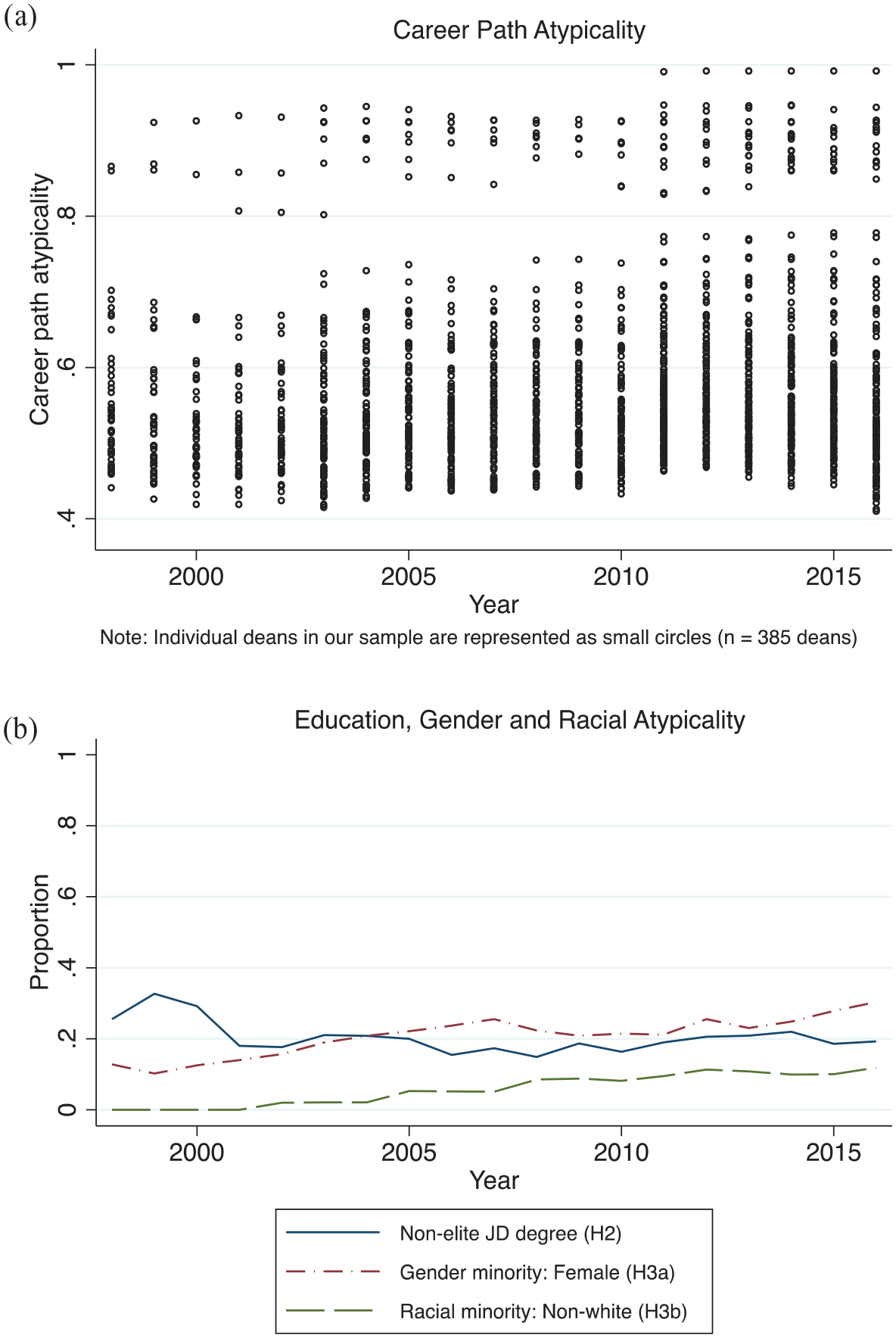
Trend of atypicality in deans’ profile attributes. (a) Career path atypicality. (b) Education, gender, and racial atypicality.
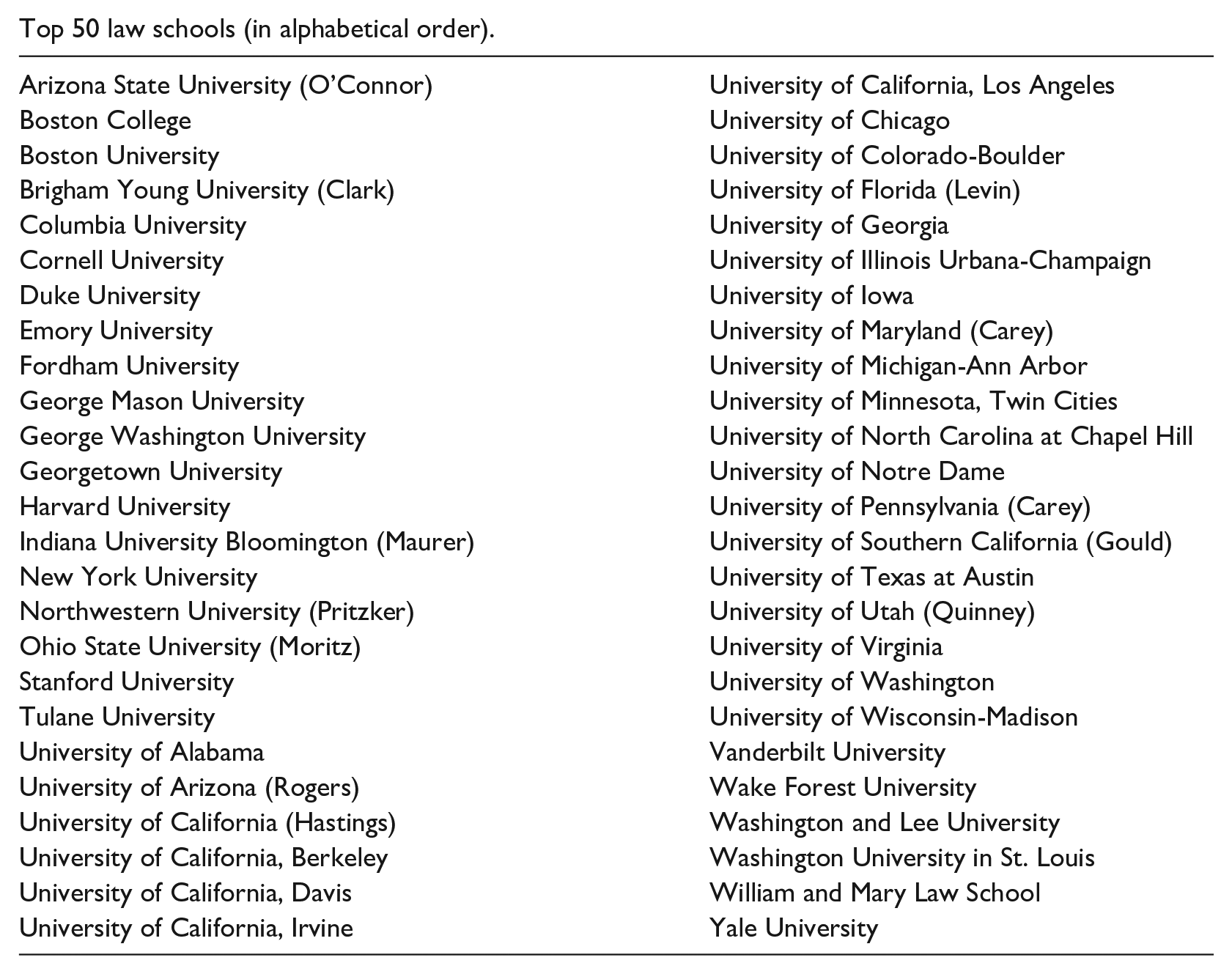
To test Hypothesis 2, we measured atypicality in a dean’s education profile by constructing the variable non-elite JD degree. A top-tier Juris Doctor (JD) degree is an important credential in the legal profession in general and law schools in particular (Henderson and Morriss, 2007; Sauder, 2008). The expectation of such elite education profiles is more pronounced for leadership positions in this profession, as exemplified in the case of an Ivy-covered path to United States Supreme Court justices (Schwartz, 2009) or law-school deans (Neitz, 2019). Given that “law school deans are predominantly graduates of elite law schools” (Neitz, 2019: 654), we defined a dean’s education profile as being atypical if they had attended non-elite law schools. We specifically coded this binary variable as 1 if a dean received their JD degree from non-top 50 law schools and 0 otherwise. The top 50 law schools were identified, based on the historical average reputational ratings during our study period (see Appendix 2 for the full list of the top 50 law schools). In our data, 307 out of 385 law deans (80%) attended one of the top 50 schools. In addition, in separate analyses not reported here, we used top 3, top 5, top 15, and top 25 for alternative measures of elite education and found that the results remained largely unchanged (available upon request).
To test Hypotheses 3a and 3b, we created two variables to measure the atypicality of deans’ gender and race profiles based on their minority status, considering that white men have historically dominated the deanship of law schools (Neitz, 2019). First, we measured gender minority as 1 if a dean is female and 0 otherwise. Information on our sample deans’ gender was compiled from the AALS Directory where respondents self-reported their gender. Second, we measured racial minority as 1 if a dean is non-white and 0 otherwise. For data on racial minority status, we followed prior research (Zhang, 2017) and had two research assistants independently code either “white” or “non-white” based on online photos of deans. The kappa coefficient between the two coders was 0.80 with 97% agreement. This suggests a high inter-coder agreement given that kappa values greater than 0.75 indicate excellent agreement beyond chance (Fleiss, 1981). One of the authors assessed and resolved each of the rare cases with disagreement. In our dataset, 93 out of the 385 deans (24%) were women, and 34 (9%) were racial minorities. Figure 1(b) shows the overall trends of the independent variables for Hypotheses 2, 3a, and 3b, highlighting that the levels of atypicality in these profile attributes relatively remained stable over nearly two decades with slight variations; the proportion of non-top 50 JD degree exhibits a slightly downward trend over time, while women and non-white deans have increased in recent years.
Control variables
To rule out possible confounding explanations, we controlled for the following factors in our models. First, we controlled for an additional set of a dean’s profile-related variables. We included dean age, the number of inter-organizational moves in their career paths, and dean tenure measured as the number of years that they had held the deanship position with a specific law school. To account for the potential influence of a dean’s individual reputation on law school reputation, we controlled for dean media prominence. We measured this variable by counting the number of articles published about each dean in a given year across all media outlets indexed in ProQuest. Following prior studies (e.g. Lovelace et al., 2022), we included only those articles that mentioned the school name and referenced the dean’s name at least twice, ensuring that the dean was discussed in a substantive manner. For all searches, we used the option to eliminate any double counting of highly similar articles or transcripts.
Second, we included several measures to account for the effects of organizational differences on school reputation. For each school-year observation, we controlled for school size, measured as the number of total enrollment students of a law school (logged), and school age, measured as the difference between the observation year and a school’s founding year (logged). To control for potential effects of differences in governance among law schools, we included school governance that was coded as 1 for public schools and 0 for private schools. As external evaluators may perceive whether an organizational leader is appointed internally or hired externally as a relevant factor in their reputational assessment (e.g. Connelly et al., 2016), we controlled for external hiring, which takes the value of 1 for those deans hired from outside and 0 otherwise. Finally, to control for broad contextual factors, we included year- and state-fixed effects in all models.
Analysis
Because the formation of organizational reputation is path-dependent (Mishina et al., 2012), our analysis may suffer from the influence of serial correlation. Thus, to control for temporal dependence of organizational reputation, we used a dynamic panel generalized method of moments (GMM) estimator, which includes lagged differences of endogenous covariates as instruments to tackle reverse causality and unobserved heterogeneity (Arellano and Bond, 1991). We specifically used the “system” GMM estimator (“xtabond2” command in Stata), which, compared to the original estimator of difference GMM, is designed to improve efficiency by including more instruments (for more detailed information, see Arellano and Bover, 1995; Blundell and Bond, 1998).
The system GMM has several advantages for analyzing dynamic panel data like ours. First, its major strength is that it includes the lagged values of the dependent variable (the prior reputation of a school at year t-1 in our case) as explanatory variables to account for temporal dependence. Second, the system GMM uses both the levels and first-differences of dependent variables as instruments to mitigate potential endogeneity problems caused by reverse causality. Thus, it can provide more efficient and consistent estimates even if reverse causality is present. Finally, the system GMM also controls for time-invariant unobserved heterogeneity specific to a law school. To control for potential heteroskedasticity or auto correlation within a law-school organization, we used robust standard errors in our analyses. The descriptive statistics and correlations for all the variables are reported in Table 1.
Descriptive statistics.
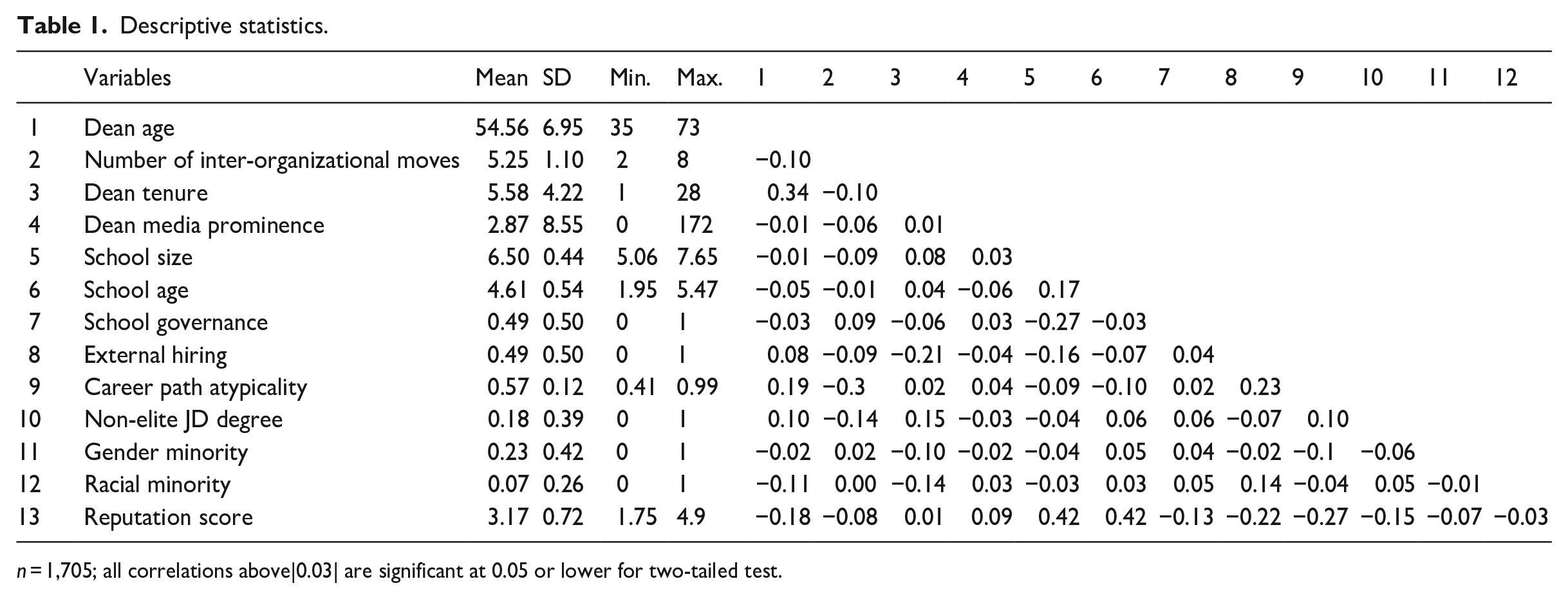
n = 1,705; all correlations above|0.03| are significant at 0.05 or lower for two-tailed test.
Results
Table 2 presents the results of the GMM models testing the effects of atypical attributes in deans’ profiles on reputational ratings of law schools. Model 1 is the baseline model with only the control variables included. In Models 2 through 5, we included each of the independent variables, one at a time, and Model 5 represents the full model containing all the hypothesized atypical attributes in deans’ profiles.
Effects of atypical attributes in deans’ profiles on law-school reputation.
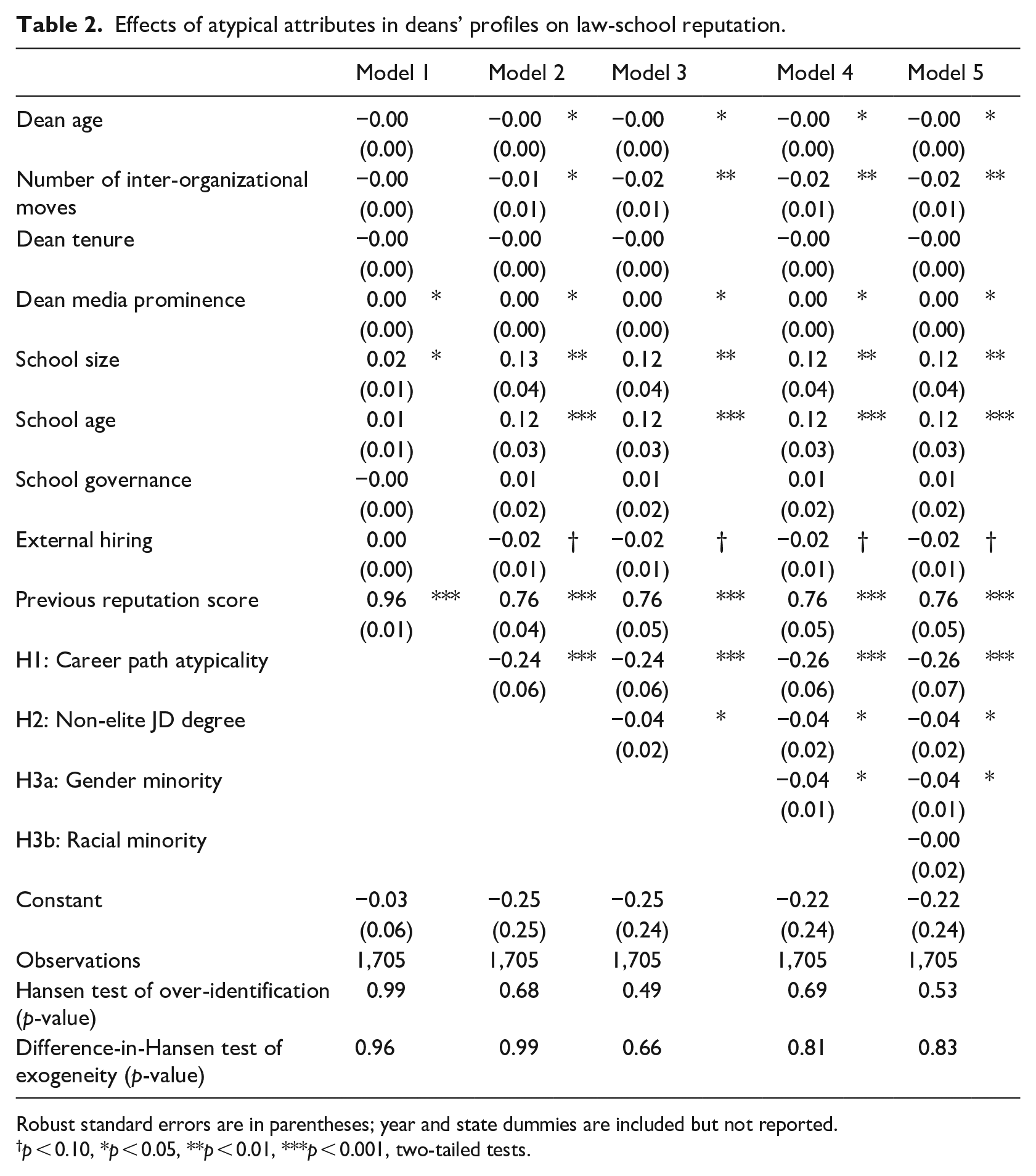
Robust standard errors are in parentheses; year and state dummies are included but not reported.
p < 0.10, *p < 0.05, **p < 0.01, ***p < 0.001, two-tailed tests.
The results in Table 2 provide strong support for Hypothesis 1, which predicted that the extent of a dean’s career path atypicality would negatively affect their organizational reputation. In both Model 2 and the full Model 5, the coefficients of a dean’s career path atypicality are negative and statistically significant (p < 0.001). Our findings indicate that a dean with a more unconventional career path, compared to peer leaders, is likely to have a negative influence on reputational judgments. According to Model 5, when a dean’s career path atypicality increased from the minimum (0.41) to the mean (0.57) and to the maximum (0.99), the dean’s school reputation score decreased, respectively, by 0.04 (−0.26 × (0.57 − 0.41) = −0.04) and 0.15 (−0.26 × (0.99 − 0.41) = −0.15). These impacts are substantial given that schools spend heavily to at least maintain their rank and that minor changes in reputation scores can cause them to move up or down several places in the rankings. For example, in our data, law schools ranked next to each other (e.g. #15 and #16 schools) are, on average, separated by only 0.025 points on a 5-point scale. The practical significance of this finding is vividly described by Sauder and Espeland (2009: 70) as follows: “Improvements elicit congratulations, celebrations, and perhaps bonuses, while a drop means long discussions at faculty meetings, power-point presentations to boards of visitors, anxious e-mails from alumni, and town meetings to reassure students.”
In Models 3 and 5, we added the variable non-elite JD degree to test the prediction of Hypothesis 2 that atypicality in a dean’s education profile would have a negative effect on their organizational reputation. The coefficient of non-elite JD degree in Model 5 is negative and significant (p = 0.013), supporting Hypothesis 2. If we consider the magnitude of the coefficient in the full Model 5, a law school’s reputation ratings, all else being equal, would decrease by 0.04 on a 5-point scale when its dean did not receive a JD degree from an elite school, compared to peers who typically attended elite educational institutions. This impact can be practically significant because a small decrease in reputation scores can cause a drop of more than one ranking level, leading to a loss in student applications and resources to the school (Sauder and Espeland, 2009).
To test Hypotheses 3a and 3b predicting that atypicality in a dean’s gender and race profile is associated with lower school reputations, we included two variables, gender minority and racial minority, in Models 4 and 5. The coefficient of gender minority in Model 5 is negatively significant (p = 0.015), providing strong support for Hypothesis 3a. This result indicates that, all else being equal, a law school’s overall reputation ratings would decrease by 0.04 on a 5-point scale when the school has a woman dean. The coefficient for racial minority is also negative but does not reach a statistical significance level (p = 0.84). Taken together, these results provide some support for our hypotheses that external observers react negatively when an organizational leader has a demographically atypical profile.
Supplementary analyses
We conducted several supplementary analyses to check the robustness of our results. First, to examine the cumulative effects of our atypical profile attributes (i.e. career, education, gender, and race) on the reputational ratings of law schools, we developed a composite measure representing the overall atypicality of a leader’s profile by considering each attribute as a component. Specifically, we first created a dummy variable for career path atypicality that equals 1 if the leader’s career path atypicality score is greater than the mean plus one standard deviation, and 0 otherwise. The composite measure was then calculated by adding together this dummy variable and three other dummy variables (i.e. non-elite JD degree, gender minority, and racial minority), resulting in a range from 0 (no atypical attributes) to 4 (all four atypical attributes). In Model 1 described in Table 3, the estimated coefficient of the profile atypicality composite is negative and highly significant (p = 0.000), indicating that leaders with multiple atypical profile attributes are likely to be perceived even more negatively by reputational evaluators due to the cumulative effects of these attributes. These results provide further support to our arguments.
Supplementary analyses.
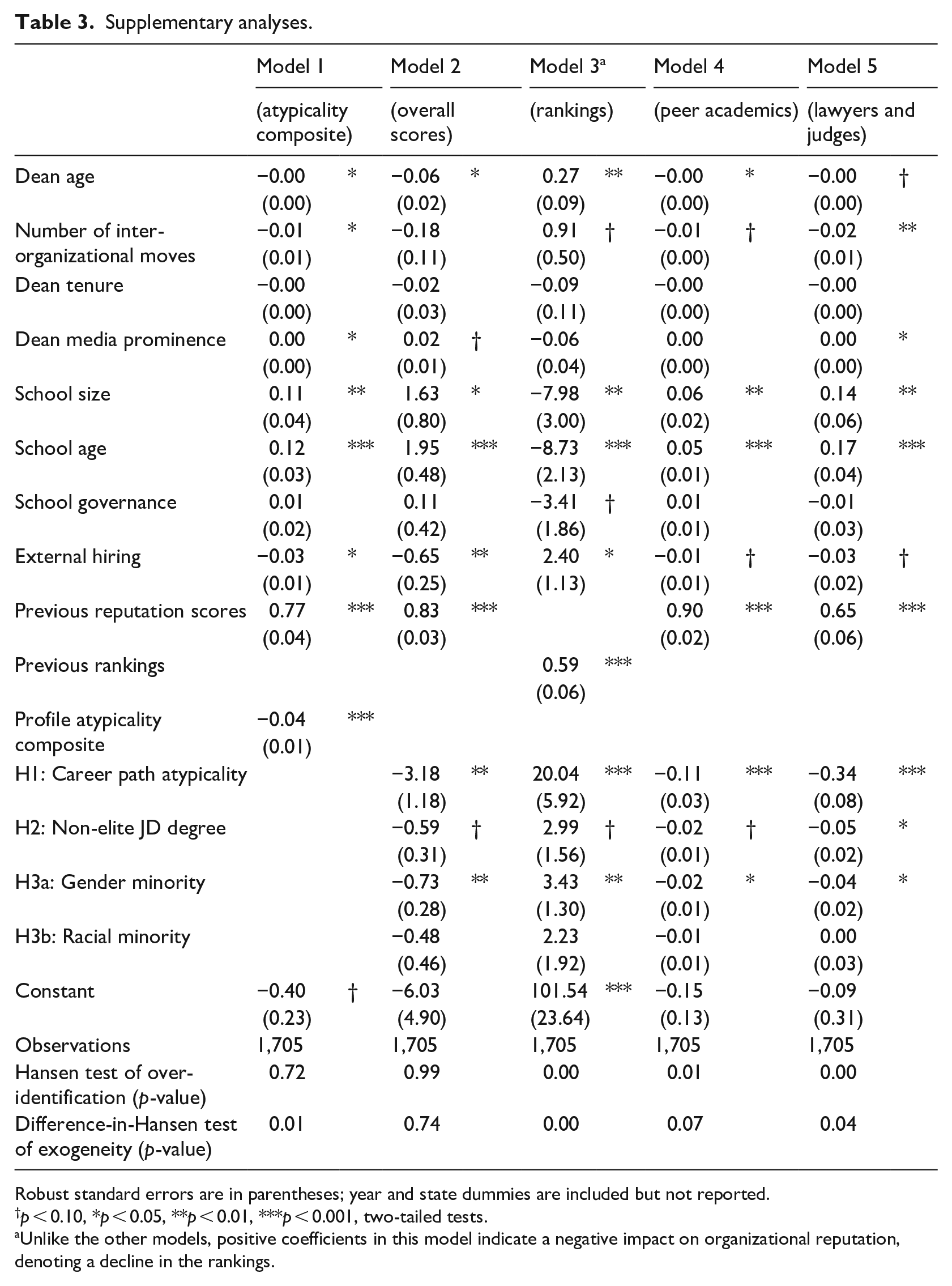
Robust standard errors are in parentheses; year and state dummies are included but not reported.
p < 0.10, *p < 0.05, **p < 0.01, ***p < 0.001, two-tailed tests.
Unlike the other models, positive coefficients in this model indicate a negative impact on organizational reputation, denoting a decline in the rankings.
Second, in addition to examining the cumulative effects, we assessed the interactive effects of our atypical profile attributes on the reputational ratings of law schools to check whether the impact of one form of atypicality (e.g. career profile atypicality) depends on another form of atypicality (e.g. education profile atypicality). We created all possible six interaction terms between the four independent variables and empirically tested each interaction variable. In analyses not reported here, we found no statistically significant interaction effects, indicating no evidence that different forms of atypicality interact to jointly influence organizational reputation.
Third, while we measured organizational reputation through stakeholders’ subjective quality assessments (a component of the USN overall scores), we also conducted robustness checks using two alternative measures of organizational reputation: USN overall scores and rankings, both of which are of great importance for law schools and their stakeholders. In Models 2 and 3 of Table 3, we found results consistent with those from our main analysis (Table 2).
Fourth, recent research suggests that different audience groups may perceive and assess the same organizational actions and events in different ways (Love and Kraatz, 2009; Zavyalova et al., 2016). To explore whether different audience groups respond similarly or differently to atypical attributes in leaders’ profiles, we used separate reputation scores from two audience groups as alternative dependent variables in Table 3: peer academics’ (Model 4) and lawyers and judges’ (Model 5) reputational ratings. Overall, our results show that both groups tend to evaluate atypical elements of deans’ profiles negatively, although the coefficients of atypical profile attributes for legal professionals in Model 5 are relatively larger (i.e. more negative) than those for peer academics in Model 4.
Finally, we assessed the extent to which a dean has a legal practice-oriented career path as an alternative measure of career path atypicality for Hypothesis 1. We measured this variable as the ratio of the number of career years in legal practice to the total number of career years. Comparing this measure with our original Hypothesis 1 measure, we found a high correlation (r = 0.81) between the two, which confirms that deans with legal practice-oriented careers are relatively atypical in the field of legal education. In analyses not reported here, we found that deans with more practice-oriented career paths, which is atypical, are negatively associated with school reputation (results are available upon request). This finding is consistent with the prediction of Hypothesis 1.
Discussion and conclusion
This study has examined the impact of atypicality in a leader’s biographical profile on organizational reputation in the context of American law schools. Drawing on institutional theory and leadership categorization theory, we proposed that atypical attributes of a leader’s profile negatively affect organizational reputation, inducing greater skepticism and scrutiny of leadership capability among external observers. The results support our arguments across a broad spectrum of deans’ key profile attributes, including their career path, educational credentials, and demographic characteristics. Overall, our findings provide evidence that external audiences compare a leader’s profile against the backdrop of prototypical profiles of peer leaders and negatively encode atypical profile attributes into their reputational assessments of the organization.
Our study makes several important contributions to the literature. First, our findings contribute to extant research on organizational reputation by drawing attention to atypicality in a leader’s profile as an important but previously unidentified source of reputation formation. Despite fast-growing research on organizational reputation, few studies have examined the influence of top leaders’ attributes on organizational reputation (Love et al., 2017). This article demonstrates that atypicality in leader profiles can be a negative signal of leadership capability to stakeholders, thus leading to reputational losses. Our findings confirm that observers’ perceptions of organizational leaders play an important role in the process of reputation formation and particularly highlight that typicality (or atypicality) in leader profiles provides stakeholders with an important lens through which to perceive capabilities of leaders as qualified (or less qualified).
In this regard, our study offers a new perspective on the impact of organizational leaders on how external stakeholders perceive and evaluate organizations. Prior research in this domain, which is often based on the romance of leadership (Meindl and Ehrlich, 1987; Meindl et al., 1985), has focused on external observers’ tendency to pay attention to positive leader credentials (e.g. media awards and attention) and overestimate the value of such positive signals on organizational outcomes (Connelly et al., 2016; Gomulya and Boeker, 2014; Love et al., 2017). For example, stakeholders’ portrayal of corporate leaders as celebrities is an outcome of such processes (Hayward et al., 2004; Lovelace et al., 2022). In contrast, our findings highlight the opposite consequences of stakeholders’ attention to organizational leaders and suggest that atypical attributes in their profiles can lead external observers to underestimate leadership capability, which in turn results in reputational losses.
Second, our findings provide implications for ongoing debates on the costs and benefits of organizational atypicality. As recent studies (Cutolo and Ferriani, 2024; Zuckerman, 2016) have pointed out, there exists the considerable ambiguity surrounding the nature and consequences of organizational atypicality. As Cutolo and Ferriani (2024: 181) noted, “Atypicality in organizational and market settings holds the potential for novelty and sociocultural change. Yet, it also invites skepticism and encourages rejection because people prefer objects, agents, and behaviors that adhere to expectations and predictable stimuli.” In an attempt to reconcile this discrepancy, recent research on optimal distinctiveness suggests that organizations with a “moderate level of atypicality” can achieve both legitimacy and differentiation through being both “like” and “different from” their peers (Gouvard et al., 2023; Zhao et al., 2017). However, we found that leaders’ atypical profile attributes consistently have a negative impact on organizational reputation. Furthermore, our findings suggest that those atypical attributes have cumulative effects on organizational reputation: each additional atypical attribute compounds the reputational loss rather than counterbalancing the negative impact. Thus, our results suggest that a moderate level of atypicality, which might produce optimal reputational outcomes, does not exist in our context. Future research should investigate when and under what conditions audiences reward or penalize atypical actors and practices, which will provide a holistic understanding of the role and impact of organizational atypicality. We suspect that, in contexts where audiences view atypicality through an innovative lens, deviations from typical expectations are less likely to generate negative stakeholder perceptions, despite potential pressures to conform. In comparison, when audiences evaluate atypicality through a normative lens, atypical organizational actions are likely seen as illegitimate and thus penalized.
Third, our study contributes to leadership categorization theory in three directions. First, our findings extend its central proposition—individuals compare their leaders’ attributes to those of leader prototypes—into collective evaluations by reputational observers. While leadership categorization theory has centered on the evaluative process in which individuals form their perceptions and ratings of a target leader (Lord, 1985; Lord and Maher, 1993), our study suggests that non-prototypical attributes in leader profiles can affect social evaluations of their organizations beyond the perceived quality of the target leader. Second, while prior work on leadership categorization theory has mainly examined gender (e.g. Lee and James, 2007) and race (e.g. Carton and Rosette, 2011; Rosette et al., 2008) as key attributes of leadership prototypes, our study reveals the presence of atypicality across broad profile attributes, such as leader career path and educational credentials, beyond demographic dimensions. Third, the study broadens the scope of evaluators in leadership categorization theory by extending into external stakeholders’ perceptions of leadership prototypes beyond internal stakeholders such as subordinates or employees, which have been the focus of prior studies in this area (e.g. Sy et al., 2010). Recent studies have begun to examine how leadership prototypes play a role in forming perceptions of external stakeholders. Petrenko et al. (2019), for example, found that financial analysts tend to issue lower earnings expectations for firms with humble CEOs because humility is not viewed as a trait of typical leaders. Our study calls for more research on how leader prototypes shape external stakeholders’ evaluations of target leaders and their organizations.
Finally, our findings suggest that reputational assessments may contribute to the persistence of typicality in the selection of organizational top leaders. Appointing a leader whose profile deviates from widely shared prototypes might be seen as a decision not only to bring in novel strategies and approaches to an organization but also to respond to increasing social pressures for leadership diversity. Despite such potential advantages, top leaders’ profiles across many fields tend to be homogeneous over time. For instance, as shown in Figure 1, most law-school deans in our research context share similar profiles in terms of their career paths, educational credentials, and gender and racial backgrounds over the last few decades, even though the law schools’ internal compositions have become more diverse. Our findings suggest that stakeholders’ negative perceptions toward and the resulting reputational costs of appointing a leader with less prototypical attributes can be a factor contributing to the persistence of typical leader profiles and discouraging organizations from deviating from established leadership prototypes. In this sense, our study offers a reputation-based explanation for why changes in typical leader profiles are much slower than one would expect.
Limitations and future research
A few limitations call for future research to validate our framework. First, it would be particularly valuable if future studies corroborate our findings by considering the historical evolution of prototypical leader profiles. While Figure 1 shows that key profile attributes of our sample deans have remained stable for almost two decades, it should be noted that our study does not account for historical changes in those attributes. Our findings suggest that, when key stakeholders cast doubt on the leadership capability of leaders with unconventional profiles through the lens of typicality, it would be difficult for individual organizations to change social expectations about what a leader’s profile looks like. However, over time, as an increasing number of atypical leader profiles are appointed to the top of organizations, those profiles would no longer receive negative reputational ratings. For example, if women deans are no longer considered atypical in this historically male-dominated field, the negative impact of gender minority leaders on organizational reputation that we found would disappear or, at least, diminish markedly.
Second, although our study shows a robust negative impact of atypicality in a leader’s biographical profile on organizational reputation, the findings of this study should be interpreted cautiously due to the specific features of our empirical context (e.g. an elite labor market or a high education sector). We expect that stakeholders tend to be skeptical and respond negatively when they attend to atypical leader profiles that are inconsistent with prevailing social expectations in their field, but their sensitivity to such atypical profiles may vary by stakeholder type, industry sector, occupation, or country. For instance, the negative reputational impact of atypicality in leaders’ profiles might be less pronounced among a certain group of stakeholders or in certain organizational fields that are more open to innovation and experimentation. Thus, cross-validations across different organizational contexts are needed to confirm the generalizability of our findings.
Finally, although we believe that our study has examined the four comprehensive and critical attributes of an organizational leader’s profile, there could be other noticeable profile attributes, such as social class, religion, region of origin, and sexual orientation. Future studies can extend our framework and findings by examining how audiences perceive atypicality in those attributes and factor them into social evaluations of organizations.
Conclusion
Reputation is a valuable asset for the success of an organization. This study shows that (a)typicality in a leader’s biographical profile is an important factor in the evaluation of organizational reputation. Our findings collectively draw three interrelated conclusions. First, stakeholders’ perceptions of typicality in a leader’s profile play a role in the process of reputation formation. Second, organizational leaders with atypical profiles are likely to receive a greater degree of scrutiny and skepticism from stakeholders concerning their qualifications. Third, appointing unconventional leaders is likely to come at the price of damaging organizational reputation. These findings advance our understanding of the significance of (a)typicality in a leader’s profile on social evaluations of organizations and suggest the need for more research on the role of (a)typicality in how external observers view organizations.
Footnotes
Appendix 1
Appendix 2
Top 50 law schools (in alphabetical order).
| Arizona State University (O’Connor) | University of California, Los Angeles |
| Boston College | University of Chicago |
| Boston University | University of Colorado-Boulder |
| Brigham Young University (Clark) | University of Florida (Levin) |
| Columbia University | University of Georgia |
| Cornell University | University of Illinois Urbana-Champaign |
| Duke University | University of Iowa |
| Emory University | University of Maryland (Carey) |
| Fordham University | University of Michigan-Ann Arbor |
| George Mason University | University of Minnesota, Twin Cities |
| George Washington University | University of North Carolina at Chapel Hill |
| Georgetown University | University of Notre Dame |
| Harvard University | University of Pennsylvania (Carey) |
| Indiana University Bloomington (Maurer) | University of Southern California (Gould) |
| New York University | University of Texas at Austin |
| Northwestern University (Pritzker) | University of Utah (Quinney) |
| Ohio State University (Moritz) | University of Virginia |
| Stanford University | University of Washington |
| Tulane University | University of Wisconsin-Madison |
| University of Alabama | Vanderbilt University |
| University of Arizona (Rogers) | Wake Forest University |
| University of California (Hastings) | Washington and Lee University |
| University of California, Berkeley | Washington University in St. Louis |
| University of California, Davis | William and Mary Law School |
| University of California, Irvine | Yale University |
Acknowledgements
The authors are grateful for helpful comments on earlier drafts from Arnaud Cudennec, Bo Kyung Kim, M. K. Chin, Michael Bednar, Najung Kim, Wonbin Sohn, and participants at the 2022 Academy of Management annual meeting.
Funding
The author(s) received no financial support for the research, authorship, and/or publication of this article.
