




Abstract
We study the effects of entrepreneurial theorization on the spread of a new collective identity within a mature organizational field. Mature fields are characterized by dominant logics, entrenched practices, and stable patterns of interaction, resulting in isomorphism and inertia. Yet, mature fields do change, often as a result of entrepreneurial activity. Whereas prior work has focused on the creation of “oppositional” niches within mature fields, we focus on an identity movement that transformed the core of a field. We do this within the context of the Canadian wine field, a field that remained stable from the end of Prohibition through the 1970s. For decades, large incumbents projected a European identity for their wines and gave these wines “faux” European names. In contrast, pioneering entrepreneurs projected a distinctly Canadian identity for their wines, an identity that was ultimately adopted by incumbents. In this way, domestic wine in Canada became tied to place rather than divorced from it. We show how entrepreneurial theorization of the “Canadian wine” identity by small producers and identity pioneers led to the spread of this identity to center of the field, and how the effects of theorization depended on the authenticity of these theorizers. We also suggest that an identity movement that engages incumbents rather than seeks to create an oppositional category is more likely to reach the center of a mature field.
Keywords
In the beginning, it was hard for them to change people’s opinions about Ontario wines. I don’t know too many people who wanted to drink them . . . Karl [Kaiser] and Donald [Ziraldo] were industry leaders in trying to change all that. Now all the wine making giants are modelling themselves after them.
Mature organizational fields are resistant to change. Dominated by large incumbents, mature fields are characterized by taken for granted logics, entrenched practices, and isomorphic behavior (DiMaggio and Powell, 1983; Reay et al., 2006; Zietsma et al., 2017). Incumbents benefit from status and scale, wedding these organizations to the status quo (Greenwood et al., 2015; Greenwood and Suddaby, 2006; Gurses and Ozcan, 2015). As a result, less powerful actors with different interests and identities are often shut out or relegated to the margins of mature fields. As Kennedy (2008) put it, “life outside the mainstream is harsh (p. 270),” and peripheral players are often overlooked and face an uphill struggle if they seek to introduce change.
Mature fields thus present an interesting paradox: they are characterized by strong inertial forces, yet they do change (Dacin et al., 2002; Greenwood et al., 2002). Studies of change in mature fields have taught us much, while at the same time suggesting some fruitful areas for further inquiry. A strong current in prior work is that field change is often associated with the emergence of new collective identities—claims of “who we are” and “what we do” for an insurgent group of organizations (Lamertz et al., 2016; Navis and Glynn, 2011: 480). New collective identities arise from identity movements, or “a collective attempt to institutionalize a novel identity” (Glynn and Innis, 2020: 121; Rao et al., 2003). These new collective identities are frequently framed in opposition to the dominant identity within a field, and once established come to occupy peripheral niches within mature fields. For example, Carroll and Swaminathan (2000) explained how microbreweries used identity-based strategies that resembled a social movement to establish a specialist niche within the mature beer industry. This identity was elaborated in opposition to what craft producers derided as “generic” mass-produced beer (Carroll and Swaminathan, 2000; Verhaal et al., 2015). Similarly, “green” energy producers arose in opposition to existing “brown” energy producers (Sine and David, 2003; Sine et al., 2005), and grass-fed meat appealed to those opposed to the “exploitative” practices of industrially-produced meat (Weber et al., 2008). In all three examples, the new categories occupied niches while the dominant incumbent identities remained in place.
The establishment of an “oppositional” niche in a mature field such as in the examples above is consistent with resource-partitioning theory, which posits that large incumbents leave niches on the periphery available for exploitation by smaller players (Carroll, 1985; Carroll and Swaminathan, 2000). Yet, the creation of a niche in a mature field is only one possible form of field change. Rather than niche creation, it is also possible for change originating on the periphery of mature fields to reach the center of these fields, or in other words transform the core of the field itself (Leblebici et al., 1991). Such “transformational” change of mature fields has received less attention within institutional theory and is the kind of change that we explore in this article.
Prior theory and research also emphasize the role of persuasive discourse as a key driver of field change. This literature builds on the notion of theorization, or persuasive discourse that renders “ideas into compelling formats” (Greenwood et al., 2015: 8; Strang and Meyer, 1993). Case-study evidence suggests that large, powerful incumbents are effective theorizers of transformational change in mature fields (i.e. change that goes beyond the establishment of a peripheral niche). For example, Greenwood et al. (2002) showed how the “Big Five” accounting firms theorized change in the mature Canadian accounting field, while Rao et al. (2003) described how elite chefs theorized the emergence of Nouvelle Cuisine in France. This emphasis on powerful actors as drivers of change in mature fields contrasts with work on more emergent fields suggesting the potential for less powerful actors to theorize change, as was the case in the radio broadcasting industry (Leblebici et al., 1991) and the early management consulting industry (David et al., 2013). In sum, we have evidence that powerful actors can change mature fields through their theorization activity, and that less powerful actors can similarly shape more emerging fields. This leads us to ask, which actor groups are best placed to theorize transformative change in mature fields? Can less powerful actors be effective theorizers of change in mature fields?
We study the effects of theorization on the spread of a new collective identity within the Canadian wine field. Specifically, we examine the spread of the “Canadian wine” identity within this field. 1 Wine with a Canadian identity first emerged in the 1970s on the periphery of the field and was met with considerable skepticism, if not outright derision, as evidenced by our opening quote. Until the mid-1970s, wine made in Canada (usually by blending low-quality native grapes with imported juice) did not claim a Canadian identity. Rather, the market was dominated by a small number of large incumbents, who for the most part sought to project a European identity for their wines, notably with their naming and labeling practices. The field was mature in the sense of being characterized by large incumbents, widely shared assumptions and beliefs, and high levels of practice standardization. Interestingly, “Canadian wine” did not remain a niche category, as small and large wineries began to experiment with it and theorize its benefits shortly after it was first introduced. Ultimately, “Canadian wine” moved from the margins to the mainstream of the field: at the start of our study period in 1985, fewer than 20% of wines displayed a Canadian identity while by 2005 over 60% of wines did, with even large wineries devoting significant proportions of their portfolio (about 30%) to “Canadian” wines. In other words, rather than remain a niche category such as craft beer or grass-fed beef, “Canadian wine” became the dominant identity in the field. In this way, wine produced in Canada went from a category divorced from place to an “emplaced” category (Croidieu et al., 2016; David et al., 2023). We argue that this change was driven by the theorization of wine producers, both large and small. We argue further, however, that small producers and the pioneers of the new identity were particularly effective theorizers of this transformative change.
Beyond increasing our understanding of this important context, our research seeks to make distinctive contributions to theory. First, we contribute to the study of change in mature fields by showing how an identity movement that does not emphasize oppositional positioning can transform a field. Rather than carving a niche that would stand in opposition to dominant incumbents, the identity movement we study sought to transform the field and ultimately became dominant. Second, we show that who theorizes matters, and in particular suggest conditions under which theorization by small, peripheral entrepreneurs can have a stronger effect in mature fields than that of larger, more powerful players. In other words, whereas much prior work has examined qualitatively “how theorization is accomplished” (Greenwood et al., 2015: 9; emphasis in original), we disaggregate theorization by groups of actors and provide an analysis of the relative effects of theorization by actor group (Perretti et al., 2008; Voronov et al., 2013b). Together, these insights help advance our understanding of the role of cultural entrepreneurship in field change, specifically how cultural entrepreneurship in the form of persuasive discourse can lead not only to positive organizational-level outcomes (e.g. Lounsbury and Glynn, 2001; Martens et al., 2007) but also to field transformation (Lounsbury and Glynn, 2019; Soublière and Lockwood, 2022).
Theoretical background
Foundational work in institutional theory depicts mature fields as an “iron cage” whereby conformity pressures lead to ever greater organizational isomorphism (DiMaggio and Powell, 1983; Tolbert and Zucker, 1983). Yet, mature fields do change (Dacin et al., 2002; Greenwood et al., 2002; Reay et al., 2006; Zietsma and Lawrence, 2010). Scholars have pointed to exogenous jolts (e.g. Sine and David, 2003) and technological innovation (e.g. Tripsas, 1997) as drivers of change in mature fields. In contrast, the cultural entrepreneurship literature emphasizes social skill, particularly the use of persuasive discourse, in driving field change (Fligstein, 2001; Fligstein and McAdam, 2012; Gehman and Soublière, 2017; Kahl and Grodal, 2016; Lounsbury and Glynn, 2019). While this literature has mostly focused on the outcomes of persuasive discourse at the organizational level, cultural entrepreneurship scholars have recently called for more work that examines the effects of entrepreneurial discourse at the field level (Lockwood and Soublière, 2022; Lounsbury et al., 2019b; Wry et al., 2011).
Persuasive discourse often takes the form of theorization, or “the self-conscious development and specification of abstract categories and the formulation of patterned relationships such as chains of cause and effect” (Strang and Meyer, 1993: 492). As Greenwood et al. (2002) explained, theorization involves “the rendering of ideas into understandable and compelling formats (p. 75).” It can promote diffusion of novelty by “motivat[ing] new arrangements as effective and replicable” (David et al., 2013: 359) and in this way suggest “that similar practices can be adopted by all members of a theoretically defined population, with similar effects” (Strang and Meyer, 1993: 496). Theorization frequently invokes success stories, to provide “evidence” that the change is successful in at least some cases (Tolbert and Zucker, 1996: 183). Notably, theorization can have both pragmatic and more normative elements. As Greenwood et al. (2002) explain, theorization can incite diffusion “either by nesting and aligning new ideas within prevailing normative prescriptions, thus giving them ‘moral’ legitimacy (Suchman, 1995: see also Tolbert and Zucker, 1996: 183), and/or by asserting their functional superiority, or ‘pragmatic’ legitimacy (Suchman, 1995) (p. 60).”
Theorization has been shown to lead to diffusion, or the spread of novelty within a field. For example, the theorization of change undertaken by the professional association in the Alberta accounting field invoked professional values to justify a new kind of multidivisional firm (Greenwood et al., 2002). Similarly, commercial whale watching was legitimated, in part, by entrepreneurs’ theorization of it as consistent with the animal rights movement (Lawrence and Phillips, 2004). New entrants to the grass-fed beef category could justify their decision to enter by accessing a “repertoire of moral justifications” articulated by early pioneers (Weber et al., 2008: 541). Early management consulting firms were theorized as consistent with the values of efficiency and rationality—values central to the Progressive Movement at that time—leading to the legitimation of this new form of external managerial advice (David et al., 2013). In short, prior research tells us that theorization can drive the legitimation of new organizational forms and practices within fields.
Organizational scholars see theorization as part of larger identity movements that go beyond new products, services, or practices. While the idea that “entrepreneurial stories” can build “entrepreneurial identity” (Lounsbury and Glynn, 2001: 547) was developed at the organizational level in the context of acquiring resources for new ventures (e.g. Martens et al., 2007), it can be extended to collective identity: “As with stories at the organizational level, collective identity stories offer ready-made constructions of credibility, appropriateness, and viability and serve as touchstones for audience assessments of legitimacy” (Wry et al., 2011: 450). Identity movements are thus collective attempts to institutionalize a novel identity (Glynn and Innis, 2020: 121) and are “expressed through cultural materials such as names, narratives, symbols and rituals” (Rao et al., 2003: 796). Identity claims must be visibly projected (Carroll and Wheaton, 2009: 273), such that “the use of narratives by members of a group serves to create and reinforce collective identity” (Wertsch, 2012: 129). As Verhaal et al. (2015) observed, the expansion of a new organizational category in a mature field requires the projection of a collective identity that allows audiences to “make sense of social entities independent of their objective features (p. 1467; emphasis added).” Seen in this light, theorization of a collective identity can be conceived of as “verbal or written expressions employed by a group of entrepreneurial actors to help project an image of themselves, collectively, as a coherent category with a meaningful label and identity” (Wry et al., 2011: 450). Consistent with our discussion above, we expect theorization of new collective identities to include both pragmatic and more normative, or emotional elements.
Empirical examples of entrepreneurial theorization aimed at legitimating a collective identity include craft beer (e.g. Carroll and Swaminathan, 2000), grass-fed meat (Weber et al., 2008), and garagiste wine (Croidieu and Monin, 2010; Wry et al., 2011: 452). In each case, entrepreneurs framed the new collective identity as oppositional to the dominant field identity at the time and sought to establish a niche outside the center of the field. While this work supports cultural entrepreneurship’s contention that entrepreneurial discourse can claim a distinct identity (Gehman and Soublière, 2017: 64), it leaves open for further study the elaboration of identities that seek to transform fields rather than stand in opposition to a dominant identity.
Moreover, prior work on the elaboration of new collective identities has focused on the content of entrepreneurial discourse (i.e. how do entrepreneurs theorize) rather than on its outcomes:
much of the work on discourse has been one-sided in its approach, focusing on either the strategic communication skills of entrepreneurs, and assuming a corresponding effect (e.g., Clarke, 2011; Garud et al., 2014), or on the broadly shared cultural norms that evaluators, such as investors or other stakeholders, rely on to assess entrepreneurial and innovative activities. (Lounsbury et al., 2019a: 7; emphasis added)
In other words, we know little about how to measure the effects of theorization on outcomes, notably on the spread of a collective identity within a field. Relatedly, we know little about the relative effects of theorization by various kinds of actors. While inductive research (e.g. David et al., 2013; Leblebici et al., 1991) suggests that smaller, less powerful actors can theorize successfully in emerging fields, Greenwood et al. (2002) suggest that change in mature fields is driven by central or powerful actors. Addressing who can effectively theorize in a mature field entails comparing the effects of theorization by different actor groups. Put another way, whereas Strang and Meyer’s (1993) notion of “culturally legitimated theorists (p. 494)” suggests that certain actors (e.g. scientists, intellectuals, professionals) are best placed to theorize change in mature fields, we know less about the relative theorization potential of less powerful actors in mature fields.
Hypothesis development
The prior work reviewed above suggests that theorization can advance change within a field. How might this occur? Inductive work focusing on the content of theorization suggests a number of possible mechanisms. Theorization can put forward pragmatic arguments that “simplify and distill” changes and explain the outcomes they produce (Greenwood et al., 2002: 60). Theorization can also emphasize replicable cause-and-effect relationships, and in this way suggest that joining the change movement is not foolish (Weber et al., 2008). Theorization can also invoke emotional elements (Suddaby and Greenwood, 2005; Weber et al., 2008). For instance, theorization can appeal to a set of values present in the field. It can also motivate diffusion by suggesting a collective struggle or the overcoming of adversity, particularly in the context of a fledgling group fighting for change. A discourse of “proving the naysayers wrong” can engender a sense of common cause toward a shared goal. This can be particularly powerful if linked to a shared identity at a higher level, such as regional or national pride (David et al., 2023). Joining a common cause or struggle, one that appeals to a set of values, can be a powerful motivator, over and above more pragmatic considerations.
While not excluding the ability of other actor groups (e.g. industry associations, professional critics) to theorize change, we argue that producers are well placed to influence other producers to change—in this case, to adopt what Weber et al. (2008) called a “collective producer identity (p. 547).” As Carroll and Wheaton (2009) emphasized, claimed identities must be credible, and producers are well placed to provide evidence of credibility, particularly with respect to pragmatic or technical elements. Producers’ theorization can persuade other producers to adopt a new identity by emphasizing the momentum for change and triggering a “fear of missing out.” Importantly, the theorization of producers can operate directly on other producers, or indirectly via other field actors such as consumers or retailers. Targets of this theorization may be incumbent producers or new entrants—incumbents may fully or partially adopt the new identity (and fully or partially dissociate from the old identity), and new entrants may opt for the new rather than incumbent identity upon entry. If consumers are persuaded by the theorization of producers, on either a technical or emotional level, they may transmit similar messages to other producers. 2
In sum, theorization can suggest the pragmatic feasibility of change, as well as appeal to values and a common cause. We draw on prior work to argue that theorization can operate through these technical and emotional levers to lead to the spread of a new collective identity within a mature field. We argue that producers themselves would have a high level of influence on potential adopting producers, given mutual respect among peers (e.g. Weber et al., 2008). We begin with a baseline hypothesis that does not distinguish between various groups of producers, since both small and large producers have been shown to be effective theorizers in various contexts. In other words, we formalize what has been suggested by prior inductive work by arguing that theorization by all producers taken together will lead other producers (incumbent or new) to adopt a new collective identity:
Hypothesis 1 (H1). Producer theorization of a new collective identity within a mature organizational field will lead other producers to adopt the new identity.
Given this baseline hypothesis that all theorization will have a positive effect, might some producers be better placed to theorize than others? Prior research suggests that both large and small producers can theorize change successfully. In the Canadian accounting field, it was the Big Five accounting firms that were central to theorizing change (Greenwood et al., 2002). Similarly, it was elite chefs with positions in the professional society of French chefs who championed the nouvelle cuisine category (Rao et al., 2003). Modern architecture was also promoted by prominent professionals already established in their field (Jones et al., 2012). Indeed, large players are well placed to invoke their accumulated experience, resources, and success to theorize change in the manner outlined for Hypothesis 1. Other research, however, suggests that novelty may be fruitfully theorized by small players. In their pioneering paper, Leblebici et al. (1991) described how many of the historical innovations in radio broadcasting took place at small, independent stations on the periphery of the industry. In the beer industry, small, specialized craft brewers claimed an identity in ideological opposition to large incumbents (Carroll and Swaminathan, 2000; Verhaal et al., 2015). Similarly, a coalition of activists including small farmers organized collective action among producers and consumers and thereby created a new category of grass-fed products on the periphery of the highly institutionalized system of industrial agriculture and food production (Weber et al., 2008: 558).
Looking across these contexts, we see that large players were effective theorizers in contexts that were highly professionalized and were governed by regulatory and/or professional bodies. In contrast, the contexts of early radio, beer brewing, and meat farming lacked professional infrastructure. In weakly professionalized fields, unencumbered by regulation or professional norms, it may be easier for small producers to foster new identities. Rather than leveraging professional infrastructure, small producers in such fields may benefit from authenticity. Specifically, small producers—particularly “artisan entrepreneurs” (Solomon and Mathias, 2020)—may benefit from craft authenticity stemming from “postmaterialist” attitudes against mass society, its production techniques and its corporate organizations (Carroll and Swaminathan, 2000: 729; Carroll and Wheaton, 2009; Schifeling and Demetry, 2021). Indeed, “there is a certain mystique in smallness” (Melcher, 1995: 70, in Carroll and Swaminathan, 2000: 729). Empirically, Carroll and Swaminathan (2000) observed that small producers benefit from assumptions, whether true or not, that they “refuse to cut corners in their quest for quality, care about their customers and communities, employ traditional methods and ingredients (p. 730).” Craft authenticity may be particularly salient for cultural products, such as beer or wine, which are often valued for their meaning over and above their technical characteristics (Carroll and Wheaton, 2009; Lawrence and Phillips, 2002: 431).
Building on these insights, we argue that the craft authenticity associated with small producers will make them relatively more effective theorizers of new collective identities within mature but weakly professionalized fields. While we know that consumers value products from producers they deem to be authentic, we argue that authenticity should also enhance the effects of producer-to-producer influence. If, as above, theorization by producers can create a desire to join a common cause or movement, we argue that the craft authenticity of small producers gives their theorization of a new collective identity more appeal than that of large producers. Indeed, authenticity can lead to a “psychological connection” that is unrelated to the organization’s quality or effectiveness (Radoynovska and King, 2019: 794). Authenticity can form the basis of an “internal community” (Weber et al., 2008: 530) and “cohesion among producers” (Weber et al., 2008: 549), both of which can lead to a greater impact for theorization statements. Finally, small producers may be seen as more trustworthy, driven more by passion for the product than by a profit motive.
In sum, if theorization related to an identity movement is a call to join the movement, then the authenticity of the theorizer should increase the impact of these calls. Given our context of a mature but weakly professionalized field, we argue that theorization by small producers will have a larger effect than that of large producers.
Hypothesis 2 (H2). In a mature but weakly professionalized field, theorization of a new collective identity by small producers will have a greater effect than that of large producers on the expansion of the identity.
We argue further that the strongest advocates for novelty are often those who pioneered it. Whereas our argument for small producers is based on their perceived craft authenticity, we argue here that the pioneers of a new collective identity benefit from type authenticity. Type authenticity “involves whether an entity is true to its associated type (or category or genre)” (Carroll and Wheaton, 2009: 255). Pioneers of a movement come to represent “a pure ideology, which supplies the cultural resources that even more pragmatic coalition members [draw] upon” (Weber et al., 2008: 542). Indeed, “although an aura of authenticity may be acquired in various ways, first movers appear to have a distinctive advantage insofar as ‘originality’ conveys authenticity” (Ha and Zuckerman, 2018: n.p.). Pioneers become a “cognitive referent” (Grodal and Kahl, 2017: 175) and can even take on iconic status within their fields, such as Fritz Maytag for craft beer (Carroll and Swaminathan, 2000), J.I. Rodale for organic food (Lee, 2009), and James McKinsey for management consulting (David et al., 2013). Even if these pioneers do not become financially successful (e.g. Rodale, McKinsey), they are often seen as embodying the essence or “soul” of the new identity. This “iconicity” implies recognition not only in space but also in time, in the form of lasting recognition (Verhaal and Dobrev, 2022: 257). Put simply, if Alfred Peet in the coffee industry (Rindova and Fombrun, 2001), Ferran Adria in the restaurant field (Carroll and Wheaton, 2009), or James McKinsey in the consulting field (David et al., 2013) were to speak, other field members would likely pay close attention.
In sum, pioneers represent the new identity “in a more coherent and pure form” (Weber et al., 2008: 542) and become “revered for being synonymous with the values of the movement” (Verhaal and Dobrev, 2022: 276). We posit that their effectiveness as theorizers does not hinge on the craft authenticity derived from small size (Hypothesis 2) but rather on type authenticity derived from their “iconic” stature in the field. In other words, small wineries are strong theorizers in this field precisely because they are small, whereas pioneers are effective theorizers because of who they are (i.e. regardless of their size). We thus predict that their theorization statements will have a strong effect on identity expansion. Even if they grow larger in size, pioneers retain their iconic status and as such would not be mistaken for late-coming opportunists.
Hypothesis 3 (H3). In a mature organizational field, theorization of a new collective identity by its pioneers will lead other producers to adopt the new identity.
Methods
Research context
The context for this research is the Canadian wine industry, which dates to the late 1800s. Until the 1970s, wineries used indigenous grapes (e.g. Labrusca), but because these types of grapes made poor quality wine, many winemakers at the time added sugar, water, and coloring agents to the wine (Ierfino-Blachford, 2020; Massa et al., 2017; Wang et al., 2020). Because wine made from indigenous grapes was exempt from the restrictions of Prohibition, wine sales increased 100-fold from 1916 to 1927 (Schreiner, 2006: 9). Aspler (1999) noted that at that time, there were no “quality controls, no government interference, and in many cases, little of the basic knowledge of the craft (p. 15).” When Prohibition ended in 1927, Canadians returned to drinking beer and spirits, leading to the consolidation of existing wineries. These wineries dominated the market for decades to come, and continued the practices they had adopted to make indigenous grapes somewhat palatable.
From the 1960s to mid-1970s, driven by the rise in European immigrants, consumers began to increasingly show a preference for imported wine (Schreiner, 2006). Making European-style wines from domestic grapes, however, was a challenge for Canadian wineries. The failure of trial plantings of high quality, Vitis vinifera grapes at government run vineyards such as the Horticultural Research Station (founded 1905) led the Ontario government to ultimately discourage the planting of vinifera (Aspler, 2006: 134; Ierfino-Blachford, 2020). Large Canadian wineries began instead to produce blended wines using imported European vinifera juice and native grapes (Schreiner, 2006). During this time, regulatory decisions supported these “blended wine” practices. For instance, the Ontario government allowed wineries to increase the overall volume of imported juice in their blended wines from 15% to 30%. This reflected the general belief that major Canadian grape growing regions did not have the potential to produce high quality wines (Mielzynski-Zychlinski, 2001: 15). Provinces also rewarded the large firms by listing all of their products in government stores in return for jobs created by the building of bottling/blending facilities. By the 1970s, the large companies controlled the market and imposed their “production values”—i.e. making blended wines (Aspler, 1999: 24).
To appeal to consumers, wineries at that time named their wines in ways that connoted the image and style of European wines (Schreiner, 2006). For example, “Schloss Laderheim” was produced by Calona Vineyards of British Columbia to compete against popular German imported wines (Aspler, 1999). Dozens of other pseudo-European names appeared, including “Alpenweiss,” “Sommet Blanc,” “Toscano,” “Schloss Wienberg,” “Capistro,” “La Rienha,” among others, none of which connoted their Canadian origins (Schreiner, 2006: 10). As one of our interviewees put it:
It was all knock offs. Essentially, what was hot. Black Tower and Blue Nun were popular. So, let’s create a German sounding one. You know all the French wines were popular, Entres-Lacs. So, there were never wines that were bona fide about our terroir, about growing grapes. They were knock offs. And, that’s what this industry was, a knockoff industry. It was very successful at it you know. And, there was probably never more money made in the industry than at that time. I mean it was incredibly successful. (interview with founder of a pioneering winery)
Even through the 1990s, some mass producers of wine still believed that wines with a Canadian identity would not sell. The president of Peller Estates (formerly Andrés) expressed the dominant assumption at that time: “We want people to think that this is a French style wine . . . If you put it in a bottle that says Niagara Dry, people wouldn’t try it” (quoted in Thompson, 1990).
In sum, the Canadian wine field in the 1970s was mature and stable (Wang et al., 2014), with few entrants from the end of Prohibition (1927) to the 1970s (Aspler, 1999). The industry was consolidated, with a small number of large players, and profitable (as referenced in the quote above). Wineries pursued a strategy of growing (or buying) indigenous grapes (e.g. Labrusca), mixing it with imported juice, and using European-sounding names for their wines. 3
Beginning in the 1970s and 1980s, pioneering wineries emerged in a phenomenon similar to other “New World” wine regions (Croidieu et al., 2016: 2338). In Ontario, the first licenses granted for winemaking after Prohibition went to two boutique wineries, one of which was Inniskillin in 1974. Inniskillin’s cofounders, Donald Ziraldo and Karl Kaiser, insisted on a Canadian identity for their wines, and contrary to received wisdom, used 100% locally grown grapes (Aspler, 1999; Ierfino-Blachford, 2020). With the advent of free trade with the United States in the late 1980s, large wineries pushed to import more bulk wines for blending purposes. Small wineries, meanwhile, initiated the Vintners Quality Alliance (VQA), an appellation system first proposed by Ziraldo in the mid-1980s. 4 Initiated as a voluntary standard in 1989, only 5% of Ontario wines were estimated to meet the standards initially (Bannon, 1988c).
By the late 1980s, small wineries began to express confidence in the ability of wines with a Canadian identity to thrive. At a press conference for Vancouver wine writers, Harry McWatters of Sumac Ridge Estate Winery in British Columbia claimed that a bumper crop in 1987 was “our answer to the naggers who say one cannot make good wines in the Okanagan” (quoted in Hoeter, 1988). Len Pennachetti of Cave Springs Estate Winery, an early founder of the VQA, stated, “We’ve made a decision to invest a lot of money and we’re confident it will work out” (quoted in Lawrason, 1987).
Given this confidence, and in contrast with craft beer as a niche within the beer industry (Carroll and Swaminathan, 2000; Verhaal et al., 2015), pioneering wine makers in the Canadian wine industry sought to transform the core of the industry rather than establish a niche on the periphery. To do this, they would have to convince large wineries to adopt a Canadian identity for their wines. As a noted wine writer and one of our interviewees observed:
The cottage enterprises were dedicated to producing labour-intensive wines of quality from vinifera and hybrid grapes and would nudge the big wineries in both grape-growing provinces to follow their lead (Aspler, 1999: 22; emphasis added). But wisely, of course, never did [the VQA pioneering executives] do anything in a negative way against those wines that weren’t entirely produced in Ontario, from Ontario grapes—and divided, essentially condoned and lived with on literally a limited kind of basis, with the larger producers that were running the import content. (interview with pioneering wine maker)
Given the maturity of the industry and the profits large incumbents reaped from their “European” sounding wines, large wineries were initially resistant to this change:
Many of the larger Ontario wineries used European generic names on their labels, leading buyers to believe that they were drinking a wine of high quality from European grape varieties. Naturally, these wineries resisted any changes to improve the quality of their wines as they would need to invest large sums in the winemaking operations and in the vineyards, replanting with vinifera varieties. (Mielzynski-Zychlinski, 2001: 84–85)
In fact, pioneers faced ridicule for their commitment to Canadian wine:
The big guys are laughing saying “These guys think they can make premium wine in Canada and hey if they can make it good for them, but nobody is going to buy it because Canadians won’t pay that kind of money. So it was ‘No, no, no’.” (interview with representative of pioneering winery)
Interestingly, and again in contrast to the case of craft beer, pioneering wine makers sought to work with rather than against large incumbents to transform the core of the industry. As one pioneering winery emphasized: “I’m not after the other Canadian wineries. I’m after the European wineries” (Paul Bosc, quoted in Orland, 1983). In particular, pioneering wineries engaged with large incumbents through the Wine Council of Ontario (WCO), the industry association at that time. A pioneering wine maker told us in an interview, referring to the WCO: “we had to work through a common organization to make this thing happen.” The founder of a pioneering winery
explained in an interview:
But I always went to the industry. I don’t believe in this starting my own industry to make a point . . . I just don’t condone this kind of infighting in our industry. It’s too small. It’s too small. It’s a waste of everybody’s energy. So, I always went to the industry. I went to the Wine Council and I went to the Canadian Vintners [Association] . . . You can be different but bring it to the table and we will work it out. It’s a democracy and hopefully the best idea will win in the end. (interview with Donald Ziraldo, used with permission)
In what follows, we investigate quantitatively whether theorization influenced the expansion of a Canadian wine identity within the field, and in particular which actor group’s theorization had the strongest effect.
Data and variables
Data sources
Our quantitative analysis spans from 1985 to 2005. Our main data source for wine names and winery variables is an annual directory published by Wines & Vines. Two books, The Wine Atlas of Canada (Aspler, 2006) and Wines of Canada (Schreiner, 2006), were used to gather information on founding dates (these sources unfortunately do not include wine names). The Canadian Newsstream database is our primary source for data on theorization. Online databases begin their coverage of most Canadian news sources in 1985. We end our study in 2005, when the Canadian Wine identity was firmly entrenched in the field. We were able to obtain data on wine names for 145 Canadian wineries from Wines & Vines. Missing values for some independent variables and the lagging of variables in our analysis reduce the number of wineries to 139 or 144 in our main estimations, depending on models used for analysis.
Dependent variable
We use wine names to track the expansion of a Canadian identity among wineries in the Canadian wine field. Consistent with prior research (Glynn and Abzug, 2002; Khessina et al., 2022; Smith and Chae, 2016; Verhaal et al., 2015; Zhao et al., 2013), we see names as encoding central features of identity. Names categorize objects into identifiable groups, serve as visible artifacts that express a set of assumptions and allow comparisons (Glynn and Abzug, 2002: 267; Ravasi and Schultz, 2006). As such, the labels that organizations use for their products and activities are important “expressions of identity” that can be used for “maintaining categorical distinctions” (Negro et al., 2011: 1450).
Labels are particularly important in the wine industry, and wineries claiming a Canadian identity were intentional in their choice of a name that signaled this identity. As one pioneer put it: “the label had to suggest the place where the grapes were grown, the name had to be connected to a terroir” (Len Pennachetti, as quoted in Wordsworth, 1992). As such, the winery “wanted authenticity, not sham European names . . . We wanted to fly our Niagara colours and to convey as much as possible that we were growers” (Len Pennachetti, as quoted in Williams, 1991). This explicit choice of communicating the wine’s origin with its name was also evident in our interviews: “So, instead of trying to sound like a big company from somewhere else in the world, we’re now trying to sound like it’s something from down in the wine region” (interview with pioneering winemaker). In other words, Canadian wine names were intentionally chosen to suggest that the wines reflected a “taste of place” (Boghossian and David, 2021; Trubek, 2008), and in this way imparted cultural significance to the category.
Figure 1 provides an example of the contrast between a “faux” European-style wine name and a Canadian one. The former refers to a wine made in Canada (Westbank, BC) that bears the name of a fictitious German-sounding chateaux (there is a “Schloss Weinberg” in Austria, but it does not resemble the one on the label), whereas the latter bears the name of a place in Nova Scotia (Gaspereau) where the wine is made.
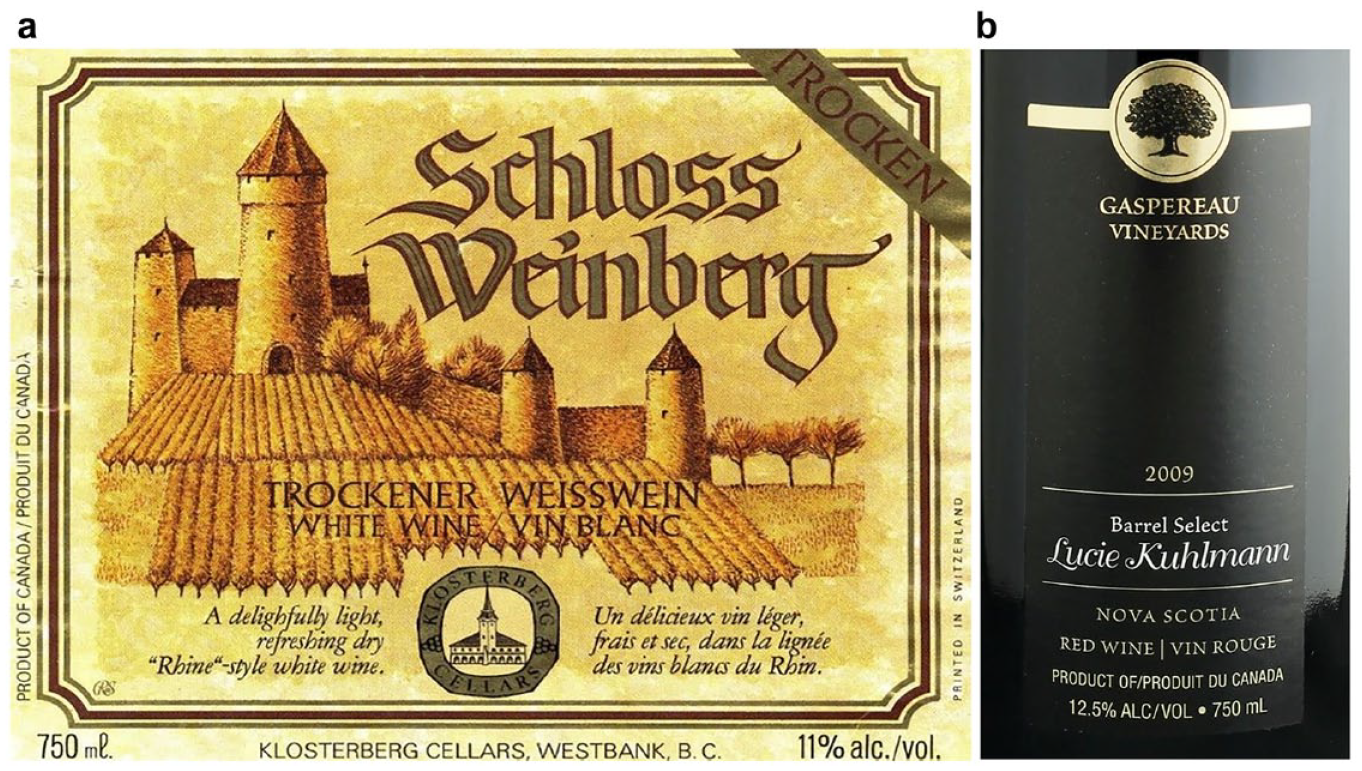
Contrast between a “faux” European-style wine name and a Canadian wine name: (a) Example of European-style wine name. (b) Example of Canadian wine name.
To track the spread of the Canadian identity within the field, we created the variable Proportion of Canadian names to total names at the organizational level as the number of Canadian names used by a winery in a given year divided by all wine names used by the winery in a given year. This variable ranges from zero to one. For example, if winery i has eight wine names in total in 1990 and four of these are Canadian, this variable would have a value of 0.5 for winery i in 1990. In other words, wineries may fully or only partially adopt a Canadian identity for their portfolio of wines, or not at all. This is significant because it allows for hybrid identities at the organizational level, in contrast to studies on the diffusion of a new product innovation where organizations either produce or do not produce the focal product.
Wine names were coded as reflecting a Canadian identity if (1) they contained the name of the Canadian winery, or (2) contained a name of a Canadian place, such as “Niagara.” For example, the wine name Ontario Country, named after the province of Ontario, was coded as Canadian. However, the wine name Domaine d’Or was not coded as Canadian. To assess the reliability of our coding, the first author and a research assistant both independently coded a random sample of 100 names. They agreed on 98% of the cases (Canadian or not Canadian). Given this high level of agreement, the first author coded the remainder of the wine names.
Independent variables
Our independent variables are lagged counts of media articles containing theorization statements made by Canadian winery owners or winery representatives. We only included articles with direct quotes or paraphrases from winery owners or representatives, not journalistic commentary. These quotes or paraphrases were considered theorization statements if they made a pragmatic or normative case for making wine with a Canadian identity. In other words, we include only positive statements that could be directly attributed to producers. We counted articles with theorization statements rather than statements within articles. We also counted articles that featured the same theorization statements (e.g. same quote featured in different articles) because we believe the volume of articles with theorization statements to be the relevant measure. We relied on the Canadian Newsstream database for our searches.
We focused on the main newspapers from major cities, including those located close to wine producing regions. Canadian Newsstream covered the following newspapers for the full period of 1985 to 2005: The Globe and Mail, The Gazette (Montreal), Toronto Star, Kingston Whig-Standard, and The Ottawa Citizen. The Financial Post, which ceased independent publication in 1998, was also included due to a prominent Canadian wine writer (Schreiner) who wrote articles for the newspaper. Two other newspapers—The Vancouver Sun and The Times-Colonist (Victoria)—not covered in Canadian Newsstream for the full period were also included. For the years that these newspapers were not covered by Canadian Newsstream (for the Vancouver Sun 1985, 1986, and first half of 1987; for The Times-Colonist from 1985 to end of 1990), we searched the Canadian Newspaper and the British Columbia Legislative Library Newspaper indexes, for articles listed under wine-related subjects (e.g. “Wine industry” and “Wine”). The articles listed under the subjects were then located on microfilm. Finally, we also included The Windsor Star and The Spectator (Hamilton) because they are major cities located close to major winemaking regions. The Windsor Star is available in Canadian Newsstream beginning in 1987, and The Spectator is available in Canadian Newsstream starting in 1991. However, printed subject indexes that covered the years in which these newspapers were not in Canadian Newsstream were not available. As such, we calculated the proportion of the total articles that these newspapers, respectively, represented in the first 3 years that the newspaper appeared in Canadian Newsstream and used this to calculate an extrapolated value for the missing years. 5
We used the following search within the advanced search option to identify relevant articles: [Canadian or Canada or Ontario or BC or British Columbia or Alberta or Manitoba or New Brunswick or Nova Scotia or Newfoundland or Niagara or Okanagan or Quebec or Prince Edward Island or Prince Edward county (within same paragraph) wineries or winery or vineyard] (document text) AND [founder or owner or winemaker or entrepreneur or representative or president or director or CEO or head of or manager or chairman or executive or proprietor] (document text) AND [”Whig” or “Financial Post” or “Globe and Mail” or “Gazette” or “Toronto Star” or “Ottawa Citizen” or “Vancouver Sun” or “Windsor Star” or “Spectator” or “Times—Colonist”] (publication title). We ran this search for each calendar year from 1985 to 2005. We then read each of these articles to find direct quotes or paraphrases from winery representatives (owners, managers, etc.). We only retained statements that were positive toward “Canadian” wine (e.g. that explained how high quality was achieved, mentioned awards or other accolades, predicted a bright future, etc.). We tested the reliability of our coding using 1 year of newspaper articles. For the year 2000, the first author and a research assistant independently coded the 174 newspaper articles retrieved from our search and agreed on all but two cases (98.8% agreement). Given this high level of consistency, theorization statements for the remaining years were coded by the first author.
To test Hypothesis 1, we constructed Total Theorization as the count of articles with theorization statements made by all winery representatives in Canada per year. To test Hypothesis 2, we constructed Small producer theorization and Large producer theorization as articles containing theorization statements made by winery representatives from small or large wineries per year, respectively. Following Wine Council of Ontario guidelines, we coded wineries producing less than 30,000 cases per year as small and those producing over 500,000 cases per year as large. Finally, Pioneer theorization is a count of articles with theorization statements made by representatives of the wineries that were the original founding members of the Vintners Quality Alliance (VQA), the original champions of a Canadian identity within the wine field: Inniskillin, Henry of Pelham, Hillebrand, Cave Springs, Chateau des Charmes, and Reif estate wineries (Bramble, 2013; Getz et al., 2004; Mielzynski-Zychlinski, 2001). These six wineries are widely credited with developing the category boundaries—or “self-governing rules”—for Canadian wine (Bramble, 2013: 71; Mielzynski-Zychlinski, 2001: 86). They were greatly celebrated in the wine industry and beyond, and were lauded in books written about their wineries and the industry in general (e.g. Aspler, 1999, 2006; Bramble, 2009, 2013; Mielzynski-Zychlinski, 2001; Phillips and Parow, 2006; Schreiner, 2006). Several were awarded the Order of Ontario, and three received the Order of Canada, the highest civilian award in Canada.
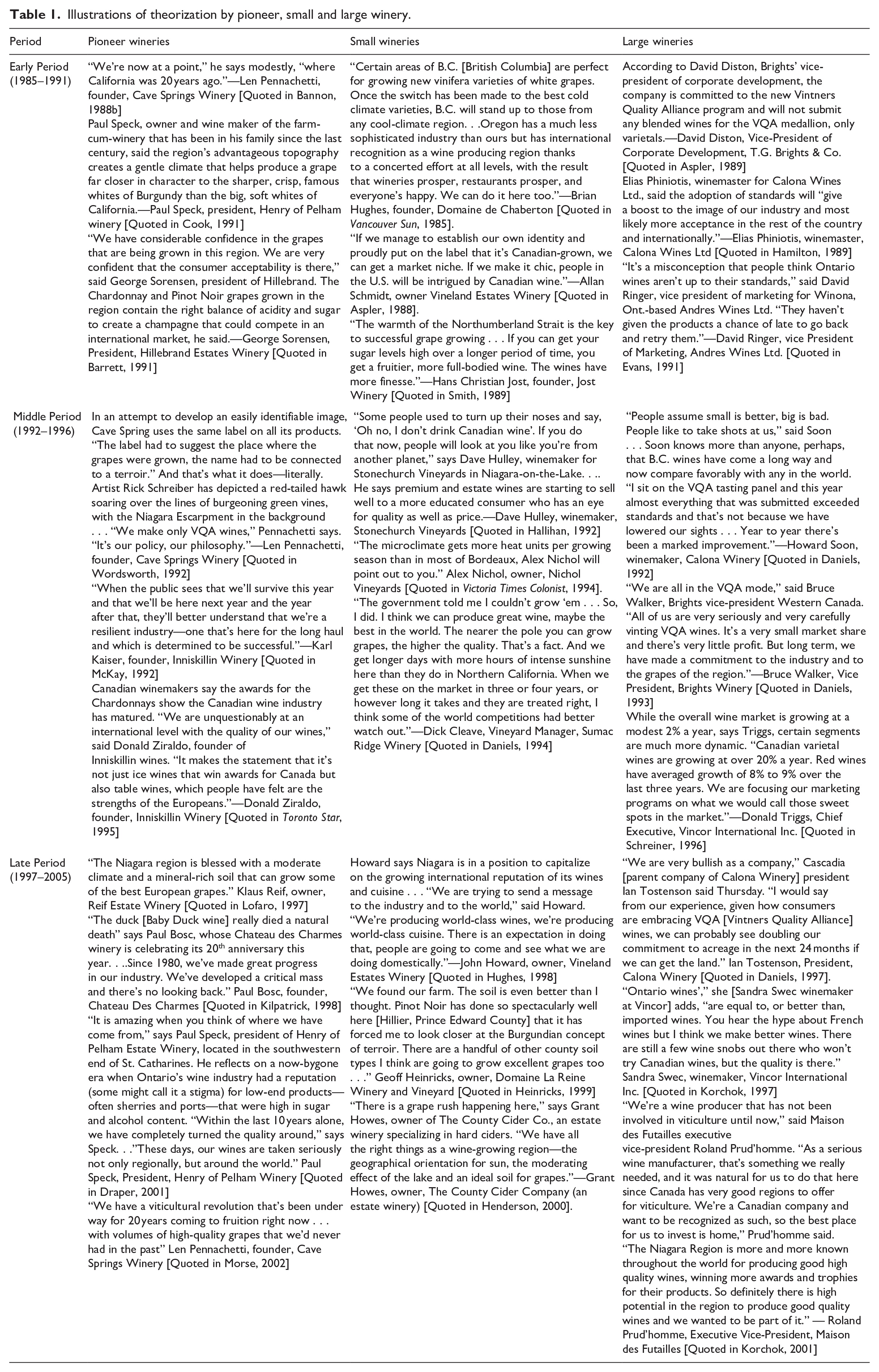
Table 1 provides examples of theorization statements in our data from pioneers, small, and large wineries. As shown, there are theorization statements made by all three groups of wineries over our study period (the time periods used in the table are for exposition purposes only and are not used in our analysis). Overall, the theorization statements illustrated in Table 1 have a collective character to them, often referring more to the field as a whole rather than to individual organizations. Statements evoke a common cause or movement, including reference to “a grape rush happening here” and “a viticultural revolution that’s been under way for 20 years coming to fruition right now.” Another winery representative stated,
We are trying to send a message to the industry and to the world . . . We’re producing world-class wines, we’re producing world-class cuisine. There is an expectation in doing that, people are going to come and see what we are doing domestically.
The collective character of these theorization statements accords with Navis and Glynn’s (2010) finding that theorization of nascent categories emphasizes the collective identity of the category as opposed to organizational distinctiveness within the category.
Illustrations of theorization by pioneer, small and large winery.
Control variables
Because small organizations are thought to be more nimble and thus perhaps more likely to adopt a new identity, we controlled for small size (wineries with less than 30,000 cases per year). In some cases, only a winery’s storage capacity (gallons per year) was provided by Wines and Vines, in which case wineries with a storage capacity of less than 250,000 gallons were categorized as small. We also included a measure of winery age, which is the year minus the founding date of each winery. Because they are less wedded to the status quo than incumbents, we expect that younger firms will be more likely to use Canadian names.
To control for possible parent company effects on their subsidiaries, a dichotomous measure for Subsidiary was included. An entity was identified as a subsidiary if owned by a parent company. The parent company was identified as a parent company if it was either identified as such in Wines & Vines, or was founded prior to the entities which had the same name. For the most part, large incumbents established subsidiaries to overcome provincial barriers to the distribution of alcohol; as such, we expect that subsidiaries are less likely to use Canadian names for their wines. We also controlled for icewine producer (as a dichotomous variable), given that icewine was diffusing through the field at the same time as Canadian names were expanding, such that icewine producers could thus be considered more innovative (Ierfino-Blachford, 2020). 6
We also controlled for any increase in quality or reputation in the Canadian wine field. By the early 1990s, wines with a Canadian identity began to win medals in prestigious international competitions. As a wine writer noted regarding Inniskillin’s 1991 award at Vinexpo, a major international wine exhibition held in Bordeaux: “it was the equivalent of a Bulgarian movie with Swedish subtitles winning the Academy Award for best picture. Wine lovers sat up and took notice” (Kennedy, 2000). Another wine writer observed that this award “changed the world’s perception of Canadian wine overnight” (Korchok, 1998). We thus included a milestone variable (First international wine award) for this first “win” of a Canadian wine at Vinexpo. Quality—or perceptions thereof—can of course continue to increase beyond this first award. As such, we also include a 3-year moving window of awards won by Canadian wines at this trade show (Vinexpo awards). To control for market size, we included total wine sales (Statistics Canada, 2013). Finally, we control for VQA regulation, the establishment of the Vintners Quality Alliance Act in 1999 (Vintners Quality Alliance Ontario (VQA Ontario), 2024).
Model specification
Because differencing a model which includes a lagged dependent variable (to remove the fixed effects) causes endogeneity, we used the Arellano-Bond (AB) dynamic panel data estimator (Arellano and Bond, 1991). This estimator uses generalized method of moments (GMM) and is designed for situations with: (1) “one left-hand variable that is dynamic, depending on its own past realizations”; (2) small T and large N, or few time periods and many cross-sectional units; (3) “fixed individual effects, implying unobserved heterogeneity”; and (4) “heteroskedasticity and autocorrelation within individual units’ errors, but not across them” (Baum, 2013: 10; Roodman, 2009: 86). The AB model “accounts for processes that may be dynamic, whereby current realizations of the dependent variable are influenced by past ones” (Roodman, 2009: 99). “Compared to RE and FE models, AB-type panel estimators thus weaken the exogeneity assumption for a subset of regressors, thereby providing consistent estimates even if reverse causality is present” (Leszczensky and Wolbring, 2022: 845). In short, the Arellano-Bond (AB) estimator offers “a powerful toolbox to tackle endogeneity problems caused by both reverse causality and unobserved heterogeneity” (Leszczensky and Wolbring, 2022: 845).
We implemented the AB model using the xtabond2 command in Stata with one lagged dependent variable and a robust VCE (Stata, 2019), which is equivalent to firm-level clustering (Cameron and Miller, 2015: 12). Generally, the number of individuals (wineries) should be greater than the number of instruments used (Roodman, 2009: 99). We thus used the “differences” option in xtabond2, which is recommended to reduce the number of instruments used in the regression (Labra and Torrecillas, 2018: 44), and the “collapse” option, which collapses the instruments to limit instrument proliferation (Roodman, 2009: 108). We also used orthogonal deviation which maximizes sample size in unbalanced panels with gaps (Roodman, 2009: 104). It is important to note that the constant in the later version of the Arellano-Bond model in Stata (xtabond2) developed by Roodman (2009) controls for time: “introducing the constant term after differencing is equivalent to entering t as a regressor before transformation” (p. 123). 7
As a robustness check, we ran a generalized estimating equation (GEE) (binomial logit) model, which Papke and Wooldridge (2008) suggest is appropriate for proportions. 8 This model allows for values between 0 and 1 including the end points. In Stata, we used GEEs with a binomial distribution, a logit link function, and the “exchangeable” correlation pattern for the panel fractional logit model (Papke and Wooldridge, 2008: 124).
Results
Table 2 shows descriptive statistics and correlations.
Descriptive statistics and correlations.

Model 1 of Table 3 is the Arellano-Bond model with control variables only, including one lag of the dependent variable. The only control variable of notable significance is for subsidiaries, which are much less likely to use Canadian names. This is not surprising, since for the most part subsidiaries were those of large incumbents set up to overcome provincial barriers on the movement of alcohol. In Models 2 to 6, we test the effects of the variables of interest on the spread of Canadian names (all theorization variables were lagged). In Model 2, the coefficient for total theorization has a positive and significant coefficient, supporting the baseline hypothesis (H1) that theorization from all producers combined will motivate increased use of Canadian names. Model 3 suggests that small producer theorization has a strong effect and Model 4 confirms that small producer theorization has a stronger effect on the use of Canadian names than does large producer theorization, as per Hypothesis 2. In fact, the coefficient for small producer theorization is positive and significant while the coefficient for large producer theorization is negative and significant. This latter result is unexpected, and suggests that in fact not all theorization contributes to the development of a collective identity—a finding we pursue in supplemental analysis below. In Model 5, the coefficient for pioneer theorization is positive and significant with a p value < 0.01, consistent with Hypothesis 3. Model 6 is the full model, with results substantively unchanged from Models 4 and 5. 9 As shown in Table 3, both the Hansen test and the difference-in-Sargan/Hansen statistic for overidentifying restrictions provide evidence in favor of the validity of the instruments in our model. Finally, the Arellano-Bond test for autocorrelation is not significant in any of our models. 10
Arellano-bond estimation of the proportion of Canadian wine names to total names.

p ⩽ 0.10; *p ⩽ 0.05; **p ⩽ 0.01; ***p ⩽ 0.001 Standard error in brackets.
Zooming out to the field level, these results cumulate such that Canadian wine names become common in the field. As Figure 2 shows, Canadian names rose from under 20% of all wine names in 1985 to over 60% of all wine names in 2005. As we discuss further in the next section, this rise comes not only from small wineries, but also from the (at least partial) adoption of the Canadian wine identity by large producers.
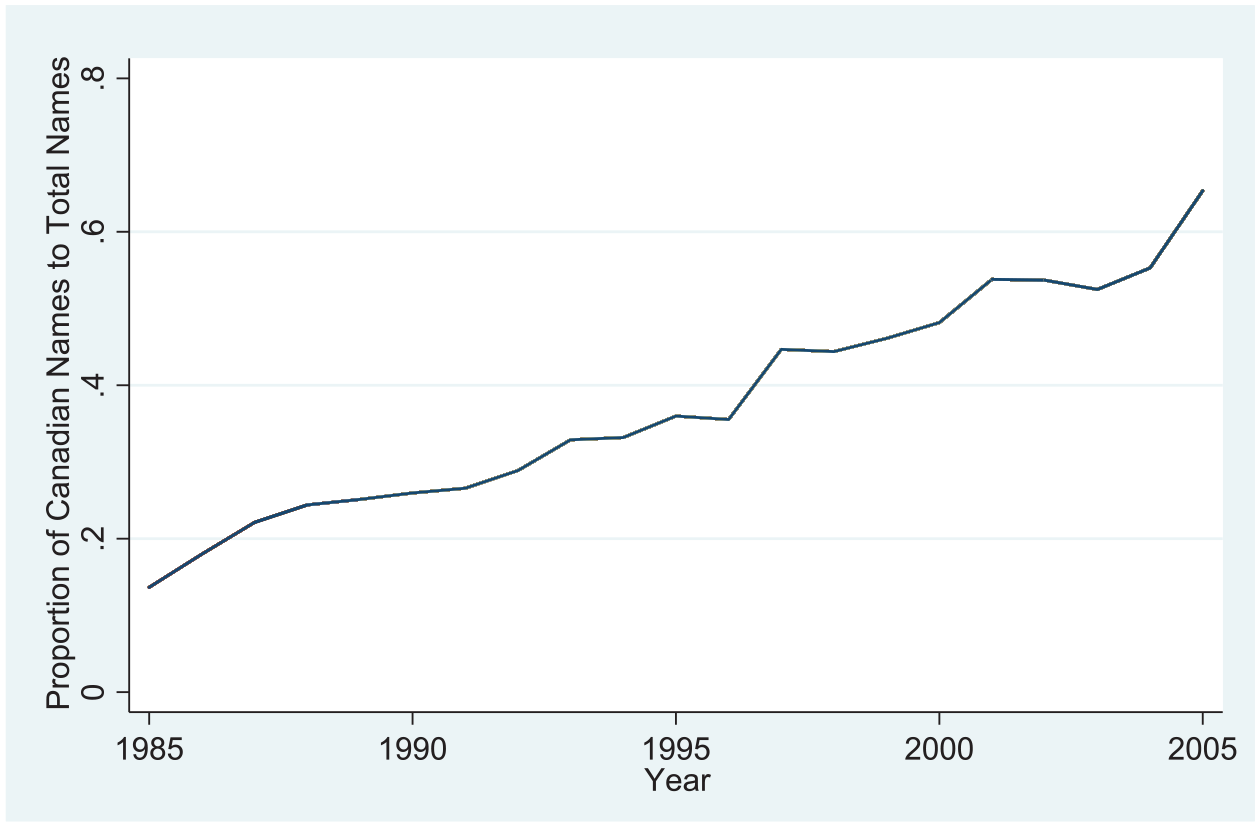
Proportion of Canadian names to total names (field level).
Supplemental analysis
In order to increase confidence in these results and to explore them further, we perform additional quantitative and qualitative analysis. First, as an alternative to the AB models shown in Table 3, Table 4 presents the same analysis using generalized estimating equations, or GEE models (Ballinger, 2004). We also ran our models using fixed effects regression, and results were substantively unchanged. The only notable change in the GEE models is that the coefficient for total theorization in Model 2 drops just below marginal statistical significance (p < 0.113). While we believe the AB model (Table 3) to be the most appropriate for our data, we must therefore interpret its support for Hypothesis 1 with caution. All other results are substantively unchanged, reinforcing support for Hypotheses 2 and 3.
GEE estimation of the proportion of Canadian wine names to total names.

p ⩽ 0.10; *p ⩽ 0.05; **p ⩽ 0.01; ***p ⩽ 0.001 Standard error in brackets.
Puzzled by the unexpected negative result for the theorization of large producers in Tables 3 and 4, we delved further into our qualitative data to better understand why the theorization of small and large producers had such different effects (we expected small-player theorization to have a stronger effect, but did not expect large-player theorization to have a negative effect). The nature of the theorization of small versus large players, illustrated in Table 1 above, provides some clues. For ease of exposition, Table 1 divides our time period into early, middle, and late periods. The table illustrates that whereas small producers (and pioneers) offered both pragmatic and more emotional appeals for Canadian wine from the start, large producers’ theorization was low on emotionality in the early period. Some large producers did join the VQA and did make a commitment to producing domestic wine in the early period, but their statements lacked the ebullience of small producers and pioneers. We also did a supplemental search for any negative statements that may have been made by large producers. 11 This supplemental search revealed that at the same time as large wineries spoke positively (albeit unemotionally) about Canadian wine, they also expressed skepticism about the market potential of this new category. For example, a representative of a large winery stated, “There are few areas in Canada suitable for grapevines” and “there’s little you can grow there that’s economic” (Foster, 1991); another claimed that “The average person does not want a fine wine [but rather] what the French call a ‘vin ordinaire’” (Bannon, 1990). These statements indicate that, in the early period, large wineries were skeptical that Canadian wine was either feasible on a large scale or even desired by most consumers. Moreover, large wineries remained committed to their blended (i.e. non-Canadian) wines, many of which were quite popular with consumers at the time.
Nonetheless, these large wineries hedged their bets, experimented with Canadian wine, and made some positive statements. As time went on, they struck a more optimistic tone for Canadian wine (see Table 1); for example, one stated,
All of us are very seriously and very carefully vinting VQA wines. It’s a very small market share and there’s very little profit. But long term, we have made a commitment to the industry and to the grapes of the region.
By the later period, the discourse of large wineries became more enthusiastic, with theorization statements such as “Ontario wines . . . are equal to, or better than, imported wines. You hear the hype about French wines but I think we make better wines” (Table 1). Another large winery representative stated, “There is every reason to believe we can challenge countries like New Zealand and Australia, and areas such as Oregon and Washington” (Schreiner, 2006: 1). In other words, a notable shift from “mixed” or equivocal support to enthusiasm is apparent in the discourse of large wineries, whereas that of small wineries and pioneers was consistently positive from the start. This supplemental analysis leads us to speculate that the mixed message from the large players in early periods may have made their theorization appear inauthentic and their later embracing of Canadian wine opportunistic.
Deeper analysis of our qualitative data also corroborates our claim that theorization contains both pragmatic and emotional elements. For example, as shown in Table 1, one winery representative offered a technical argument: “The warmth of the Northumberland Strait is the key to successful grape growing . . . If you can get your sugar levels high over a longer period of time, you get a fruitier, more full-bodied wine.” Another claimed that “The microclimate gets more heat units per growing season than in most of Bordeaux.” Others struck a more emotional tone, even evoking national pride: “B.C. will stand up to those from any cool-climate region . . . Oregon has a much less sophisticated industry than ours but has international recognition as a wine producing region . . . We can do it here too.” One statement combined both emotional and more pragmatic appeals:
The government told me I couldn’t grow ‘em . . . So, I did. I think we can produce great wine, maybe the best in the world. The nearer the pole you can grow grapes, the higher the quality. That’s a fact. And we get longer days with more hours of intense sunshine here than they do in Northern California. (Dick Cleave, quoted in Daniels, 1994)
Finally, we found suggestive evidence that theorization of Canadian wine was convincing. One winery representative suggested that theorization of technical feasibility was effective:
People didn’t believe you could grow premium grapes here. Few were aware that we sit on the 43rd latitude, the same latitude as northern California and that we’re part of the Carolinian zone, which includes North and South Carolina. In fact, our latitude is south of the vineyards of Burgundy, France. When people realized this, they stop saying you can’t grow Chardonnay or Pinot Noir grapes in Canada. (Deborah Pratt, Inniskillin Winery, quoted in Alexander, 2002)
Importantly, theorization influenced both large players and new wineries to adopt a Canadian identity. As far back as 1988, a wine writer observed:
Inniskillin gets much of the credit for the wine revolution in Ontario . . . it was the first of the boutique wineries to open in Ontario, making light table wines rather than the Labrusca sherries and ports favored by the big wineries. Since then, the big companies have got the message and more than a dozen new small wineries have followed in Ziraldo’s footsteps (Bannon, 1988a).
Similarly, a new winery founder recalled the influence of pioneers on his decision to enter the industry:
I must admit I was not very enthusiastic [at first] given my experience, with Canadian wines or Ontario wines in general, going back to those days . . . They were generally speaking artificially sweetened and carbonated, that’s where wines like Baby Duck and Baby Bear kind of gave birth to the wine industry here in Ontario and that wasn’t the kind of wine I wanted to produce . . . There were a few years where industry leaders, a few people like Don Ziraldo and Len Pennachetti and Chateau de Charmes, Paul Bosc Sr. of course, who basically bucked conventional wisdom and ripped out the Labrusca and started planting vinifera . . . My sister was actually involved in horticulture in the Niagara Peninsula and she had convinced me really just through persistence to come up and have a serious look at the Niagara Peninsula. I did that in 1998 and was frankly blown away by the remarkable transformation of the Ontario wine industry that had undergone in a very, very short amount of time . . . Don Ziraldo and Karl Kaiser, those folks were really leaders in the industry at the time. They really took the chance. (interview with a winery founder)
While such qualitative evidence is merely suggestive, it is consistent with our quantitative result that the theorization of small players, and particularly that of pioneers, influenced both large wineries and new entrants to adopt a Canadian identity for their wines.
Discussion
We explored the effects of theorization on the expansion of a new collective identity within the Canadian wine market. Prior to the 1980s, the market was dominated by imported wines from traditional wine producing countries and domestically-produced wine that blended indigenous grapes with imported juice. Some of these latter wines were very popular with consumers and quite profitable for the handful of large players that dominated the industry at that time. These domestic wines eschewed a Canadian identity in favor of a “faux” European one, under the dominant assumption that consumers preferred European wine. In contrast, the pioneers of a “Canadian wine” identity did not shy away from signaling their roots on the bottle. Despite being met with skepticism and even incredulity from both large incumbents and some wine writers, these pioneers theorized “Canadian wine” as not only technically possible, but also normatively desirable within the field. By the end of our study period, wines with a Canadian name were the majority of all wines (Figure 2). Even large wineries adopted Canadian names to a large extent: at the start of our study period, large wineries used Canadian names for 8% of their wines, but by the end of our study period this number rose to 31%. 12
Our study complements previous studies of the Canadian wine field, which have focused on spatial agglomeration (Wang et al., 2014, 2020), adaptation of global norms to local conditions (Voronov et al., 2013a), rhetorical adherence to the logic of fine winemaking (Hills et al., 2013; Voronov et al., 2013b), emotional response to wine rituals (Massa et al., 2017), and the spread of icewine as a product innovation (Ierfino-Blachford, 2020). Existing research on this industry for the most part takes the ascendance of the Canadian wine identity as its starting point and is largely concerned with how wineries acted (location choices, discourse, practices, etc.) after the field changed. We focused here on the field transformation that prior work takes as its starting point.
Implications for theory
We began our research with the question of how mature organizational fields change, in particular how new collective identities go from the margins to the mainstream of mature fields. Prior research led us to examine entrepreneurial discourse in the form of theorization as integral to the “identity movements” that advance new collective identities and transform fields. Our analysis helps advance prior research in two main ways.
First, we show that who theorizes matters, and in particular, that small players and identity pioneers can be effective theorizers of change in mature fields. Prior work on mature fields has emphasized the role of large, central incumbents (Delmestri and Greenwood, 2016; Greenwood et al., 2002; Rao et al., 2005) or established experts (Grodal and Kahl, 2017; Khaire and Wadhwani, 2010; Rao et al., 2003) in influencing field change. In contrast, we show that theorization by small producers can be more impactful than that of larger producers. At the very least, our results suggest that it is important to disaggregate theorization activity according to relevant actor groups, and that combining the theorization of different groups (as does our Hypothesis 1) may obscure important heterogeneity in effects. Here, we argue that small producers possess craft authenticity (Carroll and Wheaton, 2009), making them effective theorizers. The authenticity of small producers allows them to theorize effectively despite their lack of traditional sources of power. In supplemental analysis, we suggest that, in contrast, large incumbents may be hamstrung by existing reputations and commitments. As such, large organizations may suffer from an “inauthenticity discount” when theorizing (Frake, 2017), leading to a lower level of trustability. 13
Furthermore, pioneers of a new identity benefit from type authenticity (i.e. authenticity to the emergent “Canadian wine” identity). Rather than the craft authenticity derived from small size, pioneers benefit from their “iconic” stature in the field when theorizing. Pioneers are thus effective theorizers because of who they are, regardless of their size. Our disaggregation of theorization according to actor groups thus helps us to better understand which actors might be effective theorizers of field change. A comparison between our case and prior research suggests that in weakly professionalized fields where authenticity is highly salient, small players and pioneers can be effective theorizers. In sum, while theorization can be more or less persuasive depending on the position of the speaker (Grodal and Kahl, 2017: 175), in some fields the ability to engage in theorization may hinge more on authenticity than on traditional sources of power such as field centrality, size, or resources.
Second, our analysis suggests that theorization is different in cases of field change that results in a niche (center-periphery) structure versus cases of transformation of the field’s core. In the cases of craft beer (Carroll and Swaminathan, 2000) and grass-fed meat (Weber et al., 2008), for example, identity movements resulted in niche markets (most consumers still drink mass-produced beer and eat industrially-produced meat). While these niches are important, the core of these fields remained largely unchanged. In contrast, the “Canadian wine” identity displaced the incumbent identity and became dominant in the field over a 20-year period. While insights based on comparisons with previous research must remain speculative, we observe that the theorization of Canadian wine was inclusive rather than contentious or oppositional toward incumbents. Our qualitative analysis suggests that small wine producers rarely, if ever, disparaged or attacked incumbents. In contrast to the suggestion from prior research (Greenwood et al., 2002; Tolbert and Zucker, 1996), theorization here did not focus on a “problem” with incumbents or their products. To the contrary, pioneers sought to work with incumbents, for example through the dominant industry association that represented incumbents’ interest at the time. From the start, the goal of the identity movement was to gain adherents even among large producers, not to establish a separate niche. In other words, pioneers sought not to “defeat” incumbents, but to convince them to join the movement. While only a finer-grained content analysis can reveal systematic differences in theorization that results in the creation of a niche versus the transformation of a field’s core, we suggest here that the latter is more likely to occur when theorization (and the identity movement more broadly) seeks to “lift all boats” rather than emphasize stark differences between new and old identities.
These two contributions help advance the literatures on cultural entrepreneurship and collective identity. Until recently, the cultural entrepreneurship literature has focused largely on organizational-level outcomes (e.g. Lounsbury and Glynn, 2001; Martens et al., 2007; Soublière and Lockwood, 2022). Here, we focus on cultural entrepreneurship aimed at the field level, and show how it can lead not only to positive organizational outcomes but also to field transformation. Furthermore, prior research on entrepreneurial discourse has focused on new practices (Greenwood et al., 2002; Ierfino-Blachford, 2020), new roles (Reay et al., 2006), or new kinds of organizations (David et al., 2013), but rarely on the spread of new collective identities within mature fields. In particular, we show how categories can become “emplaced” and thus representative of local culture (Croidieu et al., 2016; David et al., 2023). Notably, a collective identity tied to place can form the basis of multiple product and process innovations. In sum, our analysis highlights the importance of studying “collective identity as a meaningful and coherent category,” beyond the individual members who constitute the category or the concrete practices that help to define it (Wry et al., 2011: 450).
Limitations and future research
Our work is, of course, not without limitations. One is the incomplete sample of the population of wineries. Because our dependent variable (the proportion of Canadian wine names to total wine names at the firm level) would not seem to either encourage or prevent listing in Wines & Vines, we believe this missing data meets Allison’s (2002: 4–5) criterion for being “ignorable” for regression purposes. Our study is also limited by the electronic availability of media data on theorization. While 1985 is very early in the life of the “Canadian wine” identity, it is not the very beginning. We have partially overcome this by discussing qualitatively the pioneers’ work done prior to 1985, but ideally identity movements would be explored quantitatively from their inception. Producers, moreover, theorize by means other than the media which we do not have access to (e.g. discussions at conferences, direct contact, etc.). Theorization may also come from other actor groups, such as journalists, critics, and oenologists among others. Future work could strive for a more holistic measure of theorization. In the same vein, future work could fruitfully combine analysis of theorization with other possible drivers of field change, such as prestigious affiliations and awards (David et al., 2013; Ierfino-Blachford, 2020), network embeddedness (Cattani et al., 2014), and resonance with society-level logics (Croidieu et al., 2016; David et al., 2013).
Furthermore, although we conceive of theorization as having both pragmatic and emotional elements, we do not analyze these separately. Future research can explore whether these elements have differential effects. For example, we notice that while small players and pioneers employ a mix of pragmatic and emotional elements in their theorization, large players rely mostly on pragmatic theorization, especially in the early period. It would be interesting to explore the differential effects of pragmatic versus emotional theorization, and whether (as we suggest) the mix of the two proves most effective.
The Canadian wine field bears some important particularities that may limit the generalizability of our findings. Notably, it is a cultural field (Cattani et al., 2014; Lawrence and Phillips, 2002). As with beer (Carroll and Swaminathan, 2000) and coffee (Rindova and Fombrun, 2001), craft authenticity may be a more salient attribute for producers than in other domains. Like other wine fields (e.g. Croidieu et al., 2016), at the start of our study period the Canadian wine field had relatively low structural barriers to entry or change (i.e. rules and regulations enforced by the state or professions). Also, judgments of quality are subjective in cultural fields (Lawrence and Phillips, 2002: 431), such that the wine field may be more amenable to theorization activity. Finally, future research may also consider the market implications of the movement of an identity from the margins to the mainstream: does the adoption of the identity by large producers tarnish, or improve consumers’ perceptions of the category? More broadly, does the authenticity of small and pioneering producers at the organization level ultimately transfer to the category itself?
Conclusion
The pioneers of a Canadian wine identity were initially decried as “fools” who “rushed in” (Aldrich and Fiol, 1994) to a mature field dominated by large incumbents. Yet, these cultural entrepreneurs did not hide their new collective identity, even though wine made in Canada had a poor reputation. Ultimately, by using Canadian names—often “local landmarks, historic events, or prominent individuals” (Verhaal et al., 2017: 2537)—producers signaled their identity and engaged in persuasive discourse to convince others, including incumbent producers, to join the movement. They did this without the material resources and powerful positions often associated with field change. These pioneers were “skilled users of cultural tool kits” (Rao, 1994: 41; Swidler, 1986) who used symbolic elements to develop and expand a collective identity that, ultimately, transformed the Canadian wine field.
Footnotes
Acknowledgements
We sincerely thank Daniel J Henderson of the University of Alabama for his assistance with our statistical models, and Yoojin Lee for her diligent work as our research assistant. We thank our three anonymous reviewers for their helpful comments, and our Editor Oliver Alexy for helping us craft a better paper.
Funding
The author(s) disclosed receipt of the following financial support for the research, authorship, and/or publication of this article: We acknowledge funding from the Social Science and Humanities Research Council of Canada (SSHRC) and the McGill Center for Strategy Studies in Organizations.
