



Abstract
Previous research on learning to contract and contracting capabilities suggests that firms in interorganizational relationships adopt contractual designs that economize on transaction costs, and over time learn to govern their relationships in a more efficient manner by incrementally aligning contractual terms with transaction attributes based on new experiences made in their relationships. We augment the learning to contract literature by highlighting the role of organizational design as a factor that may impact contractual learning and the development of heterogeneous contracting capabilities. Specifically, we suggest that the level of specialization and structural integration across the firm’s technical, commercial, and legal functions may affect the effectiveness of contractual learning and the type of learning likely to occur. We also outline boundary conditions for our model in terms of potential interactions between the contractual environment, organizational design, and contractual learning.
Keywords
How does organizational design affect the development of contracting capabilities? Research on learning to contract suggest that firms gradually learn to govern their interorganizational relationships in a more efficient manner by developing contracting capabilities (Mayer and Argyres, 2004). Contracting capabilities refer to firms’ knowledge about “how much and what kind of detail to include in a contract,” which may allow firms to improve contractual performance by matching transaction attributes with an appropriate contractual design (Argyres and Mayer, 2007: 1060). Previous research on learning to contract and the development of contracting capabilities has to a large extent focused on the relationship between prior experience and contractual learning (Argyres et al., 2007; Arino et al., 2014; Lumineau et al., 2011; Mayer and Argyres, 2004; Vanneste and Puranam, 2010; Weber, 2017; Xing et al., 2021). However, while contractual experience is likely to have a significant impact on learning, contractual experiences may affect firms’ learning in different ways depending on their internal organization (Argote et al., 2021). More specifically, firms with different organizational designs may experience varying levels of contractual learning and excel at different types of contractual learning, and thus develop contracting capabilities oriented toward particular types of contractual terms and clauses. Hence, not accounting for the effect of organizational design on contractual learning may lead to an underestimation of the level of heterogeneity in contracting capabilities across firms.
In this article, we specifically focus on organizational design choices related to the level of functional specialization and structural integration (Castaner and Ketokivi, 2019; Clement and Puranam, 2018; Jansen et al., 2009; Stan and Puranam, 2017), and how these choices may interact with the environment to affect contractual learning. We argue that contractual learning is likely to be affected by the extent to which firms realize economies of specialization in the organizational functions or departments that are involved in the contracting process (technical, commercial, legal) and the degree to which these departments are structurally integrated. Furthermore, we propose that the extent to which particular organizational structures support contractual learning depends on specific elements of the contractual environment related to bilateral dependency and uncertainty. Similar to previous studies on learning to contract, we limit our argument to contractual learning resulting from repeated dyadic transactions involving the transfer of complex products and services. This includes instances of renegotiated contracts with the same exchange partner as well as situations where exchange partners are replaced as old contracts mature.
We make three contributions to the literature. First, we suggest that the study of interorganizational relationships may be supplemented with an organizational design perspective (see Brattström and Faems, 2020). Particularly, we propose that the likelihood of myopic and superstitious contractual learning is high when functional integration is low (see Levitt and March, 1988). The notion of functional integration may thus help to explain phenomena observed in previous research related to the local and incremental nature of contractual learning (Mayer and Argyres, 2004), learning differences between technical and legal clauses (Vanneste and Puranam, 2010), and substitution between formal and relational governance (Abdi and Aulakh, 2017; Poppo et al., 2008). When functional units are less integrated in the contractual process, they are likely to produce myopic and local solutions based on oversimplified models of the contractual problems they are facing. This tendency, in turn, may make complex formal contracting a less attractive option for firms. Second, building on previous research that relates contractual dynamics to attributes of the contractual environment (Keller et al., 2021; Lioukas and Reuer, 2020; Lumineau, 2017; Weber and Bauman, 2019), we contribute new insight on how firms may organize their contractual process under different external conditions and how this choice is likely to affect learning. Our model specifically highlights the benefits of greater commercial-legal integration in stable environments with frequent bilaterally dependent transactions (e.g. industrial equipment suppliers, military systems). Greater commercial–technical and technical-–legal integration may, on the contrary, be more beneficial in more rapidly changing environments with strong social institutions (e.g. software development, biotechnology). Finally, we also add to previous research on how organizational design affects learning concerning complex and multifunctional tasks (Clement and Puranam, 2018; Fang et al., 2010; Jansen et al., 2009) by proposing new mechanisms related to the extensiveness of search and knowledge articulation/codification by which structural integration may affect organizational learning.
Heterogeneous contracting capabilities
According to transaction cost economics (TCE), firms can be expected to improve contractual performance by “assigning transactions (which differ in their attributes) to governance structures (which are the organizational frameworks within which the integrity of a contractual relation is decided) in a discriminating way” (Williamson, 1985: 41). The type of decisions that may be involved include the overall choice between market, hybrid, and hierarchy (see Williamson, 1985). In the case of non-hierarchical governance structures, contract design choices may also involve the selection of individual contractual terms. These include roles and responsibilities (Argyres and Mayer, 2007), dispute resolution (Ryall and Sampson, 2009; Vanneste and Puranam, 2010), decision and control rights (Malhotra and Lumineau, 2011; Reuer and Arino, 2007; Weber et al., 2011), contract duration (Crocker and Masten, 1988; Joskow, 1987), form of payment (Kalnins and Mayer, 2004), communication (Mayer and Argyres, 2004), and contingency planning (Mayer et al., 2022; Mayer and Bercovitz, 2008).
What are contracting capabilities?
Contracting capabilities are based on firms’ knowledge about how to coordinate and negotiate the terms of exchange with other firms. In this regard, they are akin to other capabilities, such as alliance capability (Dyer and Singh, 1998) and pricing capability (Dutta et al., 2003), which involve the internal integration of functionally specialized knowledge and interaction with an external party that may be subject to different incentives and knowledge constraints. At a general level, organizational learning and the development of organizational capabilities occur as a result of new experience, trial-and-error, and the routinization of successful behavior (Argote and Miron-Spektor, 2011). Furthermore, organizational learning is based on individuals’ cognitive representations of the environment, the aggregation of these individual representations to an organizational level, and the firm’s ability to internalize and retain knowledge (Cohen and Levinthal, 1990). Learning thus typically involves interpreting signals from the environment and storing this knowledge in different repositories, such as individuals, routines, artifacts, and processes (Argote and Miron-Spektor, 2011). Learning may result in the development of organizational capabilities when accumulated experience is articulated and codified in such a way that the firm retains the ability to perform certain tasks or produce output of particular type in a stable and routinized way (Argote et al., 2021; Winter, 2003; Zollo and Winter, 2002).
A firm’s contractual learning is likely to stem from concrete contractual experience in dealing with other firms and may involve the development of new knowledge about transaction attributes, the contracting process, and the contracting parties (Lumineau et al., 2011). However, the development of contracting capability is likely not only the result of experience accumulation, but also deliberate efforts on behalf of decision-makers within the firm related to the articulation and codification of individual knowledge and specific investments in organizational design (Zollo and Winter, 2002). Hence, while the locus of contractual learning is initially individual, turning this individual knowledge into organizational knowledge typically involves an aggregation and codification process that operates on the functional and interfunctional level (e.g. departmental routines, management, organization).
Contracting capabilities are, among other things, important for firms looking to improve the efficiency of their vertical value chain by reducing coordination problems between firms. Hence, all parties in a vertical value chain potentially stand to gain from other (up or downstream) firms developing their contracting capabilities, effectively enabling them to enhance coordination between different firms by achieving a better specification of their roles and responsibilities. However, as highlighted by the TCE’s emphasis on contracts as safeguards against opportunism (Williamson, 1985), contracting capabilities and the design of contractual terms may also affect the distribution of value through the transfer of risks and payments between the contracting parties (Weber and Coff, 2023). The transfer of risks and payments may, for example, occur in the design of contractual terms related to control and decision rights, contingency planning, and dispute resolution.
According to Argyres and Mayer (2007), a firm will
experience better contract performance if it aligns the use of various contract terms with transaction attributes following established transaction cost theory, but also if it develops contract design capabilities among appropriate groups of personnel, given the types of terms that tend to be prominent in the firm’s contracts. (p. 1061)
Heterogeneity in governance structures and contract design are thus likely a result of both transaction attributes, such as asset specificity, uncertainty and frequency; and the level of knowledge or capability held by the contracting parties in terms of their processes, routines, and the knowledge of employees involved in the contracting process. Contracting capability may be viewed as a factor influencing the relationship between transaction attributes and contractual design, where higher levels of contracting capability allow for a better alignment between transaction attributes and contractual design. The primary focus of this article is on the relationship between contractual experience and the development of contracting capabilities through the mechanism of contractual learning. We suggest a series of factors influencing this relationship related to organizational design and the contractual environment. The overall conceptual structure of the article is illustrated in Figure 1.
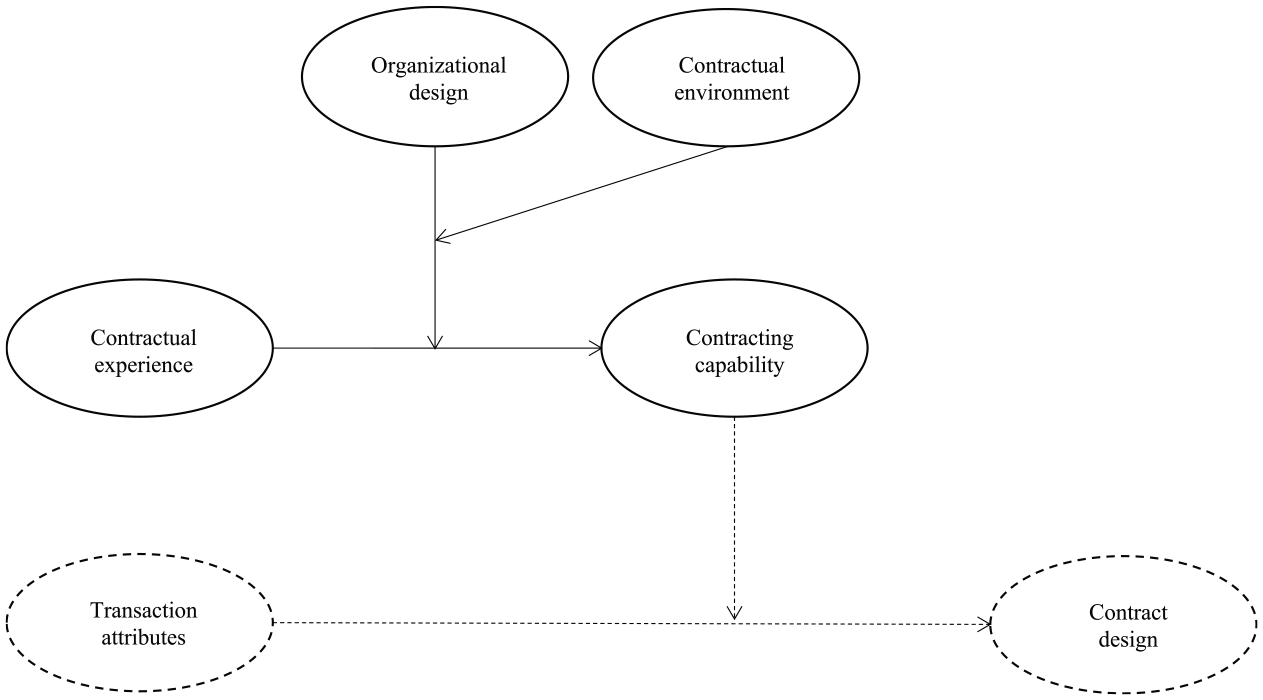
Experience, organizational design, contractual environment, and the development of contracting capability.
The role of functional specialization in contractual learning
Specialists have several advantages relative to generalists (Bunderson and Boumgarden, 2010; Epple et al., 1991; Ingram and Baum, 1997). Specialists hold more extensive knowledge within the narrow field within which they are specialized, which improves learning by enabling the specialist to relate new experiences to previously held knowledge through associative learning and task-specific procedures for “learning to learn” (Cohen and Levinthal, 1990). Specialists typically also perform delimited tasks with higher frequency, which increases the amount of experience with that task in a given time period, and thus learning (Argote and Miron-Spektor, 2011). Furthermore, specialization may also facilitate learning by allowing for functionally specialized processes for articulating and codifying experiential knowledge (Zollo and Winter, 2002). However, economies of specialization are also subject to constraints related to the demand for specialized services. Within a firm, this demand is mainly determined by the size or scale of the firm (Lawrence and Lorsch, 1967).
While the notion of functional specialization is well-established in the organization literature (Galbraith, 1973; Lawrence and Lorsch, 1967; Tushman and Nadler, 1978), we know relatively little about how organizational design and the involvement of different functional units in the contractual process affect learning and the development of contracting capabilities. Previous research suggests that contractual activity is typically performed by three categories of employees responsible for different tasks: engineers, managers, and lawyers (Argyres and Mayer, 2007). Despite some overlap in the tasks performed by the different categories of employees or functions, managers and engineers tend to be a more important repository of contractual knowledge for designing terms related to the parties’ roles/responsibilities and their communication (coordination-oriented terms), whereas lawyers constitute a more important repository when designing provisions related to decision/control rights, dispute resolution, and contingency planning (control-oriented terms). Hence, the locus of contracting capabilities may be described in terms of the knowledge about the technical, commercial, and legal aspects of contracts that resides in these different categories of employees. This is typically represented in the organizational structure of firms in terms of the different units, departments, or functions that are involved in the contracting process.
Hence, firms typically contain certain departments specialized toward the technical function of contracts; such as production, research and development (R&D), and quality, which may be characterized by a focus on the functionality of the product or service being exchanged and the conditions under which these functionalities are created. For example, engineers in a quality department of a selling firm may be responsible for conducting product tests prior to sale and documenting the test results in the product specification and the contractual roles and responsibilities of the parties. The technical function is thus strongly associated with the development of coordination-oriented terms. Firms also include departments oriented toward the commercial function of contracts and tasks related to ensuring a sustainable level of economic profitability, such as sales/marketing and procurement. For example, a buying firm’s procurement department may be responsible for negotiating and designing payment terms that match the contracted functionality of procured goods or services (see Kalnins and Mayer, 2004). This implies a focus on tasks related to the development of both coordination and control-oriented terms. Finally, firms may also include an in-house legal department oriented toward the legal function of contracts and tasks related to ensuring the verifiability and enforceability of the commitments made by the parties. Such tasks may, for example, involve the design of control-oriented terms related to patents (see Ryall and Sampson, 2009), contingency planning, decision rights, and penalties; as well as making sure that basic coordination-oriented terms related to the specification of roles and responsibilities are documented in a verifiable way.
Generally, each of these three functions plays a different role in the contracting process by means of the tasks it performs and the type of specialized knowledge it is likely to develop. In the following sections, we build on the conceptual separation between a technical, commercial, and legal function of the firm in order to explain how organizational design choices related to these three functions affect contractual learning concerning different elements of contracts. We use the five categories of contractual terms by Argyres and Mayer (2007) (roles/responsibilities, decision-/control rights, communications, contingency planning, dispute resolution) that are typically present in complex contracts, while distinguishing between coordination-oriented terms (roles/responsibility, communication) and control-oriented terms (decision/control rights, contingency planning, dispute resolution). The distinction between coordination- and control-oriented terms captures the well-established notion that contracts fulfill two basic purposes related to task description, communication, and regulating task-interdependence between the parties (coordination); and to provide safeguards against opportunism through the allocation of risk and payments (control; Lumineau, 2017; Mellewigt et al., 2007; Reuer and Arino, 2007). 1
We argue that firms may improve their contractual learning by the deliberate aggregation of tasks into specialized functions or units that only deal with narrow contractual tasks. This involves the adoption of an organizational design that improves the composition of different types of contractual experiences across specialized functions or departments. A firm’s contractual learning is likely to be more effective when relying on specialists because specialists typically require fewer contractual iterations to arrive at a better alignment between contractual provisions and transaction attributes (see Argyres and Mayer, 2007). For example, technical specialists are often adept at identifying the key items and appropriate level of detail required in product specifications. Commercial specialists, on the contrary, might excel in identifying a comprehensive range of potential payment mechanisms for a transaction. Finally, legal specialists are typically skilled at recognizing relevant contingencies and designing verifiable and enforceable safeguards. Firms’ learning to contract will thus likely depend on the extent to which technical, commercial, and legal specialists are involved in the contractual process. Hence, as a baseline proposition, we suggest the following:
Proposition 1: Firms will learn more effectively from contractual experience if they aggregate technical, commercial, and legal contractual tasks in specialized functional units or departments.
Structural integration in contracting
The questions of structural differentiation and integration have been acknowledged as major hurdles in organizational design (Galbraith, 1973; March and Simon, 1958; Tushman and Nadler, 1978). A closer look at the microfoundations of contracting capability raises a series of important questions concerning how different categories of specialized employees are organized across different units within the firm, and how differentiation and integration mechanisms across these units affect contractual learning (see Gilbert, 2005; Jansen et al., 2009; Lawrence and Lorsch, 1967). A basic premise is that firms develop contracting capabilities to govern complex transactions where the contracting capabilities in question draw on knowledge residing in different groups or departments (Argyres and Mayer, 2007). The firm, therefore, faces a coordination challenge in transferring and combining knowledge potentially held in different parts of the organization (Kogut and Zander, 1992; Nickerson and Zenger, 2004). The mechanisms through which this is achieved may be described in terms of structural differentiation and integration (Lawrence and Lorsch, 1967). Differentiation involves the partition of the firm into departments, which allows each unit to adapt more effectively to the specific environmental demands associated with the tasks performed within the unit (Gilbert, 2005). Structural integration, on the contrary, refers to “the process of achieving unity of effort among the various subsystems in the accomplishment of the organization’s task” (Lawrence and Lorsch, 1967: 4). The solution to complex problems requires knowledge residing in different units to be transferred, integrated, and aligned. Hence, firms that face environmental demands for both differentiation (to enable specialization and task-specific knowledge) and integration (to enable coordination and alignment across units) have to implement specific organizational integration mechanisms. In our proposed model, we delineate three organizational functions and interfaces that are of specific importance in contractual learning and the development of contracting capabilities: commercial–technical, commercial–legal, and technical–legal. These are illustrated in Figure 2.
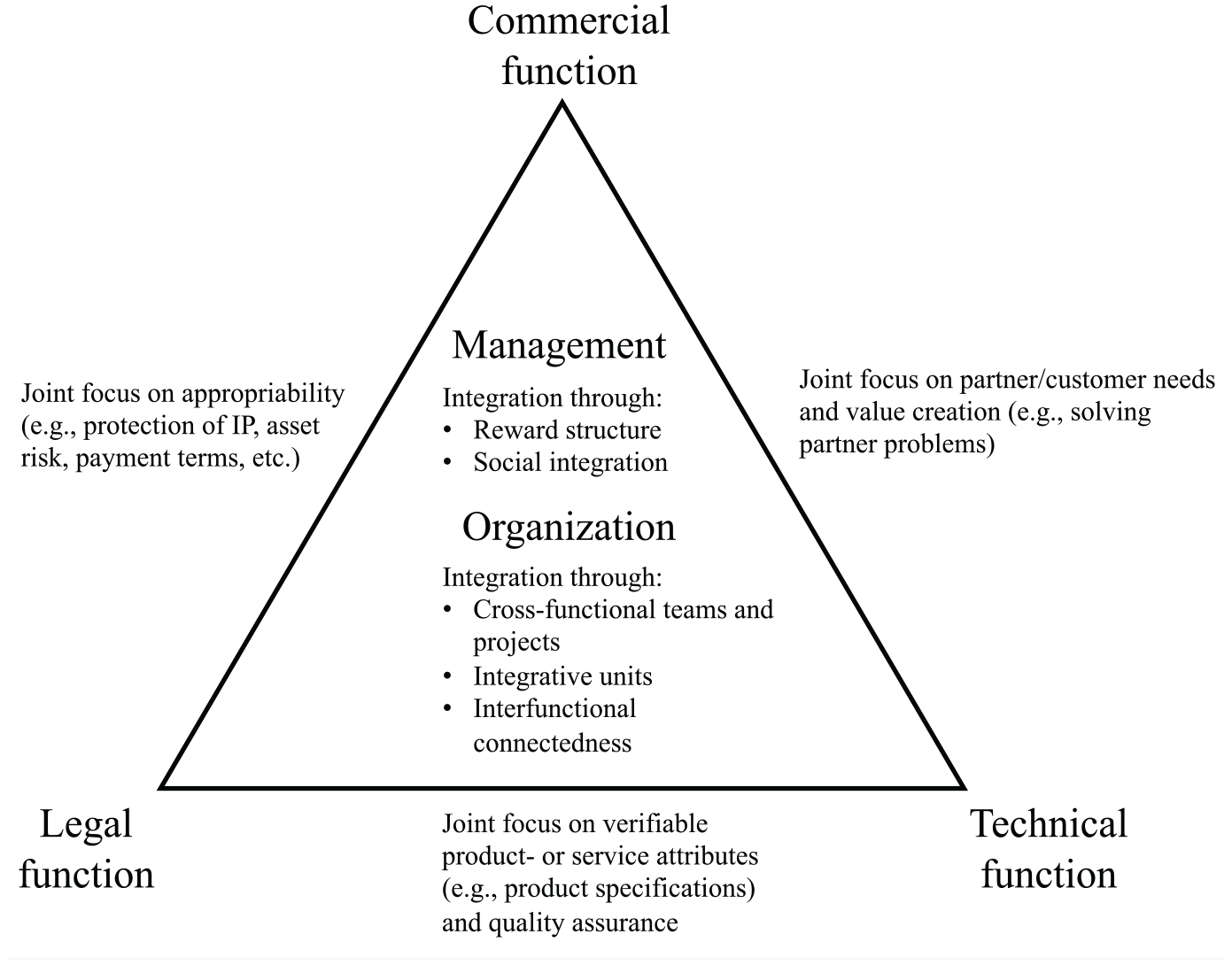
Organizational integration: contracting capability.
Integrative mechanisms may be formal or informal in nature and relate to either the organizational structure or the management team (Jansen et al., 2009). The basic principle is that integrative mechanisms are matched with tasks depending on information processing requirements and the interdependence between tasks performed in different units, so that more complex interdependencies that require extensive coordination and joint problem-solving are coupled with stronger integrative mechanisms (Tushman and Nadler, 1978). Previous research outlines a number of different integrative devices and mechanisms (Jansen et al., 2009; Lawrence and Lorsch, 1967). This includes mechanisms related to the formal organizational structure, such as specific integrative units and multifunctional teams. Integration mechanism may also involve informal elements of the organization, such as the level of connectedness between employees in different functions and integration at the management team level where members typically represent different functions.
Integration mechanisms between technical, commercial, and legal functions in the contractual process may thus involve formal structures, such as dedicated contract management units and the use of cross-functional teams; as well as informal mechanisms related to how coordination between the technical, commercial, and legal functions is supported by the managerial hierarchy, top management reward structure, and organizational culture. In smaller firms, we conjecture that such integration mechanism may play an important role in moving beyond ad hoc solutions where top management bring together functional expertise on a contract-by-contract basis without the support of formal structures. However, larger firms that operate more formalized contractual processes may, arguably, also experience significant challenges related to functional integration. Such challenges may, for example, involve overly sequential decision-processes where specialized tasks in the contractual process are performed in a functionally determined order without significant interfunctional feedback and task reciprocity. Less extensive semi-formal integration mechanisms, such as regular cross-functional lesson-learned meetings and other types of routines for facilitating interfunctional coordination, may in these situations constitute a less costly option for increasing functional integration.
Building on previous research concerning organization and learning (Fang et al., 2010), we propose that structural integration between technical, commercial, and legal functions in the contractual process is conducive to contractual learning because it facilitates joint problem-solving and a broader search for new solutions that involve heterogeneous knowledge sets and experiences (Haunschild and Sullivan, 2002). While learning limited to the functional level might be sufficient for developing a basic level of contracting capability that allows the firm to get by in the short-term (see Winter, 2003), this learning is likely to be incomplete, local, and biased; because the involved task-interdependencies are not matched by interfunctional feedback mechanisms that allow actors to discern cause and effect relationships and properly evaluate outcomes (see Zollo, 2009). However, because structural integration typically involves costs related to reduced efficiency in the performance of specialized tasks, integrative mechanisms should be carefully matched with the information processing requirement of the tasks performed in different units. This matching involves a tradeoff between search for new integrative solutions and the efficient execution of specialized functional tasks (March, 1991).
In the following section, we use the three functional interfaces identified in Figure 2 to analyze how specific instances of structural integration between specialized functions may impact different forms of contractual learning. We particularly theorize the link between the strength of integration mechanisms and the effectiveness of particular forms of contractual learning. The strength of an integration mechanism is defined here as the degree to which there is unity of effort between the involved functions, whereas the effectiveness of learning refers to the extent to which the required contractual knowledge is acquired within a given time frame. We limit our argument to the long-term dynamics of contractual learning and do not address the more immediate effects of integration on the efficiency with which specialized tasks are performed. Because of this delimitation, we mainly theorize the positive effects of structural integration on learning, while acknowledging that excessive structural integration may also have a negative impact on the efficiency with which functional tasks are performed.
Commercial–technical integration
Many organizational capabilities draw on combinations of specialized knowledge residing in the commercial and technical functions of the firm. In the case of some capabilities, such as new product development, this may even be a key interface for the development of the capability in question (O’Leary-Kelly and Flores, 2002). There is a large stream of research on the challenges associated with commercial–technical coordination and integration. This research shows that technical and commercial departments are typically subject to different norms, “thought patterns” and interpretive schemes, which may give rise to learning barriers in multifunctional projects (Dougherty, 1992; Kahn and Mentzer, 1994). Learning barriers may involve interdepartmental incentive conflicts that can be linked to communication patterns, modes of interdepartmental coordination, and organizational structure (Adler, 1995; Griffin and Hauser, 1992). Overall, internal knowledge appears to be sticky and resist internal transfer across departments (Szulanski, 1996). However, increased integration and coordination between technical and commercial functions is typically associated with improved performance (Ernst et al., 2010; Swink and Song, 2007).
In the case of contracting capabilities, we argue that the commercial–technical interface is likely to play an important role for enabling the development of technical specifications that are aligned with the needs of the parties and the agreed distribution of payments. This may involve raising and examining key technical questions early in the contractual processes so that technical specifications are aligned with the commercial terms of the contract. For example, aligning technical and commercial terms may be challenging for firms operating a contractual process where commercial units (sales, procurement, and so on) perform key contractual tasks leading up to the signing of the contract and then hand the project over to responsible technical units (production, quality, and so on). Due to the high level of technical–commercial task interdependence in the contractual process, this set-up is likely to reduce the extent to which the firm will engage in more extensive search for viable technical–commercial combinative options. Arguably, more extensive internal search for technologically and commercially viable solutions requires early reciprocal interaction between the involved technical and commercial units in the contractual process.
Consider, for example, the practice of organizing procurement and the management of supplier contracts in cross-functional teams containing a mix of engineers and commercial personnel (Kaufmann and Wagner, 2017). This organizational design is likely to lead to stronger integration between technical and commercial personnel in the procurement of products and services. Although the set-up may run the risk of slowing down some technical and commercial processes, it is likely to lead to a broader search for technical and commercial solutions and thus ultimately a better alignment between the outcome of commercial negotiations with suppliers (e.g. price, volumes, and so on) and decisions concerning product development, design, and quality. Imagine a buyer negotiating a contract for a complex customized product where different product designs are linked to particular sub-suppliers offering different component warranties. The space of viable technical solutions and product designs will in this case likely be restricted by the commercial implications of the different types of warranties offered by sub-suppliers. Success in identifying a suitable technical solution will be dependent on interfunctional interaction in the early phases of contract negotiation. Higher levels of integration in the contractual process will allow for commercial and technical questions to be examined in a reciprocal rather than sequential way and enable the evaluation of a broader and more novel set of combinative options, which is arguable conducive to learning. Commercial–technical integration in the contractual process is thus likely to improve learning about the design of coordination-oriented terms by enabling the consideration of a full range of contractual design choices, while taking both commercial and technical constraints into account. Hence, we propose the following:
Proposition 2: The stronger integration mechanisms between a firm’s commercial and technical functions, the more effectively it will learn to design coordination-oriented terms and clauses.
Commercial–legal integration
Contracting capabilities are set apart from many other organizational capabilities because they typically involve the firm’s legal function. Contracts involve a legal component in the sense that they should be verifiable to a third party and thus enforceable by means of contract law and the courts. A key organizational challenge for the development of contracting capabilities is thus the integration of the legal and the commercial functions of the firm. As pointed out by Bagley (2008), for a firm to achieve “legal astuteness” it must turn its legal function into a proactive agent in commercial decisions. There are several barriers to accomplishing this (Macaulay, 1963). For example, one responsibility of the legal function is to make sure that the firm avoids excessive risks and that the firm’s dealings with external actors are documented in a verifiable way (Nelson and Nielsen, 2000). The responsibility of the commercial function is in many ways different. Commercial activity builds on successfully handling uncertainty on grounds or calculations that are not objectively verifiable, and it is this unverifiable element of uncertainty that gives rise to profits and drives commercial activity (Knight, 1921).
The basic tension between the objectives and priorities of the legal and the commercial functions poses a severe integration challenge for firms. It may, for example, lead to situations where good business opportunities are left unattended because they are at a late stage stopped by the legal function because they are perceived as too “risky” or based on unverifiable agreements that would not hold up in court (Nelson and Nielsen, 2000). It might also lead to situations where the legal function is left completely outside contractual design choices that concern important commercial matters because involving the legal function, along with potential demand for greater transparency and verifiability, is viewed as a friction that might hurt the commercial aspects of the process (Bagley, 2008; Macaulay, 1963). Both these outcomes are likely to affect contractual learning negatively because legal issues will not be analyzed in direct relation to commercial terms and the overall set-up of the transaction. However, the effect on contractual learning is likely to be different depending on the nature of the contractual terms being developed. Specifically, we argue that control-oriented terms involve more complex commercial–legal task interdependences. This is because control-oriented terms typically depend on tradeoffs between payments and the distribution of risk, which create interdependencies between the commercial and legal tasks performed in the contractual process.
For example, consider a hypothetical firm designing contingency planning clauses with a supplier in the context of a commercial price negotiation where the distribution of risks between the parties, their respective decision rights, and possibilities of claiming liquidated damages, is expected to impact the price demanded by the supplier. In this situation, it is unlikely that the legal function’s knowledge concerning how to frame and communicate decision rights, contingency clauses and dispute resolution clauses will inform the commercial structure of the exchange unless it is highly integrated in the commercial negotiations. Similarly, it will be difficult to adapt commercial terms to the potentially complex implications of contractual safeguards unless the commercial personnel leading the negotiations are directly involved in structuring these safeguards. The key point is that the likelihood that the firm will try out new contractual safeguards and be able to communicate them effectively in negotiations is significantly lower if it applies a sequential decision-process where the legal and the commercial functions remains structurally differentiated throughout the process. For example, by having the legal function supply a template that the commercial function then uses as a starting point in negotiations; or if the commercial function handles the discussion with the supplier and sends a complete contract draft to the legal function for approval only after the real negotiations have closed. Hence, we argue that higher levels of integration between the commercial and legal functions of the firm is primarily associated with stronger learning concerning control-oriented clauses. More formally, we propose the following:
Proposition 3: The stronger integration mechanisms between a firm’s commercial and legal functions, the more effectively it will learn to design control-oriented terms and clauses.
Technical–legal integration
Another organizational challenge in the development of contracting capabilities is the integration of the technical and legal functions of the firm. As previously discussed, the technical function plays an important role in the contractual process by being a primary repository of knowledge concerning the functionality of the exchanged goods or services. This knowledge is directly related to the coordination and communication between the contracting parties concerning the technical attributes of what is being exchanged. The coordination and communication between contractual parties about the technical attributes of the exchanged good or service may in many cases take place in more or less informal ways when technical personnel in the trading organizations work together to create new solutions (Lane and Bachman, 1996). Details of these discussions may be implemented without a proper documentation that is approved by responsible managers in the trading organizations. While such relational mechanisms may be beneficial in terms of promoting trust between technical employees in the different organizations, it may also increase the risk of misunderstandings that impact the relationship negatively (Lumineau, 2017).
Learning to get technical terms right in the formal contract play an important role for coordination between the parties (Mayer and Argyres, 2004; Vanneste and Puranam, 2010). While relying on tacit knowledge and relational governance for solving complex technical problems may be efficient in the short run, it is also likely to lead to unanticipated contractual hazards in the long-run when things do not go as planned (see Lumineau, 2017). More importantly for the present argument, it is also likely to slow down and make learning concerning technical coordination-oriented terms less effective because lessons learned from previous set-ups are never made explicit in a verifiable way, which prevents a proper evaluation of contractual designs and keeps potential new insights tacit and embodied in individual employees (knowledge is not articulated and codified, see Zollo and Winter, 2002). Overall, such practices are likely to reduce knowledge retention and learning (Fiedler and Welpe, 2010). Hence, we argue that contractual learning concerning coordination-oriented terms may be improved by enabling more comprehensive and verifiable documentation of the technological scope of the relationship. Concrete examples of activities in the contractual process that may be subject to this form of technical–legal task interdependence include the creation of product specifications, the documentation of technical risks (delays, post-sale damages, and so on), and the specification of intellectual property rights to new technological adaptations. We conjecture that organizational mechanisms that involve reciprocal technical–legal collaboration and integration will give rise to more extensive search for formal contractual solutions to technical problems, and the articulation and codification of technical knowledge, which promotes contractual learning through better knowledge retention. We thus propose the following:
Proposition 4: The stronger integration mechanisms between a firm’s technical and legal functions, the more effectively it will learn to design coordination-oriented terms and clauses.
Contractual environment and organizational design
The impact of organizational design on contractual learning is likely subject to important boundary conditions related to the nature of the technological, institutional, and relational environment in which contracts are entered. Hence, in order to explicate the generalizability of the model presented in previous sections, we analyze how elements of the contractual environment related to bilateral dependence and uncertainty may impact the conduciveness of different organizational designs for the development of contracting capability. This analysis specifically involves examining the relative importance of the technical, commercial, and legal functions under different external conditions.
We know from previous research that organizational learning varies in strength and direction depending on the type of external environment in which it takes place (Argote and Miron-Spektor, 2011). Hence, to the extent that contractual and relational dynamics are influenced by external factors, such as the level of competition and legal/social institutions (Lumineau et al., 2023; Schilke and Lumineau, 2023), contractual learning is also likely to be shaped by factors residing at the level of the contractual and institutional environment (see Zaheer and Zaheer, 2006). 2 Contractual environment refers here to the type of industry and technology that is concerned, including also the specific geographical area, which normally corresponds to a certain set of political, legal, social, and cultural institutions (Lane and Bachman, 1996). Previous research on the design of contracts under different external conditions have primarily focused on transaction attributes that give rise to contractual hazards, such as asset specificity and uncertainty; but also extends to other technical and social elements of the environment, such as task interdependence and trust (Gulati and Singh, 1998; Lane and Bachman, 1996). Generally, research shows that contractual complexity is elevated by high asset specificity, measurement difficulties, unverifiability, complexity, appropriability, technological change, planned duration, prior interaction, and lack of trust (Argyres and Mayer, 2007; Mellewigt et al., 2007; Poppo and Zenger, 2002; Reuer and Arino, 2007).
On a general level, we propose that coordination- and control-oriented terms are differentially updated and refined depending on the nature of the contractual environment. This, in turn, affects how specific task-interdependencies between the commercial, technical, and legal functions impact contractual learning. For example, studies have found that the level of trust between firms differentially moderates the effects of control and coordination concerns on contractual complexity (Mellewigt et al., 2007). When trust is high, firms excel in developing more complex coordination-oriented contracts, whereas they refrain from developing more elaborate control-oriented contracts. These results speak to the issue of how the conditions under which contracts are entered may affect different dimensions of contractual complexity; such as the development of coordination-oriented and control-oriented terms, what type of learning that is likely to occur, and what organizational design that is most conducive to learning in a given context. Hence, in the following, we analyze how the contractual environment may support different types of contractual learning and thereby affect how firms may organize their contracting to facilitate learning. This analysis provides important boundary conditions for the model outlined in previous sections by indicating under what external conditions a specific type of capability development is viable and likely to occur, and how a particular organizational design may facilitate relevant forms of learning.
Bilateral dependency
Complex contracting is to a large extent driven by bilateral dependency between exchange parties (Williamson, 1985). When bilateral dependency is high, firms will seek to increase contractual complexity in order to get sufficient safeguards in place to protect against the potential opportunistic behavior of the exchange partner. Bilateral dependency in contractual relationships is typically viewed as a result of relationship-specific investments and asset specificity. However, bilateral dependency is not limited to exchange relationships where relationship-specific investments are made. Many industries, where complex contracts are prevalent, are characterized by customized project-based transactions that extend significantly in time and require ongoing project-specific adaptations by the parties (Gulati and Singh, 1998). High levels of non-sequential task interdependence between the activities performed by the parties during the project may in this context give rise to significant dependencies that cannot be traced to relationship-specific investments (Thompson, 1967). This may, for example, include situations where a seller depends on the buyer providing information or performing certain tasks at the right moment during a project in order for the good or service to be exchanged as agreed (e.g. military systems, nuclear power systems, manufacturing equipment, IT systems, and so on).
As previously discussed, the design of effective contractual safeguards in a relationship characterized by bilateral dependency is a complex organizational problem that is solved by drawing on knowledge that resides in different organizational units. The development of this knowledge is likely to be largely experiential across many different transactions and partners, and depend on which contractual environment the firm is operating. Firms who operate in a contractual environment where the prevailing technology is associated with frequent bilaterally dependent exchange relationships will make more use of extensive control-oriented terms and are thus likely to seek out organizational designs that match the complex commercial–legal task-interdependencies associated with control-oriented terms. Such organizational designs might, as already discussed, include the creation of a contract management project organization, setting-up particular integrative positions (e.g. contract manager), or simply improving social connectedness between the commercial and legal functions. Hence, we propose that the frequency of bilaterally dependent relationships is positively related to the effectiveness with which commercial–legal integration supports contractual learning. More formally, we propose the following:
Proposition 5: The more frequently a firm enters bilaterally dependent relationships, the more effectively will commercial–legal integration support contractual learning concerning control-oriented terms.
Primary uncertainty
According to Williamson (1985: 56–59), there are three kinds of uncertainty affecting contractual relationships: primary uncertainty (state-contingent lack of knowledge about the world), behavioral uncertainty (surprise resulting from strategic nondisclosure, disguise, or distortion of information), and secondary uncertainty (lack of communication and impossibility of knowing what others know). The explanatory apparatus of the TCE, with its focus on opportunism and calculativeness, primarily builds on behavioral uncertainty (Williamson, 1993). However, the inherent dynamics of learning-based models of contracting raise important questions concerning how a more symmetrical or extensive application of uncertainty across different domains may affect contracting (Foss and Hallberg, 2014; Foss and Weber, 2016; Hallberg, 2015). Primary uncertainty may, for example, involve uncertainty concerning the technology and the technical attributes of the exchange, the nature of the future contingencies that are likely to affect the transaction, and the ramifications of using a certain contractual design in a particular technological environment.
In stable environments subject to low levels of technological or environmental change, primary uncertainty is likely to be low (Furr and Eisenhardt, 2021). As a consequence, we may expect that a large frequency of contracts will follow established standards. To the contrary, the need to continuously review and update contractual terms will be much greater in environments subject to developing technology and changing external conditions. Overall, this suggests that contractual learning will be stronger in environments subject to primary uncertainty because the uncertain conditions promote a continuous and more extensive search for new contractual solutions. However, the level of primary uncertainty is likely to have a differential impact on the development of coordination- and control-oriented contractual terms and what type of functional task-interdependencies that are most pronounced in the contractual process. More specifically, we argue that increasing primary uncertainty is, up to a certain threshold, likely associated with more frequent updating and refinement of coordination-oriented terms. This requires an organizational design that matches the specific commercial–technical task-interdependencies associated with updating and refining these contractual terms.
However, primary uncertainty will likely only be conducive to commercial–technical integration and contractual learning up to a certain point. Firms’ incentives to engage in extensive coordination-oriented contracting is likely decreasing at higher levels of primary uncertainty because there are benefits to remaining flexible and avoiding detailed and formal commitment under highly dynamic conditions where knowledge about the environment is being rapidly updated (Eisenhardt and Martin, 2000). Hence, while moderate levels of primary uncertainty facilitate more extensive search for new contractual solutions and commercial–technical integration, there is likely a limit to how much uncertainty firms can accommodate without resorting to more simple contracts and relational mechanisms where commercial–technical integration is less important for contractual learning. Hence, we propose that:
Proposition 6a: There is an inverted U-shaped relationship between the level of primary uncertainty and the effectiveness with which commercial–technical integration supports contractual learning concerning coordination-oriented terms.
Contrary to the effect on the effectiveness of commercial–technical integration, we expect that primary uncertainty will be negatively related to the extensive use and revision of control-oriented terms and the conduciveness of commercial–legal integration for contractual learning. When business conditions are unknown due to rapid environmental change or technological complexity, and firms find it hard to map their environment, it becomes increasingly difficult to develop relevant and accurate performance measures that may be used to safeguard contractual relationships (Barzel, 1997; Eisenhardt, 1989). High levels of primary uncertainty make it more costly to specify extensive control-oriented terms in contracts, which lead to a less extensive use of these types of contractual terms, and thus also less pronounced learning benefits from commercial–legal integration. Hence, we propose the following:
Proposition 6b: The higher the level of primary uncertainty, the less effectively will commercial–legal integration support contractual learning concerning control-oriented terms.
Behavioral uncertainty and trust
According to Williamson (1985), behavioral uncertainty is defined as “surprise resulting from strategic nondisclosure, disguise, or distortion of information” (pp. 56–59). Behavioral uncertainty is thus closely related to the concept of “trust,” which in turn has been defined as “a psychological state comprising the intention to accept vulnerability based upon positive expectations of the intentions or behavior of others” (Rousseau et al., 1998: 395). The affinity between “behavioral uncertainty” and “trust” is pinpointed by Coleman (1990) who states that situations involving trust are very similar to those involving behavioral risk (or behavioral uncertainty), where the risk one actor is willing to take on is dependent on the expected performance of other actors.
The questions of behavioral uncertainty and trust in contractual relationships is directly related to the function of contracts to provide control and safeguards against potential opportunism (Mellewigt et al., 2007). Similar to how opportunism has been shown to be a both empirically and conceptually challenging concept (Lumineau and Oliveira, 2020), the notion of trust has also sparked debates about its meaning and how it should be empirically measured. These debates have lead scholars in different directions. For example, toward examining how contractual design may give rise to different forms of trust (Lumineau, 2017; Malhotra and Lumineau, 2011), how contractual design affect trust dynamics over time (Faems et al., 2008; Vanneste et al., 2014), how trust is shaped by contractual framing (Weber and Bauman, 2019), and to what extent trust is formed by repeated historical exposure to certain situations (McEvily, 2011).
The primary interest in this article concerns how the level of behavioral uncertainty or trust in a particular contractual environment may affect organizational design and contractual learning. The level of trust depends on actors’ perceived level of vulnerability in exchange relationships, which ultimately derives from more or less positive expectations concerning the behavior of other actors (Coleman, 1990). A high level of trust is thus found in environments where actors are likely to have positive expectations about other actors’ future behavior. Hence, trust is more likely to emerge in environments with less extensive structural contractual hazards, a strong history of successful transactions between incumbents, and an expectation of mutually beneficial future interaction (Heide and Miner, 1992).
The evidence concerning how trust affects contractual detail is mixed (Mayer et al., 2022; Mellewigt et al., 2007; Poppo et al., 2008). On one hand, a high level of trust is likely to reduce the need for more complex contractual safeguards and control-oriented terms because it allows for comparatively cost-efficient relational governance. On the other hand, high levels of trust may also make information-sharing and coordination between the parties easier, and thus, increase the parties’ incentives to refine and develop coordination-oriented terms. Hence, when the general or average level of trust in a particular environment is high (see Zaheer and Zaheer, 2006), it will likely lead to more extensive documentation and more open-hearted discussions on the best ways to refine and develop coordination-oriented contractual terms, which is likely to create a positive learning dynamic where the cumulative number of coordination-oriented contracts entered by firms is higher than when trust is low. As previously discussed, refining and updating these coordination-oriented terms involve significant commercial–technical task-interdependencies, which implies that firms are likely to benefit more from an organizational design involving commercial–technical integration. However, the effect on control-oriented terms is likely to be the opposite from coordination-oriented terms. In environments where the behavior of contractual partners is known and predictable, there is likely less perceived need to continuously review and update contractual safeguards and control-oriented contractual terms. This, in turn, implies that firms will benefit less from organizational designs based on commercial–legal integration. We thus offer the following two propositions:
Proposition 7a: The higher the level of trust, the more effectively will commercial–technical integration support contractual learning concerning coordination-oriented terms.
Proposition 7b: The higher the level of trust, the less effectively will commercial–legal integration support contractual learning concerning control-oriented terms.
Concluding discussion
One important contribution of the research on learning to contract is arguably to uncover the potential for endogenous contractual change (adjustments that originate from within the relationship rather than as a response to external pressures or conditions). On a general level, endogenous changes may come about as a result of individual-oriented processes, such as entrepreneurial judgment (Foss and Klein, 2012) or ad hoc problem-solving (Winter, 2003), as well from more incremental collective-level processes, such as organizational learning (Lumineau et al., 2011; Vanneste and Puranam, 2010) and the development of organizational capabilities (e.g. Argyres and Mayer, 2007). In this article, we seek to strengthen this latter stream of contracting research by analyzing how the organizational design of firms may give rise to differential contractual learning and heterogeneous contracting capabilities.
Theoretical contribution
Significant progress has already been made in understanding contractual learning processes. This involves describing their experiential, local and incremental nature (Mayer and Argyres, 2004), the structure of contracting capabilities (Argyres and Mayer, 2007), and differences in learning concerning technical and legal terms (Vanneste and Puranam, 2010). Previous research also examines how bargaining power and relational dynamics affect different types of contractual learning (Faems et al., 2008; Lumineau et al., 2011) and how a party’s superior contractual knowledge may be used to manipulate perceptions and the appropriation of value (Weber and Coff, 2023). In this article, we seek to make three specific contributions to these literatures related to organizational design and learning.
Organizational design and contractual learning
Previous research on contractual learning focuses on the relationship between prior contractual experience and contractual learning (Mayer and Argyres, 2004). This basic model of contractual learning may be extended in different ways by introducing new factors, such as the effect of contract detail (Xing et al., 2021), contract frames (Weber, 2017), interaction between different types of contractual terms (Argyres et al., 2007), and relational governance (Abdi and Aulakh, 2017; Poppo et al., 2008). In this article, we propose that models of contractual learning should be supplemented with an organizational design-perspective that incorporates the effects of functional specialization and structural integration. The addition of these factors is likely to shed new light on key findings in previous research. For example, previous studies indicate that contractual learning is typically incremental and local with little knowledge spillover across different contracts (Mayer and Argyres, 2004). We suggest that the observed localness of learning and the lack of knowledge spillovers may be the result of low levels of structural integration across relevant functions in the contracting firms. As highlighted by our model, experiential learning at the level of an individual functional unit is likely to be incomplete, local, and biased; because the task-interdependencies between technical, commercial, and legal contractual activities are not matched by interfunctional feedback mechanisms that facilitate coordination and the alignment of different types of terms and clauses. Lacking interfunctional feedback mechanisms may prevent employees involved in the contractual process from discerning true cause-and-effect relationships and properly interpreting contractual outcomes. In addition, a failure in articulating and codifying local experiential learning on an organizational level will make this knowledge harder to transfer across different contracts that may involve different people and units. Local and less sophisticated solutions to contractual problems may, in turn, make complex formal contracting a less attractive option for firms, and thus, result in the use of alternative approaches, such as relational contracting.
Previous studies also show that contractual learning effects are stronger for technical than for legal contractual terms (Vanneste and Puranam, 2010). This result is consistent with our argument that the specialization and structural integration of the legal function may constitute an important barrier that prevents contractual learning and the development of contracting capabilities. We posit that a lack of structural integration between the legal and other functions may lead to situations where the refinement of legal and control-oriented terms is decoupled from wider technical and commercial considerations in contracts, which in turn may explain differences in learning between technical and legal terms.
Organizational design and the contractual environment
There is a large and diverse literature on the relationship between different attributes of the contractual environment, relational factors, and contractual dynamics (Abdi and Aulakh, 2017; Keller et al., 2021; Lioukas and Reuer, 2020; Lumineau, 2017; Poppo et al., 2008; Weber and Bauman, 2019). In relation to this literature, we address the issue of how firms organize their contracting under different external conditions and how these choices are likely to affect learning concerning certain elements of contracts. The model proposed in this article highlights how the organizational design of firms may interact with the contractual environment to support specific forms of contractual learning. More specifically, we argue that supporting contractual learning in situations subject to bilateral dependency and low uncertainty will likely be focused on the control aspect of contracts and involve more extensive commercial–legal integrative mechanisms (e.g. a team-based contract management organization). On the contrary, supporting contractual learning in moderately dynamic environments with high trust is likely to be focused on the coordination aspect of contracts and involve more extensive commercial–technical and technical–legal integrative mechanisms (e.g. use of a technical sales function, placing the legal function in close proximity to the relevant technical function).
Previous research suggests that the control and coordination dimensions of contracts have differential impact on relational outcomes (Lumineau, 2017). Relatedly, it has also been shown that cognitive or contractual frames, such as prevention and promotion contracts, may affect relational outcomes (Weber and Bauman, 2019). In relation to these previous studies, our model highlights the complex relationships between the contractual environment, organizational design, and the specific orientation of contracts and learning. For example, organizational design may affect substitution between formal contracts and relational governance. While firms typically combine the use of formal contracts with relational governance (Poppo and Zenger, 2002), the performance benefits of relational governance are negatively related to exchange hazards, such as bilateral dependency and uncertainty (Poppo et al., 2008). More recent research has elaborated on the differential effect of primary and behavioral uncertainty on the potential complementarity or substitutive relationship between contractual and relational governance, linking primary uncertainty with a substitutive relationship and behavioral uncertainty with a complementary relationship (Abdi and Aulakh, 2017). Other studies point to the complex shifts in relational dynamics that may occur over time as relationships are subject to unforeseen events and disruptions (Keller et al., 2021). We add to this discussion by suggesting that firms are likely to select differential organizational designs depending on the contractual environment, and that the choice of a specific organizational design will impact the tradeoff firms make between different forms of governance: Firms are arguably less likely to substitute relational governance for formal contracts if they have an organizational design geared toward commercial–legal integration and strict control-oriented contracts. Hence, the selection of specific organizational designs may influence firms’ contractual experiences, thereby reinforcing the diversity of learning trajectories across firms. More diverse learning trajectories across firms will likely lead to increased heterogeneity in contracting capabilities.
Learning complex multifunctional tasks
Last, we also contribute to research on the role of organizational structure for learning multifunctional tasks (Clement and Puranam, 2018; Fang et al., 2010; Jansen et al., 2009) by proposing mechanisms by which specific types of structural integration may affect learning in the context of contracting. Levitt and March (1988) defines superstitious learning as a situation in which the “subjective experience of learning is compelling, but the connections between actions and outcomes are misspecified” (p. 325). In complex multifunctional activities, such as contracting, the type of causal ambiguity referenced by Levitt and March (1988) is likely to be immense, and firms are not only likely to find it difficult to identify which action caused a particular outcome, but also to properly evaluate the nature of particular outcomes (Zollo, 2009). However, the articulation and codification of experiential knowledge facilitates internal knowledge diffusion and a better “understanding of the causal mechanisms intervening between the actions required to execute a certain task and the performance outcomes produced” (Zollo and Winter, 2002: 341–342). Our model suggests that overcoming local and superstitious learning is intimately related to how knowledge is distributed across specialized functions and the inter-functional integration mechanisms that are in place. We particularly highlight how organizational design choices related to structural integration may facilitate more extensive search and the articulation/codification of experiential knowledge, which are likely to lead to a more accurate understanding of the cause-and-effect relationships involved in multifunctional tasks.
Future research
We believe that future research should be directed at two interrelated questions concerning the magnitude of contractual learning across different contexts and how heterogeneous capabilities impact economic outcomes in interorganizational relationships. The first question involves studying the extent to which differential contractual learning is in fact prominent in different environments. Answering this question will likely involve mapping how the incentives for contractual learning in different industries interact with the conduciveness of external conditions for a particular type of contractual learning. There is range of different combinations involving strong/weak incentives and conducive/non-conducive learning conditions that may be used to guide empirical research. For example, one can imagine environments subject to significant structural hazards that provide a strong incentive for firms to invest time and effort into developing contracting capabilities, but where learning is difficult or costly due to internal and external constraints. The conditions under which heterogeneity will be greatest is arguable. On the contrary, one can also imagine environments where firms have less incentive to develop contracting capabilities, but where the conditions are conducive to learning; or situations where firm do have an incentive to develop contracting capabilities and where the conditions are also conducive to learning. In these environments, it is reasonable to expect considerably less heterogeneity across firms, either because firms pay little attention to contracting or because of dispersed best practices.
The notion of heterogeneous contracting capabilities also highlights some key questions concerning the nature of transaction costs and the potential avenues that are open to firms for improving contractual performance. On one hand, contractual learning presents a potential mechanism for institutional development based on more refined contractual designs (Langlois, 1992). The model developed in this article provides more detail to this argument by indicating which specific factors in organizational design and the broader environment may improve contractual learning, and thus the development of more efficient contractual relationships. However, the notion of heterogeneous contracting capabilities also points to a potentially understudied “dark side” of interorganizational relationships (Oliveira and Lumineau, 2019). The development of heterogeneous contracting capabilities may lead to asymmetries across contracting firms. Such asymmetries in contracting capability are likely to shape both incentives and relative bargaining power (Faems et al., 2008), and may lead to situations where firms with stronger capability engage in manipulation of perceptions to capture value from less knowledgeable partners (Weber and Coff, 2023). Future research may thus be directed toward studying learning and performance effects within interorganizational relationships involving asymmetric contracting capabilities.
Conclusion
We argue that the development of contracting capabilities depends on the extent to which a firm can realize economies of specialization across the technical, commercial, and legal functions that are involved in the contracting process. However, functional specialization presents an organizational design problem related to the structural integration of specialized functional departments. Specifically, we distinguish three functional interfaces that influence the level and type of contractual learning in firms: commercial–technical, commercial–legal, and technical–legal. Last, we outline boundary conditions for our model in terms of external conditions that may impact the incentives and opportunities for contractual learning.
Footnotes
Acknowledgements
We are grateful to the editor and three anonymous reviewers of this journal for comments on previous versions of this article. The usual disclaimer applies.
Funding
The author disclosed receipt of the following financial support for the research, authorship, and/or publication of this article: This research was funded by the Swedish Research Council, grant no. 2018-01474.
