




Abstract
The grand challenges society faces compel strategy and organization scholars to engage meaningfully with practice and contribute toward solution development. As global complexities escalate, the importance of addressing these challenges intensifies. While the notion of “impact” in organization theory remains elusive, a recent surge in scholarly work highlights the tensions and challenges associated with conducting impact-driven research. In this essay, we reflect on our 15-year program of research into financial responses to disasters, illustrating the process of doing impact through activities of “translating, ‘co-creating,” and “performing.” We show how these activities fostered the emergence of new research questions, new collaborations, and novel impacts. Based on our journey, we generate four reflexive insights. First, translating, co-creating, and performing are an iterative, rather than sequential, process in which these activities partly overlap and build cumulatively on each other. Second, a flexible yet robust impact object is crucial. Third, while co-creation is indispensable, it is also, often, contentious. Finally, impactful research necessitates humility, courage, and persistence.
Keywords
Introduction
Now in its 15th year, our research program focuses on the financial response to global disasters. When some of us first started engaging in this program of research, our dataset covered key disasters with profound impacts, such as the 2010 Chilean earthquake, the 2010/11 New Zealand earthquakes, and the 2011 Japanese tsunami. Throughout our research, disasters gathered pace in terms of their frequency, severity, and the economic and social devastation they caused. Indeed, as we began writing this essay in 2022, the world was still dealing with the aftermath of COVID-19 pandemic, devastating floods in Pakistan, a year of prolonged flooding across every state in Australia, and an ongoing drought-induced famine in East Africa. As the context for our program of impactful research is the grand challenge presented by a growing gap in the capacity of global (re)insurance markets to provide capital for disaster response and reconstruction, many of these disasters that were “in the news” over this 15-year period became part of our dataset.
Our area of study, the “insurance protection gap”—the difference between insured and economic losses following disasters such as floods, wildfires, and tropical storms—constitutes a grand challenge due to its sheer magnitude, inherent complexity, and pervasive societal effects (Ferraro et al., 2015; Jarzabkowski et al., 2019, 2022). Without adequate insurance, individuals and societies struggle to rebuild post-disaster, exacerbating inequality, hardship, and financial exclusion for those suffering repeated uninsured disasters and setting back economies, sometimes for decades (Carpenter et al., 2020; Clarke and Dercon, 2016). As often occurs with grand challenges, despite increasing calls to action, and many multi-stakeholder interventions, the insurance protection gap has escalated during our research journey. For example, in 2023, insurers have stopped offering new disaster insurance policies in California, multiple insurers have withdrawn or failed altogether in Florida (Flavelle et al., 2023), and the disaster insurance protection gap in Canada is growing rapidly, due to escalating losses from extreme weather (DePillis, 2023). As the effects of climate change gathered pace, we both studied and also increasingly experienced disasters and the challenges of insuring them. Extreme weather displaced our colleagues and neighbors from their homes, and they could no longer insure themselves from floods, tropical storms, and wildfires. While we had always intended to have impact, our experience of impact escalated as we became not simply observers but participants in our field. Yet at the same time, the enormity of the challenge—complex, systemic, intractable, with no easy fixes—makes us feel both frustrated by, and humble about, our potential for impact.
This article draws from our 15-year journey of trying (struggling) to do impactful research (Bednarek et al., 2023), to provide insights into the process of translating, co-creating, and performing through which impact emerges (Bansal and Sharma, 2022; Reinecke et al., 2022), and reflect critically on our experiences of that process. Undertaking research that aims to have a meaningful impact, even as the problem under scrutiny continues to deteriorate, can be disheartening. This sense of frustration arises not merely from the inherent bleakness of the topic but from the realization that despite our scholarly efforts, the issue remains stubbornly persistent and increasingly severe. This underscores the complexity and intractability of grand challenges, which require innovative and systemic solutions beyond the realm of many current interventions. Many scholars point to the tensions and difficulties of engaging in impact (e.g. Sharma and Bansal, 2023; Williams and Whiteman, 2021). In this article, we draw from our experiences of these tensions. We begin by describing our impact journey and our impact activities and outputs to date. Next, we revisit some key concepts and activities that have emerged in the management literature that are then embedded in two vignettes to illustrate their iterative and sometimes contentious nature. Finally, we provide four reflexive insights into the iterative nature of impact activities; the importance of developing a flexible yet robust impact object; the contentiousness of co-creation; and the importance of courage, humility, and persistence in the face of intractable and deepening problems.
An overview of our impact journey
This research began in 2009 to study changes in the global disaster reinsurance market, which is the market that provides capital to pay for response, recovery, and reconstruction in the aftermath of disasters, such as hurricanes, floods, earthquakes, wildfires, and droughts. Our research quickly evolved (2011–2015) as we recognized that profound changes were taking place that would affect the taken-for-granted availability of capital for disaster response and reconstruction. By 2016, our engagement with this research context and the challenges involved in providing financial protection from disaster had evolved to studying the insurance protection gap, which is the gap between economic and insured loss following disasters (Schanz and Wang, 2014). This gap was growing rapidly in both developing and advanced economies due to the increases in disaster risk generated by climate change, growing urbanization, and geopolitical instability (Kousky, 2022). By 2020, we had studied the 17 main government and market-based entities established to address this protection gap by providing disaster insurance to 49 countries around the world (Jarzabkowski et al., 2023a). In 2020–2021, we used this knowledge and expertise to engage in a multi-stakeholder collaborative research project on addressing insurance protection gaps for pandemic risk (Jarzabkowski et al., 2020). And we are now engaged in research into how disaster risk reduction can be linked to sustainable and inclusive disaster insurance (Jarzabkowski et al., 2023b).
Throughout this process, as expected of a long-term program of research into a grand challenge (Ferraro et al., 2015; Sharma and Bansal, 2020, 2023), our research questions, participants, and indeed the research object have fundamentally evolved. The program of research was kept in play through over 20 linked and evolving research projects, some of which were small and funded by our workplaces or by industry sponsorship, and others of which were funded by research councils and research foundations. As we interacted ever more deeply with participants, we began to be invited to evaluate disaster insurance programs in different countries, to give evidence to governments seeking answers, and to be engaged in policy-informing bodies (see Table 1). This evolution not only reflects our deepening expertise in the complex, ever-evolving challenge of insuring disasters in the face of climate change, but also our growing credibility as recognized experts in the field. The number and variety of our stakeholder engagements have steadily increased over time, revealing a broad spectrum of perspectives and impacts related to these disasters.
Forms of impact and examples in our research.
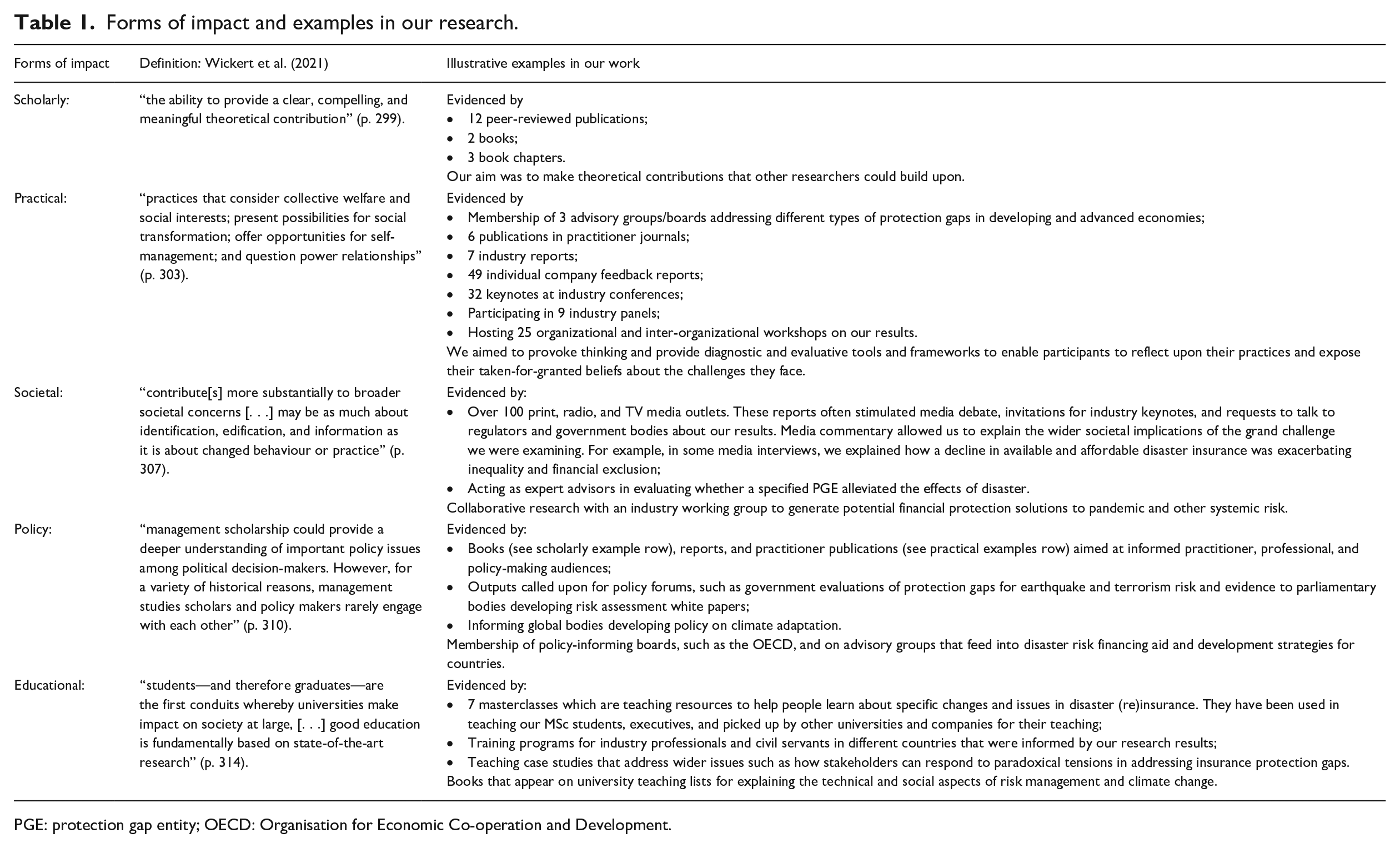
PGE: protection gap entity; OECD: Organisation for Economic Co-operation and Development.
Our research has always been guided by a desire to have impact, for three reasons. First, demonstrating that we would provide practical outputs was important to establish and maintain engagement with stakeholders. Our research requires access to insurance organizations, development banks, humanitarian organizations, government finance and environmental ministries, and emergency management and disaster response agencies. Gaining access meant negotiating with high status participants (Ma et al., 2021) in often politicized contexts. Access is rarely given by these participants on the basis of some vague promises of advancing knowledge for the good of humanity. These interviewees challenge and probe and expect to get something to help them think about the problems they face and provide useful insights (Empson, 2018). They also have time frames that are much shorter than academic publication cycles. So, providing some practically oriented outputs was an important part of maintaining access and building respect and trust with our participants (Wickert et al., 2021).
Second, practical outputs enabled us to engage deeply with phenomena (Jarzabkowski et al., 2019). This direct engagement allowed us to see beyond theoretical understandings and grapple with the complexities and nuances of real-world situations. Such immersion often resulted in the emergence of new, previously unexplored questions. These questions challenged the boundaries of our existing knowledge, prompting us to delve deeper into the research context. Moreover, as we confronted these issues and developed a more intimate understanding of their intricacies, we were struck by the need for significant change. This realization did not merely increase our academic curiosity. It stirred in us a fervor to actively participate in bringing about the changes we recognized as necessary.
This fervor raises a third, critical motivation, which is our emotional responses to the challenge we were immersed in. Studying disasters that have enormous social and economic costs is unavoidably an emotional experience. As we observed the climate crisis eroding the taken-for-granted financial response of disaster insurance in ways that were creating and exacerbating inequality, often for the most vulnerable in society, we became increasingly passionate to raise awareness, and to be part of the urgently needed changes. This, more than anything—certainly more than the pathways to impact required by funding councils—became our key motivation for impact. We were no longer satisfied with being mere observers; we yearned to play a part in shaping the solutions to the grand challenge we were studying.
Have we had impact?
It is always possible to debate whether research has had impact. The Research Excellence Framework (REF) (2021) of the United Kingdom defines impact “as an effect on, change or benefit to the economy, society, culture, public policy or services, health, the environment or quality of life, beyond academia.” Based on this definition, research is impactful only when it is adopted (has effects, changes, or benefits) in practice. Yet this, at best, overlooks the long-term contributions of theory to practice (Reinecke et al., 2022), and at worst, excludes as irrelevant any research that does not immediately change policy or practice. We have known the science of climate change for decades even as global warming escalates (Hoffman, 2021). This is not because climate scholars do irrelevant research or fail to have a clear pathway to impact. Rather, impact is multifaceted and politicized. There are many incumbent, inertial, interdependent, interdisciplinary, and institutionalized factors within which it is difficult to create change, even if research could provide a very clear answer to the grand challenges facing society. While in recent years the notion of research impact has begun to be more clearly delineated and has been judged according to criteria developed by universities and funding bodies, we feel that impact still remains somewhat elusive. Hence, to substantiate that our work has been impactful—a prerequisite for reflecting on what we have learned about the impact process—we simply note that our research has met the criteria for impact from multiple different perspectives. That is, our research has comprised impact cases within our universities, won impact awards and, as illustrated in Table 1, has produced multiple forms of the educational and scholarly impact detailed by Wickert et al. (2021). Beyond such substantiating of impact for external evaluation, we also believe that our research is impactful. We have seen industry participants and leaders engage deeply with our work and frameworks; using them as “conceptual” tools to support their understanding and assessment, as “instrumental” tools in their decision-making process, and as “legitimative” tools to gain acceptance for their decisions (Nicolai and Seidl, 2010). Having described our impact journey, activities, and outputs, we now briefly review the existing team literature to set the stage for our reflections.
What is impact? A brief review
The question of what “impact” is and how best to deliver it has become prominent within management research, partly because of the growing importance of impact as a performance criterion for the evaluation of universities and individual academics (Harley and Fleming, 2021; Reinecke et al., 2022). Increasingly, impact has come to mean academic research having relatively immediate practical relevance for managerial decision-making (Cohen, 2007; Starkey and Madan, 2001). In particular, the literature on impact calls for the practitioner voice to be incorporated into research conversations (Bartunek and Rynes, 2014), for deep research engagement with practitioners (Williams and Whiteman, 2021), for research puzzles to be a collective inquiry between researchers and the practitioners who experience them (Chen et al., 2022), and reimagining of business schools to better accommodate new forms of partnerships and training (Hoffman, 2021; Starkey and Madan, 2001). Building on these calls, Bansal and Sharma (2022) present a framework of three, often discrete, activities for doing impact, translating, co-creating, and performing, which we now explain.
Translating means shifting research findings from the realm of scientific debate to the realm of managerial action, often through diagnostic tools and explanatory frameworks (Jarzabkowski and Wilson, 2006; Pollock and D’Adderio, 2012). In practice, this means academics making research accessible for a managerial audience by translating it into practitioner language with minimal or no academic jargon. Crucially, it also means rewriting and communicating findings in a way that allows managers to fit the knowledge into the specific context of their organizations and make it actionable (Bartunek and Rynes, 2014; Kelemen and Bansal, 2002). Translation work increases the uptake of research outside the scientific community. However, as many scholars note, it often comes with tensions. For example, Rynes et al. (2007) explore the translation of HR topics into practitioner journals and find that the topics researchers believe are most important are barely covered. After a long and often exhausting research process, it can be difficult to engage in additional work to develop multiple versions of the same paper for different audiences (Bansal and Sharma, 2022; Bartunek and Rynes, 2014). Especially as this work is mostly unpaid and rarely rewarded within academic institutions (Bansal and Sharma, 2022; Williams and Whiteman, 2021); even though doing it well often requires costly support, such as hiring translators to help market the knowledge (Walsh et al., 2007). Despite these challenges, efforts at translation and knowledge transfer can be rewarding (Williams and Whiteman, 2021) because they support both dissemination and instrumental use of scholarly research (Reinecke et al., 2022).
In co-creating researchers actively involve practitioners in the research process, such as in the formulation and evolution of research questions. Co-creation does not privilege the academic as the producer and translator of knowledge, but rather identifies impact as an issue of knowledge co-production (Bansal and Sharma, 2022; Reinecke et al., 2022). Examples include workshops where academics and practitioners construct research questions or interpret data together (Sharma and Bansal, 2020). Co-creation does not simply mean developing answers to research questions of interest to managers. Not all managerial questions are relevant for research, sometimes because there are already well-known answers in the literature of which managers are unaware (Jarzabkowski et al., 2010). Rather, “practitioners become co-researchers, and researchers become co-practitioners” (Shotter, 2006: 601), as they engage in co-creating the problems that are interesting to explore. Williams and Whiteman (2021) call such co-creation “deep engagement” as co-creation is not a “one-off” but needs to be immersive and ongoing. Co-creating is “a radically different style of knowledge production” (Huff, 2000a: 288) based on collaborative scholarship (Van de Ven, 2007), where practitioners are engaged early in the research process (Ferraro et al., 2015; Wickert et al., 2021), and remain engaged over the duration of the research. This approach can enable problem-driven research focused on “what is important” (and practically impactful), produce research aimed at intervention in a field, or even underpin scientific activism (Delmestri, 2022; Reinecke et al., 2022). Importantly for research into grand challenges, co-creation is not simply aimed at working with managers on immediate and utilitarian questions and answers (Chen et al., 2022) but on producing solutions and societal changes based on theorizing from research (Reinecke et al., 2022).
In performing researchers actively engage in “responsive thinking, acting, and talking” within their research settings, rather than being outside observers (Shotter, 2006: 585). Performing with a field is not simply utilitarian, enabling managers to act upon their immediate problems. Rather, scholars engage practitioners in reflexive action that enables them to observe and critique the problems they face (Alvesson and Spicer, 2012), that might otherwise not be visible to them. Indeed, scholars may become activists to draw attention to and prompt reflexive action by practitioners (Delmestri, 2022). For example, Williams and Whiteman (2021) describe the experience of being unable to gain access to the World Economic Forum’s (WEF) annual meeting for 5 years. They, therefore, pitched a tent outside and assembled Arctic scientists, heads of state, activists, actors, artists, and organizational networks. In establishing this tent and attracting a multi-stakeholder team, known as Arctic Basecamp, they aimed to prompt action to combat climate change. Together, these stakeholders actively performed work of raising awareness about the risks of changes in the Arctic to inspire further action. Sharma et al. (2022) discuss performing through their Innovation Lab, in which practitioners and researchers work through wicked problems together, enabling and, indeed, urging them to understand and resolve problems collectively. Reinecke et al. (2022) go beyond these practical aspects of performing to also point to the long-term performativity of the theories that we develop. Theories that take hold, such as economic models that guide policy (e.g. Ferraro et al., 2005), or theories that expose hidden structures of domination, such as those aimed at decolonization (e.g. Cutcher et al., 2020), can play a role in constructing and reconstructing the social world. These impactful effects of theory that fall within the realm of scholarly impact (Wickert et al., 2021) are often long term (Reinecke et al., 2022).
Complex societal problems are dynamic with continuously unfolding phenomena that may add to wider challenges. For research to stay relevant (and thus impactful), research questions need to evolve in collaboration with practitioners (Chen et al., 2022; Sharma et al., 2022). However, most studies with impact are based on accounts of discrete research projects (e.g. Sharma and Bansal, 2020). Even where practitioners and scholars co-create research questions, the time needed to analyze and theorize from data for publication, means that the work on one project may have become past knowledge by the time it is translated for practitioner audiences (Williams and Whiteman, 2021), particularly where translation occurs after academic publications. Bansal and Sharma (2022), therefore, argue that the three approaches to doing impact have different temporalities located in distinct moments of a research project. Co-creation and translation rely mostly on past knowledge. Problems that are urgent, even though they might take place within the wider context of a long-term grand challenge, require a shift to performing, in which achieving practical impact takes the front seat in terms of focus and outputs, with academic knowledge development following later (Reinecke et al., 2022; Wickert et al., 2021). We now explain our own experience of translating, co-creating, and performing as interrelated, rather than discrete, activities within a processual pattern of impact over time. We build on these scholars, drawing from our own experience to extend understanding of long-term impact by unpacking its iterative nature across multiple projects within a research program.
Reflecting on our impact journey
As we made our impact journey, we had no blueprint to follow for “success.” While we had engaged with and actively contributed to the academic conventions for impact, such as submitting impact cases for our universities (REF, 2021), hosting impact-related workshops (Organization Studies Summer Workshop, 2007), editing special issues on impact (Jarzabkowski et al., 2010), and winning prizes for impact (ESRC, 2013), this did not dictate our path-to-impact. Rather, we were building from our prior field experiences and learning as we went. We therefore present two vignettes based on our experiences, using them as the basis for four reflexive insights on what we are learning about the iterative process of impact. The first vignette tells the story of how our impact object (Sharma and Bansal, 2020), a framework composed of the concept “Protection Gap Entity (PGE)” and set of associated tools to help explain and diagnose the activities of these PGEs, was developed, contributed to giving us legitimacy, and then helped us discover and engage with new phenomena.
Vignette: translating, co-creating, and performing an impact object
Our research into how different countries were addressing the insurance protection gap aimed to provide both theoretical and practical insights. One of our goals was developing an industry report that would make the results of our research accessible and usable to practitioners and policy makers [Translating].
Two years into our fieldwork, we felt that we had generated some robust insights and decided to communicate these back to the field. Based on our previous experience of translating research into practitioner reports (see Table 1), we thought our results would lend themselves to the production of what we called “diagnostic tools” embedded within the impact report. These tools are typically a set of linked frameworks under a thematic heading, which can be used by professionals to diagnose, discuss, and act upon their contexts (see, for example, Jarzabkowski et al., 2012). Over the course of a few months, we discussed how to translate our (interim) findings into themes that practitioners would find interesting and valuable. We spent time drawing frameworks on whiteboards and considering how they might support diagnosis of, and action on, the challenge we had been studying. The close working relationships with practitioners led us to engage them in discussions over some of these frameworks during our meetings and informal chats [co-creating]. This enabled us to evaluate our frameworks in the field, both for their ability to encompass the problem, and their value to our participants for working through the complex challenges they faced.
Through co-creating the diagnostic tools for translation, we realized that we needed a new, field-relevant but also conceptual label for the varied disaster insurance interventions we were studying in different countries. This would help our participants to conceptualize them differently. Otherwise, they became stuck in considering the specific issues in their local area, rather than considering them in the context of a global problem for disaster insurance. It also helped practitioners to recognize other, similar interventions that at the surface would seem unrelated (e.g. terrorism), but in essence had strong similarities with the problem at hand (e.g. flooding or cyclones). We coined a new term, Protection Gap Entity (PGE), which we defined as a not-for-profit insurance scheme that is brought about through multi-stakeholder interaction and government legislation, to provide insurance protection in a country for a specific disaster that would not be insurable in the private sector. As one key stakeholder noted of our PGE concept and associated diagnostic tools,
you’ve got all these different examples from around the world dealing with different types of peril, originating at different times in different circumstances, yet the work you and your colleagues have been able to do is to sort of conceptualize that actually here are the models and here are the drivers. (CEO of professional association)
Having established the value of the PGE term and diagnostic tools for helping our collaborators conceptualize ways to address the broader problem with lack of adequate disaster insurance, we held a launch event for our industry report, to disseminate and debate our findings to practitioners [Translating]. We included expert panels with stakeholders from different perspectives on, and involvement in, the grand challenge we were studying. These panels included stakeholders from the insurance industry, development banks, donor agencies, and government ministries around the world. As these stakeholders would not typically meet in their everyday work, we ran the launch as a debate between them on different themes in the report. This debate was both an opportunity for the participants to think differently about their problem and also helped fuel our research questions. Essentially, our report launch was a field-configuring event at which the participants could reflect and debate together, providing both them and us with new insights into the problem [Co-creating and Performing]. One point raised became particularly resonant to us, as the participants discussed whether and how PGEs should evolve to address the growing problem of uninsurable disasters in their countries. A CEO of one PGE argued that PGEs had a responsibility to evolve, “[it is] about creating the context in which the insurance market can evolve [. . .] through resilience [. . .] or through other activities over time that will significantly reduce uninsurability.” Others, particularly those from the for-profit insurance market were less enamored, stating that PGEs should only plug gaps in the private market, but not evolve or expand. One private-sector insurance CEO told us that PGE evolution was a matter of “scope creep, managerial ambition” rather than improved disaster protection, claiming that “[a PGE’s] number one mission, however it’s dressed-up, is to continue to survive and to grow their sphere of influence.”
The differences set the stage for further inquiries as we followed up with the different stakeholders. Ultimately, this led us to expand our research program and research questions to capture how and why PGEs were evolving to face future disasters, and the barriers they faced. Bringing together these different stakeholders with whom we had worked also deepened our relationships with them and our embeddedness in the field. For example, we were invited to join some industry advisory groups, such as a donor-funded initiative to provide advocacy and technical support for disaster protection in low-income economies, and an OECD (Organisation for Economic Co-operation and Development) Board looking at management of disaster risk in OECD countries. We sat on international panels where people debated the value of PGEs—some strongly denying their value, while others advocated for them as a source of protection in the face of increasing disaster. In 2020, as the COVID-19 pandemic exposed the problems of systemic risk for insurance, we became part of an industry working party looking at ways to form a PGE for pandemic, in the process developing our PGE framework (comprised of the PGE concept and the associated diagnostic tools) into new ways of understanding systemic risk (e.g. Jarzabkowski et al., 2021; Schanz et al., 2021). Our ongoing work of translating and co-creating had led us into activities where we collaborated with stakeholders in shaping the future of this unfolding grand challenge [Performing].
We now discuss two reflexive insights arising from our experience. These insights are not developed solely from the incidents highlighted in the vignette. Rather, the vignette is a means to illustrate some of our ongoing reflections.
Reflexive insight 1: translating, co-creating, and performing are iterative
Our research across several projects over 15 years allows us to elaborate on the dynamics of translating, co-creating, and performing. In our experience, these are not necessarily occurring at “different moments of time” (e.g. Bansal and Sharma, 2022: 831), or as distinct pathways to impact (e.g. Reinecke et al., 2022). While some studies show moments of co-creation or translation at points within a process (e.g. Sharma and Bansal, 2020, 2023), we experienced them as overlapping and iterative work aimed at understanding a challenge and supporting action upon it. The process of creating impact is iterative and cumulative, with different forms of impact (Wickert et al., 2021) and types of impact work (Bansal and Sharma, 2022) building upon each other over time and evolving across several projects within a program of research. Separation of impact work into types is conceptually convenient for explaining the various activities and tasks associated with impact. However, our first reflexive insight for those embarking upon an impact journey is to expect to be engaged in these activities within a non-linear, shifting, and messy process of building impact and impactful outputs (Wickert et al., 2021) over time.
Our impact pattern suggests making the most of opportunities as they emerge and knitting together the various work and forms of impact produced to build and deepen impact over time, and over multiple projects. The questions that are co-created, the research activities that are performed, and the emerging answers that are translated do not start anew each time. Rather, they are part of an ongoing renewal of engagement with and impact in a field and the challenges that it faces. This perspective on impact is not about building neat links between specific impact events or inputs (such as co-creation) and resultant clear outputs (such as translated industry reports). This iterative process is even more evident as we move from individual projects to our overarching and unfolding program of research. To illustrate, let us point to the examples of our impact in Table 1. While we have been writing industry reports and holding industry events since 2010, these outputs are not best understood as separate, stand-alone incidents of impact on specific parts of an industry. Rather, they are part of a stream of impacts that are connected to the wider policy conversations the team is now having about financial and physical protection from disaster in the context of climate change. Similarly, as indicated in the vignette reference to our 2012 experiences of developing frameworks, our seemingly expansive global conversations with industry, government, and inter-governmental actors that are ongoing today cannot be understood without tracing this unfolding pattern of impact to those initial reports and discussions with reinsurance practitioners. This messy, emergent pattern of engagement that we explain is implicated within multiple forms and ways of doing impact.
Reflexive insight 2: a flexible yet robust impact object is important
Many scholars have noted the importance of objects in knowledge creation (e.g. Carlile, 2002; Dougherty, 2004; Nicolini et al., 2012). Sharma and Bansal (2020) point to the importance of objects, such as jointly developed PowerPoint slides or drawings, in knowledge co-creation between academics and practitioners. They note that objects generated through dialogic exchange between researchers and their participants are incomplete and evolving but can be taken by each party into their own thought worlds. Our experience goes beyond these dynamics, echoing work in the social studies of science, which argues that objects that become adopted and impact how scientific work is done are heterogeneous, binding concepts (Star and Griesemer, 1989). As our vignette shows, our impact object—the PGE concept with its specific techniques and tools—was both flexible enough to accommodate local concerns (and thus be used by practitioners) but robust enough that it remained recognizable across different applications (Fujimura, 1992). In our pursuit to articulate our findings and make them usable, we standardized our language, ensuring that our terminology, especially surrounding the PGE, was backed not just by the term itself but by a comprehensive report and a suite of standardized diagnostic tools. This not only provided context for action but also ensured that once adopted, the term could be used with all the associated meanings and intentions we have embedded within it. Yet, as with any robust and flexible concept, its adoption by different audiences might—and did—lead to uses we never envisioned.
We had been studying forms of intervention on insurance protection gaps in multiple countries around the world. We developed our impact object because it was difficult to lift conversations with our participants beyond their specific contexts (e.g. gaps in insurance for UK flood, Californian earthquake, or Australian terrorism), in which they were undoubtedly experts. To move our translation of those specific contexts into co-creation across contexts, we needed a conceptual impact object that, while faithful to each group’s local experience, could also serve as a common focal point for examining their most salient challenges. The PGE concept and associated tools in our initial report became that object. While it was partial, evolving and co-created between us and our various participants at the outset, once formalized and translated in a report with associated diagnostic tools (Jarzabkowski et al., 2018), it became part of performing the field, beyond our co-creation. For example, it was cited in government terrorism insurance legislation (Australian Terrorism Insurance Act, 2018), as part of a European Commission report on nuclear liabilities (European Commission (EC), 2020), and published by practitioners for their purposes and audiences (Intelligent Insurer, 2018). In other words, our PGE framework (the PGE concept and its associated tools) became an object with a life of its own, adopted in different contexts and for different conceptual, instrumental, and legitimative reasons (Nicolai and Seidl, 2010), and yet maintaining sufficient integrity to be recognizable.
Our second reflection, therefore, is that translation is not a discrete, post-publication activity that is “safeguarded” by the publication process (Harley and Cornelissen, 2019). Rather, the objects produced in translation are heterogeneous in their uses and can become part of performing the field even before the first publication. This adds value to the research team in understanding and validating their findings but also comes with deep responsibility. While our field assumes that the objects in a published article are “rigorous” because they have been through the hurdles of the publication process (Harley and Cornelissen, 2019; Jarzabkowski and Wilson, 2006; Pettigrew, 2001), a translated object is different. First, it is not primarily a statement of fact (although it is built on scientifically inferred “facts”) but a tool for managers to see the world in a different way that stimulates their own reflective processes. The value of ideas and concepts in seeing differently is one of the most important forms of impact by university research, one in which academic research adds value to the experiential knowledge of managers (James March in Huff, 2000b). The CEO quote in the above vignette is a confirmation of the value of our impact object to managers. Second, because it is different in nature, an impact object has gone through a different, co-created process of validation. That process puts impact objects through different rigors (Harley and Cornelissen, 2019); those of the field, exposing them to criticism and insight from multiple different angles, so that, as a team of scholars, you can be confident in the robustness and generativity of the objects co-created and translated, despite the subsequent criticisms and consequences that these objects may undergo as they become part of performing the field.
We now present a second vignette, in which we note that efforts at impact and the objects created in those efforts may be contentious, with implications for both the iterative process of doing impactful research and for the motivations of the researchers engaged. We use this second vignette as the basis for two further reflective insights.
Vignette: impact and its objects are contentious
The 2018 event around our PGE object (report containing the PGE framework and diagnostic tools) helped us further co-create the research problems we were studying, in the process bringing in more stakeholders. While PGEs were already phenomena in the world, our impact object gave voice to them by bringing a wider set of stakeholders together to interact over their role in public fora. These stakeholders, who would not routinely interact with each other, held different viewpoints on PGEs, which then came to the surface. Some stakeholders, particularly from private-sector incumbents, were adamant that they were a disruption to the market and should be avoided. For example, one such stakeholder noted that “we were extremely unhappy about them [PGEs] and so we made clear we would, you know, fight them tooth and nail.” Others considered that a PGE should only be a last resort—such as for the collapse of the terrorism insurance market after the attacks on the World Trade Center. As another such stakeholder noted, pointing to a major flood insurance PGE in one country, PGEs should be avoided because they could have unintended consequences; “we’re not having anything that might end up like the [country] system. We’re well aware of the [country] system as well and we’re not aiming to copy it.” The phenomena we had labeled and made into a common object for discussion was contentious for the stakeholders we had drawn together, some of whom were happy to take issue with our findings. Fortunately, our impact journey to date had already prepared us for the inevitability of our impact object developing a life of its own while performing in the field, as practitioners attempted to deploy it in support of their own agenda.
In 2015, we released a book titled Making a Market for Acts of God (Jarzabkowski et al., 2015), based on our study of the profound changes in the global reinsurance market that pays for recovery from many of the local disasters around the world. The underlying research had been developed through the iterative process described in Reflexive Insight 1. The book had then been written as a crossover text, suitable for an academic audience but also intended to be insightful for an informed lay audience. In our penultimate chapter, we developed a nuanced reflection on the potentially problematic implications of capital changes, particularly the entry of catastrophe bonds, into the reinsurance market. We were slightly bemused, if pleased, to see it written up on the front page of the Financial Times as “Catastrophe deals threaten reinsurance sector collapse.” It seemed that those three to four pages of our book had been taken out of context to write a headline-grabbing story. Consistent with our insights on impact objects, we were confident that the findings had been subjected to the rigors of co-creating, translating, and performing impact work over several years and were robust. We, therefore, hoped the media attention would attract people to read the book and learn more about how to sustain this very important yet hidden industry. It certainly did attract attention! Five days later, the headline on the front page of the Financial Times was “Catastrophe bonds pioneer hits back at book,” as the CEO of a hedge fund declared that “the business school analysis that warns of dangers in the market reaches ‘completely false’ conclusions.”
Obviously, it is very disturbing to be publicly attacked by powerful incumbents who may view a grand challenge, or the solutions to it, in very different ways. While the nuanced, thoughtful debate at our book launch a few weeks later helped us to understand the value of our research to the various industry stakeholders, including many incumbents, it also made us reflect on who and what we were trying to impact. We began to see strong reactions to our impact efforts as generative of new research questions. This experience prepared us to value the 2018 reactions to our PGE object as an important stimulus for further impactful research. We now draw from the incidents recounted in this vignette, which illuminates the often-contentious nature of impactful research, to offer two further reflexive insights.
Reflexive insight 3: co-creation is both contentious and essential
The contentious nature of some of our efforts has led us to reflect on the work of co-creation, which we find to be contentious but also essential. First, while many impact studies note the tensions between academics and practitioners during co-creation (e.g. Sharma and Bansal, 2020, 2023), fewer note the tensions between the practitioners themselves within the focal context for impact. Any grand challenge will attract multiple viewpoints on ways forward (Couture et al., 2023; Jarzabkowski et al., 2022; Williams et al., 2019). As others have shown, on challenges such as climate change, incumbents find it difficult to consider anything that goes beyond business-as-usual (Wright and Nyberg, 2017). Co-creation is thus not just a matter of reconciling tensions between researchers and practitioners, difficult as that may be, but also of working out the researchers’ own stance on the tensions between practitioners. A key aspect of this insight, therefore, is not to confuse co-creation with consensus. While there will be tensions between practitioner and researchers (Sharma and Bansal, 2020, 2023), and between the practitioners themselves, reconciling these tensions within co-creation is not always necessary, or even desirable. Rather, topics where some participants vehemently oppose solutions proposed by others may very well be the areas where impact-oriented research is most needed, even if its conduct proves challenging. Indeed, the resistance to PGE evolution by some stakeholders, particularly insurance industry incumbents, guided our evolving research agenda, as we began to look at the rationales for and barriers to PGE evolution, including how to address the dysfunctional unintended consequences that incumbents often used as a reason to dismiss PGEs as a viable solution to the insurance crisis (Jarzabkowski et al., 2023a).
Second, while co-creation is contentious it is also essential, as changes to grand challenges will involve at least some input from, or effect upon, the incumbents, not least in changing their own attitudes and actions. Co-creation thus demands that researchers both work with practitioners’ interests in developing the research questions but also maintain integrity, ensuring they are not swayed by dominant stakeholders’ interests. This dimension of co-creation requires a delicate balance, as researchers need to uphold their scientific principles while ensuring their continued access to the fields they scrutinize. Many researchers operate within existing power structures, needing to find a balance in “speaking science to power” (Williams and Whiteman, 2021) while also maintaining access to the very power structures that they seek to change. Yet it is important to understand that impactful science is not impartial. While we should strive for responsible advocacy from our research, the problems to which we will dedicate our energy for impact are likely to be those where we have already taken a stance as part of our interest in addressing them (Schmidt, 2015). Sometimes, therefore, as with Whiteman’s establishment of the Artic Basecamp (see Williams and Whiteman, 2021), the most impactful problems to study are those that are too contentious to find a point of co-creation within existing power structures, leading to our final reflection.
Reflexive insight 4: impactful research requires courage, persistence, and humility
We have been working in this field for 15 years. Beyond the evidence of our impact as measured by evaluating bodies, the processes that we describe above give us confidence that we have had impact, if nothing else because our results were controversial and stimulated debate among industry participants. Nonetheless, as we outlined at the start, the problem we are studying—the retreat of disaster insurance in the face of extreme weather—has worsened. And that worsening brings negative consequences such as delayed post-disaster recovery and reconstruction, insecure housing, widening inequality, financial exclusion, and huge emotional and social costs to society. Those consequences, with real effects on lives in the communities where we live, are emotionally difficult to behold. Yet we cannot change them solely through our research. Not because we do not have impact, but because the intractable (systemic, wicked, grand) challenges that we are addressing are themselves evolving (Ferraro et al., 2015; Schad and Bansal, 2018). Our final insight, therefore, is that impact scholars need humility about their ability to generate change, alongside the courage to persist and to keep looking for new ways to co-create and perform potential solutions with an ever-wider group of stakeholders.
As our second vignette shows, courage is needed to keep trying to impact systems, policies, and people that can be vocal in their resistance to change. As many have noted, the traditional academic system does not always reward impact activities (e.g. Bansal and Sharma, 2022; Baudoin et al., 2022; Bednarek et al., 2023), while overlooking the fact that the practitioner world may also not reward efforts at impact, and the personal costs to the researcher might be high. This may mean turning our attention, as scholars with a passion for impact, toward including other, perhaps initially peripheral, stakeholders with whom to co-create that impact. This search for alternative stakeholders in co-creation has become important to us, as, despite our engagement within and impact in the field, the problem of uninsurable disaster risk has kept growing. We have thus begun shifting our focus to the links between insurance systems, PGEs, and climate adaptation (Jarzabkowski et al., 2023a). In doing so, we are persisting with our focus on the challenge of the growing insurance protection gap, and with our engagement with the incumbent insurance system, even as we also bring it into dialogue with wider parts of the system we hope to impact (Bednarek et al., 2021), such as disaster risk reduction agencies, government-funded resilience initiatives, and community resilience initiatives (Jarzabkowski et al., 2023b). In these endeavors, we are humble about our ability to change the world. Furthermore, we expect our efforts to be deeply unpopular with at least some stakeholders in our grand challenge. But we hope that our persistent efforts to evolve our research questions and seek new impact partners will enable us to continue performing actions that might ameliorate some of the effects of a breakdown in disaster insurance. Our fourth reflexive insight, therefore, is that it is important to be humble about the impact that your research can have, while having the courage to persist in doing that research. In the spirit of the Artic Basecamp (Williams and Whiteman, 2021), we encourage impact scholars to consider their humble but courageous persistence in studying intractable problems as important and scientific activism (Delmestri, 2022; Schmidt, 2015).
Conclusion
Having actively reflected on our impact work journey, we conclude that such work is nuanced and, in our experience, neither fits neatly into a predefined framework nor has the impact anticipated. Instead, impact activities of translating, co-creating, and performing take place iteratively and collectively over many years and many linked and evolving projects in which benefits may take years to eventuate. While the concepts developed by scholars of impact have guided our reflections, we do not aim to propose a specific blueprint for conducting impact research. From experience, we have seen that such a blueprint does not exist. Rather, we aim to inspire the courageous journey of the impact-driven scholar and, with this essay, stand by their side when frustrations and difficulties arise that might discourage them from persisting.
Of course, our reflections are limited to our particular research context (the global arena of disaster insurance), our team (that evolved over time and is generally interested to have impact; Bednarek et al., 2023), serendipity (the emerging insurance puzzle and its relevance to disasters such as COVID-19, with which the team was ready to engage), and, at times, a little luck. Nonetheless, we believe that our four reflective insights will stand impact scholars in good stead on their own journey: to embrace the iterative process of doing impact work, secure in the knowledge that that messy process will bring to the surface those issues most worth studying; to develop robust impact objects that can be a common focal point for stakeholders, while acknowledging that those objects will go on to have a life of their own, beyond your intentions; to engage in the essential process of co-creation, even so that efforts to do so will be contentious to at least some stakeholders, often those with much power over the system; and to combine humility over your ability to affect intractable challenges with the courage to persist and to involve an ever-wider set of stakeholders in your endeavors. We hope that our reflections inspire our colleagues and, importantly, heighten their sensitivity to the potential opportunities for impact that may present in their own impact journeys.
Footnotes
Acknowledgements
We thank our dear colleagues and collaborators who have been part of this 15-year journey at different points in time: Adrianna Allocato, Gary Burke, Laure Cabantous, Michael Smets, and Paul Spee.
Funding
The author(s) received no financial support for the research, authorship, and/or publication of this article.
