



Abstract
Behavioral theories of organizational decision making highlight the importance of decision rules for information aggregation, which are used to combine individuals’ evaluations of alternatives into collective choice. We examine how resource constraints affect the ability to make effective decisions with aggregation rules, including majority voting, averaging opinions, and delegating to experts. Using a series of computational experiments, we find that which rule is best depends on how an organization uses scarce resources to improve members’ knowledge of alternatives (accuracy resources) and include them in decisions (inclusion resources). By demonstrating the interdependence of resources and aggregation rules, we draw attention to the resource costs required to harness collective wisdom in organizations. We discuss implications for research on information aggregation and the design of organizational decision architectures and outline new directions for research.
Introduction
Behavioral theories of organizational decision making afford a central role to decision structures or decision rules (Cyert and March, 1963; March and Simon, 1993). These structures and rules orchestrate the process of making decisions. Although foundational Carnegie School research focused on decision rules for search (e.g. satisficing, Simon, [1947] 1997), subsequent research has examined rules for evaluating and selecting alternatives (Knudsen and Levinthal, 2007). Of particular interest are structures and rules for information aggregation (Puranam et al., 2015), which are used to aggregate individual judgments into organizational choices (Csaszar and Eggers, 2013). For instance, a top management team can decide whether or not to pursue an opportunity using aggregation rules such as majority rule or delegating to an expert.
One important endeavor has been to explore different types of aggregation mechanisms and examine which perform best under different conditions (Christensen and Knudsen, 2010; Knudsen and Levinthal, 2007; Sah and Stiglitz, 1986). Recent research has highlighted an important but largely overlooked consideration—the knowledge composition of the decision unit. Csaszar and Eggers (2013) showed that the performance of common rules including majority voting, averaging opinions and delegating to experts depends on the breadth of knowledge within the organization. Related work has analyzed the types of knowledge composition that facilitate other aggregation mechanisms, including crowd-based decisions (Davis-Stober et al., 2015; de Oliveira and Nisbett, 2018; Larrick and Soll, 2006; Mannes et al., 2014; Page, 2007). To date research has treated the knowledge composition of the decision unit as an exogenous factor and assumed that knowledge composition is given—that is, it takes on particular characteristics such as diversity, breadth, or bracketing (Csaszar and Eggers, 2013; Larrick and Soll, 2006; Puranam et al., 2015). In practice, however, the composition of decision units often reflects organizational and social psychological factors, which means that idealized configurations of knowledge are rare (Klein and Harrison, 2007).
Accordingly, in the present research we use an agent-based model to examine the formation of the decision unit as an endogenous process. In doing so, we extend research on information aggregation to account for the mechanisms by which knowledge and expertise is brought into the decision process. Although various factors influence the knowledge composition of the decision unit, we focus on a limitation underlying all organizational decisions—the scarcity of available resources (Simon, [1947] 1997). Specifically, we examine how resources affect the formation of the decision unit, shaping its knowledge composition and determining which aggregation rules are most effective. We identify two such resource constraints, specifically concerning the time, effort and energy required to (1) develop accurate knowledge of the environment (which we term accuracy resources) and (2) include individuals in the decision unit (which we term inclusion resources). Researchers have discussed how achieving the distribution of expertise required for effective decisions may require resources and thus entail costs (Csaszar and Eggers, 2013; Hastie and Kameda, 2005; Sah and Stiglitz, 1986). But, the role of resources in information aggregation has not been analyzed systematically.
Our findings demonstrate that there are complex interdependencies between the resources directed toward decision making and the aggregation rules used to evaluate and select opportunities. For example, we show that when organizations invest little in accuracy but invest heavily in inclusion they would benefit from a delegating rule. In contrast, when an organization devotes scant resources to accuracy but is able to spend time and effort on inclusion using a crowd-based decision rule such as individual averaging is advantageous. Overall, our results suggest that organizations must either adapt their method of aggregation to the resources available or change how they use resources to support their preferred aggregation mechanism. The findings provide clues for this important aspect of the design of organizational decision architectures.
Theoretical background
Information aggregation and group decision rules
The literature on information aggregation in organizations is concerned with the process by which individual evaluations are aggregated into organizational-level decisions (for a review, see Puranam et al., 2015). Information aggregation is a vital process because it determines how organizations harness the individual knowledge and expertise at their disposal and factor it into collective decisions. Puranam et al. (2015: 371) describe information aggregation mechanisms as decision architectures consisting of “a set of rules that influence information flows and decision rights in an organization.” For instance, making decisions by majority rule means that all individuals in the decision unit input to the process and decision rights go to the predominant sentiment whereas making decisions by delegating restricts who inputs to choice and prescribes decision rights to a particular individual or individuals. Groups may adopt decision rules explicitly and deliberately, as in formal voting systems. In the absence of a formal system, groups follow rules implicitly. For example, following the largest faction or prevailing attitude can be viewed as an instance of majority rule (Hastie and Kameda, 2005).
Table 1 provides an overview of key ideas in the information aggregation literature. Research on information aggregation initially followed Sah and Stiglitz’s (1986) seminal analysis of the architecture of economic systems. Equating performance to the likelihood of making Type I (rejecting profitable ideas) and Type II (accepting unprofitable ideas) errors, they introduced two influential ideas. First, mistakes arise from errors of individual judgment. Second, mistakes also arise from the structure of decisions. They showed that centralized hierarchies in which few individuals can approve ideas are more conservative (they make fewer Type II errors) whereas decentralized polyarchies in which several individuals can approve ideas make more Type II errors but also accept more ideas. Christensen and Knudsen (2010) examined the range of optimal arrangements between hierarchy and polyarchy for varying numbers of decision makers. Knudsen and Levinthal (2007) showed that hybrid structures comprising a mixture of polyarchy and hierarchy performed best on a rugged landscape. Csaszar (2013) provided a general topology of the design space of organizational structures.
Key concepts in the information aggregation literature.

As shown in Table 1, a related body of work has examined decision rules rather than decision structures, the latter being more fixed arrangements of flows and rights. Group decision rules determine what the group preference or decision is for any given set of preferences among the individuals in the group (Miller, 2015). Research on group decision rules has focused on finding the best performing rule under different conditions. Building on social psychological research on the benefits of groups, Hastie and Kameda (2005) compared nine possible group decision rules and showed that the majority rule is robust across a range of group tasks and environments. Csaszar and Eggers (2013) extended this approach to analyze group decision rules that are common in organizations and showed that the best performing rule depends on the knowledge composition of the organization and its external environment. A related stream of literature on the wisdom of crowds has focused on one particular rule, namely, averaging across individual opinions, and examined how decision makers can find the group size that best leverages the statisticized distribution of estimates. More recently, researchers have turned to look at the psychological processes that influence and are influenced by the aggregation process, including social influence and deliberation (see Table 1).
As shown in Table 1, a theme running through research on information aggregation is that the cognitive composition of the decision unit exerts a major influence on the effectiveness of alternative aggregation mechanisms. Some research has focused on uncovering the particular distribution of knowledge required by a particular aggregation mechanism. For instance, Larrick and Soll (2006) showed that the commonly touted averaging rule, whereby individual opinions are averaged to find a more accurate collective evaluation, relies on bracketing; that is, individuals judgments must fall on both sides of the true value. The general literature on crowd decisions points to the importance of sampling diverse judgments (Page, 2007) and the effects of homogeneity/heterogeneity (de Oliveira and Nisbett, 2018). For Csaszar and Eggers (2013), the key aspect of composition concerns the breadth of knowledge in the decision unit, where breadth concerns the distribution of individual expertise relative to one another and the environment (see also Csaszar and Laureiro-Martínez, 2018).
However, as noted at the outset, the question of how a decision unit arrives at a given configuration of knowledge has not been systematically explored. We argue that a key consideration in this regard is the resources at an organization’s disposal.
Resources and costs of organizational decision making
The resource costs of decision making were fundamental to Simon’s treatment of bounded rationality. As Simon ([1947] 1997: 256) noted: underlying all administrative decisions is a limitation—a “scarcity”—of available resources. This is the fundamental reason why time and money are costs. Because they are limited in quantity, their application to one administrative purpose prevents the realization of alternative possibilities.
As summarized in Table 2, most research on the costs of decision making follows Simon. These works highlight the costs associated with using scarce resources to reach a decision, chiefly human information processing resources including time, energy, effort, and attention. Although resources occupy a central role in strategic management and organization theory (e.g. Barney, 1991), research has mainly focused on how decisions influence resources rather than on how resources influence the decision process.
Key works on the costs of decision processes.

As shown in Table 2, whereas some discussions of decision costs emphasize the resources required for individual choice, others focus on the resources required to coordinate the choice process as a group. For instance, Marschak and Radner (1972) drew attention to the communication cost involved in gathering information from others and the cost of computing the best action and communicating it to the appropriate persons. Sah and Stiglitz (1986) similarly highlighted the time and resources needed to acquire and communicate evaluations across individuals. Hastie and Kameda (2005) highlighted the social effort required to use various aggregation rules.
We build on these foundations to examine the resources needed to bring knowledge and expertise into the group’s decision-making process. By costs, we mean using scarce resources to develop and aggregate evaluations. Juxtaposing the literatures on information aggregation and costs, two resource constraints stand out as potential influences on the formation and knowledge composition of the decision unit; namely, the influence of resources on individuals’ ability to develop an accurate picture of the alternatives at hand and their influence on the ability to recruit people into the decision unit.
Increasing the accuracy of individuals’ knowledge of potential opportunities requires time, effort and other resources, which we refer to as the cost of accuracy. The accuracy of individuals’ knowledge is important since greater individual accuracy generally results in more accurate collective evaluations (Mannes et al., 2014), notwithstanding potential errors in communicating evaluations (Sah and Stiglitz, 1986) and the thorny problem of recruiting the right (i.e. most accurate) individuals into the decision unit, which we consider below. However, achieving accuracy is costly for organizations. Specifically, developing accurate knowledge of events requires learning in the form of updating and extending knowledge and beliefs (Cohen and Levinthal, 1990). Accuracy cost can thus be viewed as a type of learning cost (Levinthal and March, 1993; March, 1994). Applied to the present case, improving understanding of a potential opportunity entails a direct cost in terms of the time, effort, and attention required to acquire and process information and accommodate/assimilate it with existing knowledge. Examples include learning about new technological developments or market trends. Our conception of accuracy cost aligns most closely with the concepts of observation costs and individual cognitive effort discussed in Table 2. Using accuracy resources also entails an opportunity cost. As individuals spend time and other resources (effort, money) learning about a given opportunity, they are taken away from other alternatives and other tasks (March, 1991).
A second key type of decision cost is more social in nature. This cost concerns the use of scarce resources to include individuals in the decision unit, that is, the group of people whose judgments will be used to form the collective decision. We refer to this as the cost of using scarce resources for inclusion. Our conception of inclusion costs is thus closely related to the concepts of communication cost or social effort (see Table 2). We posit that it requires not insignificant time and effort to find individuals to include, make sense of their potentially contrasting judgments, and incorporate their inputs into a collective decision in simple terms, it is more costly in time and effort to process information from two people rather than one, three people rather than two, and so on (Kameda et al., 2011).
Although prior discussions of costs largely focus on the resources needed to include greater numbers of evaluators (Csaszar, 2018), we argue that resources also affect the ability to include different types of individuals. By different types, we mean individuals with differing knowledge and expertise. For instance, when individuals have different knowledge of and views on potential options it may take more time and effort to understand each other and share judgments (Felin and Knudsen, 2012). In particular, to gather inputs from “outlier” individuals whose knowledge and opinions differ significantly from the locus of consensus within the organization people have to spend time, effort and other resources (e.g. social capital) to gather, make sense of and combine their judgments (Gruenfeld et al., 1996; Kameda et al., 2011). Network research underscores the resource costs of seeking information from those who are distant in cognitive or social networks (Borgatti and Cross, 2003).
Model
To analyze the interrelationship between resources and aggregation rules we used an agent based computational model. Computational modeling has proven fruitful for studying organizational search and evaluation processes (Harrison et al., 2007; Knudsen and Levinthal, 2007). Agent-based computational models are ideal for analyzing the links between micro-behaviors (e.g. heterogeneity of individual agents) and processes and outputs at the collective level (Baumann and Stieglitz, 2014).
Our model follows other models of adaptive bounded rationality in organizations (Puranam et al., 2015). It examines the ability of groups of agents who are boundedly rational and adaptive—they do not know the true value of an opportunity and must estimate it using potentially inaccurate knowledge that they update in response to the task environment—to evaluate opportunities using alternative aggregation rules, in a world where resources are scarce. Our model provides a virtual laboratory that enables us to experiment systematically with relevant aspects of the decision process (Csaszar, 2020). Specifically, it enables us to examine the effects on performance when organizations devote varying levels of resources to accuracy and inclusion and use different aggregation rules to make choices. Like all models of social phenomenon, our model provides “a simplified picture of part of the real world” (Lave and March, 1993: 3). It is simpler than the system it represents but powerful enough to provide insights for theory building (Davis et al., 2009).
The model represents organizations comprising multiple agents evaluating opportunities. We allocate each organization a resource base comprising accuracy resources (Ra) and inclusion resources
In the first step, agents use resources to: (1) improve the accuracy of their estimates of the focal opportunity (accuracy resources) and (2) build the decision making unit by including individuals whose estimates will be used for the organization’s final evaluation (inclusion resources). We model the formation of the decision unit as a bottom-up process because the formation of evaluation teams tends to be endogenous and in a dynamic environment uncertainty regarding who is most expert means that agents cannot simply select the individuals who know best (Gavetti, 2012; Shah et al., 2019). The model is in line with decision making in dynamic organizations such as Valve, where “people choose their own projects and vote with their feet. They assess markets for new opportunities, gather information about existing projects and teams, and make their own judgments about whether to affiliate with existing teams or form their own projects” (Felin and Powell, 2016: 85). Our model can be understood in similar terms. Market learning is distributed and teams form organically as individuals learn about opportunities; individuals come together to form a decision unit from the organization’s existing members, as is often the case when managers assemble teams to assess new ideas (e.g. Shah et al., 2019).
In the second step, agents apply a group decision rule to aggregate estimates from individuals within the decision unit to make a final decision: accept or reject the opportunity (cf. Csaszar and Eggers, 2013). Agents evaluate opportunities sequentially, one at a time, and an organization’s resource base is the same for each opportunity evaluated.
Figure 1 shows how the model works, Table 3 provides an overview of model components and values, and Appendix 1 is a technical description of the model that can aid replications and extensions. The code for the model is available in Supplementary Material. Next, we describe the model’s components.
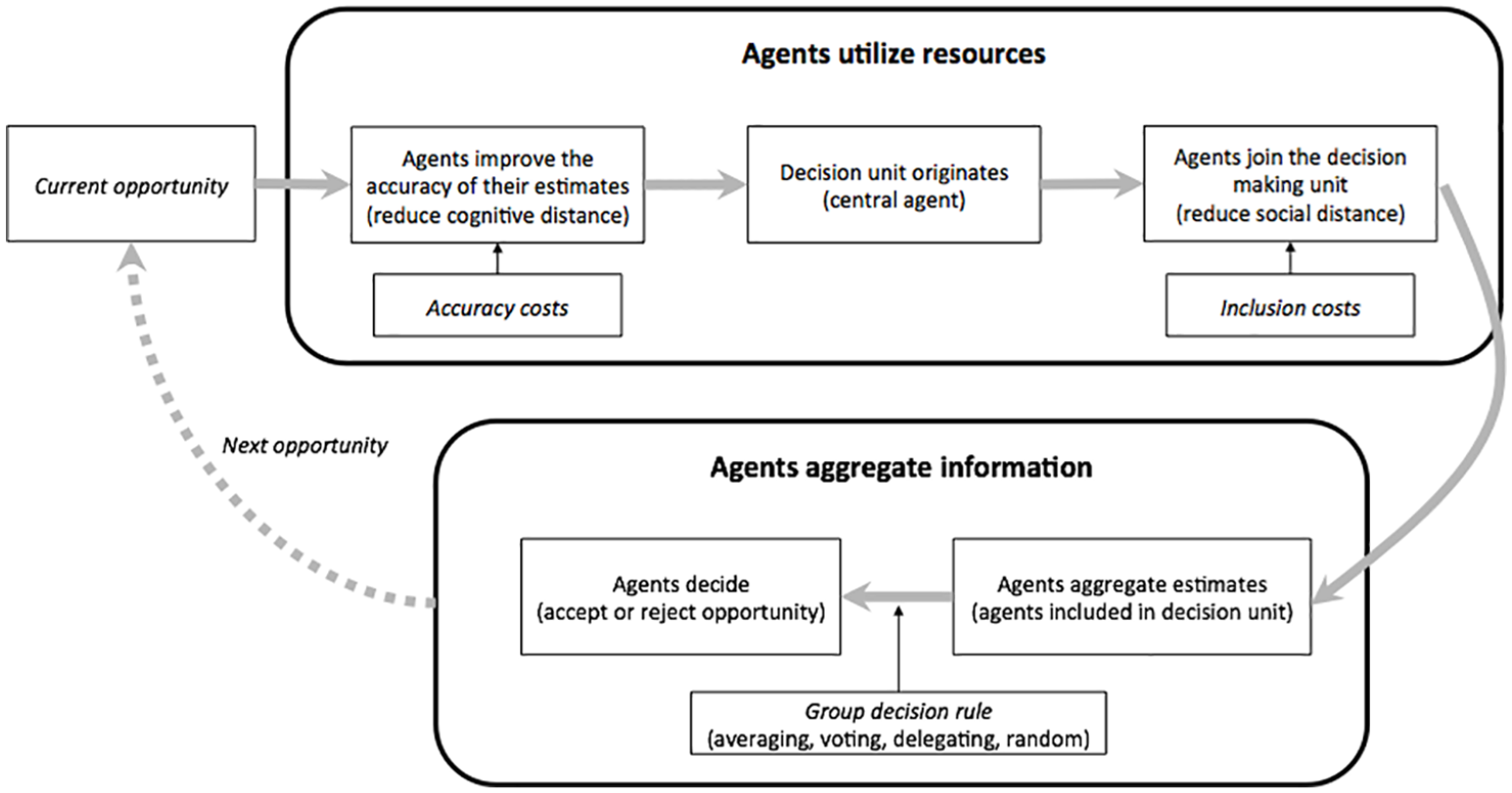
Process of decision in each period for all agents.
Model components and values, in order of appearance in the simulation.

Opportunity types
Following Csaszar and Eggers (2013), each opportunity is defined by a tuple
Agent knowledge and evaluation: Individual types
After an opportunity arises, individuals begin to assess its potential value. An individual’s accuracy in estimating an opportunity’s value depends on his or her specialized knowledge, that is, the knowledge and beliefs that they bring to a decision (Hambrick and Mason, 1984). Accordingly, we follow the approach adopted by Csaszar and Eggers (2013) to equip individuals in the organization with an individual type, which represents the relevant portion of individuals’ knowledge used to evaluate a given opportunity’s type. Agents’ individual types also determine their position in the organization’s knowledge network. Individual types are assigned randomly at the beginning of the simulation to ensure equal probabilities of expertise regarding the focal opportunities across simulated organizations. The distance between an individual type and the focal opportunity type defines the cognitive distance (
The individual produces an estimate from a random draw in the Normal distribution
Resources
Our units of resource correspond to individuals’ types. One unit of resource represents the time, effort, and other resources required to change one bit of an agent’s type (for accuracy) or include an agent based on one bit of his or her type (for inclusion). Specifically, one unit of accuracy resource enables one agent to switch one bit of their individual type to match the corresponding bit of the focal opportunity. One unit of inclusion resource enables the agent forming the decision unit to bring one agent one bit closer to being included in the decision unit. Figure 2 illustrates how accuracy and inclusion resources operate.
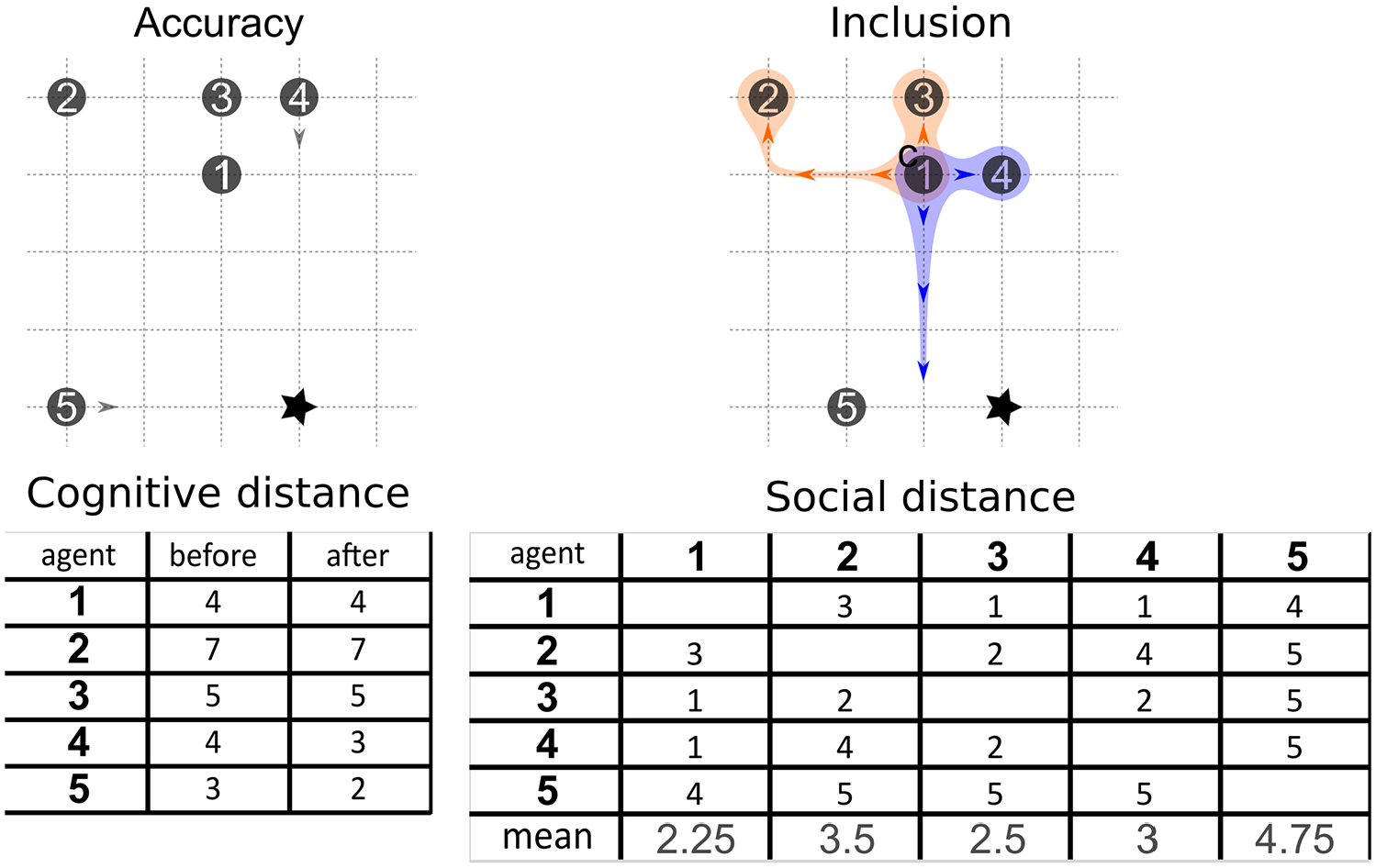
Illustration of accuracy resources and inclusion resources.
Accuracy resources
An organization’s given level of accuracy resources restricts both how many individuals are able to learn and how much they are able to learn about the current opportunity (i.e. how many bits of their individual type they adapt to the opportunity). Either way, expending accuracy resources changes the configuration of individual types in the organization from its initially random state. Learning about a given opportunity thus creates a degree of specialization or path-dependency in the organization (Tripsas and Gavetti, 2000). However, because opportunities in our landscape are uncorrelated, learning about one opportunity does not necessarily confer an advantage for evaluating subsequent ones.
We model accuracy in terms of the resources an organization uses from its budget

where M is the number of dimensions in the opportunity and agent types and d is the cognitive distance. Prob (accuracy)i thus decreases with cognitive distance
Inclusion resources
After individuals have made their evaluations, agents draw on the organization’s limited resources
Accordingly, we assume that forming the decision unit starts with the most central individual in the organization. We locate the central individual based on what we call social distance, which is defined as the Hamming distance between individuals in terms of the similarity of their knowledge (i.e. their individual types). The most central individual is the one whose individual type has the shortest average social distance from every other member’s type. Our assumption here is based on a large volume of social psychological research on the effects of prototypicality on group formation and leader emergence in decision-making groups (Hogg, 2001; Hogg and Terry, 2000). This research shows that the most prototypical members of a group tend to take the lead in group decisions made under uncertainty (Van Knippenberg et al., 2000) and that decision-making groups are more likely to endorse their most central or prototypical member and weight their inputs most heavily (Hogg et al., 1998; Van Knippenberg and Wilke, 1992). Research also shows that being central in a group gives managers access to information and expertise needed to initiate new projects (Ibarra, 1993).
The central agent builds the decision unit by expending resources to include other agents in addition to themselves until the organization’s inclusion resources are depleted. This aspect of the model can be viewed in terms of inclusion resources enabling the central agent to include others in the decision unit (see Figure 2). Inclusion is costly for two reasons. First, it takes more time and effort to include additional persons in a decision. Second, the more distant people are from the central agent, the more time and effort it takes to include them in the decision. The more people are different, the more they may find it difficult to work collectively, requiring time and effort to communicate and understand one another (Mitchell et al., 2017). As with accuracy, resources for inclusion are allocated probabilistically. Specifically, the probability that an individual i reduces its social distance

and this probability decreases with social distance si. If
Although all individuals in the organization have a nonzero chance to be included in the final decision, they are more likely to be included if they are closer to the central agent. Basing inclusion on proximity of expertise is in line with evidence that managers often start new projects by recruiting others with similar knowledge (Bunderson, 2003; Shah et al., 2019). Expending resources on inclusion allows the organization to include socially distant members into the decision-making unit, thereby increasing the unit’s knowledge diversity. However, these individuals will not necessarily be experts in relation to the focal opportunity. The model is thus consistent with evidence that there is no guarantee that a strategic decision unit will contain individuals whose knowledge fits with a new opportunity (Christensen, 1997; Tripsas and Gavetti, 2000). Moreover, and consistent with our theorizing, resource scarcity affects not only how many individuals are included but which individuals are included. Although our baseline model defines inclusion in terms of centrality, in extensions we experiment with alternative ways of defining inclusion, including building the decision unit by recruiting socially distant members.
Group decision rules
Finally, agents use a group decision rule to aggregate the evaluations of the individuals in the strategic decision unit (
Due to the stochasticity of the opportunity types and values as well as the initial individual types, we simulated 1500 organizations, each with a uniquely random opportunity environment and initial individual types. Both opportunity and individual types are strings of length
We simulate all combinations of accuracy and inclusion resources varying within the intervals [0,1]. The upper limits of these intervals correspond to a state where additional spending provides no additional information as all members of the organization have perfectly accurate estimates or are included in the decision. This state is relative to the parameter choice, namely,
Results
We structure our findings around three sets of results. We first describe the basic effects of investing resources and highlight the interdependence of resources and aggregation rules. Next, we provide formal tests to determine which rule dominates under different combinations of resources. Then we analyze the performance of pairs of aggregation rules under these conditions. Finally, we examine extensions to our baseline model and check the robustness of our results.
Interdependence of resources and aggregation rules
As shown in Figure 3, a basic observation is that all aggregation rules perform better at higher levels of accuracy and inclusion; the more resources an organization devotes to accuracy and inclusion, the better it will perform irrespective of the aggregation rule used. Crucially, however, these performance improvements vary in magnitude depending on the rule used: two organizations that use resources for accuracy and inclusion in the same way but use a different rule will make different decisions and achieve differing levels of performance. The intersecting planes in Figure 3 show these variations. Figure 3 also shows that group aggregation always outperforms the choice of a randomly selected individual.
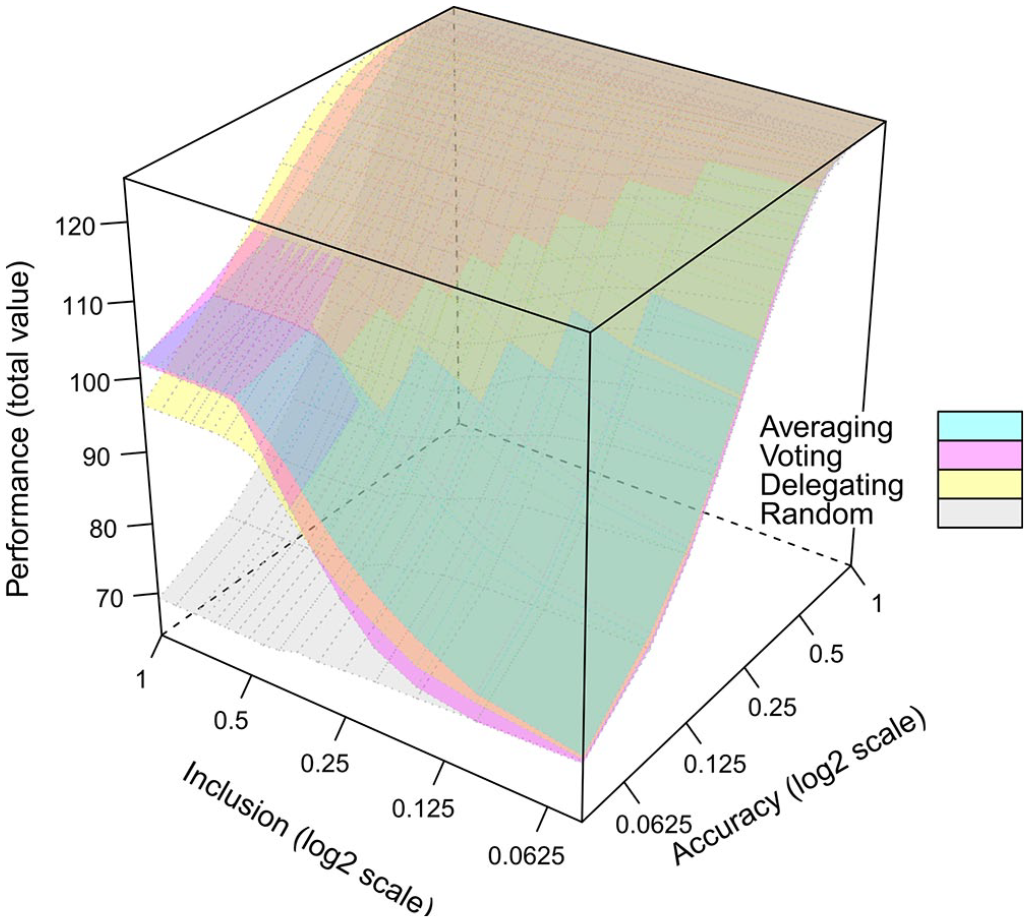
Effects of resources and aggregation rules on performance.
It is instructive at this juncture to examine the mechanism by which resources affect performance. Figure 4 shows how using accuracy resources shapes the distribution of knowledge in the organization by changing individuals’ cognitive distance from opportunities. The top panel of Figure 4 shows the minimum, average, and maximum cognitive distance of individuals in the organization. The bottom panel of Figure 4 shows the standard deviation of the average cognitive distance of individuals; this panel shows that investing moderate accuracy resources produces the highest dispersion of individual types in an organization, that is, the most cognitively diverse organization. Given moderate accuracy resources and because accuracy improves probabilistically with cognitive proximity, an organization’s diversity endures over time. In contrast, high expenditure on accuracy helps the organization converge toward the focal opportunity type, reducing the average level of cognitive distance and thus organizational diversity. The consequence of this effect is that when organizations are diverse (i.e. individuals have dissimilar individual types), they need to spend more on inclusion in order to ensure that experts input to collective evaluation. Conversely, when organizations are homogeneous, they need to spend less on inclusion in order to harness the judgments of experts. These results underscore the three-way interdependence of accuracy, inclusion and aggregation rules. That is, the effectiveness of aggregation rules depends on accuracy and inclusion and looking only at the two-way interaction (e.g. between accuracy and a given rule or inclusion and another rule) misses an important third part of the solution.
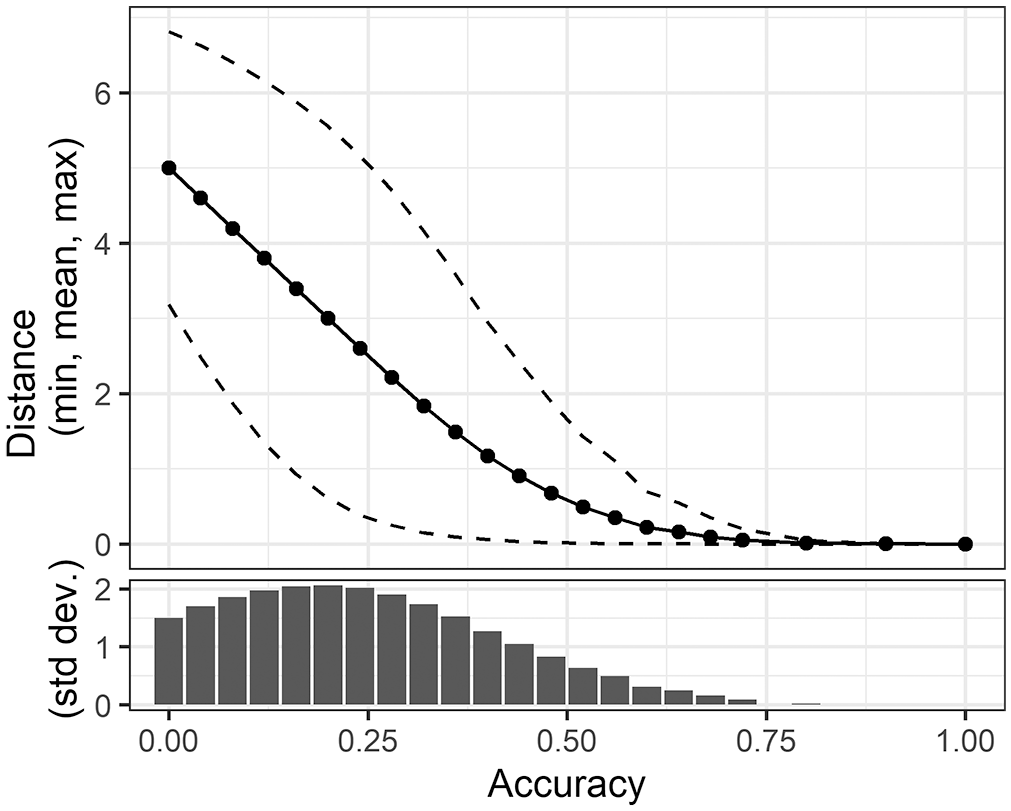
Effects of accuracy resources on cognitive distance in the organization.
The interdependence of resources and aggregation rules can be seen more clearly in Figure 5, which shows how rules perform when varying accuracy resources are combined with nil, low, medium and high levels of inclusion. In each of the panels in Figure 5, we observe a changing hierarchy of rules. Averaging is the best performing rule when an organization invests few resources in accuracy. But, with increasing investments in accuracy, averaging loses its advantage to the point where delegating and voting both perform better, with delegating becoming more effective than voting. However, the point at which averaging loses its advantage depends on an organization’s expenditure on inclusion; at low levels of inclusion (0.15) averaging is advantageous under a greater range of accuracy resources, whereas at high levels of inclusion (0.60) delegating and voting soon outperform averaging. These results are confirmed by Figure 6, where the focus is on inclusion resources, varying by levels of accuracy. An interesting observation from comparing these two figures is that when inclusion is null (Figure 5) the decision is in the hand of the central agent alone, hence there are no differences between aggregation rules. Yet, when accuracy is null (Figure 6), we can see how the rules perform when no individuals in the organization learn about the opportunities.
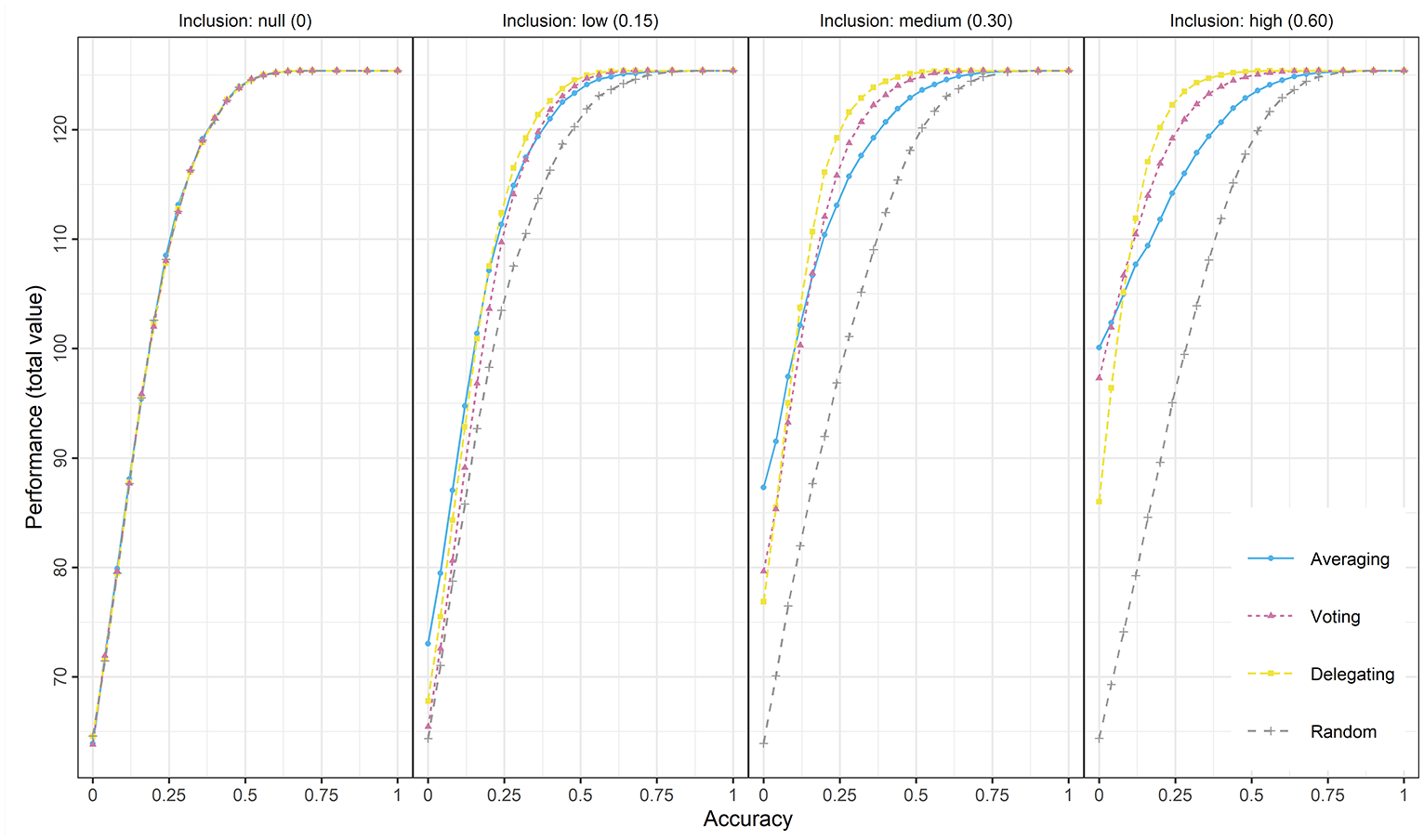
Effects of accuracy on the performance of aggregation rules, by levels of inclusion.
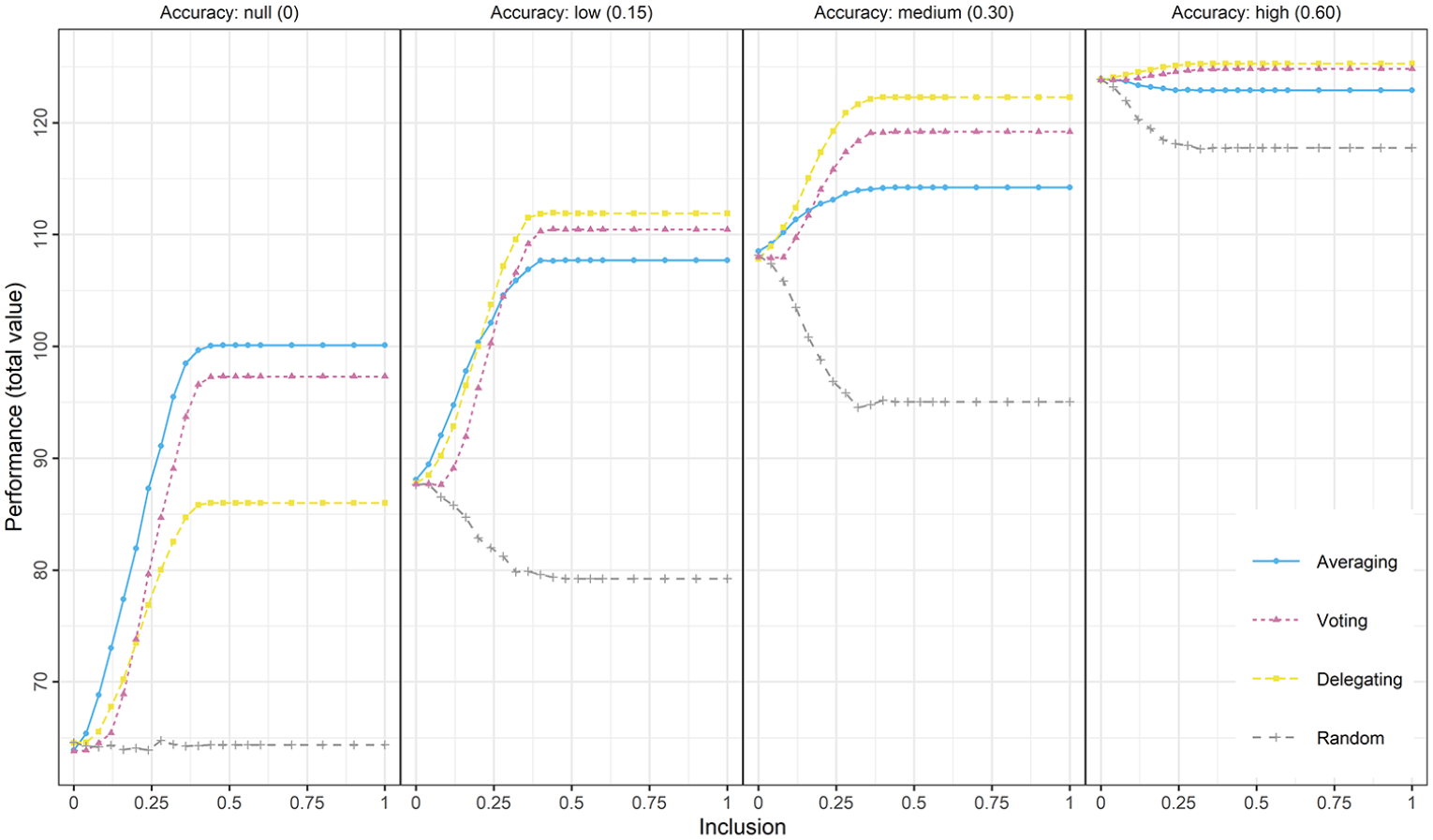
Effects of inclusion on the performance of aggregation rules, by levels of accuracy.
Determining the best performing group decision rule
To assess the relative performance of the four rules formally, we ran analyses of variance (ANOVAs) examining whether the performance of the rules differed significantly at each combination of resources. These tests enable us to show the resource conditions under which a particular rule or set of rules dominates, that is, performs significantly better than its closest alternative. If the difference was not significant, then all rules are equally effective. If the difference was significant, we ran corrected t-tests (using the Tukey procedure) to identify which rule or set of rules dominated. Thanks to large samples and low p-values, we set
Figure 7 shows the resource conditions structures under which particular rules dominate. As explained next, there is one set of resource conditions under which averaging dominates and another set of resource conditions under which delegating dominates. Voting does not dominate alone under any combination of resources.
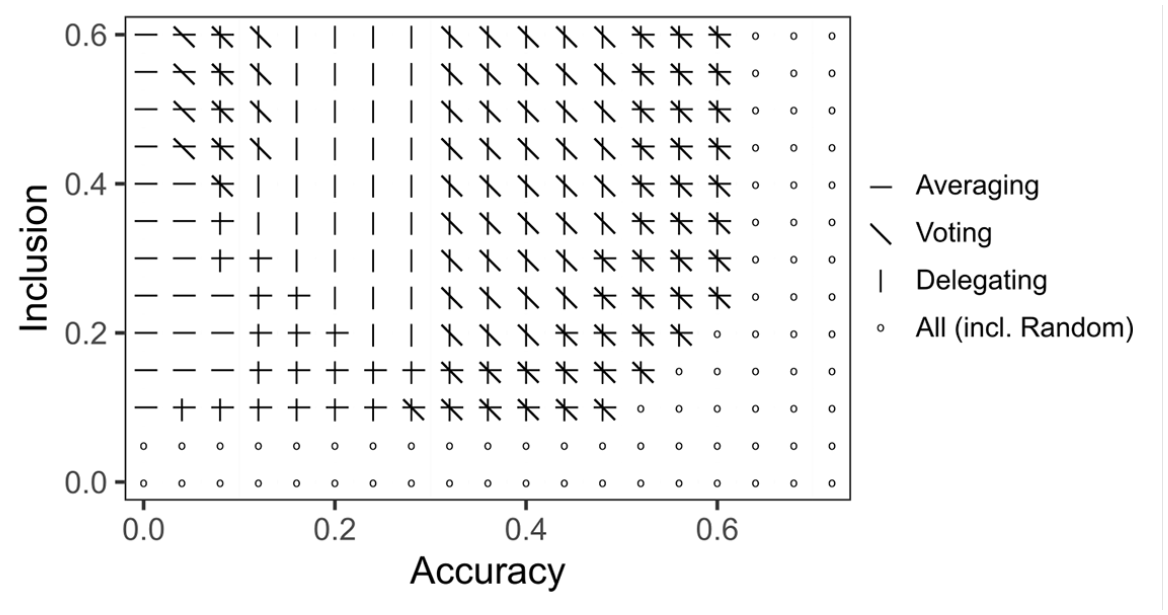
Dominance of aggregation rules by resources.
Averaging dominates only under very specific resource conditions, namely when an organization spends very little on accuracy. For very low accuracy, averaging is almost always the best performing rule, irrespective of how much the organization invests to include people in the decision unit. This effect obtains because low accuracy means that individuals learn little about the focal opportunity and are more likely to provide low accuracy estimates. Hence, in this condition averaging dominates since it allows an organization to include a higher number of estimates from the agents in its decision unit, triggering the benefits of the wisdom of crowds (Page, 2007; Surowiecki, 2005). In contrast, delegating under low accuracy increases the chances of relying on a poor individual estimate. Similarly, when accuracy is low voting leads to lower performance than averaging because it fails to take into account the magnitude of individuals’ errors (Keuschnigg and Ganser, 2017) and voting is particularly conservative in small groups (e.g. majority rule in a two-person unit requires unanimity). Hence, averaging appears a safe option when an organization is unable or unwilling to invest in accuracy; it is always better to average if the organization cannot be sure that agents are well-informed, irrespective of how many agents are included.
However, increasing accuracy quickly destroys the dominance of averaging. Figure 7 shows that if an organization invests moderately in accuracy and at least moderately in inclusion, then delegating dominates. Given these resource conditions, some individuals will have accurate estimates, and as a result of moderate investment in inclusion there is a higher chance of those individuals’ evaluations being incorporated in the decision unit. Hence, delegating allows the organization to choose a very accurate estimate, whereas averaging introduces more error.
Outside of the resource conditions where a single rule dominates, different combinations of rules dominate. As Figure 7 shows, when investing very little in accuracy but investing in very high levels of inclusion, then averaging and voting dominate equally over delegating (triggering a wisdom of crowds effect). In the opposing conditions—when inclusion is low and accuracy is moderate—averaging and delegating dominate over voting, since low inclusion undermines the advantages of voting. Finally, if an organization spends moderately on accuracy and at least moderately on inclusion, then voting and delegating dominate over averaging. Under these conditions, investing more in inclusion is detrimental to averaging because it gives too much voice to the few inaccurate agents included in the decision unit: the wisdom of crowds turns into an “inaccuracy trap.”
Comparing pairs of aggregation rules
A consideration for organizations is not which group decision rule is best from all possible alternatives, but how a given rule performs compared to a feasible alternative. Organizations may not be able to switch easily to the best performing rule, but rather be able only to move from a given rule to a viable alternative, due for example to rigidities in routines (Teece et al., 1997). Given such restrictions, pertinent questions include: when is it better to use majority rule than averaging, and when is it better to delegate rather than use majority rule? To help answer these questions, we compared the performance of pairs of aggregation rules under varying levels of accuracy and inclusion. We excluded the random rule since it invariably performs worse. These comparisons reveal some interesting performance reversals.
The left panel in Figure 8 compares the consequences of averaging and majority rule (i.e. “voting”). These results show that when an organization spends moderately on inclusion but spends very little on accuracy, averaging outperforms majority rule. These results are similar to those reported by Csaszar and Eggers (2013): when individuals learn little about an opportunity (low accuracy), the extra information provided by averaging is an advantage over the basic “yes/no” signals of voting. However, averaging loses its advantage over voting as more resources are allocated to accuracy. This performance reversal is most acute under high inclusion: when an organization spends highly on inclusion and moderately on accuracy, voting outperforms averaging. More specifically, when accuracy increases, voting becomes better because experts cannot be outvoted by the highly inaccurate estimations of non-experts. However, these effects are tempered by the organization’s ability to invest in inclusion. Without inclusion, even with the highest levels of accuracy, voting does not outperform averaging.
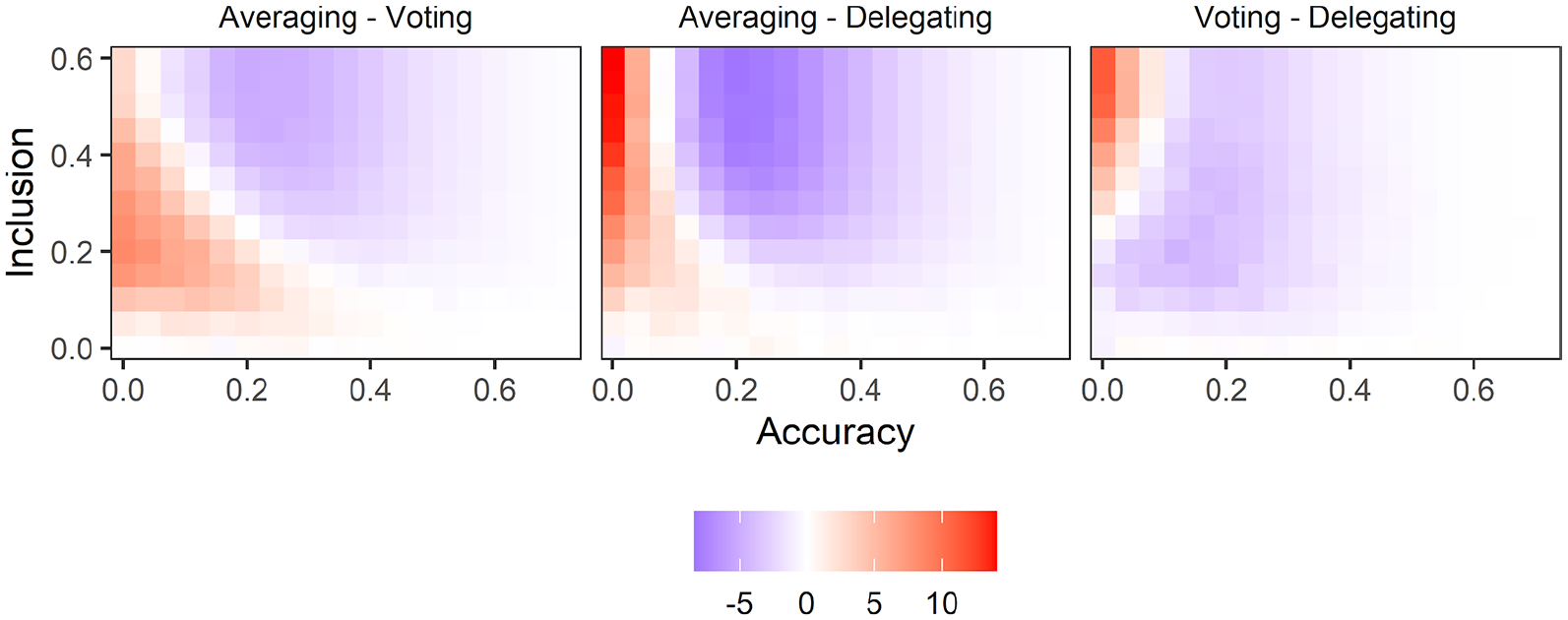
Paired comparisons of aggregation rules.
The relative performance of averaging versus delegating is less sensitive to inclusion. As shown in the middle panel in Figure 8, at higher levels of accuracy, delegating soon outperforms averaging. In this configuration of resources, switching from averaging to delegating takes advantage of the expertise provided by a high level of accuracy. For high levels of inclusion but relatively low accuracy delegation is superior to averaging because with more individuals to draw from and the ability to identify the most accurate one, delegating will be better than the average of many low-accuracy estimates.
Our final comparison concerns majority rule and delegating (see right panel in Figure 8). This comparison is instructive since these two rules are more practicable for and common in organizations (Eisenhardt, 1999; Sengul et al., 2012). Our results suggest that voting outperforms delegating only when accuracy is low. With low accuracy and at least moderate inclusion, voting rather than delegating enables organizations to capitalize on the error-canceling effects of using multiple independent evaluators. Hence, if organizations prioritize high inclusion and focus less on improving accuracy, then switching from delegating to voting is beneficial. However, at higher levels of accuracy delegating soon outperforms voting; as the most expert member of the organization moves closer to accurately understanding an opportunity, it is more beneficial to listen to their judgment than follow the consensus of those with lower expertise.
Extensions and robustness
To test the robustness of our results we examined alternative means of (1) utilizing accuracy resources, (2) utilizing inclusion resources, (3) determining the starting point for inclusion, and examined (4) the effects of the size of the organization and the dimensionality of the knowledge space. We summarize the results below (for full results, see Supplementary Material, which also includes an analysis of the simulation parameters).
First, we tested two alternative ways of utilizing accuracy resources. In our baseline model organizations prioritize the most knowledgeable agents for accuracy resources, seeking to maximize expertise. The alternatives we examined entailed investing in the accuracy of randomly selected individuals and investing in the accuracy of individuals whose knowledge is furthest from the focal opportunity. The latter case represents organizations trying to bring up to speed decision makers who are less informed (Mitchell et al., 2011). Both of these alternatives undermine the advantage of delegating; in both alternatives averaging is the only single rule to dominate. When organizations invest accuracy resources in those furthest from the opportunity, rather than destroying the dominance of averaging over delegating as in the baseline model, increasing investment in accuracy confers an advantage to both averaging and voting over delegating. This effect occurs because allocating accuracy resources to non-experts significantly improves their accuracy even at low resource levels, creating a large pool of less inaccurate agents from which to build the decision unit, triggering the advantage of crowd-based rules, while making the creation of perfectly accurate experts more costly (i.e. resource intensive). Overall, these results illustrate the boundary conditions for delegating to dominate. Whereas Csaszar and Eggers (2013) found that delegating is often best, these results reveal how difficult it is to achieve the cognitive conditions required for effective delegating.
Second, we tested the effects of changing the mechanism by which organizations allocate inclusion resources. We again examined two alternatives to our baseline assumption that when investing in inclusion organizations prioritize individuals who are closest to their center. We tested a random model in which organizations are more likely to deploy resources to bring into the decision-making unit a randomly selected member. We also tested a furthest first model that is the opposite of our baseline. This involves allocating giving priority for inclusion to agents that are furthest away from the center of the organization, akin to situations in which organizations seek judgments from atypical or outlier individuals to provide alternative viewpoints (Kray and Galinsky, 2003). Changing the inclusion mechanism had negligible effects, showing that our findings are robust to changes in the method of inclusion.
Third, we varied the starting point for inclusion. In our baseline model, organizations find their most prototypical member and use inclusion resources to gather judgments from those closest to that individual. We tested two alternatives whereby the organization designates a unique member selected at random as the center and a variable model in which the organization changes the designated center at random for each opportunity evaluated, representing situations in which the origin of the decision unit varies. Both the unique and variable models increase the range of conditions under which delegating dominates over averaging or voting. These effects obtain because in the random and variable models the average individual distance to the center is greater than in the baseline model; hence, it is more costly to bring individuals into the center to join the decision-making unit. With identical resources, but fewer individuals in the decision unit, crowd-based rules are less dominant.
Finally, we tested the robustness of our findings to variations in organizational size and the dimensionality of the knowledge space (i.e. the length of the bit string for opportunity and individual types). Comparing smaller (N = 3) and larger organizations (N = 10) to our base case (N = 5), we observed that for larger organizations the advantage of delegating diminishes in favor of averaging or voting; crowd-based aggregation rules become more dominant as the size of the organization increases. For smaller organizations, delegating dominates under a wider range of resource conditions, since in smaller groups the likelihood of experts outperforming the crowd increases. When we varied the number of dimensions comprising opportunity and individual types (M ={5, 20, 50}), the overall pattern of results was qualitatively similar to our main results above. Interestingly, with more dimensions the differences between the performance of different rules across resource conditions are greater, magnifying the effects of resources.
Discussion
We set out to examine how resource constraints affect information aggregation in organizations. Our findings show that which aggregation rule performs best depends on the scarce resources organizations direct toward developing knowledge of alternatives and including potentially diverse individuals in the decision unit. Our work thus extends research on information aggregation to include the costs of forming decision units, particularly the resource costs of achieving requisite knowledge composition. We discuss below the contributions to and implications for research on information aggregation and organizational decision making. We then outline directions for future research.
Implications for research on information aggregation and organizational decision making
A key contribution of our work is that it extends research providing a contingent perspective on information aggregation. Specifically, it draws attention to how internal organizational characteristics—namely, resource constraints—influence the effectiveness of alternative aggregation mechanisms. Extant research shows that the mechanisms by which individual evaluations are aggregated into organizational-level decisions are an important part of the decision architecture of organizations (Puranam et al., 2015). Managers face important choices among alternative structures and rules for this purpose, which determine the ability to make use of expertise available within the organization. Research has begun to develop a contingency perspective on this problem by analyzing the conditions under which different structures and rules are effective (Christensen and Knudsen, 2010; Csaszar and Eggers, 2013; Davis et al., 2009; Hastie and Kameda, 2005). For instance, research highlights the nature of the external environment (Csaszar and Eggers, 2013), the level of diversity within a group (Davis-Stober et al., 2014), and social influence (Reitzig and Sorenson, 2013) as key moderators. We extend this perspective to include a hitherto overlooked consideration, namely, the moderating role of resources. Our work shows the interdependence of resources and aggregation.
Another contribution of our work is that it extends information aggregation research to account for the mechanisms by which knowledge and expertise is brought into the decision process, via the use of scarce resources. Existing research shows that the composition of the decision unit is key to information aggregation and decision outcomes. To date, however, research has treated knowledge composition as an exogenous factor that takes on particularized characteristics (Csaszar and Eggers, 2013; Davis-Stober et al., 2015; Larrick and Soll, 2006). In contrast, we showed that the decision unit’s knowledge composition forms endogenously contingent upon available resources. Our modeling and results show that how organizations allocate scarce resources to enable individuals to learn about the alternatives at hand and build the decision unit jointly determines the knowledge that is used for evaluation and selection. An advantage of our approach is that it accounts not only for the number of individuals included in decisions, as emphasized in prior research (e.g. Csaszar, 2018), but also for who is included. This is a key consideration since decisions reflect the knowledge of decision makers. We show inclusion based on social processes (i.e. social distance in a network) and resources is a fruitful way to understand this crucial consideration.
Our work also sheds new light on debates concerning the benefits of alternate aggregation mechanisms. One popular view is that organizations should act like statisticized groups by using an averaging rule (e.g. Mannes et al., 2014; Page, 2007) and should delegate evaluation to experts only when the decision unit’s expertise is configured in very particular ways (Csaszar and Eggers, 2013). Our findings provide two important qualifiers to these directives. First, averaging requires costly resources for inclusion. Hence, when inclusion is effortful and time-consuming (e.g. people have diverse knowledge and opinions) organizations need to dedicate significant resources to inclusion to benefit from averaging. Second, as organizations increase investment in the accuracy of their experts the advantage of averaging quickly disappears; even with little to moderate investment in inclusion, organizations would be better served by delegating or voting. Given that giving people time and space to learn about opportunities prevailing in the environment is an intuitively rational and desirable thing for organizations to do, our results suggest that most organizations are unlikely to benefit from averaging. It seems irrational to systematically underinvest in expertise and rely on the judgments of non-experts. But these are precisely the costs that organizations must bear to capitalize on aggregation by averaging. Moreover, although not investing in learning might facilitate effective screening through averaging it might also impede subsequent efforts to pursue and exploit opportunities, where learning is vital (March, 1991).
The current findings also extend research on the advantages of majority rule (i.e. voting) and delegating (Csaszar and Eggers, 2013; Hastie and Kameda, 2005). These rules may be more efficient than averaging in terms of computational cost. However, our findings suggest that before knowing whether to average, vote, or delegate, we must understand how investments in accuracy and inclusion are influencing the configuration of expertise that is applied to collective judgments. Majority rule is costly in terms of inclusion resources, because although it works well at almost any level of accuracy it requires a high number of decision makers. Nearly always being the second best rule, it seems to be a safe strategy when the organization is unsure of the cognitive distance of its members (Gavetti, 2012) but can easily rely on a large pool of members. Conversely, delegating works well in small groups with a high level of diversity, where accuracy can cheaply be achieved by a single individual. Compared to averaging, delegating provides an effective cost-performance trade-off; it performs well across a range of resources. Although, identifying experts to delegate to is a challenge in uncertain environments.
More generally, our work suggests that an overlooked aspect of organization design is the interdependence of resources and information aggregation mechanisms. Equipped with an understanding of the link between resources, aggregation rules and performance, managers have two options. They can change their aggregation rule to match their resources (i.e. how much time and effort they put into accuracy and inclusion). Or they can change how they use their resources to match their preferred aggregation rule. Our findings provide important clues to guide such design efforts, as discussed above. In order to find the right ratio of investment in accuracy and/or inclusion, an organization must understand the degree of fit between the knowledge inside the organization and the characteristics of opportunities in the environment.
The alternative approach is for an organization to adapt its approach to aggregation to its use of resources in decision making (Felin and Zenger, 2011; Teece, 2007). To give an example, when inclusion is cheap, but it is difficult to control the accuracy of evaluators then it might prove advantageous to switch to an averaging system, notwithstanding the above caveats. This may be one reason why some organizations crowdsource screening of ideas for new products and services (Bayus, 2013). Electronic platforms make inclusion easy, but expertise is unclear. Conversely, when an organization is investing more heavily in accuracy and inclusion is not prohibitive, then organizations would be better served by delegating or majority rule.
Directions for future research
By highlighting the importance of resources to information aggregation, our work provides a platform for further studies of how resources shape decision architectures. At present, the general relationship between resources and decision processes is not well understood (Haynie et al., 2009), despite the importance of resource scarcity in foundational behavioral theories of organizational decision making (Simon, [1947] 1997). We outline three ways future research can take forward research on resources and information aggregation.
First, an important starting point is to examine empirically how resources affect the formation of decision units and the aggregation process. Through our simulations we were able to examine the full range of combinations of accuracy and inclusion resources. In practice, it seems likely that some combinations are more likely than others. Researchers can identify common combinations with case studies or field surveys. To the extent that organizations are heterogeneous in the resources they devote to aggregation, related questions concern why particular configurations emerge and under what conditions. For instance, evidence suggests that some organizations are more likely to invest heavily in inclusion than accuracy, especially when technologies are available to aid inclusion (Afuah and Tucci, 2012). A further question concerns the relationship between resources for accuracy and inclusion. Here we assumed that accuracy and inclusion are independent. In practice, the situation may be different. For instance, if organizations invest heavily in the expertise of particular individuals, then it would seem somewhat counterintuitive to use social forms of aggregation that devolve rights to large numbers of individuals. In a related vein, investing in sophisticated systems for expanding inclusion might mean that an organization is disinclined to invest in in-house expertise development (Afuah and Tucci, 2012). These examples raise the possibility that the logic of expertise development and the logic of the crowd might constitute competing logics affecting information aggregation.
A second issue worthy of attention concerns the direct effects of resources on the aggregation process. Here we studied the indirect influence of resources on aggregation via their effect on knowledge composition. An interesting question is how might resources affect the choice of aggregation structure more directly. For instance, does time pressure lead managers to favor delegating over more effortful and thus time-consuming forms of aggregation such as majority rule or averaging? Another way to think about the emergence of aggregation mechanisms is in terms of human and social capital resources (Felin et al., 2012). How might these resources favor certain types of aggregation? For instance, whereas smaller teams might be more comfortable with majority rule, larger teams might be more inclined to delegate due to the increasing complexities surrounding social aggregation structures as the number of individuals involved grows. Another potentially relevant social capital resource is trust (Nahapiet and Ghoshal, 1998). It would seem that some aggregation structures require a high level of trust whereas others are more forgiving. For instance, social decision structures such as majority rule and averaging seem to require a level of trust in the group that delegating does not. The same is true of polyarchy. Felin and Powell (2016) observed that creating the human capital conditions for polyarchy to thrive begins with selection into the organization individuals with the right expertise and attitudes. Analyzing the interrelationship between human and social capital resources and aggregation structures seems to hold considerable promise. Experimental studies would enable researchers to examine which aggregation structures (e.g. majority rule, unanimity, delegating) emerge when controlling for human and social capital resources.
A third potential line of inquiry concerns the broader relationship between resources and organizational decision-making processes. We focused here on how an organization’s given resources affect a particular decision. An alternative view is that consecutive and concurrent decisions within an organization draw on a common set of resources (Langley et al., 1995). This view suggests that there is a feedback loop through which good or bad decisions affect the availability of resources for future decisions. Future models could use our platform to incorporate such a loop to document its effects on processes and performance. Moreover, this alternative view highlights the need to understand how resource considerations affect concurrent decisions. One of the potential advantages of delegating or selecting crowds over more inclusive forms of aggregation is that they are more efficient. For instance, requiring all individuals to evaluate all possibilities in a munificent environment—as required for a decision by majority rule or averaging—is much more resource intensive than delegating a yes/no decision to particular individuals or a subset of individuals. Future research should thus examine the efficiency of alternative aggregation structures alongside their effectiveness.
Supplemental Material
sj-docx-1-soq-10.1177_14761270211003849 – Supplemental material for Costs of collective wisdom: How resources influence information aggregation in organizational decision making
Supplemental material, sj-docx-1-soq-10.1177_14761270211003849 for Costs of collective wisdom: How resources influence information aggregation in organizational decision making by Mark P. Healey, Adrien Querbes and Mercedes Bleda in Strategic Organization
Footnotes
Appendix 1
Acknowledgements
The authors thank the editor Ann Langley and three anonymous reviewers for their helpful feedback. The authors also gratefully acknowledge feedback on earlier versions of this paper from Chengwei Liu, Karl Täuscher, and attendees of the 2018 Annual Meeting of the Academy of Management in Chicago, Illinois and the 2019 Theoretical Organizational Models (TOM) Society Conference in Frankfurt.
Declaration of conflicting interests
The author(s) declared the following potential conflicts of interest with respect to the research, authorship, and/or publication of this article.
Funding
The author(s) disclosed receipt of the following financial support for the research, authorship, and/or publication of this article: The authors received financial support from the Alliance Manchester Business School (AMBS) Lord Alliance Strategic Research Investment Fund [LA-SRIF AA14173].

Supplemental material
Supplemental material for this article is available online.
Notes
Author biographies
References
Supplementary Material
Please find the following supplemental material available below.
For Open Access articles published under a Creative Commons License, all supplemental material carries the same license as the article it is associated with.
For non-Open Access articles published, all supplemental material carries a non-exclusive license, and permission requests for re-use of supplemental material or any part of supplemental material shall be sent directly to the copyright owner as specified in the copyright notice associated with the article.
