




Abstract
The management literature has been investigating teams’ human capital resources as a predictor of their task performance. However, our knowledge regarding the precise structure of the human capital-performance relationship, as well as the resource orchestrator role managers play in this relationship, remains limited. In this study, we relax the assumption that human capital resources are used effectively, and conceptually extend the human capital resources construct by distinguishing between gross and active human capital resources. Doing so both helps to better understand the human capital-performance link and clarify the exact role that managers play in this link. Using 98 teams’ data over 2 years (5492 sets of player-level data aggregated to 196 sets of team-level data) from European Big Five football (soccer) leagues, we test our predictions. Our study has implications for the human capital literature as well as for the resource-based view literature on organisational slack.
Keywords
Introduction
‘It’s not the size of the dog in the fight, it’s the size of the fight in the dog’. Mark Twain
Human capital, defined as the ‘knowledge, skills and abilities (KSAs)’ of an individual or collective (e.g. Crook et al., 2011; Messersmith et al., 2013), is well established in the literature as a key source of competitive advantage (Coff and Kryscynski, 2011; Ployhart and Moliterno, 2011; Powell, 2014). Studies at different levels show that the human capital resources of an entity are positively associated with its task performance (e.g. Ployhart et al., 2014). These include studies conducted at the level of the individual (e.g. Barney and Felin, 2013; Ployhart and Moliterno, 2011; Schmidt and Hunter, 2004), organisation (Barney, 1991; Mayer et al., 2012; Rumelt et al., 1995) and, most recently, the team (e.g. Gerrard and Lockett, 2018; Rumelt; Schendel and Teece, 1994; Tasheva and Hillman, 2018). However, while a link between human capital resources and task performance is observed, our knowledge regarding the specifics of this relationship remains very limited. That is, in the human capital literature, there is an unclarity regarding how the overall set of available resources turn into task performance.
Furthermore, not only in the human capital literature, but also in the broader Resource-Based View (RBV) literature (Barney, 1991; Bonardi, 2011; Lioukas et al., 2016), there is need for a more fine-grained understanding regarding when available resources (e.g. organisational slack) result in task performance. For example, recently, Carnes, Xu, Sirmon, et al., (2019) noted that ‘With respect to the slack–performance relationship, the mechanisms linking these constructs are ambiguous. The literature provides little insight into the effective utilization of slack that would lead to positive performance outcomes’ (p. 62).
The contributions of this article to the literature are two-fold. First, we aim to gain a better understanding of the human capital-performance link at the team level of analysis by relaxing the assumption of the prior literature that human capital resources are used effectively. Instead, we argue that a better predictor of performance is a team’s active human capital resources. That is, we begin by acknowledging the fact that many times when engaging in an activity, a collective (e.g. team, department, organisation) does not or cannot use all of its human capital resources. For instance, in the case of a football (soccer) team, only 11 members of the team are allowed to engage in a task at a given time. Likewise, when responding to a customer at a fast food chain, the restaurant can use only one cashier; this means that having millions of employees around the globe is important only to the extent to which this empowers the organisation to provide one high-quality cashier for that one position. 1 Likewise, an airline may have thousands of employees, but if it is unable to find pilots to fly its airplanes (e.g. pilots go on strike), the organisation may not be able to perform, despite having a large overall human capital. Building on this idea, we conceptually extend the human capital resources construct by proposing a distinction between gross human capital resources – the total KSAs of a team – and active human capital resources – the subsection of gross human capital resources that is actually being utilised for a task. In other words, we argue that the overall size and ability of a team are a distal predictor of task performance, and the actual amount and quality of human capital resources allocated to the task is the proximal predictor. That is, the positive effect on task performance is related less to the overall size of a team’s human capital resources, and more to the size of a team’s human capital resources that can actually be focused on the task. In other words, there are two kinds of human capital resources (gross vs active) and the latter explains the positive effect of the former on task performance. This contribution concerns not only the research on human capital, but also the RBV research on organisational slack. That is, from the perspective of that research stream, human capital is one type of organisational slack resource, and the first contribution of this study serves to take a step towards a better understanding of the mechanisms linking organisational slack to performance (e.g. Carnes, Xu, Sirmon, et al., 2019).
The second contribution of this article again concerns both the human capital literature as well as the RBV research on organisational slack. In particular, we decided to include the human capital resources of the manager as a factor in our framework because the active human capital of a team (the effective use of human capital slack) is not exactly an emergent phenomenon; it is also influenced to a large extent by the conscious decisions of the manager (i.e. the ‘resource orchestration’ role of a manager – for example, Sirmon et al., 2011). Managers have a great value for firms because of their effects on collective’s (teams’, departments’, firms’) performance levels (e.g. Desai et al., 2016; Hitt and Duane, 2002; Krause et al., 2016; Yukl, 2008). Indeed, prior research suggests a link between managers’ human capital and different levels of performance outcomes (e.g. Kor and Misangyi, 2008; McDonald et al., 2008; Krause et al., 2016). Some of the existing studies on managers’ human capital have also demonstrated a significant relationship between manager–follower human capital interaction and individual performance (e.g. Crocker and Eckardt, 2014; Hitt and Duane, 2002; Makri and Scandura, 2010). In this study, we build on and extend prior findings by proposing that one of managers’ primary roles is to maximise their teams’ active human capital resources by selectively using teams’ gross human capital resources. Likewise, from the perspective of the research on organisational slack, one of managers’ primary roles is to use organisational slack efficiently – which, we argue, depends on the managers’ own human capital. That is, in this study, we provide more detailed insights into the moderating role of managers’ human capital on task performance.
In brief, this study has contributions for the on-going discussions in the human capital literature. To begin with, recent studies (e.g. Gerrard and Lockett, 2018) show a positive effect of human capital resources on team performance, but the precise conceptual structure of the human capital-performance link is not yet clearly elucidated. Most importantly, we are making an assumption that human capital is used effectively, but actually, this is true only sometimes and to a certain extent. This assumption restricts our understanding of such a relationship in at least two ways. First, the exact nature of the relationship between human capital and performance (as well as the link between organisational slack and performance) is not conceptualised in detail, thus limiting our understanding of the circumstances under which the relationship holds (i.e. moderating factors), the stability of this link and how it can be strengthened (i.e. how collectives can fully benefit from their human capital). Second, and more importantly from the perspective of the management literature, the moderating role of the manager cannot be fully understood without a detailed understanding of such a link. In particular, although we know that managers’ human capital plays a moderating role in the human capital-performance relationship (e.g. Crocker and Eckardt, 2014; Gerrard and Lockett, 2018), we do not have fine-grained knowledge regarding the nature of this moderating mechanism (i.e. exactly which specific mechanism in the human capital-performance link is being moderated). In this study, we show that managers’ human capital resources moderate the link between teams’ human capital resources and performance because it moderates the link between teams’ gross human capital resources and active human capital resources (and not necessarily the link between teams’ active human capital resources and task performance). This study also offers an empirical contribution. Prior research generally examines human capital by using one or a few variables. For instance, Gerrard and Lockett (2018) utilise a dataset about football and use only the time individuals spent in the team (tenure) as the indicator of human capital. However, there are numerous physiological, psychological and knowledge-related factors that constitute the overall human capital of an individual. In this study, the variable we used to measure teams’ human capital resources is based on a variety of factors applied in sports simulations and in sports betting. That is, we use a complex human capital resource variable, which is the aggregate of a large set of specific variables created by multiple coders.
The remainder of this study is organised as follows. In the following section, we propose that teams’ active human capital resources are a distinct variable compared with their gross human capital resources, and are a proximal predictor of task performance. We likewise examine the human capital of the manager as a moderator of the relationship between teams’ gross and active human capital resources. Next, we describe our dataset and the measures we used. Following this, we test our hypotheses and check the robustness of our results by using different methods and performance variables. Finally, in the ‘Discussion’ section, we review the contributions and implications of our study, as well as areas of future research.
Theory
Conceptualisation of teams’ gross versus active human capital
In parallel with the assumptions of the RBV (e.g. Barney, 1991; Barney et al., 2001; Coff, 1999), the human capital literature has been investigating the effects of work-related ‘knowledge, skills, abilities and other characteristics of individuals’ (Becker, 2009; Ployhart, 2006; Ployhart et al., 2006; Soltis et al., 2018) on different types of performance outcomes. These analyses have shown that human capital has positive effects on performance at almost every level of analysis (e.g. Crook et al., 2011; Noe et al., 2017). The stream of research investigating the effects of human capital on performance initially focused on this relationship at the individual level (e.g. Schmidt and Hunter, 2004). These studies were then followed by others at higher levels of analysis, especially at the organisational level (e.g. Barnes et al., 2016; Nyberg et al., 2014; Ployhart et al., 2011; Somaya et al., 2008). Most recently, studies have begun conducting analyses at the team level, focusing on the effects of the total knowledge, skills, abilities and other characteristics of a team on its performance (i.e. Crocker and Eckardt, 2014; Gerrard and Lockett, 2018; Nyberg et al., 2014).
As we noted in the previous section, in this study, we relax the assumption that human capital resources are used effectively, and instead propose that they should be conceptualised as two related but distinct variables. A team’s gross human capital resources are the aggregate of all knowledge, skills, abilities and other characteristics of the individuals within a team. By contrast, the team’s active human capital resources are the actual amount of human capital resources the team is able to utilise, so it is a more proximal variable to performance. That is, the positive effect of the gross human capital occurs through its effect on the active human capital. For instance, the gross human capital of a football team with many mediocre players and another team with 11 top-notch players may be the same. However, considering that the rules of the game present a bottleneck in which only 11 players can be used at any given time, the active human resources (and thus, the performance levels) of these two teams would be very different. Such bottlenecks are also very common in other types of teams. For instance, a customer of a company can see one or two salespeople at a time. Therefore, being able to send one or two high-quality salespeople to the customer is likely to have a stronger positive effect on performance than being able to send hundreds of mediocre salespeople. Such examples can be multiplied.
Hypothesis 1. The gross human capital of a team has a positive effect on its active human capital.
Hypothesis 2. Through its effect on the active human capital, a team’s gross human capital has an indirect positive effect on performance.
Conceptualisation of managers’ human capital
The human capital resources of a manager are also considered an important factor for gaining sustainable competitive advantage (Campbell et al., 2012; Coff and Kryscynski, 2011; Crocker and Eckardt, 2014; Miller and Xu, 2019; Ployhart et al., 2014; Ployhart and Hale, 2014). However, so far, there is quite limited evidence on the link between the human capital resources of managers and different types of performance outcomes (e.g. Miller et al., 2015; Troy et al., 2011). Managers have great importance for their teams because of their education, background, experience and social ties, among other reasons (e.g. Barker and Mueller, 2002; Delmar and Shane, 2006; Henderson et al., 2006).
The streams of research on slack resources (e.g. George, 2005; Vanacker et al., 2017) and resource orchestration (e.g. Chirico et al., 2011; Miao et al., 2017; Sirmon et al., 2011) suggest that managers are a key element in the optimal allocation of available resources within teams and organisations. We argue that managers with more human capital resources can positively influence the conversion of their teams’ gross human capital into active human capital. In a team setting, typically managers do the work allocation and assign employees to the tasks (e.g. Mintzberg, 2009 – scheduling and delegation functions of management). For instance, in the case of a football team, the technical director chooses when and how long a player will be on the field. Having more KSAs is typically positively associated with mental abilities (e.g. Friso-Van den Bos et al., 2013; Jones and Potrafke, 2014; Perlow et al., 1997; Seidler et al., 2012) – in fact, certain mental abilities (e.g. the ability to assess and evaluate individuals and situations) are directly part of the KSAs that would constitute a manager’s human capital. Overall, individuals with higher mental abilities are generally better at complex analytical problem-solving tasks such as optimisation (e.g. Burgoyne, Sala, Gobet, et al., 2016; Stadler et al., 2015). In other words, they are relatively more likely to find a good solution when searching for the best bundles of slack resources to employ. In parallel with this, prior research suggests that mental abilities are positively associated managerial performance (e.g. Cavazotte et al., 2012; Simonton, 2006). That is, for managerial roles, a part of having more human capital is having superior mental capabilities such as the ability to judge the abilities of the employees (resulting from such factors as individual differences, education and prior experience – for example, Coff and Kryscynski, 2011), which is likely to help them find better solutions to optimisation problems, such as choosing the best bundles of slack human capital resources to utilise.
However, the only function of managers is not scheduling and delegating. In fact, management (e.g. technical director) is also a leadership position (e.g. Mintzberg, 2009). As a result, just like the knowledge, abilities and skills constituting an employee’s human capital includes various job-specific KSAs (e.g. in the case of a football player, variables such as endurance, teamwork and tackling ability), in the case of a manager or technical director, leading is a key component of that individual’s job, and therefore, human capital. Effective leadership is known to help to decrease issues that impede the successful mobilisation of the human capital. For instance, effective leadership increases safety performance (Clarke and Taylor, 2018; Künzle et al., 2010; Martínez-Córcoles et al., 2013; Zohar et al., 2014). This is important, as an injured employee (e.g. player) cannot perform (i.e. become active human capital) even though he or she constitutes a part of the gross human capital. Effective leadership can also eliminate other impediments to the activation of the human capital such as absenteeism (e.g. Hassan et al., 2014), work withdrawal (e.g. Wang and Walumbwa, 2007), turnover intentions (e.g. Harris et al., 2014), resistance to change (Levay, 2010) and counterproductive work behaviours (e.g. Holtz and Harold, 2013). That is, managers with higher human capital levels can better mobilise their workforce towards the task.
In sum, managers’ human capitals positively influence the conversion of gross human capital or slack resources into active human capital resources in two ways. First, managers with higher human capital levels are better at calculating the optimum bundle of human capital resources (i.e. the scheduling and delegating functions of management). Second, they are better able to mobilise the human capital towards the task (i.e. leading function).
Hypothesis 3. Managers’ human capital resources positively moderate the relationship between a team’s gross and active human capital resources.
The theoretical model of our study is shown as follows in Figure 1.
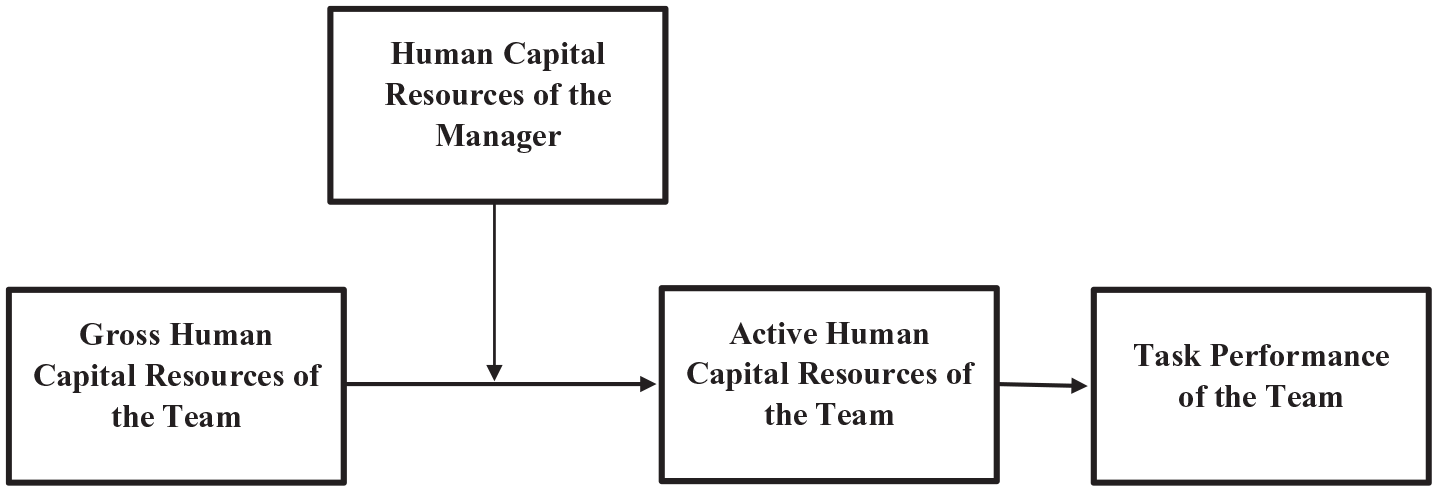
Conceptual model.
Method
Data collection and sample
To test our hypotheses presented earlier, we collected data from the top five European football leagues, which are the England League (Premier League), Spanish League (La Liga), Italian League (Seria A), German League (Bundesliga) and French League (Ligue 1), which are called the Big Five (Della Torre et al., 2018; Gerrard, 2002; Rohde and Breuer, 2017). The football context has been used in prior studies in different areas, including management (e.g. Della Torre et al., 2018; Fainshmidt et al., 2017; Gerrard and Lockett, 2018; Müller et al., 2017), economics (e.g. Franck and Nüesch, 2012) and sports management (e.g. Relvas et al., 2010; Koenigstorfer et al., 2010). In line with this, sport contexts have found a place for themselves in human capital studies (e.g. Crocker and Eckardt, 2014; Gerrard and Lockett, 2018; Harris et al., 2014).
To examine our predictions, we focused on all football teams (98 different teams, a total of 196 instances for 2 years) and their directors from the Big Five European football leagues for two seasons (2015/2016–2016/2017). More specifically, 5492 sets of individual player-level data were aggregated to form the 196 sets of team-level data.
We gathered the data from four different websites that provide parts of the dataset collected by the Opta Sports Data Company (OPTA) (www.optasports.com). OPTA is an official system that collects individual and team statistics in several sport events, such as football, basketball cricket and American football, in many countries in order to support the partners in these sectors, such as bet companies, sport websites, clubs, sport programmes and TV channels. The four websites we used in our study, namely whoscored (www.whoscored.com), squawka (www2.squawka.com), footballdatabase (www.footballdatabase.eu) and transfermarkt (www.transfermarkt.com), provide information about players, teams and directors from the Big Five European football leagues on a yearly basis. Past studies have also used these websites for purposes of academic research (e.g. whoscored; Della Torre et al., 2018; Müller et al., 2017), squawka (Oukil and Govindaluri, 2017) and footballdatabase (Peeters, 2018), transfermarkt (Müller et al., 2017; Peeters, 2018; Rohde and Breuer, 2017).
Measurement
Teams’ gross and active human capital resources
To measure teams’ gross human capital resources, we used the footballdatabase website, which collects followers’ physical, mental, technical and goalkeeping characteristics (see Table 1 for the subdimensions of the gross human capital). The human capital score of each player is created by averaging these scores for every individual (goalkeeping is used only for goalkeepers). Then, the gross human capital score of each team is created by aggregating individual scores to create a team-level variable. To measure teams’ active human capital, we multiplied each player’s gross human capital by the amount of time that player was in the game during that year. That is, we calculated the extent to which the human capital of each player is used by the team (i.e. the team’s active human capital).
Subcomponents of the teams’ human capital resource variable (based on footballdatabase).

Note: The pronouns he and his were used because our dataset consisted of players in the male leagues. Male leagues were used as the available existing data on those leagues were quite detailed (due to sports betting). This is mentioned as a limitation of our study in the ‘Discussion’ section.
Managers’ human capital resources
For this variable, we have collected data from the footballdatabase website related to various mental and leading abilities of the technic directors (Table 2). Technic directors’ human capital scores are created by averaging these items. Then, we multiplied technic directors’ human capital scores by the number of matches he managed in a season. If more than one manager led a team in a season, we collected the human capital scores of these technic directors’.
Subcomponents of the managers’ (technical directors’) human capital resource variable.

Teams’ task performance
To determine the performance of the unit dataset, we used whoscored website, which keeps football match statistics. A team’s task performance was measured in terms of the total goals scored, but we also scraped the data on alternative task performance variables for the purpose of using them in the robustness checks.
Control variables
Data were collected from the five different leagues, so league was included as a control variable in our models. The data were from two different years, so year was also included as a dummy variable. To control for size and age effects, we controlled for the annual number of viewers of the teams, the capacity of the teams’ stadiums and how long they have been in the league. We also controlled for manager changes as well as the number of yellow and red cards received by the team.
Results
The correlation matrix of our study is presented below (Table 3). The correlations were in line with our expectations. In particular, teams’ active human capital resources were positively correlated with their gross human capital resources (r = .44, p < .001) and performance (r = .74, p < .001). Moreover, in line with the assumptions of our model, this correlation between teams’ active human capital resources and performance was larger than the correlation between teams’ gross human capital resources and performance (r = .23, p < .01). We also tested the size difference between the two correlations with the test proposed by Steiger (1980) using the software provided by Lee and Preacher (2013). This test also confirmed that the difference was statistically significant (Steiger Z = 8.86; p < .001).
Correlation matrix.

Note: N = 196; Team’s human capitals, stadium capacity and annual viewers are measured in thousands.
p < .05; **p < .01; ***p < .001.
The model was tested using moderated mediation with bootstrapping, as described by Andrew Hayes (e.g. Hayes, 2018; Preacher and Hayes, 2004, 2008). Hayes’ bootstrapping technique has recently become a popular method for testing mediation and models (e.g. Lu et al., 2019; Yam et al., 2018). We used 50,000 samples, which was the maximum option (Table 4).
Bootstrapped regression models.

Notes: Bootstrapped unstandardised coefficients and p-values reported; 50,000 bootstrap samples. In the context of the bootstrapped moderated mediation test, BootLLCI stands for the lower limit of the confidence interval and BootULCI for the upper limit of the confidence interval.
League 1 is used as the benchmark variable.
N = 196; *p <.05; **p < .01; ***p < .001.
The bootstrapped regressions show that a team’s gross human capital resources have a positive effect on the team’s active human capital resources (Model 1: b = .17; p < .01), supporting Hypothesis 1. Again, in line with our predictions, managers’ human capital was a positive moderator of the relationship between teams’ gross and active human capital resources (Model 1: b = .07; p < .05), supporting Hypothesis 3. Following that, the moderated mediation model we proposed in Figure 1 was also tested as a whole. The confidence interval did not include zero (Model 2: Index = 2.02; BootLLCI = .16; BootULCI = 4.23), which provides support for our overall model, as well as for Hypothesis 2. As an objective indicator of the difference in effect size, we referred to the conditional effect sizes provided by Process. There was a substantial difference between the low (16th percentile) human capital of the manager condition (Effect = 2.01; BootSE = 1.98; BootLLCI = –1.60; BootULCI = 6.18) and the medium (50th percentile) human capital of the manager condition (Effect = 4.61; BootSE = 1.75; BootLLCI = 1.35; BootULCI = 8.21), which was substantially different than the high (84th percentile) human capital of the manager condition (Effect = 7.78; BootSE = 2.62; BootLLCI = .06; BootULCI = 13.36).
Finally, as a post hoc test, we also tested whether managers’ human capital resources moderate the link between teams’ active human capital resources and performance. The analysis (conducted using Process, Model 58) suggested that managers’ human capital resources moderate only the link between teams’ gross and active human capital resources (F = 4.79; p < .05), and not the one between teams’ active human capital resources and performance (F = .14; p = .71). While this finding will be revisited in the ‘Discussion’ section as it may provide further insight into the findings of prior research, it is worth noting that this was simply a post hoc test. In other words, we did not theorise that manager’s human capital resources would not moderate the link between team’s active human capital resources and task performance, and this finding can well be a statistical fluke or an artefact of the sport context or our measures.
Robustness checks
Triangulation with alternative task performance variables
As a robustness check, we triangulated our results by using different variables relating to task performance. In particular, we repeated the test of our moderated mediation model by using the number of goals scored against the team, games won and lost by the team and total points gained by the team. Each of these variables provided support for our model. That is, the moderated mediation model found support (i.e. the confidence interval did not include zero) when the outcome variable we used was goals scored against the team (Model 3: Index = −1.51; BootLLCI = −3.26; BootULCI = −.12), games won by the team (Model 5: Index = .78; BootLLCI = .07; BootULCI = 1.64), games lost (Model 6: Index = −.69; BootLLCI = −1.47; BootULCI = –.06) and points gained (Model 4: Index = 2.25; BootLLCI = .19; BootULCI = 4.74).
Triangulation with alternate variable for human capital of the manager
In past research, past performance of the manager was commonly used as an indicator of a technical director’s human capital. We used this variable as an alternative measure to conduct robustness checks. We first scraped data on each technical director’s team match result from the beginning of that individual’s technical directorship career until the 2015–2016 and 2016–2017 seasons. The aggregate of each point gained by the technical director’s team (3 for wins, 1 for draws and 0 for losses, in line with football rules) was divided by the number of total games that directed by that individual to produce the manager’s human capital resource variable. Again, the moderated mediation model found support (i.e. the confidence interval did not include zero) when the outcome variable we used was goals scored by the team (Index = .12; BootLLCI = .01; BootULCI = .26), goals scored against the team (Index = −.09; BootLLCI = −.19; BootULCI = −.01), games won by the team (Index = .04; BootLLCI = .004; BootULCI = .10), games lost (Index = −.04; BootLLCI = −.09; BootULCI = –.003) and points gained (Index = .14; BootLLCI = .01; BootULCI = .29).
Robustness check with more control variables
In our dataset, there were a number of potential control variables we decided not to add to the model, because they were too closely related to the human capital variables. In particular, controlling for these variables would remove some of the genuine effect of the model. The variables related to the HC of the team were total number of players in the team, average age of the team, average height and average weight. There also were two variables highly related to the HC of the manager (manager’s age and total number of games played, both of which are related to experience). While we did not include these variables as a part of the model, we still decided to use them as a robustness check. Once again, the moderated mediation model found support (i.e. the confidence interval did not include zero) when the outcome variable we used was goals scored by the team (Index = 1.15; BootLLCI = .11; BootULCI = 2.48), goals scored against the team (Index = −.65; BootLLCI = −1.48; BootULCI = −.05), games won by the team (Index = .39; BootLLCI = .04; BootULCI = .82), games lost (Index = −.34; BootLLCI = −.73; BootULCI = –.03) and points gained (Index = 1.12; BootLLCI = .11; BootULCI = 2.33).
10-fold cross-validation
A 10-fold cross-validation is a useful tool to compare the predictive validity of regression models (e.g. Joseph et al., 2018; Peng et al., 2017; Sun et al., 2019). More specifically, cross-validation produces insight into the extent to which a model can successfully estimate the outcome variable (e.g. team’s task performance) by dividing the sample into equal groups, one by one removing each group and extrapolating the variable for the missing group by using the data from the rest of the groups (e.g. Refaeilzadeh et al., 2009). Then, this process is repeated multiple times. The model with the lowest error rate in estimating the actual values is the one with the highest predictive validity (i.e. better fit to the data). In this study (Figure 2), we estimated the model by using (1) the teams’ gross human capital resources; (2) the gross human capital resources, managers’ human capital resources and the interaction term; and (3) the gross human capital resources, managers’ human capital resources, the interaction term and the active human capital resources (the whole model). The second model had higher predictive validity (mean squared error = 254) than the first model (mean squared error = 298), and the third model, which included all variables, had higher predictive validity than the two other models (mean squared error = 139). In other words, in line with our theory, the addition of the manager’s human capital resources and active human capital resources variables increased the predictive ability of the model.

10-fold cross-validation results.
Discussion
In this study, we have reconsidered the assumption in most human capital research that the human capital resources are used effectively, and have an effect on performance. Instead, we proposed that gross human capital resources of the teams affect and their task performance levels only to the point that they have an effect on the teams’ active human capital resources. Furthermore, we investigated the role of managers’ human capital resources in this relationship. Our results suggest that indeed, teams’ active human capital resources explain the positive effect of teams’ human capital on their performance. Furthermore, managers’ human capital is a significant moderator of the link between gross and active human capital resources. Overall, this study has several implications for the emerging stream of literature on human capital at the team level (e.g. Gerrard and Lockett, 2018; Tasheva and Hillman, 2018) as well as for research on organisational slack-performance relationship (e.g. Carnes, Xu, Sirmon, et al., 2019).
To begin with, our study builds on and extends prior knowledge regarding the nature of human capital resource constructs at the team level. In particular, we conceptualise human capital resources as two related but distinct variables, where the second one explains the positive effect of the first. Gross human capital resources refer to the total KSAs of a team. The addition of any extra individual to the team increases gross human capital resources, as any person has some KSAs (as one would remember from basic economics, this is what makes trade possible even if one trading partner has absolute advantage over the other – for example, Golub, 1995). However, in most cases, there is a limit to how many individuals can be brought into a team. In the case of a football team, the limit is 11. Likewise, only a handful of employees can be used in a sales presentation or consultancy project. Therefore, there are many business situations where a bottleneck exists limiting the amount of gross human capital resources that can be converted into active human capital resources and thus into performance. That is, the addition of any individual to the team increases gross human capital resources, but only the addition of highly skilled individuals increases active human capital resources. In sum, the first contribution of this study is providing a more detailed insight into the conceptual structure of human capital resources as well as into a key mechanism explaining the human capital-performance link. In doing so, this study also provides insights regarding the organisational slack-performance relationship.
Furthermore, in this article, we proposed that managers’ human capital resources moderate the link between their teams’ gross and active human capital resources, and we indeed confirmed this effect. Prior research suggests that the link between teams’ human capital resources (i.e. gross human capital resources) and performance may be moderated by managers’ human capital resources. However, once we introduced the concept of active human capital resources, there were three possibilities regarding the moderating role of managers’ human capital. First, only the link between teams’ gross and active human capital resources is moderated. Second, only the link between teams’ active human capital resources and performance is moderated. Third, managers’ human capital resources could be a moderator of both links. Upon testing Hypothesis 3, we found that in line with our theoretical predictions, the link between teams’ gross and active human capital resources was moderated. As a post hoc test, we also examined whether managers’ human capital resources moderate the right-hand side of our conceptual model, and we found that this was not the case regardless of which of the two measures were used for manager’s human capital. In other words, our study provides further insight into the findings of past research by showing that the prior observation that managers’ human capital moderates the link between teams’ human capital resources and performance is due to the fact that the link between the gross and active human capital resources of teams is moderated. In this study, managers’ human capital resources do not seem to play a role in the link between teams’ active human capital resources and performance. However, it is worth remembering that this study was conducted in the sports context using a specific set of measures, so this result may be different in other contexts or when using different measures.
The findings of our research also have important implications for managerial practice. Most importantly, our results suggest that two companies with similar levels of overall (gross) human capital may experience very different performance effects, as the overall size of the human capital is only a distal indicator of the actual human capital that can be employed in a given scenario (i.e. active human capital). In other words, managers need to consider bottlenecks when building human capital. For instance, perhaps, a company will be spending much for a new employee, but are there actually sufficient opportunities in the organisation so that it fully benefits from this employee? Likewise, will this employee fulfil a complete gap, in which case the increase in gross human capital resources will result in a direct increase in active human capital resources and performance, or is this person a more capable alternative to an existing person, in which case the increase in active human capital resources will be smaller than the increase in gross human capital? If the new person is more capable than the existing employee, what happens now with the existing one? Can that person be effectively re-assigned somewhere else or be fired without significant consequences, or will there be a redundant employee that the organisation still needs to take care of and assign tasks to but will not benefit from? In the latter case, while the increased gross human capital will both have a positive effect through the increased active human capital, it will also have an increased negative direct effect. In sum, our study also suggests the conversion of human capital resources into active human capital resources (i.e. active human capital resources divided by gross human capital resources) as a key performance indicator (KPI) for organisations. For managers in sports-related industries, our findings are likewise important from an empirical standpoint, as they can potentially be helpful in understanding how much investment would be appropriate in certain situations.
Limitations and future research
The limitations of our study suggest areas for future research. First, although the sport context (e.g. major league baseball data) is being used in management research for the purpose of examining the effects of human capital on performance (e.g. Crocker and Eckardt, 2014), applying these findings in other kinds of organisations (e.g. manufacturing, service, military) would be beneficial to increase the generalisability of such studies, including ours. Second, the characteristics of the sample we had access to in this study can limit the generalisability of our findings. In particular, the teams consisted of young, male-only members from the Big Five European football leagues. Future research could try to replicate our findings in other kinds of populations, such as female-only, non-European teams, as well as other kinds of organisations. While sports data are commonly used in human capital research, nevertheless sports is a very specific type of context with specific assumptions (e.g. always 11 players are active in the field), and our findings should be viewed in this light. For instance, managers may also influence the link between active human capital and task performance in other contexts. Third, from the perspective of the RBV literature on organisational slack, this article examines only one type of resource (human capital), and generalising our results to that literature requires further research examining whether the relationships hold also with other kinds of organisational resources. Finally, using our limited resources, we manually scraped and cleaned a substantial amount of data from several websites, and, thus, we could only do so for 2 years. Future researchers may be able to gain access to the whole dataset and test the relationships we observed using the data for more years, which would again help further demonstrate the robustness of our findings.
Footnotes
Declaration of Conflicting Interests
The author(s) declared no potential conflicts of interest with respect to the research, authorship, and/or publication of this article.
Funding
The author(s) received no financial support for the research, authorship and/or publication of this article.
