




Abstract
Firms increasingly rely upon trademarks, but management research exploiting trademark data is surprisingly limited. Reasons for this include data availability, awareness, and bias toward other sources, in particular patents. I demonstrate how imaginative scholars have used trademarks to capture several elements of how, when, and to what extent firms bring (new) products and services to the market. Their work can inspire further applications, particularly now that trademarks are becoming more strategically relevant for companies and as more data are becoming available. After taking stock of what has already been achieved, I look ahead to original research by discussing conceptual and methodological opportunities.
Out there is a source of data that management scholars have only casually tapped: trademarks. Some imaginative scholars have developed original and effective trademark-based measures, often not only to overcome the limitations of patents but also to exploit the peculiar informational content of trademarks. These original approaches have not been embraced in any systematic way by management scholars. This clashes with the evidence that trademarks are the most widespread intellectual property right (IPR) used by companies of all sizes, sectors, and countries (WIPO, 2013). Their strategic importance is only bound to further increase. Market competition is a “semiotic struggle” where companies profile their offerings as value propositions and use symbols such as trademarks to capture intended meanings (Mendonça, 2014). In a context of increasing digitization (Smith, 2011) and servitization (Cusumano et al., 2015; Vargo and Lusch, 2004) reputational assets protected by valuable trademarks are becoming key.
Nevertheless, use of trademark data within management research has been constrained by at least three concerns: data availability and readiness for use, a bias toward other archival data, in particular patents, and sheer unawareness of the possibilities due to the fact that trademark-based empirical studies have appeared across different literatures. Economic studies, reviewed in Schautschick and Greenhalgh (2016), find a positive relation between trademark ownership and economic performance but do not disentangle the organizational constructs that are revealed by the trademark portfolios of companies. In this essay, I aim to give due credit to the pioneering studies within management that have developed original trademark-based indicators to capture organizational properties. I will also look ahead by outlining several avenues for further conceptual and methodological research efforts.
What are trademarks in the first place?
A trademark is “any sign that individualizes the goods of a given enterprise and distinguishes them from the goods of its competitors” (WIPO, 2004, Ch. 2: 54). According to this definition, trademarks fulfill two fundamental functions. First, they indicate the origin of the market offerings by linking them to the firm responsible for bringing them to market. Second, they flag to consumers that those offerings are different from competing offerings in the same marketplace. These two complementary functions are at the core of the economics of trademark systems. By acting as an information signal, trademarks are expected to reduce search and transaction costs for consumers and provide incentives for companies to deliver the expected quality of products/services (Economides, 1988).
The conditions for trademark registration are essentially three: distinctiveness, no misleading or immoral character, and (intent to) use in market (WIPO, 2004). Trademark offices require applicants to actually use the trademark in the marketplace, in the specific markets indicated in the application through Nice product and service classes (http://www.wipo.int/classifications/nice/en/). These are 45 Nice classes covering all possible markets. A trademark is broader when covering more classes and this broader coverage comes with higher fees and the understanding that the trademark should be used in all chosen classes. Most offices work with an intent to use in commerce requirement that gives applicants a grace period to start using the trademark if they are not doing so at the time of application. Non-use typically results in cancellation (Graham et al., 2013).
Compared with patents, trademarks are easier and cheaper to file. The lower costs are mostly due to the fact that trademark filing does not require complying with any novelty requirement. Establishing the newness of a claimed invention engages patent examiners in complex exercises of checking prior art and establishing the validity of the patent claims (Harhoff and Wagner, 2009). Trademarks have instead their “use in market” requirement. This requirement implies that trademark filers cannot simply claim potential use but have to prove actual use. The proof itself can come from evidence as simple as a website or a picture of a physical shop where the trademark is used to indicate products and/or services. While patents will expire after a certain time (typically 20 years), trademarks can be renewed indefinitely upon payment of renewal fees and compliance with other administrative duties. This feature makes trademarks attractive for companies concerned with the expiration of their patents (Reitzig, 2004), or even their copyrights (Calboli, 2014).
All the great things that have already been done with trademarks
Taking stock of pioneering studies
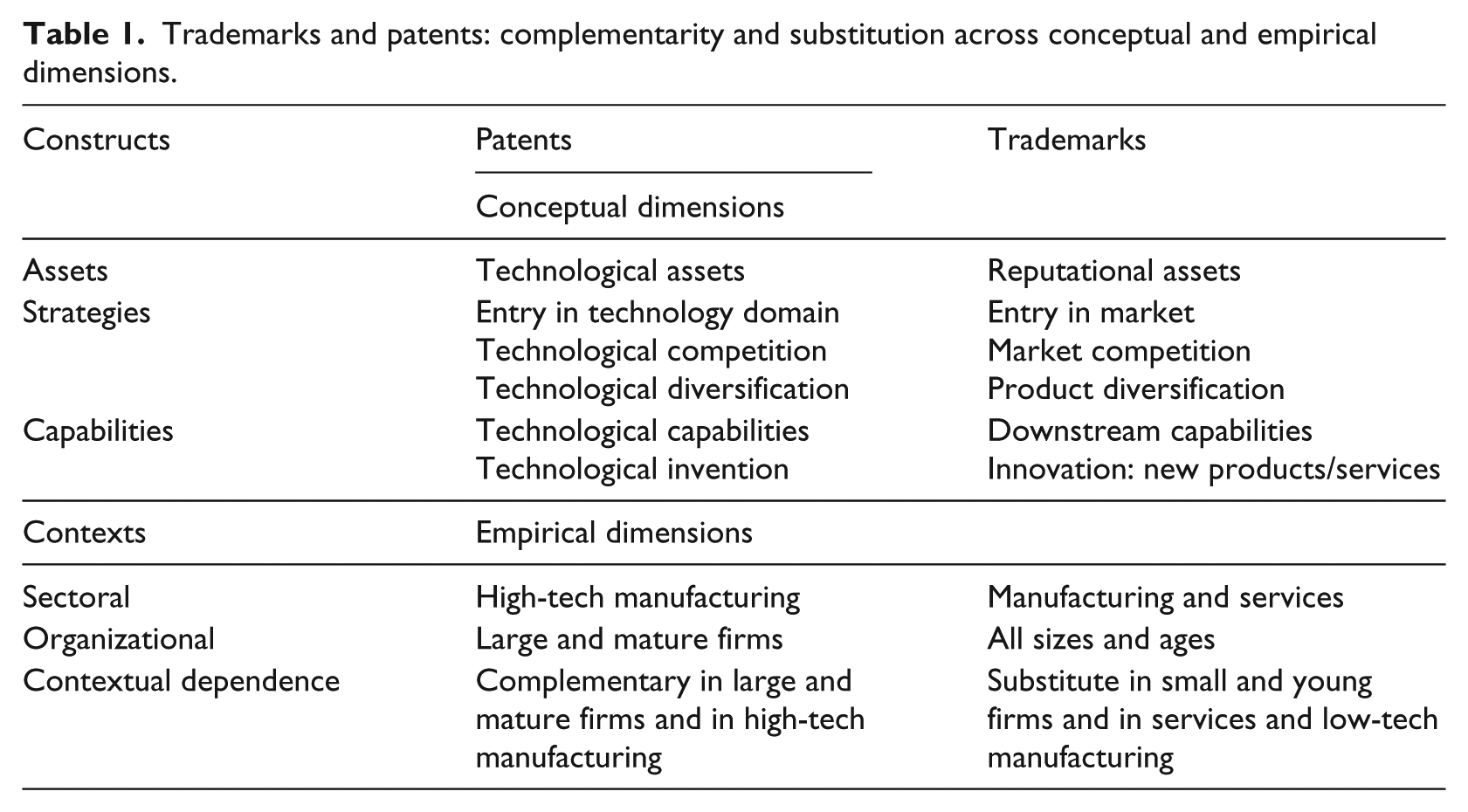
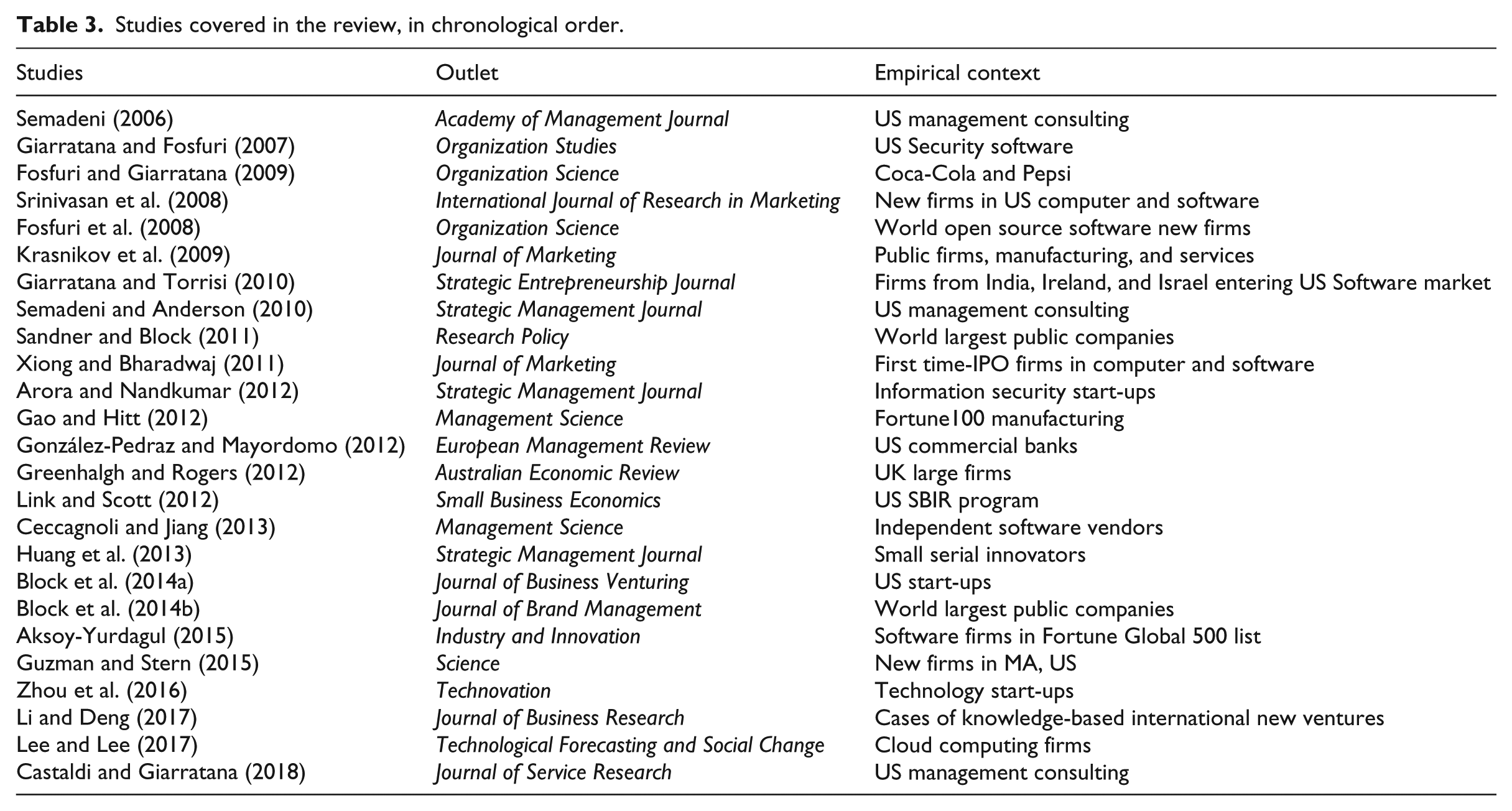
A few research pioneers have understood the potential of trademarks early on. They have looked at the strategic ways in which companies have filed for trademarks: in specific markets, in specific countries, with specific qualities, and at specific times. They have also looked at the more emergent ways in which trademark filings reveal the painstaking processes of coordination and design that allow companies to arrive at the point where they can showcase their newest products and services. My systematic analysis of this small but promising bundle of studies revealed three types of organizational constructs that have been operationalized with trademarks: (a) reputational assets, (b) market strategies, and (c) organizational capabilities. Table 1 provides a detailed overview of these studies, while Table 3 in Appendix 1 lists them in chronological order and includes their publication outlet and empirical context.
Trademarks and patents: complementarity and substitution across conceptual and empirical dimensions.
Trademarks as indicators of reputational assets
This group of studies is concerned with drivers of firm market value, namely different types of assets, including intangibles. Fosfuri et al. (2008) first translated insights from marketing research to the field of strategic management: they theorized that trademarks signaled investment in intangible assets related to reputation. Ceccagnoli and Jiang (2013) exploited this idea and used trademarks to capture complementary assets. Similarly, Sandner and Block (2011) used trademark stocks to capture the strength of reputational assets, as complementary to other assets. In the same study, they also measured technological assets, operationalized by patents and R&D stocks. They found a positive effect of firms’ reputational assets on firm value for a large sample of publicly traded companies. Aksoy-Yurdagul (2015) operationalized brand equity using trademark stocks. He found that building brand equity in the context of open source software (OSS) clashed with the underlying collaborative culture of OSS initiatives. Other studies captured the qualities of reputational assets by classifying trademarks into specific categories related to the type of information signals sent to consumers or markets (Block et al., 2014b; Krasnikov et al., 2009).
When dealing with assets in market value studies, a key concern is valuation (Hall, 1993). Trademark value has been captured in different ways: as the number of Nice market classes covered, that is, the breadth of trademark, by considering oppositions, number of countries covered, that is, seniorities, or with trademark age (González-Pedraz and Mayordomo, 2012; Sandner and Block, 2011).
Trademarks as indicators of market strategies
Within strategic management, a few pioneering studies have used trademarks to capture market strategies. The “use in commerce” requirement implies that trademarks signal entry and presence in specific markets. Second, trademarks are either “live” or “dead” depending upon the willingness of the trademark owner to renew the trademark by paying renewal fees or abandoning it instead for different reasons (González-Pedraz and Mayordomo, 2012). A live trademark is then a trademark which is being actively used in its designated market(s) and can signal long-term market presence (Giarratana and Torrisi, 2010; Huang et al., 2013). A last key property is that trademarks are geographically bound to national borders. Hence, a trademark application in a country different from the country of origin signals international expansion (Li and Deng, 2017).
Within a focal market, competing firms will often battle through resonating trademark applications to respond to rival firms’ moves (Fosfuri and Giarratana, 2009). Semadeni (2006) and Semadeni and Anderson (2010) used text analysis to reveal features of the competitive strategies of management consulting firms. Starting from the narratives in the trademark filings, they derived keywords. The very first firm that used a new keyword in a market could be considered as an innovator. Instead, firms that replicated that keyword in successive narratives acted as imitators. The extent of imitation could then be captured by the extent of overlap in narratives, measured by an adjusted number of keyword occurrences (Semadeni and Anderson, 2010). The distance in the narratives between new trademarks and existing ones, captured by the overlap in keywords, revealed positioning strategies (Semadeni, 2006) and trade-offs underlying imitation strategies (Semadeni and Anderson, 2010).
Finally, two studies have operationalized diversification patterns using trademarks. The main idea behind the work of Lee and Lee (2017) was that firms are likely to diversify into new markets that are related to their existing technological assets and capabilities (Teece et al., 1997). They looked at potential business opportunities revealed by a systematic analysis of typical patent-trademark combinations: they could basically predict in which Nice classes firms would be most likely to file trademarks based upon their patent portfolio. A simpler use of trademarks to operationalize diversification is by Castaldi and Giarratana (2018): they analyzed both overall product diversification and corporate shifts toward product offerings, so-called commoditization, for the case of management consulting firms.
Trademarks as indicators of capabilities
Trademarks can signal the outcome of a (long) series of activities aimed at bringing a new product or service to the market. Hence, trademark filings over time can serve as a proxy for underlying downstream capabilities. These capabilities include most commonly the ability to commercialize products, through the right positioning, value proposition, and complementary assets (Semadeni and Anderson, 2010). As such, these studies used trademarks to capture how firms might differ in their ability to extract value from existing assets, rather than viewing trademarks as assets themselves. In particular, new trademarks could signal the ability to develop new products (Gao and Hitt, 2012) or new services (González-Pedraz and Mayordomo, 2012; Semadeni, 2006). Hence, downstream capabilities were directly linked to innovation capabilities. Importantly, studies using trademarks as a proxy for innovation capabilities focused on services (consulting in Semadeni, 2006, banking in González-Pedraz and Mayordomo, 2012) where the nature of innovation is such that it can only marginally be protected (hence measured) by patents.
For US commercial banks, González-Pedraz and Mayordomo (2012) found that the financial market reacted to trademark events significantly in the short term: trademark registrations were associated with significantly positive abnormal returns, while trademark cancellations with negative ones. This suggested that banks with trademark registrations demonstrated evident capabilities to introduce new financial products.
The entrepreneurship literature has also turned to trademarks to operationalize capabilities. Studies found that venture capitalists were more likely to fund, or value highly, those ventures that could already claim (plans for) the commercialization of their product through trademark ownership (Block et al., 2014a; Zhou et al., 2016). Other studies found positive effects of trademark counts on the probability of organizational survival (Giarratana and Fosfuri, 2007; Srinivasan et al., 2008), employment growth (Link and Scott, 2012), an initial public offering (IPO) event (Guzman and Stern, 2015), or the actual IPO value (Xiong and Bharadwaj, 2001). Some studies have operationalized the quality of start-up capabilities by exploiting information on the market classes covered by their trademark portfolios (Block et al., 2014a; Xiong and Bharadwaj, 2011).
The main message here is that there is already an extensive range of trademark-based indicators that can inspire management researchers. Several of these studies have appeared in prominent journals but have been picked up by relatively few other studies.
Trademarks as complements and substitutes to patents
The massive body of research on patent and patent strategies (Somaya, 2012) has promoted the widespread use of patents as indicators of technological assets, strategies, and capabilities. At the same time, this focus has overshadowed attempts at going beyond patents as the preferred archival source for (innovation) management scholars. Patents do provide a wealth of information on how companies position themselves within technological trajectories but are mute on the later phases in the innovation value chain. In the commercialization phase, innovative firms can turn to trademarks to signal the market introduction of their innovations and to appropriate returns from those innovations through related branding (Flikkema et al., 2014, 2019; Sandner and Block, 2011). In this sense, patent-based measures operationalize technological assets, strategies, and capabilities (Hsu and Ziedonis, 2013; Tanimura, 2018), while trademarks capture reputational assets, market strategies, and downstream capabilities.
At the same time, this complementarity is much less evident in contexts where organizations are less R&D intensive or where the nature of the commercialized output is hardly technical. These contexts include many service sectors, for instance, not only professional service sectors but also low-tech manufacturing and the creative and cultural industries (Castaldi, 2018). In these contexts, trademarks can substitute for patents. Trademarks can reveal “soft innovation” (Stoneman, 2010), “service innovation” (Schmoch and Gauch, 2009), or “organizational innovation” (Millot, 2009). Patents focus by definition on technological invention. Trademarks have instead a symbolic function, which matches the symbolic and conceptual nature of most non-technological innovations (Castaldi, 2018; Mendonça, 2014). These innovations deserve as much attention as the technological ones but get neglected when using only patents to reveal innovation. An illustrative example is Les Mills (Parviainen, 2011): this is a company that developed a highly innovative and successful new business model around a new concept of service provision for group gym classes. In a traditionally low-tech, low-productivity, and low-skill sector, they managed to grow by moving upstream the design of classes to then develop appealing new categories (BodyPump®, Zumba®, etc.). Hardly any part of their innovations met patent eligibility criteria, but trademarks did allow the company to flag their innovations and protect them from imitation.
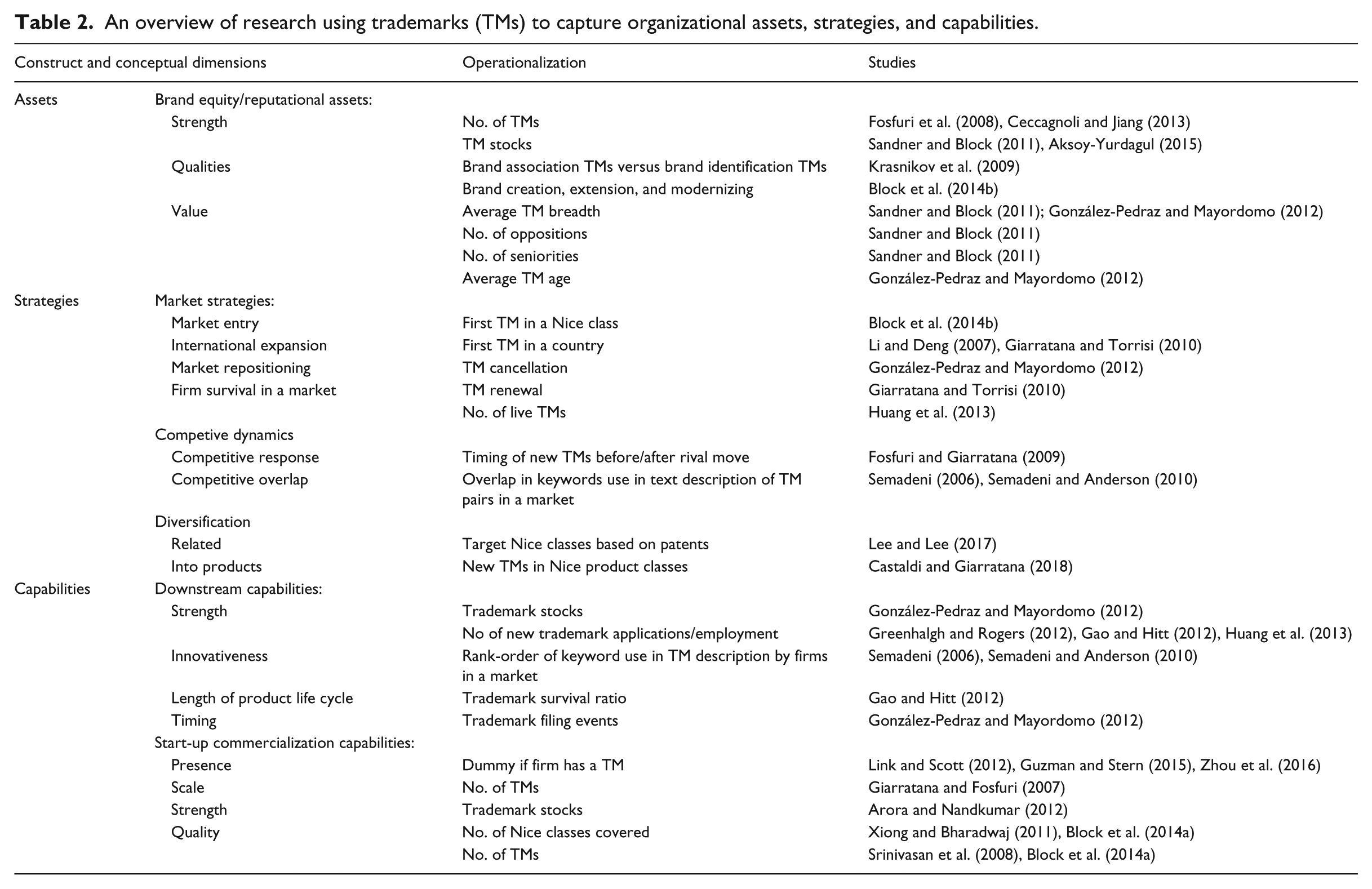
A last consideration is that small and young firms make more use of trademarks than of patents (Greenhalgh et al., 2011; Seip et al., 2019). This is part of the reason why the entrepreneurship literature has also turned to trademarks. To conclude, trademark-based indicators can both operationalize constructs that are complementary to constructs operationalized with patents and can represent alternative measures for constructs and contexts where patents are not particularly helpful (see Table 2).
An overview of research using trademarks (TMs) to capture organizational assets, strategies, and capabilities.
Looking ahead: avenues for further research
Opportunities for conceptual work
A first conceptual opportunity when using trademarks is to disentangle trademarks, brands, and innovation. Not all brands or innovations are trademarked and not all trademarks become brands or relate to innovation (Mendonça et al., 2004). We already have clues on which trademarks are most likely to refer to innovation. For instance, Flikkema et al. (2019) found that trademark filings corresponding to the creation of new brands related more often to product innovation than trademarks filed for the purpose of brand extension or brand modernization. They also found that trademarks combined with patents were more likely to refer to product innovation, confirming the complementarity of patents and trademarks in capturing technological innovation. One could try to develop a comprehensive theory of why firms would trademark or not and of their trademark strategies. This would help to establish the construct validity of trademark-based indicators, given the known problems of using archival data that was not collected for the specific purpose of measuring given constructs (Ketchen et al., 2013). The conceptual building blocks of this theory are likely to combine insights not only from marketing and branding research (Aaker, 2007), innovation research on appropriability strategies (Desyllas and Sako, 2013; Hall et al., 2014; Teece, 1986; Zobel et al., 2017), but also legal research (Beebe, 2004; Lunney, 1999). Both rational and myopic motives play a role in the decision of firms to trademark (Castaldi, 2018). Yet, there is room for further theorizing about how these decisions are shaped by characteristics of the organizations themselves, the projects they run or the markets and industries where they are active.
A second conceptual opportunity relates to developing the idea of “markets for brands,” paraphrasing the concept of “markets for technologies” (Arora et al., 2001). Ramello (2006) discusses the “unbundling process” through which trademarks become commodities with a life of their own, usually in combination with strong investment in branding. Valuable trademarks transcend the products that they are meant to flag and trademarks are indeed extensively traded (Graham et al., 2018). Researchers could start focusing on trading dyads, looking at which trademarks are being acquired and by which firms, and distinguishing acquisition of trademarks only from M&As including trademark transfer. It would also be relevant to investigate in which directions trademarks flow in global value chains (Timmer et al., 2014). A claim from the international business literature is that companies from emerging countries often acquire Western companies to exploit their assets (Amendolagine et al., 2018), including their trademarks (Frey et al., 2015; Makino et al., 2002). Large sample evidence to support, nuance, or dismiss this claim is missing, but trademarks could offer the opportunity to analyze this possibility. More generally, a complete theory of “markets for brands” would have to include the international element of trademark strategies, for instance, by accounting for how trademark acquisition and development may overcome liabilities of newness and foreignness (Barroso et al., 2019). This would imply developing more global research beyond Western contexts (either Europe or United States and Canada), with their specific culture and institutions.
Finally, trademarks have potential to uncover certain types of dynamic capabilities (Teece, 2007), in particular the ones related to seizing opportunities for entry in new markets for products and services (King and Tucci, 2002). These capabilities could be captured by the (related) streams of trademark filings in the markets where firms progressively enter. The extent to which firms adapt their trademarks when entering new countries or new markets or instead develop new ones can reveal their underlying capabilities for adaptation and renewal. Such studies can go beyond trademark counts and fully exploit the information on qualities of trademark portfolios. For instance, the market and geographical breadth of trademark portfolios could be an indication of the opportunities for exploitation across different markets (Sebrek, 2019). Of course, these exercises should take seriously the looming pitfalls of using archival data to measure capabilities (Stadler et al., 2013), but careful consideration of contextual peculiarities represents a large part of possible solutions (Grant and Verona, 2015).
Opportunities for methodological contributions
Overall, data availability has increased in the last years. The United States Patent and Trademark Office (USPTO) released a complete coverage of its trademark records: the Trademark Case Files database (Graham et al., 2013). This database is expected to spur research on trademarks in a similar way to how the NBER-USPTO database did for patents (Hall et al., 2001). The USPTO also released the Trademark Assignment database (Graham et al., 2018). This is a fresh source of information on trademark transactions, with great potential for use in future research on markets for brands discussed in the previous section. Hopefully, other trademark offices will follow and make their data available offline.
At the same time, the use of trademarks in firm-level research can only thrive if trademark data were consistently matched to firm-level data. Dinlersoz et al. (2018) are currently involved in a major effort to release a matched database linking all USPTO trademarks to the population of US firms. There are also commercial initiatives: the Orbis database of Bureau van Dijk lists both patents and trademarks owned by the covered companies. This data has been linked to the firms in the EU Industrial R&D Investment Scoreboard and used in several policy reports (Castaldi and Dosso, 2018; Dernis et al., 2015). Another issue that might be encountered in multi-industry analyses of broad samples of firms is how to match trademark and industrial classifications. Millot (2009) offered an early attempt at concordonace, while Zolas et al. (2017) proposed a probabilistic approach relying on matching keywords.
An additional methodological opportunity concerns the definition of trademark families, with several implications for research, including reconstructing branding strategies of firms and their evolution in time, and recovering internationalization paths. This would allow going beyond counts and uncovering the structure of trademark portfolios. Practically speaking, one would be able to better estimate assets and capabilities by weighting trademarks according to their position in relevant families and portfolios. Sandner (2010) has suggested using word similarity and market coverage to reconstruct trademark families at the company level. Petrie and Webster (2016) are exploring neural networks to match similar trademarks applied at different national offices, including figurative ones.
Last, but not least, there are several opportunities to develop new metrics of trademark value and novelty. Some of the existing metrics are inspired by similar metrics for patent value, like number of oppositions and international applications (Sandner and Block, 2011). Yet, other patent value metrics are not applicable, particularly the ones from citations (Van Zeebroeck, 2011). Nasirov (2019) provides a systematic overview of different valuation approaches. New value metrics could exploit information on quotes in trademark licensing to gauge revealed value or rely on big data (see von Graevenitz et al., 2016 for an attempt using online search frequency). As for novelty, Semadeni (2006) and Semadeni and Anderson (2010) identified novel trademarks as those using for the first time a new keyword in a specific market. More generally, analyzing keywords in trademark descriptions bears great potential for going beyond the rather crude Nice classification to uncover new combinations of good and service descriptors.
To conclude, several data and methodological initiatives are in place. As is usually the case with research, conceptual refinements will shape new data availability and metrics development, as well as the other way around. Exciting original research lies ahead for researchers interested in engaging with trademarks and trademark data. Looking at the conceptual and data challenges together, a clear task is to advance research on how organizations use trademarks and account for those insights when constructing trademark-based indicators of organizational constructs. Trademarks have multi-faceted functions: they are symbols whose value is culturally and socially constructed, they are tools to persuade customers in smart branding strategies, and they can be powerful legal weapons in the hands of companies. Because of this multitude of functions it seems only natural to embrace a wide range of disciplines if one wants to better understand trademarks and the practices through which they are used: not only strategic management but also law, cultural economics, psychology, marketing, industrial organization and more. The cross-fertilization of approaches can only benefit the further development of meaningful trademark-based indicators for research in strategic management and related fields.
Footnotes
Appendix 1
Studies covered in the review, in chronological order.
| Studies | Outlet | Empirical context |
|---|---|---|
|
Semadeni (2006)
Giarratana and Fosfuri (2007) Fosfuri and Giarratana (2009) Srinivasan et al. (2008) Fosfuri et al. (2008) Krasnikov et al. (2009) Giarratana and Torrisi (2010) Semadeni and Anderson (2010) Sandner and Block (2011) Xiong and Bharadwaj (2011) Arora and Nandkumar (2012) Gao and Hitt (2012) González-Pedraz and Mayordomo (2012) Greenhalgh and Rogers (2012) Link and Scott (2012) Ceccagnoli and Jiang (2013) Huang et al. (2013) Block et al. (2014a) Block et al. (2014b) Aksoy-Yurdagul (2015) Guzman and Stern (2015) Zhou et al. (2016) Li and Deng (2017) Lee and Lee (2017) Castaldi and Giarratana (2018) |
Academy of Management Journal
Organization Studies Organization Science International Journal of Research in Marketing Organization Science Journal of Marketing Strategic Entrepreneurship Journal Strategic Management Journal Research Policy Journal of Marketing Strategic Management Journal Management Science European Management Review Australian Economic Review Small Business Economics Management Science Strategic Management Journal Journal of Business Venturing Journal of Brand Management Industry and Innovation Science Technovation Journal of Business Research Technological Forecasting and Social Change Journal of Service Research |
US management consulting US Security software Coca-Cola and Pepsi New firms in US computer and software World open source software new firms Public firms, manufacturing, and services Firms from India, Ireland, and Israel entering US Software market US management consulting World largest public companies First time-IPO firms in computer and software Information security start-ups Fortune100 manufacturing US commercial banks UK large firms US SBIR program Independent software vendors Small serial innovatorsUS start-ups World largest public companies Software firms in Fortune Global 500 list New firms in MA, US Technology start-ups Cases of knowledge-based international new ventures Cloud computing firms US management consulting |
Acknowledgements
I would like to thank the editors, Ann Langley, Luca Berchicci and Glen Dowell, for their valuable feedback. I would also like to thank Marco Giarratana, Sandro Mendonça and Andrea Fosfuri for all the conversations that helped shaped this essay.
Declaration of Conflicting Interests
The author(s) declared no potential conflicts of interest with respect to the research, authorship, and/or publication of this article.
Funding
The author(s) received no financial support for the research, authorship, and/or publication of this article.
