




Abstract
This study addresses the question of how established organizations develop new business models over time, using a process research approach to trace how four business model innovation trajectories unfold. With organizational learning as analytical lens, we discern two process patterns: “drifting” starts with an emphasis on experiential learning and shifts later to cognitive search; “leaping,” in contrast, starts with an emphasis on cognitive search and shifts later to experiential learning. Both drifting and leaping can result in radical business model innovations, while their occurrence depends on whether a new business model takes off from an existing model and when it goes into operation. We discuss the implications of these findings for theory on business models and organizational learning.
Keywords
Introduction
Both scholars and practitioners focus increasingly on business models (BMs) to complement more traditional units of analysis, such as the product, firm, industry, or network (Amit and Zott, 2001; Arend, 2013; Baden-Fuller and Mangematin, 2013). A BM defines how an organization creates and appropriates value and thereby captures essential features of how companies conduct their business (Zott et al., 2011). Innovative BMs constitute significant sources of competitive advantage and firm performance (Casadesus-Masanell and Zhu, 2013; Desyllas and Sako, 2013; Zott and Amit, 2007), so organizations are motivated to innovate BMs by making fundamental changes in the way they create and appropriate value.
Despite the attractiveness of BM innovation, its pursuit faces substantial challenges and is prone to failure (Pauwels and Weiss, 2008). Difficulties arise due to uncertainty about the effectiveness of new BMs (Andries and Debackere, 2007) and the complexity of those models, as configurations of interdependent BM components (Baden-Fuller and Mangematin, 2013; Klang et al., 2014). Interactions among components make the development of an effective configuration more difficult because none of the components can be considered in isolation, and their possible interactions increase the number of effects to take into account (Gavetti and Levinthal, 2000), especially under uncertainty, when those interactions remain unknown.
Further complications arise for established firms that develop their new BM in parallel with an existing one (Mezger, 2014). BM innovation in established firms may draw on components of an existing configuration to create synergies (Kim and Min, 2015; Markides and Charitou, 2004), but it also may suffer from forces of inertia acting on its components, as well as potential conflicts between old and new BMs (Chesbrough and Rosenbloom, 2002; Tripsas and Gavetti, 2000). These challenges raise questions about how established firms might still find ways to pursue BM innovation.
So far though, the process of BM innovation in established firms has received insufficient research attention (Arend, 2013; Demil et al., 2015). Publications that have attended to the process dimensions of BM innovation offer conflicting assumptions and findings: some emphasize the design of BMs (e.g. Chatterjee, 2013; Osterwalder and Pigneur, 2010), others emphasize emergent, iterative processes such as trial-and-error learning and experimentation (Dmitriev et al., 2014; McGrath, 2010; Sosna et al., 2010) or suggest that design may be followed by refinement or adjustment after the BM has been implemented (Cortimiglia et al., 2015; Demil and Lecocq, 2010; Lehoux et al., 2014). Moreover, only few studies provide comparative investigations of BM innovation in the specific context of established firms (Cortimiglia et al., 2015; Mezger, 2014; Sánchez and Ricart, 2010). In particular, we lack insight into how the specific challenges for established firms affect the process of innovation as it unfolds over time.
The question that we address in this article is the following: How do business model innovation processes unfold over time in established organizations? To answer this question, we investigated multiple cases (Eisenhardt, 1989) using a process research approach to trace trajectories of BM innovation in established firms (Langley, 1999; Pettigrew, 1990). We considered BM innovation relative to a firm’s existing BM(s) (e.g. Massa and Tucci, 2014) and we studied four cases in which established firms added a new BM to existing one(s). We use organizational learning theory as an analytical lens (Levitt and March, 1988) because several authors have referred to innovation in general (e.g. Garud and Van de Ven, 1992), and BM innovation in particular (e.g. Mezger, 2014; Sosna et al., 2010) as a learning process. Moreover, we draw on the distinction between cognitive search and experiential modes of organizational learning, which have been used before to investigate dynamics in complex systems of interdependent components (Gavetti and Levinthal, 2000).
We contribute to literature on BMs in several ways. First, we advance the BM concept by arguing that it has both cognitive and action dimensions, which form a generative duality. Second, we provide systematic insights into the processes of BM innovation in established organizations, which involve multiple learning mechanisms. This integrates and extends prior studies that suggest single modes of learning and shows the distinct and complementary contributions of cognitive search and experiential learning mechanisms. Third, we show that these mechanisms combine into two distinct patterns that either start from cognitive search and shift to experiential learning (which we label “leaping”) or else start with experiential learning and move to cognitive search (which we label “drifting”). The drifting pattern differs from dominant conceptions of BM innovation and shows that a process that starts incrementally can also lead to radical BM innovation. We find that differences between the leaping and drifting patterns depend on the degree to which a BM innovation trajectory can take off from an existing BM configuration and whether the BM can go into operation early. Finally, we explain how the relation of new BMs to existing BMs of established organizations affects the BM innovation process.
Theoretical background
Business models
A common feature of BM conceptualizations is that they consider BMs as configurations of multiple components (Baden-Fuller and Mangematin, 2013; Morris et al., 2005). Researchers use various labels to characterize BM components (Zott et al., 2011). Osterwalder and Pigneur (2010) propose a widely used, detailed framework: A value proposition is the core component; activities, resources, partnerships, and cost structure are the components needed for value creation; and customer segments, customer relationships, distribution channels, and revenue streams define how value gets delivered and how some of that value may be captured. This conceptualization is used in several academic studies (Cortimiglia et al., 2015; Ghezzi, 2013), and the components can be mapped onto other frameworks (Morris et al., 2005; Zott et al., 2011), so it represents a good choice for our analysis.
As a configuration of components, a BM involves interdependent strategic decisions. The effectiveness of any set of BM components depends heavily on the interactions among those components, as was evident in the example of Polaroid shifting from instant printing photography to digital photography, without changing its revenue model (Tripsas and Gavetti, 2000). This characteristic of BMs—namely, that they feature interdependent components—relates them to broader management literature that considers combinations of interdependent decision variables (Billinger et al., 2014; Gavetti and Levinthal, 2000), which may display complementarities (Milgrom and Roberts, 1995) or “fit” (Siggelkow, 2001). When a BM achieves fit, it consists of a coherent set of reinforcing choices (Morris et al., 2005). Mismatches instead occur when BM components have adverse or conflicting implications for other components (Lehoux et al., 2014).
The configurational nature of BMs complicates the process of BM innovation because the underlying interactions among BM components may be hard to predict and difficult to change over time (Demil and Lecocq, 2010). BM innovation involves changes in multiple components, and the eventual outcomes depend on the interactions between all components involved. This adds to the uncertainty associated with BM innovation, making it hard to predict a priori whether a particular BM will succeed (Andries and Debackere, 2007; Cavalcante et al., 2011; McGrath, 2010).
In established firms that pursue a new BM alongside an existing one, the existing configuration of components may help or hinder the establishment of new BMs. A new BM might have synergy with the existing model, when the old and the new models share some components, such as technological resources (Kim and Min, 2015; Markides and Charitou, 2004; Sabatier et al., 2010). The existing configuration may also create cognitive inertia because existing BMs shape managerial thinking and distort perceptions of novel opportunities (Cavalcante et al., 2011; Tripsas and Gavetti, 2000). Existing configurations also create structural barriers when new uses of components conflict with the relations of those components embedded in the existing configuration (Chesbrough, 2010). The associated conflicts of interest may create internal resistance (e.g. Chesbrough and Rosenbloom, 2002).
BM innovation and organizational learning
To better understand the process of BM innovation, we use organizational learning as a theoretical lens, so that we can leverage a fundamental duality. That is, BMs have been conceptualized as both cognitive artifacts and patterns of action (Baden-Fuller and Morgan, 2010; Massa and Tucci, 2014). On the one hand, BMs have been viewed as a cognitive phenomenon (Furnari, 2015; Martins et al., 2015) and described as representations (Arend, 2013; Morris et al., 2005; Perkmann and Spicer, 2010), cognitive instruments (Baden-Fuller and Mangematin, 2013), heuristics (Chesbrough and Rosenbloom, 2002), logics (Teece, 2010), and blueprints (Osterwalder and Pigneur, 2010). These views assert that BMs exist in a cognitive domain. On the other hand, the concept of BMs is used to refer to what organizations do, such that they have been defined as activity systems (Zott and Amit, 2010), sets of routines (Winter and Szulanski, 2001), or patterns of action (Brousseau and Penard, 2007). We use this duality of representation (cognition) and reality (action) as key to understand the process of BM innovation by drawing on literature on organizational learning.
Cognition and action iterate in processes of organizational learning (Fiol and Lyles, 1985). We draw on the distinction between two basic modes of organizational learning: cognitive search and experiential learning (Gavetti and Levinthal, 2000; Levitt and March, 1988). In cognitive search, action follows cognition; in experiential learning, cognition follows action (Gavetti and Levinthal, 2000). We use this organizational learning lens to investigate how BM innovation comes about through interactions between cognition and action.
Existing literature on how to generate BM innovation can also be categorized according to these two modes. Cognitive search refers to a forward-looking process: a cognitive representation is used to create and select alternatives according to their consequences. Some studies emphasize the primacy of the cognitive domain in BM innovation (Cortimiglia et al., 2015; Furnari, 2015). Aspara et al.’s (2011) historical study of Nokia, for example, describes how top managers’ cognitions of change in the corporate environment informed their search for and decisions about changes to the composition of Nokia’s businesses and their value-creating linkages. Moreover, several normative models for designing BMs have been presented that emphasize forward-looking analytical processes suggesting that BMs have to be conceived first, then put into action (Chatterjee, 2013; Osterwalder and Pigneur, 2010).
Experiential learning instead is backward looking. The basic process of experiential learning is that past experiences get encoded in routinized actions, such that successful actions are retained, and failures are abandoned (Levitt and March, 1988). Indeed, others have described BM innovation as a process that emerges primarily from the domain of action, captured in concepts such as experimentation (McGrath, 2010), effectuation (Chesbrough, 2010; Sitoh et al., 2014), and trial-and-error learning (Mezger, 2014; Sosna et al., 2010). In experiential learning, the relation between cognition and action is reversed: action and its effects are the sources of learning. Thus, both cognitive search and experiential learning involve action and cognition, but in opposite sequences.
Experiential learning and cognitive search bring about different dynamics in configurations of interdependent components. A basic assumption is that complex interactions among components yield “rugged” performance landscapes, in which particular combinations form “local peaks” (Levinthal, 1997), depending on the extent and type of interactions (Rivkin and Siggelkow, 2007). Most research on learning processes in these rugged landscapes focuses on experiential learning (Billinger et al., 2014), which is characterized by local search as it responds to outcomes of nearby alternatives (Cyert and March, 1963). Especially when complex interactions create local peaks, experiential learning may become trapped in one part of the landscape, even if other areas would offer better outcomes (Levinthal, 1997).
In contrast, cognitive representations may help make long jumps to distant parts of the landscape (Gavetti and Levinthal, 2000). Through cognitive search, actors can play around with more elements than would be available to them through experiential learning, such that they come up with different solutions and outcomes. Cognitive search can be enabled by analogical reasoning (Gavetti et al., 2005; Martins et al., 2015) and imitation of others (Rivkin, 2000). Yet, cognitive representations are always simplified (Gavetti and Levinthal, 2000; Gavetti and Rivkin, 2007). Especially in uncertain conditions, the effectiveness of strategic search and planning is limited by unforeseen contingencies and changes, both within the firm and in its external environment (Gruber, 2007; McGrath, 2010; Mintzberg and Waters, 1985).
To advance theoretical understanding of BM innovation processes, we investigate the contributions and interactions of both cognitive search and experiential learning. Both modes of learning have been identified in the BM innovation literature (Martins et al., 2015), and we seek to determine how they combine and interact in BM innovation processes. Initial theoretical explorations offer a foundation by analyzing the interaction of cognition and action over time (Gavetti and Levinthal, 2000; Gavetti and Rivkin, 2007). We specify our research question accordingly: How do BM innovation processes in established organizations progress through cognitive search and experiential learning over time?
Methods
Our research aim is best characterized as theory elaboration (Vaughan, 1992) with regard to innovation in BMs. Theory elaboration means that our study builds on pre-existing models and conceptual ideas and aims to refine concepts, relations, and their explanatory limits (Lee et al., 1999). Theory elaboration deploys procedures similar to theory generation (Eisenhardt and Graebner, 2007; Locke, 2001) and requires a similar open research attitude to avoid premature closure (Vaughan, 1992: 176).
To answer our research question, we adopt a process research approach and investigate how BM innovation is realized through sequences of events (Langley, 1999; Tsoukas and Chia, 2002). We deployed longitudinal studies to depict the evolution of actual processes in their natural environment. Furthermore, our open and iterative approach to data collection and analysis enables us to explore and refine our conceptualization of process dynamics (Strauss, 1987).
The study follows replication logic, investigating multiple independent BM innovation trajectories to seek potential corroboration of the findings (Yin, 2008). We used a purposeful sampling strategy to select information-rich cases that can reveal insights into issues of importance to the inquiry (Patton, 2002). We focused on BMs rather than firms and used BM innovation trajectories as primary unit of analysis. We selected cases that shared similar features, as that allows for meaningful comparison in cross-case analysis and increases the likelihood that similarities and differences between cases have theoretical significance (Gerring, 2007). Specifically, we selected cases that met the following criteria: (1) The BM that resulted from the trajectory had to be new to the firm, so that BM innovation was both strongly present and transparently observable (Pettigrew, 1990); (2) The trajectory also had to be relatively new for its sector and therefore a challenging endeavor, with much uncertainty and limited opportunities to imitate other firms (Rivkin, 2000); (3) The initiatives had to be undertaken by established firms, which had at least one working BM; (4) The trajectories had to be technology intensive to limit variety among the cases (Gerring, 2007); and (5) BM innovation had to be recently realized, and firms had to approve the non-anonymous disclosure of findings to increase the data collection reliability (Gibbert, Ruigrok & Wicki 2008). We gained in-depth access to four cases that met these criteria, which we introduce below.
Phenom was a BM innovation trajectory to commercialize a new tabletop scanning electron microscope (SEM), later labeled “Phenom.” This trajectory was executed by FEI (established in 1971; 1700 employees), which was the first organization to introduce such a tabletop SEM. While FEI usually focused on increasing performance levels of electron microscopy, the new microscope instead filled the performance gap between optical microscopes and low-end electron microscopes that were on the market at that time. While it started as a product development trajectory, it eventually required changes in most of the other BM components, including customer relationships, partnerships, and cost structures, due to interdependencies between components. The initiative was spun off in the end due to the lack of synergy with FEI’s main BM.
Exhibits.nl was a BM innovation trajectory to commercialize a portfolio of custom-made exhibits as standardized exhibits, sold via the Internet, starting in 2005. This new BM was developed by Bruns (established in 1963; 70 employees), which mainly focused on creating one-of-a-kind systems for museums and exhibitions before. For Bruns, all the components of the new “Exhibits.nl” BM changed compared to the old BM. The main changes were in the value proposition, new customer segments, and revenue model, triggering related adaptations in the other BM components. This new model was initiated because management wanted to differentiate, to spread risk, and reuse exhibit designs that were developed in one-of-a-kind projects. Bruns was first among its competitors to offer both custom-made and standardized exhibits.
MiPlaza was a BM innovation trajectory to commercialize a bundle of research services of electronics firm Philips (established 1891; 125,000 employees). For long Philips’ research, activities were internally oriented and fenced off from the outside world. With this new initiative, eventually labeled “MiPlaza,” Philips opened up its research facilities to others—a major step for a technology-based firm. Several support departments of Philips’ central research and development (R&D) organization started offering research services such as analysis, measurement, and prototyping and consulting services to outside parties such as R&D labs of multinationals and start-ups to generate new revenues using Philips’ research support infrastructure. In the end, all the BM components were changed. Initial adaptations in the value proposition, activities, resources, and customers triggered changes in interdependent components such as the development of alternative customer relationships and new partnerships. Philips has been considered as a frontrunner in the use of such open BMs (Chesbrough and Garman, 2009).
Waste no more was a BM innovation trajectory to commercialize high-quality recycled materials and facilitate closed loops, thereby coupling supply and demand of materials for customers. This new BM was developed by waste management company Van Gansewinkel (established 1964; 5800 employees). BM innovation started with the renewal of activities, resources, and revenue streams, which gradually led to necessary changes in other components such as customer relationships and partnerships. This initiative was regarded as a means to escape commoditization of the waste management market and generate new revenue streams. The innovative nature of Van Gansewinkel’s approach has been acknowledged in a Nature article (Wise et al., 2013).
So, these BM innovation trajectories were similar on key dimensions: they resulted in a BM that was new to the firm and relatively new to its sector, which was operated within an established firm besides an existing BM or a portfolio of BMs, with a significant role for technology. Yet, the cases also differed. As a consequence of the selection criterion that the new BM had to be new relative to its sector, it was impossible to have cases from the same sector. Moreover, the companies in which the BM innovation trajectories were embedded had different sizes, with potential differences in scope of the existing BM portfolio. This variety adds to the robustness of findings (Eisenhardt and Graebner, 2007), but also opens up the possibility of alternative explanations, to which we will return in the Discussion section.
Data collection
Our data collection focused on tracking changes in BM components and their interdependencies during the new model’s first years of development. Interviews were our primary data source, which we triangulated with archival data to enhance validity (Jick, 1979; Yin, 2008). We began by interviewing informants who played a central role in the development of the new business, according to suggestions from industry contacts and media coverage of the initiatives. Then, we applied snowball sampling to identify additional interviewees, following the suggestions made in the initial interviews (Patton, 2002). We sought interviewees with multiple backgrounds and perspectives, including managers, employees, and external stakeholders involved in the BM innovation trajectory. Interviewing multiple informants mitigated the potential biases of any individual respondent because the information could be corroborated by several sources (Gibbert et al., 2008). At least three sources of information contributed to each episode that we analyzed. In total, we interviewed 39 respondents, some of them twice (see Table 1). The interviews were recorded and transcribed verbatim (except for a few interviews at one organization where some interviewees chose not to allow recording; two interviewers took notes at those interviews, which were transcribed within 24 hours). The interviews were conducted in 2011 and 2012.
Data sources.
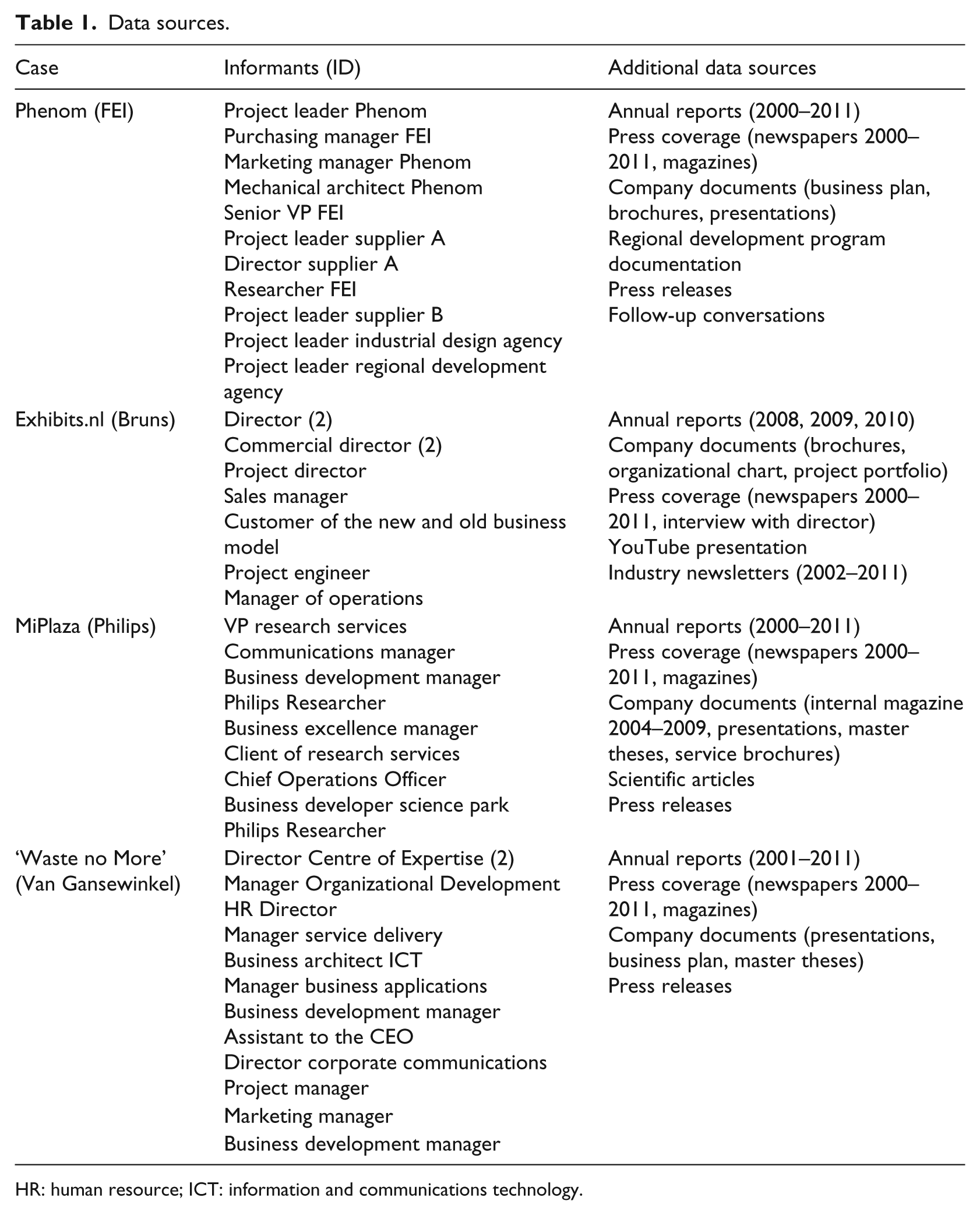
HR: human resource; ICT: information and communications technology.
The interviews were semi-structured by a protocol to enhance reliability (Yin, 2008). They typically started with a question asking interviewees to explain their personal background, position, and history in the organization. Then they recounted the history of the BM innovation trajectory as it unfolded over time. During this explanation, we frequently prompted interviewees for further details. In particular, we ensured that they discussed all developments and changes in the BM components, including the value proposition, customer segments, distribution channels, customer relationships, revenue streams, activities, resources, partnerships, and cost structures (Osterwalder and Pigneur, 2010). Some interviewees used the term “BM” explicitly to discuss how the business initiative differed from their existing business. In other interviews, we prompted respondents to specify any differences regarding specific components of their pre-existing BM and how and why these differences arose. Our questions aimed to uncover concrete events, factual data, and actual behavior, which help increase reporting accuracy (Huber and Power, 1985). Later interviews were aided by an emerging timeline, so that interview time could be used effectively to fill gaps in our understanding and validate earlier accounts.
We triangulated these interview data with both internal and external archival data (see Table 1), such as business plans, presentations, annual reports, company brochures, press releases, media articles, and public interviews about the new BM, its host organization, or direct competitors (Jick, 1979). These sources of data helped specify and verify dates of events and develop a reliable chronology of the BM innovation trajectory. The same documents also helped us prepare for interviews, in that they provided background and in-depth insights. Overall, the combination of interview and archival data enabled a rich, reliable understanding of the BM innovation trajectories.
Data analysis
The first step in our analysis involved within-case analyses to develop comprehensive case narratives (Eisenhardt, 1989; Langley, 1999). These case descriptions contained the original BM(s) of the organization and the development of the new BM. Both were described according to the BM components identified by Osterwalder and Pigneur (2010), whose conceptualization offers an effective tool for communicating with practitioners. Moreover, the initial case descriptions contained an overview of each BM innovation trajectory. We sent each case description to key informants at the pertinent organization to check for validity (Gibbert et al., 2008). Their feedback resulted in minor revisions to the case narratives.
As the second step in the within-case analysis, we analyzed BM innovation trajectories as sequences of learning episodes, similar to Bingham and Davis (2012). We identified distinct learning episodes in the case histories as embedded unit of analysis (Yin, 2008), which formed the basis for further process analyses (Langley, 1999; Poole et al., 2000). Learning episodes involved a coherent set of actions, analyses, reflections, or proposals that resulted in, or were based on, increased understanding. Moreover, episodes had to be significant to the development of the new BM, such that they affected the direction and progress of the trajectory. Some unfolded as longer term trends; for these episodes, we dated the moment they first emerged. The resulting sequences, which included between 9 and 31 episodes each, mapped the evolution of the new BM. We maintained the chain of evidence to ensure construct validity (Yin, 2008); for each episode, we noted relevant data sources, and we coded interview segments pertaining to each episode in qualitative data analysis software.
In the third step, we operationalized the two basic types of organizational learning by distinguishing specific learning mechanisms. The identification of mechanisms was based on the iterative combination of prior literature and our empirical data. Using open, inductive analysis as complement to previous theory enables “extending and refining … existing theoretical categories and relationships” (Locke, 2001: 103). We systematically compared episodes and discussed them in the research team (Strauss, 1987) and related these episodes where possible to learning mechanisms known from literature without restricting ourselves to a predefined set of categories. This process resulted in a framework of four mechanisms used by the established organizations to develop and refine new BM configurations. Table 2 contains the coding scheme, including the definitions of the mechanisms, empirical indicators for each mechanism, and illustrative quotes. More quotes related to the different mechanisms appear in Appendix 1.
Coding scheme.
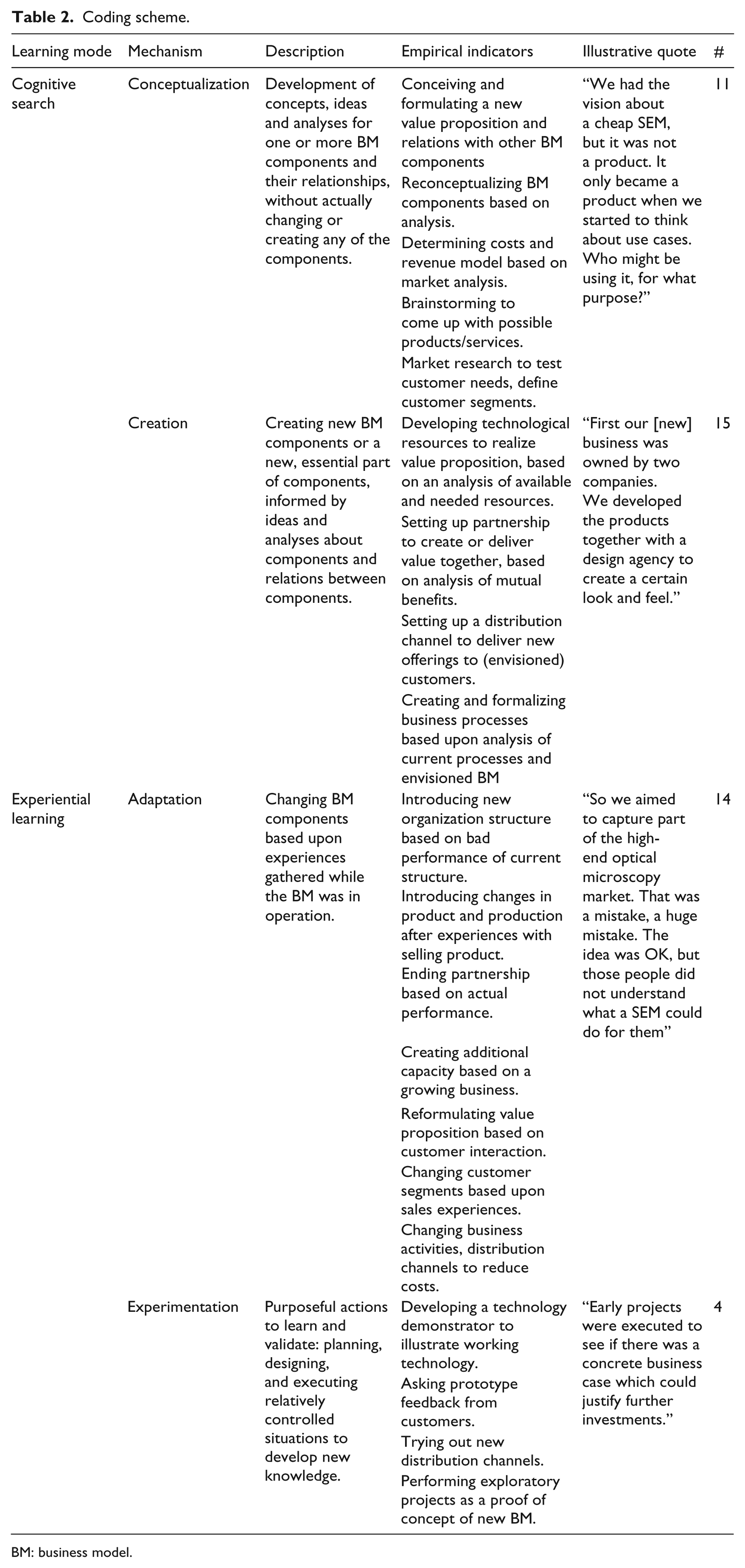
BM: business model.
Two mechanisms are characterized primarily by cognitive search: conceptualization and creation. Conceptualization refers to the development of concepts, ideas, and analyses for one or more BM components and their interactions, without actually changing or creating any of the components. Conceptualization may occur before any aspect of the BM gets implemented. As such, it has been described as “learning-before-doing” by Pisano (1994). Conceptualization may also concern the reconceptualization of existing operations, as reinterpretation of past and present can be a key learning process (Hernes and Irgens, 2013). Creation refers in this study to the actual realization of new BM components or a new, essential part of components, primarily informed by preceding analyses of components and the interactions among them. While it shares with conceptualization that it is rooted in cognitive search, creation means that ideas are also implemented in reality. As such, it relates to what Miner and Mezias (1996) call “generative learning.” Creation primarily relies on cognitive search through the ideation and analysis of BM components and their relation with other components.
Two other mechanisms characterize experiential learning: adaptation and experimentation. Adaptation means changing BM components and their interactions according to experiences gathered while the BM was in operation. The adaptation of BM components can be more or less radical, in reaction to misfits or (partly) positive outcomes. It covers what others have called trial-and-error learning (Bingham and Davis, 2012; Sosna et al., 2010). Experimentation, or experimental learning (Bingham and Davis, 2012), entails purposeful actions to learn: planning, designing, and executing relatively controlled situations to develop new knowledge and validate existing forms. Similar to adaptation, experimentation relies on learning from experience, but experimental learning differs because it only concerns experiences that are intentionally evoked with learning as main purpose.
The fourth step in the analysis involved coding all learning episodes with this set of mechanisms, as well as coding the BM component(s) in each of the four trajectories. Coding the distinct episodes required understanding of prior developments in the case history (Pettigrew, 1990) and the use of multiple data sources (Pratt, 2009). This holistic understanding was aided by integrating interpretations of multiple researchers. Coding was performed by two members of the research team who had been involved in data collection and at least one additional researcher, who was more distant and could serve as a “devil’s advocate” and challenge interpretations (Nemeth et al., 2001). These analytical steps involved iterations, and the final coding process resulted in some refinements to the prior identification of learning episodes in the BM innovation trajectories.
As the final step in the analysis, we compared the four learning trajectories to gain insights into how BM innovation trajectories unfold over time. We first compared the distribution of dominant mechanisms in the episodes over the BM innovation trajectories. Next, we compared the four BM innovation trajectories for continuity and change in the learning mechanisms, grouped into the two overarching learning modes. This step led to the identification of two main patterns, each of which fits two cases. Finally, we explained both patterns according to the specific conditions of the BM innovation trajectories.
Findings
Learning trajectories in the BM innovation process
The four BM innovation trajectories consisted of multiple episodes (42 in total), characterized by a multitude of dynamics. Appendix 1 contains for each BM innovation trajectory the key episodes in chronological order. These episodes map the evolution of the new BM, and for each episode, we identified which learning mechanism dominated. Although highlighting a single mechanism in each episode meant abstracting away from some of the complexities in the case histories, it also enabled a better view of the overall trajectory. For each episode, Appendix 1 also indicates the BM component(s) addressed in that episode and the interactions between these components as changes unfolded, together with illustrative quotes. Appendix 2 gives for each innovation trajectory an overview of the original BM that was most related to the new BM at the start of the trajectory, and, at the right-hand side of the table, the final BM components at the end of the BM innovation trajectory. The tables summarize for each learning episode the BM components that evolved during that episode. Appendix 2 shows that many BM components evolved several times over the innovation trajectory, indicating processual relationships across episodes. Appendix 2 also indicates that multiple BM components are touched upon in individual episode due to interactions between these components. These interactions are further explained for each episode in Appendix 1.
Patterns emerge when we shift attention from episodes to the full trajectories. We find two distinct patterns that characterize learning trajectories according to cognitive search and experiential learning: two of the four trajectories—FEI’s Phenom and Bruns’ Exhibits.nl—initially emphasized cognitive search mechanisms (conceptualization and creation), then shifted to experiential learning mechanisms (adaptation and experimentation), but the other two cases—Philips’ MiPlaza and Van Gansewinkel’s “Waste no More”—initially emphasized learning from experiences and only later shifted more toward cognitive search.
Pattern 1: from cognitive search to experiential learning
FEI’s Phenom and Bruns’ Exhibits.nl trajectories began with emphasis on cognitive search. The Phenom trajectory started as a product development activity but turned into a radically different BM, which eventually spun off (similar to cases described by Chesbrough and Rosenbloom, 2002). As Appendix 2 shows, all its BM components changed over time. For a long time, the core value proposition of FEI had been to offer high-end SEM systems, incorporating the latest developments to increase image quality on sub-micron and atomic levels. Customers included leading research institutes, universities, national laboratories, and industrial companies, which employ dedicated microscopists for research and development.
By 1995, the company had pushed the boundaries of miniaturization and developed an electron microscopy column about the size of a cigar. After a failed application in the semiconductor industry, around 2003–2004, FEI began to conceptualize an easy-to-use, tabletop SEM. This trajectory continued with creation processes, as researchers worked to realize breakthroughs deemed necessary to develop a relatively inexpensive, usable system around the small column. Partial success spurred multiple episodes of conceptualization and creation, in which FEI started to develop a business plan, analyzed pricing and potential customers, and formulated a tentative value proposition, such that the tabletop concept might fill the gap between optical and electron microscopy. These BM components and interactions were designed on the basis of collected information, including interviews with about 35 potential customers. Early in 2005, FEI articulated a product concept, called Phenom, and a business owner and developer were appointed to manage the development of the concept, as well as its introduction into the market.
Meanwhile, top managers at FEI also started arguing that a low-cost SEM did not really fit FEI’s culture. To be manufactured, Phenom would require operations vastly different from FEI’s traditional BM of highly customized, low-volume production, shifting to much more cost-efficient, mid-volume production. Early in 2005, FEI’s business developer contacted a consortium of small suppliers that had joined forces in an effort to become knowledge-intensive system suppliers (Table 4, episode 4). The consortium previously had approached FEI seeking actual projects to work on, and Phenom offered a mutually beneficial opportunity. Several consortium members agreed to co-invest under a risk–reward model to help develop the tabletop SEM. This unanticipated partnership could solve both FEI’s financing and culture problems, while the suppliers gained an opportunity to demonstrate their capabilities.
After this period of predominantly cognitive search, the Phenom trajectory entered several episodes of experimentation and adaptation that moved it further beyond product development into BM innovation. In 2006, the team at FEI was ready to test a prototype of the new tabletop SEM as well as the associated value proposition of the BM. In an experimental setup with defined customer segments, FEI approached potential users to test the value proposition of a beta version.
The product’s market launch triggered several episodes, from which the Phenom team learned and engaged in adaptation and experimentation. The Phenom microscope was introduced in Germany in October 2006, then in the United States in June 2007. However, it failed to meet sales targets: instead of 2500 systems, only a few hundred systems had shipped by the end of 2008. The development of this new market appeared harder than anticipated because of FEI’s inexperience selling the system, as well as the emerging global financial crisis. Team members learned that FEI’s distribution structure and sales approach, which were leveraged from the traditional business to the new BM, were better suited for selling large, complex microscopes than tabletop microscopes. Because Phenom was not profitable and did not fit the existing FEI sales organization, FEI spun off Phenom in a structure in which FEI and the supplier partners remained shareholders. Thus, overall, the Phenom case started with conceptualization and creation episodes and turned more toward experimentation and adaptation in the second half of the trajectory.
Bruns’ Exhibits.nl trajectory displayed a similar shift from cognitive search to experiential learning. Initially, Bruns developed tailor-made, interactive exhibits for large museums, science centers, visitor centers, and traveling exhibitions, mainly in Western Europe. It worked closely with clients and was paid on a project basis. The new BM trajectory was initiated in 2006, when senior management began looking for ways to increase income predictability, noting the severe risk of large, one-of-a-kind projects. They also wanted to leverage their excess manufacturing capacity in their low season and reuse designs. In early conceptualization and creation episodes in 2006 and 2007, Bruns conceived a new BM, later named Exhibits.nl. Instead of offering tailor-made, interactive exhibits, Exhibits.nl would provide standardized, economically priced, shockproof exhibits, purchased online, with limited after-sales service. Bruns analyzed the kind of customers that might value such standardized exhibits (e.g. smaller museums and science centers) and which of its existing exhibits might be standardized (with a fee paid to the original client). It developed a website and a stand at an annual trade fair as sales channels and then created a partnership with a design agency to enhance redesign capabilities. The BM went into operation in 2007, followed by several episodes of adaptation to develop it further. For example, in 2007, much of the interest for Bruns’ new value proposition originated from emerging economies in the Middle East, South America, and Asia, according to website data. Therefore, it shifted its attention to these parts of the world, enabled by the transactional customer relationships it established through its new, web-enabled BM, which did not require much interaction or after-sales service. Bruns also learned that it did not need the design agency with which it had initiated Exhibits.nl, leading to the dissolution of this partnership, but it required intensified marketing efforts. So, whereas cognitive search dominated in the early episodes, experiential learning came to the fore in the later episodes.
Pattern 2: from experiential learning to cognitive search
Two other trajectories display a different pattern. Philips’ MiPlaza and Van Gansewinkel’s “Waste no More” emphasized experiential learning, rather than cognitive search, in the early phases. Both started with a reconceptualization of an existing situation, followed by a period dominated by experiential learning. Cognitive search intensified only in the later phases.
The MiPlaza trajectory at Philips began with the recognition that selling research support services represented a business opportunity, in an episode of conceptualization. In the early 2000s, as open innovation became a buzzword, Philips opened its research campus and embraced a strategy of open innovation. It reinterpreted existing activities, such as incidental provisions of research services to spin-offs and other interconnected companies, as manifestations of an open innovation paradigm. Acts initially performed as a favor to old colleagues and friends became viewed as a novel BM, already in operation in an embryonic form. Therefore, Philips officially opened a new clean room and related research services for outside companies and research institutes under the name MiPlaza in June 2004. Shortly thereafter, Philips’ MiPlaza trajectory featured several episodes of adapting BM components and their interactions, triggered by the growing business and broadening client base. Specifically, Philips initiated partnerships with equipment manufacturers, developed additional resources, and strengthened customer relationships.
After these episodes, its cognitive search intensified and became dominant. In 2006, MiPlaza’s senior management realized that the current model was too loosely defined, which led them to initiate a “One MiPlaza” change program, based on an analysis of MiPlaza’s current situation. On the basis of this analysis, the company conceptualized several changes to BM components and developed a change plan. This change plan then triggered three creation episodes in 2008 that strengthened MiPlaza’s value proposition and customer relationships, while also developing new resources and activities, such as a “process house” and ongoing process analysis. The MiPlaza trajectory thus started with reconceptualization of existing activities, followed by several episodes of adaptation, and turned to an emphasis on conceptualization and creation in later episodes.
Similarly, Van Gansewinkel’s “Waste no More” trajectory displayed a broad shift from experiential learning to cognitive search. It also started with reconceptualization. Van Gansewinkel already had a small recycling operation, able to offer raw materials such as glass that was regarded as a by-product of the company’s core service, namely, collecting and processing customer waste. Rising raw materials prices led it to review its activities in a new light. Inspired by a high-profile television documentary “Waste Equals Food,” Van Gansewinkel employees came to see their existing operations as a materials supplier BM that could compete in the raw materials market. Thus, they appreciated existing raw materials activities and strengthened their importance. The documentary features Dr. Michael Braungart of the Environmental Protection Encouraging Agency (EPEA), a German non-profit institute, promoting a “cradle-to-cradle” philosophy. To accelerate its transformation, Van Gansewinkel enthusiasts created a collaboration with EPEA. The subsequent episodes were highly experiential, such that employees experimented with projects and adapted the structure to control the projects. In later phases, Van Gansewinkel’s “Waste no More” trajectory showed several episodes of cognitive search, using conceptualization to strengthen the BM as material supplier and creation to develop resources and systematize activities. Experiential learning thus was stronger in the early episodes, but the use of cognitive search dominated in the later ones.
Comparison of patterns
In this section, we explain the contrasting sequences of learning mechanisms in the BM innovation trajectories and label the two types of trajectories as “leaping” and “drifting.” We characterize the trajectories that started from cognitive search and moved to experiential learning as “leaping” because they only leveraged a limited number of resources from the traditional business and mainly start with the conceptualization and creation of new BM components, thereby distancing from the existing model right from the start, only to shift to experiential learning after going into operation. We characterize the trajectories that relied mainly on experiential learning initially and moved later to cognitive search as “drifting” because they gradually drift from the original model while being in operation and shift to cognitive search to systematize the model when scaling up later in the process. Below, we first explain the differences in the first parts of the trajectories and then analyze the shift that occurs in both patterns. Table 3 provides an overview of the differences between these two types of trajectories.
Comparison of two patterns.
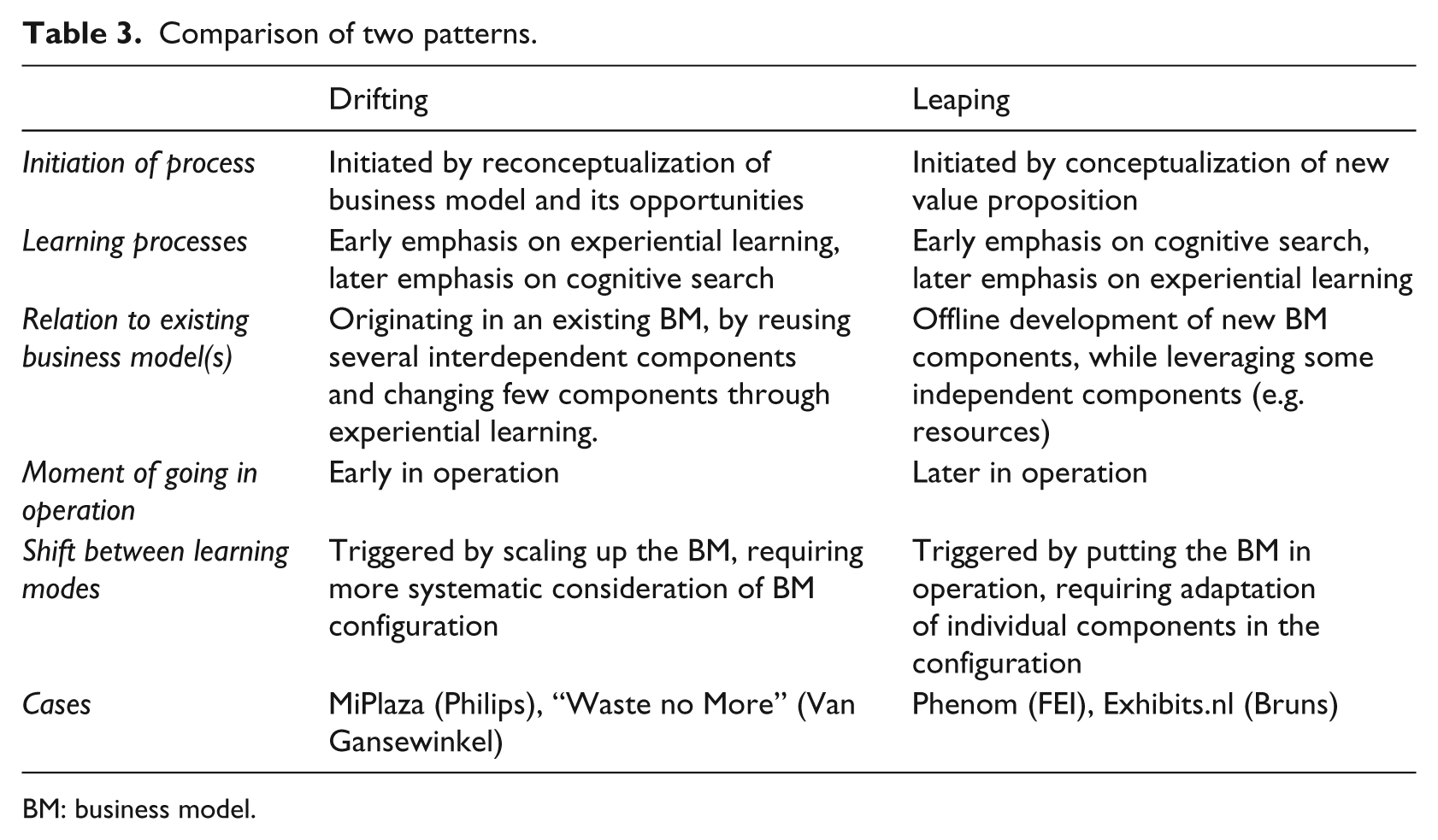
BM: business model.
A key difference between the initiation of the patterns concerns the relationship with the existing businesses that the organizations had in operation: drifting originates from an existing BM configuration, whereas leaping mainly starts by developing new interdependent BM components. The two trajectories that we label as drifting–Philips’ MiPlaza and Van Gansewinkel’s “Waste no more”–originated from ongoing business. Through reconceptualization, they regarded their ongoing business in a new light, shifting attention to alternative value propositions that could sprout from their existing business activities. When Philips’ R&D organization shifted from an internal provider of research services to providing services to external clients, it used most of the BM configuration that was already in place (e.g. resources, activities, and relations with external parties), although some of those components changed substantially later on. Similarly, Van Gansewinkel worked with existing clients, customer relationships, channels, activities, and resources to develop its new value proposition. In this drifting process, the role of some of these components changed. Notably, customers of waste collection services were reframed in the new BM as suppliers of raw materials. Although Philips’ MiPlaza and Van Gansewinkel’s “Waste no More” moved far away from the existing BM over time, they took off from an existing, ongoing BM, thereby starting BM innovation “on the fly.”
In contrast, the trajectories at Bruns (Exhibits.nl) and FEI (Phenom), which we label as “leaping,” mainly started with the offline development of several new BM components, including the products that the BMs evolved from and the channels to bring the products to new customers. BM innovation in Bruns’ Exhibits.nl and FEI’s Phenom constituted more de novo developments.
Relatedly, the patterns show different moments of going into operation: drifting trajectories are in operation early and leaping trajectories are in operation relatively late. When BM innovation can take off from ongoing business, a firm can operationalize an integral BM early, as was the case in Philips’ MiPlaza and Van Gansewinkel’s “Waste no More” trajectories. BM development thus took place in the midst of ongoing operations for clients. In contrast, in FEI’s Phenom and Bruns’ Exhibits.nl trajectories, BM components were developed first, which were put into operation later. These cases had to deal with the sequential dependence of the development of BM components: The realization of one component may be necessary before other elements can be realized (Sánchez and Ricart, 2010). For example, for FEI’s Phenom, the technology had to be developed first to be sure that technological resources could support the imagined value proposition. Then, the foundations of other components needed to be developed, such as exploring distribution partnerships before going into operation. For Bruns, developing a partnership with a design agency to realize the look and feel of the business was a prerequisite before it could develop the website for Exhibits.nl. These sequences of developing individual BM components implied a later moment of going into operation.
It is easy to see how the sequence of learning processes is influenced by the degree to which the new BM develops from existing business and by the moment of going into operation. Taking off from existing business allows going in operation early and that enables learning about a functioning BM from experience. All cases include episodes of adaptation to unexpected problems or opportunities, which led to further development of the BMs. The earlier a BM is in operation, the sooner such adaptive learning is possible. The trajectories that started with reconceptualization of existing activities for novel BMs thus enabled earlier experiential learning. In contrast, the other trajectories did not originate from ongoing business and went in operation later and therefore relied more on cognitive search initially.
The second part of the explanation of the two patterns centers on the opposite shifts in learning mode that occurred roughly halfway along the trajectories: from experiential learning to cognitive search in the drifting pattern and from cognitive search to experiential learning in the leaping pattern. These shifts have different triggers.
The drifting pattern shifts from experiential learning to cognitive search when scaling up the BM. In Van Gansewinkel’s “Waste no More” trajectory, the shift occurred in episode 6. In episodes 3 and 4, Van Gansewinkel experimented with a new value proposition, and in episode 5, they adapted their organizational structure to further develop new activities. After experimental projects had been undertaken, Van Gansewinkel decided to scale up this new BM as exemplary for a new identity. This triggered episodes of cognitive search to systematically advance the BM. In particular, episode 8 concerned a systematic analysis of the markets that would be attractive for the firm’s new identity as a materials supplier, sharpening the value proposition for customer segments, and further specification of the revenue model and cost structure to make the new BM financially viable. Episode 9 further crystallized the internal activities and resources required for a full-scale BM.
Similarly, after Philips’ MiPlaza BM had been in operation for some time, the decision to scale up around episode 6 triggered a shift from predominantly experiential learning to predominantly cognitive search. This was enabled by the organizational allocation of responsibility for the new activities in episode 5. The decision to scale up the BM created the need to analyze customer needs more rigorously, to determine training demands, design a “process house” to formalize internal business processes in pursuit of formal certification, and strengthen customer relationships in the following episodes.
In both trajectories that followed the drifting pattern, the early episodes of experiential learning focused on one or two components and limited interactions at a time (see Appendix 2), such as experimenting with the value proposition for Van Gansewinkel’s “Waste no More” BM. Such experiential learning regarding few components occurred against the backdrop of the overall configuration, like varying a single parameter in a system while keeping the other parameters stable. Scaling up required more systematic conceptualizations and analyses, and later cognitive search mechanisms dealt with the interaction of more BM components and thus a larger search space.
The leaping pattern makes the opposite shift, from cognitive search to experiential learning, triggered by the new BM going into operation, which occurred in episode 6 of Bruns’ Exhibits.nl trajectory and at episode 9 of the FEI’s Phenom trajectory. Going into operation spurred more experiential learning episodes prompted by misfits among initial BM components that emerged during actual operation. For example, late in its trajectory, FEI recognized that the sales channels and customer relationships that were leveraged from the existing business did not fit the novel BM for the Phenom microscope. Bruns (Exhibits.nl) only realized that its partnership with the design agency (which owned 50% of the business) was of limited value after its BM had been in full operation for several years.
The leaping pattern is also different in terms of the number of components and interactions per episode. The early cognitive search episodes in Bruns’ Exhibits.nl and FEI’s Phenom trajectories that occurred when the BMs were not yet in operation for clients involved multiple BM components, configuring the BM as interacting variables. While a larger number of BM components as well as their interactions are considered initially in the leaping pattern, during actual operation, it shifts to the fine-tuning of specific components.
Discussion
Our study responds to recent calls for research to enhance theoretical understanding of the processes of BM innovation in established firms (Arend, 2013; Demil et al., 2015; Massa and Tucci, 2014). We find a “drifting” pattern that originates from an existing BM configuration, goes early into operation, emphasizes experiential learning in early phases, and shifts to cognitive search when an organization aims to scale up the BM. In contrast, a “leaping” pattern is mainly initiated by developing new BM components, goes into operation relatively late, focuses initially on cognitive search, and shifts to experiential learning after the BM goes in operation. Our findings offer several specific contributions to literature on BM innovation and organizational learning.
First, we advance the BM concept by detailing how its cognition and action dimensions form a generative duality. This duality can go unnoticed if BMs are in full operation and cognitive representations resemble the manifest operational reality. In the process of BM innovation, though, differences exist between cognition and action, which make that a BM cannot be reduced to either of these dimensions. A BM is more than what an organization does because current actions may not yet reflect a BM as conceived, and ongoing activities can be interpreted in multiple ways as demonstrated by the reconceptualizations that initiated BM innovations at Van Gansewinkel and Philips. Nor can a BM be reduced to a cognitive representation though because interdependencies among components may be only partially conceived, and understanding of a model may rely on it being embedded in practice. Thus, whereas some researchers emphasize BMs as patterns of action (e.g. Winter and Szulanski, 2001; Zott and Amit, 2010) and others consider them cognitive artifacts (e.g. Baden-Fuller and Mangematin, 2013; Martins et al., 2015), we argue that a BM cannot be reduced to either organizational actions or cognitive representations but should be understood as a duality. Moreover, the duality of these two dimensions makes BMs inherently dynamic and generative. This generative duality reflects the generative dynamics of organizational routines as general patterns and specific actions (Feldman and Pentland, 2003). In BM innovation, cognition and action interact over time to generate new configurations: Actions get reinterpreted, new ideas are implemented and examined in action, and new patterns of action result in experiences that lead to altered conceptualizations of actual and possible business activities. Understanding these dynamics requires attention to both dimensions of BMs’ dual nature.
Second, we show that BM innovation emerges through combinations of different learning mechanisms–each involving a different interaction of cognition and action. Prior studies tend to use single process characterizations, focusing on either cognitive search by emphasizing BM design (e.g. Osterwalder and Pigneur, 2010) or experiential processes such as experimentation (McGrath, 2010) or trial-and-error learning (Sosna et al., 2010). We show that BM innovation processes cannot be captured with a single mechanism because they involve multiple, contrasting mechanisms in a series of episodes. Each learning episode concerns a subset of BM components and the complete configuration of components develops across multiple episodes (see also Cortimiglia et al., 2015).
In all trajectories, both cognitive search and experiential learning appeared necessary–albeit in different sequences. Our findings corroborate the assumption in simulation studies that experiential learning typically involves a more limited set of decision parameters than cognitive search, as it is easier to manipulate variables in thought than in reality (Gavetti and Levinthal, 2000). Experiential learning mechanisms address a few BM components, improving their fit in an integral BM. Cognitive search mechanisms address more BM components at the same time and are thereby more concerned with the overall configuration of components and their interdependencies. Thus, our findings show the distinct, complementary contributions of cognitive search and experiential learning to deal with the configurational complexity of BMs. This also implies that our findings do not just resemble the distinction between emergent and deliberate strategy formation (Mintzberg and Waters, 1985) because all trajectories involve emergence and deliberation, albeit in different sequences.
Third, we identify two process patterns, which we labeled leaping and drifting, with contrasting sequences of cognitive search and experiential learning. The leaping pattern moves from cognitive search to experiential learning. In these trajectories, the BM components and their interdependencies are considered and created upfront. A shift occurs when the BM goes into operation, after which experiential learning helps fine-tune any specific components that do not fit within the configuration. This sequence corresponds to those who argue that fine-tuning or adaptation may be needed after designed BMs are implemented (Cortimiglia et al., 2015; Lehoux et al., 2014).
The drifting pattern is an alternative trajectory that is not explicitly considered in current literature. This pattern, in which emphasis shifts from experiential learning to cognitive search, seems typical for established firms because it originates from ongoing business activities. The pattern poses two puzzles, though. First, it seems surprising that experiential learning enables substantial divergence from the initial BM because existing theory suggests that experiential learning cannot escape a local peak (Levinthal, 1997) and that “revolutionary” approaches are asked for BM innovation (Arend, 2013: 394). A key lies in the use of reconceptualization to initiate BM change. Reinterpreting a current configuration, inspired by the concept of “open innovation” by Philips’ MiPlaza and “cradle-to-cradle” by Van Gansewinkel, changes the performance landscape. Seen in a new light, the contributions of the components to BM performance and their interdependencies change, and the existing configuration no longer offers a local optimum. Moreover, both companies had less stringent demands on profitability in this period of experiential learning, thereby also reducing the “pull” of a prior local optimum. Changes in individual components triggered changes in interdependent components through experiential learning, prompting a greater drift away from the prior equilibrium. Thus, even though drifting takes off from ongoing business, it allows to deviate radically from it in the end.
Another surprising observation is that the drifting trajectories, which emphasize experiential learning in the early episodes, also feature a notable shift to cognitive search later in their trajectories. This shift toward cognitive search has not been documented by those who have emphasized the experiential nature of BM innovation (e.g. McGrath, 2010; Sosna et al., 2010). After adaptation and experimentation with core components (e.g. value proposition, customer segments) showed promising results, the organizations aimed to scale up their new BM operations and thus had to deal with new interdependencies. Minimal experimentation could tolerate inconsistencies; scaling up required more thorough alignment of all BM components. Thus, the organizational actors used cognitive search to align a larger set of BM components systematically and as a coherent configuration.
Overall, this pattern resonates with recent studies of organizational change that document that incremental changes may culminate into radical change (Girod and Whittington, 2015; Plowman et al., 2007). Besides revealing a similar phenomenon for BM innovation, we specify that drifting from an existing BM through subsequent emergent processes may be followed by a more systematic analytical approach to consolidate the new BM as a radical departure from the past. These findings suggest that drifting can be used by incumbent firms to overcome barriers for BM innovation (Chesbrough, 2010) as the initial reconceptualization addresses cognitive constraints upfront and the gradual process makes it easier to legitimize the ultimately radical BM change.
Fourth, our study contributes to the literature on synergies between different BMs of one firm. Prior literature suggests that when established firms add new BMs and operate multiple BMs simultaneously, they are more successful if the models are connected (Casadesus-Masanell and Tarzijan, 2012; Markides and Oyon, 2010; Sabatier et al., 2010). Indeed, such connections were evident in the reuse of components in both patterns. Synergies occurred most immediately in the drifting pattern, where linkages between old and new resulted from reconceptualizations of a significant part of the existing business as a new BM, such that familiar components gained new meaning.
Literature mostly assumes that the synergies become enacted whenever a certain component of one BM can be directly reused in the other BM that the firm employs, for example, when certain resources can be shared (e.g. Markides and Charitou, 2004). However, in two cases, we observed an indirect reuse, when a certain component of the old BM (i.e. customer segment) became a different component in the new BM (i.e. partners). Moreover, we observed that adaptation frequently occurred when direct reuse of a BM component resulted in misfits instead of synergy. Adaptation of BM components helped to resolve such conflicts between the old and the new BM. We observed that the drifting pattern allowed firms to identify such lack of synergy earlier in the process.
Although it might be argued that a broader BM portfolio, like Philips had, increases options for reuse and synergy, this did not appear decisive for the nature of BM innovation trajectories, as we find a similar “drifting” pattern in one of the other firms with only one main BM (i.e. Van Gansewinkel). This indicates that the number of BMs in a portfolio does not explain much of our findings. More broadly, size does not appear to differentiate between the two patterns. The two companies that are smaller in size in terms of employees, FEI and Bruns, displayed the leaping pattern, whereas the bigger firms displayed the drifting pattern. However, this association is likely to be accidental and not causal because existing theory suggests that if size would have an effect, it would point in the opposite direction: prior research found that smaller firms tend to use more emergent and less planned approaches than large firms (e.g. Berends et al., 2014), whereas in the present study, the two bigger firms started in a more emergent way.
Boundary conditions, limitations, and further research
Several boundary conditions and limitations of our study deserve to be mentioned and addressed in future research. We investigated four cases that were similar in several ways, which invites additional studies of BM innovation trajectories in other settings. In particular, our findings refer to BM innovations that were new for their sectors, which imply extensive learning in these trajectories. The process of BM innovation may differ when a BM follows a recipe or existing exemplar (Baden-Fuller and Morgan, 2010). Learning trajectories may be less complex in such situations, and followers’ approaches may involve more learning from external sources, whereas the cases we studied drew primarily on their own analyses and experiences. Our findings also pertain to cases in which new BMs complement existing BMs instead of substituting for them. The dynamics may differ when a new BM needs to replace an old one (Kim and Min, 2015) because the competition for attention and resources may strengthen the role of inertia.
The organizations that executed the BM innovation trajectories were regarded mostly as a whole, ignoring any intra-organizational social dynamics and micro-institutional effects. Any innovation effort that deviates from an organization’s existing businesses likely faces internal resistance, dealing with which requires leadership (Chesbrough, 2007) and political maneuvering (Van Dijk et al., 2011). While drifting may potentially help alleviate some of the resistance, additional research is needed to investigate how intra-organizational dynamics shape BM learning processes. Finally, we did not include performance as a variable in our analysis. We only selected BM innovations that came to fruition, without differentiating their ultimate contributions to firm performance. To extend this study, researchers should investigate the performance consequences of different learning trajectories.
Conclusion
BM innovation is a complex process in which action and cognition intertwine. It is not a two-step process of conception and execution, in which a BM is developed first as a cognitive representation and then implemented in reality later. Instead, it is a multi-step, multi-mechanism learning process that can occur through “drifting” and “leaping” patterns. In addition to considering which BM will be most effective, organizations therefore should consider how they can arrange an effective learning process to reach a novel BM.
Footnotes
Appendix 1
Appendix 2
Acknowledgements
The authors thank Senior Editor Ann Langley and three anonymous reviewers for their constructive feedback and guidance. They are grateful to Tomi Laamanen, Mohammad Rezazade Mehrizi, and seminar participants at University of Liverpool and Johannes Kepler University Linz for comments and input during the development of this article. Finally, they thank the interviewees for giving generously of their time. Earlier versions of this article were presented at the SMS 2012 and AOM 2013 conferences. All errors are the responsibilities of the authors.
Declaration of Conflicting Interests
The author(s) declared no potential conflicts of interest with respect to the research, authorship, and/or publication of this article.
Funding
The author(s) disclosed receipt of the following financial support for the research, authorship, and/or publication of this article: This research was funded by the European Regional Development Fund as part of the EURIS/INTERREG IVC program.