




Abstract
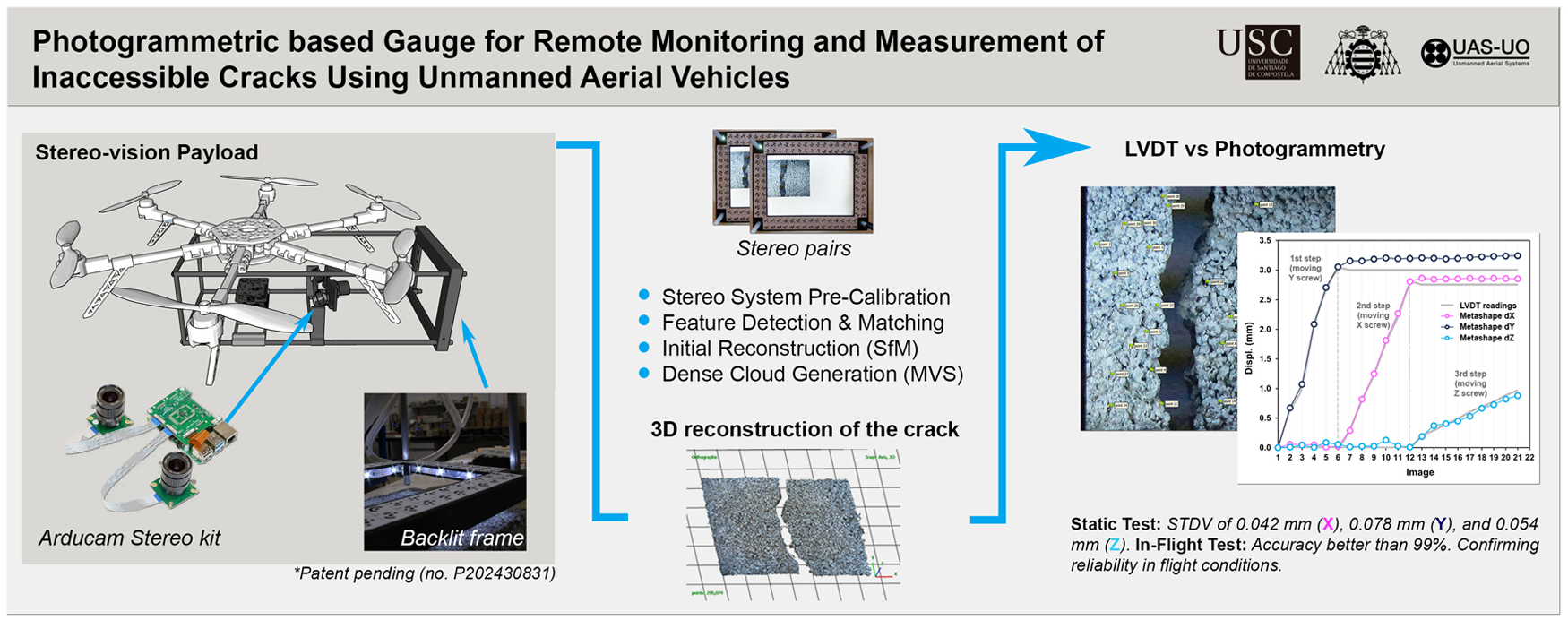
Monitoring and tracking the evolution of crack width in structures over time is a complex yet critical task to ensure their integrity and prevent catastrophic failures. Conventional assessment methods are expensive, labor-intensive, and require direct access to hazardous locations, posing significant risks to personnel. This article presents a novel, low-cost approach that eliminates these dangers and enables three-dimensional monitoring of cracks without the need for direct site access. The method relies on a short-range optical system based on structure from motion and multiview stereo (SfM-MVS) photogrammetry to accurately measure crack morphology and progression. A stereoscopic vision system has been developed, designed to be mounted on various drone configurations, whether commercial or custom-built for the application. The system is lightweight and cost-effective, tested on small commercial drones with a maximum take-off weight of approximately 1.5 kg, facilitating safe and efficient access to areas with structural damage. To assess the feasibility and accuracy of this method, multiple experimental tests were conducted in which crack widths were systematically varied and measured using both the proposed vision-based technique and high-precision linear variable differential transformers (LVDTs). Results demonstrate high accuracy, with a maximum relative error below 8%. The total displacement measured was 2.901 mm (LVDTs) compared to 2.886 mm (SfM-MVS), indicating minimal error in point clouds derived from stereoscopic imagery processed using SfM-MVS techniques. Furthermore, the method was validated in both static and flight conditions, confirming its reliability. The selection of components and aircraft prioritizes affordability, ensuring that the proposed method is not only technically feasible but also economically accessible. By leveraging low-cost hardware and widely accessible processing techniques, this approach provides a scalable solution for structural health monitoring in a variety of engineering applications.
Get full access to this article
View all access options for this article.