



Abstract
A challenge for professional psychology programs is the assessment of students’ professional competence. Despite its potential, objective structured clinical examination (OSCE) has not gained widespread use in the psychological field. However, at Umeå University and Örebro University in Sweden, the OSCE has been introduced at the Clinical psychology programs to assess professional competence. The aim of this study was to explore students’ perceptions of whether and how, preparing for and performing the OSCE benefits their professional learning and prepares them for clinical practice. A web-based questionnaire was administered to 88 psychology students who completed the OSCE and field training. Most of the students perceived the OSCE as a valuable experience that benefits their learning. The OSCE prepared them for clinical practice through practical hands-on training, and by providing essential experience in client interaction, increasing students’ confidence in the role as a psychologist. Students also reported that feedback from the OSCE was crucial for their ongoing learning, but that the authenticity of the examination can be improved. Based on these findings, recommendations for future OSCEs in professional psychology include appropriate preparations, providing constructive feedback as well as striving for high authenticity in the tasks of the OSCE stations.
Keywords
Introduction
Assessment of professional competence is a challenge in professional psychology training, as for many other professional programs in higher education. Professional psychology programs are guided by educational objectives related to skills and abilities. For the present study, which was carried out in a Swedish context, the national educational objectives comprise skills and abilities, as well as professional attitudes, self-reflection, self-awareness, and empathic abilities (SFS 1993: 100). Regarding the development of professional competence during psychologist training, the model by Fouad et al. (2009) is useful. According to this model, there are three levels of professional competence among students during training; readiness to demonstrate their skills (readiness for practicum), readiness to practice under supervision (readiness for internship), and readiness to independently practice as psychologists (readiness for entry to practice). Similar to the Swedish national goals of psychologist education, this model includes knowledge, skills, and reflection. It also includes competencies such as professional values and ethics, self-reflection, scientific knowledge, relational skills, clinical competencies, and empathic abilities (Fouad et al., 2009).
The idea of constructive alignment refers to the idea to align teaching and learning activities and assessment tasks to the intended learning outcomes (Biggs & Tang, 2007). Regarding assessment, valid, and reliable methods for assessing skills, abilities as well as values and attitudes are needed to ensure that all the learning objectives are fulfilled (Kaslow et al., 2009). Traditional assessment methods like exams and written assignments primarily focus on assessing knowledge and understanding, whereas skills-based learning objectives are more difficult to assess. Assessment of psychology students’ professional competence often relies on supervisors’ ratings during field training (Dunsmuir et al., 2017; Hitzeman et al., 2020) despite several limitations to this type of assessment. One significant aspect is that field training does not allow students to be systematically assessed on a range of psychology-specific professional skills and abilities, as the assessment criteria are often relatively general. Another crucial limitation is that achieving inter-rater reliability among supervisors can be challenging, as the placements are different and that the supervisors are usually not well trained in assessment of students’ skills. Furthermore, the dual role of supervisor and examiner can lead to biased assessments. Despite these limitations, supervisor assessments are the most common form of assessing professional competence in psychology (Dunsmuir et al., 2017; Gonsalvez et al., 2013; Stevens et al., 2017). Given this background, there is a need for more standardized, objective methods to assess a broader range of specific aspects of professional competence in psychology reliably and meaningfully.
In the field of medical education, structured assessments of clinical competence have been in use for a long time. A common assessment method in medical and nursing education is the objective structured clinical examination (OSCE), which is a structured and standardized assessment of clinical skills introduced in medicine in the 1970s (Harden et al., 1975). This assessment method is suitable for assessing both skills and abilities as well as professional attitudes. OSCEs consist of a series of stations where students are presented with tasks intended to reflect the learning objectives within the program. Each station has a simulated patient with whom the student interacts. The simulated patient is an actor, trained to act as a real patient by simulating symptoms and behaviors of an illness (Paparo et al., 2021). At each station an assessor evaluates the student's performance based on predefined assessment criteria (Khan et al., 2013). Studies in the medical field have shown that OSCE is a reliable and valid assessment method for evaluating clinical skills (e.g., Kaslow et al., 2009; Newble, 2004; Sheen et al., 2015).
In recent years, there have been some examples of OSCEs professional psychology programs (see e.g., Dunsmuir et al., 2017; Roberts et al., 2017; Yap et al., 2012, 2021). Studies on the use of OSCE in psychology have mainly focused on students’ evaluations and experiences of the OSCE. Findings indicate that students in general have a positive view of the OSCE and consider it a valuable and educational experience (Bagri et al., 2009; Hakelind & Sundström, 2022; Sharma et al., 2013; Sheen et al., 2015; Yap et al., 2012). Results also show that students perceive the OSCE as an authentic and high-quality assessment method, and that the feedback they receive from the OSCE is valuable for their ongoing learning (Dunsmuir et al., 2017, 2020; Hakelind & Sundström, 2022; Sheen et al., 2015; Yap et al., 2012). Despite these perceived benefits of OSCE, studies also report on negative aspects, such as feeling anxious and nervous about performing the OSCE (Bagri et al., 2009; Sheen et al., 2015; Yap et al., 2012). In addition to students’ evaluations, studies have also reported on the reliability and validity of the OSCE (see e.g., Roberts et al., 2017; Sundström & Hakelind, 2023) as well as examiners’ perceptions. By and large, examiners perceive the OSCE as a relevant, high-quality examination, although there is room for improvement (Hakelind & Sundström, 2022; Sheen et al., 2015).
Although the main reason for introducing OSCE in professional psychology training is to enhance the assessment of professional competence, very few studies have touched upon students’ perceptions of the usefulness of the OSCE for developing professional competencies and preparing for clinical practice. In a questionnaire study, Sheen et al. (2015) found that students perceived that OSCE provided them with essential practical experience, bridging the gap between theory and practice. Findings from other studies also indicate that students believe that the experiences from the OSCE will be valuable in their practical work (Bagri et al., 2009; Sharma et al., 2013) and that students who complete the OSCE experience a greater increase in their sense of competence during field training (Glatz et al., 2022). However, knowledge is lacking regarding students’ perceptions of in which ways OSCE might contribute to the development of professional competence during the psychologist training. The present study contributes to this research gap by mapping the experience of OSCE in relation to development of professional competence during professional psychology training. The aim of the present study was to explore students’ experiences of whether, and how, preparing for and performing the OSCE benefits their professional learning and prepares them for clinical practice.
Method
OSCE Adapted for the Master in Psychology Program at Umeå University and Örebro University
In Sweden, the requirements to become a licensed psychologist is a 300 ECTS (European Credit Transfer System) credits/5-year master level education in psychology, which is followed by one additional year of supervised practice. The OSCE was introduced in the Masters in psychology programs at Umeå University in 2018 and in Örebro University in 2019 in order to enhance the alignment between the national goals and the examination of clinical skills and abilities. The OSCE is administered at the 5th (Umeå) and 6th (Örebro) semester out of 10 and is part of a course in which students prepare for the OSCE by rehearsing and practicing skills, for example, by role-playing with each other. The OSCE is carried out during one day at the end of the course. Since its introduction, the OSCE has been administered both on campus and digitally via Zoom. Shortly after the OSCE, students enter a 15-week long field training (internship) in which they attend a placement within a large range of workplaces such as psychiatric or somatic healthcare, school healthcare, or occupational settings including occupational healthcare. During the field training, the students meet with clients in an apprenticeship model under the guidance of qualified supervisors. In this study, students in Umeå and Örebro completed the digital OSCE via Zoom before entering their field training, and answered the questionnaire after their completed field training.
In the digital OSCE, each student undergoes a circuit of five stations assessing different skills and abilities, for example, cognitive behavior therapy, psychodynamic therapy, and motivational interviewing (see Table 1 for example stations in the digital OSCE). Before each station, the student reads a brief case description and the task for the station. At each station, which lasts for 13 min, the student interacts with a simulated client, played by an actor and the students’ performance is assessed by an examiner using a detailed checklist and a global rating of performance. The students are graded pass or fail, and the passing score is set at 60%. A few days after the OSCE, the students receive the assessment as well as written feedback from the examiners for each OSCE station. The simulated clients do not give any feedback. Each station is assessed by one examiner. The examiners are licensed psychologists and teachers at the department, and besides assessing the students they are also responsible for constructing the tasks and assessment criteria for the station. More detailed descriptions of the OSCE at Umeå University and Örebro University have been reported elsewhere (Glatz et al., 2022; Hakelind & Sundström, 2022; Sundström & Hakelind, 2023).
Example Stations in the Digital Psychology OSCE.
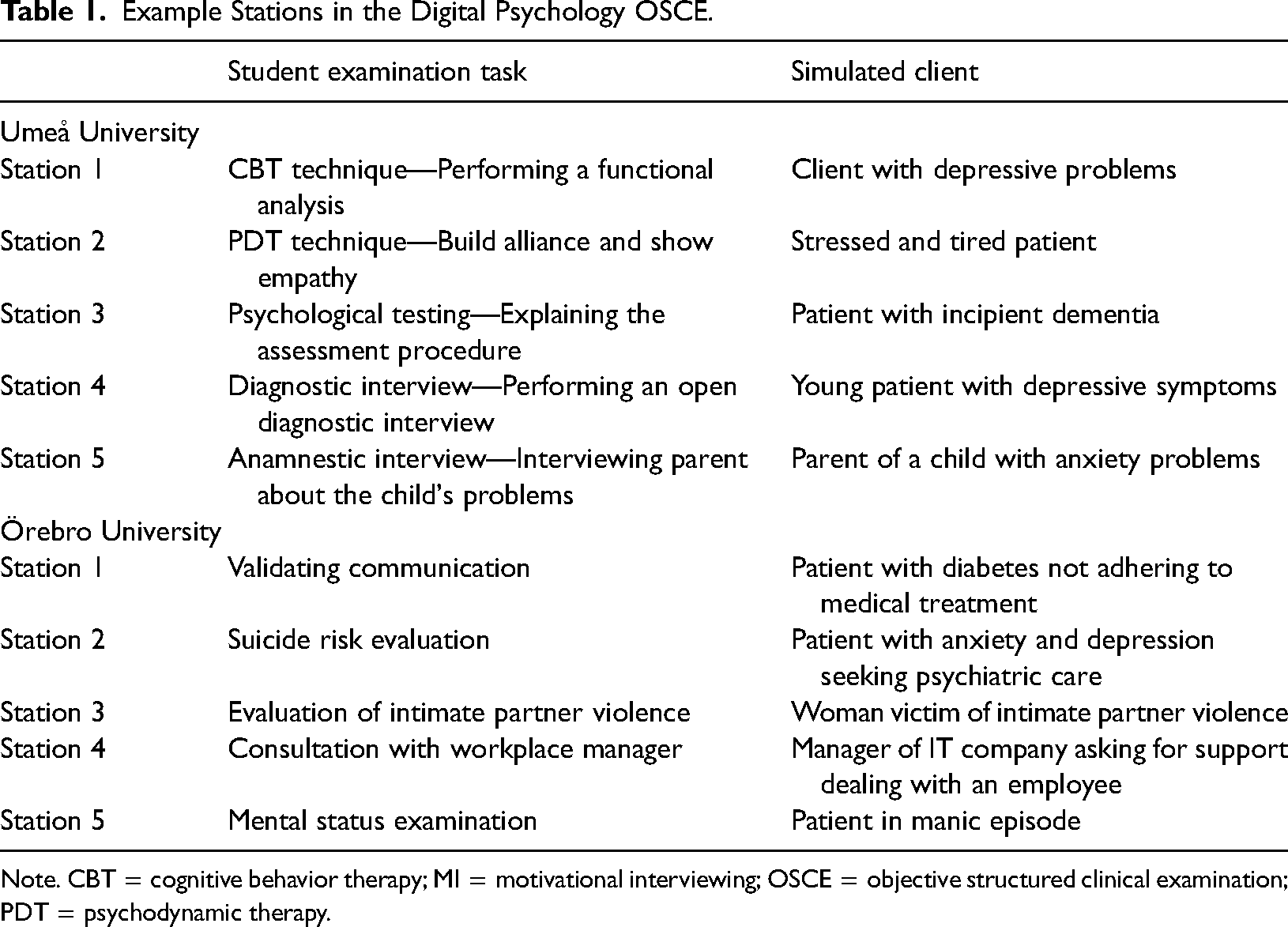
Note. CBT = cognitive behavior therapy; MI = motivational interviewing; OSCE = objective structured clinical examination; PDT = psychodynamic therapy.
Participants
Participants in the study were 88 students in the psychology programs in Umeå and Örebro who performed the OSCE and participated in the field training. In Umeå, 54 students were included (who completed the digital OSCE in the spring semester of 2021 and the autumn semester of 2021), and in Örebro, 34 students were included (who completed the digital OSCE in the autumn semester of 2019 and the spring semester of 2020).
Procedure and Instruments
A few weeks after the OSCE, students enter a 15-week field training. At the end of the field training, students were contacted and asked to complete a web-based questionnaire asking about their experiences of the OSCE and the utility of the OSCE for their field training. In Umeå, students answered these questions at the end of the field training period, and in Örebro, students answered the same questions shortly after the field training. The following three statements were included in this study: “Overall, OSCE is a valuable experience,” “The OSCE examination prepared me well for the field training,” and “Preparing for and performing the OSCE benefited my learning.” Participants were asked to indicate how well these statements applied to them on a five-point scale, where 1 corresponded to “Strongly disagree” and 5 corresponded to “Strongly agree.” The questionnaire also included one open-ended question about how students perceived the utility of the OSCE for their field training and clinical work. Participants were informed about the study, and participation was voluntary, and the questionnaire responses were anonymous. Two reminders were sent out to increase the response rate. The research projects were ethically reviewed and approved by the ethics review board (Dnr 2020-01440 and 2020-01121).
Analysis
The study is based on both qualitative and quantitative data. For the three rating-scale questions, descriptive statistics are reported, and the response distributions are presented graphically (see Figure 1). The partial dropout rate was small; only one participant did not answer the questions. The free-text responses to the open question about the utility of the OSCE for the field training were analyzed using inductive content analysis (Elo & Kyngäs, 2008). A total of 80 out of 88 students had responded to the open question. The analysis was conducted in several steps. First, the material was carefully read and coded by the first author. Then, codes were grouped into content categories, which constituted subthemes and main themes. This categorization was reviewed by the second and third author, and after a consensus discussion revisions were made. In the next step the themes and subthemes were reviewed by all authors and a few final revisions were made, ending up with the final categorization. In presenting the results, great emphasis was placed on retaining the semantic content of the material, that is, all aspects mentioned by the participants were included. In Figure 2, the themes and subthemes are presented and counts for each theme are provided. The results section presents the content analysis and is illustrated with selected quotes. To demonstrate the spread of quotes in the participant group, participant ID numbers (#1-88) are provided for each quote. Participants in Örebro have codes between 1 and 34, and participants in Umeå have codes between 35 and 88.
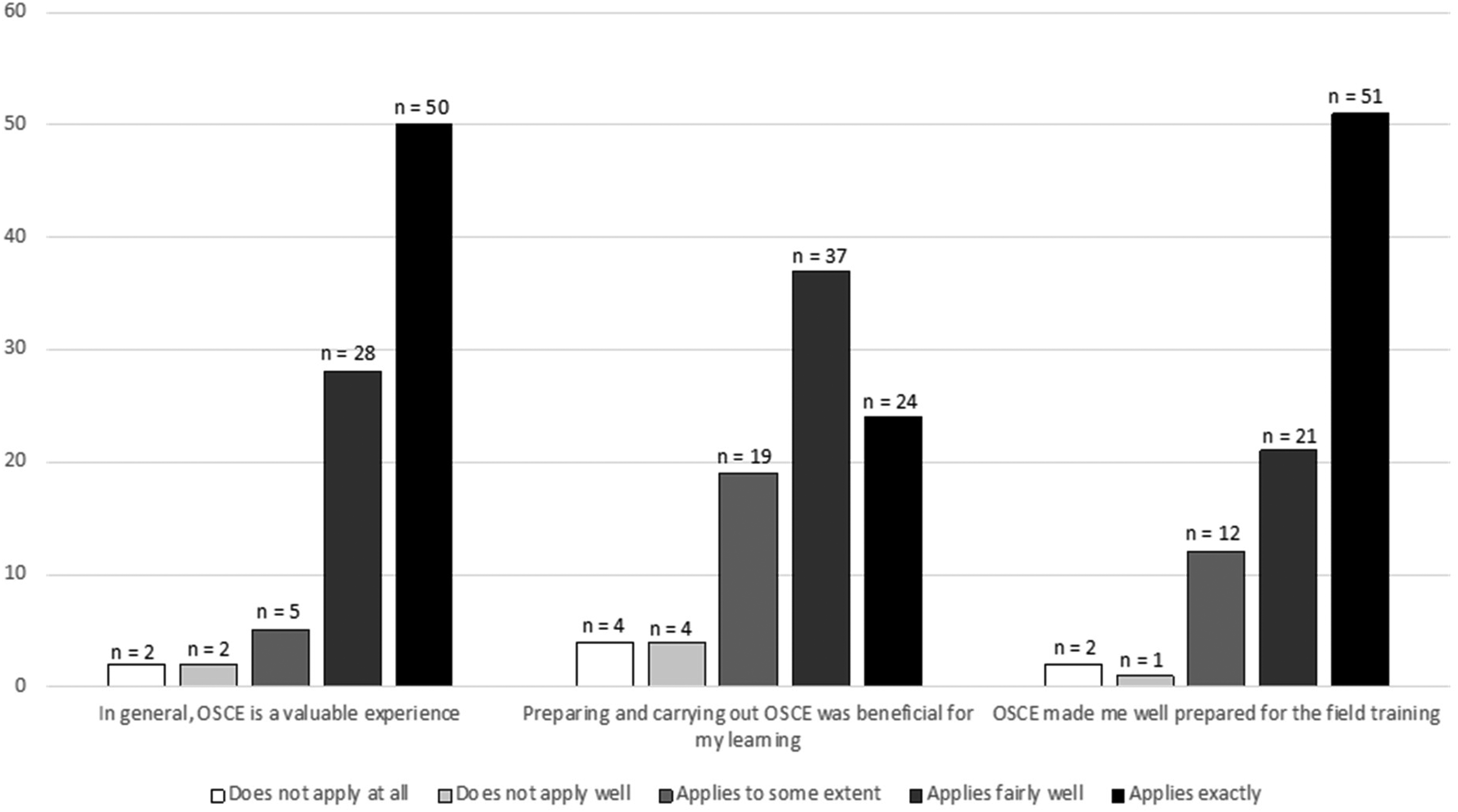
Students’ experiences of the objective structured clinical examination (n = 88).
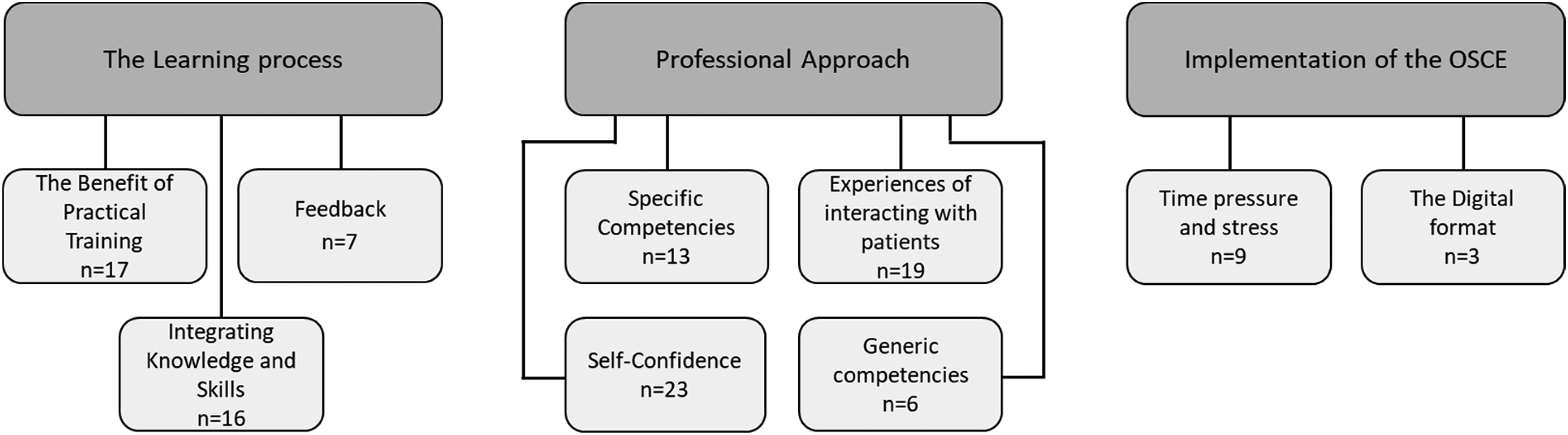
Main-themes and subthemes with number of counts.
Results
The results from the rating scale questions showed that most students viewed the OSCE as a valuable experience (M = 4.40; SD = 0.88). Furthermore, the results indicated that students perceived the preparing for, and performing, the OSCE as beneficial for their learning on a general level (M = 4.36; SD = 0.93) and that they viewed the examination as a good preparation for the field training (M = 3.83; SD = 1.03). Figure 1 presents response distributions for the three questions.
The results, thus, indicate that most students experienced that the OSCE contributes to their preparedness for the field training, and this pattern was found at both universities. To explore this further, we qualitatively examined how students perceived the usefulness of the OSCE. The qualitative data aimed to give more in-depth knowledge on how OSCE might have benefitted their perceptions of their learning. Content analysis of responses to the open question resulted in three overarching themes: (1) the learning process, (2) professional approach, and (3) format of the OSCE. Several subthemes were identified for each main theme (see Figure 2).
The Learning Process
The first main theme concerned how preparations for the OSCE benefit the learning process of the development of clinical competence. Participants described that they gained practical experience and skills, and integrated theoretical knowledge. It also pertained to the feedback that students received from examiners, which was perceived as favorable for their learning.
The Benefit of Practical Training
In this subtheme, participants emphasized that preparations for the OSCE provide practical training and stimulate the development of fundamental skills, such as communication skills, which are highly valuable for clinical work during the field training. Having had the opportunity to practice skills for real, rather than just reading about how to do it, was very beneficial. (#58)
Participants highlighted that both the preparation for and performing the OSCE were valuable. Both the preparation for the OSCE and the OSCE itself, I believe, were very rewarding. We bring out all the practical knowledge we've learned, list it, practice it, and develop it. It's very positive to refresh the memory of skills we almost knew once but had nearly forgotten. By doing so, we remember everything for a much longer time. (#88)
Participants also stressed that the OSCE contributed to their practical experience, which is crucial for their future profession. Practical experience and knowledge. Because that's what the psychology profession looks like! (#87)
Integrating Knowledge and Skills
This subtheme included descriptions of how the OSCE provided an opportunity to integrate knowledge and skills that participants had learned during their education. I learned to use the knowledge I had gained from previous terms in practice, to put it into words, and to convey it to a client. (#29)
It was also highlighted that this integration is valuable for developing understanding, ongoing learning, and applying knowledge in practical exercises. I learned to combine the knowledge I had acquired in previous terms to create a good conversation with the clients I met during the OSCE, and it was subsequently very useful during the field training. I'm especially thinking about learning to use conversational techniques naturally and using them to perform tasks (e.g., supportive conversations, interviews) more successfully. (#14)
The theme also included comments that the OSCE provided an opportunity for the repetition of practical skills and knowledge. Rehearsing knowledge and keeping it fresh in your mind before the field training. (#45)
Participants also commented that the overview provided by the training before the OSCE was very beneficial for the upcoming field training. Of course, it would have been possible to do the field training without the OSCE since we had the knowledge from previous courses. However, I think that practicing before the OSCE and having the OSCE made an enormous difference. It helped in reviewing everything and refreshing our knowledge. (#86)
Feedback
In the third subtheme, participants highlighted the positive aspect of receiving feedback from the OSCE before the field training. …and the feedback was very detailed and helpful. (#68)
Professional Approach
The second main theme focused on how the OSCE contributes to the development of specific competencies and more generic skills. It also provides valuable experience in client contact, which seems to boost self-confidence and a sense of security in the role of a psychologist.
Specific Competencies
This subtheme included statements about how the OSCE involved training and development of specific competencies such as communication skills, suicide risk assessment, functional analysis, motivational interviewing, testing, and result reporting. These specific competencies were found to be valuable in clinical work during field training. I brought with me my knowledge of validation, motivational interviewing, suicide risk assessment, and functional analysis, which I encountered during the field training, and I am grateful for having that knowledge. (#5)
Experience of Interacting With Clients
This subtheme included statements about the value of interacting with fictional clients and gaining experience with different types of conversations before encountering real clients in a professional setting. I believe it was particularly valuable to have the experience of conducting individual sessions with different clients, even if it wasn't “real.” (#47)
Participants also expressed that the OSCE provided a framework for how a real client meeting could look. It primarily provided a frame of reference for what an actual meeting with a client looks like. Before the OSCE, we had only role-played with each other in class, which is nowhere near the experience of sitting with a completely unknown person. (#19)
Furthermore, participants commented that the OSCE gave them experience in how to act in various situations when interacting with clients, which was a valuable preparation for their field training. Good skill training for the internship, as you meet real clients and are required to respond empathetically, provide psychoeducation, reflect, treat or make assessments, and explain things. (#62)
Self-Confidence
This subtheme focused on how preparing for the OSCE and the OSCE itself provided students with a sense of competence and increased their self-confidence. Practicing situations that one might encounter during the field training contributed to a sense of calm and increased trust in my abilities. (#83)
Participants also emphasized that the increased self-confidence contributes to a greater sense of security in the role of a psychologist. I became more comfortable in that situation, meeting a client and being the “psychologist” in the room. (#20)
The participants also expressed that the OSCE was an important preparation and boosted their confidence in meeting clients during their practical training. The OSCE was an important preparation for the internship, making me feel more capable and confident in interacting with clients. (#64)
Generic Competencies
Another subtheme concerned the OSCE as contributing to the development of more generic competencies needed in the psychologist profession, such as the ability to meet a person without knowing in advance who they are and what they will share. Being able to respond to what happens in the moment without the opportunity to have practiced with fellow students beforehand and thus “know what to expect.” It is the only experience that somewhat resembles reality in our practical components in the program. (#59)
The Format of the OSCE
The third main theme included statements about the practical format of the OSCE. The previous two main themes dealt with positive aspects of the OSCE, whereas this main theme largely included negative aspects related to the format of the OSCE.
Time Pressure and Stress
The first subtheme was about participants experiencing the OSCE as a stressful and time-pressured examination. The OSCE itself is not of any use at all for practical training or professional life. Mainly because of the time pressure involved. As a psychologist, I believe one should prepare well for meetings and allocate plenty of time, such as reading the client's records and setting the agenda. In other words, the opposite of what is tested in the OSCE. (#35)
Participants also expressed that the OSCE is perceived as stressful, and the format does not feel authentic. …I think the format differs greatly from reality with these short conversations with a lot of pressure. (#36)
However, participants mentioned that preparations for the actual OSCE are useful, even though the format of the examination does not resemble real-life situations. I'm not sure if I like the examination format because it feels far from reality, but it is definitely a good preparation. (#46)
The Digital Format
A few participants commented on the digital format of the OSCE. Some highlighted disadvantages of the format in terms of how well it prepared them for practical training and how it allowed students to demonstrate their competence. I did not feel that the Zoom-OSCE was fair in the sense that it reflected all the competence I have. (#81)
One participant also commented that the format exceeded the expectations. Practicing different skills in short moments in a high-pressure situation worked better than expected on Zoom. (#62)
Discussion
Assessment of professional competence is a challenge in professional psychology training, and lately researchers have advocated greater use of standardized assessment of clinical skills, such as the OSCE (Yap et al., 2021). Previous studies of OSCEs in professional psychology indicate that students in general perceive OSCE as a relevant, authentic, high-quality examination (see e.g., Hakelind & Sundström, 2022; Roberts et al., 2017; Sheen et al., 2015; Yap et al., 2012), but there is a lack of knowledge with regard to students’ perceptions of OSCE in relation to development of professional competence. Therefore, the present study aimed to explore whether and how students perceive that preparing for and performing the OSCE benefits their professional learning and prepares them for clinical practice. The results showed that students in general perceived OSCE as a valuable experience, that was beneficial for their learning and a good preparation for field training. The content analysis of the open question provided more insight into students’ perceptions of how OSCE contributed to development of professional competence. Three main themes were identified: “The Learning Process,” “Professional approach,” and “Implementation of the OSCE,” and these will be discussed in the following. In the first main theme, it was illustrated that the OSCE is part of a learning process where both preparing for and performing the OSCE benefited their learning. A central aspect identified was that students perceive the practical hands-on training and repetition that takes place before the OSCE as beneficial for their professional learning and thus valuable for their clinical practice. Another important aspect identified was that OSCE contributes to the integration of theory and practice, increasing both understanding and professional competence. These findings are in line with what Sheen et al. (2015) observed in their study of Australian students’ experiences with OSCE in psychology, where the practical preparation prior to the OSCE and consolidation of knowledge and skills were seen as advantages of the OSCE. The current study also illustrates that feedback from the OSCE is valuable for professional learning. From a learning perspective, feedback is essential for developing self-awareness and the ability to regulate one's learning (Hattie & Timperley, 2007; Morris et al., 2021). The findings regarding the benefits of feedback from the OSCE are in line with previous studies, where the results show that OSCE is a useful learning experience, and that feedback from examiners help facilitate learning and develop self-awareness (Dunsmuir et al., 2017; Roberts et al., 2020; Sheen et al., 2015; Yap et al., 2012). With regard to self-awareness, Glatz et al. (2022) found that students who completed the OSCE made more realistic self-assessments of their competence compared to a cohort of students that did not take the OSCE, suggesting that the feedback from OSCE benefits learning and might contribute to a more accurate self-assessment of competence.
The second main theme illustrates that preparing for and performing the OSCE contributes to developing a professional approach, partly by the experiences of interacting with clients and learning to master specific clinical competences. Central to the students’ statements is that through the OSCE, students gain valuable experiences of interacting with fictive clients before meeting real clients, providing a gradual increase in the level of difficulty contributing to their confidence in the role of a psychologist and boosting their self-confidence. These results are corroborated by previous studies indicating that being exposed to simulated clients is a good learning experience (Sheen et al., 2015) and that the feedback from OSCE led to increased confidence among students (Roberts et al., 2020).
In the third main theme, the format of the OSCE was addressed, and the findings illustrate that some students experience the OSCE as time pressured and stressful. This is in line with previous studies, which also show that students experience stress during psychology OSCEs (see e.g., Sheen et al., 2015; Yap et al., 2012). In general, the results from this study show that students find the preparations for the OSCE very valuable, but some perceive that the time-pressure and short OSCE stations make the examination less authentic. However, it is important to note that not all stress is necessarily negative, as a certain level of stress can contribute to concentration and focus (Hakelind & Sundström, 2022; Sheen et al., 2015). There are also students pointing out that the uncertainty of not knowing whom they will encounter in the room actually can contribute to making the OSCE more authentic and that this experience can help prepare students for similar situations in their future role as psychologists. In the design of the OSCE, there are aspects to consider in order to avoid unnecessary time pressure and stress. For example, it is important to adjust the scope of the tasks to the length of the stations. Previous studies have also shown that improving information and instructions to students can be helpful in decreasing the level of stress.
Valid and reliable assessment of professional competence in clinical psychology training requires the use of a range of assessment methods (such as portfolios, simulations, role-plays, client process, and outcome data internship) (Kaslow et al., 2009) in which OSCE is one assessment form. The advantages of the OSCE include that the stations have a certain duration and cover specific contents, allowing for standardized, objective assessment of students’ performance across a broad spectrum of professional competence (Kaslow et al., 2009). Adopting a performance-based examination such as the OSCE in professional psychology training entails students preparing for the examination through practical training of skills. In this way, the OSCE contributes to the progression of developing professional competence as described by Fouad et al. (2009). During the preparations for the OSCE, students gradually move closer to the level described as “readiness for practice under supervision” (readiness for internship). Passing the OSCE provides confirmation that the students have the professional competence required to practice under supervision. One advantage of placing the OSCE before students have their field training, is thus the opportunity to ensure that students have achieved a minimum level of professional competence before they encounter real clients. Of course, OSCEs could also be valuable at later stages in professional psychology training to ensure that more advanced skills are developed.
Limitations and Future Research
This study has both methodological strengths and weaknesses that need to be considered in interpreting the results. Two samples of students from two different universities participated in this study. Both samples have completed the OSCE, but there were some differences, for example, in the content of the stations of the OSCEs (see Table 1). Despite these differences, the results show similar patterns. This can be seen as a strength and contributes to the generalizability of the findings. The questionnaire used in the study is based on a questionnaire used in a previous study of OSCE in psychology (Sheen et al., 2015), and Hakelind and Sundström (2022) showed that the Swedish translation of the rating scale items demonstrated good psychometric properties. In the open question, participants were able to freely express their thoughts and experiences, and the coding and thematization were performed by two researchers and reviewed by another researcher, which strengthens the reliability of the thematization. Moreover, the results from the content analysis comprised both positive and negative aspects of the OSCE, which provides credibility to our findings. Although participants responded anonymously to the questionnaire, there is a risk that their responses might have been prone to participant reactivity (also referred to as the Hawthorne effect; Paradis & Sutkin, 2017), thus implying more positive responses. Moreover, as participation in the study was voluntary, self-selection might also have biased the sample toward more positive views of the OSCE. This needs to be considered when interpreting the results. The results from the present study indicate that students perceive that preparing for and performing the OSCE benefits their professional learning. However, evaluating the effectiveness of the OSCE is outside the scope of this study. Future studies should consider ways to assess the impact of the OSCE on the development of professional competence, for example, by using experimental or quasi-experimental designs.
Where to From Here—Suggestions for Future OSCEs in Professional Psychology Training
This study adds to previous findings indicating that the OSCE is an assessment form worth considering in the strive of strengthening skills, abilities, professional competence, and self-confidence in psychology students. Furthermore, there are several aspects that might be considered when implementing OSCEs in professional psychology training. First, preparing for and performing the OSCE provides students with essential practical hands-on training and experiences of client interaction important for developing professional skills, a professional approach as well as confidence in the role of a psychologist. Making room for proper preparations before the OSCE is therefore one important recommendation, which is also in line with previous findings (see e.g., Roberts et al., 2020; Yap et al., 2021). Second, the feedback provided from the OSCE is important for students’ ongoing learning and might contribute to an increased self-awareness. Ensuring that students are provided with high-quality feedback on their OSCE performance is thus another important recommendation, which has also been highlighted in previous work (Paparo et al., 2021; Roberts et al., 2017; Sheen et al., 2015). Future work includes examining the possibilities of using feedback that students receive from the OSCE during field training, in order to further develop students’ professional competence and self-awareness. Third, some of the participants experienced the format of the OSCE with multiple short stations as time-pressured and not very authentic. Hence, adapting the task of the stations to the time frame, as well as combining shorter and longer stations to increase authenticity should be considered in future work.
In conclusion, the current study adds to previous limited findings on the use of OSCEs in professional psychology training. Overall, the results indicate that the preparation for the OSCE provides students with practical hands-on experiences which benefits the development of professional competence and increases their self-confidence and self-awareness.
Footnotes
Author Contributions
AS was involved in conceptualization, methodology, formal analysis, writing initial draft, and editing final version of the manuscript; CH in conceptualization, formal analysis, reviewing and editing the original draft as well as final version of the manuscript; TG in conceptualization, formal analysis, writing initial draft, reviewing and editing the final version of the manuscript; SE in conceptualization, reviewing and editing the original draft as well as the final version of the manuscript; and SB in conceptualization, reviewing and editing the original draft as well as the final version of the manuscript.
Declaration of Conflicting Interests
The authors declared no potential conflicts of interest with respect to the research, authorship, and/or publication of this article.
Funding
The authors disclosed receipt of the following financial support for the research, authorship, and/or publication of this article: This work was supported by the School of Education Umea university (grant number FS 2.1.6-344-19).
