



Abstract
As coronavirus disease of 2019 (COVID-19) continues to disrupt pretertiary education provision and examinations in the United Kingdom, urgent consideration must be given to how best to support the 2021–2022 cohort of incoming undergraduate students to higher education. In this paper, we draw upon the “Five Sense of Student Success” model to highlight five key evidence-based, psychology-informed considerations that higher education educators should be attentive to when preparing for the next academic year. These include the challenge in helping students to reacclimatize to academic work following a period of prolonged educational disruption, supporting students to access the “hidden curriculum” of higher education, negotiating mental health consequences of COVID-19, and remaining sensitive to inequalities of educational provision that students have experienced as a result of COVID-19. We provide evidence-based, psychology-informed recommendations to each of these considerations.
Coronavirus disease of 2019 (COVID-19) continues to have a disruptive and transformative impact on education provision at all levels (e.g., Aristovnik et al., 2020; Crawford et al., 2020; UNESCO, 2020). In 2020, in preparation for the first academic year of online teaching, several “best practice” guides provided a useful set of recommendations for higher education teachers navigating emergency shifts to online teaching (e.g., Bao, 2020; Nordmann et al., 2020; Sandars et al., 2020). As we approach the next academic year, it is important to now consider how best to support the new cohort of undergraduate students as they transition to higher education, during this turbulent climate. In the 2021–2022 academic year, U.K. universities will welcome a cohort of undergraduate students who have faced ongoing disruption to their pretertiary studying, resulting in an approximate loss of 6 months of education (Office for National Statistics, 2020), mass cancellations of exams, and a notable lack of preuniversity preparatory support, compared with pre-COVID-19 cohorts (Eyles et al., 2020). This new cohort of undergraduates will, therefore, require extra support in their transition to university.
Post-16 education in the United Kingdom has been dramatically affected by the COVID-19 crisis. In the United Kingdom, schools closed from April 20 and an intermittent phased reopening began on June 1, 2020, for keyworkers' children (Bayrakdar & Guveli, 2020). Schools were then again closed in January 2021, with A level and vocational examinations canceled and moved to teacher assessed grades (UCAS, 2021). There was also a large variety in schooling experiences from June 2020 to January 2021 as school provision was regularly interrupted by COVID-19 breakouts, self-isolation due to COVID-19 contact, and changes in keyworker education provision. As a result, these students will arrive at university having missed a considerable amount of their schooling, socializing, and will not have been formally assessed by pretertiary examinations. As such, they may experience notable challenges in acclimatizing to the university context. During the past year, students have also faced a plethora of mental health challenges (Irawan et al., 2020; Van Lancker & Parolin, 2020), a lack of social support (Elmer et al., 2020), difficulties in adjusting to online education (Yates et al., 2020), and unequal access to educational opportunities (Bayrakdar & Guveli, 2020; Moreno & Gortazar, 2020), which may further exacerbate these challenges in the transition to university.
Previous literature has considered how higher education pedagogy can respond effectively to other crisis contexts (e.g., economic crises; Cairns, 2017; IT crises; Andersen et al., 2019). In light of this, Lotz-Sisitka et al. (2015) note that higher education pedagogy should be responsive enough to flexibly adapt to key global disruptions. In this paper, we present a compendium of five key considerations and recommendations for higher education educators to support students during the transition to university in the 2021–2022 academic year. These recommendations reflect the pedagogic literature that demonstrates how students can best be supported in “normal” pre-COVID circumstances and offers ways to adapt these suggestions in light of the current context.
In the literature, there are useful pedagogic models, frameworks, and approaches that consider how best to support students in an online teaching context. For example, Deci and Ryan's (2008) self-determination theory has been used to demonstrate how students' psychological needs of autonomy, relatedness, and experienced competence can be met through online teaching (Oga-Baldwin, 2015; Stolk et al., 2018), which has also been applied to online teaching prompted by COVID-19 (e.g., Holzer et al., 2021). Similarly, the capability, opportunity, motivation, and behavior (COM-B) model of behavior change (Michie et al., 2011) has also been applied to the context of online learning, for example, in psychology (Garip et al., 2020). This model allows educators to establish barriers and facilitators of self-regulated learning in an online context.
In this paper, our five recommendations are aligned with the “Five Senses of Student Success” model (Chester et al., 2013; Lizzio, 2006), which suggest that students' success in university can be generally categorized as relating to their capability, connectedness, purpose, resourcefulness, and culture (see Table 1). This model was chosen due to its focus on the student experience as a whole, the applicability to transitions specifically (Chester et al., 2013; Holder et al., 2019; Wilson et al., 2016), and the overlap between the five senses and other frameworks of success in higher education.
Suggested considerations and recommendations to address Chester et al.'s “Five Sense of Student Success” issues which arise as a result of the COVID-19 crisis.
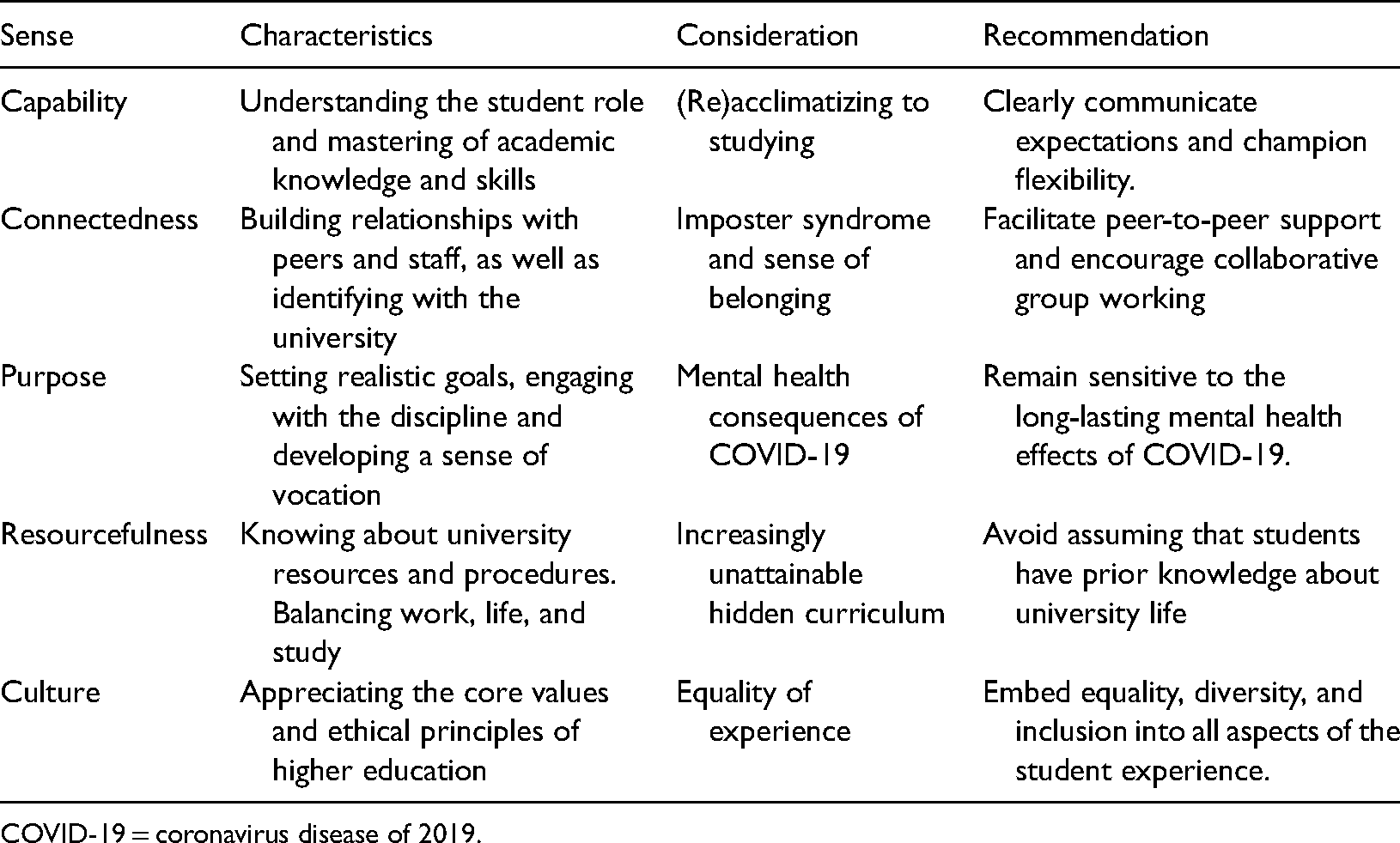
COVID-19 = coronavirus disease of 2019.
Given how COVID-19 has disrupted high school level education and affected young people's mental health specifically (Orben et al., 2020), in this paper, we focus predominately on supporting students who are entering university directly from pretertiary education, rather than via other routes to higher education (e.g., access courses). We appreciate that the routes to university are increasingly nonlinear, however, the majority of these recommendations can be extended to other less traditional routes to an undergraduate education that may be equally impacted by COVID-19.
Consideration 1: (Re)acclimatizing to studying
Chester et al. (2013) suggest that “capability” is an important facet of student success in higher education. Capability, in this context, refers to students' ability to master academic knowledge and skills, grasp subject-specific content, and understand their role as student learners (Lizzio, 2006). This aligns with the “competence” aspect of self-determination theory, which has been found to be a strong predictor for students' positive emotions in COVID-19 times (Holzer et al., 2021). Typically, new first-year undergraduate students can struggle to adapt to the academic expectations of university, and often have difficulties grappling with the structure, independence, and content of university-level learning (McPhail, 2015; Scutter et al., 2011; Smith & Wertlieb, 2005). Experiences of pretertiary teaching and learning can form the basis for expectations about university (Leese, 2010; Robinson et al., 2013), which can provide students with a sense of capability. Indeed, students' academic performance at the pretertiary level is predictive of academic performance at university (e.g., McKenzie & Schweitzer, 2001). However, students in the incoming undergraduate cohort will have missed a considerable amount of their pretertiary education and, due to the widespread cancellation of formal examinations in Summer 2021 (Walker, 2021), they will not have sat formal examinations. As such, concerns regarding students' sense of capability may be exacerbated in the incoming academic year and may struggle to “reacclimatise” to university academic life.
Thus, higher education educators should redefine the “capability” sense of student success (Lizzio, 2006); that is, more time and care should be given in ensuring students' grasp of academic content given the need to “reacclimatise” to academic studying. As Lizzio (2006) notes, students who arrive at university ready to learn tend to be more academically “successful” during the first months of university. In the upcoming academic year, the majority of students may not be as ready and equipped to learn as they would be in “normal” pre-COVID-19 circumstances, which must be accounted for in teaching content, setting of learning outcomes, and assessment practice.
As Crafter and Maunder (2012, p. 18) suggest, to facilitate healthy and productive transitions to university, “learners need to be given the chance to actively participate in their transition experience.” This fits well with Whelehan's (2020) suggestion that adopting a “student as partners” approach during the COVID-19 shifts may be particularly productive. Specifically, Whelehan notes how collectively rethinking student engagement mechanisms can offer the opportunity to work with students to embrace new ways of working that situate the student voice at the center of higher education's response to COVID-19.
Higher education should also consider how “standard practices” can be rethought in a way that supports students in the unique context of the COVID-19 pandemic. Student capabilities are typically measured through assessment and supported through feedback. Within a constructionist framework (Biggs, 2003), delivery is tied to learning outcomes, and achievement of learning outcomes forms the basis of assessment. Therefore, following the disruption to education as a result of COVID-19, higher education may need to adjust expectations of standards, and clarify the purpose of assessment. Rahim (2020) provides a useful set of guidelines for assessment practice in the context of COVID-19. These include, among others, the need to re-evaluate the prerequisites for assessments, ensuring that assessment is tied directly to clearly stated learning objectives, and balancing between formative and summative assessments. The implementation of additional “low stakes” formative assessments can increase learning, help students gain confidence, and improve retention (e.g., Boitshwarelo et al., 2017).
Consideration 2: Imposter syndrome and sense of belonging
The second “student success sense” in the five-sense model is students' sense of “connectedness” or “belonging” to both the academic environment and peer support networks (Chester et al., 2013; Lizzio, 2006). However, there is a plethora of literature that demonstrates how students generally struggle to establish a strong sense of belonging in the early days of university study (e.g., Christie et al., 2008), which can impact the rest of their university experience (e.g., Ahn & Davis, 2020; Humphrey & Lowe, 2017; Read et al., 2003). The challenge of students' developing a strong sense of belonging at university is likely to be heightened by COVID-19 due to unique situational issues, including an increase in students undertaking caring roles, the heightened financial precarity of students, and a lack of social connectedness (Lederer et al., 2020).
Additionally, a strong sense of belonging at university is associated with the feeling that they have “earned” or “deserved” their place at university (Ramsey & Brown, 2018). When students do not feel that their place at university is legitimately earned, they may experience “imposter syndrome,” or “feeling like a fraud,” which is related to mental health problems, such as anxiety (Cokley et al., 2013). However, academic-related “imposter syndrome” may be negated by pretertiary grades that serve as a testament to student's ability to perform academically. This may be particularly true for students who come from underrepresented backgrounds (Stephens et al., 2014), given the prevalence of imposter syndrome or feeling like they “do not belong” at university among these students (Soria & Stebleton, 2013). These feelings of imposter syndrome are heightened by the perception that universities only “select the best students” (Jury et al., 2015) who are well suited to the university context.
However, the 2021–2022 cohort of students' place at university will have been decided by teachers' predicted grades (UCAS, 2021) and not by performance on sat exams throughout the United Kingdom (Gov.Wales, 2020; NI Direct, 2020; SQA, 2021). As such, these students will not have the affordance of examination grades to “justify” their place at university to combat feelings of imposter syndrome. This may lead to unique identity management concerns that must be negotiated, particularly among lower socioeconomic status students (Hearn & Rosinger, 2014) and mature students (Chapman, 2013), who are typically underrepresented in higher education.
Imposter syndrome is also likely to be heightened given the lack of access to the physical and social environment of university campuses. Scholars have warned that this lack of a physical “university space” in a COVID-19 context can impact students' self-discipline, wellbeing, and sense of belonging (Raaper & Brown, 2020). Furthermore, given that online teaching, or a hybrid of online and in-person teaching, may last into the next academic year of 2021, students in the incoming cohort may also not have the affordances of frequent in-person peer-to-peer social interaction during the transition to university. This lack of social interaction and a strong social network could affect student's sense of belonging, given how the social networks of students are an important factor in buffering stress and improving academic performance (Stadtfeld et al., 2019) which is difficult to establish in COVID-19 time (Odriozola-González et al., 2020). For example, in Canada, Busseri et al. (2011) show how participation in introductory activities that enable students to gain a sense of institutional belonging (e.g., academic clubs, sports teams, etc.) predicts a positive adjustment to university. Having a support network of friends at university contributes to students' increased confidence and security about their own self-image, which can also negate imposter syndrome (Brooks, 2007). Similarly, Orben et al. (2020) stress the importance of peer interaction on young peoples' social development and caution that physical distancing may have a disproportionate effect on 18–24 year olds, an age group that represents the vast majority of undergraduate students (HESA, 2020).
As Watermeyer et al. (2020) stress, students in the incoming cohort will ultimately “no longer experience a unique life-stage of social learning and development” in the early part of their university life. Therefore, academic teachers will need to account for this in their student support practice, by responding sensitively and proactively to combatting students' fragile sense of belonging during this year. Efforts to establish more authentic social support will also be important in the new academic year. The literature demonstrates how peer-to-peer tools, such as peer mentoring, have been found to support a successful transition to university (Chester et al., 2013; Yomtov et al., 2017). Therefore, higher education educators should consider facilitating peer-to-peer support, in efforts to improve their sense of belonging and negate feelings of imposter syndrome. Research demonstrates that students can feel connected to other students and have a more established sense of belonging through collaborative working in an online COVID-19 context (Harris et al., 2021). This may be achieved both in academic settings, for example, through group working and peer-tutoring and also in more informal settings, for example, by encouraging students to engage with university clubs and societies. It may be also useful to have a targeted approach to peer learning, by encouraging underrepresented groups of students, such as mature students, lower socioeconomic status students, and ethnic minority students, to engage in peer-to-peer support. This may bolster social belonging, allow students to overcome imposter syndrome, and thus improve retention and persistence with higher education (e.g., Murphy et al., 2020).
Consideration 3: Mental health consequences of COVID-19
Aligned with the “purpose” element of the student success model, students' need a strong sense of personal value and goal-setting that is tied to their place at university. Students' sense of purpose enables them to more readily access help and support, for both academic and pastoral matters (Lizzio, 2006). We argue that this facet of the model is also tied to concerns surrounding student mental health and help seeking, a concern that is particularly heightened in the COVID-19 context.
Indeed, student mental health has been on the higher education agenda for several years (e.g., HEFCE, 2015). There have been compelling calls to “take student mental health seriously,” and scholars have critiqued the provision of adequate student mental health recourses and culture at universities (e.g., Baik et al., 2019; Wynaden et al., 2014). The COVID-19 pandemic has exacerbated these concerns (Grubic et al., 2020). COVID-19 has prompted a heightened prevalence of self-reported depressive and anxious symptoms among the general population (e.g., Torales et al., 2020), and this has been particularly notable among university students (Copeland et al., 2021). In the United Kingdom, national “stay at home” lockdowns have prompted a widespread lack of social interaction and exercise, which negatively impacts mental health, including for students (Savage et al., 2020). In a recent study by Cao et al. (2020) in China, ∼25% of students were experiencing symptoms of anxiety that were related to the financial impact of COVID-19, among other factors.
Although a body of literature has considered how best to support students during the 2020–2021 academic year (e.g., Liu et al., 2020), educators should now consider how to support the new cohort of students in the forthcoming academic year. This should also be sensitive to the long-term developmental and social effects of living through the COVID-19 pandemic as a young person (Orben et al., 2020). To achieve this, it may be useful to follow Houghton and Anderson's (2017) recommendations of actively embedding concern for mental health into the university curriculum as part of an inclusive curriculum design process. Similarly, we propose that the notion of “reasonable adjustments” in student education, particularly in the context of summative assessment practice, should be reappraised in light of the COVID-19 pandemic. As Morgan and Houghton (2011, p. 2) suggest, a reappraisal of the curriculum in light of students' mental health concerns should “enable course designers to structure modules and programmes in ways that will minimise the need for individual reasonable adjustments.” Therefore, given that a cornerstone of inclusive learning and teaching is the ability to make adjustments and allowances for students who need them (Advance HE, 2016), it may now be useful to appraise what the “competence standards” are for each local subject context, and how educators can adjust their provision given the unique mental health challenges that have arisen due to COVID-19 (Equality Challenge Unit, 2015). This may be done at a local level, that is, by appraising how existing competence standards can be adjusted in the classroom, and also at an institutional level, with wider top-down support from accrediting bodies and professional standards organizations.
Consideration 4: Increasingly unattainable hidden curriculum
The five-sense model of student success suggests that students are successful at university when they have a strong and coherent sense of “resourcefulness” related to their university studies (Chester et al., 2013; Lizzio, 2006). This is echoed throughout the literature; for example, Garip et al. (2020) showed how the accessibility of resources was an important theme in students' online learning self-regulation. However, for students to be able to develop this sense of resourcefulness, they should be equipped with access to the “unspoken rules” or “hidden curriculum” of academia in order to navigate university successfully. The “hidden curriculum” of higher education refers broadly to the societal, educational, or institutional values or norms that are transmitted unconsciously to students (Cotton et al., 2013). Although it has been applied as a pedagogic term to various facets of the student experience (Cotton et al., 2013), here, in the context of transitions to university, it refers to the practices, processes, and values that students are assumed to understand but that are not explicitly taught. To achieve this, students use both “hot” and “cold” knowledge to understand the university context (Slack et al., 2014). “Hot” knowledge about university refers to information acquired “through the grapevine,” such as from speaking to peers, second-hand recommendations, and social networks. In contrast, “cold” university knowledge is obtained through “official routes,” such as open days, prospectuses, and websites, and is thus typically more constrained and less authentic (Hutchings, 2003).
Pre-COVID-19, students were offered the opportunity to obtain both “hot” and “cold” knowledge about the experiences of studying at university in ways that, arguably, are less prevalent or accessible this year. For example, pre-COVID-19 students can begin to unravel the complexities of higher education's “hidden curriculum” through speaking to other students at applicant events, open days, or taster lectures. Indeed, open days are considered to be one of the most reliable sources of information about “real” university life (Veloutsou et al., 2005). These events can act as a tool to ease transition to university. In a U.S. context, for example, Swanson et al. (2019) conducted a randomized experiment that demonstrated how students who visit college campuses before attending university had a better overall understanding of college compared to those who received information about college but did not visit the campus. Further, even if they have received access to “cold knowledge” (i.e., through university websites and “official” communications), there is less opportunity to engage meaningfully in establishing the second-hand “unofficial” “hot knowledge” that is valuable in navigating university for the first time. Importantly, there are also demographic and socioeconomic factors that affect access to this knowledge (e.g., Hutchings, 2003; Slack et al., 2014), which we will explore further in Consideration 5.
Unlike the 2020 entry cohort, the vast majority of new students will have had no opportunity to attend in person pre or postapplication events. As such, they will have had considerably less access to crucial “hot” knowledge. Higher education providers should therefore consider how the “unspoken rules” or “hidden curriculum” of undergraduate study can be made clearer to new students. As Giroux and Penna (1979) explain, the hidden curriculum can be “uncovered” or “exposed” through a process of a “covert pattern of socialization” (p. 21), in which students gradually learn the “hidden rules” of academic expectations through interactions with peers and academics. Therefore, in the 2021–2022 academic year, higher education educators should be particularly sensitive to how the hidden curriculum is perpetuated by assumptions that students possess prior knowledge about the norms, rules, and etiquette of higher education. To help to provide students with valuable “hot knowledge” that helps them to unravel this hidden curriculum in the upcoming academic year, educators may wish to encourage peer-to-peer working, facilitate staff-student relationships, and ultimately aim to foster a respectful, collaborative culture of learning, in which students feel able to inquire about the hidden curriculum without judgment. This recommendation relates to the wider culture of an institution, and thus educators would no doubt benefit from having institution-level support with implementation.
Consideration 5: Accounting for (in)equality of experience
Finally, students' ability to access, understand, and readily participate in the culture of higher education is the final “sense” in Lizzio's (2006) model that ties together all facets of student success. It has also been thought of as a standalone “sense” that students can work on developing in isolation to the other elements (e.g., Chester et al., 2013). This sense refers to students' ability to engage with university “culture,” by developing an appreciation for the university's values, ethics, and norms. Wilson et al. (2016) have interpreted this sense as creating a new identity as a student. This sense, much like the rest of this model, is often affected by students' preuniversity experiences and demographic factors (e.g., Briggs et al., 2012). For example, socioeconomic status, gender, and age, have been found to affect student's successful transition to undergraduate-level learning from pretertiary education (e.g., Rummey et al., 2019). Given that preuniversity experiences often determine whether students are able to understand and participate in the “culture” of university, students who have not had access to adequate preuniversity support may struggle more to develop their identity as higher education students. Therefore, this widens the gap between students who are “trained” for university and those who are not, which exacerbates existing inequalities. The impact of COVID-19 has the potential to widen this gap, given the concerns of inequality in access to online teaching provision, university transition support, and teacher assessments as a replacement for formal examinations.
Indeed, a concern for (in)equality of experience can be seen in all the considerations raised in this paper. For example, the incoming cohort of students' capability may be affected by the quality and quantity of their pretertiary education provision, which is affected by students' socioeconomic background. Data from Teacher Tapp (2020), a survey of teachers in England, shows that during the Spring 2020 pivot to online teaching, private high schools had more adequate provision of online teaching infrastructure for A-level teaching, and were more likely to use video calls and online chat, compared with state schools. A report from The Sutton Trust (2020), which asked university applicants in the 2020 year about their views on the A-level grading system, also found vast socioeconomic inequalities, including internet access, access to tools and devices for learning, and a suitable place to study between private and state schools (cited in The Edge Foundation, 2020). Therefore, the “digital divide” is a pervasive issue during this time (Ramsetty & Adams, 2020; Watts, 2020). As ElSaheli-Elhage (2021) stresses, a lack of access to online tools can exacerbate inequalities of education opportunities.
Similarly, due to the inconsistencies of preuniversity studying experience and opportunity, there is also likely to be inequalities in new students' sense of belonging or connectedness to university. This will likely be exacerbated by concerns over the equity of teacher assessments as a replacement for formal examinations. For example, Woolf et al. (2020) surveyed over 2,000 medical applicants about their views of the cancellation of exams in 2020 and found that female applicants and applicants from Black Asian and Minority Ethnic backgrounds had heightened concerns about the fairness of teacher assessments as a means of determining higher education opportunity. Students from disadvantaged or underrepresented backgrounds may thus suffer from more marked mental health concerns as a result of heightened imposter syndrome during the 2021–2022 academic year.
There are also other systemic inequalities that are likely to be starkly heightened in the 2021 cohort. For example, students with disabilities may also be unfairly disadvantaged during this time. ElSaheli-Elhage (2021) surveyed teachers and found that the majority (69%) of respondents did not feel adequately prepared to teach students with “severe disabilities” online. This could mean that these students face barriers in accessing necessary support in the transition to university. Therefore, higher education educators should be mindful of these systemic inequalities and be prepared to champion equality and inclusion in the university transition. To achieve this, educators should provide “student-centred” assistance and reassurance that is “proactive, timely, and tailored” (Nelson et al., 2006, p. 4), paying particular attention to students who may have been disadvantaged due to the “digital divide” of pretertiary study. Similarly, providing access to university support systems, such as study skills support and pastoral student support, has been referred to as a key “enabler” that assists students with the transition to university (Bowles et al., 2014); therefore, academic staff should prepare for the 2021–2022 year by being ready to clearly signpost these resources, which will also enable students to unravel some of the hidden curriculum.
Conclusion
Overall, in this paper, we have outlined five core considerations that higher education educators should keep in mind when facilitating the transition of students in the 2021–2022 academic year; these considerations and recommendations are compiled in Table 1. Considerations include the anticipated academic consequences of disrupted schooling, mental health concerns surrounding COVID-19 and young people's social development, inequalities exacerbated by online education and reliance on teacher assessments and heightened feelings of imposter syndrome among new students. We have provided a set of recommendations for educators in higher education who have a role in the provision of student education practice and/or student support.
However, it is important to note that some of these recommendations require institutional or managerial support to implement meaningfully and successfully. In a discussion of tips during the migration to online teaching during the early stages of the COVID-19 pandemic, for example, Sandars et al. (2020) highlighted the need for organization-level change and support in supporting staff and students during this time. They also stressed how adequate infrastructure and staff support are crucial factors in student education and support during COVID-19. Indeed, it is important to note that individual action and institutional strategies are both important in the implementation of these recommendations. Some of the recommendations we share here can be more readily implemented in the classroom with students and require relatively little change in policy, culture, or structure, whereas others may require a more top-down method of implementation. The extent to which recommendations can be implemented locally, departmentally, or institutionally is likely to differ depending on the local context and culture. Therefore, we invite educators to take these recommendations as a set of evidence-based principles, which can then be strategically implemented in a way that is sensitive to each local context.
Moreover, we also recognize that schoolteachers, parents, and higher education teaching staff are all under an immense amount of pressure during COVID-19 times (Letzel et al., 2020) and, therefore, these recommendations should not serve as a prescriptive set of “rules” that educators should follow. Instead, we have presented a series of evidence-based recommendations that educators may shape and adapt to their own unique context, with their own set of local resources and facilities.
Finally, there are, of course, groups of students who are equally affected by COVID-19, but who will experience the impact of COVID-19 in different ways. For example, students who have caring responsibilities, students who live at home rather than on-campus, and mature students who have not arrived at university directly from pretertiary education (e.g., Holdsworth, 2006; O’Donnell & Tobbell, 2007). However, in this paper, we aimed to compile a set of core recommendations that can be applied broadly to the student experience. There will be nuances within these recommendations and considerations that should also be navigated sensitively that we do not cover in full here.
Footnotes
Declaration of Conflicting Interests
The authors declared no potential conflicts of interest with respect to the research, authorship, and/or publication of this article.
Funding
The authors received no financial support for the research, authorship and/or publication of this article.
