




Abstract
Understanding characteristics that contribute to psychology students’ academic success is important to better support them during their studies. Referring to person–environment fit theory, we examined effects of study-relevant characteristics (self-efficacy beliefs, self-assessed level of information about the study program) on subjective criteria of success (persistence with the choice of study subject, later study satisfaction) and controlled for effects of grade point average (GPA) and mathematical skills. We present a longitudinal survey study including five cohorts of first-year students (total N = 854). Mediation models (N = 254) revealed that self-efficacy and level of information at study entry predicted students’ persistence at the end of the first semester, which predicted satisfaction at the end of the second semester. In the presumed overall model we found total effects of self-efficacy and level of information, with direct and indirect effects (via persistence) on satisfaction, and no total or direct effects of GPA and mathematical skills, but an indirect effect of GPA on satisfaction. Thus, psychology students’ satisfaction substantially depends on study-relevant characteristics and less on skills. An enhancement of students’ self-efficacy beliefs and comprehensive information for those who are interested in the subject might help to increase satisfaction and thus success.
Introduction
Academic success is one of the most important constructs in higher education research. Usually, academic success is seen as a multi-dimensional construct, with subjective and objective criteria (Bean & Bradley, 1986; Dahm & Kerst, 2016). Objective criteria are students’ grades and grade point average (GPA; Bettinger et al., 2017; Harackiewicz et al., 2002; Menzel, 2005), and study duration (Menzel, 2005; Schmidt-Atzert, 2005). Subjective criteria are students’ persistence – that is, their confidence with the choice of study subject (Hasenberg & Schmidt-Atzert, 2014) and satisfaction with the studies (Gold & Souvignier, 2005; Kauffman, 2015; Trapmann et al., 2007; Yilmaz, 2017). It should be noted that academic success is a process (Blüthmann, 2012) in which objective and subjective criteria correlate and influence each other mutually (Bean & Bradley, 1986; Schüpbach et al., 2006). Thus, it is assumed that persistence is positively related to satisfaction and academic achievement (Schüpbach et al., 2006; Thiele & Kauffeld, 2019), which are likewise interrelated (Bean & Bradley, 1986; Blüthmann, 2012; Schüpbach et al., 2006).
Although there is consensus about the importance of students’ persistence and satisfaction as dimensions of academic success, less is known about the determinants of persistence and satisfaction in different study subjects. Regarding the subject psychology, many studies consider objective criteria of academic success (Busato et al., 2000; Diseth et al., 2010; Macher et al., 2011), while studies on subjective criteria are rare. Yet, an investigation of psychology students’ characteristics that contribute to persistence and satisfaction is relevant for lecturers and universities to get better prepared for their students’ needs and attitudes and in consequence to better support them during their transition to university and enhance their academic success.
The person–environment fit theory (Edwards et al., 2006) assumes that a fit between personal and situational factors leads to positive outcomes. Applied to the context of higher education, particularly a fit of demands of the subject (e.g. requirements) and abilities of the students (e.g. skills, knowledge, attitudes) predicts academic achievement (Etzel & Nagy, 2015; Li et al., 2013). For example, if students’ subject-relevant skills (students’ abilities) match class content (subject demands), students achieve better grades and are less likely to fail in exams or to withdraw from the study (Mathiasen, 1984; Mouw & Khanna, 1993). Likewise, self-efficacy beliefs are positively related to study grades (Richardson et al., 2012; Robbins et al., 2004) and persistence (Robbins et al., 2004). Additionally, a sufficient level of information about the study program is related to persistence (Brown & Kurpius, 1997) and satisfaction with the study (Bebermeier & Nussbeck, 2016).
In the subject psychology, demands are multifaceted, as students have to pass inter alia statistical, biological and pedagogical courses. Hence, a fit of demands and abilities and thus academic success, e.g. persistence and satisfaction, should be more likely for excellent school achievers with a very good GPA and comprehensive math skills as well as for students with confident self-efficacy beliefs. Furthermore, as beginners in the subject psychology are commonly not aware of the scientific character of their subject (Fonteyne et al., 2015; Veilleux & Chapman, 2017) and are often overwhelmed by the unexpectedly large proportion of mathematical content (Ruggeri et al., 2008), a match of subject demands and students’ characteristics resulting in persistence and satisfaction should be more likely for well-informed students (who know what to expect from the study).
Notably, grades and subject-relevant skills are measures of students’ competences, whereas self-efficacy beliefs and information level are considerable measures of study-relevant characteristics. Both competences and study-relevant characteristics are accepted as being relevant for objective criteria of academic success. But yet, their joint importance as determinants for psychology students’ satisfaction as subjective criterion of academic success has not been examined so far. In the present study, we investigated if self-efficacy beliefs (e.g. expectation of one’s own success, confidence with one’s own competence) and self-assessments of the level of information about the study program (e.g. about study requirements, study conditions and course options) can explain psychology students’ persistence with the choice of study (e.g. confidence, satisfaction with the choice) and their overall satisfaction with their subject. In our model, we controlled for effects of school GPA and mathematical skills.
Self-efficacy Beliefs and Level of Information as Study-Relevant Characteristics Determining Persistence and Study Satisfaction
Self-efficacy beliefs (Chemers et al., 2001; DeWitz & Walsh, 2002) as well as level of information (Bebermeier & Nussbeck, 2016) are well established to relate to satisfaction as subjective indicators of academic success. Poor self-efficacy beliefs render a study withdrawal more likely (Lent et al., 1984; McKenzie & Schweitzer, 2001), whereas higher self-efficacy beliefs should increase the perceived fit of abilities and demands and render students more persistent and confident in their choice of study and more satisfied with their studies (Chemers et al., 2001; DeWitz & Walsh, 2002). Regarding the subject psychology, Elias and Loomis (2000) found that academic self-efficacy beliefs were negatively correlated with the number of times students had changed their majors for those students who had changed their majors at least once.
It has been further shown that first-year university students often experience serious difficulties with the formal and informal requirements of the transition to university (Trautwein & Bosse, 2017). An insufficient level of information about the study program can increase the probability of a study withdrawal (Blüthmann, 2012). On the contrary, students who are well informed about the study requirements, conditions and options can better assess their perceived suitability for the study program (Hasenberg & Schmidt-Atzert, 2014), which should result in a better person–environment fit (either in a fit of competences and subject demands or at least in a more realistic assumption of one’s own suitability and the need of extra effort) and higher persistence with the choice of study subject as well as satisfaction. Regarding the subject psychology, there is evidence that students’ level of information about the study program is a good predictor of their later satisfaction with their studies (Bebermeier & Nussbeck, 2016).
Previous findings regarding the relation of students’ persistence with their study satisfaction differ: Ware and Pogge (1980) found a positive relation between persistence and students’ satisfaction, whereas Nauta (2007) did not find this relation. Hasenberg and Schmidt-Atzert (2014) assume that adequate self-efficacy beliefs and sufficient information are required for a successful study and thus lead to a higher persistence and ultimately to higher satisfaction. Therefore, we examined the presumed relations of self-efficacy beliefs and level of information with persistence and satisfaction using a mediation model with persistence as intervening variable.
The Need for Controlling Subject-Relevant Skills as Determinants of Academic Success in the Subject Psychology
Psychology is the study of an empirical science, in which statistical methods and data analyses have become indispensable. Thus, statistics courses are mandatory in nearly every undergraduate psychology program (e.g. American Psychological Association, 2013; British Psychological Society, 2019; German Psychological Society, 2005). At our university, more than 20% of the credits in the bachelor program have to be passed in methodology and statistics courses, which corresponds to the recommendations of the German Psychological Society (2005, p. 5). Thus, it is not surprising that particularly mathematical skills favor a successful study entrance as well as overall study success (in terms of a fit of students’ abilities and subject demands): psychology students with extensive mathematical skills achieve better results in statistics exams than those with lower skills (Fonteyne et al., 2015; Reiss et al., 2009) and the school grade in mathematics is a good predictor of grades in psychology (Steyer et al., 2005). Several studies have validated these results for psychology students in Germany (Bebermeier & Nussbeck, 2016; Schmidt-Atzert, 2005), the US (Lester, 2016) and the UK (Huws et al., 2006). Schüpbach et al. (2006) demonstrated that skills predict particularly objective indicators of academic success but are not equally suitable to predict subjective indicators.
The Present Research
The present research investigates determinants of persistence (confidence with the choice of study subject) and general study satisfaction of first-year psychology students. Controlling for subject-related skills (GPA and math skills), we examined effects of study-relevant characteristics (self-efficacy and self-assessed level of information) on persistence and satisfaction longitudinally.
Based on the literature, we expected particularly the study-relevant characteristics (self-efficacy beliefs, level of information) to have a positive impact on persistence and on satisfaction beyond the impact of skills, which should be particularly predictive for objective outcomes of success. However, since it has been shown that skills relate to academic success, and satisfaction and achievement are closely linked together, we control for skills. As the person–environment fit theory implies that a fit of students’ abilities or characteristics with subject demands leads to success, we specifically examined whether persistence mediated the relation between study-relevant characteristics and satisfaction. Hence, we postulate:
H1: significant positive relations of self-efficacy beliefs and level of information with persistence with the choice of study and satisfaction with the study (H1a), implying an indirect effect of self-efficacy beliefs on satisfaction via persistence (H1b) as well as an indirect effect of information level on satisfaction via persistence (H1c). More specifically, we hypothesized indirect effects running from both study-relevant characteristics (self-efficacy beliefs, level of information) via persistence to satisfaction (H1d) (see Figure 1).
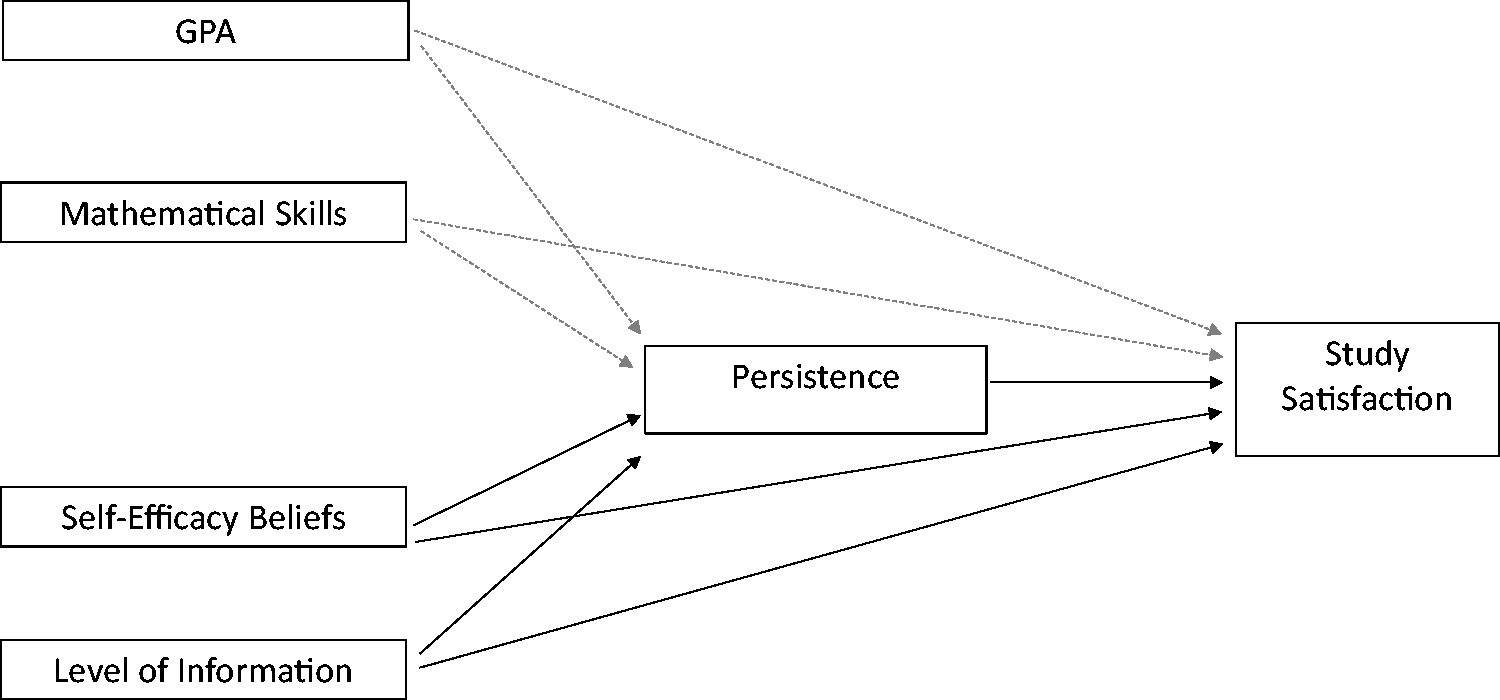
Proposed Model for Effects of GPA, Mathematical Skills, Self-Efficacy Beliefs and Level of Information on Persistence and Satisfaction.
Method
Overview
Participants were psychology students at our German university having started their studies in five consecutive years (2013–2017). During their first two semesters all of them had to pass an introductory psychology statistics course. Data was collected in the course sessions via paper and pencil questionnaires.
We surveyed: i) self-efficacy beliefs and self-assessed level of information as well as GPA and mathematical skills prior to the start of study as potential determinants of later persistence and satisfaction, ii) persistence with the choice of study as predictor of later study satisfaction (and presumed mediator) at the end of the first semester, and iii) satisfaction with the study at the end of the second semester.
Students created a personal (pseudonymized) code enabling us to link together the answers of the surveys. We explained the purposes of the study (i.e. ‘determine factors that influence student adaptation to university’), informed students that participation was voluntary and all responses would be kept confidential, included a plea for participation and compensated participants with curricular credits.
Measures
First survey (at the beginning of the first semester)
GPA
Participants indicated their grade point average of their school graduation (Abitur). Grades ranged from 1.0 (best grade) to 4.0 (worst grade). On average participants stated a low (good) GPA (M = 1.794, SD = .659).
Mathematical skills
Twenty-one multiple-choice tasks assessed students’ mathematical skills (four tasks on algebra, four on fractional arithmetic, four on percentage calculation, five on probability calculation and four on the interpretation of graphics and tables; Bebermeier et al., 2020). For the present sample, the internal consistency (Cronbach’s α) was .652 and on average participants solved about half of the items correctly (M = 10.360, SD = 4.144, Range: 2–21).
Self-efficacy beliefs
We used Schwarzer and Jerusalem’s (1999) scale of self-efficacy beliefs which consists of ten items ranging from 1 (does not apply) to 6 (applies perfectly), e.g. ‘Generally, I do not have difficulties in realizing my goals’, or ‘I am able to find a solution for every problem.’ For the present sample, α was .868 and on average participants stated moderate to high self-efficacy (M = 3.988, SD = .765).
Self-assessed level of information
Participants indicated their level of information on a four-item measure ranging from 1 (unsatisfactory) to 6 (satisfactory): ‘I am well informed about the study conditions in the subject psychology’, ‘I am well informed about the study requirements in the subject psychology’, ‘I am well informed about course and focus options in my subject’, and ‘I am well informed about necessary competences and skills in the subject psychology’ (Heublein et al., 2010; Thiel et al., 2010). High scores indicate that respondents feel well informed about the study conditions, subject requirements, options and preconditions. Internal consistency was α = .761 and on average participants stated a moderate to high level of information (M = 4.285, SD = .924).
Second survey (at the end of the first semester)
Persistence with the choice of study
Participants rated their persistence answering one item (1 = not at all sure, 6 = very sure): ‘How confident are you that studying psychology is the right choice?’ (Heublein et al., 2010). On average participants stated a high persistence (M = 5.052, SD = 1.041).
Third survey (at the end of the second semester)
Satisfaction with the study
We used the scale of study satisfaction proposed by Westermann et al. (1996) consisting of three subscales, each containing three items ranging from 1 (does not apply) to 6 (applies perfectly):
Satisfaction with the study content (e.g. ‘I really enjoy what I am studying’). Dissatisfaction with the study conditions (e.g. ‘I wish my study conditions at university were better’). Dissatisfaction with coping with study burdens (e.g. ‘I can hardly reconcile my studies with other obligations’).
The two dissatisfaction subscales were coded in such a way that high scores indicate satisfaction, allowing us to calculate the overall scale mean representing general satisfaction. For the present sample, all coefficient alphas of the three subscales were ≥ .80 and α was .815 for the combined scale general satisfaction. On average participants stated a moderate to high general satisfaction (M = 4.268, SD = .797).
Participants
Data from 854 respondents (out of the five cohorts) exist: in total, 759 students answered the first, 474 the second, and 342 the third survey. Among these, 307 participants responded only to the first survey, 34 only to the second and 46 only to the third one. Furthermore, 171 participants responded to the first and second survey, but not to the third. In addition, 27 participants responded to the first and third survey, but not to the second. Another 15 participants responded to the second and third survey, but not to the first. Thus, 254 complete and 600 incomplete data sets exist. In the analyses, we used all available data for each kind of analysis (e.g. N = 254 for the mediation models, N = 759 for the descriptive statistics at the first occasion of measurement).
We compared complete and incomplete cases with respect to the variables investigated in the present study (see Table A, supplementary material). We found statistical differences regarding age (completers were younger) and that completers meet the formal study requirements better (indicate a higher GPA and show better mathematical skills). We did not find differences between completers and non-completers with respect to self-efficacy beliefs, level of information, persistence with the choice of study, or satisfaction with the study. Additionally, we investigated the robustness of our findings by comparing the bivariate correlations of all our variables for completers and non-completers (see Table B, supplementary material). We found differences in the bivariate correlations of persistence and GPA, self-efficacy beliefs and self-assessed level of information as well as in the bivariate correlations of satisfaction and self-efficacy beliefs. For non-completers these correlations are lower and lack significance. These differences imply limitations with respect to the generalizability of our findings (see discussion section).
Furthermore, we compared respondents out of the different cohorts (1st: 177 respondents, 64 completers; 2nd: 169 respondents, 49 completers; 3rd: 175 respondents, 56 completers; 4th: 175 respondents, 37 completers; 5th: 158 respondents, 48 completers; see Table C, supplementary material). We found a significant difference for mathematical skills only but did not find meaningful interaction effects of completeness and cohort. For all estimated models testing the hypotheses, we checked for differences between the cohorts. Results remain stable across the cohorts, although the effects mostly did not reach significance in the smaller cohort subsamples. Hence, we present the results for the whole sample.
Since female students were overrepresented in our sample – which corresponds to the ratio of male and female students in the population of psychology students (Sander & Sanders, 2007) – we analyzed for gender effects (see Table D, supplementary material). Although we found statistical differences suggesting that women are younger, indicate a lower (better) GPA and state lower self-efficacy beliefs, there are no differences in mathematical skills, self-assessed level of information, persistence with the choice of study, satisfaction with the study or the estimated models testing the hypotheses. In essence, all associations between the variables for testing the hypotheses were similar for women and men, although the effects sometimes did not reach significance in the smaller subsample of men. However, as we did not expect women and men to differ and did not find any differences in the absolute values of the model results, we report the results for the pooled sample (males and females). Table 1 shows gender and age of completers and non-completers in the five cohorts.
Participants’ Characteristics of Completers and Non-Completers.
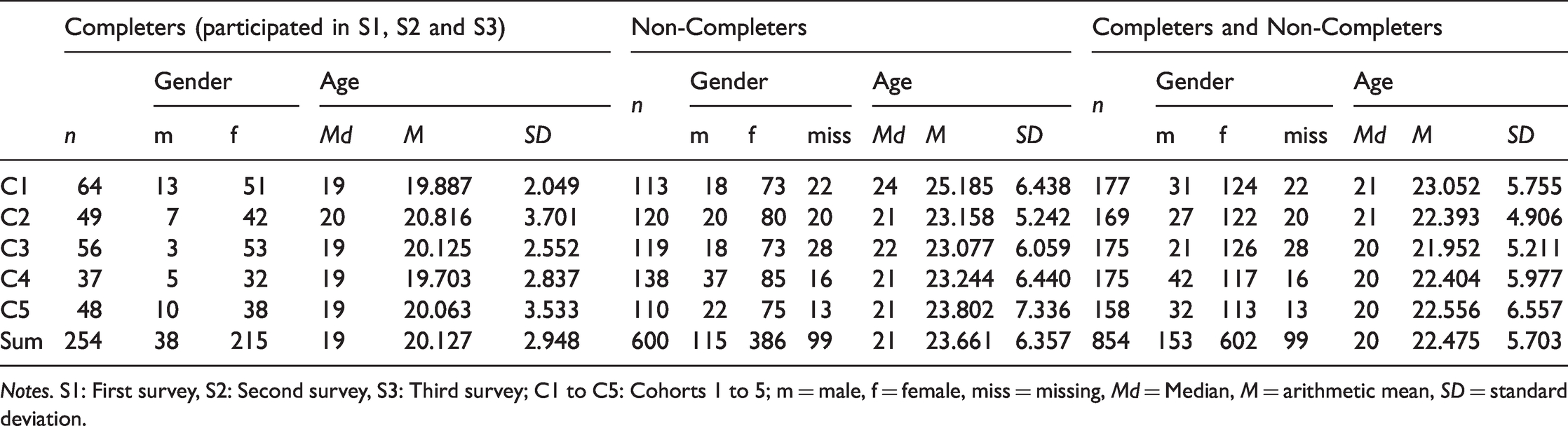
Notes. S1: First survey, S2: Second survey, S3: Third survey; C1 to C5: Cohorts 1 to 5; m = male, f = female, miss = missing, Md = Median, M = arithmetic mean, SD = standard deviation.
Results
We used correlation analyses, linear regressions and path analyses to test the hypotheses. Table 2 presents means, standard deviations and zero-order correlations for all variables.
Zero-Order Correlations, Arithmetic Means and Standard Deviations for all Observed Variables.
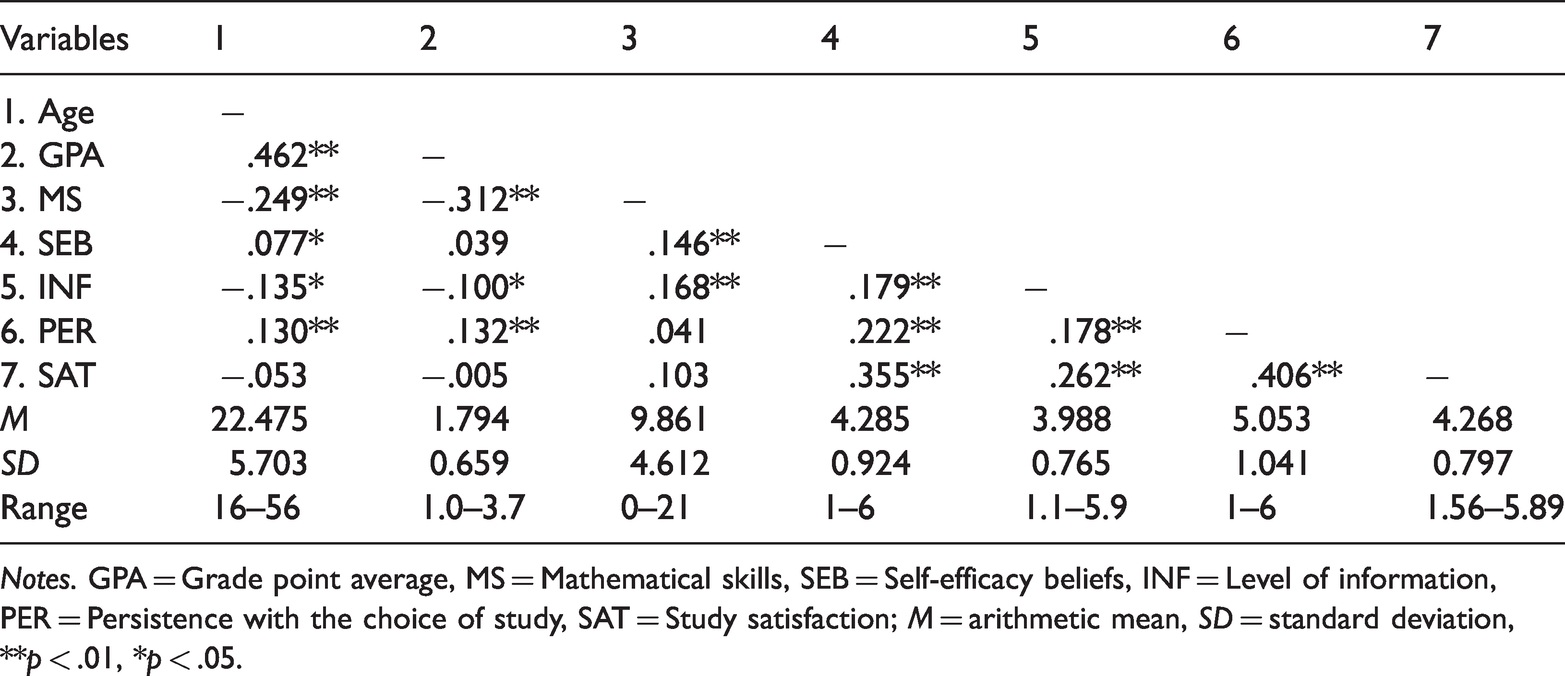
Notes. GPA = Grade point average, MS = Mathematical skills, SEB = Self-efficacy beliefs, INF = Level of information, PER = Persistence with the choice of study, SAT = Study satisfaction; M = arithmetic mean, SD = standard deviation, **p < .01, *p < .05.
As postulated, self-efficacy beliefs, level of information, persistence with the choice of study and study satisfaction are positively related (H1a). Self-efficacy beliefs are positively correlated with persistence, r(420) = .222, p < .001, and satisfaction, r(273) = .355, p < .001. Self-assessed level of information is positively correlated with persistence, r(421) = .178, p < .001, satisfaction, r(275) = .262, p < .001, and self-efficacy, r(246) = .179, p < .001. Furthermore, persistence and satisfaction are positively correlated, r(265) = .406, p < .001. We further found relations between the self-assessed level of information and GPA, r(726) = −.100, p < .001 (a higher level of information relates to a lower (better) GPA) and correlations between student characteristics and mathematical skills: both, a higher self-efficacy, r(744) = .146, p < .001, and a higher self-assessed level of information, r(746) = .168, p < .001, relate to higher (better) mathematical skills.
In order to test hypotheses H1b and H1c, we specified two mediation models employing self-efficacy beliefs (H1b), respectively, self-assessed level of information (H1c) as predictors, persistence with the choice of study as mediator and study satisfaction as criterion. We found the postulated indirect effects: the effect of self-efficacy beliefs on satisfaction is mediated by persistence (confirming H1b): a bootstrapping procedure with 10,000 bootstrap samples (Preacher & Hayes, 2004) yields a 95% confidence interval around the mean indirect effect, ab = .086 excluding zero [.042; .140]. We further found a significant direct effect of self-efficacy on satisfaction, c' = .288, t(247) = 4.914, p < .001, as well as a significant effect of self-efficacy on persistence, a = .222, t(420) = 4.657, p < .001, and a significant effect of persistence on satisfaction, b = .304, t(247) = 5.196, p < .001. In sum, 22.5% of the variance in study satisfaction can be explained by this model. Similarly, the effect of self-assessed level of information on satisfaction is mediated by persistence (confirming H1c): a bootstrapping procedure with 10,000 bootstrap samples (Preacher & Hayes, 2004) yields a 95% confidence interval around the mean indirect effect, ab = .072 excluding zero [.031; .121]. We further found a significant direct effect of information level on satisfaction, c' = .154, t(248) = 2.562, p < .05, as well as a significant effect of information level on persistence, a = .178, t(421) = 3.714, p < .001, and a significant effect of persistence on satisfaction, b = .406, t(265) = 7.233, p < .001. In sum, 16.7% of the variance in study satisfaction can be explained by this model.
Finally, we tested hypothesis H1d with the overall model as depicted in Figure 1, including all study variables using path analysis with MPlus (Muthén & Muthén, 1998–2017). We found the presumed effects for study-relevant characteristics predicting persistence and study satisfaction when GPA and mathematical skills were controlled (confirming H1d). The total effect of self-efficacy beliefs on study satisfaction is β = .296, p < .001; 95% C.I. = [.178; .414], with a direct effect β = .240, p < .001; 95% C.I. = [.120; .361] and a total indirect effect via persistence β = .056, p < .01; 95% C.I. [.018; .094]. The total effect of self-assessed level of information on study satisfaction is β = .173, p < .01; 95% C.I. = [.052; .293], with a direct effect β = .126, p < .05; 95% C.I. = [.010; .242] and a total indirect effect via persistence β = .047, p < .05; 95% C.I. [.010; .084]. We found no direct or total effects of GPA or mathematical skills on study satisfaction and no indirect effect of mathematical skills on study satisfaction via persistence, but a total indirect effect of GPA on study satisfaction via persistence, β = .048, p < .05; 95% C.I. [.012; .083], see Table 3. In sum, 22.9% of the variance in study satisfaction can be explained by the overall model. Figure 2 presents the model including all path parameters running from subject-relevant skills and study-relevant characteristics via persistence to satisfaction.
Path Analysis for Effects of GPA, MS, SEB, INF, PER and SAT. (Bootstrap N = 10,000)
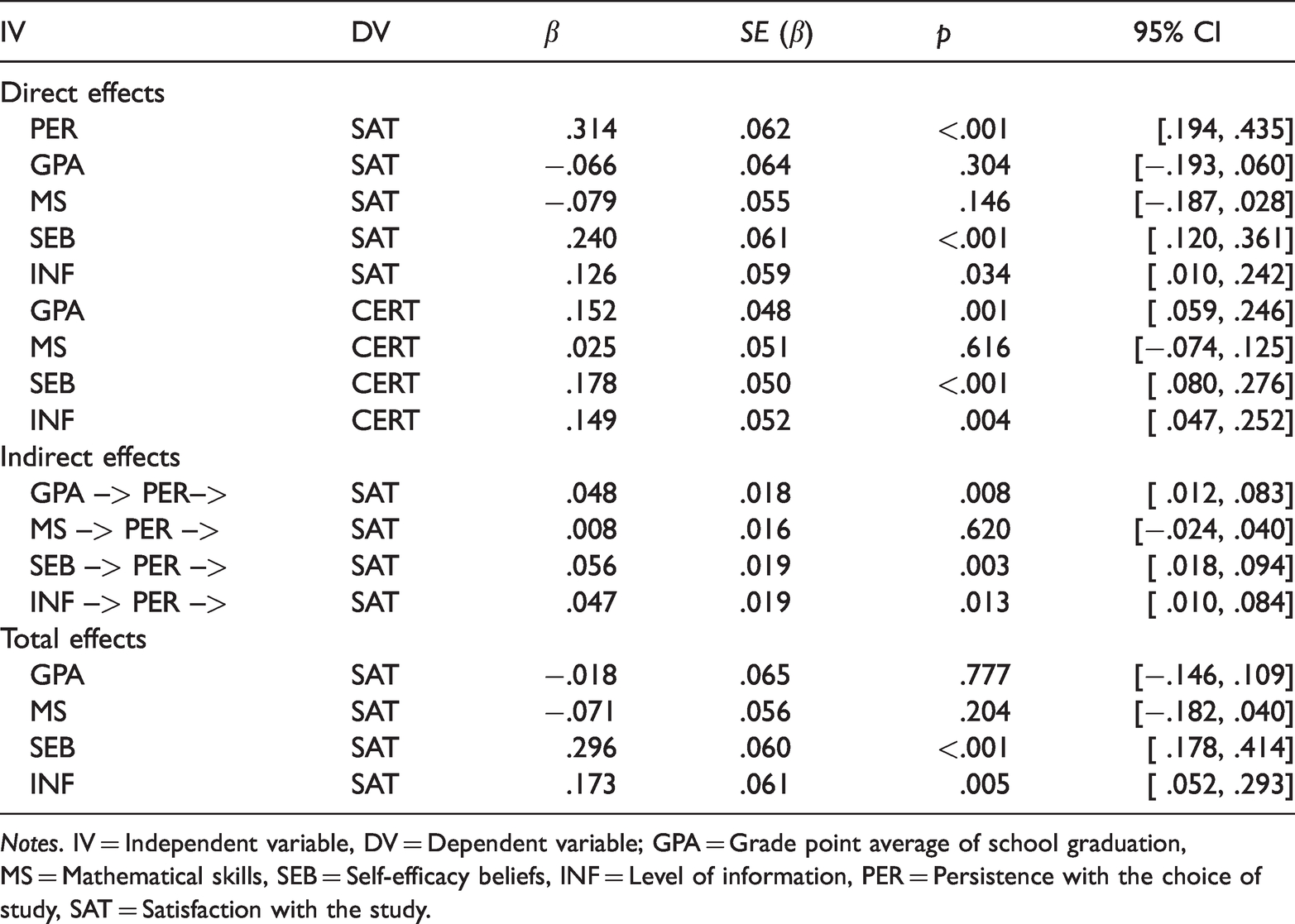
Notes. IV = Independent variable, DV = Dependent variable; GPA = Grade point average of school graduation, MS = Mathematical skills, SEB = Self-efficacy beliefs, INF = Level of information, PER = Persistence with the choice of study, SAT = Satisfaction with the study.
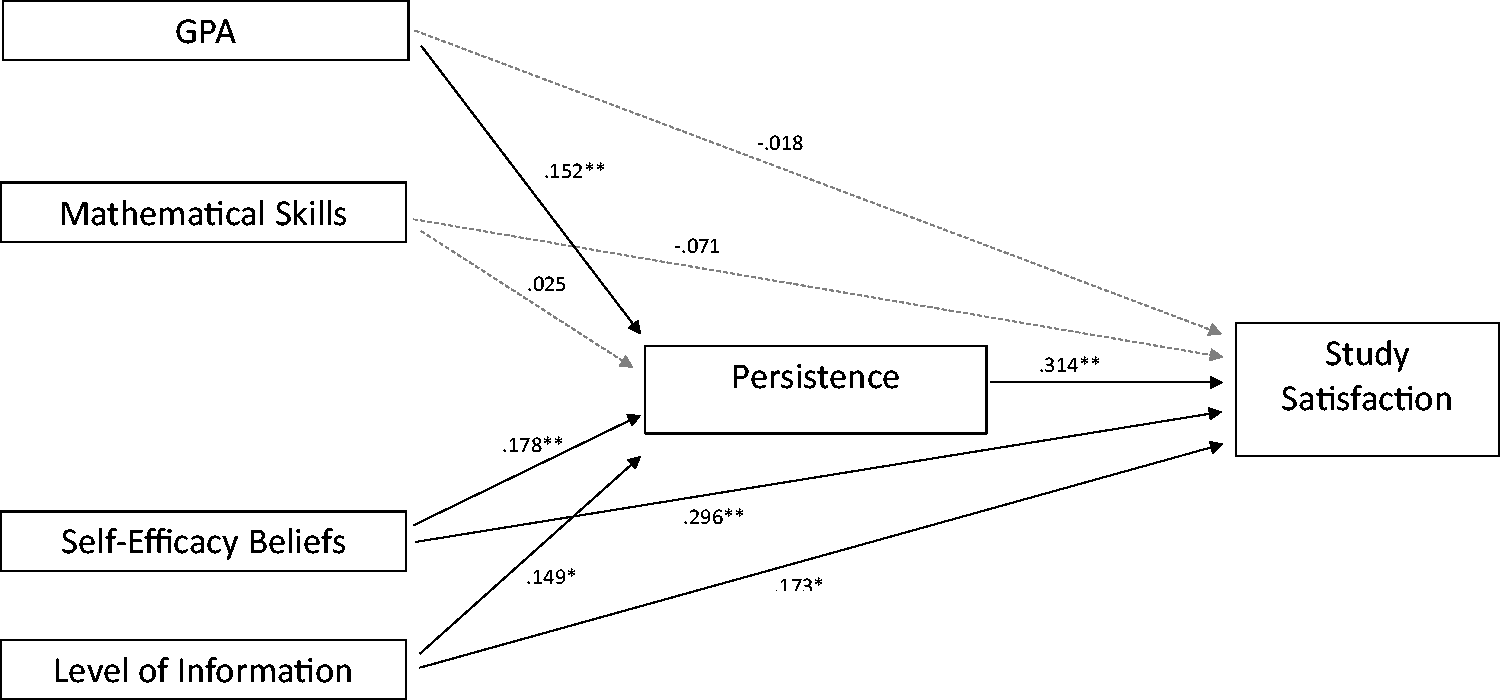
Path Weights for Effects of GPA, Mathematical Skills, Self-Efficacy Beliefs and Level of Information on Persistence and Satisfaction.
Discussion
We found that psychology students’ self-efficacy beliefs at study entry and self-assessed level of information about the study program positively relate to the persistence with the choice of study and satisfaction with the study program providing support for Hypothesis 1a. Students with previously lower self-efficacy beliefs and levels of information reported lower persistence and lower satisfaction, whereas in turn students with previously higher self-efficacy beliefs and levels of information reported higher persistence and higher satisfaction. Importantly, the observed effects on satisfaction are partially mediated by persistence, supporting Hypothesis 1b and 1c. Above that, when GPA and mathematical skills were included in the model and were controlled, we still found the indirect effects running from self-efficacy beliefs and level of information via persistence to satisfaction supporting Hypothesis 1d. For GPA and mathematical skills, we found no total or direct effects on study satisfaction, but an indirect effect of GPA (but not of mathematical skills). This seems plausible assuming that students with better school grades and higher competences also perform better in their study modules (Steyer et al., 2005), and thus gain a higher perceived fit of abilities and demands, leading to more persistence and a higher satisfaction with the study. Additionally, one could speculate that because of the high initial GPA of the psychology students in our sample, 1 they meet the study requirements well and are able to adequately prepare themselves for almost any exam even if they differ in their initial mathematical skills at study entry. This might explain why specific (mathematical) skills of our students ultimately did not relate to persistence and study satisfaction. We derive from these findings that the satisfaction of psychology students (and thus a key facet of their academic success) substantially depends on study-relevant characteristics, self-assessed level of information and self-efficacy beliefs, but less on their skills at study entry.
Our findings confirm previous research (Bebermeier & Nussbeck, 2016; Chemers et al., 2001; Hasenberg & Schmidt-Atzert, 2014; Lent et al., 1984): high self-efficacy beliefs match with the demands of the subject psychology and lead to persistence and satisfaction with the subject of study. Furthermore, a sufficient level of information is also more likely to result in a person–environment fit (either in a fit of students’ competences and subject demands or at least in an adequate expectation about the needed extra effort for studying successfully) and enhance persistence and satisfaction as well. Although we did not explicitly measure the perceived suitability or the change in study satisfaction, it is very likely that our participants become more confident regarding their suitability in their first year and thus validate their satisfaction with the subject psychology. Future research should examine the potential change in students’ attitudes during their first year, the processes of proceeding or withdrawing from the study program as well as the relationship between private limitations (e.g. professional commitment, childcare obligations) and satisfaction with the program.
It should be emphasized that this study provides particularly ecologically or external valid empirical evidence, because the results originate from real psychology students attending the introductory statistics course at our German university. Nevertheless, we do not want to conceal threats to the internal validity of our results. First, our analyses rely solely on self-reports, which may artificially increase the associations of the study variables due to a method effect and have to be treated with caution. Especially the level of information can vary depending on quality and source of the gathered information. Second, the results can be distorted by a self-selection bias, leading to the quite large amount of missing values: Maybe, particularly highly conscientious, motivated, interested or competent students attended the lectures at the end of the first and the second semester and thus answered the second and the third questionnaire more likely. On the other hand, non-completers differed from completers in GPA, level of information and age as well as in the bivariate correlations of persistence and GPA, self-efficacy beliefs and level of information and satisfaction and self-efficacy beliefs. Hence, students with lower competences and information level, but a presumably high need for support, maybe tended to avoid the confrontation with the course content, no longer attended classes, and could not fill in the questionnaires at the end of the first (second questionnaire) and second (third questionnaire) semester. This assumption is also reflected in the relatively high mean scores of persistence (around 5 in all cohorts). Some students (with low persistence) may have already withdrawn from either the course or from studying psychology. Therefore, we should not generalize our findings to students with lower scores in persistence since we investigated the effects of differences in persistence at a high level of persistence. Also, our findings do not readily generalize to the subgroup of non-completers who no longer attend classes, yet, this group of students is of special interest and should explicitly be investigated in future studies. Further, future research should test the psychometric properties of the measures, particularly of the persistence measure, the measure of math skills and the level of information scale, which lack such investigations yet. Again, it should be considered that level of information and persistence were only assessed by self-reports and further could be affected by personality variables (e.g. conscientiousness, motivation, self-efficacy) as well as institutional variables (e.g. accessibility and quality of information, offer of support services). Additionally, potential confounding variables (e.g. motivation or interest) should be examined and controlled. Also, it seems worthy to consider an additional measure of specific self-efficacy (e.g. academic self-efficacy), despite the general self-efficacy measure, in order to differentiate effects on satisfaction. In this regard, DeWitz and Walsh (2002) have already shown that particularly academic self-efficacy correlates with study satisfaction, besides general and social self-efficacy. Apart from that, the formulated theoretical model needs further investigation. Although the assumed causal effects are theoretically grounded, they should be tested by either experimentally manipulating the level of information or by comparing different cohorts of students which differ with respect to the amount of information they received before starting their studies, for example. Finally, future research should focus the generalizability of our findings: are the results replicable to psychology students in other institutions or countries, who are not as selective as the highly competent psychology students in German universities, and are the results replicable in other subjects?
Nevertheless, we can carefully derive some implications for teachers and higher education institutions from our results: according to the finding that self-efficacy beliefs are related with persistence with the choice of study and study satisfaction, and according to the theoretical framework of self-efficacy (Bandura, 1982; Zimmerman, 2000), teachers and institutions should try to strengthen self-efficacy beliefs in their students (e.g. in courses or via additional support services). This could be achieved by creating settings to likely have success, challenging but transparent and feasible requirements, as well as useful and individual feedback supporting students in their self-determined learning. Furthermore, the self-assessed level of information is linked to greater satisfaction with the studies and satisfaction is linked to better grades (Lizzio et al., 2002). Despite the potentially limited validity of the self-reported level of information, we recommend that teachers and higher education institutions should ensure to inform those who are interested in a subject regarding content, course options and support services, through e.g. websites, flyer or leaflets, and information programs (Mayhew et al., 2011) to help their undergraduates to adjust to university. Regarding psychology programs, higher education institutions should particularly inform about the relevance of statistical knowledge, because initial competences and mathematical skills relate to better grades in statistics and other study modules (Steyer et al., 2005). Comprehensive information should include concrete and realistic examples of typical mathematical/statistical problems or a clear description of requirements with respect to the mathematical skills, and educators should provide support for students who meet the prerequisites sufficiently, but not yet optimally: it has been shown that a summer bridge program before the start of study that focuses on improving basic skills and familiarizes new students with the university environment results in significant gains in first- and second-year retention rates (Garcia, 1991) and positively affects academic skills and academic self-efficacy (Strayhorn, 2011). With regard to the subject psychology, there is evidence that a preparatory course in mathematics leads to an increase in the self-reported statistical competences of initially low competent students and higher perceived confidence of initially high competent students (Austerschmidt & Bebermeier, 2020). Furthermore, the provision of support services in a psychology program (e.g. tutorials led by advanced students, practice classes, worksheets for self-paced individual practice, online enrichment materials, voluntary activities) can enhance students’ academic success (Austerschmidt & Bebermeier, 2019; Bebermeier & Hagemann, 2019; Bebermeier et al., 2020).
To conclude, self-efficacy beliefs and the self-assessed level of information are important determinants of psychology students’ persistence and satisfaction with the study program as dimensions of academic success. Future research should further address the relation of psychology students’ satisfaction with their grades as more objective criteria of success (Bean & Bradley, 1986; Lizzio et al, 2002; Oja, 2011) and investigate the contribution of additional support to enhance self-efficacy beliefs and level of information as well as later subjective and objective criteria of success.
Supplemental Material
sj-pdf-1-plj-10.1177_1475725720985223 - Supplemental material for Determinants of Psychology Students’ Study Satisfaction
Supplemental material, sj-pdf-1-plj-10.1177_1475725720985223 for Determinants of Psychology Students’ Study Satisfaction by Sarah Bebermeier, Kim L. Austerschmidt and Fridtjof W. Nussbeck in Psychology Learning & Teaching
Footnotes
Declaration of Conflicting Interests
The author(s) declared no potential conflicts of interest with respect to the research, authorship, and/or publication of this article.
Funding
The author(s) received no financial support for the research, authorship, and/or publication of this article.

Supplemental material
Supplemental material for this article is available online.
Note
Author Biographies
References
Supplementary Material
Please find the following supplemental material available below.
For Open Access articles published under a Creative Commons License, all supplemental material carries the same license as the article it is associated with.
For non-Open Access articles published, all supplemental material carries a non-exclusive license, and permission requests for re-use of supplemental material or any part of supplemental material shall be sent directly to the copyright owner as specified in the copyright notice associated with the article.
