




Abstract
This qualitative study introduces a pedagogic design which addresses the challenging task of teaching and learning self-awareness and critical reflection in the teaching of psychology. The context of the study was a course in personality psychology for first year students, and the topic of interest was how the perception of personality is affected by gender stereotypes. The pedagogic design included the recording of a mixed-sex dialogue, which was then digitally altered for pitch and timbre producing two gender-switched versions of one single recording. Students were divided into two groups who listened to one of the two different voice alterations, and were given the task to rate the personality traits of male or female sounding versions of the same character. In the subsequent debriefing seminar, students were presented with the data from their ratings. These results were then used as a reference point for inter-group discussion, and later students were also asked to reflect over the activity individually in writing. A thematic analysis of their written answers indicates that this pedagogic setup, in combination with guided reflection, can be helpful to challenge students’ own assumptions, aiding self-awareness and critical reflection related to stereotyping.
Keywords
Introduction
One of the major challenges in psychology teaching is to develop courses and activities that foster the part of psychological literacy that concerns “being insightful and reflective about one’s own and others’ behavior and mental processes” (McGovern et al., 2010, p. 11). To reflect critically is a metacognitive competence that includes questioning the way we are, relate, and act (Hibbert & Cunliffe, 2015). It puts higher demands on teaching, requiring that we rethink our pedagogic methods and move towards more student active learning (Boud & Walker, 1990; Bruno & Dell’Aversana, 2017). Many of the assumptions of the surrounding world are based on constructions we take for granted. It follows that the teaching of psychology should include activities that help students to critique their habitual perspectives, that is, generate critical reflection (Mezirow, 1990). It is only when the students are able to include social aspects and themselves in their reflections that they can fully grasp and challenge the validity of their own assumptions (Høyrup, 2004), suggesting that self-awareness is a crucial part of critical thinking. Or, as Mezirow puts it: What we perceive and fail to perceive, and what we think and fail to think are powerfully influenced by habits of expectation that constitute our frame of reference, that is, a set of assumptions that structure the way we interpret our experiences. (Mezirow, 1990, p. 1)
One area of psychology in which this is particularly apparent is in the teaching and learning of social stereotypes (Skorinko, 2018), a key concept in applied psychology (Tomcho & Foels, 2017). Stereotyping has been described as an automatic, and to a large extent, unconscious reductive cognitive phenomenon in the categorization of groups of people (Fiske & Neuberg, 1990; Macrae et al., 1994; van Knippenberg & Dijksterhuis, 2000). The fact that the stereotyping process mostly occurs unconsciously, makes it a particularly elusive phenomenon for students to gain self-awareness of. Reading about stereotyping and pointing to studies that confirm its consequences alone do not seem to help. Monteith et al. (2001), for example, present evidence that a majority of students tend to doubt that they themselves are affected by prejudice or stereotypes, and Adams et al. (2014) mention that students even occasionally reject their personal scores in tests suggesting prejudice or stereotypes by explaining away the observed results as methodological artifacts. Generally, people tend to think that they do not stereotype, and/or that gender bias is a thing of the past (Stephens & Levine, 2011).
It is important that psychology students fully understand the implications of how stereotypes can affect their own thoughts and actions, and it is particularly problematic if students wrongly assume that theoretical knowledge about stereotypes as a phenomenon will somehow protect them from, or make them immune to, stereotypic thinking. Traditional teaching designs, such as lectures and reflection exercises in seminar format, rely heavily on students having the capacity to reflect quite independently over their own stereotypic preconceptions, but the nature of stereotypes, that is, that they are largely unconscious, risks making such activities ineffective, as a prerequisite for effective self-reflection is self-awareness.
Recent years have seen a growing number of studies exploring ways to foster awareness and critical thinking among students in the context of stereotypes and prejudice. In an early example, Goldstein (1997) describes how a labeling exercise can be quite effective for introducing and illustrating the stereotyping process, whereas Adams et al. (2014) demonstrate that the implicit association test can be used with good effect in the teaching of these topics. Another approach, involving in-class reflective exercises, is reported by Skorinko (2018) who, inspired by Stoeger et al. (2004), worked with stereotype inconsistent riddles, a method which quantitative measures of objective and subjective learning indicated to be effective.
This paper describes how a pedagogy in which confronting students with their own group-level data in combination with a guided reflection exercise can be used to support self-awareness and critical reflection in first-year psychology students. The learning activity presented here took place in the context of teaching and learning gender stereotypes in a personality psychology course. We used qualitative methods to study students’ reflections.
More specifically, the aim of this study is to explore how the use of our method would help students towards:
understanding of how gender stereotypes influence them (self-awareness); and being able to reflect critically and to challenge their own assumptions.
Method
Participants
The participants were 52 undergraduate students in their first year of psychology studies enrolled in a Personality Psychology course in the spring of 2018. Out of these 52 students, 41 (28 females and 13 males) completed all activities related to the design described here, and agreed to make their data available to research. Four students did not complete all activities while seven students did not agree to make their data available. Their data are not included here. All students were in the age span between 19 and 40 years old, with the majority (33 students) within the age span of 19–25. Twenty-four students described their ethnic identity as “Swedish”, four as “Swedish and other,” and 13 as “Other than Swedish.” Participation in the research study was voluntary and the design was ethically approved by the Swedish Ethical Review Authority.
Design and Procedure
We created a case where students were asked to evaluate personality aspects of one of the case characters. The case was constructed as a spoken mixed-sex dialogue in four short scenes, illustrating two characters with different personality traits working on a joint thesis project. This case was manipulated using updated matched-guise methodology. The core of the method is the use of two identical versions of one case, which are then rated by participants in order to capture stereotypes and attitudes (see, for example, Tamminga, 2017) while minimizing confounding variables. Because the focus was gender stereotypes in our course, we produced two versions of the case dialogue, where the voice of the targeted character sounded like a man in one version, while the other version had been manipulated for pitch and timbre so that the character sounded like a woman. The reverse was then true of the other character in the dialogue. Importantly, the two versions of the dialogue were thus based on one singular recording which had been altered using digital voice manipulation methods (regarding matched-guise designs, see for example Dennhag et al., 2019; Lindvall-Östling et al., 2019). Building both case versions on the same recording guaranteed that crucial aspects for the interpretation of the dialogues and their characters, such as pauses, intonation and force, remained identical. This was achieved by using Apple Logic Pro. The manipulated voices were then piloted for quality reassurance. The sound files were further manipulated with background sounds in order to create a sense of reality. Finally, to emphasize the perception of a mixed-sex conversation, a neutral silhouette image of a male and female student engaged in activities relevant to the case supported the dialogue sound. To ensure that students perceived the intended gender, control questions were included in the questionnaire. For more details about the case and the digital manipulation and the procedures surrounding digital voice morphing, see Dennhag et al. (2019) and Lindvall-Östling et al. (2019). The overall ambition of the design was to reveal how the gender of the character affected the respondents’ evaluations of personality aspects in order to identify the students’ own assumptions, and then invite them to discuss and explore the origins of the patterns that the activity revealed to them. The students were initially not informed about the real purpose of the activity.
The pedagogic design consisted of five parts: exposure to the case; response to the case; a debriefing session; a discussion seminar; and a short written-reflection task (see Figure 1).
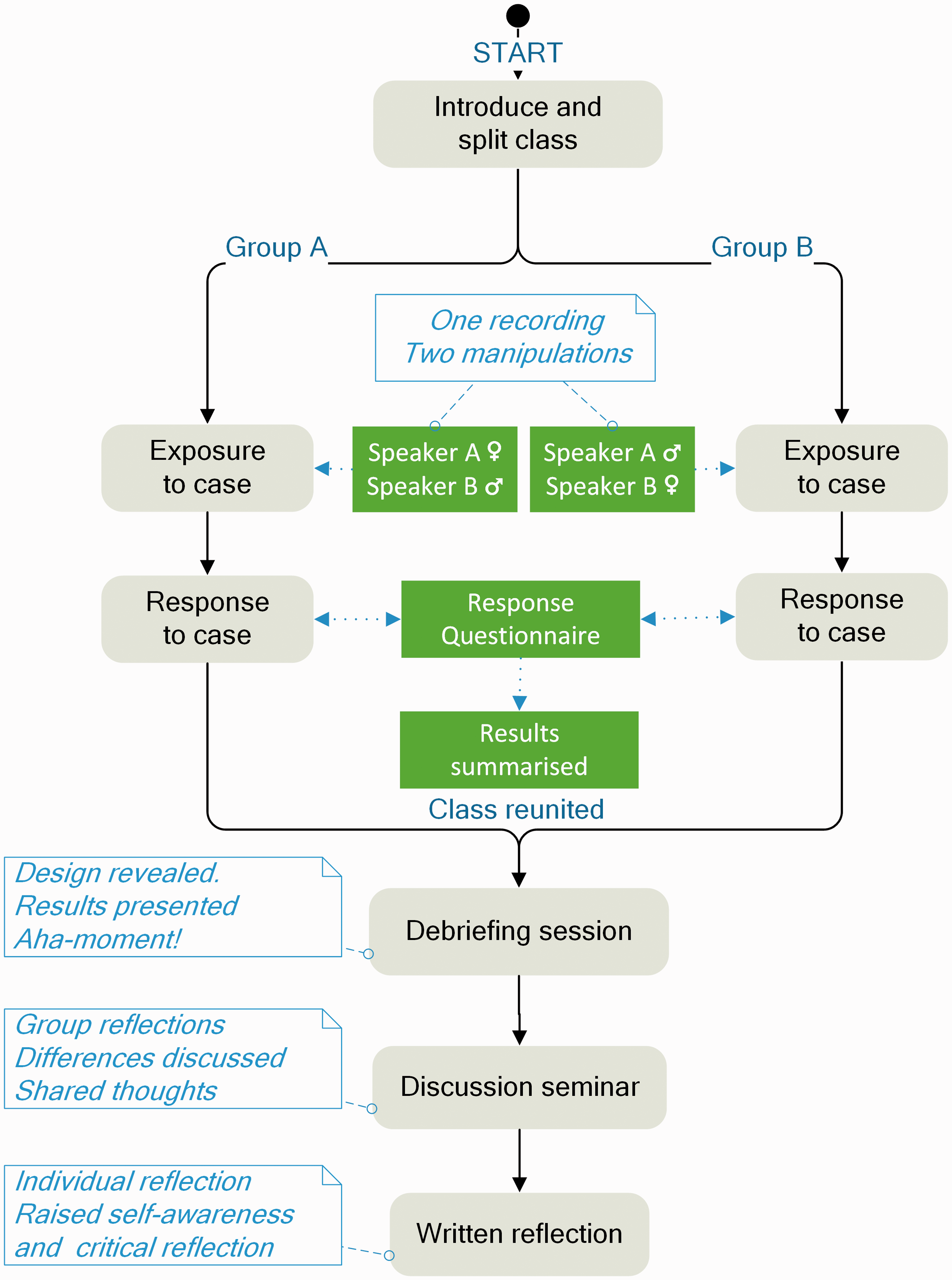
The pedagogic design for teaching and learning self-awareness and critical thinking in relation to the topic of gender and personality stereotypes.
Exposure to Case
The students were divided into two groups, each assigned to listen to one of the two versions of the case online through a link only available to each group within a limited time frame. Students completed this activity from home. The students could only listen to the recording once.
Response to Case
At the end of the case exposure, the students were automatically taken to an online questionnaire where the task was to evaluate the personality traits of the targeted character in the dialogue in relation to the Ten Item Personality Inventory (see Gosling et al., 2003), and to answer some questions about that character’s social behavior. The questions were the same for both versions. Before the debriefing session, an analysis of the ratings of the two student groups was conducted and summarized.
Debriefing Session
In the debriefing session, the real purpose of the tasks was revealed to the students. Now they were informed that the two different groups had listened to two versions of the same case with swapped gender, after which the results from their own ratings were presented to them. The results revealed that depending on whether students had been listening to a male or a female sounding voice, they would rate the personality and social behavior of the characters in the case scenario differently. For an example of what results can look like, see Dennhag et al. (2019). The students could now see for themselves how the interpretation of the target character in the two response groups differed, depending on which version they listened to (female-sounding or male-sounding). Here it was important to emphasize a crucial factor—because the recordings were identical except for the perception of gender, any difference between the two groups in the ratings of the character could only be in the “ears” of the beholders, that is, themselves, and that, in extension, these differences were a reflection of how the group’s gender expectations and stereotypes colored interpretations of the character. Using this design, the ambition was to create what we call an “aha-moment”—a realization that the students themselves were actually affected by gender stereotyping.
Discussion Seminar
The debriefing session constituted the introduction for the discussion seminar. In this seminar, the students were tasked with discussing questions relating to the results from their own ratings and to the theories about stereotypes and personality that they had learned. The students were organized in smaller groups in which the members had been exposed and had responded to both cases, thus providing opportunities for them to discuss their different perspectives and reference points vis-à-vis the cases. Such a procedure was aimed at stimulating the students to consider their personal biases and assumptions more carefully, and at giving them an opportunity to contemplate the effect of other perspectives (cf. Campbell & Oswald, 2018). The students were free to raise their own questions and discussion points, but were also prompted with some directed questions for discussion (see Table 1).
Discussion seminar questions for students.
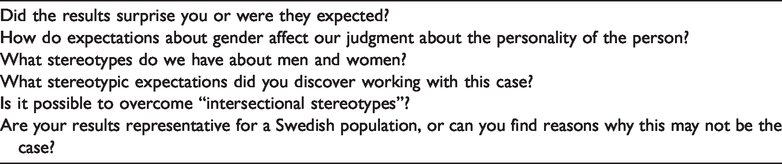
In addition to supporting students’ discussions, these questions served as guidelines for the teacher when making a whole-class summary of the students’ thoughts on the results of the intervention, in this way providing scaffolding for guided reflections on the matter (see, for example, Forneris & Peden-McAlpine, 2007).
Short Written-Reflection Task
In order to record the students’ individual thoughts while also providing an opportunity for individual reflection on the implications of the intervention, students were given individual questions to answer in an online survey (Table 2). The questions were aimed to target the students’ critical reflection and self-awareness related to the topic of stereotypes. In this way, the students could individually verbalize what they had been able to gain from the pedagogic setup. The analysis and discussion below are based on the answers we received on these individual questions.
Questions for students’ individual reflection.

Method for Analyzing Responses
The students’ written answers were analyzed using thematic analysis following the method proposed by Braun and Clarke (2006), starting with reading and re-reading the data, noting down ideas, and coding the data systematically. Next followed the generation of themes and assembling all relevant data to each potential theme. The themes were then reviewed, checking whether they worked in relation to the coded quotes and the data set as a whole. After that phase, the themes were defined, refined, and given headings. Finally, the material was summarized and described, and the most illustrative examples were chosen to highlight the core meaning of the result. The students’ answers have been edited for language correctness, but great care has been taken to maintain the semantic content. As described above, the questions were thematized, commented on, illustrated with quotes, and then discussed in relation to the theoretical framework presented.
Results
Five main themes emerge in our analysis. The first of these ‘Raised self-awareness’ deals with reflections over how the task has helped students understand new aspects about themselves related to how they are affected by stereotyping. The second theme ‘Ambitions to challenge and change behaviors’ consists of reflections of how students feel that they can use the new insights gained to change their behavior, thus making themselves less susceptible to stereotyping. Thirdly, ‘Consequences of own stereotypes’ includes reflections of how stereotyping has affected their behaviors in the past. The fourth theme includes ‘Ethical reflections’ of how stereotyping may affect students’ future professional objectivity, and the final theme, ‘Meta-cognition in relation to the self,’ consists of more complex ponderings on the effects of stereotyping on general structural patterns and ideological beliefs in relation to the self. The findings are summarized below. Whenever a quantifier (such as many or a few) has been used the exact number has been given in parentheses for clarity.
Raised Self-Awareness
Many of the students’ comments (16) demonstrate how the design of this study made their own frame of reference more detectable. Their comments indicate that they have come to new insights about themselves with regard to the impact of stereotyping on their judgments of a speaker. The example below is showing just this—how this pedagogic setup helped a student see things from a new perspective: It [stereotypic preconception] probably affects me in many regards, implicitly. I am to the best of my knowledge free from prejudice, which probably means that up until this point I’ve been quite unaware how much it can still be something that affects us. We are influenced by stereotypes even when we are not aware of it. We use stereotypes much more than we think, it’s an unconscious behavior that is very hard to change.
Ambitions to Challenge and Change behaviors
Many students’ comments (22) also reveal insights of how awareness of stereotyping can lead to changes in automatic behavioral processes through active reflection, and through a deliberate effort to lift unconscious processes to the conscious level. These comments demonstrate self-reflective thinking as well as an ambition to challenge one’s own assumptions: I will be more attentive towards my own prejudices. By being aware of them, it’s easier to not act out on them in a negative way. I think the first step towards getting rid of problematic stereotypes is actively reflecting and thinking about them and how they affect us. Only then, you are able to do something about it since some processes are automatic. A. Becoming aware of the fact that everyone (including myself) has these preconceptions. B. Challenging these preconceptions (while still trying to keep an open mind) neither point is easy or effortless though … Try and be aware of that we do it [stereotype], “catch ourselves in the act” so to say and then try to work around it from there. Since it is an automatic process, I think it will be very difficult to avoid it altogether.
Consequences of Own Stereotypes
One important aspect of stereotypes is that they do not only affect our judgments of people, but frequently also our behavior towards those people (Bargh et al., 1996). For this reason, it was encouraging to see many comments (18) where students could take their reflections one step further and articulate the relevance of the results of the case exposure in relation to their behavior vis-à-vis unknown people and their future professional role: To choose words and explanations about gender more carefully. They may be harmful to some people, although you didn't mean it that way. Especially in the way you talk with future clients, this could be an important factor. It [the effect of stereotypes] would increase the chance for me to make false assumptions. They [stereotypes] can encourage a very generalized way of interacting with people depending on which groups they are identified as belonging to and make me less perceptive to how/who someone really is. It [stereotyping] can affect both how I think about others and how I treat them. Even before I get to know them. Probably they [stereotypes] do [affect how one deals with others] and in many more or less subtle ways; how I speak, treat people, which words I use, which opinions I voice etc.
Ethical Reflections
Some of the students’ comments (9) focused on the fact that they will not be able to rid themselves of stereotypes entirely, as exemplified below. The conclusion that the important thing is to try to minimize the possible harm that stereotypes might cause in terms of behavior can be interpreted as a realization of the importance of self-monitoring and using their knowledge to act ethically: We all have stereotypes and even though we are aware of them it is still hard to not act on them sometimes. We can never delete all stereotypes but what we can do is try and minimize the negative outcomes of them [We need] to be careful with clients, to try not to judge or decide on beforehand what they are like. [We have] to remember that we are all prejudiced (both me and the potential client) and I will try to find a way to work with it. [We should] be aware of them [stereotypes]. Trying to treat every person as unique and look for what makes them distinct. Also awareness regarding the fact that my own stereotypes will influence me whether or not I want to and that this also applies to the one being given therapy or being diagnosed.
Meta-Cognition in Relation to the Self
Students’ comments also concerned the relation between the self and the gendered expectations that we recorded through the design. Some of these (8) were comparatively long and revealed introspections where particular consequences of the presented pattern were reflected upon.
The comment below, illustrating critical reflection about how stereotypes might influence this student’s own thoughts and behavior, is one such instance. The student appears to be quite aware of stereotypes and behaviors that can lead to oppression, and discusses back and forth whether the combination of some stereotypes and strategies to compensate for those might lead to fair or unfair judgments. In this way, it highlights an important instance of critical reflection, questioning one’s own thoughts in relation to general patterns and ideological beliefs: I consider myself as quite aware of the stereotypes and what behaviors can lead to discrimination or oppression, so I might be too sensitive and too harsh on judging those behaviors/persons I stereotypically believe is gonna execute those behaviors. e.g. if a man is dominant, I might perceive him as more dominant than he actually is. On the other hand, I know that we naturally usually “cut men more slack” so I might end up with a “correct” judgment. Hard to keep the balance and not “do gender”. I might also cut women too much slack in my fear of stereotypically judging them too hard. I definitely tend to see men as aggressive and dominating and respond very poorly to men participating in that type of behavior. In the clip I heard, it [the rated character] was a woman and I was much more reluctant to label her behavior as aggressive (even though I subjectively thought that it was). I will need to be careful not to over-correct and to be as sensitive to men as I am to women. I see that sometimes I think about females that are speaking their minds as “bossy” or intimidating, of course I behave differently. But at the same time I accept a man doing the same thing. I guess they [stereotypes] often affect what I think of others and sometimes how I act towards others. The stereotypes I “belong” to also affect [me]. For example, as a girl I might think that boys are generally better at football than girls and therefore undermine my own competence in football. I then see boys I play with as better. Stereotypes affect self-efficacy and expectancies.
Discussion
In this study, the design revealing group results from students’ own ratings created an “aha-moment” which was followed up by group discussions of the results in the experiment. The teachers leading the discussion noticed that the shared experience helped the students understand that stereotypic categorization is something that concerns us all and that we all do. It provided a shared starting point from which they were able to discuss the topic in a way that included students themselves as subjects, as agents of stereotyping. As pointed out by Høyrup, the context of reflection is important: “Reflection processes are embedded in social interaction” (Høyrup, 2004, p. 444).
The discussion seminar, consisting of group reflection and careful use of probing questions, as well as a teacher summary, provided guided reflection to stimulate critical thinking (see e.g. Forneris & Peden-McAlpine, 2007). This made the discussion session into a significant learning opportunity (Chavez et al., 2011). Taken together, the written reflections revealed that students had gained a deeper understanding of how gender stereotypes influence them (self-awareness), and made them challenge their own assumptions. For example, many of the students pointed out that they had earlier believed themselves not to be affected by stereotypes, but now realized that they probably were. This demonstrates that the experience had given the students the frame of reference (Mezirow, 1990) that we were aiming for and an opportunity to confront their own habitual assumptions. The pedagogic design helped them notice their otherwise invisible automatic cognitive processes, and thus meta-cognitive reflections became possible. Our results demonstrate how this matched-guise inspired design was quite powerful in revealing the students’ assumptions. The questions given also led the students to express strategies for changing behaviors, and to reflect upon their need to be aware of the effects of stereotyping. This is very positive since awareness of one’s own stereotypes can be a first step towards both personal development and social change (Adams et al., 2014). Being exposed to the unconscious and automatic nature of stereotyping, many of the students also considered that changing behavior is challenging and that it is very hard to avoid stereotypic categorization altogether. These and other examples of critical reflections were what we had aimed and hoped to stimulate. They show that the students had come to the realization of the mental effort that is required in order to change their habitual thinking (Campbell & Oswald, 2018; van Gelder, 2005).
Students’ self-reflective comments illustrated the ability to reflect upon how unconscious stereotypic assumptions that they make may influence them in their coming profession. This was satisfying to see, since the students were first year students, thus as yet quite inexperienced, and we were encouraged to see that the comments point to an ability of transferring the new-gained knowledge from the pedagogic setting to a valid context outside the classroom. One of the most important goals of teaching students critical thinking and self-reflection is that they should be able to apply their knowledge in their future professional life in a judicious way, and avoid resorting to heuristic thinking (Campbell & Oswald, 2018; van Gelder, 2005).
Below we discuss three of the factors we consider to be the strengths of the pedagogic design in promoting self-awareness and aiding critical reflection.
Firstly, the design made what is usually an implicit process visible by presenting students with their own group data showing different scores from assessments of exactly the same scenario, but where the manipulation of tone of voice created a perception of difference of gender. The experience made it visible to them that they also are affected by stereotypes. As the students wrote: in order to become aware, they need to be able to see their own stereotypes, to be able to “catch themselves in the act.” In this design, we could point to their own stereotyping actions. For this reason, it would probably not have worked as effectively only to show them results from other groups of students.
Secondly, it might have been crucial that in our setup the students were presented with their own group data, rather than their individual scores. As earlier stated, students have a tendency to doubt that they are affected by prejudice or stereotypes, even when they are proven to be so (Monteith et al., 2001). Group data might therefore have been more beneficial, and less face-threatening to take in than individual scores. Since stereotypes are considered negative, and facing one’s own stereotypic thinking often raises our defense, showing that students are similar to others might have made the results easier to accept: “It’s not just me—it’s us.” That students more readily acknowledge their own prejudice when learning that other groups have shown similar tendencies has previously been observed by Adams et al. (2014).
Thirdly, the group discussion in small groups, where students had the opportunity of guided reflection to aid them and examine their biases and assumptions in a structured way (Forneis & Peden-McAlpine, 2007), was probably one of the key components in the design. The fact that they were discussing the results with others who had experienced the case with another gender configuration gave access to alternative perspectives and possibly increased their feelings of interpersonal connection, which can motivate critical thinking (cf. Campbell & Oswald, 2018).
There is of course room for improvement. One such aspect would be to ask students to reflect on gender stereotypes and personality at the very beginning on the course, well before the intervention. This material could later serve as a reference point for their discussions and reflections after the exposure to their own results, but also for judging the efficacy of the pedagogic exercise.
Possible limitations of this type of pedagogic design are that it can be quite labor intensive in the start-up phase when creating material, and that it requires some basic data analyses from the teacher. Once in place, however, it is in comparison to many other pedagogic designs quite effective and efficient. Since students access the case online and their reactions to the case are recorded online, a minimum of precious contact time has to be wasted gathering data, but instead time can be spent on the rewarding debriefing and discussion seminar. We have used this method in several semesters with similar results. However, no systematic replication study has yet been carried out, which could be considered a limitation.
In sum, teaching and learning of critical reflection and self-awareness is undoubtedly a challenging task (Abrami et al., 2015; Arum & Roksa, 2011; van Gelder, 2005). Constructs such as stereotypes are often perceived as distant and abstract to us. The pedagogic design described here generated an increased urgency for discussions of concepts and constructs in relation to students’ own experiences and frames of reference, which resulted in responses signaling self-awareness and critical thinking. Furthermore, we believe that this method is applicable to many different contexts where social categorization is a factor. Given the prevailing social climate and social debate, it is important that abstract concepts such as stereotypes and prejudice are not dismissed as something that applies to “others,” something which has been proven common (Monteith et al., 2001). We must educate students in such a way that these concepts are made real, personal, and urgent. Doing so, we can help them approach self-awareness and critical thinking.
Footnotes
Declaration of Conflicting Interests
The author(s) declared no potential conflicts of interest with respect to the research, authorship, and/or publication of this article.
Funding
The authors disclosed receipt of the following financial support for the research, authorship, and/or publication of this article: The research was funded by The Swedish Research Council, grant 721-2014-1972.
