




Abstract
Anxiety is one of the most prevalent mental health problems; it is known to impede cognitive functioning. It is believed to alter preferences for feedback-based learning in anxious and non-anxious learners. Thus, the present study measured feedback processing in adults (N = 30) with and without anxiety symptoms using a probabilistic learning task. Event-related potential (ERP) measures were used to assess how the bias for either positive or negative feedback learning is reflected by the feedback-related negativity component (FRN), an ERP extracted from the electroencephalogram. Anxious individuals, identified by means of the Penn State Worry Questionnaire, showed a diminished FRN and increased accuracy after negative compared to positive feedback. Non-anxious individuals exhibited the reversed pattern with better learning from positive feedback, highlighting their preference for positive feedback. Our ERP results imply that impairments with feedback-based learning in anxious individuals are due to alterations in the mesolimbic dopaminergic system. Our finding that anxious individuals seem to favor negative as opposed to positive feedback has important implications for teacher–student feedback communication.
Introduction
Anxiety is the most prevalent mental health problem affecting people worldwide (Mkrtchian et al., 2017). Defined as a negative multidimensional state (Gibson, 2014) increased anxiety is known to elicit debilitating physiological changes to the sympathetic nervous system. Long term, increased anxiety or chronic stress heightens individuals’ susceptibility to cancer, psychosis, and neurodegenerative disease, including Parkinson’s and dementia.
Anxiety seriously impedes cognitive functioning (Poorman et al., 2019), including the ability to regulate emotion (Endler & Kocovski, 2001; Gu et al., 2010a; Xu et al., 2013), to create positive expectations (Mitte, 2007; Shepperd et al., 2005; Wray & Stone, 2005), and to adapt decision-making, particularly when outcomes are uncertain (Eysenck et al., 2007). Moreover, increased anxiety and stress experienced in uncertain environments increases usage of attentional resources diverted toward potential threats (Bishop, 2008). Such instances lead individuals to express vigilant–avoidant behaviors, particularly as objective thinking diminishes. This example highlights just some of the complex interactions between anxiety and decision-making.
In educational settings, students often complete formative assessments so that teachers can target students’ needs for learning (Nordström et al., 2019). While ability to maximize task performance involves usually the same cognitive processes across individuals, individual differences affect overall performance. Expectations have increased for educational institutions to adopt a pragmatic approach which reinforces students’ efficacy for learning (Andersson et al., 2019). Both quantitative approaches, for example, performance feedback, and qualitative approaches, for example, directive feedback, have been demonstrated to lead to better assessment outcomes, thereby reinforcing efficacy for learning via functionalfeedback-sessions over time (Andersson et al., 2019).
Research has shown that providing feedback after a formative test is more likely than additional revision to improve students’ performance on a later summative test (McDaniel & Fisher, 1991). Feedback offers students clarification on what they need to improve on in the future, whereas revision focuses on the rehearsal of prior taught material. Further evidence has revealed feedback timing to play an important role in learning; feedback presented immediately upon each response promoted learning by strengthening associations between a response and its outcome (Kulik & Kulik, 1988). However, in another study, feedback (the correct response in this case) only improved learning when presented after an error, as opposed to after a correct response (Pashler et al., 2005). Moreover, learners needed time to process associations between errors and negative feedback (but not positive feedback) to improve decision-making. A potential solution to this timing issue might be in the form of a probabilistic learning task (PLT) that has already been found to support students’ learning (Kulik & Kulik, 1988). The PLT encourages an explorative approach to learning, with candidates asked to make decisions to exploit an underlying algorithm. Utility of a PLT provides students with an opportunity to increase their performance over multiple attempts, and push their learning further, as the algorithm changes over a series of trials.
As another example, Hadden and Frisby (2018) investigated instructor–student communication and how instructors’ high or low facial mitigated threat (FMT) during a (verbal) feedback session influenced students’ learning efficacy. After reporting their anxiety levels participants were randomly distributed between one of the two FMT feedback conditions. Within the high FMT condition, instructors delivered either positive or negative feedback with a negative facial expression, whereas in the low FMT condition, positive or negative feedback was delivered with a positive facial expression. Results showed that participants in the high FMT condition experienced greater self-efficacy for learning than those in the low FMT condition. In addition, a linear regression analysis revealed that increased anxiety towards feedback was associated with lower self-efficacy, in both high and low FMT conditions, regardless of feedback outcomes. In addition, highly anxious individuals seek to reduce outcome uncertainty, even at the expense of correctness, particularly during complex tasks (Bensi & Giusberti, 2007). In a similar vein, it has been argued that increased attention on emotionally salient stimuli distracts anxious individuals from relevant, task-related information (Eysenck et al., 2007). However, others suggest that increased attention toward negative feedback reduces the likelihood of negative outcomes, thus increasing performance (Giorgetta et al., 2012). Given these diverse and sometimes contradictory results, the implications of positive versus negative feedback are still quite unclear. Overall, there seems to be a lack of consensus in the literature. The present study will inform this debate by taking a neuroscientific approach, which provides insight into the neurocognitive mechanisms linking anxiety with feedback processing.
The neural mechanisms of feedback processing have been explored by a number of neuroimaging studies. Neural activity in dopaminergic circuits including the striatum, which is part of the basal ganglia, and the anterior cingulate cortex (ACC) increases during reinforcement learning (Ferdinand & Opitz, 2014; Nieuwenhuis et al., 2005). The dopaminergic system in the basal ganglia regulates both anxiety and decision-making. Phasic dopaminergic changes in the basal ganglia reflect a proclivity toward learning from positive versus negative feedback due to preferential activity of either of two dopaminergic pathways (Frank et al., 2004).
In addition to neuroimaging, research measuring event-related potentials (ERPs) during reinforcement learning tasks have shown negative compared to positive learning outcomes to increase negative ERP responses most likely generated in the ACC. The difference between these two signals, termed feedback-related negativity (FRN: Holroyd & Coles, 2002) seems to reflect the activity of an evaluation system, gauging the difference between expected and received feedback (Proudfit, 2015). In other words, the larger the subjectively experienced or objectively modeled difference between the expected and the received feedback is, the larger, that is, the more negative, is the ERP elicited by that feedback (Ichikawa et al., 2010). Crucially, the FRN has been shown to be sensitive to both learning related changes (Arbel & Wu, 2016; Dainton et al., 2020; Luft, 2014; Opitz et al., 2011) and to individual differences in anxiety (e.g., Cavanagh et al., 2019; Gu et al., 2010b), with more anxious individuals exhibiting a reduced FRN, that is., a more similar amplitude elicited by positive and negative feedback, in a risk-taking task (Takács et al., 2015). In her review, Luft (2014) argued that the FRN represents activity of the ACC when feedback on a task indicates the necessity to deal with new information or to revisit previously learned information. It is further suggested that the sensitivity to positive or negative feedback depends on the (subjective) utility of either type of feedback (Dainton et al., 2020; Luft, 2014).
In the present study, we therefore aim to measure feedback processing in adults with varying levels of anxiety symptoms using Frank et al.’s (2004) version of the PLT, which is ideal for our purposes. In this task participants are required to select between abstract stimuli associated with different probabilities of providing positive feedback (see Figure 1). Thus, this task assesses the tendency to learn from positive versus negative feedback under high levels of uncertainty. Using the PLT, Frank et al. (2005) demonstrated larger FRN amplitudes to be associated with increased negative feedback learning, that is, with increasing task performance after being presented with a negative feedback-outcome. This effect is more pronounced when participants have learned from the feedback and adjusted their behavior accordingly (van der Helden et al., 2010). Capitalizing on these task characteristics we can compare efficacy for learning after negative and positive feedback across anxious and non-anxious participants.
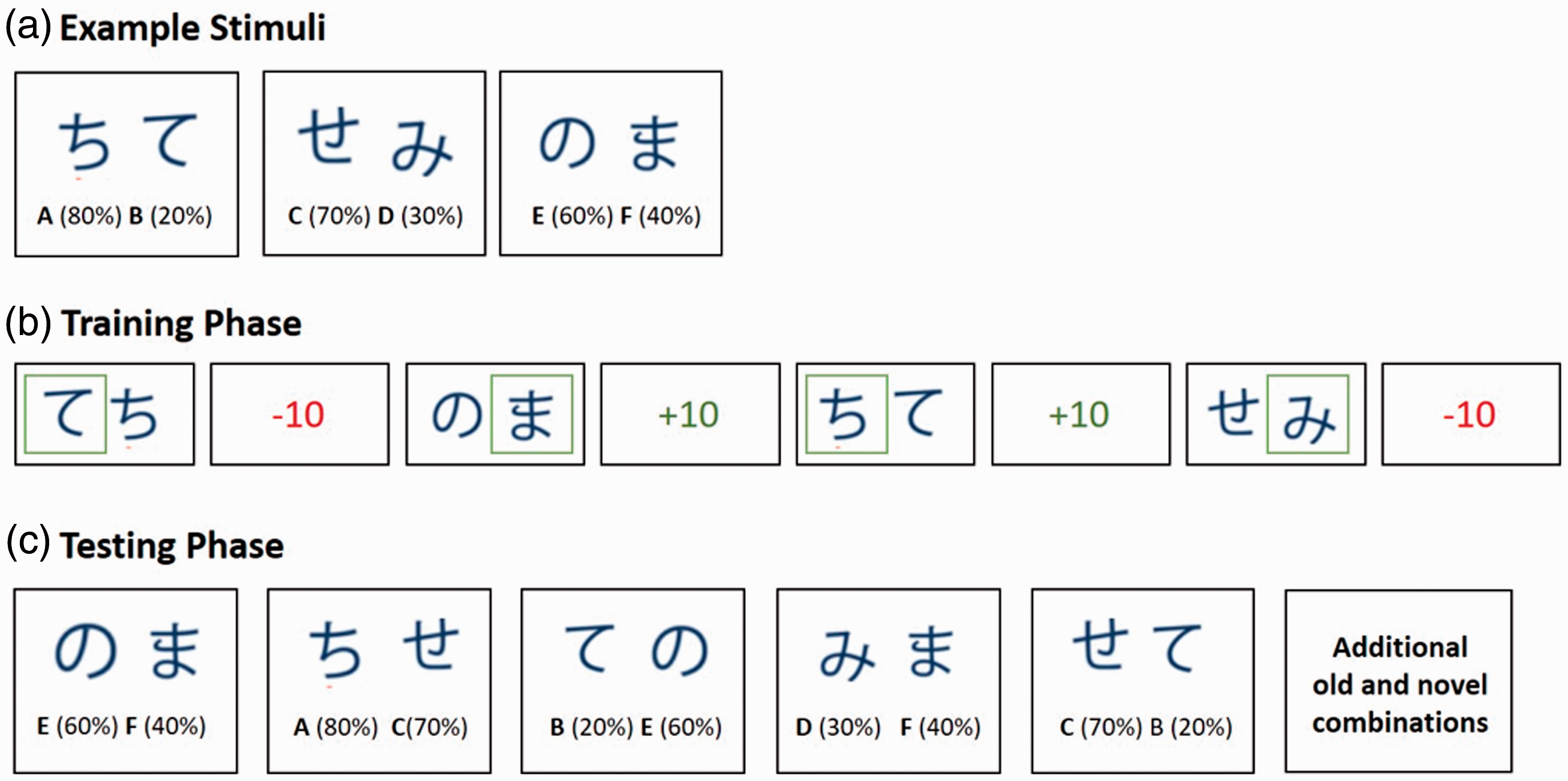
Example stimuli and task procedure of the probabilistic selection task: (A) example stimuli and their respective probability of being rewarded; (B) the training phase whereby participants select one stimulus from a stimulus pair and receive either a positive (+10) or negative (−10) feedback response presented on a separate screen in order to maximize their total score; (C) the testing phase, whereby participants select one of the stimuli presented that they predict will provide positive feedback, without receiving any subsequent feedback confirmation. Please note that neither Latin letters nor percentages are presented to the participant.
As suggested in the literature reviewed above, highly anxious individuals do show negative avoidance. That is, anxious individuals put in considerable effort trying to avoid negative feedback and are, thus, more likely to learn faster from negative than from positive feedback, despite their overall poorer performance (Takács et al., 2015). Thus, we predict that these individuals will show increased bias to perform better after negative compared to positive feedback. Operationally, we define negative feedback bias as better task performance after receiving negative feedback than after receiving positive feedback. This bias would be reflected in a positive correlation between measures of anxiety and increased task performance after receiving negative feedback but not after positive feedback. Based upon recent findings (Bishop, 2008; Takács, et al., 2015) we predict anxious individuals to more readily expect negative feedback and thus to show a diminished FRN component. This should be captured by a positive correlation between measures of anxiety and the ERP response to negative feedback.
Methods
Participants
A total of 30 participants aged between 24 to 56 years (mean (M) = 33 years, standard deviation (SD) = 11.49) including 10 males and 20 females, were recruited by opportunity sampling from the general public. Exclusion criteria disallowed participation of individuals with history of neurological or psychiatric disease, or with any previous interactions with the probabilistic selection task described below (Frank et al., 2005). Informed consent was obtained from all participants. Three participants were excluded from all data analyses due to extensive signal loss in the electroencephalogram (EEG) recording. Thus, a total of 27 participants provided complete data included within our statistical analyses. Individuals who took part did not receive any compensation for their participation.
Apparatus
Participants sat in a dimly lit, electrically shielded, sound attenuated booth. On a desk in front of them was a 17-inch liquid-crystal display monitor used to display the probabilistic selection task at a screen resolution of 1280 × 1024 at 60 Hz. The screen was approximately 1 meter from the subject’s face at eye level. Responses on the probabilistic task were recorded via a standard computer keyboard.
Stimuli and Procedure
In the first part of the experiment participants filled out the Penn State Worry Questionnaire (PSWQ: Meyer et al., 1990), assessing how related 16 different statements were to their tendency to worry, a known characteristic of anxiety diagnoses. According to a recent study, the PSWQ is highly correlated with trait anxiety as measured using the State-Trait Anxiety Inventory (r = 0.71, Olatunji et al., 2007). This suggests that the PSWQ is a valid tool to not only assess the level of negative symptoms, but also to highlight individuals whose characteristics suggest underlying trait anxiety. Crucially, this test has been found not to correlate with measures of depression, indicating that it is tapping an independent construct with severely anxious individuals (Meyer et al., 1990).
Following completion of the PSWQ, participants completed a version of the PLT used by Frank et al. (2005). This task included a forced choice training phase followed by a subsequent testing phase as shown in Figure 1. In the training phase, participants were presented three pairs of hiragana symbols (represented here using roman letters: AB, CD, EF) for 1,000 milliseconds (ms) and instructed to learn via trial-and-error to select the symbol most likely to provide positive feedback from each of three pairs. Pairs were presented in random order, and the side that the superior symbol appeared on was pseudorandomized such that symbols appeared equally often on either side of the screen. Participants were provided with positive (+10 points, green color, Arial font, size matched to the hiragana characters) or negative feedback (–10 points, red color) in a probabilistic manner to guide their learning. For example, choosing A in the AB pair would result in positive feedback 80% of the time, whereas choosing B would result in positive feedback only 20% of the time. If no selection was made within the 1,000 ms, the message “no response detected” was displayed.
In order to maximize their score in the training phase, participants should have learned to choose A from B, C from D, and E from F. Note that this could be accomplished by either learning to select the winners (A, C, and E), to avoid the losers (B, D, and F), or both. We enforced the same training criterion as Frank et al. (2005); starting after 60 trials, performance levels were checked after every trial (65% A in the AB pair, 60% C in CD, and 50% E in EF), and if the criterion was met, participants were released to the test phase. If the criterion was not met, participants would continue up to a maximum of 120 training trials. These criteria ensured trials balanced participants’ exposure to learning and uncertainty.
During the test phase, old pairs (AB or CD) as well as novel combinations of symbols (e.g., AC or BD) were presented to participants. They were told to use their gut feeling to choose the symbol from the pairs presented, that they thought would more likely provide them with positive feedback. This time no feedback was provided. In contrast to the original paradigm, the number of pairings in the test phase containing A or B were increased by one, while all other pairings were reduced by one to increase reliability of bias estimation without increasing the duration of the study.
During the completion of this task EEG was recorded, as described in more detail below. After a short practice block, stimuli were presented in three blocks, each containing a training phase and test phase. For each block a different stimulus set was used to ensure learning. Block order was randomized across participants.
Data Recording and Analysis
Behavioral Data
Each of the 16 items on the PSQW (Meyer et al., 1990) was assessed via a 5-point Likert scale; these individual items were summed to give a total score between 16 and 80 points.
The PLT was implemented and run using E-Prime 2.0. All responses were input via keyboard. The mean accuracy scores across all pairs involving A and B were calculated. Learning from positive feedback was defined as the accuracy of choosing A from C, D, E, and F (i.e., Choose A), whereas learning to avoid negative feedback was defined as the accuracy of choosing C, D, E, and F from B (i.e., Avoid B). The feedback learning bias (FLB) score is defined as the mean difference between the proportion of correct Choose A and correct Avoid B responses (Frank et al., 2005). The AB pair was excluded from this calculation since the preferred strategy (Choose A, or Avoid B) could not unequivocally be determined. In this task EEG signals were computed from participants’ responses to feedback for the training phase. During the testing phase, both behavioral indices of learning and FLB were recorded, to assess responses to feedback during learning.
Electrophysiological Data
During the PST, a 32-channel continuous EEG recording of each participant was made using Ag/AgCl electrodes affixed to an appropriately sized EEG cap (EASYCAP GmbH). The extended 10–20 electrode layout (Klem et al., 1999) was employed. Two additional electrodes placed on the participant’s left and right mastoid served as a linked mastoid reference. Horizontal and vertical electrooculograms were recorded with electrodes located below and on the outer canthus of the participant’s left eye. Interelectrode impedances were kept below 10 kΩ. All channels were amplified with a band pass from DC to 70 Hz and A/D converted with 16-bit resolution. Sampling rate was 500 Hz.
The ERPs were pre-processed as described in Knytl and Opitz (2019) using BrainAnalyzer2 (Brain Products GmbH, Gilching, Germany). Data pre-processing consisted of a digital band-pass filter from 0.5 Hz to 30 Hz (−8 dB cut-off) to eliminate low-frequency signal drifts and high-frequency artifacts. Eye-movement artifacts were eliminated using an automated independent component approach as implemented in BrainAnalyzer2. An automatic artifact rejection procedure (gradient criterion: voltage variation of more than 75 µV in two subsequent time points, amplitude criterion: any voltage exceeding ±100 µV and low activity criterion: 0.5 µV/50 ms) was applied to all channels to mark segments contaminated by additional artifacts. These segments were excluded from further analysis. Recordings were segmented with epochs ranging from −200 to +800 ms relative to the onset of the feedback. The 200-ms prior to feedback onset served as the baseline. Artifact-free segments from the training phases were averaged separately for each participant for positive and negative feedback.
We created the FRN difference wave by subtracting the ERP to positive feedback from the ERP to negative feedback for each participant at the Fz electrode (e.g., Pfabigan et al., 2011). Automatic peak detection was employed to pick the most negative value of the difference wave in the grand average across all participants within a time window from 220 to 320 ms post-feedback. The mean amplitude in a window ±50 ms of this peak was extracted for each participant for further analysis. To assess whether any change in this FRN difference across groups was driven by the ERP response to positive or negative feedback – the mean amplitude of the same time window was also separately analysed for each condition.
Results
Anxiety scores were calculated from the PSWQ. Across 27 participants, scores ranged between a minimum of 24 and a maximum of 77 (M = 54.44, SD = 15.27). Anxiety scores were highly varied (variance = 233), providing a good range for a correlational analysis.
Overall performance across all participants in AB trials (M = 0.705, SD = 0.221) was: (a) significantly different from chance, t (26) = 4.827, p < 0.0005 Cohen’s d = 0.929, indicating learning and above chance accuracy in AB trials; and (b) negatively associated with the PSWQ as indicated by a negative Pearson correlation, r (27) = –0.439, p = 0.023. Figure 2 gives a scatterplot showing the relationship of anxiety and performance on the AB trials.
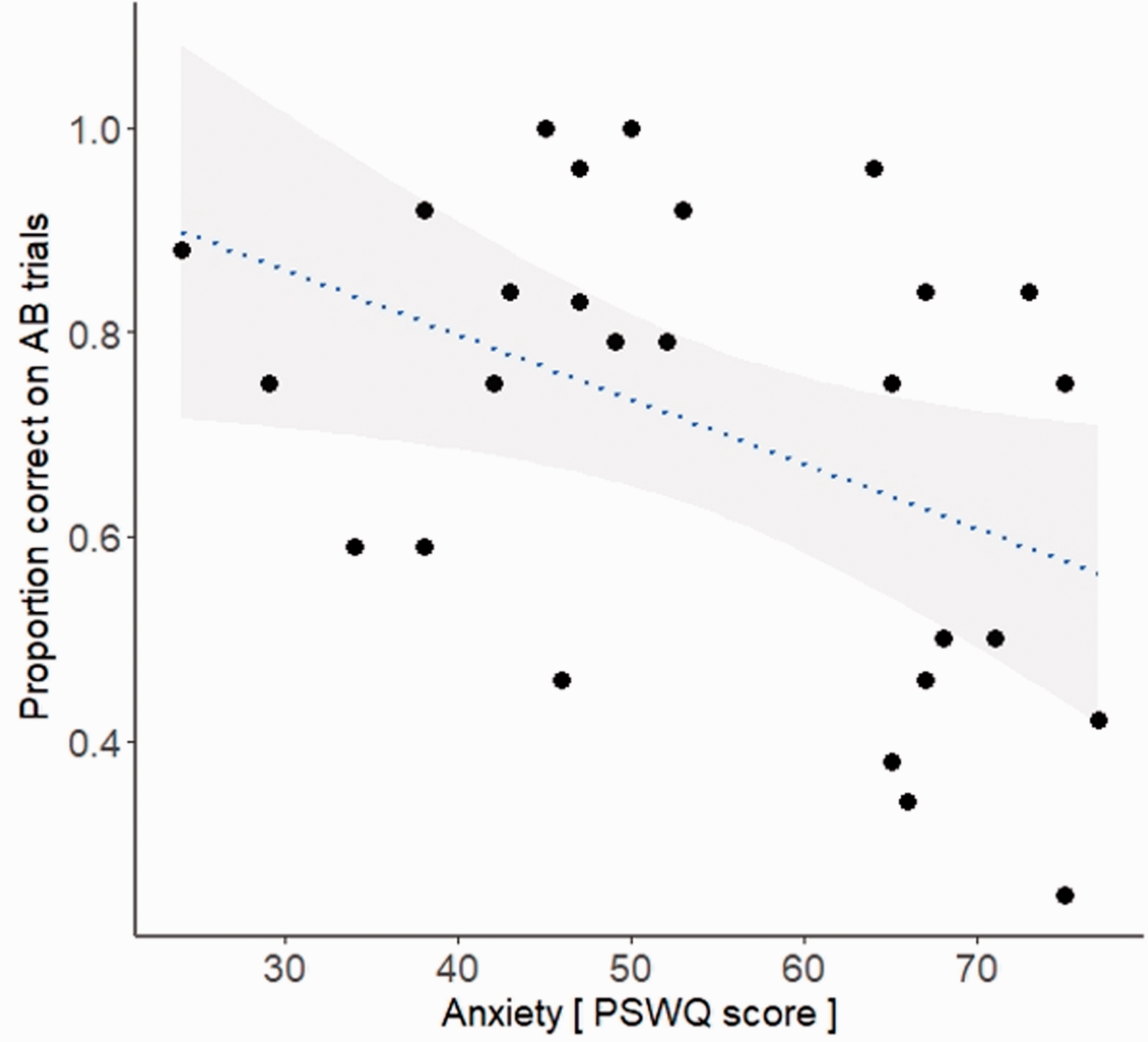
Scatter plot results showing participants’ anxiety scores on the Penn State Worry Questionnaire (PSWQ) plotted against participants’ proportion of correct choices made on AB trials.
A neutral FLB was observed from histogram analyses across all participants (M = 0.01, SD = 0.17, t (26) ≪ 1, d = 0.008) with no significant skew (Skewness = –0.29, SEskewness = 0.44) nor kurtic distribution (Kurtosis = –0.53, SEkurtosis = 0.87). However, FLB did not correlate with anxiety, that is, PSWQ score (r (27) = –0.05, p = 0.75). This was due to performance for both Choose A and Avoid B decreasing as anxiety levels increased. However, PSWQ did not correlate with Choose A or Avoid B performance (r (27) = –0.35, p = 0.078 and r (27) = –0.24, p = 0.226, respectively).
Participants’ ERP responses to positive feedback were, on average, more positive (M = 6.48, SD = 5.05) than ERP responses to negative feedback (M = 3.38, SD = 4.83). Across the sample, participants showed a FRN difference (M = –3.09µV, SD = 0.52) which in timing and topography corresponds to the literature (see Figure 3). We performed a two-tailed one-sample t-test which confirmed that the FRN difference was significantly different from zero across participants (t (26) = –6.37, p < 0.001, d = –1.23). This indicates that the FRN difference is a robust measure to compare negative versus positive feedback processing. To assess the relationship between the FLB and the FRN difference a Spearman’s Rho non-parametric correlation analysis was carried out because histogram analyses showed that data did not fulfill the necessary criteria for parametric testing. There was no significant correlation between FRN difference and FLB, r (27) = 0.21, p = 0.26.
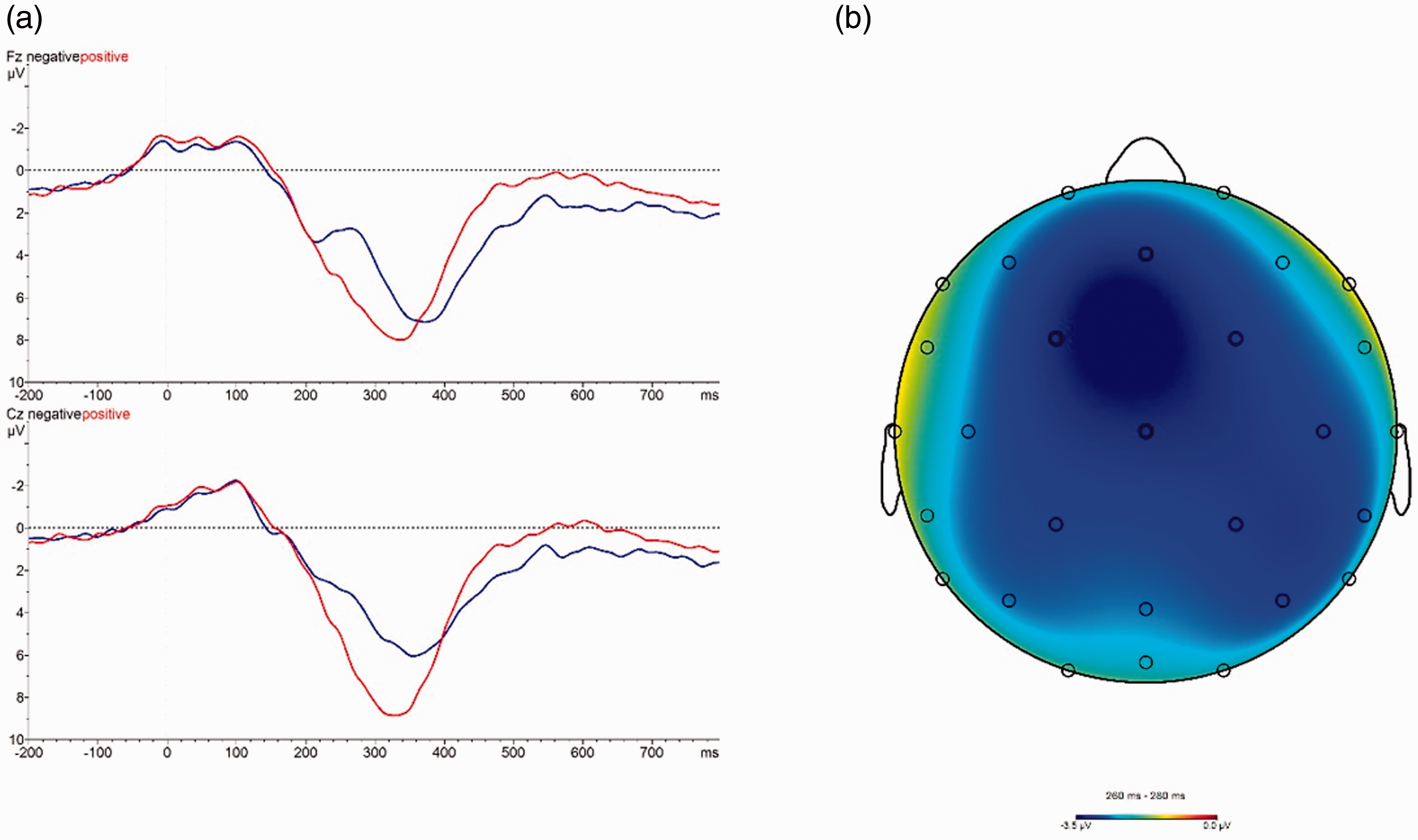
Neuroimaging results showing event-related potential (ERP) activity specific to the feedback-locked feedback-related negativity component (FRN): (A) ERP waveforms at Fz and Cz electrodes. The negative-feedback-elicited waveform is shown in blue and the positive-feedback-elicited waveform in red; and (B) scalp topography specific to the FRN highlighting peak activity over the fronto-medial regions.
Furthermore, the relationship between FRN and PSWQ was explored. To this end PSWQ was correlated separately with ERPs to positive and negative feedback. While there was no correlation between PSWQ scores and ERP response to positive feedback r (27) = 0.17, p = 0.37, a significant positive correlation between PSWQ and ERPs to negative feedback was observed, r (27) = 0.38, p = 0.04. This outcome is presented in Figure 4, which shows that participants scoring high on the anxiety scale exhibited a more positive FRN in response to negative feedback but not to positive feedback. This suggests that people with high anxiety are more sensitive to negative feedback.
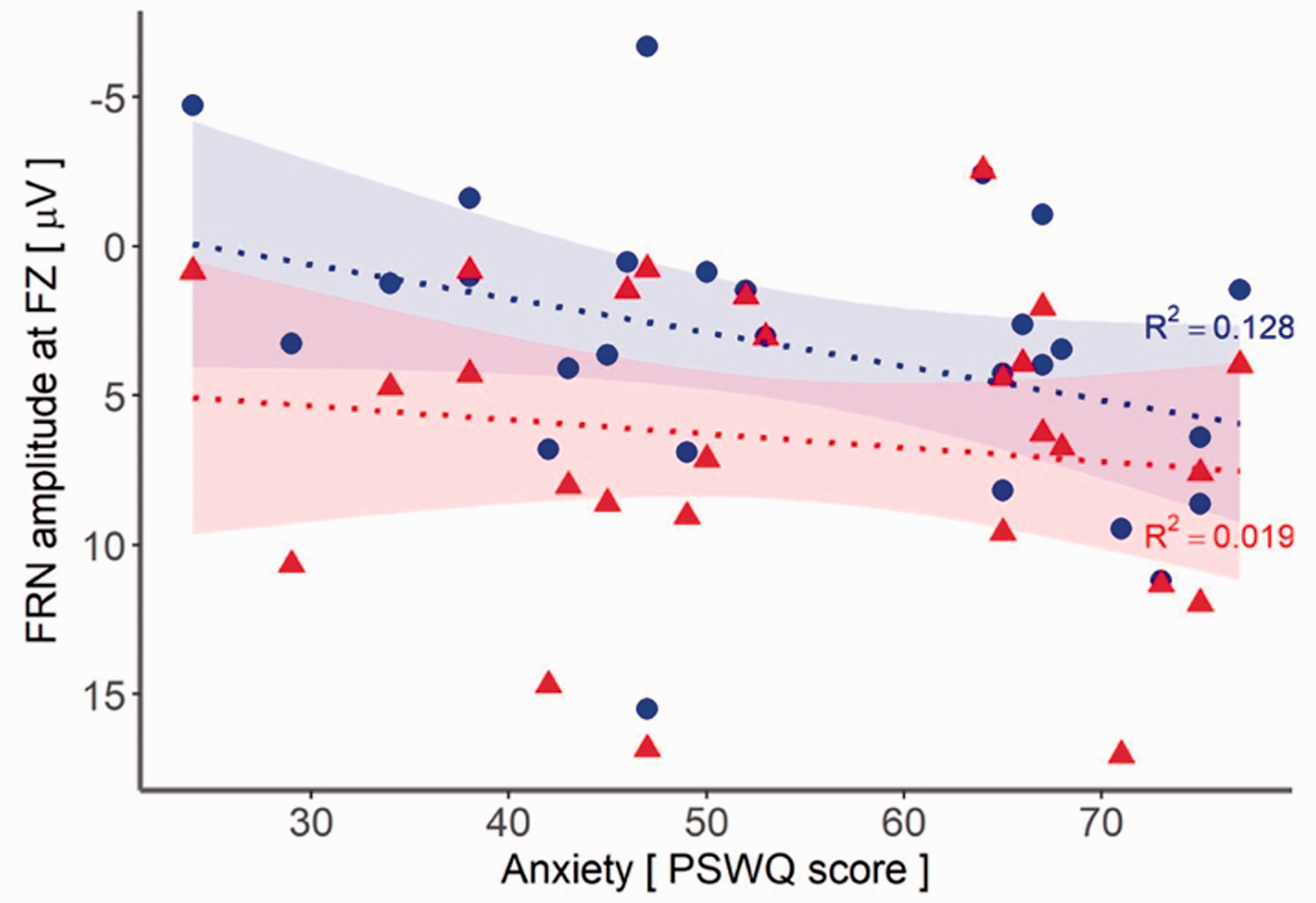
Scatterplot results showing participants’ feedback-related negativity component (FRN) activity at the Fz electrode in response to negative or positive feedback plotted against participants’ Penn State Worry Questionnaire (PSWQ) anxiety score. In this figure, increased anxiety scores are shown to exhibit a more positive going FRN in response to negative feedback.
Discussion
The present study set out to investigate whether the dopaminergic system may regulate both anxiety and feedback learning. Hadden and Frisby (2018) found that anxious students were less likely to benefit from teacher feedback, hindering prospects for learning. To further explore this, we used Frank et al., (2004) probabilistic selection task to measure FRN component alongside behavioral responses to positive versus negative feedback. Our results highlighted that task performance decreased in anxious participants. In addition, a significant FRN difference in both timing and scalp topography was found, which replicated previous findings (Frank et al., 2005). Crucially, a more positive FRN amplitude to negative feedback was found in more anxious individuals compared to less anxious individuals. As the FRN has been shown to be more negative when actual feedback deviates from expected feedback (Hauser et al., 2014; Ichikawa et al., 2010), the reduced, that is, more positive amplitude suggests that anxious individuals perceive less of a difference between expected and received negative feedback. We, therefore, argue that anxious individuals do seem to expect negative rather than positive feedback and are less surprised when receiving negative feedback. This could be interpreted as a tendency for anxious individuals to adopt negative bias when learning via reinforcement. This negative bias seems to cause less subjective conflict between the expected negative and the actual feedback received. This view is also supported by findings that patients suffering from general anxiety disorder fail to adapt to emotional (Etkin et al., 2010), and non-emotional (Larson et al., 2013) conflict situations. Furthermore, the present results confirm that the relationship between anxiety and FRN is driven by responses to negative feedback, which activates the No-Go pathway (Frank et al., 2005). This corroborates recent findings in highly symptomatic depressed individuals that anxiety scores predicted better avoidance learning due to a tighter coupling of negative prediction error signaling with FRN amplitude after negative feedback (Cavanagh et al., 2019).
Contrary to our expectations, the FRN difference did not significantly correlate with the behavioral data. It is conceivable that the PLT might not have been sensitive enough to assess the behavioral responses of a highly anxious sample. Although probabilistic models have been successfully employed as descriptive models of learning in adults as well as infants and children (Gopnik, 2012; Nelson et al., 2014) they exploit assumptions for an ideal learner (e.g., Oaksford & Chater, 2009a, 2009b). It is unclear whether anxious individuals will meet these assumptions, for instance the assumptions of unbiased representations of probabilities and unlimited memory capacity. The probabilistic nature of the task involves high levels of uncertainty. Anxiety, as an incidental emotion, is also associated with increased perception of uncertainty; both state and trait emotions (see discussion in Lerner & Keltner, 2001) can have similar effects. Anxious students’ behaviors are less predictable and greatly influenced by their confidence in a task (Watershoot et al., 2020). Thus, it is plausible that anxious individuals, in our task, perceived especially high levels of uncertainty. Their behavioral variability may be a response to that perceived uncertainty. Children with anxiety overestimate the probability of future negative events (Muris et al., Mayer, 2004). Thus, it is conceivable that some or even most individuals within the present sample diverged from the assumption of an ideal learner, overestimating the likelihood of negative feedback. In this case, we would argue that the FLB might not provide an accurate reflection of anxious individuals’ tendency to better learn from positive or negative feedback. As an alternative, the Bayesian modeling approach and the optimal experimental design (OED) hypothesis may provide a useful framework to evaluate anxious individuals’ learning. The OED hypothesis would be that the learner has specific hypotheses in learning and is trying to figure out which hypothesis is correct during the learning process (Coenen et al., 2018). Given better models of individual learners, that incorporate information about their trait and incidental emotional characteristics, and how those characteristics influence their probability perceptions (see Bertram et al., 2020) and goals, it may be possible to better design individually adaptive tutoring systems (Bertram, in press).
Our data showing increased FRN sensitivity in anxious participants after negative feedback receipt highlight some implications of providing assessment feedback. Crucially, typical feedback provided to students highlights opportunities to improve their overall understanding for a given topic or subject. In addition, teachers often highlight positive aspects of students’ work, aimed to encourage their self-perceived level of competence for improving performance assessment in the future (Kinchin, 2016). Our data highlight the importance of negative feedback for learning in anxious individuals as well. Should anxious individuals predominantly, or only, be given negative feedback? That would be a tantalizing and provocative conclusion to make. There are substantial costs of negative assessment feedback, including increased anxiety levels and feelings of failure, reduced confidence and an overall sense of competence for a given task. Attentional bias to negative feedback is encouraged by increased competence frustration (Watershoot et al., 2020). Limited ability to capitalize on positive feedback in anxious individuals from our sample could have reduced their self-perceived competence to perform well on the probabilistic task. This could have caused them to expect more negative feedback and consequently to perceive less conflict compared to positive feedback, which might help to enhance their learning after negative feedback.
Further evidence for a mutual influence of (perceived) performance and affect is provided by a recent study on mathematics, wherein improved affect leads to improved learning, just as improved learning leads to improved affect (Pekrun et al., 2017). One long-term goal is thus to encourage students’ efficacy for learning, encouraging adaptability when making decisions in academic settings. Others suggest that feedback does not always encourage individuals to reach task-related goals by demonstrating that similar perceptual properties of positive and negative feedback, that make them look highly similar, diminish overall performance and FRN amplitudes in a PLT (Liu et al., 2014). Such similarity between positive and negative feedback can make it hard to adapt learning. It would thus seem plausible that increased bias for negative-feedback learning in anxiety-prone individuals can also be caused by a subjective perception of similarity between positive and negative feedback information, as indicated by diminished FRN amplitudes. In an educational context, this similarity between positive and negative feedback might be increased by negative feedback embedded in positive feedback, or by negative feedback being phrased in a positive way. However, we can only speculate whether this subjective perception of similarity would indicate impaired motivation or, in fact, a reduced ability to access information content of the feedback. In any case, the distinctiveness of positive and negative feedback seems an important factor for its efficacy.
Using a neuroimaging approach, we investigated how learners process new, abstract information, while measuring brain activity in response to positive or negative feedback. In the psychology classroom, the task used in the current study could itself be used in demonstration of how the brain is involved in learning, to make the relationship between one highly relevant cognitive behavior (processing of assessment feedback) and underlying brain networks. This type of demonstration is both feasible and manageable for students and could thus facilitate their learning (Howard & Michael, 2019). Furthermore, this hands-on experience could facilitate mnemonic strategies for meaningfully organizing and chunking to-be-learned information about the present paradigm (McCabe, 2015). This approach should assist with increasing students’ understanding of feedback processing, thus improving their receptivity to what is generally accepted as a difficult component of learning psychology. In addition, involving students in a live neuroscience experiment may strengthen their interest in neuroscience.
In conclusion, our results show that, even at subclinical levels, anxiety symptoms bias individuals to expect more negative feedback. Although there is not much previous work in this area our results also corroborate previous findings (e.g., Cavanagh et al., 2019; Takács, et al., 2015) on the relationship between anxiety and diminished FRN. However, we did not find significant behavioral effects to parallel the EEG findings. Because our sample size was relatively small, we could have missed moderate effect sizes for the behavioral data. (For example, in our study a correlation of 0.3 to 0.4 would only be detected with a probability of about 0.37 to 0.61, given alpha = 0.05 and two normally distributed variables). Nevertheless, our results provide promising first evidence and a blueprint for a future higher power study to check for possible small-to-moderate effects in behavioral learning data. We believe that outcomes from our research should be considered when developing solutions that improve anxious students’ efficacy for learning. In addition, demonstrating this task in a classroom setting might offer a potential opportunity for teachers to flesh out students’ needs first-hand. Opportunities to gain an increased understanding of each student’s response to assessment feedback should assist with tailoring feedback communication toward academic success. With persistent scientific effort to elucidate anxiety’s influence on cognition, its mechanisms and circuitry, the long-term goal of improving students’ learning across educational institutions and experiences is not only worth striving for but will hopefully become in reach
Footnotes
Author Contributions Statement
DLJ and BO designed the experiment, DLJ conducted the experiment, DLJ and BO analysed data, and DLJ, JDN, and BO wrote the paper.
Declaration of Conflicting Interests
The author(s) declared no potential conflicts of interest with respect to the research, authorship, and/or publication of this article.
Funding
The author(s) received no financial support for the research, authorship, and/or publication of this article.
