




Abstract
Social media is riddled with memes (i.e., captioned images intended to convey cultural ideas or beliefs) that often promote maladaptive and unsupported beliefs about human development and parenting. This paper presents a scientific writing assignment designed to help spread accurate information on human development beyond the classroom through creation and sharing of original material on social media. Students were tasked with identifying applicable themes of the course, transforming these themes into scientific memes with supporting research articles, posting these materials to social media, and reflecting on their experiences. This assignment helps students develop critical thinking and scientific literacy, as well as their ability to apply course concepts to everyday life and share those applications with others. Student outcomes from several sections of Lifespan Development—those with the scientific meme assignment versus those with a traditional writing assignment—were analyzed for differences in quantitative measures of student success (i.e., grades). Students’ written reflections were also assessed for common themes. Findings suggest advantages of social media assignments with regard to students’ sense of purpose, experience with scholarly discourse, and student growth, and may inspire creation of additional innovative assignments that promote student learning and application.
Scientific Memes: Using the Language of Social Media to Improve Scientific Literacy and Communication in Lifespan Development
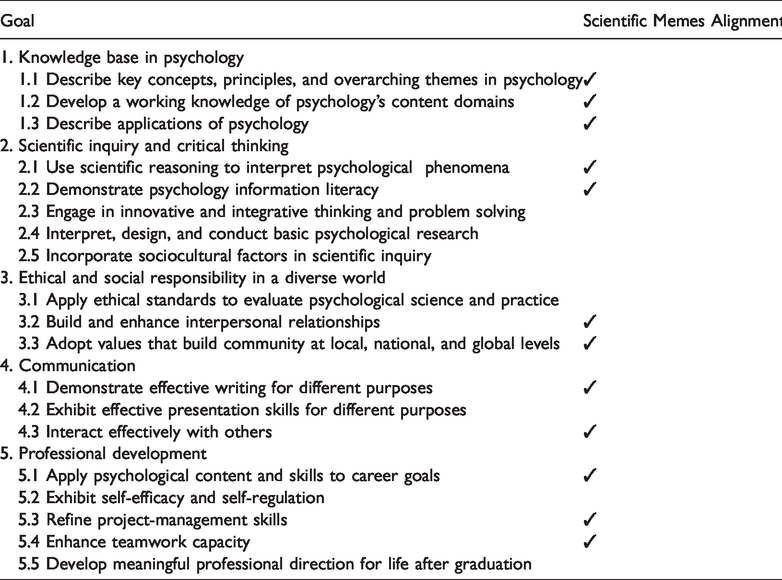
A primary goal of college is to engage students in open and respectful scholarly discourse by modeling professionalism and guiding discussions with credible sources. As undergraduates gain fluency in scholarly discourse, they are encouraged to use their qualified perspectives to make positive changes within their communities. Scientific literacy, writing, and application are a related triad of skills integral to scholarly discourse. These skills broadly include the ability to interpret scientific readings, as well as to demonstrate knowledge and critical thinking through writing and applying scientific topics. While the majority of instructors agree that these skills are paramount to professional success, many find it challenging to address the varied skill levels of students (Graham & Perin, 2007; Pecorari & Petric, 2014; Zhu, 2004). The present study presents an integrative assignment incorporating scientific literacy, writing, and application skill building that aligns with the American Psychological Association’s (APA, 2013) Guidelines for the Undergraduate Psychology Major: Version 2.0 (see Table 1). Lifespan Development students were tasked with reading and interpreting scholarly literature in a writing assignment and sharing their knowledge with the broader community on social media in an accessible format. Through this process, students engaged in scientific literacy and writing, using social media to encourage positive change and application of science within their communities.
Meme Assignment Alignment with APA Guidelines for the Undergraduate Psychology Major
The challenges associated with teaching scientific literacy, writing, and application skills lie in a number of limitations on both student and instructor ends. Students generally lack scientific literacy (National Science Board, 2018; Kennedy & Hefferon, 2019) and graduate from high school with a poor foundation of scientific knowledge (Tomovic et al., 2017). Students also lament the steep learning curve of scholarly writing, including the process of integrating and drawing insight from a variety of sources (Cumming et al., 2016; Fallahi et al., 2006). Furthermore, many college instructors fail to emphasize the importance of sharing scientific knowledge with the broader community, much less the importance of tailoring such knowledge to a general audience (e.g., by removing or defining jargon, providing access to empirical research, and/or using contemporary tools such as social media; Dudo & Besley, 2016). To address this problem, the present assignment required students to share their knowledge with the community on social media, supplementing their written work with both a link to an open-access scholarly article and a student-crafted scientific meme (i.e., an image captioned with a humorous and/or evocative message regarding course concepts).
Higher education has worked to rectify what has been described as “the near epidemic” of poor scientific writing in students (Fallahi et al., 2006, p. 171). However, these efforts have been met with subpar results (e.g., Burgess-Proctor et al., 2014; Fields et al., 2014; Miner, 2018). The present study details an alternative psychology writing assignment intended to promote the skills of scientific literacy, writing, and application while incorporating social media as a way of engaging the community. We believe this scientific memes writing assignment may inspire creative progress in pedagogy, with students gaining scientific literacy by reviewing empirical studies, engaging in scientific and APA writing, and applying scientific knowledge via communicating with a general audience on social media.
Importance of Developing Scientific Literacy, Writing, and Application Skills
Although there is a lack of consensus in the literature on a concrete definition of scientific literacy, it is herein defined as the knowledge and reasoning ability required to identify and apply accurate, relevant information (Dawson & Venville, 2009). Scientific literacy encompasses the skills essential to informed decision making, civic engagement, and economic productivity, benefiting both individuals and society at large (American Association for the Advancement of Science, Project 2061, 1990; National Research Council, 1996). At the individual level, scientific literacy has been shown to promote the application of science-based, healthful behaviors in one’s own life and across generations (Bay et al., 2017; Bloom et al., 2011). For example, Figure A1 is a student-crafted meme which promotes positive parenting behaviors by illustrating a parent applying pretend play to support cognitive development in children. Scientifically literate individuals better understand the extent of one’s impact on complex social, political, and environmental systems and are typically more engaged, conscientious citizens (Tomovic et al., 2017; Yacoubian, 2017). Considering these findings, it would be reasonable to envision a scientifically literate world as a healthier, wealthier, and more egalitarian place. The scientific memes assignment promotes scientific literacy not only at the individual level, but also in the community, by encouraging students to self-educate and use social media as a tool for knowledge-sharing.
Writing is intricately linked to and supports the development of skills and competencies associated with scientific literacy (Gee, 2015). Instructors across disciplines consider writing to be an important outcome for university graduates (Moon et al., 2018; Zhu, 2004), with scientific writing emphasizing empirical evidence. According to Chen (2019), writing helps to mold thinking and knowledge. From a cognitive perspective, writing builds metacognitive skills, including the ability to self-regulate during learning (Kuhn, 1999). Writers are thus well equipped to build new knowledge using existing knowledge, connect disparate topics, and apply information in hypothetical contexts. These cognitive processes are associated with brain changes in adolescence and adulthood that may serve as the foundation for informed decision making and conscientious citizenship (Blakemore & Chowdhury, 2006). Despite the numerous benefits associated with the aforementioned skills, it is often difficult for instructors to adequately nourish scientific literacy, writing, and application through the undergraduate curriculum due to certain systemic issues in education detailed below. The scientific memes assignment is unique in that it fosters the development of all of these skills through its incorporation of research, writing, and community engagement components.
Challenges of Developing Scientific Literacy, Writing, and Application Skills
In forming a connection between scientific literacy, writing, and application, we hope to highlight the value of assignments and pedagogy that support the integrated development of these skills. However, we recognize that there are numerous challenges associated with both serving undergraduates’ wide-ranging needs and incorporating skill-building assignments across the curriculum. There has been underwhelming national adoption of structured science standards in K-12 education, and many high school graduates begin college with suboptimal scientific training. Common Core Standards have historically focused on reading and mathematics to the exclusion of science (Tomovic et al., 2017). In 2013, a set of research-based science standards was introduced to the US, but these “New Generation Science Standards” (NGSS) have only been adopted by 20 states (National Science Teaching Association, 2019). There remains a pressing need for undergraduate instructors to address the lack of scientific literacy in incoming freshmen, especially in the cohort of students untouched by the NGSS initiative.
While most instructors agree that writing is a highly valued skill in numerous fields, many struggle to support the writing-across-the-curriculum movement due to time constraints and poor instructor-to-student ratios (Zhu, 2004). Instructors also note difficulties correcting both basic and discipline-specific writing errors in classes composed of students with varied skills who are writing at different levels (Faigley & Hansen, 1985). Perhaps resulting from a lack of time to carefully assess both basic and discipline-specific aspects of writing, some instructors alternate between learning-to-write (LTW) and writing-to-learn (WTL) assignments, which focus on reinforcing basic writing skills through traditional writing assignments and the application of knowledge through discipline-specific writing assignments, respectively (e.g., Moskovitz & Kellogg, 2011; Reynolds et al., 2012). Any ambiguity or conflation on the instructor’s part regarding the writing skills being assessed in LTW and WTL assignments may add to the confusion and anxiety students experience with inconsistent instructor feedback (Pelger & Sigrell, 2015). Thus, the scientific meme assignment aimed to resolve this issue by integrating basic and discipline-specific writing.
To address these challenges, we propose that the incorporation of social media into assignments could help build valuable skills in a format students already enjoy. Echoing Prain and Hand’s (2016) argument that scientific literacy grows in both private and public landscapes, the current scientific meme assignment incorporates LTW in private—through scholarly writing, peer feedback, and formal assessment—and WTL in public—through the creation of scientific memes and the discussion of relevant issues on social media. The following sections outline the potential utility of incorporating social media into assignments, along with the role of scientific knowledge-sharing in an era afflicted by the spread of misinformation online (Del Vicario et al., 2016).
Incorporating Social Media in Teaching and Learning
The influx of social media (e.g., social networks) in the 21st century has raised questions in the education sphere about its potential value for teaching and learning (Perrin, 2015). Many studies have explored how students respond to social media’s integration into course assignments, in the form of faculty/student reflections or assessments of student outcomes (e.g., Dyson et al., 2015; Junco et al., 2011, 2012). Previous research has included several outcomes congruent with the APA Guidelines 2.0 (APA, 2013; Dyson et al., 2015; Forte & Bruckman, 2010; Junco et al., 2011, 2012; Kassens, 2014; Shane-Simpson et al., 2016; Voorn & Kommers, 2013). In the present study, we assessed assignment efficacy based on several of the APA learning objectives, grade outcomes, and students’ reflections on the community’s responses to the memes.
Several studies have focused on the use of social media, in particular wikis, to promote learning objectives including student collaboration, knowledge building, writing skills, and scientific literacy. Wikis (i.e., publicly editable websites with informative articles) are commonly used by educators as tools to foster student collaboration (Hulbert-Williams, 2010; Kummer, 2013; Shane-Simpson et al., 2016; Zheng et al., 2015) and knowledge building, or the “collective creation of public knowledge” (Kimmerle et al., 2011, p. 139; Lin & Reigeluth, 2016, 2019). Kummer’s (2013) meta-analysis on wiki collaboration indicated that providing wiki training, incentivizing participation, scaffolding collaborative activities, and establishing netiquette guidelines are all important for facilitating productive collaboration. Multiple studies have suggested that, to optimally build collaborative knowledge, instructors must integrate scaffolding, class discussions, and multiple time points of graded feedback (Lin & Reigeluth, 2016, 2019). The scientific memes assignment integrates similar characteristics to optimize student learning outcomes (e.g., scaffolding, class discussions, and multiple graded feedback stages). Further, memes share common ground with wikis in that they are an accessible avenue for publicly disseminating scientific information while building knowledge.
Wikis also nurture students’ information literacy (i.e., “ability to access, understand, evaluate, and use digital information”; Shane-Simpson et al., 2016, p. 270) and writing versatility (Forte & Bruckman, 2010). For example, in Shane-Simpson et al.’s (2016) study, editing and improving existing Wikipedia articles enhanced students’ information literacy by improving their ability to distinguish peer-reviewed articles from non-peer-reviewed articles and to differentiate between empirical and non-empirical studies. Forte and Bruckman (2010) also evaluated wiki assignments and reported related improvement in students’ ability to write for a public audience. Examined together, studies integrating wikis into course curricula suggest that creating and editing educational wiki articles promotes student collaboration, knowledge building, information literacy, and writing versatility. The present assignment similarly requires students to access and interpret scientific scholarly literature and to write for a public audience, which may promote information and scientific literacy.
Student engagement, grades, and comprehension improve with educational use of social media but may depend on faculty engagement and regularity of social media use throughout the course (Junco et al., 2011, 2012, Study 1; Dyson et al., 2015). Using social media regularly is likely essential, as studies demonstrated that when engagement with social media is made optional, less than half of students choose to participate (Dyson et al., 2015; Junco et al., 2012, Study 2). Accordingly, the instructor in the present study required students to share their work via social media and engaged with students on the chosen platform(s) in order to maximize benefits. The requirement also ensured students used accessible language and encouraged student engagement by providing an avenue to share their scientific knowledge with their social media community.
Correlational studies have examined the influence of educational social media use on student outcomes such as concise writing and interpersonal skills. For instance, in Kassens’s (2014) study, students practiced writing concisely by posting content-related tweets on Twitter. Kassens’s (2014) study, and the aforementioned wiki studies, underscore social media’s potential to enhance students’ multi-medium writing skills—a communication goal in the APA’s Guidelines 2.0 (see Table 1; 2013). Social media use in education improves students’ interpersonal skills and dynamics, such as collaboration, self-confidence, and community (Chawinga, 2017; Franz, 2012; Kassens, 2014; Meyer, 2010; Voorn & Kommers, 2013). These studies, combined with the research hitherto discussed, highlight educators’ opportunity for furthering students’ growth through social media. The present study took advantage of this opportunity by incorporating social media into the scientific meme assignment with the ultimate goals of providing students with an audience beyond the classroom and promoting scientific literacy in an era marked by misinformation.
Relevant and Applicable Writing in a Digital Era
While misinformation has always existed, the advent of technology has served as a catalyst for its spread, exacerbating its reach and impact in recent years (Mazer et al., 2015; Smith et al., 2014; for a review, see Chiluwa & Samoilenko, 2019). This, combined with a growing distrust of science, has led to difficulties in science reaching and educating individuals outside academia (Allcott et al., 2019; National Science Board, 2018). One proposed way of addressing this is to encourage behavioral scientists to share findings and encourage application of psychological research (Tsipursky et al., 2018). While faculty are often limited in their time to educate individuals in the greater community, they have the ability to empower and encourage students to share scientific content. As such, the scientific meme assignment requires students to verify and cite their findings, defend their position, and educate others to promote scientific truth.
Recently, non-disposable assignments—digital or online assignments with audiences beyond a given course—have become a popular assessment tool, as they encourage pedagogy that reaches audiences outside of the classroom while still assessing student learning within the course (Seraphin et al., 2019). The scientific meme assignment meets many of these criteria by ensuring students are sharing their work not only with their classmates but also with their social media followers in an educational and impactful manner. In the spirit of sharing their knowledge with the world, students are required to use research articles that are open access (Seraphin et al., 2019). Sharing scientific memes delivers scientific knowledge to a broad audience in a format that is accessible and competitive with the preponderance of misinformation online. Scientific memes send informative messages through both written and visual mediums and thus may be more likely to draw attention and compete with misinformation in an online environment. The scientific meme assignment is detailed below along with data on student grades and completion rates and a qualitative summary of student reflections on learning objectives. We expected the scientific meme assignment to support scientific literacy, writing, and application learning objectives, while remaining challenging and improving assignment engagement.
Study Overview
We obtained qualitative data on students’ perceptions of their growth through written reflections on their experience with the assignment and the community’s response. The prompt for this part of the assignment was as follows: “What was the social media response to your meme and what insights can you take from that?” We expected students to report growth in scientific literacy, writing, and application in line with the APA and course learning objectives as a result of the scientific meme assignment, but not necessarily to earn higher grades on the scientific meme assignment than on the traditional assignment. Support for these hypotheses would reflect similar rigor of the two assignments with additional positive outcomes resulting from students’ engagement with the broader community. The objective of creating the scientific meme assignment was to use an assignment that would build skills and assess with similar rigor the learning objectives of a traditional offline research essay, but in a more engaging medium for students and with a reach beyond the classroom.
Description of Meme Assignment and Objectives
Students in Lifespan Development, often their first course following General Psychology, are expected to be able to communicate and critically analyze lifespan development and psychological research methods, two of the course-level learning objectives. Accordingly, this writing assignment exposed students to scientific literature and required them to find and summarize scientific articles using APA citations. APA Guidelines 2.0 (APA, 2013) were essential to infuse in a course of this level, and the following assignment was designed to meet at least one objective within each of the major guidelines (see Table 1 for APA Guidelines 2.0).
The scientific meme writing assignment included multiple steps to facilitate: (a) scaffolding of the scientific writing activities; (b) feedback from the classroom community; and (c) student reflection on their observations of the public/social-media response and insights on their intra- and inter-personal experience of sharing the content. The students completed this assignment by writing a brief APA-format essay and creating a meme, i.e., a captioned image designed to spread an idea. Memes are easily made by using a website to find a popular image (or a user-generated image) and captioning the image with a short and provocative or direct message. Popular memes often involve humor, current cultural references, or another means of generating an emotional response. By writing a scientific essay and creating a publicly disseminated and accessible meme, students gained experience conveying a complex aspect of human development to a broad audience.
Students began this assignment by identifying four course-related messages (based on classroom learning) that they believed were most important to share with the public. Next, students created a meme for each message and found scientific articles supporting their messages. For example, a student might want to convey that vaccines save lives and promote healthy development across the lifespan (as illustrated in Figure A2). The student would (a) find their meme image; (b) caption their image with the message; and (c) find and cite a scientific article that supports that course message (e.g., Orenstein & Ahmed, 2017). The scientific article was required to be peer-reviewed and open access, thus encouraging public engagement with scientific knowledge and avoiding the growing paywall problem. Following the captioned meme, students wrote a brief essay and reference in APA format which conveyed the findings of the article as well as the importance of their message. Students then shared their captioned meme, article, and essay with the instructor and class, thereby completing the first step.
Following the first deadline, memes were peer reviewed within the class. At this stage, the instructor also reviewed all materials. After a student had three classmates approve their meme, they posted it to the social media outlet of their choice (usually Facebook or Instagram). Students posted the meme publicly along with their APA essay, a link to the article, and a class-assigned searchable hashtag (e.g., #psychsciencememe). Upon completing the aforementioned tasks, students were graded on scientific accuracy/research tone, completion of steps, and APA style. At this point, students were encouraged to simply observe how the public responded to their posts and to respond to any comments with professionalism and courtesy.
For the final step, students revised their essays to improve their writing and APA style (per earlier instructor feedback) and then added a paragraph in which they reflected on how the public responded to their captioned meme. In the case that the public did not respond, students reflected on why the social media response may have been minimal (e.g., did they touch on a topic that has become common knowledge, or did they try to address a topic that is “taboo”?). The instructor then graded and gave feedback on the final completed assignment. The assignment instructions and sample student work are available from the first author upon request.
Impact of Assignment on Student Learning
Student grades on the scientific meme assignment (M = 79.17, SD = 27.48) were similar to the average grade on the traditional writing assignment (M = 76.33, SD = 27.80), t(215) = 1.50, p = .13. Both assignments graded students on APA style, research tone, quality of writing, and use of scientific articles. The meme assignment was completed at a higher rate (99.07%) than the traditional writing assignment (93.36%), with a Mann–Whitney test indicating a statistically significant difference in completion rates, U = 1.00, p = .04, r = .72. These data indicate that while the scientific meme assignment is just as challenging as a traditional writing assignment, the meme assignment may have been more engaging as evidenced by higher completion rates.
Student responses to the reflection section of the assignment (n = 161) were independently rated by two of the authors for qualitative themes of student-perceived growth in line with assignment and APA learning objectives for the scientific meme assignment. The most common themes were: positive emotional responses to being able to share their learning (n = 50), noting that posting to social media led to learning improvements and/or positive discussion with an online group (n = 45), and/or noting that the assignment process helped students develop further insight (n = 42). Many students also noted: frustration that their online community did not read the article or think critically (n = 37), positive emotional response to social media engagement on an important topic (n = 35), and/or that a parent/caregiver said the post had resonated with or been observed by them in their lives (n = 25). The above themes supplement the quantitative data by indicating students’ expressed growth in scientific literacy and application skills as well as an appreciation for the value of scientific reading and engagement with their community.
Students also noted controversy or debate online regarding their posts (n = 15), greater discussion participation from more highly educated individuals (n = 13), or negative reactions from social media and/or “mean” comments (n = 11). Four students expressed discomfort regarding sharing their learning materials with social media. In these cases, the students were concerned that their social media community would view their learning in a negative light (e.g., one student reported being mocked by their friends/family for going to college); the instructor provided these students with an alternative avenue for sharing on social media. These student-perceived challenges could serve as opportunities for growth as students gain experience communicating with individuals who may be skeptical of scientific findings and/or hold conflicting viewpoints.
Discussion
The present study investigated a novel assignment based on the APA Guidelines for the Undergraduate Psychology Major: Version 2.0 (APA, 2013). The assignment was designed to incorporate skill building in scientific literacy, writing, and application through creation of a science-based meme, a writing component, peer feedback, and engagement with the broader community via social media. We found that, although scores on the scientific meme assignment and traditional writing assignments were similar—suggesting comparable academic rigor of the two types—students completed the scientific meme assignment at higher rates and reported learning improvements. Although it is always possible that a demand characteristic or expectancy effect could be influencing hypothesis testing and outcomes, we do not believe this was the case in the current study. Students were not privy to any instructor goals related to the hypotheses, thus reducing the likelihood of demand characteristics influencing outcomes. Instructors graded the assignments prior to the development of any hypotheses which should reduce the likelihood of any expectancy effects in comparing quantitative grade data. Students gained personal fulfillment and insight on controversial issues through the assignment. Some expressed frustration at the lack of individuals on social media who read and thoughtfully responded to the open-access scientific articles and posts.
This feedback raises a couple of important points. First, students may feel a greater sense of purpose in completing assignments that involve active and collaborative learning (e.g., Kilgo et al., 2014), which may explain the relatively higher completion rate for the scientific meme assignment versus traditional writing assignments. Students also received peer feedback and discussed their learning on social media, thereby gaining greater insight on controversial issues. These experiences align with Dawson and Venville’s (2009) definition of scientific literacy as learning to construct scientific arguments by drawing from both private and public feedback. Further, the scientific memes assignment parallels Prain and Hand’s (2016) discussion of scientific literacy development occurring in both private and public landscapes, with students first reviewing scientific literature and writing about it independently, then gaining peer and instructor feedback, and finally sharing their work in the public sphere. These findings suggest that social media-based assignments may serve as useful tools for building the triad of related skills emphasized in this paper (i.e., scientific literacy, writing, and application). Further quantitative research is needed to ascertain whether such assignments result in improved learning.
Second, based on our qualitative data and national surveys (National Science Board, 2018), there is a lack of community engagement in scientifically based relevant issues, especially from those lacking access to higher education resources. These individuals are the ones the scientific memes assignment implicitly targets by providing open-access scientific articles on social media, breaking down the paywall that exists for those without institutional access to scientific articles. Individuals without access to scientific resources may be prone to misinformation despite opportunities for growth in scientific literacy via informed online discussions. Future research should examine how to better engage individuals outside academia in scholarly discourse. This could be done by using more effective “hooks” (e.g., memes); framing discussions with an open mind; using language that is accessible to a larger audience; or better moderating online discussions to avoid cyber bullying.
To elaborate from the scientific community’s perspective, Dudo and Besley (2016) found that protecting the public from misinformation and spreading knowledge is of utmost importance to most scientists, but building trust with and empowering the public to engage in scientific discussion is not. Data from the National Science Board (2018) indicate a lack of public trust in scientific authority that has plagued the US for decades. As such, there is room for improvement in the way we frame and present our scientific knowledge to the broader community to stimulate public trust. Through encouraging more scientists and budding scientists to post and share provocative and accurate content, we will begin to increase community exposure to and practice with scientific literacy, thereby stemming the spread of misinformation.
Conclusion
The scientific meme assignment contains qualities of scientific literacy, writing proficiency, and application skills through its emphasis on primary source use, scholarly writing practice, peer and instructor feedback, and public communication. This assignment is heavily influenced by the APA guidelines and encompasses many levels of the learning process (APA, 2013). Through the conscientious creation of assignments based on pedagogical principles and standards, we hope to build valuable skills in students that transcend the “ivory tower” and translate to truth sharing and growth in the broader community.
Footnotes
Author Note
Allison N. Stallworth is now at Department of Psychological Sciences, Augusta University.
Declaration of Conflicting Interests
The author(s) declared no potential conflicts of interest with respect to the research, authorship, and/or publication of this article.
Funding
The author(s) received no financial support for the research, authorship, and/or publication of this article.
