




Abstract

Reviewed by: Lindsay C. Masland, Department of Psychology, Appalachian State University
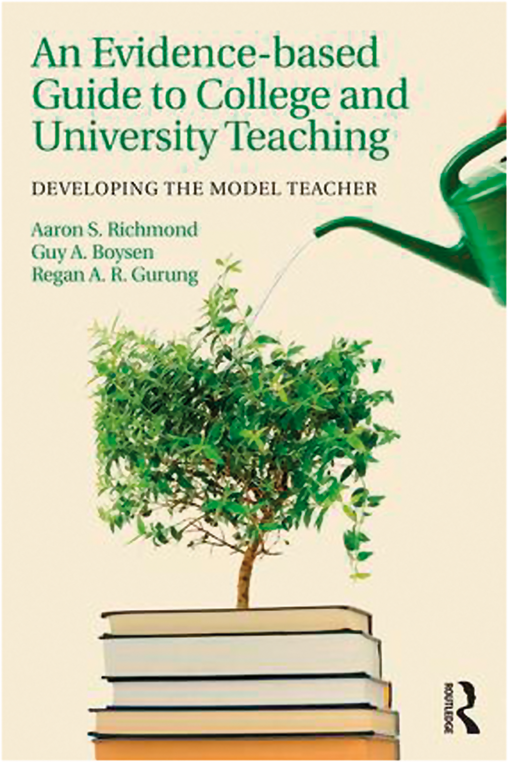
An evidence-based guide to college and university teaching by Richmond, Boysen, and Gurung is the culmination of a multi-year empirical investigation into the characteristics of the “model teacher” in higher education. As members of a task force commissioned by the president of the Society for the Teaching of Psychology (APA Division 2), the authors undertook several reliability and validity studies in their quest to define what makes a model teacher (e.g., Richmond, Boysen, Gurung, et al., 2014; Boysen, Richmond, and Gurung, 2015). The task force identified six general criteria with 19 sub-criteria: this book is the practical, applied accompaniment to that body of empirical work. As such, the book opens with several chapters introducing readers to the construct of model teaching, and it continues with one chapter per model teaching criterion, including teacher training, instructional methods, student learning, classroom assessment, syllabi construction, and use of student evaluation data.
Readers well acquainted with the research on effective instruction or popular books on teaching in higher education will not be surprised by any of the authors’ recommendations pertaining to effective instructional strategies, teacher training, or syllabi construction. However, the lack of “new” ideas in these areas is not a shortcoming, as the book does not endeavor to question existing paradigms. What it does do—and well—is offer a new schema for organizing what we already know about effective teaching. This is not “old wine in new bottles” but “old wine in better-designed bottles,” which can make all the difference in the palatability of the product. That being said, there are some interesting insights that merit special mention.
For example, the authors’ treatment of classroom-level assessment in Chapter 6 is particularly commendable, as they make a compelling argument for aligning classroom assessment with institutional assessment in a way that is both efficient and effective. Additionally, their examination of student evaluations of teaching in Chapter 8 is simultaneously common-sense and evidence-based, and even includes a thoughtful discussion of evaluation tools commonly maligned in higher education, such as RateMyProfessors.com.
Although the book is well researched and clearly tied to an empirical model, it does not read like a textbook or a stuffy academic tome. The authorial voice is conversational and often playful, which makes for an engaging read. In fact, frequent references to elements from pop culture and the liberal but appropriate use of colloquialisms are likely to have readers smirking, if not plainly laughing out loud. The accessible tone is further bolstered by a well-designed chapter structure, which is replicated in each of the eight chapters of the book. Most of the chapters begin with a relatable case study of a teacher facing a pedagogical challenge. Reflection questions and scorable self-assessments deepen the reader’s engagement with the case study, encouraging comparisons between the hypothetical teacher and the reader’s own teaching practice. The authors then delve into relevant research from the Scholarship of Teaching and Learning (SoTL) and learning sciences fields that helps to address the challenges of the case study. Then, the case study is reinterpreted in light of the presented evidence-based literature, and reader understanding is again deepened through reflection questions. Each chapter concludes with “The Very Busy People Book Club,” a list of four to five resources for additional reading. These curated resource lists, consisting mostly of other highly accessible higher ed teaching books, may be worth the price of the book!
In terms of the appropriate audience for the book, it bears noting that the work is penned by three teachers of psychology, so many of the applied examples come from the teaching of their own psychology classes. However, the authors take care to broaden their application of the model teaching criteria to other fields of academia as well, including the humanities, business, and other STEM fields. As such, although the examples provided in this book will certainly resonate with psychology teachers, I think that anyone who teaches at the college or university level would benefit from reading it. It would be particularly useful as a text for experienced graduate teaching assistants, as the focus of a Faculty Learning Community or book study through a Center for Teaching and Learning, or as a “welcome gift” at new faculty orientation. The only population that might not reap maximum benefits from this book are individuals who have no teaching experience at all. Because the power of the book rests in its ability to engender reflection about your past and current teaching practice, it might be difficult for brand-new teachers to see themselves in the presented case studies and reflection questions. However, even novice teachers have a rich history of classroom experience (as students), so this book could still resonate with inexperienced instructors.
In sum, An evidence-based guide to college and university teaching is an imitation of exactly what teaching itself should be. It is current, inviting, engaging, and occasionally playful, yet exceedingly rigorous in its connection to evidence-informed ideas. It prompts frequent self-assessment and metacognitive reflection, leading to gains for the learners (readers) at every turn. This book would make a welcome home on any academic bookshelf—from the instructor just starting to dabble in strengthening their pedagogical practice to the faculty development professional seeking new ways to frame critical discussions about teaching in the academy.