




Abstract
Psychology as an A-level subject in senior high school (12th to 13th grade) has increased in popularity in recent years. The purpose of this study was to investigate why students choose psychology as a subject, and their satisfaction with this choice. A total of 624 Norwegian students responded to a survey. A factor analysis supported a three-factor solution in relation to reasons for choosing to study psychology in terms of “interest,” “therapy,” and “rigor.” The results showed that interest in the subject was the most common reason, thus supporting the “sexy subject hypothesis.” However, a substantial minority of the students also reported personal reasons for choosing psychology, hence there was some support for the “therapy hypothesis.” The least pertinent reason for choosing this subject was a perception of psychology as an easy subject. Hence, the “rigor hypothesis” was not supported. The findings also showed general satisfaction with their choice of psychology as a subject, and realistic expectations of expected academic performance (grades) in psychology. Practical consequences were discussed.
Psychology as a subject has increased in popularity among post-16 high school students in Western cultures (Jarvis, 2012; Walker, 2010). For example, the number of students selecting psychology in the UK has increased substantially, and it is among the most popular choices of subject for A-level (Banyard, 2014). This trend is also evident in Norway (Jacobsen & Diseth, 2018). At present, 12.59% of Norwegian senior high school students choose psychology as an A-level subject, and this number has been increasing ever since psychology was introduced as an A-level subject in 2009 (Utdanningsdirektoratet, 2018).
The curriculum plan for psychology in Norwegian high schools describes psychology as a general education with broad aims. The general aims are to give students an introduction to central topics such as developmental psychology, learning psychology, and social psychology to name a few. There is a specific focus on health psychology in both of the two offered psychology subject modules (Psychology 1 and Psychology 2), and the high school subject as a whole is specifically aimed at providing knowledge about factors that preclude and promote psychological (mental) health. In European countries, psychology as a subject is available in between 25% and 100% of the schools (Sokolová, 2014). Even though psychology is not a compulsory subject in any senior high school, it has been described as a subject with high informal status (Sokolová, 2014), which students find interesting and useful for their everyday life (Augustin, 2012; Sokolová, 2013). However, with the exception of a few studies (Hirschler & Banyard, 2003; Jarvis, 2012; Walker, 2004), there is little research on why students choose psychology as an A-level subject, or how they rate their choice in terms of satisfaction. Knowledge about these issues could be helpful for psychology teachers who are interested in their students’ motivations and satisfaction levels. Hence, the present study investigated the reasons Norwegian senior high school students had for choosing psychology, and how satisfied they were with the subject.
Reasons for Choosing Psychology
There have been some attempts to investigate students’ self-reported reasons for selecting psychology at post-16 high school level. In a survey of 454 post-16 level-3 psychology students (A-level), Hirschler and Banyard (2003) found that three factors emerged as particularly relevant: “sounded interesting” (64%), “want a career in psychology” (19%), and “something different to study” (11%). The reasons for studying psychology have also been investigated among undergraduate university students. A survey study of 308 psychology students, which also included focus groups in its methodology, suggested that students most often state “interest” as their reason for studying psychology, followed by wanting “to help others” (Hastie, 2006). Students also reported having experienced psychological distress, or having witnessed someone close to them suffering, as reasons to study psychology.
Taken together, Jarvis (2012) suggested three reasons for the popularity of psychology at senior high school level (A-level):
The “rigor hypothesis”: Psychology is selected because it is an easy alternative to other subjects; The “sexy subject hypothesis”: Choice of psychology is motivated by interest in the subject; and The “therapy hypothesis”: Students want to understand themselves better and deal with their own personal mental health issues.
The rigor hypothesis
The assumption that students choose psychology A-level as a convenient choice is based on the notion that it is easy to obtain good grades in psychology as compared to other A-level subjects, as shown in a study by Fitz-Gibbon and Vincent (1994). However, more recent evidence does not support this assumption (Jarvis, 2004; Morris, 2003).
Research has shown that students do not perceive psychology as an easy subject. In fact, Hirschler and Banyard (2003) found that 43% of the students described psychology as being more difficult than other subjects, 30% perceived it as equally difficult, and 27% described psychology as easier. Hence, when students are turning from, for example, natural science subjects (e.g., physics, biology, chemistry) to psychology, a social science, it is not because psychology is a “soft option” (Woolcock, 2008).
Statistics on Norwegian senior high school psychology students show that they obtain an overall achievement grade of 4.5 in psychology on a scale from 1–6 (Utdanningsdirektoratet, 2018). However, when students take exams in psychology, the results on the written exam produce an average grade of 3.6, and an average grade of 4.5 on the oral exam. Taken together, these statistics indicate that psychology is not a particularly easy subject.
The sexy subject hypothesis
Morris (2003) points out that people have a natural interest in understanding human experience and behavior, and that students choose psychology because of this interest. Accordingly, Walker (2004) found that the principal motivation is for students to increase their understanding of themselves and others, including the opportunity to increase their effectiveness in personal interactions. In line with these findings, Augustin and Williamson (2012) reported that the majority of students found psychology interesting, useful, and important in a survey of 1495 senior high school students across more than 17 European countries.
Hirschler and Banyard (2003) also found that interest was the primary reason for selecting psychology as a subject. Walker (2010) further investigated this issue by categorizing interest into five distinct aspects on the basis of asking the students “Why do you want to study psychology?” The students’ mean level of responses in descending order were as follows: interest in subject matter, interest in people, novelty interest, career interest, and personal reasons. The students were primarily motivated by interest in the subject matter and an interest in people, but personal reasons were not important. Interest in the subject matter and interest in people appeared to be equally important.
In order to investigate the students’ interest in psychology, it is also relevant to explore their interest in psychology relative to other school subjects. For example, Hirschler and Banyard (2003) found that 80% of the students reported that psychology was “much more interesting” (44%) or “slightly more interesting” (36%) than their other subjects at school.
The therapy hypothesis
Students who choose psychology may be perceived as having a stronger need to understand themselves and to deal with their own mental health problems. This assumption has been reported by psychology teachers (Jarvis, 2012). Furthermore, Craig and Zinkiewicz (2010) claim that the proportion of higher education students with mental health problems is higher in psychology than in any other discipline. It is possible that some students may choose psychology because they want to sort out their personal problems, which may be a conscious or unconscious reason for their choice.
Jarvis (2012) suggests that students with mental health problems may actually benefit from studying psychology. While certain students may surmise that a psychological understanding of their problems is helpful, other students may feel that psychology as a subject makes them even more self-absorbed, thus increasing a sense of hopelessness (Craig & Zinkiewicz, 2010). This is particularly important when considering discussions of sensitive, emotive topics that have the potential to upset or distress certain students (Hulme & Kitching, 2017).
These issues are particularly pertinent considering the increasing focus on mental health among young people in Norway in recent years. It has been shown that approximately 15–20% of Norwegian children and youth have psychological problems, showing symptoms of anxiety, depression, and behavioral problems that pose a challenge to their daily lives (Regjeringen, 2017). For example, 85% of girls and 30% of boys report experiencing pressure regarding body image, which is a concern regarding the development of eating disorders, depression, and anxiety (SIFO, 2014; Kevin, Thompson, & Smolak, 2001; Grilo, Masheb, Brody, Burke-Martindale, & Rothschild, 2005). In addition, a large investigation (N = 10,000) showed that 14–24% of Norwegian youths had a chronic sleeping disorder, which also increases the risk of depression (Departementene, 2016). The number of children and youth who report psychological problems has increased from the 1990s and onwards, particularly among girls (Departementene, 2017).
However, Walker (2010) comments that investigation of the therapy hypothesis is difficult for several reasons. Firstly, the students who initially had a therapy focus may modify their view during the course as they discover what the content of the subject really covers. Secondly, teachers may have communicated to the students that their role is not to counsel. Such experiences with both subject content and teacher role may have influenced the students to leave their original interest in psychology as a means to deal with their own problems. Finally, students may also be unwilling to admit to having personal difficulties preferring to report “interest” to preserve their integrity. In fact, Jarvis (2012) concludes that the therapy hypothesis has not been supported in previous research findings (e.g., Walker, 2004). Ethical concerns may also prove challenging to the investigation of the therapy hypothesis. It may in fact be unethical to investigate the extent to which students with mental health problems are overrepresented among those who choose psychology, and whether this was their reason for electing psychology as a subject. Ethical issues as these could preclude testing the therapy hypotheses at all (Walker, 2010).
The Present Study
The main purpose of the present study was to thoroughly investigate the reasons for post-16 high school students selecting psychology in relation to three hypotheses: rigor (“the rigor hypothesis”), interest (“the sexy hypothesis”), and personal issues (“the therapy hypothesis”).
The aim was to start with a simple question regarding the extent to which the students choose psychology due to “rigor,” “interest,” and “therapy,” and to rate these from least to most important. A more detailed survey subsequently investigated several indicators related to each reason. Furthermore, the extent to which students evaluate “rigor,” “interest,” and “therapy” in relation to psychology as compared to other school subjects was investigated.
It was also an aim to investigate the students’ satisfaction levels with psychology as a subject, and their expected achievement in terms of grades. These final measures (satisfaction and expected achievement) enabled a correlational analysis that made it possible to explore whether satisfaction and expected achievement were related to the distinct reasons for choosing psychology. For example, it might be the case that the motivation to choose psychology on the basis of interest is more strongly related to satisfaction with the subject and an expectation of better academic achievement (grades) as compared to other reasons.
The present study comprised data from two groups of psychology students, one from students in their second year in senior high school (Psychology 1), the other from third year students (Psychology 2). This enabled a comparison between students studying these respective modules. Because psychology is chosen as a subject in senior high school more frequently by girls than by boys, gender differences were also considered. For instance, in the UK, approximately 78% of psychology students are female (Joint Council for Qualifications [JCQ], 2018); similarly, in Norway, approximately 74% are female.
The mere fact that an overwhelming proportion of girls elect psychology may indicate that girls choose psychology for “interest” reasons more than boys (Utdanningsdirektoratet, 2018). However, because girls report mental health problems more frequently than boys, they may also choose psychology for “therapy” reasons to a larger extent than boys. Equally, because girls perform better than boys, they may find psychology to be an easier subject, and therefore choose it due to “rigor” reasons, at least more so than boys do.
Taking into account previous research findings, regardless of gender differences, it is anticipated that “interest” will emerge as the primary reason for choosing psychology. However, personal “therapeutic” reasons might also be a factor; “rigor” will probably be the least important factor.
Methods
Participants and Context
Distribution of Norwegian Psychology Students (Norway and Hordaland) and the Current Sample by Gender and Psychology 1/Psychology 2.
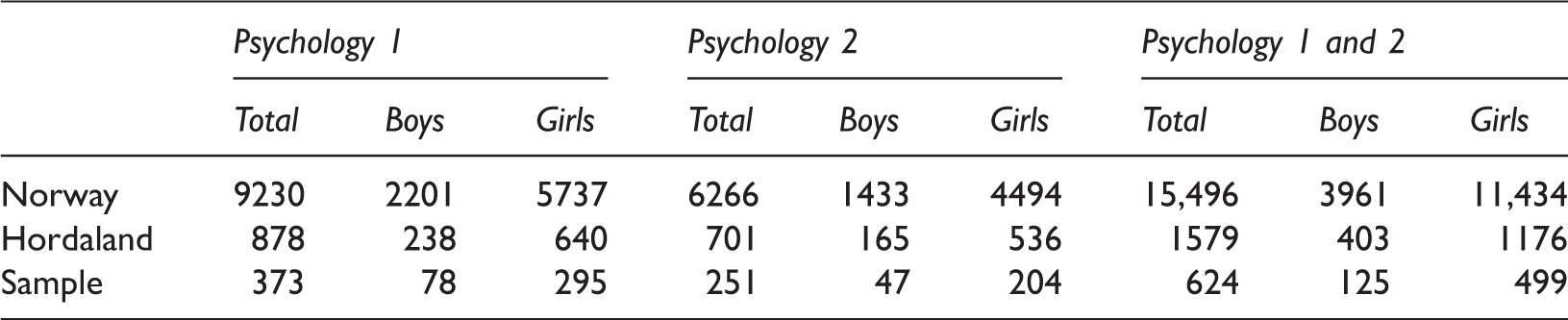
Within a Norwegian A-level subject, students receive 140 h of teaching per year (5 h per week) in both the second (Psychology 1) and third (Psychology 2) years of their 3-year senior high school program, (at ages 18 and 19, respectively). The students may elect to take both modules (Psychology 1 and 2) during their high school years, or just one (Psychology 1 or 2).
Measures
Reasons for choosing psychology
The students were asked to indicate to what extent their choice of psychology was due to reasons of “interest,” “rigor,” and/or “therapy” (cf. Jarvis, 2012), as follows: “Psychology is an interesting subject,” “Psychology is an easy subject,” and “Psychology is a subject which is of personal use to me.” The students responded to these three items on a scale from 1 (“disagree strongly”) to 5 (“agree strongly”).
Rating of reasons for choosing psychology
The students rated their reasons for choosing psychology on a scale from 1 (“most important reason”) to 3 (“least important reason”) regarding the following statements: “Psychology is an interesting subject” (interest), “Psychology is an easy subject” (rigor), and “Psychology is of personal use to me” (therapy).
Detailed measures of reasons for choosing psychology
The abovementioned reasons for choosing psychology provided a single-item measure of the “interest,” “rigor,” and “therapy” hypotheses based on previous research (Jarvis, 2012). However, the present study also aimed to measure these by introducing several indicators for each reason. These indicators included 14 items about which the students were asked to specify their relative agreement, for example, “I have chosen psychology because I have an interest in other people,” The students responded to these items on a scale from 1 (“disagree strongly”) to 5 (“agree strongly”).
Comparison with other school subjects
The students were asked to compare psychology with their other subjects at school regarding “interest,” “rigor,” and “personal usefulness” as follows: “Compared to other subjects at school, how interesting is psychology?” The students responded on a scale from 1 (“much less interesting than other subjects”) to 5 (“much more interesting than other subjects”). The second comparison elicited “how personally useful is psychology?” To facilitate comparison and avoid any confusion with this question, we used the more common/neutral description “usefulness” rather than the more abstract, clinical term “therapy.” The students responded on a scale from 1 (“much less useful to me”) to 5 (“much more useful to me”). The final item was “compared to other subjects at school, how easy or difficult is psychology?” The students responded on a scale from 1 (“much more difficult”) to 5 (“much less difficult”).
Satisfaction with psychology as a school subject
The students rated their general satisfaction with psychology as a school subject on a scale from 1 (“very dissatisfied”) to 5 (“very satisfied”).
Expected academic achievement
Finally, the students were asked to report their expected academic achievement in psychology in terms of the overall grade they expected to attain, on a scale from 1 (“fail”) to 6 (“excellent”).
Procedure
The students responded to a survey comprising the abovementioned items. Each student was invited to participate via their teachers. The students were given a link to SurveyMonkey; they responded using their own computers. Data collection took place in March and April 2018 during the spring term; hence, the students had had similar exposure to their respective psychology courses (Psychology 1 and 2).
Results
Reasons for Choosing Psychology
Percentage of Responses for Reasons to Choose Psychology.
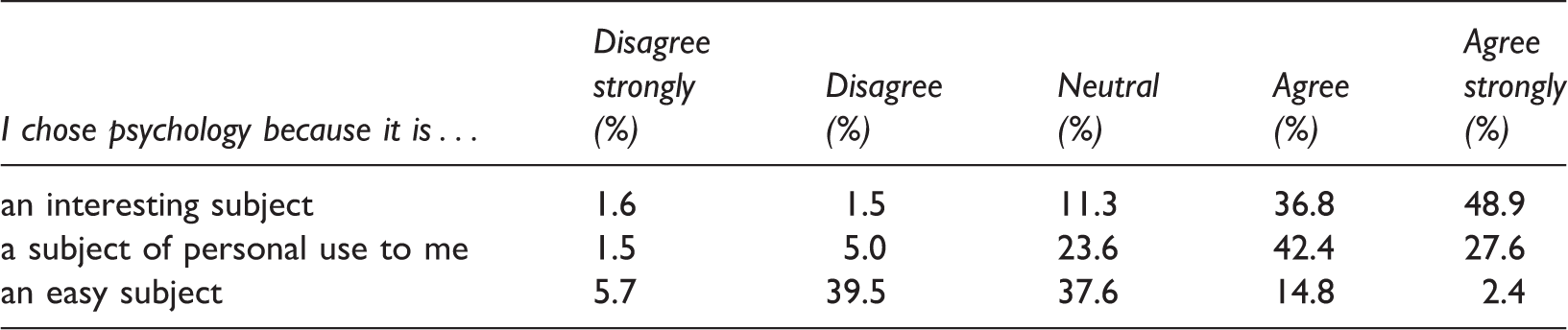
When the students were asked to rate their reasons for choosing psychology, the majority (69.54%) rated “interest” as the most important reason. Most (61.07%) subsequently rated “personal use” as the second most important reason; 72.32% rated “easy subject” as the least important reason.
Factor Analysis (Principal Component, Varimax Rotation), Correlations and Descriptive Statistics.
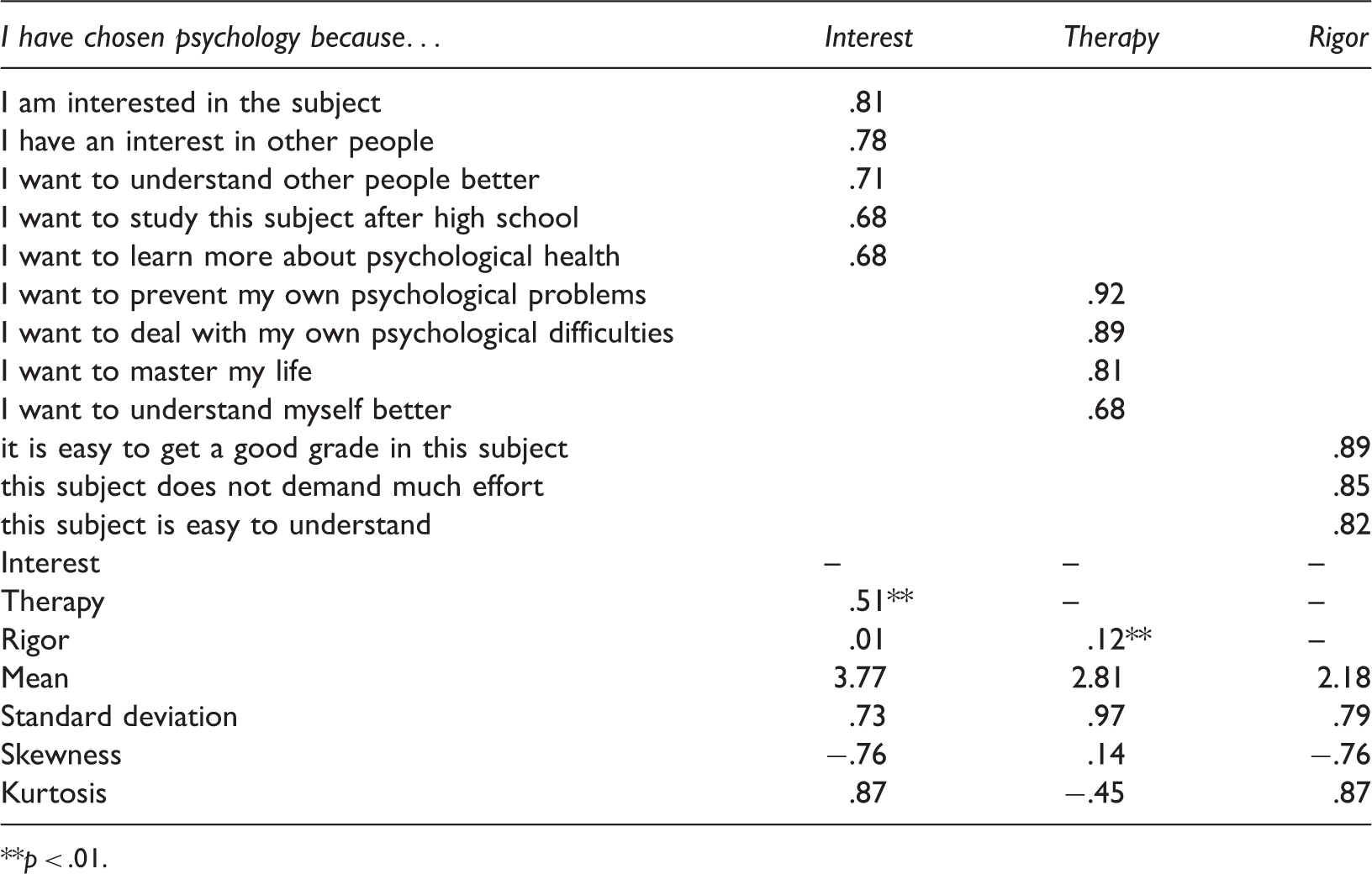
p < .01.
The analysis of these factors showed a substantial correlation between “interest” and “therapy” (r = .51, p < .01), and a significant correlation between “rigor” and “therapy” (r = .12, p < .01), but no significant correlation between “interest” and “rigor.”
A chi-square analysis showed that none of the students’ responses to the three factors had expected frequencies less than 5 (“interest” χ2 = 453.79, df = 20, p < .00; “therapy” χ2 = 184.86, df = 16, p < .00; “rigor” χ2 = 511.61, df = 12, p < .00), thus indicating that the responses were not distributed equally across the alternatives.
Gender Differences
A t-test showed a significant mean level difference between boys and girls regarding reasons of “interest” and “therapy” (“interest”: mean level boys = 3.46, SD = .78; mean level girls = 3.85, SD = .70, t = −4.84, p < .01, d = .53; “therapy”: mean level boys = 2.66, SD = .92; mean level girls = 2.85, SD = .97, t = −2.02, p < .05, d = .20). According to Cohen (1992) who defined effect sizes as small (d = .2), medium (d = .5), and large (d = .8), the effect sizes were moderate for “interest” and small for “therapy.” However, there was no significant mean level gender difference for “rigor” (mean level boys = 2.20, SD = .87; mean level girls = 2.18, SD = 77, t = .23, not sig.). Hence, this analysis showed that girls reported a higher mean level of “interest” and “therapy,” but not “rigor,” compared with boys.
Response Frequencies
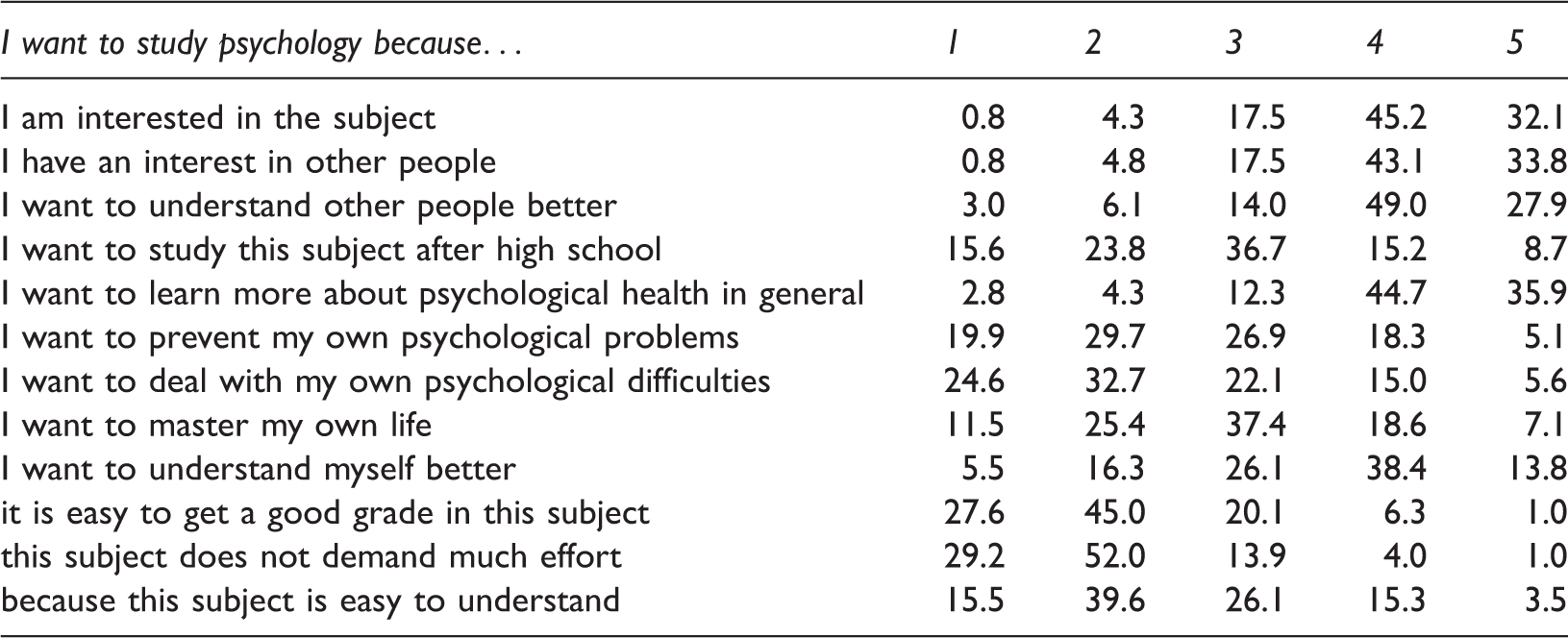
Response Frequencies (Percentages) for Each Item Representing Interest, Therapy, and Rigor, Respectively, on a Scale From 1 (“Disagree Strongly”) to 5 (“Agree Strongly”).
Comparison With Other School Subjects
Mean Levels of Interest, Usefulness, and Rigor of Psychology Compared to Other Subjects.

When comparing psychology to other subjects regarding “interest,” students scored a mean level of 3.89, suggesting that they find psychology more interesting than other subjects. Regarding “personal usefulness” they scored an average of 3.96, suggesting that they find psychology more useful than other subjects. Finally, regarding “difficult or easy” they scored an average of 2.77, suggesting that they find psychology to be slightly more difficult than other subjects.
Satisfaction With Psychology as a School Subject
The students indicated their degree of satisfaction with psychology on a scale from 1 (“very dissatisfied”) to 5 (“very satisfied”), and their distribution of responses were as follows: 2.0% reported being “very dissatisfied”; 7.0% were “dissatisfied”; 18.8% stated they were “neutral”; 47.4% were “satisfied”; and 24.8% “very satisfied.” Hence, the majority of the students reported that they were “satisfied” or “very satisfied” with psychology as a subject.
Expected Academic Achievement: Gender Difference
The students reported their expected overall achievement grade in psychology from 1 (fail) to 6 (excellent) as follows: Grade 1: 0.00%; Grade 2: 1.70%; Grade 3: 7.64%; Grade 4: 28.18%; Grade 5: 45.67%; Grade 6: 16.81%. The total sample expected grade mean level of 4.68, with boys anticipating 4.37 and girls 4.76. There were significant mean level differences between boys and girls (mean difference: .39, t = −3.75, p < .01). Girls expected significantly better grades than boys.
Correlations With Satisfaction and Expected Achievement
Correlation Between Reasons for Choosing Psychology and Satisfaction/Expected Grade.
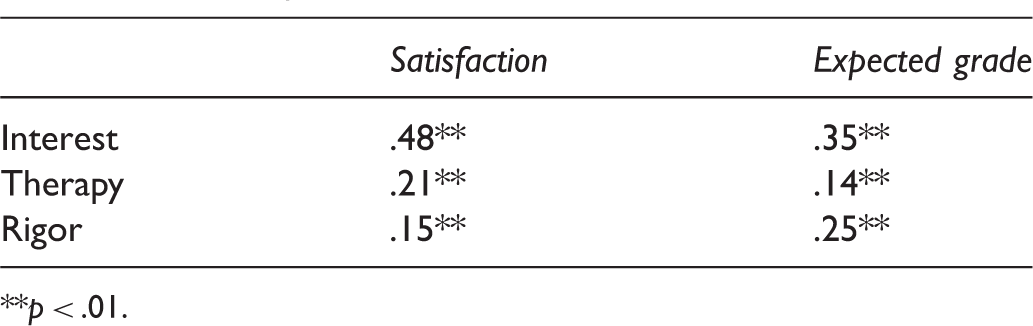
p < .01.
Hence, the students who valued psychology and had high performance expectations also scored higher on all three reasons for choosing psychology. However, “interest” was particularly strongly correlated with “satisfaction” and “expected grade.”
Comparison Between the First and Second Year Students
A t-test of mean level differences showed no mean level difference between Psychology 1 and Psychology 2 students regarding reasons for choosing psychology (“interest”: t = −.87, not sig.; “therapy”: t = .59, not sig.; “rigor”: t = 1.39, not sig.). A t-test of satisfaction with psychology as a school subject did show mean level differences (Psychology 1: mean = 3.74, SD = .97; Psychology 2: mean = 4.03, SD = .86; t = −3.87, p < .01, d = .32), as did expected school performance in psychology in terms of grade (Psychology 1: mean = 4.75, SD = .89; Psychology 2: mean = 4.59, SD = .90; t = 2.01, p < .05, d = .18). Hence, Psychology 2 students had a higher mean level of satisfaction, but a lower mean level of expected academic achievement.
Discussion
The main purpose of the present study was to investigate Norwegian high school students’ reasons for selecting psychology as an A-level subject. The basic assumption was that these reasons could be accounted for by the abovementioned factors, as described by Jarvis (2012) and Walker (2010). The present study investigated these issues further by introducing several indicators (items) reflecting “interest,” “therapy,” and “rigor.” The factor analysis of items measuring the reasons for choosing psychology showed that what we labeled as “interest,” “therapy,” and “rigor” emerged as separate factors. However, there was a substantial correlation between “interest” and “therapy.” In addition, this study investigated students’ degree of satisfaction with the subject in itself and in comparison with other school subjects, as well as exploring expected grade performance and gender differences.
Reasons for Choosing Psychology
The initial investigation into reasons for choosing psychology showed that “interest” (sexy subject) was most relevant, followed by “personal value” (“therapy”), and finally “rigor” (“easy subject”) as the least significant reason. The students’ subsequent ratings of reasons for choosing psychology, from most to least important, supported these initial findings. However, with reference to the study by Walker (2010) it is worth noting that the sexy subject hypothesis (“interest”) comprises several interrelated reasons for choosing psychology including interest in the subject, interest in other people, understanding other people better, intention to study psychology after high school, and a desire to learn about psychological health. In accord with previous findings, it may be difficult to distinguish between different forms of interest (Walker, 2010).
The present findings also showed that personal interest in terms of “therapy” emerged as a key reason for selecting psychology for a substantial minority of the students. This finding was not in line with previous assumptions, which largely dismissed “therapy” as a factor in choosing psychology (Jarvis, 2012). However, as Walker (2010) states, the therapy hypothesis refuses to go away completely: As the present research shows, there may be good reasons to assume that some students who select psychology do so for therapeutic reasons. As Jarvis (2012) points out, students with psychological difficulties may find psychology helpful.
Having said that, it should be remembered that “interest” remains the most salient reason for selecting psychology, with a mean level response well above the theoretical mean level (mean = 3.77, range 1–5). The mean level score on the “therapy” variable (mean = 2.81) did not reach the theoretical mean level (mean = 3), indicating most students did not select psychology for “therapy” reasons.
Nevertheless, the substantial minority of students who did choose psychology for “therapy” illustrates a dilemma for teachers of the subject: On the one hand, psychology introduces topics that are directly relevant to students’ personal lives, their emotions, and well-being. On the other hand, the primary goal of any subject, including psychology, is to provide knowledge and reason. For example, Jacobsen (2017) found that Norwegian psychology teachers experienced more ethical dilemmas relative to teachers of other subjects. The predominant dilemma was that students tended to utilize examples from their own lives that were very private and not therefore appropriate for sharing in class. Teachers who reported this also had the impression that students thought they could use the psychology teacher as a therapist. Were teachers to deal with students’ personal experiences (emotions, etc.) they would be at risk of engaging in a therapist–patient dyad rather than a teacher–student relationship, creating an ethical dilemma (Andersen, 1995).
Gender Differences in Reasons for Choosing Psychology
Analysis of gender differences showed some significant results regarding the choice of psychology. For a start, the majority of students who elect to study psychology are female, a trend seen internationally (JCQ, 2018). Regarding reasons for choosing psychology, the findings showed higher mean levels of “interest” and “therapy,” but not “rigor” among girls, compared to boys.
Regarding gender differences in the sexy subject hypothesis (interest), more girls than boys choose psychology as an A-level subject. This may explain why girls report a stronger interest in psychology than boys. Regarding gender differences in the therapy hypothesis, it is beyond the scope of the present study to establish a link between the prevalence of mental health problems and the tendency to select psychology as a subject in senior high school. Nevertheless, there is a remarkable correspondence between increased levels of psychological problems in the youth population and the tendency to select psychology, and both of these tendencies are stronger among girls. Hence, it is not so surprising perhaps that girls reportedly select psychology for “therapy” reasons more than boys, as indicated in the present findings.
Satisfaction With Psychology: Expectancy and Value
The findings showed relatively high mean level scores on students’ evaluations of the extent to which they found psychology more interesting and personally useful than other subjects at school. However, on average they did not find psychology less difficult: on the contrary, they found it slightly more difficult compared with other school subjects. Taken together, these latter findings may be considered an indicator of the students’ satisfaction with psychology relative to other subjects; this was confirmed by the 71.8% of students reporting that they were “satisfied” or “very satisfied” with psychology as a subject. However, students in Psychology 2 were significantly more satisfied than students in Psychology 1. A possible explanation for this is that students who are not satisfied with their first year of psychology do not continue on to the second year.
Regarding expected exam performance in psychology, the students scored an average of 4.77 on a scale from 1–6. This is relatively close to the grades students actually obtain nationwide, hence, they appear to have a realistic view of achievement levels in psychology. Girls expected higher grades (4.76) than boys (4.37), which reflects actual gender differences in achievement.
However, students in the second year of psychology expected lower grades, on average. An explanation for this may be that Psychology 2 students have experienced grading in their first year of psychology, hence they are more realistic regarding the academic level they are capable of achieving. Another possible explanation is that written, as opposed to oral, assessment is more important in the Psychology 2 module. In this module, 67% of the students are randomly selected by the The Norwegian Directorate for Education and Training to have a written exam, and exam statistics show that it is more difficult to obtain good grades on written assignments (Utdanningsdirektoratet, 2018).
The students’ rating of satisfaction and their expected grade performance correlated positively with all of their reasons for choosing psychology (“interest,” “therapy,” and “rigor”). Such “expectancy” and “value” components are considered to be indicators of students’ motivation, as described within “expectancy–value theory” (Wigfield & Eccles, 2000). This assumption was supported by the fact that the students valued psychology more than other subjects regarding both “interest” and “therapy” reasons.
Practical Implications
Teachers may consider the fact that whereas most students choose psychology for reasons of interest, a substantial minority also elect to study this subject for “therapy” reasons. It may therefore be important to pay particular attention to this latter group of students in the classroom to avoid ethical dilemmas in relation to e.g. student privacy and teacher role. Certain aspects of psychology may be more directly relevant to students’ lives, in particular topics such as health psychology, in which factors preventing and promoting mental health are discussed. Hulme and Kitching (2017) noted that certain issues may be sensitive for some of the students, leading to distress. Students’ disclosure of their own distress responses may in turn be perceived by teachers as challenging.
Hence, it is important to ensure that students and teachers are able to deal with sensitive topics safely in order to maximize benefits and minimize any negative implications. Accordingly, research has shown that teachers find covering sensitive topics challenging, but also appreciate the value of doing so for the students and society more widely (Hulme & Kitching, 2017).
Limitations
The present study was limited by the fact that it was based on students’ self-reported responses. In addition, we did not have any objective measurement of the students’ actual academic achievement; such data would have required the identification of each student, which might have compromised the validity of the responses. It would also have posed an ethical challenge, as this would have enabled identification of students who chose psychology and their primary reason for doing so, in particular regarding investigation of the therapy hypothesis.
Although the present study included several indicators of interest in psychology (the sexy subject hypothesis), we might also have added an item reflecting the intention to pursue a career in psychology, in accordance with findings by Hirschler and Banyard (2003). However, it could be argued that the item “I want to study this subject after high school” largely covers the intention to continue with psychology.
Regarding the measurement of interest in psychology compared with other subjects, there is reason to question whether this was meaningful. It might have been better to ask for an interest rating in several school subjects, and then compare these scores with interest scores in psychology.
Finally, we asked the students when they were in their spring term for their original reason for selecting psychology as an A-level subject. Hence, their responses might have been affected by their experience of psychology subsequent to their actual choice of the subject. It might have been advantageous to ask them both before they had any actual experience of the subject, preferably early in the fall term and in the spring. On the other hand, administering the survey twice to the same students in such a short period of time could prove challenging, both in regard to response rates and disclosure of student identities.
Conclusion
Norwegian senior high school psychology students select psychology as a subject largely due to interest in the topic. Some students also report “therapy” reasons, but this reason is less important than “interest.” In accordance with previous research, the present findings do not support the idea that students choose psychology because it is perceived as an easy subject. However, the present findings do, to a larger extent than previous conclusions, suggest that a substantial minority of the students choose psychology for “therapy” reasons, particularly among the female students. This may reflect the increasing focus on mental health issues in society and the increasing incidence of psychological problems in youth.
Footnotes
Declaration of Conflicting Interests
The author(s) declared no potential conflicts of interest with respect to the research, authorship, and/or publication of this article.
Funding
The author(s) received no financial support for the research, authorship, and/or publication of this article.