




Abstract

Reviewed by: Cathal O’Siochru, Department of Education Studies, Liverpool Hope University, Liverpool, UK
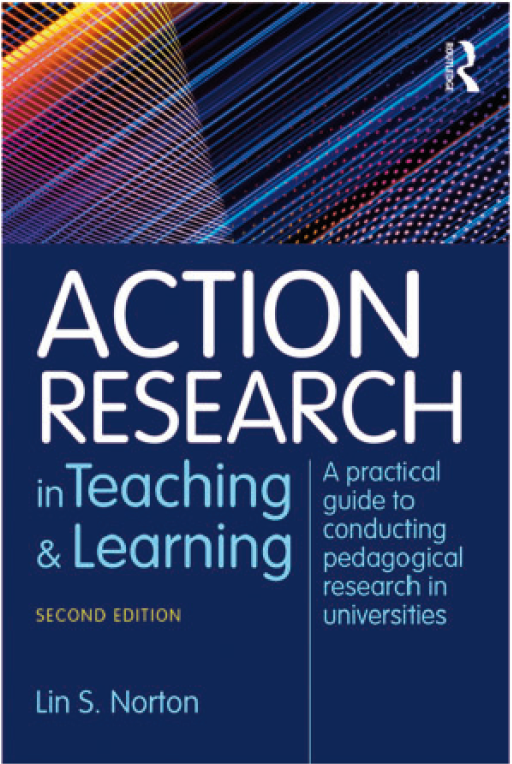
I am reviewing Action research in learning and teaching: A practical guide to conducting pedagogical research in universities by Lin Norton. This book presents itself as a practical guide to pedagogical action research (PAR) which can assist anyone wishing to use PAR to evaluate and refine their own practice. It is aimed at a higher education (HE) audience but is intended to be accessible not only to lecturers but also to those working in a learning and teaching support role in HE who are interested in action research. The writing style lives up to this aspiration to be inclusive; it demonstrates academic rigour, but the language and layout are both accessible and inviting. The author plainly has a lot of experience and enthusiasm for the field of action research and both of these qualities come across very clearly in her writing, drawing you in to the topics she is discussing.
As well as being a guide to the methodology of action research, one of the other aims of the book which the author outlines in the introduction is to equip the reader with the tools required to justify the value of PAR to others. This particular aim really resonated with me and reminded me of countless debates and discussions I have had over the years trying to make that exact case to colleagues, funding committees, and occasionally line managers. The idea that this book could arm me for the next time I need to defend the importance and value of my action research was very appealing because, to this day, it remains a challenge to get PAR acknowledged as being equal to other forms of research.
There are eleven chapters and they can be roughly divided into two groups: chapters with a theoretical focus; and chapters with a methodological focus. The first four chapters have a theoretical focus, exploring topics such as the meaning of PAR in the current HE context, why reflective practice is important, why the professionalization of university teaching is important, and the ways in which PAR can contribute to your professional development.
As an example of one of these chapters in more detail, the chapter on “what PAR means in the current HE context” explores the potential role for action research within the HE sector in relation to a number of current issues. The issues discussed range from the challenge presented by the diverse make-up of the student body to the pressures from marketization and metrics such as the teaching excellence framework. One thing I found particularly refreshing about the approach taken in this chapter was that it resisted the most obvious route, presenting PAR as a solution to these challenges. Instead it took a much more nuanced approach, inviting us to question the assumptions made in our intuitive understanding of these challenges. In this light, PAR is seen as a way to test these assumptions so as to better understand the nature of these challenges before we leap into action.
The remaining seven chapters each consider a different aspect of PAR methodology. Topics include “when you should start a PAR study,” “what research methods to employ,” separate chapters on “the use of quantitative and qualitative data in PAR,” “the use of pedagogical tools in PAR,” “ethical issues” and “publicizing your findings.”
In another example of one of these chapters in more detail, the chapter on “ethical issues involved in PAR” explores the challenges of balancing the roles of educator and researcher, particularly when your own teaching is also the focus of your research. This chapter offers a very thought-provoking combination of practical advice on the ways you can ensure your research is conducted ethically, alongside the author’s personal reflections on the ethical challenges they faced in their own past research. One aspect of those reflections that made a big impact on me was the author’s frank acknowledgement of their own doubts about some of the ethical decisions made when they view those decisions now in hindsight. This approach both personalizes what might otherwise appear as a rather abstract issue, ethical considerations in research, but also invites the reader to learn from the author’s “mistakes” and so benefit from her experience. This is very much the kind of approach I find myself taking to the teaching of ethics in my own classroom and so it was a very pleasant surprise to see that approach taken here.
When viewed together, all these chapters have a similar aim, seeking to provide the reader with a theoretical and methodological PAR “tool-kit.” Each chapter comes with a mixture of case studies, activities, reflection/discussion points and further readings, all of which offer the reader some excellent “access points” to the material. This approach very much encourages your active participation in the topics under discussion. There are plenty of foundational materials here for the PAR “novice,” while also managing to offer some new and interesting ideas and provocations for those like myself who already have some experience with PAR and are looking for something more.
Returning to the beginning, in its title this book touts itself as a practical guide to PAR. I feel that it delivers on this promise and more as it also offers a very well-argued theoretical basis for the importance of PAR in modern HE. Even when discussing the theoretical, it never loses sight of its aim to offer practical guidance; framing the theoretical debate as essential ammunition which the reader can use to make a case for PAR should anyone question its value. This is not a reader or a collection of PAR studies, there are many other books out there which fill that niche. This is a textbook, the essential guide to PAR and required reading for anyone wishing to enter into the field of PAR for the first time or those wishing to take their research in this field to the next level.