




Abstract
This study examined student outcomes of participating in a semester-long, intergenerational service-learning course compared to a traditional pedagogy course. At the beginning and end of the semester, students (N = 161) voluntarily completed a series of measures assessing six outcomes across four domains: personal, social, citizenship, and academic. Results from mixed analysis of variance and multivariate analysis of variance tests suggest service-learning students only outperformed the traditional pedagogy group on self-efficacy for community service (i.e., a personal outcome). Service-learning students maintained a high level of self-efficacy across the semester, while the self-efficacy of those in traditional pedagogy courses declined. There were no significant group differences over time in social, citizenship, or academic outcomes. These results suggest more tempered support for service-learning than many previous studies. Factors potentially affecting the results include the service-learning dosage, broader educational context, and methodological rigor. Future studies may further illuminate possible effects of the educational context.
Service-learning has been identified as a high-impact educational practice (Kuh, 2008) that should be an integral part of the undergraduate psychology curriculum (Altman, 1996). Psychology and service-learning are well matched because both focus on understanding and improving the lives of people (Ozorak, 2004). Furthermore, Chew et al. (2010) identified service-learning as a strategy to promote sociocultural awareness, which is important to meet the American Psychological Association’s (APA, 2013) goals for the undergraduate psychology major related to ethical and social responsibility in a diverse world. Bringle, Ruiz, Brown, and Reeb (2016) stated, “… service learning is the most effective pedagogical tool for psychology educators seeking to develop psychologically literate citizens” (p. 295). The APA has emphasized that civic education should be systematically integrated into the psychology curriculum, but has received “marginal” attention within the field (Bringle, Reeb, Brown, & Ruiz, 2016, p. 27). Likewise, Reich and Nelson (2010) noted that service-learning has not become part of the typical undergraduate psychology curriculum. To this end, Bringle, Reeb et al. (2016) provided guidance about the integration of service-learning into a variety of psychology courses, including developmental psychology and less applied courses, such as statistics, research methods, cognition, learning, and behavioral neuroscience.
Service-learning is a pedagogical approach with strong theoretical underpinnings. It answers Boyer’s (1996) call for universities to become more engaged with their communities and be “staging grounds for action” (p. 20). The benefit of service-learning is also supported by prominent theories of learning. For example, Dewey, as noted by Giles and Eyler (1994), believed that for knowledge to be remembered and applied, it must be acquired through experience. Building on Dewey’s theory, Kolb’s experiential learning cycle involves concrete experiences, followed by reflection on those experiences, leading to abstract conceptualization of what one has experienced, and finally resulting in active experimentation to test whether those conceptualizations are supported over time. Kolb’s model highlights reflection as the key ingredient linking concrete experiences to theoretical understanding (Cone & Harris, 1996). Together these two theories emphasize the importance of action and reflection—two key components of service-learning—in knowledge acquisition. Consistent with these theories, Bringle and Hatcher (1995) defined service-learning as A credit-bearing, educational, experience in which students participate in an organized service activity that meets identified community needs and reflect on the service activity […] to gain further understanding of course content, a broader appreciation of the discipline, and an enhanced sense of civic responsibility. (p. 112)
A Comparison of Eyler and Giles (1999) and Conway et al. (2009) Service-Learning Outcomes
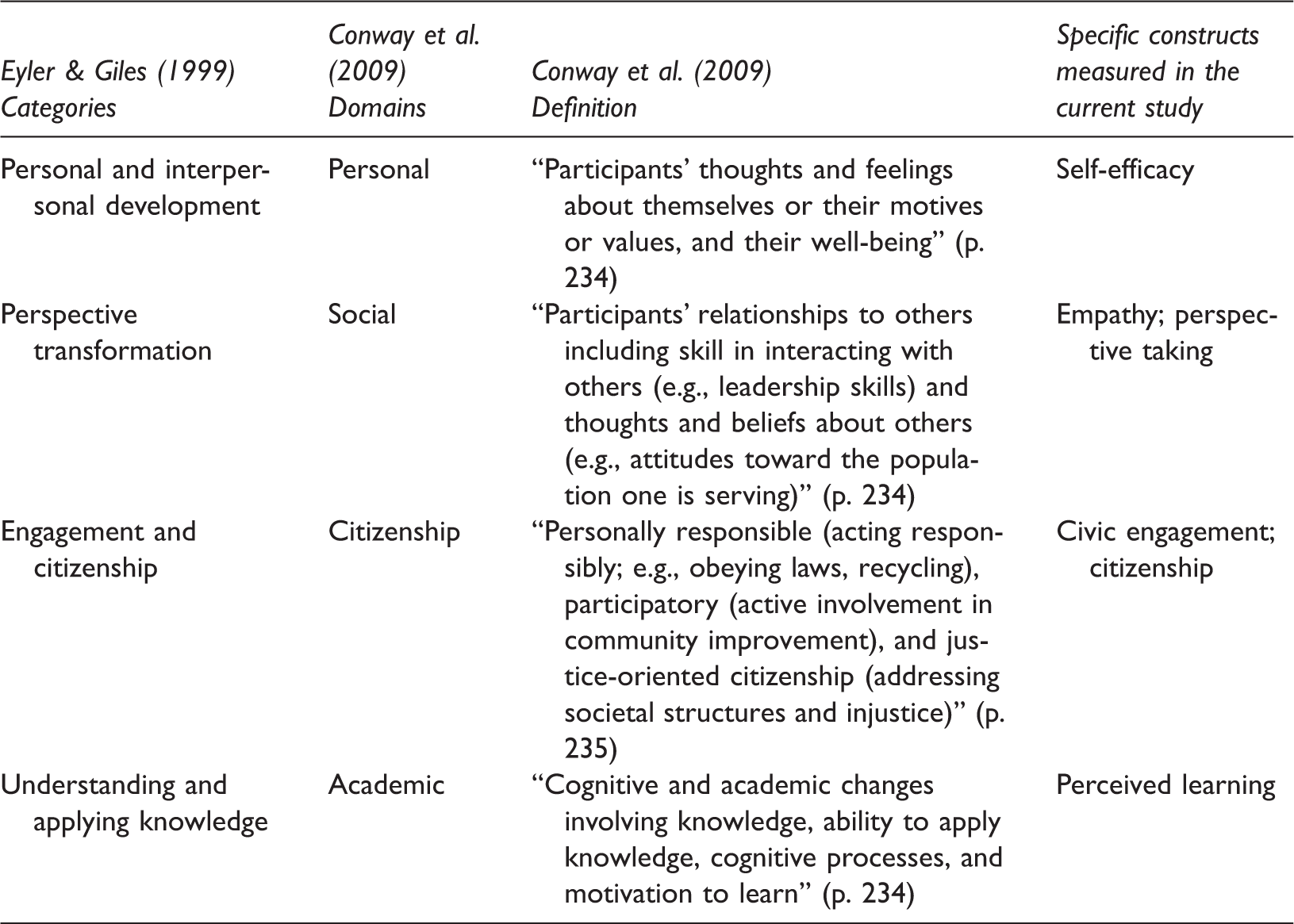
Notably, outcomes in the areas of attitudes toward self, attitudes toward school and learning, civic engagement, social skills, and academic performance have not been consistent across studies, with some studies suggesting little to no positive change in these outcomes (Celio et al., 2011). Overall, positive academic outcomes are the most robust outcome of service-learning (Celio et al., 2011; Conway et al., 2009; Yorio & Ye, 2012), however, effect sizes are larger when the measure of academic outcomes is objective (e.g., test grades, grade point average (GPA), or objective assessment of student papers) than when the measure is subjective (e.g., self-reports or perceived learning; Yorio & Ye, 2012). Meta-analyses have found smaller effect sizes in the domains of personal outcomes (Celio et al., 2011; Conway et al., 2009; Yorio & Ye, 2012), social outcomes (Celio et al., 2011; Conway et al., 2009; Yorio & Ye, 2012), and citizenship outcomes (Celio et al., 2011; Conway et al., 2009).
Unfortunately, our understanding of service-learning outcomes in psychology classes is hampered by the methodological problems of many studies, such as relying on participants’ retrospective reports, relying on one-group pre/post designs, and obtaining small sample sizes that limit power. Other difficulties include focusing on outcomes in a limited number of domains (i.e., examining personal, social, citizenship, or academic outcomes) rather than several being assessed in one study, failing to acknowledge or address the influence of social desirability in self-report data, and collecting and reporting limited information about the demographics of participants (Bringle, Reeb et al., 2016; Clayton, Bringle, & Hatcher, 2013; Howard, 2003; Roodin et al., 2013). The current study improves upon previous studies by utilizing a quasi-experimental design with pre- and post-test assessment to compare change in students participating in a service-learning psychology class to those taking a traditional pedagogy psychology class. In addition, this study includes data collected across four semesters, resulting in a larger sample size than utilized in many previous studies. Furthermore, participants completed a multidimensional assessment that included measures of six outcomes spanning the four domains identified by Conway et al. (2009): Personal, social, citizenship, and academic. The study also includes a measure of social desirability to determine whether participants’ desire to respond in socially desirable ways may influence their responses. Finally, participants provided detailed background information so that the findings will have context that allows for a richer understanding of external validity.
Wilson-Doenges, Troisi, and Bartsch (2016) identified eight standards to elevate the quality of scholarship of teaching and learning in psychology, indicating that achieving all of them is unlikely. However, researchers should attempt to meet several of them to maximize their contribution. The current study achieves at least three of the standards including theory-based hypotheses, large sample size, and advanced and multivariate data analyses.
We examined the outcomes of participating in a semester-long, intergenerational service-learning course compared to traditional pedagogy. Based on service-learning theory and previous research, we hypothesized that students in an intergenerational service-learning class would demonstrate improvement over the course of the semester as compared to students in a traditional pedagogy course on an assessment of service-learning outcomes across the four domains identified by Conway et al. (2009). More specifically, we predicted that the two groups would demonstrate differences in personal (i.e., self-efficacy for community service), social (i.e., empathic concern, perspective taking), citizenship (i.e., civic action attitudes, social justice attitudes), and academic (i.e., perceptions of learning) domains, with the service-learning group making greater gains in all areas when compared to their traditional pedagogy peers.
Method
Participants
Demographics Overall and by Group
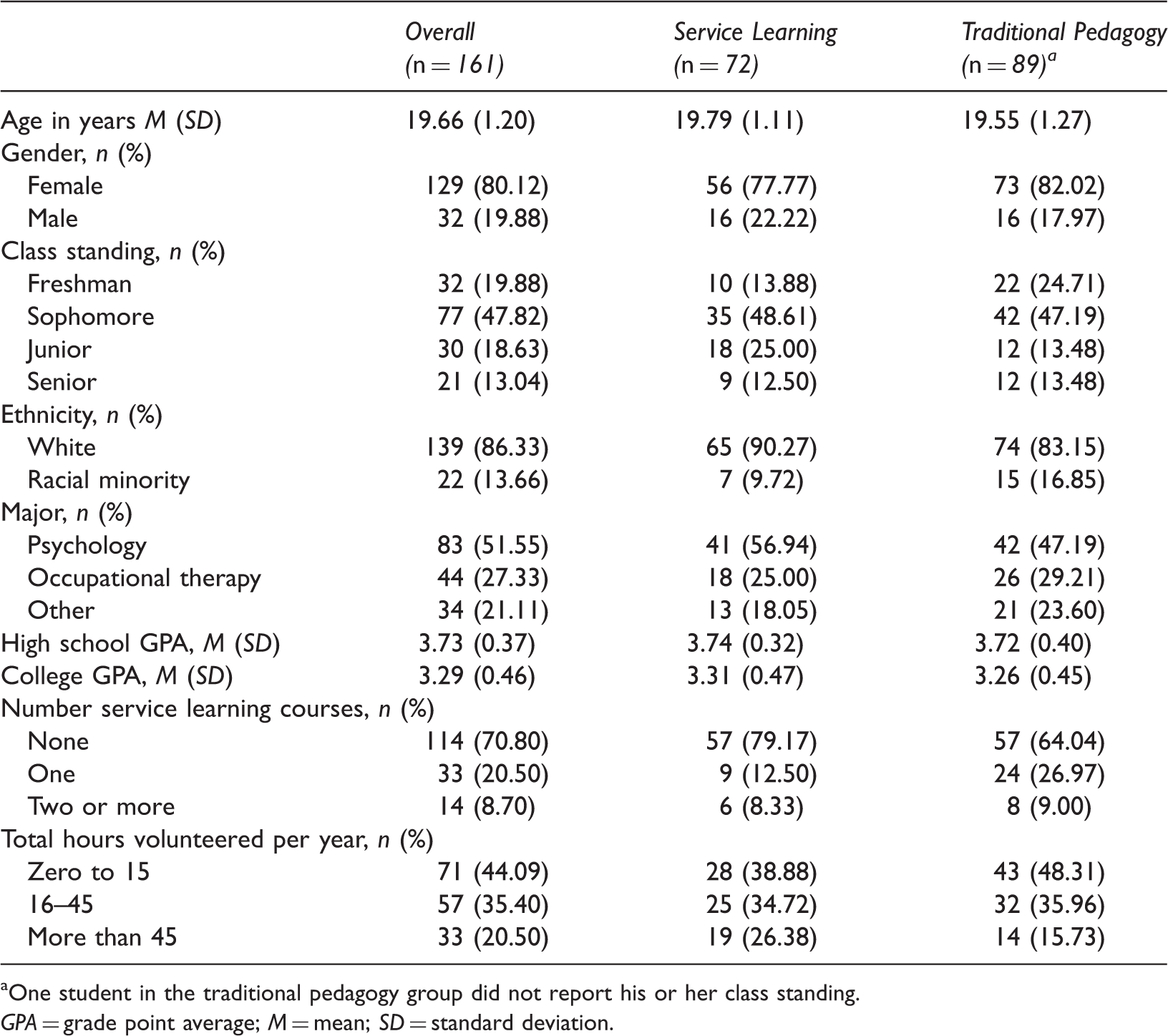
One student in the traditional pedagogy group did not report his or her class standing.
GPA = grade point average; M = mean; SD = standard deviation.
Sampling and Data Collection Procedures
A few days before the beginning of the semester, students were invited to participate in this study via an announcement posted on their course section’s learning management system website, which also went out to students as an email message. Course instructors reviewed the informed consent document with students emphasizing the voluntariness of participation, answered questions, and distributed hard-copy pre-test data collection packets on the first day of the semester. Students returned completed packets to their instructors within the first week of the semester. Similarly, instructors completed the aforementioned informed consent procedures and distributed hard copies of the post-test packet during the last two weeks of the semester. Students returned completed post-tests during the last week of the semester. As part of the informed consent process, students were given the option to return a blank pre-test or post-test packet if they did not want to participate; it was believed that this would minimize instructor influence on students’ participation. Students completed the measures anonymously, but provided an identification number known only to them to allow for matching of pre- and post-tests. The study was deemed exempt from oversight by the university’s institutional review board due to the anonymous nature of the data and minimal risk to participants.
To increase the response rate, participants during the Fall 2014 and Spring 2015 semesters were offered 1.5 h of psychology department research participation credit for completing matched pre- and post-tests. This credit could be applied to any psychology course that required research participation. The overall rate of returning matched pre- and post-tests was 52%, with a 59% response rate for the service-learning group and 48% for the traditional pedagogy group. A z-test to compare sample proportions indicated that the response rate for the two groups was comparable, z = 1.9, p > 0.05.
Service-Learning Course Descriptions
Students either participated in a service-learning section of Developmental Psychology (one section during each semester; four sections total) or Child Psychology (one section during the Spring semesters; two sections total), or a traditional pedagogy section of Developmental Psychology (10 sections total). The same instructor taught the Developmental Psychology service-learning course during all semesters, while another instructor taught the Child Psychology course during both semesters. Review of syllabi indicated that there were no significant changes to the content or structure of these courses during the study. In the service-learning sections, traditional pedagogical strategies (e.g., traditional lecture, discussion, and in class activities) were supplemented with service-learning, as described below.
The service-learning courses required students to develop a one-on-one relationship with an older adult or a child in the community. Students met with their community partner several times throughout the semester to develop an intergenerational relationship. In Child Psychology, students worked with child partners from a public elementary/middle school (Kindergarten–8th grade) located in a low income, primarily African–American community near the University. The child partners were selected by school personnel based on a high need for mentorship. Students spent at least an hour a week for at least 10 weeks of the semester engaging in unstructured mentorship activities such as helping their partner with school/homework, playing, and engaging in conversation. Developmental Psychology students met with older adult partners at least four times and reported spending a mean of 8.70 h (SD = 3.33, range = 3–23) with them for the first three meetings. The Developmental Psychology students provided companionship for their older adult partners, listened to and recorded their partners’ life histories, and created life history memoirs that they gave to their partner during their last meeting. Thus, the nature of the activities differed across classes to be developmentally appropriate for the age of the partners, but the time spent with the partners was similar.
All students in the service-learning courses engaged in structured, written reflection about their interactions with the community member throughout the semester. Child Psychology students completed five papers in which they applied theories learned in class to their partners’ lives and reflected on their experiences, including a pre-service and post-service reflection. Developmental Psychology students developed three journal entries (i.e., pre-service reflection and two during service-learning) and a cumulative life history paper in which they applied developmental theory to their partners’ lives and reflected upon their experiences (i.e., post-service reflection). In both classes, the estimated total amount of service-learning related writing was approximately 20 pages. The content covered by these assignments was also similar as all paper and journals required the students to integrate personal reflection and application of course content.
Developmental Psychology is a required course for psychology majors, psychology minors, and occupational therapy majors, whereas Child Psychology is an upper division, elective course. However, there were no significant differences between students in the service-learning sections of Developmental Psychology and the students in sections of Child Psychology on any pre-test or post-test outcome measures. This equivalence, along with the similarities between the service-learning components of the two classes, provides support for combining these two service-learning courses in the analyses.
Traditional Pedagogy Course Description
Five instructors taught the traditional pedagogy sections of Developmental Psychology. All sections used a common textbook (i.e., Feldman’s seventh edition of Development across the Lifespan). Review of course syllabi indicated instructors included similar course objectives (e.g., “describe physical, cognitive, social, and personality development across the lifespan”). Most syllabi also included information about the course format including lectures, videos, discussion, and classroom activities. Traditional pedagogy sections required an equivalent amount of writing. We believe that the pedagogy used in the traditional course sections was similar across sections based upon this information, although some variability across instructors is inevitable. In addition, as the instructors responsible for teaching the traditional pedagogy sections were consistent across semesters and review of syllabi indicated no significant changes in the courses, combining courses sections across semesters into one traditional pedagogy group was appropriate.
Instruments
At pre- and post-test, participants completed a background questionnaire and a measure of socially desirable responding. They also completed four self-report measures to assess six outcomes of service-learning within the four domains identified by Conway et al. (2009): personal (i.e., self-efficacy for community service), social (i.e., empathic concern, perspective taking), citizenship (i.e., civic action attitudes, social justice attitudes), and academic (i.e., perceptions of learning).
Self-efficacy for community service
The Community Service Self-Efficacy Scale (CSSES; Reeb, Katsuyama, Sammon, & Yoder, 1998) is a 10-item, self-report questionnaire that assesses a person’s confidence in his or her ability to make significant contributions to the community through service. It was used as a measure of personal outcomes in the current study. CSSES item responses utilize a 10-point Likert-type scale, ranging from 1 (Quite Uncertain) to 10 (Certain). The Cronbach’s alphas for the CSSES pre- and post-test were 0.94 and 0.96, respectively.
Empathic concern and perspective taking
The Interpersonal Reactivity Index (Davis, 1980) is a 28-item, self-report questionnaire composed of four 7-item subscales, including the Empathic Concern Scale (ECS) and Perspective Taking Scale (PTS) used in the current study as two measures of social outcomes. The ECS assesses “the tendency to experience feelings of warmth, compassion, and concern for other people” (Davis, 1983, p. 117). The PTS assesses “the tendency to adopt the point of view of other people in everyday life” (Davis, 1983, p. 117). Interpersonal Reactivity Index item responses utilize a 5-point Likert-type scale, ranging from 1 (Does not describe me well) to 5 (Describes me very well). The Cronbach’s alphas for the ECS pre- and post-tests were 0.82 and 0.80, respectively. The Cronbach’s alphas for the PTS pre- and post-test were 0.78 and 0.76, respectively.
Civic action attitudes and social justice attitudes
The Civic Attitudes and Skills Questionnaire (CASQ; Moely, Mercer, Ilustre, Miron, & McFarland, 2002) is a 45-item, self-report questionnaire on which individuals evaluate their skills and attitudes about civic and social issues. The CASQ contains six scales, including the 8-item Civic Action Scale (CAS) and 8-item Social Justice Attitudes Scale (SJAS) used in the present study as two measures of citizenship outcomes. The CAS measures plans for future involvement in the community, while the SJAS measures awareness of social institutions’ importance in determining an individual’s fate (Moely, McFarland, Miron, Mercer, & Illustre, 2002). CASQ item responses utilize a 5-point Likert-type scale, varying from 1 (Completely Disagree) to 5 (Completely Agree). The Cronbach’s alphas for the CAS pre- and post-test were 0.83 and 0.85, respectively. The Cronbach’s alphas for the SJAS pre- and post-test were 0.72 and 0.74, respectively.
Perceived learning
The Cognitive Learning Scale (CLS; Steinke, Fitch, Johnson, & Waldstein, 2002) is a 9-item, self-report questionnaire that assesses perceptions of academic outcomes of service-learning. The CLS was used as a measure of academic outcomes in the current study. Questions utilize a 5-point Likert-type scale, ranging from 1 (Strongly Agree) to 9 (Strongly Disagree) and assess whether students believe that course requirements that go beyond participation in class and assigned readings help them learn in various ways. Questions include, “make connections between the ideas and questions I encounter in different classes and/ or fields of study” and “apply things I learned in class to real problems.” The Cronbach’s alphas for the CLS pre- and post-test were 0.91 and 0.90, respectively.
Social desirability
Short-form 1 of the Marlowe–Crowne Social Desirability Scale (SDS; Strahan & Gerbasi, 1972) assessed participants for a socially desirable response set. This 10-item, true or false, self-report measure is frequently used, but often does not demonstrate strong internal reliability. Kuder–Richardson Formula 20 reliability coefficients (equivalent to Cronbach’s alpha for dichotomous tests) in the scale development study ranged from 0.59 to 0.70 (Strahan & Gerbasi, 1972). In the current study, Cronbach’s alphas were lower, 0.38 at pre-test and 0.51 at post-test, with items 1, 4, 7, and 10 demonstrating weak associations with the other items at pre- and post-test. Subsequently, those items were removed from the scale, increasing the Cronbach’s alphas to 0.67 and 0.70 at pre- and post-test, respectively. Therefore, the final version of the SDS included six rather than 10 items. There were no significant correlations between scores on the SDS and other measures, indicating that it is unlikely that participants were responding in socially desirable ways.
Results
Means and SDs
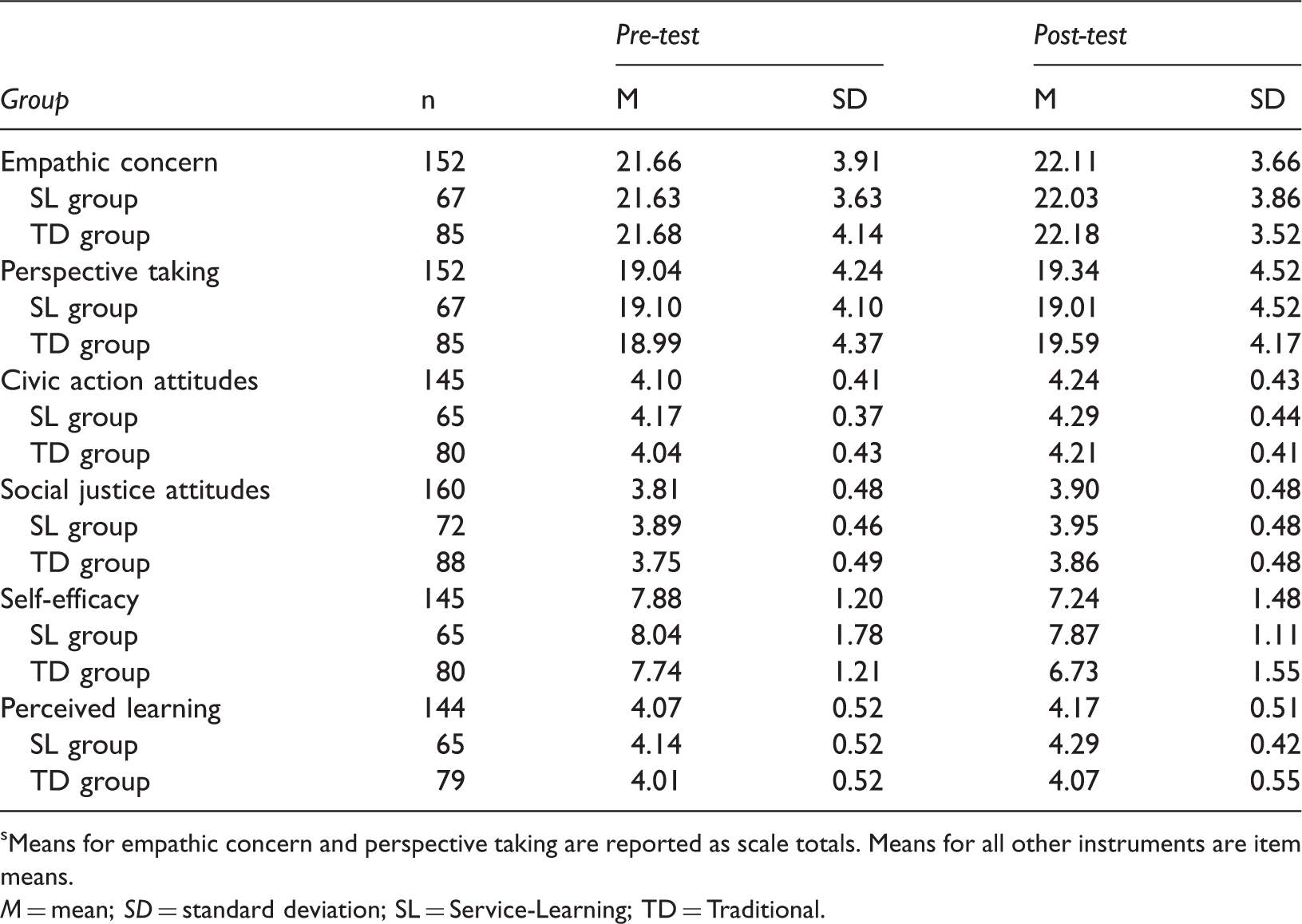
Means for empathic concern and perspective taking are reported as scale totals. Means for all other instruments are item means.
M = mean; SD = standard deviation; SL = Service-Learning; TD = Traditional.
Correlations among Dependent Variables for Combined Sample
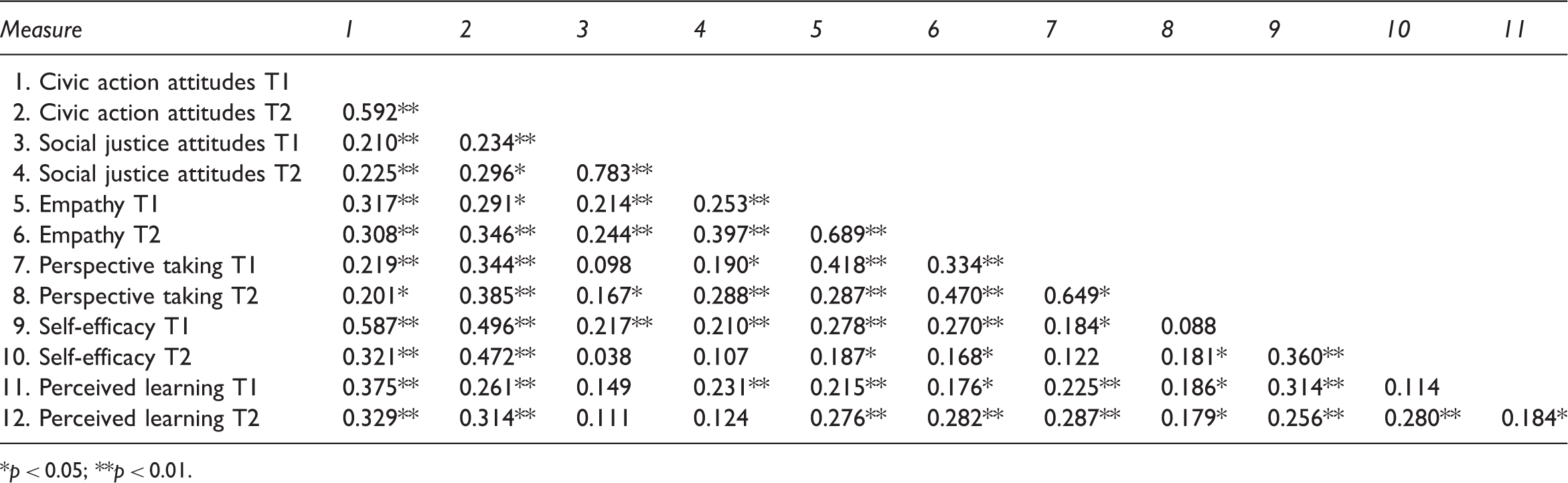
p < 0.05; **p < 0.01.
First, we ran a MANOVA with civic action attitudes and self-efficacy for community service as dependent variables. The multivariate test indicated significant main effects for time, V = 0.29, F(2, 142) = 29.16, p < 0.001, ηp2 = 0.29, and type of course, V = 0.11, F(2, 142) = 8.69, p < 0.001, ηp2 = 0.11, and a significant interaction of time and type of course, V = 0.90, F(2, 142) = 7.04, p = 0.001, ηp2 = 0.09. Univariate tests indicated a significant interaction of group and time for student self-efficacy for community service, F(1, 143) = 11.44, p = 0.001, ηp2 = 0.07. Examining the graph of marginal means revealed that students in the service-learning group remained relatively stable in their self-efficacy from pre- to post-test, whereas students in the traditional pedagogy group significantly decreased from pre- to post-test. In addition, univariate tests indicated a significant change over time in civic action attitudes, F(1, 143) = 19.23, p < 0.001, ηp2 = 0.12, indicating that both groups increased in their attitude toward civic action. All other univariate tests were nonsignificant.
A second MANOVA examined empathy and perspective taking as dependent variables. The multivariate test indicated no significant main effects or interactions. Next, we ran an ANOVA with social justice attitudes as the dependent variable. There was a main effect for time, V = 0.06, F(1, 158) = 10.85, p = 0.001, ηp2 = 0.06, indicating that both groups increased in their social justice attitudes over time, but no main effect of group or interaction effect. Finally, we ran an ANOVA with perceived learning as the dependent variable. There was a main effect for group, F(1, 142) = 6.95, p = 0.009, ηp2 = 0.05, but no main effect of time or interaction effect, indicating that the service-learning group consistently reported higher levels of perceived learning; however, their change in this perception was not significantly larger in comparison to the traditional pedagogy group.
Discussion
This study assessed changes in personal, social, citizenship, and academic outcomes of intergenerational service-learning in comparison to traditional pedagogy. While there were no significant group differences across time in the domains of social, citizenship, or academic outcomes, service-learning outperformed traditional pedagogy in the domain of personal outcomes. Specifically, at post-test, students’ self-reported self-efficacy for making a meaningful contribution to a community through service remained unchanged in the service-learning group, but was significantly lower in the traditional pedagogy group when compared to pre-test. This suggests that service-learning may have assisted students in maintaining their level of self-efficacy across the semester.
Several previous studies have reported similar results in the domain of personal outcomes (Fleck, Hussey, & Rutledge-Ellison, 2017; Knapp, Fisher, & Leveseque-Bristol, 2010; Reeb et al., 1998). For example, Reeb et al. (1998) indicated that a service-learning group did not endorse a significant increase in self-efficacy from pre-semester to post-semester, but instead maintained a high level of self-efficacy. Fleck et al. (2017) found no significant post-test differences between students enrolled in service-learning and traditional pedagogy sections of a developmental research course when using a modified version of the CSSES (i.e., used the term “community engaged research” rather than “community service”). The authors attributed the lack of differences, in part, to the students’ older age and increased life experiences, which might have contributed to higher scores at the outset. Students in our study scored even higher than students in the study of Fleck et al. (2017), indicating preexisting high levels of self-efficacy for community service, which may have left little room for improvement. In another study, Knapp et al. (2010) also reported that expected gains in self-efficacy did not occur after students participated in service-learning. The authors identified students being engaged in shorter service-learning experiences that required fewer service-learning hours as contributing to the unexpected results. Similarly, the shorter service-learning experience could have contributed to lack of improvement in the current study. Finally, Gerholz, Liszt, and Klingsieck (2018) used a mixed methods approach to explore self-efficacy in German business students who engaged in service-learning. The authors identified students’ experience of social support from the charitable organizations they served and their peers as contributing to the intensity of change in self-efficacy. Additionally, students perceived themselves to be more self-efficacious if they saw their knowledge and skills working in the community. Thus, in the current study, if students did not feel well supported and/or were not able to see a positive impact on the community they served, then they may not have experienced increased self-efficacy.
Other studies have found a decrease in constructs similar to self-efficacy after students participated in service learning. For example, Miller (1997) found that students who participated in community service-learning courses reported a decreased sense of power to make a difference in the world, which might have reflected a more general decrease in their sense of power due to maturation through college. Similarly, Osborne, Hammerich, and Hensley (1998) reported decreased global self-esteem among pharmacy students who were involved in service-learning, which was significantly lower than students who were involved in a laboratory project. The authors indicated that the service-learning students may have developed a more realistic evaluation of their worth at post-test. Therefore, our finding that the service-learning group remained stable in self-efficacy while the traditional pedagogy group decreased is encouraging. It could be that while the traditional pedagogy group experienced a developmentally normative decrease in their sense of power, the service-learning group maintained an optimistic sense of efficacy because they were able to see themselves making a difference through their service-learning project.
Although our findings might suggest group differences in our academic variable, perceived learning, with students in the service-learning group consistently scoring higher in perceived learning than students in the traditional pedagogy group, there was not a significant difference in how the groups changed over time. However, the graph of perceived learning marginal means suggests that there may be an interaction effect that was not captured in the current study, but may be apparent in a study with a larger sample size. Future, higher-powered studies may find that students in service-learning courses significantly increase in perceived learning, while traditional pedagogy students remain stable, although the effect size is likely to be small.
Students in a study by Hébert and Hauf (2015) also did not exhibit a significant increase in academic development. The authors suggested that academic development that occurs in service-learning may be inadequately assessed by methods usually used. While subjective measures of academic outcomes (e.g., self-reports or perceived learning) are common, a meta-analysis suggests larger effect sizes for studies with objective measures of academic outcomes (e.g., test grades, GPA, or objective assessment of student papers; Yorio & Ye, 2012). In contrast, another meta-analysis by Warren (2012) did not find significant differences between measures of self-reported learning and concrete measures of learning. The measure used in the current study assesses whether students believe that assigned readings and course requirements that extend beyond class participation assist them in learning and is a subjective measure of learning. This measure may not have been the best instrument to examine change in the academic domain as students may have underestimated their learning (Yorio & Ye, 2012). Future researchers might gather data from multiple sources to combine objective and subjective assessment of student learning.
In contrast to previous studies, we did not find that service-learning was associated with improved social or citizenship outcomes compared to the control group (Lundy, 2007; Roodin et al., 2013). In their cross-temporal meta-analysis, Konrath, O’Brien, and Hsing (2011) found that perspective taking and empathic concern declined among US college students from 1979 to 2009 and will likely continue to decline over time. However, students in the current sample endorsed higher levels of perspective taking at pre- and post-test compared to both men and women in the normative sample (Davis, 1980). This may suggest that students in our sample already had a high level of empathy and perspective taking compared to the average student today, leaving less room for service-learning to have an impact.
Overall, the results of the current study provide minimal support for the use of intergenerational service-learning. Of the six outcomes we examined, service-learning students only outperformed the traditional pedagogy group on self-efficacy, which is in the domain of personal outcomes. There were no significant group differences over time in the five outcomes examined across the domains of social, citizenship, or academic outcomes. There are three reasons that the current study may have found less positive outcomes than many previous studies of service-learning.
First, it is possible that the “dose” of service-learning provided to students in the current study was insufficient to produce greater changes within the service-learning group. Astin and Sax (1998) reported that the more time that was devoted to service, the more positive the effect on the students. Likewise, Mabry (1998) indicated that service-learning was more effective when students provided at least 15–20 h of service. Conversely, in a meta-analysis, Conway et al. (2009) did not find a larger number of service hours or longer service duration were related to a larger effect of service-learning. Consequently, the literature does not unequivocally support the idea that more service-learning hours result in greater positive effects on students.
Second, as previously noted, it is also possible that there was a ceiling effect for several of the outcomes we assessed, which may be related to characteristics of our sample. The high pre-test levels of self-efficacy for community service, empathy, and perspective taking, as well as the increase in civic action and social justice attitudes displayed by both groups, might be explained by our participants’ Jesuit Catholic education. Jesuit schools not only aim to instill values such as solidarity and service as part of the educational experience of all students, but also tends to attract students who already hold these values. Consistent with these values, Jesuit schools emphasizes the importance of community service and provide students with many opportunities to volunteer. This is a confounding factor that may limit the external validity of our study. However, there are 28 Jesuit colleges and universities in the USA and approximately 189 worldwide. Hence, the results may be most applicable to the extensive worldwide network of Jesuit higher educational institutions and institutions that maintain a similar mission. Future researchers at such universities and those comparing several different types of universities might help assess whether service learning is as beneficial in contexts such as Jesuit schools that already include a prominent focus on service throughout the educational and co-curricular experience. It may be that students at other types of colleges and universities have more room for growth in the personal, social, and citizenship outcomes we examined.
Third, it is also possible that the increased methodological rigor used in this study resulted in less positive outcomes than less rigorous studies. The service-learning students significantly improved on three of our six outcomes (self-efficacy, civic action attitudes, and social justice attitudes), but the traditional pedagogy group also improved on two of the outcomes (civic action attitudes and social justice attitudes). Without this control group, we would have been much more excited about our finding that service-learning students increased in their attitudes towards civic action and social justice. Thus, the quasi-experimental nature of our study allowed us to properly temper our enthusiasm.
Eyler and Giles (1999) posed a key question about whether the considerable effort required to arrange and use service-learning is worthwhile intellectually. They stated that a deeper understanding and application of information might be two of the most important ways service-learning differs from traditional coursework. While our results suggest that for the Jesuit university students in our sample the benefits of service-learning were minimal, we argue that they are still important and worth the effort. The theory of planned behavior (Ajzen, 1991) suggests that a positive attitude towards a behavior is not in and of itself enough; the individual must also feel efficacious. Thus, students who have positive attitudes towards civic engagement and a strong sense of self-efficacy to engage in community service (a pattern seen in our service-learning students) may be more likely to actually engage in community service in the future. On the other hand, students who have a positive attitude towards citizenship, but lose their self-efficacy over time (a pattern seen in our traditional pedagogy group), may become less likely to get involved.
Although the current methodology improved on weaknesses of previous research, several limitations remain. In addition to those limitations already mentioned, the quasi-experimental design limits our ability to infer causation. Although students from two courses participated, only one university was represented and the sample reflected limited racial diversity; this limits the generalizability of the results. All instruments were self-report measures, which could have resulted in response bias and only reflects the students’ perception of their experiences. Likewise, it is possible that these students were responding to a demand characteristic because the purpose of the study was clear from the informed consent materials. Finally, we used retrospective versions of the CSSES and CLS at post-test; it is possible that the pre- and post-test versions of the scales measure different constructs.
Utilizing a longitudinal research design, future research should assess whether psychology service-learning students engage in more community service or are more civically engaged distally. As previously mentioned, the sample hampered some implications of this study. Hence, researchers conducting future studies should utilize a larger and more racially diverse sample attending diverse types of higher education institutions. Finally, future researchers should employ non-self-report measures, including assessing student outcomes from other perspectives (e.g., faculty, community members).
In conclusion, this study examined student outcomes of participating in a semester-long, intergenerational service-learning course compared to a traditional pedagogy course. Our results indicated that service-learning students outperformed traditional pedagogy students in the domain of personal outcomes, while both groups improved in citizenship outcomes. With regard to personal outcomes, we found that from pre-test to post-test, self-efficacy for community service remained unchanged for the service-learning group, but decreased for the traditional pedagogy group. Our findings suggest that engaging in service-learning assisted students in maintaining self-efficacy for community service over the semester. Although the benefits of service-learning suggested by our results are not as numerous or encouraging as those found in some previous studies, our study suggests that service learning may contribute to achieving APA’s (2013) Learning Goal 3, Ethical and Social Responsibility in a Diverse World. Specifically, a foundational indicator for this goal is that students accept the opportunity to serve others through civic engagement, including volunteer service. Higher self-efficacy combined with positive attitudes about civic action and social justice (i.e., citizenship) may result in greater future civic engagement among students who engaged in service-learning compared to students who did not. Thus, our results support the continued use of intergenerational service-learning in undergraduate psychology classes as a way to promote APA’s goal of creating ethically and socially responsible psychology students.
Footnotes
Acknowledgements
The authors gratefully acknowledge the following individuals who assisted with the data collection for this study: Stephen Fritsch, PsyD,Janet Schultz, PhD, ABPP, Tammy Sonnentag, PhD, and Amanda Trice, PsyD.
Declaration of Conflicting Interests
The author(s) declared no potential conflicts of interest with respect to the research, authorship, and/or publication of this article.
Funding
The author(s) received no financial support for the research, authorship, and/or publication of this article.