



Abstract
An innovative learning partnership took place between undergraduates in an educational psychology course and fifth graders at a local elementary school. The goals for the partnership were: (a) to use videoconferencing to provide educational psychology students with a window into a live classroom, thus allowing opportunities to see theories and principles in action; (b) to give fifth graders opportunities to experience videoconferencing, to practice presentation skills, and to observe a university environment; and (c) to create a model for a videoconference-based collaboration between a K-12 teacher and an educational psychology professor that could be replicated by others. Videoconferencing offers an affordable strategy for bridging theory and practice, as well as promoting collaborative learning communities between K-12 schools and universities.
Keywords
Educational psychology professors often seek opportunities for students to apply course concepts to real-world settings. Constructivist perspectives encourage these efforts, as they highlight the need for education students to both build a knowledge base of the science of teaching and to apply and interpret that knowledge through practice (Faircloth, He, & Higgins, 2011). An ideal combination of theory, research and practice equips students with an “arsenal of tools and the expertise to apply those tools in the right way and at the right time in different circumstances” (Commander, Ward, & Zabrucky, 2012, p. 395).
The theoretical rationale for providing educational psychology students with numerous opportunities to bridge theory and practice is robust. Specifically, students benefit from having experiences where they can observe theories unfold in real-life. From a situated cognition framework, this “authentic learning” positions students as apprentices to the expert teachers whom they see working in real classrooms (Ryan, Carrington, Selva, & Healy, 2009). In line with Bandura’s (1986) social cognitive theory, the students can learn how to connect theory to practice from observing teacher models. That is, when they “are presented with a classroom narrative, video or animation modeling how an expert teacher applies principles of learning to her classroom, they will be more likely to imitate the displayed behaviors in the future” (Moreno & Ortegano-Layne, 2008, p. 452). Also, when students elaborate new ideas—i.e., extend meaning by connecting new information to existing knowledge—they deepen their understanding and increase the likelihood of effective retrieval of those ideas (Woolfolk, 2016). Theories of experiential learning and dynamic memory suggest that when students are presented with real-world examples of concepts and principles, they integrate the observed classroom behaviors and the previously encoded theoretical knowledge. As a result of this pairing, students are more likely to transfer and apply the principles to new classroom scenarios than they would be if the theoretical concepts were taught without authentic examples. Essentially, familiar examples serve as models that can be relied upon in future situations (Moreno & Ortegano-Layne, 2008).
A variety of instructional strategies have been used to connect theory and practice in educational psychology courses, including assigning a school-based action research project (Deemer, 2009), encouraging students to participate in service learning in schools (Faircloth, He, & Higgins 2011), and showing videotaped classrooms during the course (Moreno & Ortegano-Layne, 2008). Notably, technological advancements have made live videoconferences an affordable strategy for giving undergraduates opportunities to apply concepts to real-world educational settings. Computers with internet access, a web camera, and free videoconference software are all that is required to allow for videoconferences to take place between university and K-12 classrooms.
Videoconferencing is considered to be one of the most interactive modes of online learning, as it requires the participants’ real-time physical presence to communicate with others at distant sites (Newman, Falco, Silverman, & Barbanell, 2008). During a videoconference, two or more people at different locations can see and hear each other at the same time. Videoconferencing has been defined as “an interactive instruction method where a classroom is transmitted by an integrated system of video, audio, and/or computer signals to more than one location” (Havice & Chang, 2002, pp. 76–77). Six different types of videoconferences, each with their own unique interaction patterns, have been described in the K-12 education literature. In provider-based point-to-point videoconferencing, an external expert communicates with a single classroom. In collaborative classroom videoconferencing, two classrooms in distinct geographic locations videoconference in order to share resources or activities. Multi-point videoconferencing describes videoconferences where three or more sites communicate simultaneously. The fourth type consists of electronic field trips, whereby a class is able to videoconference with a non-classroom setting, such as a museum. Homebound videoconferencing accommodates students who are unable to access the school or classroom (e.g., due to disability or illness). Finally, a one-to-one connection type of videoconference involves a single learner connecting with an expert, perhaps for academic support or research purposes (Newman et al., 2008). In this project, collaborative classroom videoconferencing was employed.
In higher education, videoconferencing is often used for distance learning (Gillies, 2008; Havice & Chang, 2002; Pitcher, Davidson, & Goldfinch, 2000). Offering lecture courses to students in multiple locations via videoconferencing can provide significant cost savings to both universities and students. Professors have also used Skype to provide virtual instructor support (“office hours”) to college students (Charron & Raschke, 2014).
Our work supports the view that videoconferencing itself can be a powerful instructional tool for helping higher education students connect theory and practice in meaningful ways. For example, in the undergraduate training of nurses, interactive videoconferencing has been used to bring in the practical aspects of electrocardiography (ECG) from a nursing skills lab to a college classroom where the professor facilitated theoretical connections (Celikkan, Senuzan, Sari, & Sahin, 2013). Notably, much of the research that has been carried out on videoconferencing in education has related to pre-service teacher preparation. Kent (2007) conducted a pilot study in which pre-service teachers learned about lesson planning and then, through videoconferencing, observed a teacher as she taught a lesson. Similarly, Barnett, Truesdell, Kenyon, & Mike (2008) reported on a teacher education program that used videoconferencing to link a college class with an urban school. Specifically, pre-service teachers observed an urban teacher conducting lessons on literacy and then had an opportunity to reflect on the lesson through a videoconference-based conversation with the urban teacher. In yet another study, Knowlton & Chaffin (2007) explored the use of interactive videoconferencing to prepare pre-service special education teachers.
The current project extends the existing literature on videoconferences in education in a number of ways. First, our approach is unique in that an elementary school teacher and an educational psychology professor collaborated intensively in the planning and design of each videoconference. Essentially, a learning partnership was forged between the elementary school and the university. In viewing the project as a partnership, we intended to create educational benefits for the fifth graders as well as the undergraduates.
The specific goals for our learning partnership were as follows: (a) to use videoconferencing technology to provide educational psychology students with a “window” into a live classroom, thus allowing opportunities to see theories and principles in action; and (b) to give fifth graders opportunities to experience videoconferencing technology, to practice presentation and communication skills, and to observe a university classroom environment; and (c) to create a model for a videoconference-based collaboration between a K-12 teacher and an educational psychology professor that could be replicated by other educators. While in pursuit of these goals, we also collected data to address the following research questions.
How would undergraduates perceive the impact of participation in videoconferences and discussion boards on their own course engagement and learning? Would undergraduates who participate in videoconferences provide higher ratings of their course engagement and learning, as well as higher course evaluation ratings, than undergraduates who did not participate in videoconferences? How would elementary school students and the class teacher and professor rate their experience of participating in the videoconference partnership? Would they realize benefits as well as the undergraduates?
Method
Participants
Participants included university undergraduates and a class of fifth graders. One section of educational psychology (n = 35) participated in videoconferences with the fifth-grade class and/or their fifth-grade teacher during the semester, while a comparison section of educational psychology (n = 36) did not take part in the videoconferencing partnership. Both classes included a combination of sophomores (videoconference n = 2, comparison n = 4), juniors (videoconference n = 25, comparison n = 14), and seniors (videoconference n = 8, comparison n = 18). Additionally, both sections enrolled Business majors (videoconference n = 27, comparison n = 22), Applied Psychology majors (videoconference n = 2, comparison n = 8) and “other” Arts and Sciences majors (videoconference n = 6, comparison n = 6). The fifth graders (n = 18) and their teacher were from a public elementary school in the same suburban town as the university.
Course Background
The two sections of the educational psychology course were taught by the same professor (the first author) during the same 14-week semester. The course is an applied psychology elective offered by the Department of Applied Psychology within the College of Arts and Sciences at a private regional university that also includes a College of Business. The university does not have a teacher education program.
The two educational psychology sections (videoconference and comparison) were matched on as many dimensions as possible. Both sections were taught in the same classroom on Mondays, Wednesdays, and Fridays for 50-minute class sessions. The videoconference section met at 1:00 pm and the comparison section met at 12:00 pm. The 1:00 pm section was chosen to participate in the videoconference program because the fifth-grade class was not available during the 12:00 time slot. All students enrolled in both sections had taken Introduction to Psychology as a prerequisite.
The instructional format for both class sections included a mix of interactive PowerPoint lectures, class discussions, and small group learning activities. In addition, 15–20 minute excerpts (or multi-scene “mashups”) from two documentaries and eight popular films (e.g., The Karate Kid, Good Will Hunting, Spellbound) were shown on the same dates throughout both course sections to illustrate course concepts and to serve as a springboard for class discussion (See Butler & Weber, 2016). Students worked in pairs or small groups to complete application exercises following the film excerpts. Class PowerPoint presentations were designed as “instructor versions” and “student versions.” Student versions of PowerPoint slides were posted on the course website before class and were skeletal versions of the complete “instructor versions” that the professor displayed during class lectures. The purpose of providing student versions before class was to provide an advance organizer for the content and to provide structure for note-taking. Students were encouraged to interpret and synthesize important points and examples from the lecture and record those in their own words on PowerPoint handouts (printed at home).
The syllabi for both sections were the same except in the sections of the document where videoconferencing was either mentioned or not included. Course topics, concepts covered, and assigned readings were identical. Both sections covered theories of learning and motivation, developmental characteristics of learners, individual differences, teacher behavior, assessment, and sociocultural influences on learning and schooling. Students in both classes completed a comprehensive lesson plan project, and took quizzes and two exams that were similar, but not identical. The videoconference section syllabus listed an additional course objective, indicated dates when the videoconferences were scheduled, and described an additional assignment—contributing to a discussion board following each videoconference. In the videoconference class, videoconference-related discussion board posts were scored pass/fail and counted toward 5% of the final course grade, while attendance and participation comprised an additional 5%. In the comparison class, attendance and participation counted toward 10% of their final course grade.
Four course objectives framed both sections of Educational Psychology, and a fifth objective was added for the videoconference section: (1) Students will gain and demonstrate understanding of psychological theory and research that has direct implications for educational practice; (2) Students will think critically as they analyze and evaluate research and theories; (3) Students will apply psychological theories and research to popular films that are relevant to educational psychology; (4) Students will use their understanding of teaching and learning to construct a teacher’s lesson plan that is informed by readings and research presented in the course; (5) Videoconference group only: Students will apply psychological theories and research to real-time lessons and discussions with a local fifth-grade class and teacher via videoconferencing.
Videoconference-Based Instructional Program
Collaborative classroom videoconferencing—whereby two classrooms in distinct geographic locations videoconference in order to share activities—was employed, although the precise nature and format of each videoconference was unique (Newman et al., 2008). Five pre-planned videoconferences took place over four months. Skype was the free software application used to conduct the videoconferences over the internet, and Camtasia software allowed the videoconferences to be recorded. Instructional technology professionals from the university and public school district coordinated the technical details of each session.
The fifth-grade teacher and the educational psychology professor met regularly to design the activities and format for each videoconference. The themes for the five videoconferences directly related to educational psychology learning objectives and were: (a) Vygotsky’s Sociocultural Theory; (b) Social and Moral Development; (c) Information Processing/Memory; (d) Educational Policy; and (e) Motivation. The themes were chosen following multiple brainstorming sessions between the professor and teacher where they looked for points of overlap between the fifth-grade curriculum and activities, the teacher’s instructional style and expertise, and topics and themes typically covered in an educational psychology course. During each videoconference, educational psychology students took notes on observations or comments that illustrated course concepts.
In the first videoconference, educational psychology students observed two parts of a fifth-grade language arts lesson related to the novel Tuck Everlasting. To prepare, the college students read about Vygotsky’s sociocultural theory in their textbook (Woolfolk, 2016) and attended a day of class that focused on Vygotsky’s contributions. In Part I of the videoconference, the fifth graders met in a circle with their teacher to engage a discussion about themes and motifs in the novel. Each student came to the circle with his/her own ideas about the novel’s themes written on a handout. The teacher used a Vygotskian approach to facilitate a whole class discussion about the themes that the students extracted from the novel. The educational psychology students had the opportunity to see the Vygotskian concepts of intersubjectivity, scaffolding, and zone of proximal development applied in the teacher-facilitated class discussion. In Part II, the fifth graders worked back at their desks in small, mixed-ability groups on a character development activity. Each small group was instructed to work together to decorate a poster using images and words that convey five specific character traits of their assigned character. The students were talking to others in their group to negotiate their ideas and to ultimately agree on which final five character traits should be included on the poster. Here again, educational psychology students were able to apply Vygotskian concepts to the group work, discussion, and teacher feedback that they observed.
The second videoconference was also comprised of two parts. In the first half of the session, educational psychology students asked fifth graders questions regarding friendship, peer relations, school, and family. The questions had been generated by the students in advance and were inspired by their reading of a textbook chapter focused on self, social, and moral development (Woolfolk, 2016). After screening by school personnel, a final list of 25 questions was compiled and grouped by theme (personal/moral, school, friendship/peer relations, family). Some questions on the list included: What does it mean to be a good friend? Do you think it is ok to break the rules every once in a while? How might someone get bullied online? Most students in the educational psychology class were assigned a specific question to ask during the live videoconference interview. Over week leading up to the conference, the fifth-grade teacher assigned each student in her class three interview questions to answer in writing. Then, during the live videoconference, a structured interview took place in which 25 undergraduates each came up to a microphone, read their assigned question to the class, and then the fifth graders came up one at a time to share their responses. Following the interview, the educational psychology professor presented a modified version of a classic Kohlberg moral dilemma to the fifth graders and asked them follow-up questions. Fifth graders raised their hands and spontaneously answered the professor’s questions, thus providing an opportunity for the educational psychology students to consider evidence of the fifth graders’ levels of moral reasoning.
The third videoconference focused on information processing. The undergraduates had completed textbook readings and attended two classes focused on information processing in preparation for the conference. The fifth-grade teacher assigned her students the task of preparing short oral and visual presentations on a variety of games and activities they do in school (e.g., Bingo, Sparkle, illustrating mathematics problems) to solidify their understanding of important concepts. In Part I of this videoconference, fifth-grade students came up to the microphone and shared their short presentations. Seeing and hearing about classroom strategies to promote retention of important ideas provided applications of the information-processing model for the college students. In Part II, the educational psychology professor used the Groupboard application (a virtual shared whiteboard) on a touch-screen tablet to run memory exercises with the fifth graders. Both the fifth-grade classroom and the college classroom were equipped with tablets, and they were both connected to the projectors and Skype. This technology allowed students and teachers in both settings to write on their respective tablets but contribute to the same virtual whiteboard. Using the tablet and Groupboard application made it possible for the educational psychology professor to run digit-span exercises with the fifth graders, whereby the professor could list digits on the whiteboard, shake the tablet to erase them, and then invite fifth graders to come up and write them from memory on the tablet in their classroom. During this portion of the videoconference, the professor involved the fifth graders in a variety of digit-span exercises, including presenting a phone number. This allowed the professor to introduce the concepts of chunking and the capacity of working memory to the fifth graders. Simultaneously, educational psychology students were able to see the fifth graders applying specific memorization strategies during these exercises, and they had an opportunity to analyze the developmental aspects of information processing.
The fourth videoconference took the form of a live interview of the fifth-grade teacher by the educational psychology undergraduates. The fifth-grade students were not present. To prepare for this conference, Psychology students were asked to generate two questions each for the teacher inspired by recent course discussions on policy and assessment. Then, spontaneously, undergraduates came up to the microphone one at a time to ask their questions. During the interview, the fifth-grade teacher shared her opinions regarding current educational policy, standardized testing, teacher evaluation procedures, and the tenure process in K-12 education.
The last videoconference focused on motivation and was comprised of three parts. The conference began with the educational psychology students asking the fifth graders to discuss their most and least favorite school subjects and projects they have completed. There were also questions regarding how their parents and teachers help them when they are having trouble completing something or doing their best work. This list was compiled during a whole class discussion in the educational psychology class the week leading up to the conference. In Part II, the undergraduates observed as the fifth-grade teacher encouraged a discussion with her class about an incentive-based program (“challenge”) she was using in language arts to encourage students’ learning of 25 new vocabulary words. The undergraduates listened in as the teacher asked her students to discuss the challenge, and why there was initial interest but motivation seemed to dwindle, and ultimately, after many weeks, still no one had accomplished the 25-word goal. The fifth graders shared insights about their degree of motivation for the challenge and contemplated why a number of them had gradually lost interest. Finally, in Part III, the fifth-grade teacher spoke privately to the educational psychology class about an anonymous former student who was not having basic needs met at home, which created a barrier to academic motivation and learning in school. The educational psychology students were able to consider this example in light of Maslow’s hierarchy of needs.
At the end of the school year, undergraduates from the videoconference class, the educational psychology professor, and the school district superintendent visited the elementary school to present certificates of recognition to the fifth-grade class in person.
Comparison Class Tasks
In place of the videoconferences, the comparison class engaged in a learning activity, whole class discussion, or small group application exercise on the same topic addressed by the videoconferences. First, when the videoconference class was watching the teacher execute a Vygotskian lesson plan, the comparison class was working in teams to design a Vygotskian lesson themselves. Then, when the videoconference class was interviewing the fifth graders about topics related to peer relations, self-concept, and bullying, and facilitating discussion of a moral dilemma, the comparison class watched and discussed video clips (textbook publisher videos) of children discussing peer relations and friendship. Then they answered questions about the same Kohlberg dilemma that the videoconference class had presented to the fifth graders. Next, when the videoconference class had an information-processing themed videoconference, the comparison class played memory games that illustrate the benefits of memory-strategy use. As the videoconference class interviewed the fifth-grade teacher about her views of educational policies, the comparison class engaged in whole class discussion (in response to prompts) and shared their opinions on the same issues (teacher evaluation, qualities of effective teachers, tenure, failing schools). Lastly, in place of the videoconference on motivation, students in the comparison class worked in teams to review and discuss case studies that tapped into concepts and theories of motivation.
Data Sources
We were interested in assessing the impact of the videoconferences on the undergraduates (videoconference group versus comparison group), the fifth graders, and the two educators (professor and classroom teacher). As such, data were gathered from each of these participant groups.
Undergraduates: Videoconference group
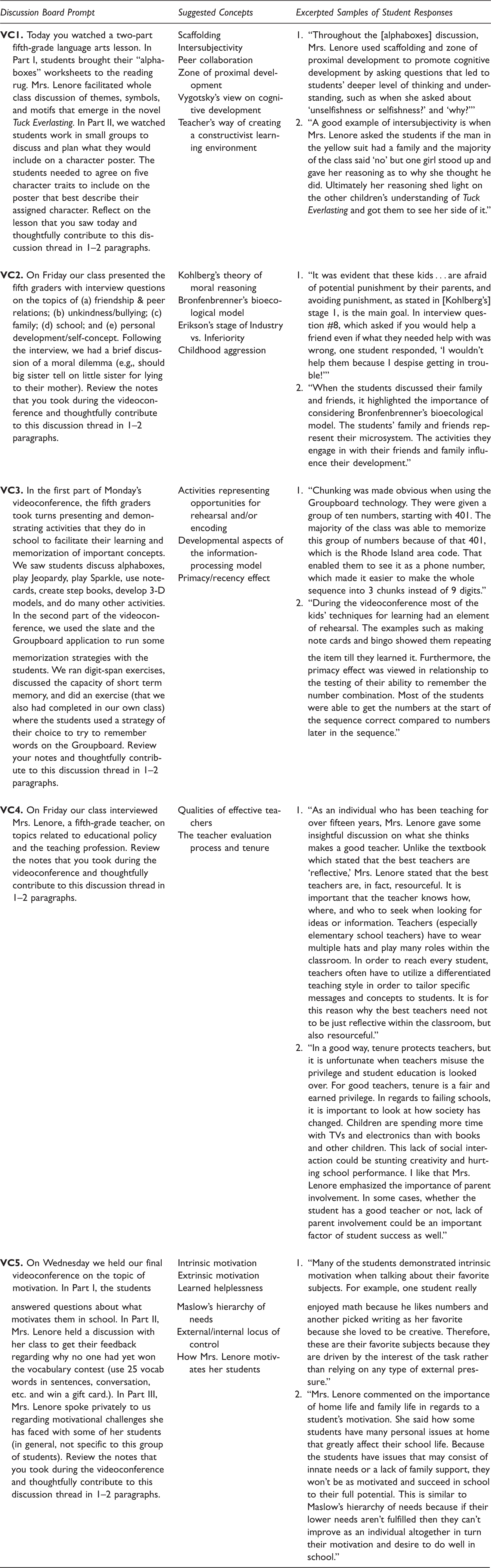
Discussion board prompts, suggested course concepts, and sample student responses for each of five videoconferences
In addition, these students completed a brief, four-item online survey following each videoconference. The first item assessed students’ perceptions of the extent to which the videoconference made them feel engaged in the course. The second item assessed students’ perceptions of the extent to which the videoconference impacted their learning of certain course concepts. The third and fourth items also related to students’ engagement and learning, except that they were asked to consider the extent to which contributing to the discussion board (after the videoconference) impacted their engagement and learning, respectively. Participants rated all four items on a 5-point Likert scale ranging from 5 (strongly agree) to 1 (strongly disagree). The template for the videoconference engagement item was: “Participating in Videoconference [#], where we [insert description of videoconference activities], helped me to feel more engaged in the educational psychology course.” The template for the videoconference learning survey item was: “Participating in Videoconference [#], where we [insert description of videoconference activities], helped me to learn more about [insert course concept or theory].” The engagement and learning items related to the discussion board followed a similar structure. Data from these four-item online surveys administered after each of the five videoconferences were combined to create average scores for videoconference engagement, videoconference learning, discussion board engagement, and discussion board learning.
Undergraduates: Videoconference group versus comparison group
Both sections completed global measures of engagement and perceived learning. Specifically, Handelsman, Briggs, Sullivan & Towler’s (2005) Student Course Engagement Questionnaire (SCEQ) (Appendix A) and an instructor-generated Perceptions of Learning (POL) measure (Appendix B) were administered in class at the conclusion of the course. The SCEQ lists 22 behaviors and asks the student to provide a rating for each on a scale of 1 (“not at all characteristic of me”) to 5 (“very characteristic of me”). Therefore, a total score on the SCEQ could range from 22–110. The POL lists 12 statements about students’ perceptions of their learning in the educational psychology course. Students are asked to indicate their agreement with each statement by providing a score of 1 (“strongly agree”) to 5 (“strongly disagree”). A total score on the POL measure could range from 12–60.
Students’ final course grades were recorded. The grades can range from A to F and align with the following 4-point scale: 4.0 (A); 3.7 (A−); 3.3 (B+); 3.0 (B); 2.7 (B−); 2.3 (C+); 2.0 (C); 1.7 (C−); 1.3 (D+); 1.0 (D); 0.0 (F). Course grades were comprised of scores on a course project (40%), exams (40%), quizzes (10%), and participation (10% for comparison class; 5% for videoconference class + additional 5% for discussion board posts).
University-sponsored course evaluation surveys were also given to both the videoconference and comparison sections of educational psychology at the end of the semester. The course evaluations include two global items that assess the course and the instructor’s teaching ability. Specifically, these two items read: (a) I have become more competent in this area due to this course; and (b) Rate the instructor’s teaching ability in this class. Students rated the first item on a 5-point Likert scale ranging from 5 (“strongly agree”) to 1 (“strongly disagree”) and the second item on a 5-point Likert scale ranging from 5 (“excellent”) to 1 (“poor”).
Fifth graders
At the conclusion of the program, fifth graders completed a survey about their experiences and what they learned as a result of the partnership. One item on the survey asked them to rate (1 “terrible” to 10 “excellent”) their experience participating in the videoconferencing project overall. For the remaining survey questions, students responded to questions about what they liked/disliked about the videoconferences, specific things they learned, and which specific session of the four that they participated in was their favorite.
Educators
Both the professor and the classroom teacher completed brief pre- and post-surveys. Before the first videoconference, they commented on their expectations/goals for the partnership, and at the end of the semester, they reflected on the benefits/challenges of the videoconferencing.
Results
Undergraduates: Videoconference group.
All students’ discussion board posts met the minimum criteria for a “pass,” in that they addressed the prompt, included two or more course concepts, and accurately related those concepts to specific examples from the videoconferences. Sample responses are shown in Table 1.
Mean ratings (out of 5), standard deviations, and effect sizes for videoconference and discussion board engagement and learning items with comparison to midpoint of the scales (3.00)

Note: ***p < .001
Undergraduates: Videoconference group versus comparison group
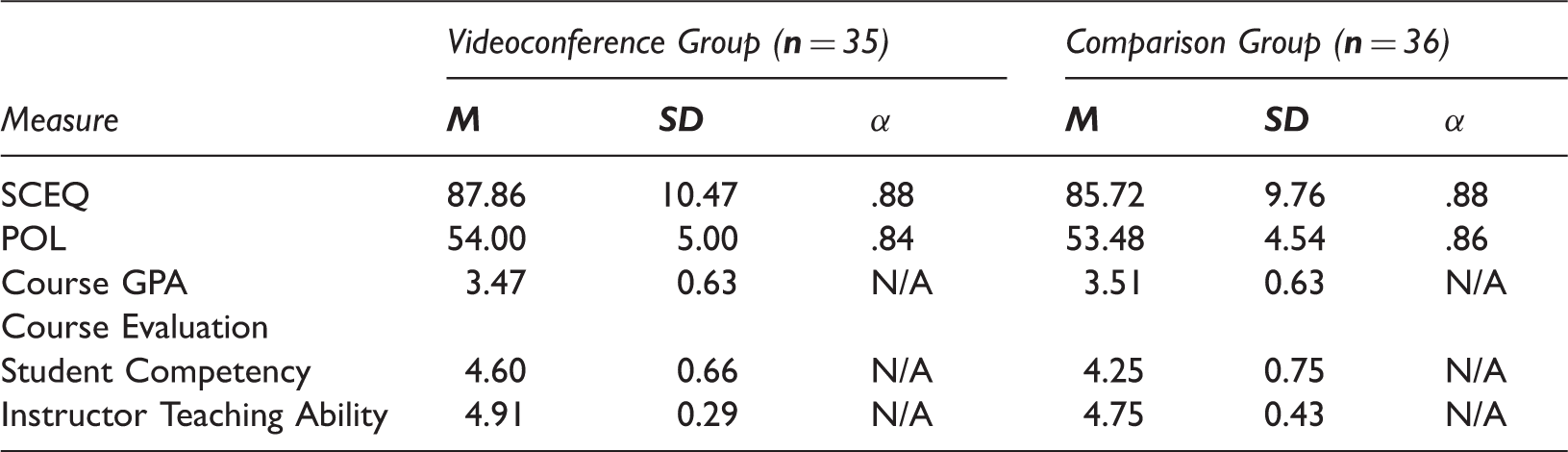
Course engagement means as measured by the Student Course Engagement Questionnaire (SCEQ) were high for both sections (videoconference M = 87.86, SD = 10.47; comparison M = 85.72, SD = 9.76), as were the student-reported perceptions of learning (POL) means (videoconference M = 54.00, SD = 5.00; comparison M = 53.48, SD = 4.54). Final course grade point averages were also strong across sections (videoconference M = 3.47, SD = 0.63; comparison M = 3.51, SD = .63). A one-way MANOVA run on SCEQ score, POL score, and final course grade point average showed no significant differences between the videoconference class and the comparison class, F(3, 57) = .30, p = .828.
Videoconference and comparison group means, standard deviations, and internal consistency values for the Student Course Engagement Questionnaire (SCEQ), Perceptions of Learning (POL) scale, course GPA, and course evaluations
Fifth graders
Fifth graders’ numerical ratings of their overall experience participating in the videoconference project were positive (M = 7.03, SD = 1.46). Fifth graders’ comments suggest that they most enjoyed the third videoconference because of the interactive nature of the memory exercises and the opportunity to use the Groupboard app. When asked about their experiences, 61% of the students chose memory games and activities for the session they liked participating in the most; 72% of the students stated they learned most about memory as a result of participation in this project, and 77% listed the memory session as the videoconference that was their favorite. Some fifth graders disliked preparing written work for the conferences and felt nervous during presentations. However, “presentation of knowledge and ideas” is one of the Common Core State Standards (CCSS) for Speaking and Listening at the fifth-grade level (Common Core State Standards Initiative, 2016).
Educators
The educators initially felt apprehensive about using videoconference technology because they were concerned about spontaneous technological mishaps. Both educators ultimately felt supported by technological specialists at their respective schools. Additionally, the educators felt that they experienced significant professional development as a result of the collaborative pedagogical experience and enjoyed taking part in a K-12/higher education partnership. The fifth-grade teacher commented that she enjoyed getting reacquainted with the learning theories and topics covered in her M.A.T. program, and she found it affirming to realize that her teaching methods aligned well with theoretical perspectives discussed in Educational Psychology. The professor in this study had formerly worked as a fifth-grade teacher, and she expressed enjoyment in having an opportunity to directly interact with the elementary school student population. Essentially, the partnership provided an opportunity for the professor to attend to the real-world applications of educational theories while also giving the elementary school teacher an opportunity to reflect on the theoretical underpinnings of her work.
Discussion
Our primary aims in creating a videoconference-based partnership between a fifth-grade class and a class of educational psychology undergraduates were: (a) to provide opportunities for educational psychology students to apply course material to real-world, real-time teaching and learning in an elementary classroom setting; (b) to foster fifth-grade participants’ communication and presentation skills, introduce them to a college class, and to give them experience with cutting-edge technology; and (c) to create a model for how videoconferencing can be used to connect an educational psychology class to a K-12 class and teacher in the future.
To measure our first objective, we required that all undergraduates in the videoconference section of educational psychology contribute to a discussion board following each conference. Although it proved difficult to code the narrative student responses in a detailed way, the undergraduates’ posts to the discussion thread did provide evidence that, overall, students were able to successfully connect course concepts to specific instances and comments that took place during the individual videoconferences. It was clear that the majority of students attended to very precise details from each conference, took notes, and could ultimately make meaningful linkages between their experience in the conferences and their understanding of educational psychology material.
To gain a broader perspective on how the videoconferencing impacted the experience of the educational psychology students, a number of additional measures related to students’ course engagement and perceived learning were utilized in the study. Students’ survey responses following the videoconferences reflected their opinion that participating in them contributed both to their high level of engagement in the course and to their learning of course material. Interestingly, students’ ratings of the value of the discussion board for engagement and learning were significantly lower than their ratings on the value of the videoconference itself.
It is not altogether surprising that undergraduates would prefer a multimedia videoconference to the more academic task of responding to a discussion board prompt. However, from a pedagogical perspective, we know that the discussion board activity was a critically important phase of the program, since this was the point at which the learners were required to construct their own understandings of how course concepts played out in a real-world educational setting. Education researchers suggest that providing students with opportunities for reflection is an effective way to facilitate students’ abilities to connect pedagogical theory and practice (Smith & Greene, 2013). Moreover, the process of students articulating their ideas in writing contributes in significant ways to developing their understanding (Oliver, 2000). While research on the use of discussion boards highlights additional benefits such as allowing students to learn from each other (Northover, 2002), in the case of this project, requiring students to write a short individual reflection/application paper after each videoconference might have been preferable to the discussion board post.
Since the professor was teaching two sections of educational psychology during a single semester, there was an opportunity to compare the videoconference section of the course with the comparison section. Even though the professor had an intuitive sense that students in the videoconference section were slightly more engaged than students in the comparison section, any differences that did exist were not robust enough to translate to the global measure of course engagement (SCEQ), the global measure of perceptions of student learning (POL), or the university-sponsored course evaluation items. As the means for these three measures were very high for both course sections, especially for the course evaluation items, we suspect that there may have been ceiling effects in play. Perhaps the addition of the videoconference component to an already engaging course that was frequently using popular film excerpts and other team-based activities to bridge theory and practice was not robust enough to reveal an additional strong effect on the dependent variables. If the comparison class was only taught using PowerPoint lectures or strict didactic methods, the results may have come out more strongly in favor of the videoconference class. Another possibility is that the scores were high across sections as a function of social desirability bias or a desire to please the instructor. But of course, we can only speculate as to the reasons why the means did not differ between sections.
A limitation of this research is the lack of other standardized, objective measures of student learning. Quizzes and exams could not serve as objective measures in this study because they were not identical across the two sections. The final course grade point averages were compared but did not reveal differences between the two sections. However, embedding direct measures of learning—in addition to or in place of a measure of students’ perceived learning—would have enhanced our examination of the impact of a videoconference-based instructional strategy on students’ understanding of how psychological concepts translate into real-world educational practice.
Our second program objective was to design videoconference-based experiences that would bring benefits to the fifth graders. Through preparing for and participating in the videoconferences, the elementary school students were able to practice oral, written, and communication, and the videoconferences may have been a valuable opportunity for students to improve their presentation skills (Common Core State Standards, 2016). In a future iteration of this program, it would be valuable to collect data to determine whether the experience of participating in the program lead to measurable improvement in the fifth graders’ presentation skills. Beyond addressing a CCSS, participation in the program gave students exposure to a college classroom environment. In addition, for many students, the opportunity to try out live videoconferencing and/or Groupboard technology was a new and exciting experience.
The third aim of this project was to document a collaborative model in enough detail that it could either be replicated by other educators or at least encourage additional K-12 and university educators to consider the benefits of a learning partnership that would suit their unique needs. Ultimately, this project entailed a complex learning partnership on multiple levels: between schools, educators, technology professionals, and students.
One of the unique features of our approach was the extent to which it was co-planned as opposed to being completely spontaneous (e.g., as in other videoconferences in education where students have observed a lesson taking place). For example, the idea to plan out interview questions in advance and to allow students to write out responses and then read them in front of the camera took some of the pressure off of both groups of students and provided the educators with a greater sense of control. With the approach suggested here, educators would include a mix of highly planned and structured interactions (e.g., the interview about friendship in Videoconference 2), authentic lessons that the undergraduates could observe from a distance (e.g., the Tuck Everlasting lesson in Videoconference 1), and some less structured, open-ended interactions (e.g., the interview of the fifth-grade teacher in Videoconference 5). From the perspective of the fifth graders, the most successful videoconference was the information-processing/memory session that allowed the elementary school students to interact firsthand with both the technology and the college professor. In the future, designing new videoconference-based lessons that allow both groups of students to be active participants is warranted.
This videoconference-based program was truly a collaborative partnership on a number of levels. The professor and teacher made a joint presentation about the videoconference-based partnership at the university’s annual Research and Engagement Day. Shortly thereafter, the school principal invited the professor and teacher to co-present the program at a school committee meeting in the district. Additionally, the success of the partnership relied on the collective expertise of the technology professionals from both institutions. It has been shown that the reliability of the technology and the availability of technical support are leading factors in the success of videoconferencing (Al-Kodmany, George, Marks, & Skach, 1999). These technology directors had not known each other previously but, as a result of this project, have now developed a professional rapport. The program closed with a visit by the educational psychology students, their professor, and the district superintendent to the fifth-grade classroom where the children were honored for their participation.
As the years go on, our hope is that these two educational institutions will continue to explore ways to support each other’s efforts to promote innovative, engaged, and meaningful learning for all students. The results from this project suggest that utilizing videoconferences to connect undergraduate educational psychology students and elementary school students may be a promising strategy for bridging theory and practice, as well as promoting collaborative learning communities between K-12 schools and universities.
Footnotes
Declaration of Conflicting Interests
The author(s) declared no potential conflicts of interest with respect to the research, authorship, and/or publication.
Funding
The author(s) received no financial support for the research, authorship, and/or publication of this article.