




Abstract
Psychology graduate students in the United States are expected to demonstrate competency in the history of psychology. Despite the topic’s importance, there are limited guidelines. The present study examined history and systems of psychology (HSP) course syllabi from American Psychological Association accredited Doctor of Psychology programs. Of those programs solicited (n = 62), 43.5% (n = 27) returned syllabi. Syllabus content was analyzed to develop a better understanding of when and how the course was taught. The HSP course was usually offered for three credits and was most often scheduled in the summer semester of a student’s third year of training. Most HSP courses used a lecture format and a textbook was the principal pedagogical resource; journal articles were often used as a supplemental resource. Primary sources and diversity-focused resources were used less frequently. The average syllabus had five learning objectives, although these objectives were rarely described in an observable and measurable manner. Objectives were rooted almost entirely in foundational competencies. Prevalent assessment methods included participation and exams. Nearly every course was organized chronologically. Frequent class topics included: behaviorism; functionalism; psychoanalysis; experimental psychology; and structuralism. There was little mention of historiography, major clinical psychology training conferences, or humanistic psychology.
The American Psychological Association (APA) (American Psychological Association, 2006) requires accredited doctoral programs to cover the history of psychology. Thus, psychology graduate students in the United States are expected to demonstrate a comprehensive understanding of the discipline’s history. Despite the topic’s importance, there are limited guidelines. According to the APA (American Psychological Association, 2015), an accredited program must instruct students in the origins and development of major ideas in psychology. The only other guideline is that neither a narrow subdiscipline history (e.g., neuropsychology) nor a specific knowledge or skill domain history (e.g., psychotherapy) fulfills the requirement (2015).
Additionally, current research papers or model syllabi that might inform instructors about course format or organization, optimal objectives, appropriate competency benchmarks, engaging content, or effective pedagogical techniques are minimal and inadequate. First, the PsychINFO database was reviewed. All English-language, peer reviewed journal articles published from January 2011 through December 2016 were searched using “history of psychology” and “teaching” as keywords. This date range captured contemporary research and the keywords were general terms a course instructor might use to gather current pedagogical information. The search generated five results: the history of psychology in Spanish psychology curricula (Chisvert-Perales, Monteagudo-Soto, & Mestre, 2016); teaching the “Lewinian links between social psychology and rehabilitation psychology” (Dunn, 2011); a survey of history of psychology teaching, research, and faculty positions in Canadian universities (Barnes & Greer, 2014); a brief report on using student presentations to aid the “historically challenged” instructor of a history of psychology course (Steirn, 2011); and how a story about “Victor the Wild Boy” of Aveyron was used as a teaching tool to increase student enthusiasm, enhance class engagement, and improve knowledge acquisition (Nawrot, 2014).
Expanding the date range to ten years (2006-2016) generated five additional results: a historiography of Czech psychology (Hoskovcová, Hoskovec, Plháková, Šebek, Švancara, & Vobořil, 2010); tips for teaching the Hawthorne studies (Olson, Hogan, & Santos, 2006); an assignment based on William James’ “automatic sweetheart” question (Sibicky, 2007); a critique of course instructors who are not trained in historiography (Henderson, 2006); and teaching psychology to university students in China (Zhang & Xu, 2006). Eliminating time constraints produced additional results: a special issue in History of Psychology dedicated to teaching the topic (Baker, 2002); using a pluralistic instructional approach (Dagenbach, 1999); incorporating critical thinking exercises (Henderson, 1995); a survey of syllabi for an undergraduate history and systems course (Hogan, Goshtasbpour, Laufer, & Haswell, 1998); brief ideas and activities for teaching the history of psychology (Landrum, 1992); and using personal-construct theory (Tobacyk, 1987). Finally, using the additional keyword “history and systems” for the same time frames produced similar results.
Next, the Society for the Teaching of Psychology (STP) and the Society for the History of Psychology (SHP) websites were searched for model history of psychology course syllabi. The STP website contained eight syllabi (seven undergraduate, one graduate). The SHP website contained seventeen syllabi (11 undergraduate, six graduate).
The available resources provide meager rations for a history of psychology course instructor. Many articles contain content that is either not pertinent or focuses on an idiosyncratic topic with limited pedagogical applicability. Furthermore, many articles are dated, brief, and/or anecdotal. Steirn’s (2011) advice for incorporating student presentations to alleviate the teaching burden upon the “historically challenged” instructor provides some sustenance, although it is little more than “common sense” that a novice instructor either could arrive at intuitively or would likely receive from a colleague, mentor, or more senior faculty member. Olson et al. (2006) provide some tips for teaching the Hawthorne effect (which occurs when individuals modify their behavior in response to being observed). While this might make for an interesting assignment, it is an idiosyncratic topic that lacks applicability. Nawrot’s (2014) and Sibicky’s (2007) articles are interesting in that they conducted pre- and post-course assessments for a history of psychology course and compared the results to a control group in which the special content was not used. They found that students exposed to the special content had higher ratings of overall knowledge and enthusiasm than the control group. While these authors are commended for studying assignment efficacy, the special content items (“Victor the Wild Boy” of Aveyron, William James’ automatic sweetheart) are highly idiosyncratic and do not represent major topics in psychology.
The model syllabi offer generic ideas regarding course format and organization, assignments, and pedagogical resources. However, certain issues limit the syllabi’s utility. Most syllabi focus on undergraduate courses. Most graduate course syllabi are dated and lack both clearly stated learning objectives (some lack any objectives) and appropriate competency benchmarks. One graduate course syllabus has only administrative content.
The present paper serves multiple purposes. First, it provides a clear snapshot of the present educational moment. Very little is known about teaching the history of psychology at the graduate level; thus, this paper offers a concise, contemporary summary of what instructors are doing in their courses. Next, this paper provides an empirical foundation upon which further research may be built: it generates baseline data and provides a scalable platform from which a more expansive inquiry could be undertaken across all doctoral-level clinical and counseling psychology programs. Additionally, a course instructor may field test in a classroom setting the resources, formats, objectives, assignments, competencies, and topics that are discussed in the paper. This may facilitate course design, pedagogical best practices, and instructor preparation. Finally, the paper serves as a “thought piece” that may stimulate broader discussions within the discipline about the history of psychology and how it might be taught. Should a core curriculum be established? What competencies should the course promote? When in the training sequence should the course occur? Such discussions could contribute to greater clarity and consistency in our understanding of the discipline’s history and how best to communicate this knowledge to subsequent generations.
Methods
Knowledge about the history of psychology is typically acquired through a specific course titled “History and Systems of Psychology.” HSP course syllabi were solicited from APA accredited Doctor of Psychology programs. As mentioned, surveying syllabi from these programs provides baseline data and establishes an empirical foundation upon which additional research may be built. Each syllabus’s content was analyzed to identify what pedagogical resources were used, if observable and measurable learning objectives were described, how the course promoted foundational and/or functional competencies, what tasks were assigned to evaluate these competencies, how course content was organized, what topics were covered, and when the course occurred in the training sequence (Figure 1).
Syllabus coding items.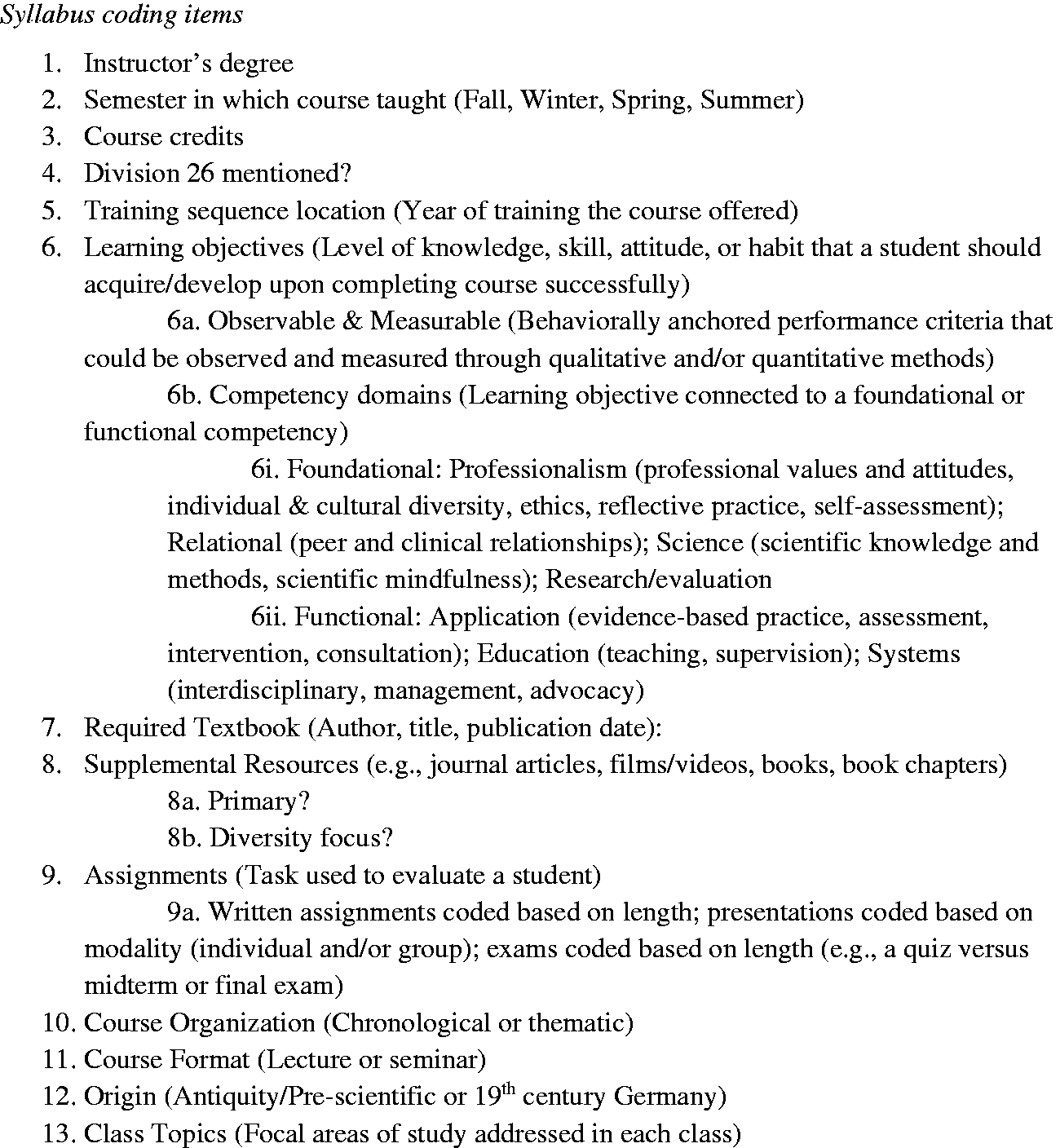
HSP syllabi were solicited from APA accredited clinical psychology Doctor of Psychology programs. As of 17 May 2016, there were 64 active programs accredited by the APA (American Psychological Association, n.d.). This included programs on probation, although not accredited programs with inactive status. Data collection occurred through contacting via email either the course instructor (when identifiable) or the department/program chair, and requesting a copy of the syllabus for inclusion in a comparative survey and analysis. In two instances, program websites contained no faculty contact information; thus, 62 programs were solicited. If there was no response after two weeks, then a follow-up email was sent. The response rate was 43.5% (n = 27). Additionally, if the course’s location in the training sequence was not on the syllabus, then program websites were viewed to find this information.
The following information was recorded: course instructor’s degree; what semester the course was offered; course credits; course format (e.g., lecture, seminar); the principal pedagogical resource (e.g., a textbook), and if additional resources (e.g., journal articles, videos) were used; whether any resources were primary or had a diversity focus; and if there was any reference in the syllabus to APA Division 26 (the Society for the History of Psychology). Categories and subcategories were created for other data sources. Relevant content was then coded as either present (1) or absent (0) based on whether it was stated explicitly, there was an obvious synonym, or if it fitted the definitional/coding criteria. The following categories were used: “Learning Objectives,” “Assignments,” and “Class Topics.”
“Learning Objectives” were defined as: “the knowledge, skills, attitudes, and habits of mind that students take with them from a learning experience” (Suskie, 2009, p. 117). An objective was coded as present if it identified a level of knowledge, skill, attitude, or habit that the student should acquire/develop upon completing the course successfully. On some syllabi, there was conceptual and/or terminological confusion between course “goals” and learning “objectives” (e.g., the syllabus listed “goals” but meant “objectives”). While these concepts/terms are often used interchangeably in general language usage, differences exist within the curriculum design lexicon. Anything fitting the definition was categorized within “Learning Objectives.” A subcategory determined whether an objective was observable and measurable. An objective was coded as present if it conveyed behaviorally anchored performance criteria and described the method used to evaluate the student’s performance. A second subcategory determined what competency was promoted by the objective, using Fouad et al.’s (2009) definitions of foundational and functional competencies, as updated by Hatcher et al. (2013). A “foundational” competency was coded as present if the objective fitted keywords related to scientific knowledge/methods, professionalism, or relational skills. A “functional” competency was coded as present if the objective fitted keywords related to assessment, intervention, consultation, teaching, supervision, or management.
In addition to examining learning objectives, course assignments and class topics were also surveyed across HSP syllabi. “Assignments” were defined as any task or project that was used to evaluate a student. This included papers, presentations, participation, and/or exams. A subcategory provided greater specificity: written assignments were coded further based on length, presentations were coded based on modality (individual and/or group), and exams were also coded based on length (e.g., a quiz versus midterm or final exam). When students could present a topic either individually or in a group, this was coded as a group presentation; additionally, a debate was coded as a group presentation. “Class Topics” were defined as the specific areas of study addressed in each class. Common and expected focal areas of study were coded based on keywords. A subcategory determined whether the topics were organized chronologically or thematically. That is, did the course begin with classes in antiquity and then continue era by era through contemporary times? Or was each class organized around a theme (e.g., consciousness, empiricism) with readings drawn from throughout history? If there was hybridization, then “chronological” was coded. A second subcategory determined at what point in history the course began, either antiquity or the 19th century. Finally, any item that did not fit into an above-mentioned category or subcategory was recorded.
Two researchers used a detailed coding protocol and practiced on syllabi prior to actual coding. Interrater agreement was measured using Cohen’s Kappa (κ). Interrater agreement was near perfect (Landis & Koch, 1977) across categories for seven randomly sampled syllabi (κ = .83, .86, .88, .89, .92, .93, and .96).
Results
General Information
Most HSP course instructors (n = 17, 63.0%) possessed the Doctor of Philosophy (PhD) degree; nine (33.3%) instructors possessed the Doctor of Psychology (PsyD) degree; one (3.7%) instructor possessed the Doctor of Education degree. The course was most frequently offered in the summer session (n = 12, 44.4%), followed by the fall semester (n = 8, 29.6%), and then the spring semester (n = 5, 18.5%). The course was usually offered for three credits (n = 18, 66.7%), with some programs offering it for two credits (n = 4, 14.8%); course credit information was not available for five (18.5%) courses. No syllabus mentioned APA Division 26 (n = 0, 0.0%). The course’s location in training sequence was not available for seven (25.9%) programs. Of the remaining programs, the course typically occurred in the third year (n = 9, 33.3%), followed by the fourth year (n = 4, 14.8%), first year (n = 5, 18.5%), and second year (n = 2, 7.4%).
Pedagogical Resources
Textbooks Used in History and Systems of Psychology Courses.
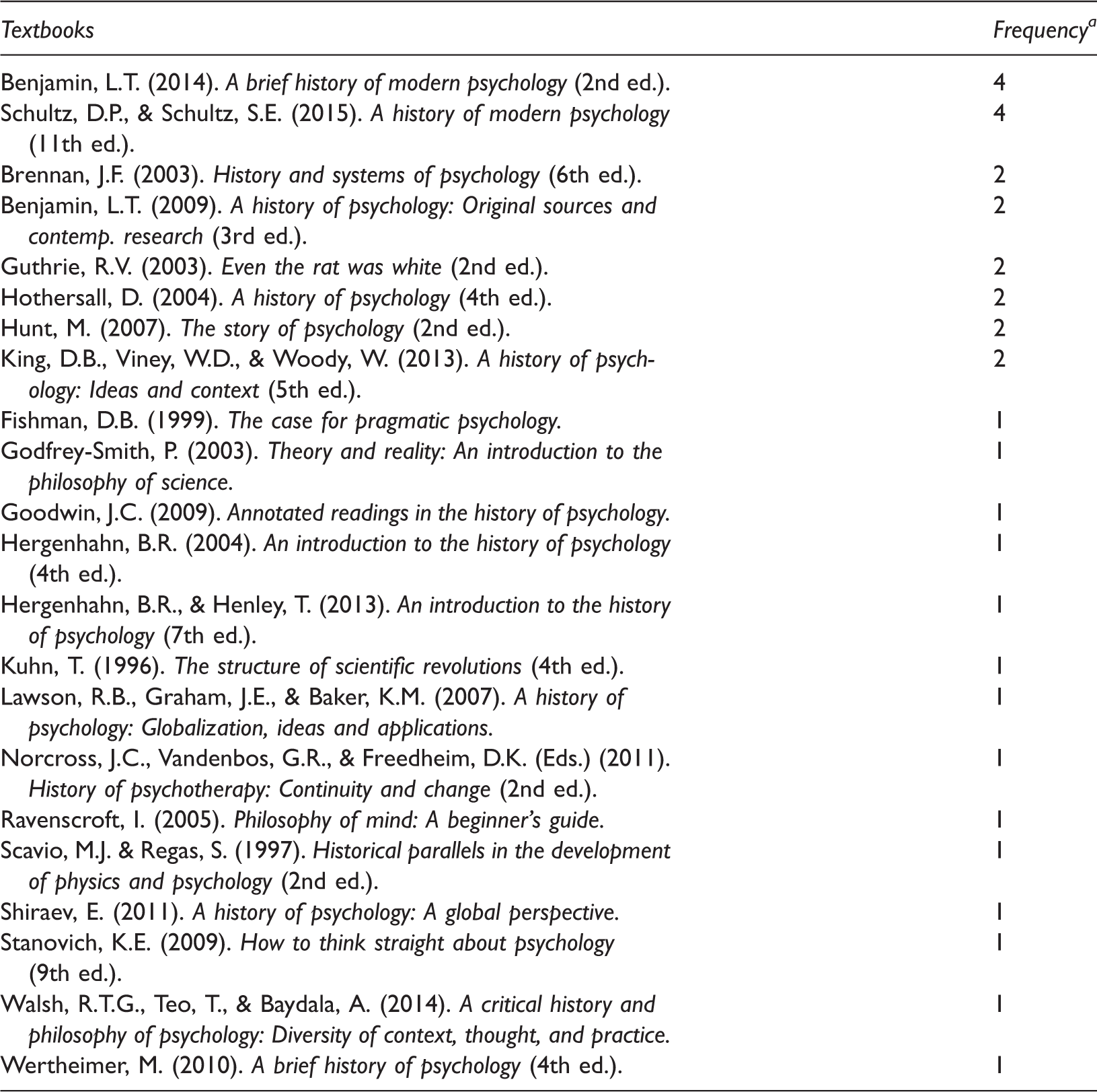
Note. This list does not include publisher or publishing location for the purpose of brevity.
More than one textbook was assigned in some courses.
Learning Objectives
Six (22.2%) syllabi described between 1 and 3 objectives; 16 (59.3%) syllabi contained between 4 and 6 objectives; 3 (11.1%) syllabi described between 7 and 10 objectives. Only two (7.4%) syllabi contained no objectives. The modal number of objectives was five (n = 8, 29.6%). While the vast majority of syllabi utilized learning objectives, very few described them in an observable and measurable manner. Only five (18.5%) syllabi connected objectives to behaviorally anchored performance criteria and designated a method to assess the student’s performance. Of those syllabi that listed objectives, all had objectives rooted in foundational competencies. The most prevalent foundational competencies were science (scientific knowledge and methods) and professionalism (professional values, ethics, and reflective practice). Only two syllabi used functional competencies: application (intervention, assessment) and management. Two syllabi tried to describe certain objectives as functional competencies, but they were actually foundational.
Assignments
The most prevalent method with which to assess performance was participation (n = 18, 66.7%). Mid-term and/or final exams were used in 15 (55.6%) courses. Quizzes, brief papers (1–5 pages), and group presentations were each used in 10 (37.0%) courses. Medium-length papers (6–10 pages) and individual presentations were each used in 7 (25.9%) courses. Only 2 (7.4%) courses used long papers (>10 pages); 3 (11.1%) courses had writing assignments with no specified length. Assignment overlap occurred on most syllabi (n = 24, 88.9%); only 3 (11.1%) syllabi assessed performance entirely through quizzes/tests. The most frequently occurring combination was participation and quizzes/tests (n = 12, 44.4%).
Class Topics
Nearly every course was organized chronologically (n = 26, 96.3%). Only one (3.7%) course was organized entirely using a thematic framework. In several instances, there was hybridization. That is, the course used a chronological framework with some classes organized around a particular theme. The course format was predominately lecture (n = 25, 92.6%), with only two (7.4%) courses formatted entirely as a seminar.
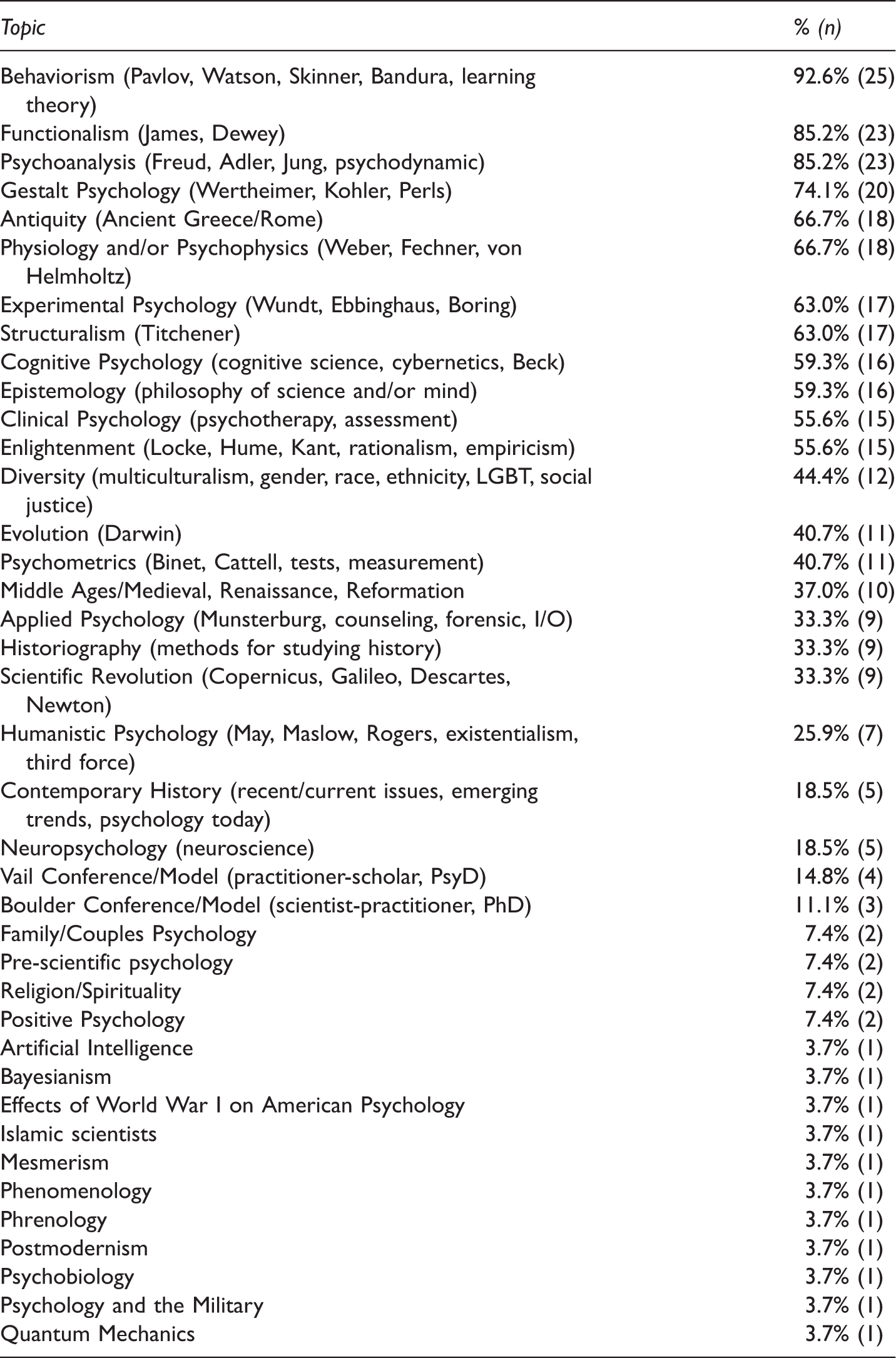
Class Topics Listed/Described on Syllabi.
Discussion
Based on the findings, the HSP course is scheduled late in a student’s education and is usually regarded as a “capstone” course. The purposes of a capstone course are to reflect upon previously acquired knowledge, integrate it into a more holistic perspective, and arrive at a more advanced level of understanding (Grahe & Hauhart, 2013). Would the HSP course be more effective if it is regarded as a “cornerstone” course offered earlier in a student’s education (e.g., Milar, 1987)? Studying the discipline’s history and surveying its major systems could provide an important foundation for psychology students’ subsequent education. Locating the course toward the beginning of training may contribute to better scholarly habits and increased intellectual diversity. Studying history grounds current theory, research, and practice within past knowledge, which contributes to good scholarship. Ideas are too frequently appropriated without sufficient acknowledgement of historical antecedents (Levy & Anderson, 2013). Studying history also highlights the importance of intellectual diversity: science and psychology benefit from competing ideas and different perspectives.
As mentioned previously, the present paper serves several purposes, including: fostering further empirical study of how the course is taught; and promoting broader discussions within the discipline. In this section, recommendations are best viewed as hypotheses to be tested in the classroom, and as possible discussion topics.
Most HSP courses had a lecture format (n = 25, 92.6%) and used a textbook (n = 24, 88.9%). Some textbooks were nearly/over a decade old. Primary sources (n = 10, 37.0%) and pedagogical resources with a diversity focus (n = 9, 33.3%) were used less frequently than textbooks. Might a seminar format using more primary and diversity-focused resources permit a more collaborative, critical, dialogical, and dialectical learning process? Students probably learn best when engaged actively in the pursuit of knowledge (e.g., Markant & Gureckis, 2014). In a seminar, classes are peer-led and involve problem-based learning, case-based learning, and team-based learning. The instructor facilitates learning by encouraging students to: delve deeper into a topic; ask more nuanced questions; consider alternative perspectives; and integrate information. Because a seminar involves active learning, it likely improves motivation and attention, as well as the encoding, comprehension, and subsequent retrieval of information (Markant & Gureckis, 2014). Students appear to favor the seminar format over a lecture-based format (Casteel & Bridges, 2007; Minhas, Ghosh, & Swanzy, 2012).
While nearly all syllabi did contain learning objectives, there were numerous problems that interfered with the objectives being useful to both students and instructors. Too many syllabi blurred concepts and/or terms. As mentioned previously, sometimes course goals sounded like learning objectives (and vice versa). Instead of identifying what knowledge, skill, or attitude a student should expect to attain from the course, there were vague, general, and/or philosophical pronouncements. Too many objectives were written poorly or used terminology imprecisely. A vast majority of syllabi contained objectives that were neither observable nor measurable. Problems emerged even when there were attempts to connect an objective to an evaluation method. For example, on one syllabus, “Class Discussion” was listed as a way in which knowledge attainment would be evaluated for some objectives, yet it was not a graded course component in the assignment section. Too many objectives were untethered from a specific competency. The opposite problem also occurred: one objective would be connected to multiple, often unrelated, competencies. Finally, there were two syllabi in which an objective was described as being connected to a functional competency when it was actually a foundational competency.
The preceding issues are inconsistent with best practices in teaching. Students need to know: what knowledge and skills will be acquired upon successful course completion; what methods are used to evaluate performance on each objective; and what competency is promoted by an objective. A learning objective is an outcome statement. It should describe clearly and concisely what a student will know or be able to do as a result of having taken the course. The objective should be behaviorally anchored and describe an evaluation method so that a level of competence can be determined by the instructor. Behaviorally anchored objectives reduce rater subjectivity and biases (e.g., leniency, halo), therefore improving evaluation reliability and accuracy. Finally, every objective should promote a specific competency.
Analyzing syllabi content (assignments, class topics) revealed that many HSP courses focused on biographical and intellectual history. That it, emphasis was on a specific individual’s life, career, and contributions. This is the “great men and their ideas” approach to historiography that once dominated historical narratives (Ball, 2012). In this approach, individuals, usually white men, are celebrated for their achievements. More contemporary historiographical methods focus on the sociocultural, economic, and political factors that shape a society as a whole and on individuals/groups typically excluded from traditional celebratory historical narratives.
Several antidotes counter the tendency toward presenting the typical “great men” narrative. First, introduce students to different methods for studying history. Only a third (n = 9, 33.3%) of syllabi included content on historiography. A critical methodology embeds the discipline of psychology within particular societal systems of knowledge and power (e.g., Danziger 1985, 1990; Elcock & Jones, 2013; Jones & Elcock, 2001; Kendall & Wickham, 1999; Teo, 2015; Walsh, Teo, & Baydala, 2014). This shifts emphasis away from specific individuals to the various contexts that create the possibilities for thinking and behaving in certain ways. For example, Wundt’s lab was the product of unique German social, political, economic, and cultural factors that did not exist in England, France, the United States, or anywhere else in the world. When these factors are considered, it is neither surprising nor coincidental that many scientific breakthroughs, including in psychology, occurred in 19th century Germany. Critical histories also focus on co-cultures that are usually left out of the familiar narratives (e.g., Adams & Hanna, 2012; Arnett, 2008; Brock, 2006; Furumoto & Scarborough, 1986; Holliday, 2009; Pickren, 2009; Sue, 2009).
Another antidote is to inculcate diversity. Diversity-focused resources (n = 9, 33.3%) and topics (n = 12, 44.4%) were lacking from some syllabi. Diversity education is considered necessary for clinical psychology graduate training in the United States (American Psychological Association, 2002). Diversity education promotes greater awareness of societal factors that marginalize/oppress certain populations and provide unearned advantages to members of a dominant group (e.g., Ball et al., 2013; Burnes & Stanley, 2017; Jones, Dovidio, & Vietze, 2014; Ortiz & Jani, 2010; Rutherford, 2013). It is important to recognize the role the discipline has played in marginalizing racial, ethnic, gender, sexual orientation, physical ability, and economic class co-cultures (e.g., Arnett, 2008; Furumoto & Scarborough, 1986; Sue, 1999). Within psychology, diversity education also demonstrates how seemingly value-free theories and empirical research served constitutive and/or normalizing functions (e.g., Varga, 2011; Watkins & Shulman, 2008).
Finally, organizing the HSP course within a thematic framework, rather than a chronological one, may also act as an antidote. A chronological framework encourages a march through biographical history. A thematic framework emphasizes focal areas of study using primary sources drawn from multiple chronological periods. One possible thematic framework is to identify historical, dialectical tensions within psychology. For example, how has the mind-body problem been studied throughout history? Thus, instead of reading about various philosophers and psychologists, students would read works by them. In this way, students would use a primary source to learn how it contributed to the study of psychology and to inform their own opinion. Other historical, dialectical themes could include empiricism and rationalism, free will and determinism, and nature and nurture.
In addition to being overly focused on biographical history, most HSP courses maintained a narrow focus on psychology’s evolution as an experimental science. Only 15 (55.6%) syllabi referenced the emergence and/or history of clinical psychology. Given the survey sample was drawn from PsyD programs, it is surprising that more HSP courses did not address explicitly the history of clinical psychology. Topics related to the history of clinical psychology, such as psychometrics (n = 11, 40.7%), humanistic psychology (n = 7, 25.9%), applied psychology (n = 9, 33.3%), and the Boulder (n = 3, 11.1%) and Vail (n = 4, 14.8%) Conferences (and associated training models) were mentioned rarely. This is a significant deficit. Studying psychology’s history is important because doing so helps define it as a unique discipline with its own topics, theories, and methods, separate from philosophy, physiology, and psychiatry. Establishing a circumscribed domain also allows a distinct professional identity to develop. The same may be said of clinical psychology.
Would students benefit from greater coverage of more contemporary history? Are there current topics that would be relevant to clinical psychology graduate students? Examples include efforts (e.g., the biopsychosocial model, common psychotherapy factors) to bridge historical sectarian tendencies toward schism, fragmentation, and reductionism. Only one HSP syllabus addressed the APA’s recent collusion with the United States Department of Defense to issue loose ethical guidelines for interrogations, which enabled torture (Hoffman et al., 2015). This seems like vital contemporary history for a clinical psychologist.
Finally, most HSP courses (n = 20, 74.1%) began in antiquity or had content described as “pre-scientific psychology,” while seven (25.9%) courses began in the 19th century. This occurs because there are two different origin stories for psychology. If an instructor begins in antiquity or “pre-scientific psychology,” then he or she constructs a pedigree for psychology to rival other (older) scientific disciplines. If an instructor begins with the German psychophysicists, then he or she emphasizes psychology’s experimental foundation to demonstrate the discipline’s credentials as a natural science. The differing origin stories offer students another dialectical theme. Part of learning the history of psychology is asking what enabled the discipline to emerge in the late 19th century; the answer has both distal and proximal explanatory factors.
Limitations
It is likely that some topics were undercounted. This may have occurred for several reasons. First, some programs may cover a particular aspect of the history of psychology in another course and not include it in the HSP course. For example, the history of psychological testing might be covered in an assessment course, humanistic psychology in a psychotherapy course, or the influence of Gestalt psychology might be addressed in a course on the cognitive-affective bases of behavior. Next, an instructor may informally include a topic but not specify this content on the syllabus, or students, through assignments such as presentations, may also yield topics not found on a syllabus. Finally, there are inherent methodological limitations when conducting a content analysis: categories and coding criteria need to be constructed for the purpose of reliably sorting data into circumscribed, analyzable domains. If a category is defined too narrowly and/or its coding criteria are too restrictive, then it will likely not capture relevant data. Alternatively, if the category is defined too broadly and/or its coding criteria are too expansive, then it will likely capture superfluous data. The focal area “Experimental Psychology”, within the “Class Topics” category, was found on 17 (65.4%) syllabi. This category was intended to capture the founding of a scientific psychology in 19th century Germany. It seems unlikely that an HSP course would not cover the discipline’s experimental origins, even if this content was found in another course. Thus, either the coding criteria were too restrictive or this content was covered by another focal area (e.g., structuralism, psychophysics) on some syllabi.
Another limitation of the present paper may be its generalizability. While it seems likely that the results are generalizable across PsyD programs, the present paper’s applicability may not extend to clinical or counseling psychology programs that award the PhD degree. Further examination should be pursued to gather HSP course content in clinical and counseling psychology PhD programs, and determine if/how it may differ from PsyD programs. Anecdotally, Barnes & Greer (2016) reported that some PhD programs integrated the HSP course into other courses because it takes away from research time; they also reported programmatic and jurisdictional efforts to by-pass the history of psychology requirement by permitting course substitutions.
Future Directions
The present paper provides a foundation upon which further research on teaching the history of psychology may be built. Important next steps are to: expand the study to PhD clinical and counseling psychology programs; and for course instructors to incorporate the findings and feedback from the present paper and field test them in their classrooms. It is hypothesized that offering the course earlier in the training sequence, using a seminar format, organizing the course thematically, using primary and diversity-focused resources, and incorporating behaviorally anchored and measurable objectives would benefit both students and instructors. These hypotheses are straightforward and testable. Results could be published in peer reviewed journals or posted in a centralized public location, perhaps on the Society for the History of Psychology’s website. As suggested previously, this process may facilitate course design, pedagogical best practices, and instructor preparation. It is recognized that both practical constraints (e.g., class size) and an instructor's knowledge and training impacts any given course’s format and content.
It would be helpful to attain current information about HSP instructors and their educational preparation for teaching the course. Are they psychologists interested in the topic? Are they historians? Do they have specific training in the history of psychology or historiographical methods? When Fuchs & Viney (2002) asked these questions, they found most HSP instructors lacked expertise in historiography and their scholarly activities were focused on other topics. Henderson (2006) noted the pedagogical and ethical challenges of teaching the HSP course when the instructor lacks proficiency in the domain.
More broadly, the present paper may serve as a catalyst for discussions within the discipline about the nature of the history of psychology and how it might be taught most effectively. Is it desirable or even feasible to develop a more consistent curriculum? What are the desired outcomes? Should HSP be considered primarily a foundation course, or can it be more relevant clinically? When in the training sequence would the course be most effective? Such discussions could contribute to greater clarity and consistency in our understanding of the discipline and how best to communicate this knowledge to subsequent generations. Furthermore, such discussions are important because the HSP course offers a valuable, and under-utilized, opportunity for psychology graduate students to develop their critical and reflective capacities as both practitioners and scholars.
Footnotes
Declaration of Conflicting Interests
The author(s) declared no potential conflicts of interest with respect to the research, authorship, and/or publication of this article.
Funding
The author(s) received no financial support for the research, authorship, and/or publication of this article.