



Abstract
This article presents a unique approach for teaching crisis intervention in that it involves students reading novels and autobiographies to use as case studies in order to apply the theories and concepts. A rationale for the use of literature as a projective device to help students experience personal growth and to target the affective domain of learning is presented. Guidelines for how to structure the assignment are outlined, including a written paper and a group presentation. Examples of relevant novels and autobiographies are listed along with practical tips for maximizing the usefulness of this learning activity. The article concludes with a summary of students’ reactions to the project.
Introduction
The volatility of today’s world creates a pressing need for crisis responders and professionals who are well trained, flexible, and sensitive to the varied backgrounds of those they serve. Gerald Caplan (1961), who is viewed as the father of modern crisis intervention, defined a crisis as an obstacle that seems insurmountable by ordinary methods of problem-solving and which leads to a period of disorganization. Examples include natural disasters, terrorist acts, suicidality, rape, serious illness, sudden loss, and domestic violence. Crisis intervention is the process of providing immediate, short-term help to individuals and groups with the goal of mobilizing coping abilities, restoring equilibrium, and preventing adverse emotional and behavioral outcomes (James & Gilliland, 2017). Unlike many other forms of mental health treatment, crisis intervention has a history of training lay people or non-licensed paraprofessionals (i.e., “crisis workers”) as a way of empowering local communities, expanding access to care, and providing peer support, often from individuals who have experienced similar stressors or who have cultural backgrounds similar to those in need. Many colleges and universities offer crisis intervention courses as part of their curricula to prepare students in psychology, human services, social work, and criminal justice to work in community settings that serve people in crisis.
Crisis workers are in a pivotal position to influence the perception of the crisis event in a way that allows people to find strength, purpose, and hope, as opposed to blame, bitterness, and despair. The challenge for training in crisis intervention is to go beyond the mere teaching of skills and techniques to promote understanding, empathy, and compassion (James & Gilliland, 2017; Myer & Conte, 2006). The crisis worker needs to know how to make a meaningful human connection with the person in crisis. This level of affective learning requires creative approaches that allow the student to experience the crisis from the client’s point of view. Reading works of literature is a vehicle for such insight, as it provides the student with an immersive experience into a vivid case study that can be explored from the perspectives of a variety of characters with backgrounds both similar to and different from their own (Flood & Farkas, 2011; Gelman & Mirabito, 2005). This article presents an argument for the use of literature to teach crisis intervention, a description of how to structure and design the case study assignment, some suggested books to use, and a discussion of students’ reactions to this learning experience.
Literature as a Learning Device
A variety of disciplines have used literature as a device for deepening learning. Medical education has a particularly long and well-developed history of using novels and other works of literature to promote a more humanistic approach to patient care (Donohoe, 2013; Gordon & Evans, 2007), dating back to the seminal work of Osler (1920). Robert Coles (1989), a psychiatrist and psychoanalyst at Harvard Medical School, writes eloquently about the courses he offered to medical students examining works of literature that encouraged them to think beyond “conceptual categories and diagnoses” and see their patients as human beings. He audiotaped his discussions with students to examine how literature helped them to open their hearts and minds, arguing that reading a person’s story allowed the students to experience “the palpable pain and suffering of another human being” (Coles, 1989, p. 8). DMani (2011) developed a literature and medicine course for medical students in Malaysia with the goal of helping them to embrace principles of social justice, compassion, and responsiveness with regard to individuals from different backgrounds. He argues that the use of literature broadens the students’ perspectives and enhances the humanistic value of medicine. Maccio and Garcia-Shelton (1985) describe their use of literature to teach family medicine residents about family dynamics and the stages of the family life cycle. In addition to enhancing their ability to apply these theories and concepts, the authors observe that reading literature nurtures the spirits of their students and helps them to see the importance of listening to their patients’ individual stories. Students in Welch and Harrison’s (2016) literature and medicine course reported that reading, discussing, and writing about literature helped them to examine their own biases and consider others’ perspectives. Additional accounts of using literature to teach medical students have focused on the use of poetry and short stories (Andrews, 2015; Blackie & Wear, 2015; Evans, 2002; Moulton-Barrett, 1984; Zouhouri, Amini, & Sagheb, 2017).
Other disciplines that have used literature as a tool to expand self-awareness and sensitivity in relation to populations students will serve include gerontology (Brown & Niles-Yokum, 2016), social work (Scourfield & Taylor, 2014), nursing (Freeman & Bays, 2007; Patterson, Begley, & Nolan, 2016; Roberts, 2010), pharmacy (Flood & Farkas, 2011), and pastoral care (McClure, 2011). Michaelson (2016) makes a strong and detailed argument for using literature to teach business students how to examine ethical issues and to promote empathy. He asserts that whereas the formal case studies typically used in business education present a “cleansed version of reality” with “facts selected to suit the pedagogical need,” works of literature present a more complex and nuanced approach to understanding individuals and examining philosophical questions of how people should live and work.
Rationale for Using Literature to Teach Crisis Intervention
The process of teaching is often viewed as targeting the three domains of cognitive, behavioral, and affective learning identified in Bloom’s Taxonomy (Bloom, 1956). The textbooks and research articles we provide for students are typically very effective at targeting the cognitive and behavioral domains by providing theories, conceptual frameworks, findings, techniques, and exercises to help students build knowledge and skills in order to become effective crisis workers. However, education geared toward the affective domain of the learner is arguably more elusive because it involves changes in self-awareness, attitudes, and biases. It also requires developing a balance between awareness of the universality of human emotions and suffering, and sensitivity to the unique experiences and perceptions of each individual (Martin & Reigeluth, 1999). Reading works of literature such as novels and autobiographies allows for deep engagement in learning, opportunities for self-reflection, and rich case material that can be used to target the affective domain (DMani, 2011; Flood & Farkas, 2011; Gelman & Mirabito, 2005; Haven, 2014).
Focused attention on a work of literature affords students a close-up view into the minds, hearts, and emotions of people in crisis. Similar to the immersive experience of films (Wedding, Boyd, & Niemiec, 2010), novels and autobiographies function as projective devices that allow students to identify with the main characters and to experience their pain, as well as their growth. Reading a detailed personal account evokes a vivid awareness of the uniqueness of each individual’s response to a crisis. As the narrative evolves within the context of a family and cultural setting, students can compare the reactions of different family and community members to the same event, providing a powerful illustration that the individuals’ backgrounds and perceptions of the event are the key to their experience of the crisis (Kanel, 2014; Myer et al., 2014).
Abrahamson (2006) argues that storytelling is an effective educational technique because it facilitates commonality and the shared resonance of experiences, thereby promoting a bridge of understanding. In this way, reading literature may allow students to develop greater empathy with people in crisis because individuals are seen as real people with strengths, weaknesses, and feelings (Slattery, 2011). In an article describing how she targets the affective domain for criminal justice students, DioGuardi (2016) describes the use of empathy-evoking films to reduce us versus them thinking and break through resistance to examining students’ preexisting positions on complex issues. Chrisler (2000) uses novels as case studies for teaching psychology, arguing that in addition to enhancing empathy for people with psychological problems, novels promote critical thinking when students apply concepts to cases by completing assignments for which there are no answers readily obtainable from published sources. Pointing out that research on attitude formation and persuasion consistently finds that people are influenced more by personal examples than by statistics and logic, Stoddart and McKinley (2006) propose that stories evoke emotion and arouse different neural pathways in the limbic system that may help to focus attention and consolidate memory. In a detailed account of the science of storytelling, Haven (2014) argues that stories have the power to change a person’s beliefs and attitudes because they hold the audience’s attention by providing context, relevance, engagement, understanding, and meaning.
Reading novels allows concepts to come to life, providing nuanced illustrations of complex phenomena encountered in crisis situations, such as victim-blaming and survivor guilt. It is easy for students to defensively assert that they would never blame a victim or to dismiss survivor guilt as something a person should just let go of, until they experience the reactions of individuals and communities in actual crisis situations and hear the voices of their struggles along with judgment by themselves and others in their communities. Books can also give voice to otherwise invisible aspects of the crisis experience, such as the grief of children and the experience of individuals marginalized by poverty, racism, substance abuse, and mental illness (Gelman & Mirabito, 2005). Reading a complex personal account of a crisis experience also allows the student to see that recovery from a traumatic experience is typically not a linear process, and is often characterized by the arduous work of breaking through protective and defensive positions over time, along with the help of key individuals in a person’s support network and the summoning of individual strength, resilience, and spirituality.
Purpose and Objectives
This literature case study assignment is offered as part of an undergraduate course in crisis intervention, which in turn is an upper division elective for psychology majors and students in other social science disciplines (e.g., criminal justice, sociology, interdisciplinary studies) at a public university in the southeastern United States. The university primarily caters for non-traditional students who are older than 18–24 years of age, do not live on campus, have delayed entry into post-secondary education, work part-time or full-time, are parents, and/or do not depend on their parents for financial support. Many of the students will do internships and/or seek employment in settings that offer crisis intervention (e.g., homeless shelters, juvenile detention centers, victim advocacy, rape crisis centers, Department of Family and Children’s Services). As such, the crisis intervention course is designed so that students can learn the theory and practice of crisis work in order to be able to communicate and intervene effectively in their internship settings as volunteer crisis workers, and potentially beyond graduation in mental health or human service positions. Additionally, many students in the course typically are already working in human service settings where they can immediately apply the theory and skills learned in the course.
The purpose of the assignment is to provide an opportunity for students to apply the theories and concepts they are learning in the course to a specific case example, while also using the work of literature to promote identification with the characters and to target the affective domain of learning. The crisis intervention course has four objectives. Students will be able to: (a) analyze the human response to a variety of situational and developmental crises; (b) apply developmental and crisis theories to case examples in order to gain an understanding of how best to intervene; (c) consider cultural and family influences on coping during a crisis; and (d) examine the role of the human service professional in responding to a crisis. Thus, the project requires students to analyze the responses of both the main character and the family system to the crisis, while also reflecting on the cultural context. Students are asked to consider how a crisis worker could have intervened to help the individuals and family respond more effectively to the crisis and prevent negative outcomes.
To maximize affective learning, the project consists of both an individual paper and a group presentation. The paper allows the individual students to reflect on their personal reaction to the crisis and consider how they may identify with the characters, with the goal of promoting empathy and increasing awareness of cultural variables that influence perceptions of the crisis situation. It also allows the instructor to assess the degree of mastery each student has attained with regard to the course and theories. The group project has the additional aim of promoting discussion among a small group of students who have read the same book, in order to enhance critical thinking and promote awareness of each individual’s unique perceptions of the crisis situation, given their background characteristics and cultural lens. The group presentations also foster class discussion among students who have read about different types of crisis events and studied characters from a wide variety of backgrounds. Requiring the students to create and perform a role play of effective crisis work using the book’s characters engages the whole class in the story and allows students to practice the skills they are learning. The class critiques the role play to allow for additional refinement of skills and approaches.
Structuring the Assignment
Suggested Books for the Case Study Assignment
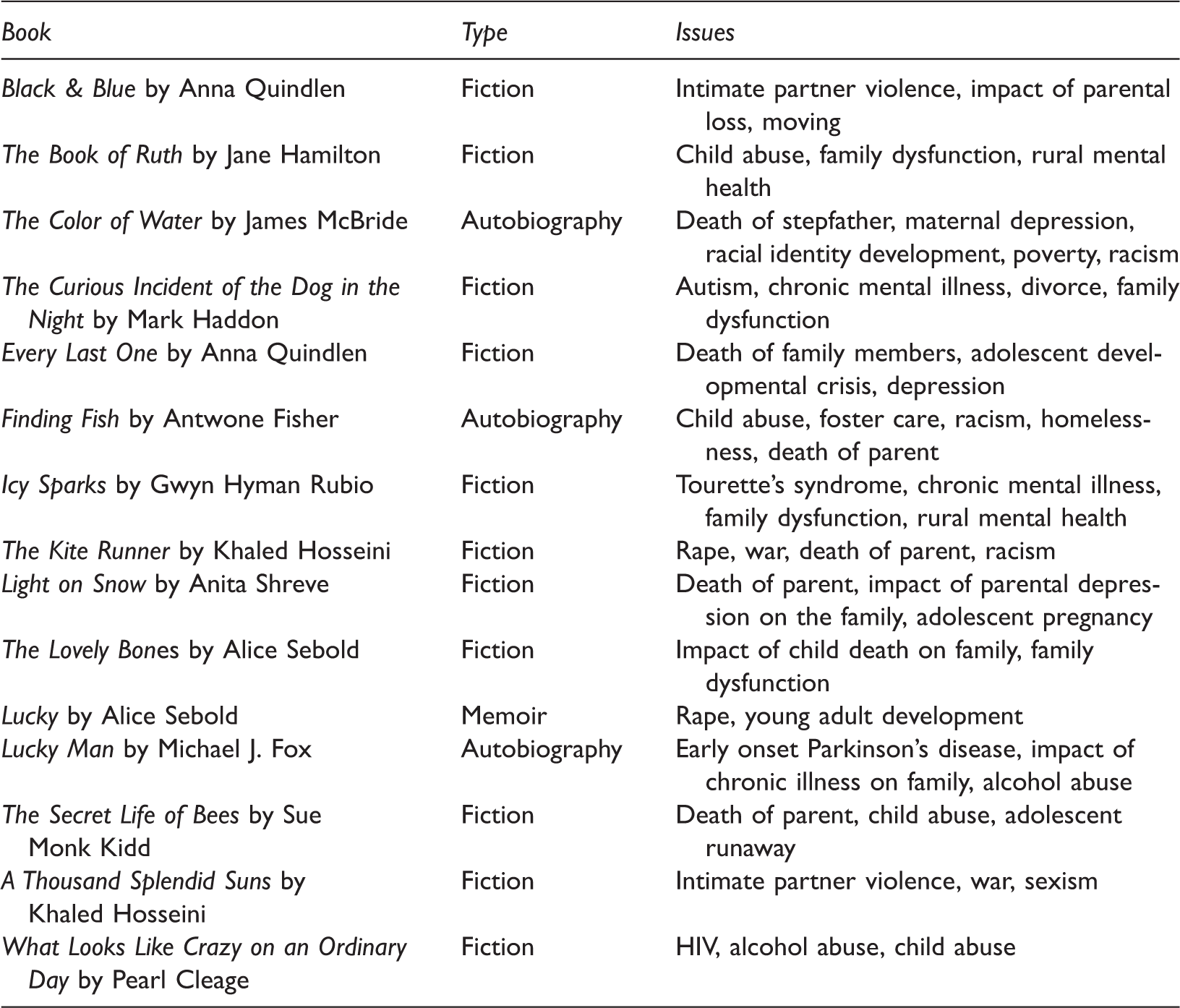
All the books are novels, autobiographies, or memoirs that portray an individual and family in crisis, all of whom go through a period of ineffective coping for which crisis services could have been useful. The books are screened to include only those that lend themselves to in-depth case studies and a clear application of the theories and concepts from the course. Books that are unusually long or have chaotic plot lines are not included. Only books available in paperback for low cost or in a public library are assigned. In order to foster cultural competency in crisis work, the books represent the stories of individuals from diverse backgrounds in terms of race, religion, gender, socioeconomic status, ability, sexual orientation, and other characteristics. Students are given six to eight weeks to read the books and do the case study assignments before they are asked to submit individual papers and deliver their group presentations. During the first six to eight weeks of the course, the theory and practice of crisis intervention are presented, including all of the concepts and skills needed to complete the case study assignment using exercises (e.g., role plays, case analyses, video clips) to apply and critique the theory.
The instructor takes a few minutes to describe the books in class, along with any trigger warnings (e.g., graphic language, child abuse, rape.) Students then randomly pick which book they would like to use and are clustered into small groups of four students for each book. The reason for the random assignment is to prevent students from pairing up with their friends in order to maximize a diversity of majors and perspectives, as well as to promote fairness in cases where several students prefer the same book. After the students have made their selections, they are given a chance to swap books with each other in case they are not happy with their selection or the book contains a trigger or issue they are not comfortable exploring. The instructor emphasizes that the students are allowed to continue swapping book choices among each other until they are all reasonably satisfied with their assignments and no student has a book that is viewed as unacceptable for any reason.
Writing the Paper
Each student writes an 8 to 10 page paper answering the following 8 questions below which are designed to help them apply the theories and concepts from the course to the case study contained in the book they have read. Students are instructed to follow the outline of questions and given a grading rubric that focuses on these areas. They are cautioned not to write a book report, and that there is no need to summarize the plot, list the characters, or provide a literary critique. The book will be used as a case study to examine crisis intervention theory and practice.
Case study questions
What was your personal reaction to reading this book? What kinds of feelings did it generate as you explored the main character’s reactions to the crisis? How do you think you would react to the same event—how would your reaction be similar or different and why? Write about two pages of your own reactions to the book, noting anything that you found helpful to your understanding of people’s reactions to a crisis or just aspects of the book that touched you in some significant way. Describe each of the four components of a crisis in the book (e.g., precipitating event, perceived meaning, ineffective problem-solving, and functionally debilitating state). How did the reactions to the precipitating event differ for various characters in the book? Which of Erikson’s (1950) developmental stages was the main character in when the crisis occurred? How did the crisis influence how the main character coped with the developmental tasks of that stage and how well did he/she execute those tasks? Which phase of Carter and McGoldrick’s (1989) Family Life Cycle was the family in when the crisis occurred? How did this influence the family’s perceptions of the event and how they coped with it? Discuss the sociocultural context of the crisis in this book. What was the ethnic and religious background of the main character and how did this influence his/her perception of the event? Identify and discuss any sociopolitical issues (e.g., sexism, racism, class differences, stigma, victim-blaming) that were influential in this case study. Which of Hansell’s (1974) basic needs were met for the main character prior to the onset of the crisis? Which were not? Describe which of the basic needs were threatened as a result of the crisis and how this affected how the individual coped. What kinds of resources and social supports did the individual and family use to deal with the crisis? What kinds of defense mechanisms were used by the main character or other key individuals in this case example? List at least three different examples of defense mechanisms used by individuals in this book and give examples of how each one was illustrated. Was there a crisis worker involved in this case? If so, how would you assess this worker’s effectiveness and why? If not, what kinds of interventions by a crisis worker could have been helpful at the time of the event? What was the outcome of the crisis? Did the person return to the precrisis state (however healthy/unhealthy that was), experience growth due to discovery of new resources, or experience an emotional breakdown? Describe your reasons for choosing a particular outcome.
The Group Presentation
Each of the small groups of four students gives a 20–30 minute oral class presentation of their case study. Whereas the written paper assignment allows the instructor to assess the individual students’ abilities to apply material from the course, the group presentation is designed to promote discussion and analysis of affective reactions among the students, who inevitably have different perceptions of the individuals and families experiencing the crisis, based on their own backgrounds, diversity characteristics, and potential biases. For this reason, the students are asked to discuss once again the four components of the crisis in the book and to compare the reactions of each character, because the students typically disagree in their perceptions. Students meet in small groups outside the class to discuss and critically think through their own analysis of the crisis situation versus those of their peers.
The group presentation also requires the students to write and perform a role play of effective crisis intervention skills and techniques that could have been used with the individual and/or family at the time of the crisis.
Group Presentation Questions
Briefly describe each component of the crisis in the book (e.g., precipitating event, perceived meaning, ineffective problem-solving, functionally debilitating state). How did the reactions to the precipitating event differ for each of the main characters? Would intervention by a crisis worker have been useful in this case? If so, what kinds of intervention would be helpful? Do a brief role play of effective crisis intervention using the main character(s) in your book. In this role play, be sure to demonstrate effective use of listening skills and crisis planning as discussed in class and in your textbook. How did each person in your group react similarly or differently to this book and the case portrayed in it? Here, each of you will need to give a brief account of your own feelings and impressions. What aspects of the book were most compelling or informative to you? In what ways could you identify with the main character or other characters in the book? (Note: You do not have to experience the same event in order to identify with a character—you just need to be able to relate to the feelings or other contextual characteristics, such as the developmental stage.)
Outcomes of the Assignment
Students have a very positive response to this assignment. While they may express initial hesitation at being required to read a work of literature—and many of them do not typically read for recreation—they are often surprised to discover how much they enjoy the books and how moved they are by the characters’ experiences. They identify with the characters, and they often find that the stories shed light on their own experiences with loss and crisis. Generally, students are quite capable of using their book assignment to apply crisis intervention theories and concepts. The theories and concepts seem to come to life as the students apply them to a specific case example. During their group presentations, students present their unique and varied reactions to the books and note the influence of their own backgrounds and perceptions on their views of the crisis situation. Many confess feelings of blame or judgment toward the characters, often reporting that they changed their perspectives as they continued to read and understand the context and complexity of the characters’ responses.
The following are written comments from students responding to open-ended questions about their reactions to the case study assignment. Reading the book helped me to use the crisis concepts in a real-life setting. I understood the concepts better, and they are more likely to stay with me in the future. I enjoyed the case analysis because it was similar to a hands-on situation where I could implement what we have learned. At first I was very hesitant about doing the case analysis because I felt like some of the books would bring out some emotions/feelings that I had not dealt with. But, as I read the case analysis and heard others I realized that everyone at one point in their lives experiences a crisis. This was an interesting project because it allowed each student to put their own particular insights in their analysis. What was valuable about this project was that it showed just how varied the applications of crisis intervention can be. I enjoyed reading the book. Although it wasn’t the typical book I would read, it helped me to expand my narrow view. It was really useful in helping to apply the different theories and concepts. I liked the book that I read because it opened my eyes to the different trials/crises a person goes through and conveyed in a personal way the sameness we have as human beings. This sameness is something that we as helpers must be in tune with in order to be effective in helping others. Overall, I enjoyed doing the case analysis project. I think it was a good learning experience. It took crisis out of the textbook and put it into the real world.
Implications and Future Directions
While this article has focused on the use of literature to teach a course in crisis intervention, there are other psychology courses that might benefit from the approaches described here. Assigning works of literature has been used to teach abnormal psychology (Chrisler, 1990; Flood & Farkas, 2011), developmental psychology (Boyatzis, 1992), health psychology (Kaptein, Muelenberg, & Smyth, 2015), and introductory psychology (Abrahamson, 2006; Chrisler, 1990; Stoddart & McKinley, 2006).
Although the student population described in this article was primarily non-traditional, it could be argued that the use of literature as a projective device and for offering a rich personal and cultural context might be equally if not more powerful for traditional students who are younger and have not yet been exposed to the world of work and raising children. Getting immersed in a work of literature can open up a person’s worldview and help learners to envision life beyond what may be their own limited experience.
This article does not provide objective data to support the effectiveness of the use of literature for teaching crisis intervention or other psychology courses. Future research is needed to examine this question, and a mixed methods design with pre- and post-testing of students exposed to this learning approach compared to traditional methods, along with a qualitative exploration of the subjective impact on the learners, would be ideal. These data might allow for a more in-depth examination of the possible impact of literature as a teaching tool to promote affective learning with the attendant changes in self-awareness, biases, and attitudes that educators strive to promote in their students.
Footnotes
Declaration of Conflicting Interests
The author(s) declared no potential conflicts of interest with respect to the research, authorship, and/or publication of this article.
Funding
The author(s) received no financial support for the research, authorship, and/or publication of this article.