




Abstract
In response to recent research indicating that the benefits of study abroad are significantly enhanced by pre-departure training, tertiary institutions are increasingly offering pre-departure courses to students preparing to study abroad. Teachers of psychology are well positioned to contribute to such courses in that a large number of psychological concepts are relevant to the student sojourner experience and the goals of pre-departure training. In this article I present the goals, format, content, and assessment of a psychology-based study abroad pre-departure course, describe relevant psychological concepts, and provide suggestions for psychology instructors interested in developing and teaching such courses.
Since the early 1960s, there has been a steady increase in the number of students enrolled in institutions of higher education outside of their home countries. More than 4 million students studied abroad worldwide in 2013 (OECD, 2015), a population with an average annual growth rate of approximately 5% (OECD, 2016). Considerable research has documented the benefits of participating in study abroad programs, including enhanced emotional resilience (Earnest, Rosenbusch, Wallace-Williams, & Keim, 2016), improved intercultural competence, global understanding, and worldmindedness (Behrnd & Porzelt, 2010; Douglas & Joan-Rikkers, 2001; Kitsantas, 2004; McCabe, 1994), increased foreign language interest and competence (Dwyer, 2004; Opper, Teichler, & Carlson, 1990), increased perception of responsibility for the environment (Wynveen, Kyle, & Tarrant, 2012), greater interest in the arts, language, history, and politics of countries outside of one's own (Carlson & Widaman, 1988; Carsello & Creaser, 1976), and the ability to see members of different national groups as individuals rather than in association with non-personal attributes, such as food or geographical characteristics (Drews, Meyer, & Peregrine, 1996). Such qualities not only facilitate personal growth, but also have value as students move from the educational sphere to the work force (Hannigan, 2001; Mohajeri Norris & Gillespie, 2009; Preston, 2012; Trooboff, Vande Berg, & Raymond, 2009).
Recent research indicates that the benefits of study abroad are significantly enhanced by, and in some cases largely dependent upon, students’ participation in intercultural training programs (Brewer & Solberg, 2009; Deardorff, 2008; Paige & Vande Berg, 2012), which have has been found to increase students’ cross-cultural adaptability, emotional resilience, and openness to experience (Goldstein & Smith, 1999). It has become clear that cultural contact alone often fails to result in the reduction of stereotypes or the development of intercultural competence unless accompanied by specific interventions that shape how those contact experiences are construed (Bennett, 2008). Such interventions involve “intentional and deliberate pedagogical approaches, activated throughout the study abroad cycle (before, during, and after), that are designed to enhance students’ intercultural competence” (Paige & Vande Berg, 2012, pp. 29–30). Despite these findings, the vast majority of students receive little or no formal pre-departure orientation (Berdan, Goodman, & Taylor, 2013) and such training, when it does occur, ranges widely from semester-long classes to brief workshops, podcasts, online documents, or student handbooks. As institutions of higher education increasingly address the need for pre-departure training, teachers of psychology should consider crafting or contributing to pre-departure courses, since psychology as a discipline has much to offer in preparing student sojourners and assessing their intercultural competence. In this article I outline the goals, format, content, and assessment of a psychology-based study abroad pre-departure course, describe psychological concepts that may enrich pre-departure training, and provide suggestions for psychology instructors interested in developing and teaching such courses.
Study abroad pre-departure courses
In one of the first articles advocating pre-departure courses for study abroad participants, Martin (1989) outlined three specific objectives: (1) providing students with a conceptual framework for understanding intercultural interactions; (2) offering students an opportunity to learn about their particular host culture; and (3) assisting students in developing strategies for adjusting to an unfamiliar culture. Thus, these courses tend to be both culture-general and culture-specific (Bennett, 2008) in that they address basic dimensions across which all cultures vary, while also providing students with opportunities to learn about their individual destinations. Study abroad pre-departure courses are distinct from courses focusing on the role of culture in human behavior, such as a cross-cultural psychology or anthropology course, in that in addition to objective knowledge about specific cultures, they focus on preparation for intercultural interaction (Bennett, 2008).
Topics commonly addressed in pre-departure training include stereotyping others and being stereotyped, intercultural communication and value differences, intercultural adjustment and culture shock, language learning strategies, health and safety abroad, establishing relationships with host culture members and maintaining relationships with home culture members, and the process of reverse culture shock (Cushner & Karim, 2004; Thebodo & Marx, 2005). Although these topics are typically approached from an intercultural communication perspective, instructors of pre-departure courses draw from a variety of academic disciplines in constructing course content (Martin, 1989). Yet, many psychological concepts and research findings that are relevant to the student sojourner experience have been omitted from pre-departure training. The course described below incorporates these concepts and findings into the curriculum.
Course goals, structure, and format
Outline of learning outcomes, topics, psychological concepts, and activities.
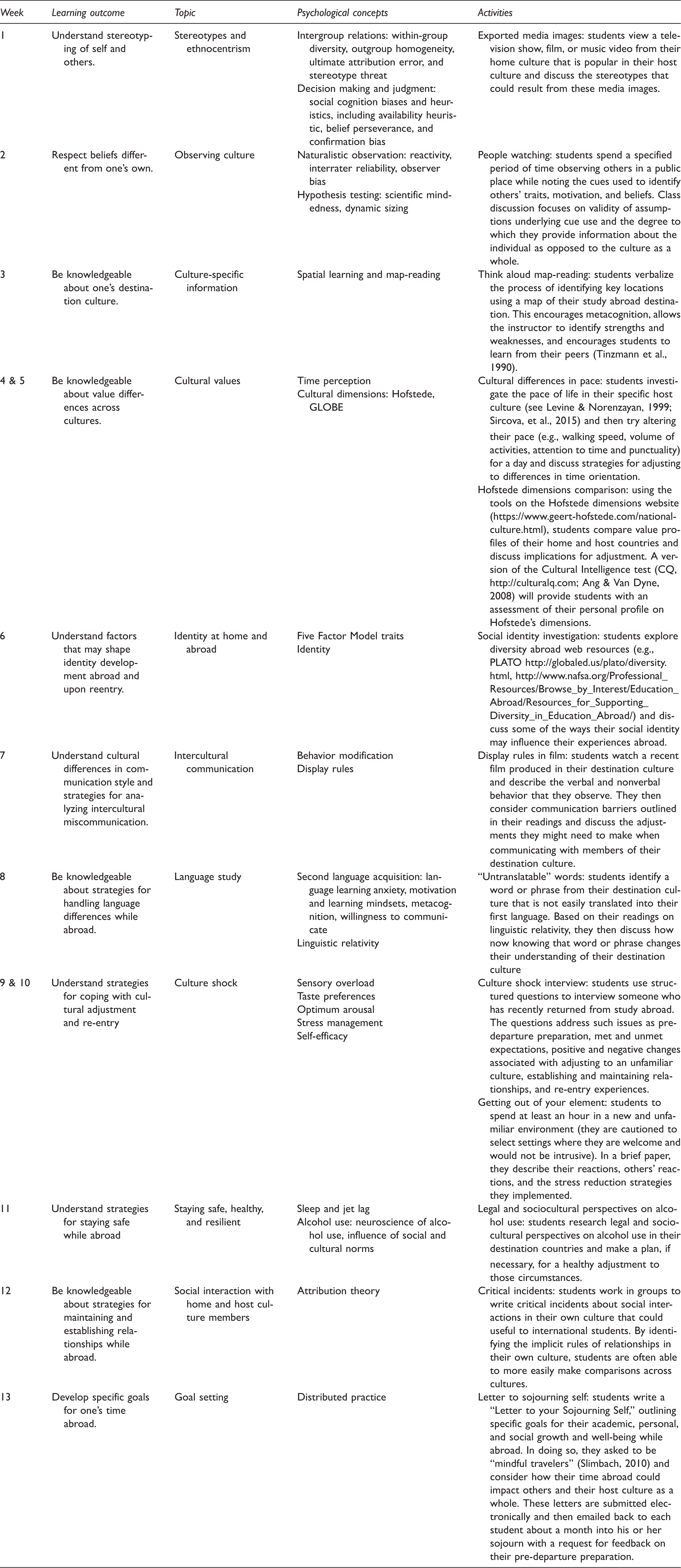
The course learning outcomes are derived from the research literature on intercultural competence (e.g., Bennett, 2008; Deardorff, 2008; Fowler & Blohm, 2004) and adjustment (Ward, Bochner, & Furnham, 2001), which emphasizes critical knowledge (e.g., awareness of cultural values, culture-specific knowledge, self-awareness), skills (e.g., communication skills, perspective taking, stress management, goal setting), and attitudes (e.g., respect for cultural differences, suspension of judgment, tolerance for ambiguity) for successful intercultural interaction. These outcomes build on Martin’s (1989) three objectives for pre-departure courses in that (1) frameworks are introduced for understanding intercultural interactions, (2) students make culture-specific applications, and (3) they consider implications for adjustment. Table 1 provides the learning outcomes, chronology of specific course topics, relevant psychological concepts, and application activities.
The progression of topics is such that students are initially exposed to basic cultural knowledge and strategies for observing and gathering nonjudgmental information about unfamiliar cultures. We then focus on how aspects of students’ intersectional identity (e.g., involving race/ethnicity, sexual orientation, gender, personality traits, social class, and nationality) might shape their experiences abroad. Once the students have a sense of the cultural and intrapersonal context they can better prepare for adjusting to an unfamiliar culture, communicating across cultures and establishing intercultural relationships. Finally, students draw on what they have learned throughout the course to develop specific goals for their academic, personal, and social well-being while abroad. Throughout this course, I introduce psychological concepts and research findings that support the development of intercultural competencies and the achievement of learning outcomes.
Relevant psychological concepts
Student sojourners can benefit from exposure to concepts and research findings from a wide variety of psychological subdisciplines, including experimental methods, states of consciousness, sensation and perception, learning and memory, motivation and emotion, language, cognition, stress and coping, personality, and social psychology. These concepts are briefly outlined below in conjunction with each course topic.
Stereotypes and ethnocentrism
Since cultural differences and similarities are a reoccurring theme in this course, it is important that students are introduced early on to the distinction between stereotypes and modifiable generalizations, as well as strategies for language that avoid ethnocentric standards of comparison. The following concepts are critical in this effort.
Intergroup relations
It is helpful for student sojourners to understand the cognitive processes involved in forming stereotypes, as they explore their own outgroup attitudes, such as prejudice and ethnocentrism, and prepare to deal with being stereotyped by members of their host culture. Useful concepts to discuss include within-group diversity, outgroup homogeneity, ultimate attribution error, and stereotype threat.
Decision making and judgment
As student sojourners prepare to draw conclusions about their host culture, it is useful to familiarize them with potential impediments to sound decision making and judgment, including the availability heuristic, belief perseverance, and confirmation bias.
Observing culture
Much of what happens in this course revolves around students’ observations of the behavior of individuals in different cultural settings. After discussing the elements of and influences on culture, the following concepts can be helpful in ensuring that such observations are valid.
Naturalistic observation
Naturalistic observation is frequently recommended as the primary strategy for learning about cultural variability in everyday behaviors (e.g., Gordon, 2010; Wolfgang, 1995). While not implemented in the systematic manner used in psychological research, some of the same concerns apply to students observing host culture behavior, including (1) reactivity – the influence of the student’s presence on those being observed, (2) interrater reliability – as different observers (particularly those with different cultural perspectives) draw different conclusions after witnessing the same behavior, and (3) observer bias – ways in which the student’s attitudes and expectancies influence the type of behaviors observed and how those observations are interpreted.
Hypothesis testing
As students develop expertise in observing and identify patterns of behavior across cultures, or what Duke (2014) has termed “cultural sleuthing,” they will no doubt start to form hypotheses regarding sources of these patterns of behavior. Instructors of pre-departure classes can facilitate the formation and informal testing of these hypotheses by training students in two skills that have emerged from the multicultural counseling literature: scientific mindedness and dynamic sizing (Sue, 1998). Scientific mindedness is the ability to develop general principles about the role of culture in the form of testable hypotheses rather than fixed conclusions. Dynamic sizing is the ability to determine when to generalize behaviors to a cultural group and when to view the behavior as a characteristic of a particular individual.
Culture-specific information
Toward the end of the semester, my students present a brief slide show on the physical environment (e.g., climate, geography), daily living (e.g., transportation, etiquette, food, dress), cultural features (e.g., language, gender roles, pop culture figures), and social environment (e.g., education system, political system) of their host country. To support students’ semester-long investigations of their specific destination cultures, this session focuses on accessing culture-specific geographic information.
Spatial learning and map-reading
Students from more technologically developed societies are often highly dependent upon GPS and may have poor map-reading skills. Research in cognitive psychology has identified some of the component skills of map-reading – a set of skills that would be useful to discuss and practice with pre-departure students. These include deciphering the meaning of symbols, route planning, self-locating, and image rotation (Lobben, 2004). The “think aloud” protocol often used in map-reading research (Lobben, 2004) may also be useful during a practice activity with student sojourners.
Cultural values
This portion of the course is aimed at prompting students to identify their own cultural values and those of their destination culture, as well as to begin to link observable behaviors (e.g., queuing, greeting, eating) to those underlying values. Concepts from the area of sensation and perception, as well as social psychology, provide examples of less visible values.
Time perception
Sojourners often have difficulty adjusting to cultural and regional differences in pace of life. Brislin and Kim (2003, p. 63) identified 10 ways in which time perception varies across cultures, which are relevant to student sojourners at both a culture-general and culture-specific level: (1) Clock and event time: Do people follow set schedules or let the event take its natural course before moving to another event? (2) Punctuality: How sensitive are people to deviations from appointed times? (3) The relation between task and social time during the workday; (4) Whether people do one activity at a time or do many at once; (5) Efficiency vs effectiveness; (6) Fast and slow paces of life; (7) How people deal with long periods of silence; (8) People's time orientation: past, present and the future; (9) The symbolic meaning of time; (10) Cultural differences in importance of work and leisure time.
Cultural dimensions
Hofstede’s (2001) and the more recent GLOBE (House, Hanges, Javidan, Dorfman, & Vipin, 2004) cultural dimensions models may be helpful to student sojourners in understanding the values underlying cross-cultural differences in attitudes, practices, and beliefs. One version of the Cultural Intelligence Test (CQ; Ang et al., 2007) allows students to compare both their personal and their home country scores with host country scores on the Hofstede dimensions of national culture (Power Distance, Individualism/Collectivism, Masculinity/Femininity, Uncertainty Avoidance, Long Term Orientation, and Indulgence).
Identity at home and abroad
This session draws from personality psychology to encourage students to consider how individual differences (e.g., race/ethnicity, sexual orientation, gender, social class, and personality traits) might shape their study abroad experience and the experiences of their classmates.
Five Factor Model traits
Students may be interested in learning about studies finding an association between intercultural adjustment and the Five Factor Model (FFM) traits of extraversion and openness to experience (high) and neuroticism (low; e.g., Wilson, Ward, & Fischer, 2013). A brief measure of the FFM (e.g., Gosling, Rentfrow, & Swann, 2003) could be administered in class, followed by a discussion of strategies for enhancing or adapting individual personality traits in an intercultural context.
Identity
Changes in personal, ethnic/racial, and national identity are a common outcome of study abroad (Savicki & Cooley, 2011), yet students may fail to anticipate these changes (Goldstein & Keller, 2015). Psychology instructors can assist students in understanding the concept of identity and exploring potential changes in self-concept that may result from their study abroad experience. It may be particularly useful to discuss the concept of socially constructed racial/ethnic identity (e.g., Omi & Winant, 2015), since students may encounter dramatic and often confusing changes in how their race/ethnicity is perceived by others – and themselves – while in their host culture and upon return.
Intercultural communication
This session focuses on understanding cultural variation in verbal and nonverbal communication. We explore key concepts from the intercultural communication literature, such as personal space, high and low context communication, and polychronic and monochronic cultures (Hall, 1976), as well as the following psychological concepts.
Behavior modification
One way to assist sojourners in developing intercultural skills is through an application of the principles of behavior modification (Black & Mendenhall, 1990). According to this perspective, study abroad participants would observe the behavior of host nationals (social learning) and then strive to enact the behaviors viewed in the host culture as appropriate (rewarded) and avoid those seen as inappropriate (punished). Students’ goal of “fitting in” may seem more achievable if it is framed, in part, as a process of learning a new set of behavioral contingencies.
Display rules
Student sojourners will benefit from exploring the display rules for emotional expression (Ekman & Friesen, 1969) in their host culture. Despite evidence for universals in human facial expressions (e.g., Hwang & Matsumoto, 2015), implicit expectations for situation- and intensity-appropriate emotional displays can vary markedly by culture. For example, US students abroad often report embarrassing consequences of their automatic tendency to smile at strangers, a behavior associated with low intelligence in some cultures (Krys, Hansen, Xing, Szarota, & Yang, 2014) and viewed as inappropriate in many others.
Language study
Whether preparing for courses taught in one’s nonnative language or trying to adapt to an unfamiliar dialect or accent, most study abroad students will benefit from exposure to strategies for facilitating language learning and use. Materials from the Center for Advanced Research on Language Acquisition (CARLA; e.g., Paige et al., 2006) specifically address this need. Additional concepts from research on psycholinguistics, as indicated below, are relevant to the student sojourner experience in that psychological processes are central to language learning strategies (Mercer, Ryan, & Williams, 2012)..
Second language acquisition
A positive attitude toward language learning is predictive of interest in study abroad (Goldstein & Kim, 2006) and preference for a more immersive study abroad experience (Goldstein, 2015). Furthermore, proficiency in one’s host culture language is associated with a number of positive study abroad outcomes, including early sociocultural adaptation and higher levels of psychological well-being (Savicki, 2011). Teachers of psychology can assist pre-departure students by sharing psychological research findings on strategies for second language acquisition in adults, including those dealing with language learning anxiety, motivation and learning mindsets, metacognition, and willingness to communicate (e.g., Mercer et al., 2012).
Linguistic relativity (Sapir–Whorf hypothesis)
This idea, that the language one speaks shapes one’s cognitions and worldview, is associated with a complex and often contradictory research literature (e.g., Enfield, 2015). Yet, there is general agreement that cultural values and systems are often reflected in language, and that an understanding of language is often a window into understanding the culture of its speakers (e.g., de Bres, Holmes, Marra, & Vine, 2010; Wilkins & Gareis, 2006). An awareness of linguistic relativity may reinforce the value of language learning even for students attending programs where courses are taught in their native language.
Culture shock
Drawing psychological concepts from the areas of sensation and perception, motivation, and stress and coping, this portion of the course is aimed at familiarizing students with the intercultural adjustment process and equipping them with strategies for successful adaptation to their host institution and destination culture. To provide a student-friendly explanation of why culture shock occurs and how it might best be alleviated, I focus on Ward et al.’s (2001) model, which categorizes approaches to sojourner adjustment in terms of the affective, behavioral, and cognitive components of the process – components they view as complementary and interacting.
Sensory overload
Individuals encountering an unfamiliar culture often report feelings of sensory overload – an overstimulation of the body’s senses as a result of features of the environment (Lipowski, 1975). Sensory overload has been shown to result in mood changes, difficulty concentrating, and increased feelings of aggression, anxiety, and sadness (Baker, 1984; Lipowski, 1975). Student sojourners can draw on their own past experience with overstimulation and prepare short-term strategies to cope with sensory overload, such as limiting stimulation and getting adequate rest, while focusing on the long-term strategy of better understanding their environment.
Taste preference
Cultural differences in food have long been recognized as a significant component of intercultural adjustment (Brittin & Obeidat, 2011; Brown, Edwards, & Hartwell, 2010). Teachers of psychology can share research findings indicating that exposure is a key variable influencing taste and flavor preferences (e.g., Hong et al., 2014; Kremer, Shimojo, Holthuysen, Köster, & Mojet, 2013; Tan et al., 2015). Students might be encouraged to practice trying unfamiliar foods and discussion could follow regarding cultural differences in the etiquette surrounding accepting and refusing food.
Optimum arousal
Students in my pre-departure course often state that a primary goal for their study abroad experience is to step outside of their “comfort zone.” The Yerkes–Dodson law (Hancock & Ganey, 2003), which indicates that in general performance is best at moderate levels of arousal, can guide students in identifying intercultural experiences that will allow for growth without a sense of being overwhelmed. Results of the extensive Georgetown Consortium study of US study abroad participants (Vande Berg, Connor-Linton, & Paige, 2009) emphasized the need for achieving a balance between a challenging and supportive environment to facilitate culture learning.
Stress management
Students preparing to deal with the stress of adjusting to an unfamiliar culture may benefit from an understanding of the positive effects of aerobic exercise (Salmon, 2001), meditation (Sears & Kraus, 2009), and social support (Manne, 2003) on anxiety and depression. Class time could be devoted to developing strategies for incorporating mental health-promoting behaviors while abroad.
Self-efficacy
Students with higher levels of self-efficacy are more likely to recover quickly from setbacks and achieve their personal goals (Margolis & McCabe, 2006). Given the likelihood of experiencing feelings of failure in an unfamiliar culture, study abroad students would benefit from an understanding of the concept of self-efficacy and the use of performance accomplishments, vicarious experience, verbal persuasion, and regulation of physiological states (Bandura, 1977) to increase self-efficacy beliefs.
Staying safe and healthy
Along with discussions about obeying local laws, handling money and documents, issues of crime and security, sexual harassment, and dealing with illness, this session draws on concepts from psychological research on states of consciousness to assist students in staying safe and healthy.
Sleep and jet lag
According to Sack (2010), jet lag results from crossing time zones too rapidly for the circadian clock to keep pace. Teachers of psychology can explain the concept of circadian rhythms and why jet lag is typically more severe when traveling west to east (Boulos et al., 1995). Student sojourners can be alerted to the symptoms of jet lag, including insomnia and daytime drowsiness, dysphoric mood, diminished physical and cognitive performance, and gastrointestinal disturbances, and be advised about strategies for reducing these effects, such as altering exposure to light and planning for a gradual shift in sleep schedule (Sack, 2010).
Alcohol use
Alcohol use is a consistent theme in the study abroad literature, particularly in regard to US students; those studying in Europe, Australia, and New Zealand are at risk for problematic drinking behavior (Pedersen, Skidmore, & Aresi, 2014). In fact, there is some evidence that heavier drinking US college students may self-select into study abroad programs with the intention of using alcohol in their host environment (Pedersen, LaBrie, Hummer, Larimer, & Lee, 2010). Pedersen et al. (2014, p. 251) note the potential for heavier drinking students to experience …a host of consequences that are unique to the abroad environment, such as legal problems with a foreign government, academic sanctions from both the home institution and the affiliated study abroad program, placing oneself in a dangerous situation with local people, social and personal consequences (e.g., missing flights or class excursions, offending or disrespecting host families or international program staff), and contributing to negative stereotypes of American students.
Social interaction with home and host culture members
As suggested by Berry’s (1997) acculturation model, adjusting to an unfamiliar culture is often less stressful if one can both maintain relationships with members of one’s home culture and establish new relationships with members of one’s host culture. This session draws on social psychology to assist students with understanding social interactions in their host culture.
Attribution theory
Attribution training, a leading method of preparing sojourners for intercultural success, addresses difficulties in understanding the meaning of host national behavior (Littrell & Salas, 2005). Using a series of critical incidents, trainees learn to interpret behavior such that their attributions are similar to those made by host nationals. A wide variety of vignettes are available for use with student sojourners (e.g., Storti, 1994; Wang, Brislin, Wang, Williams, & Chao, 2000).
Goal setting
In this session, students focus on setting academic, personal, and social goals for their time abroad. Research on learning and memory can assist students with setting and meeting their academic goals.
Distributed practice
Study abroad participants may need to adjust their strategies for reading and retaining course material along with cultural differences in academic systems. For example, it may be helpful for US students, accustomed to frequent tests or assignments throughout the semester, to understand the value of distributed (as opposed to massed) practice (Cepeda, Pashler, Vul, Wixted, & Rohrer, 2006) when in some European academic environments in which the course grade is largely determined by final exams or papers.
An understanding of the psychological concepts outlined above was expected to enhance students’ intercultural competencies and assist them in achieving the learning outcomes.
Student evaluations
A total of 34 students enrolled on this course during spring 2016 (n = 12), fall 2016 (n = 11), and spring 2017 (n = 11) semesters completed an anonymous survey in the first and 14th (final) week of the course. Of these 22 female and 12 male students, 14 were second-year, 15 were third-year, and five were fourth-year undergraduates. All but one identified as US American. These students are part of a fairly diverse student body (approximately 50% Students of Color) at a small liberal arts institution where over half of students participate in one of several study abroad options, varying in levels of immersion and duration.
Wilcoxon matched pairs signed rank test and median and mean responses to learning outcome items at weeks 1 and 14.
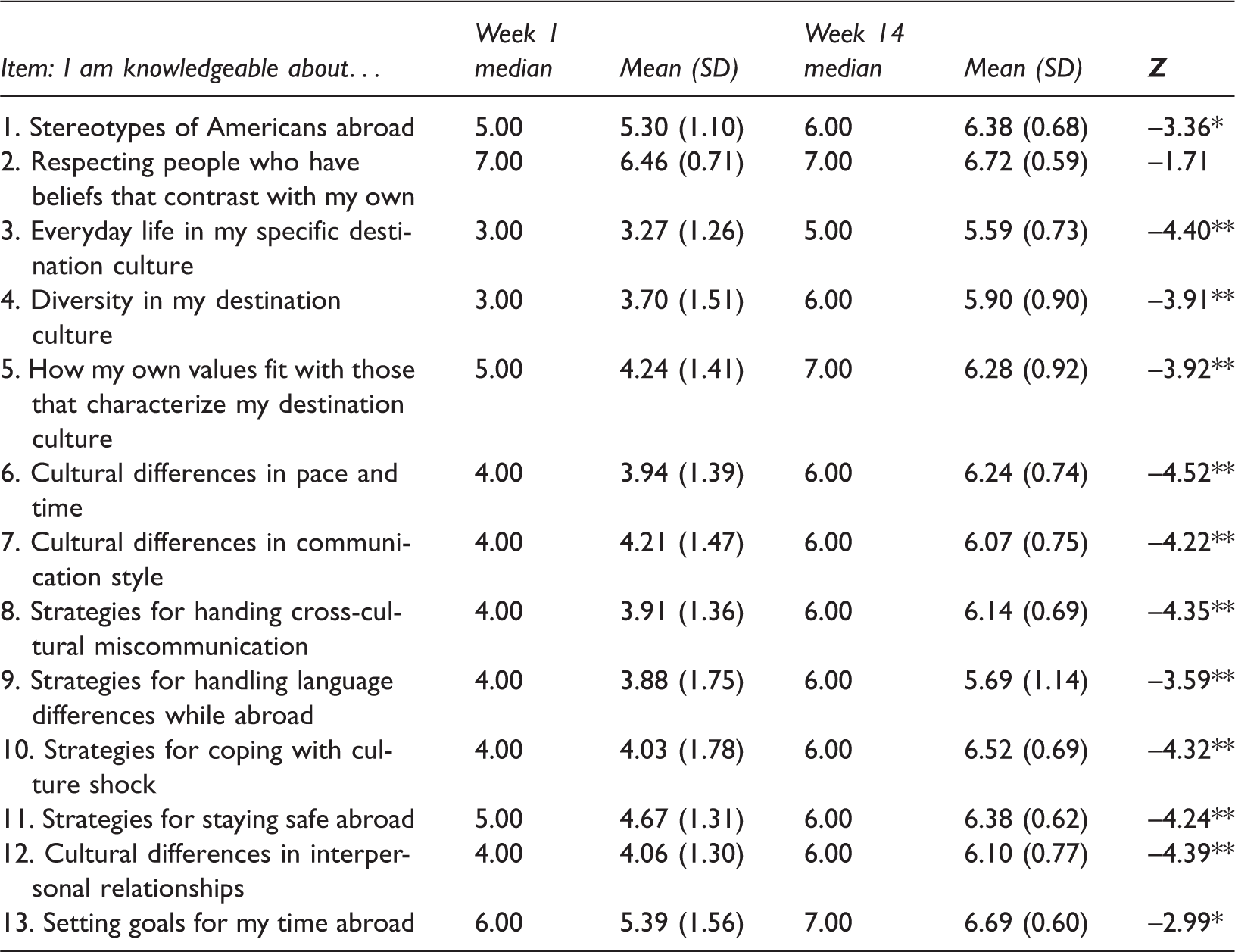
Note: *p < .005, **p < .001.
In addition to items assessing the learning outcomes, students also rated the course organization, readings, and instructor, as per their institution’s end of semester procedures. On a seven-point scale (1 = strongly disagree, 7 = strongly agree) median scores were equal to 7 for each of the items: (1) the course was well organized; (2) the readings were relevant; (3) the course assignments were beneficial; (4) assignments were graded fairly; (5) the course held my interest; (6) the instructor was well prepared; (7) the instructor challenged me to think; (8) i would recommend this course to others. The lowest mean score (M = 6.5) was for the second item regarding the relevance of readings.
Conclusions
This article detailed the goals, format, content, and assessment of a psychology-based study abroad pre-departure course. The evaluation of learning outcomes suggests that such courses may be useful in equipping students with the intercultural competencies essential for a successful study abroad experience. Students indicated gains in both culture-specific and culture-general knowledge and skills. Yet, limitations of the self-report format must be acknowledged. For example, the fact that there was no significant difference between weeks 1 and 14 in self-assessed respect for people with contrasting beliefs perhaps suggests that social desirability may be a concern in this data, since this item seems particularly sensitive to social desirability bias. According to Deardorff (2011), there is value in both indirect (e.g., self-report surveys) and direct (e.g., behavioral observations) methods of assessing culture learning. Ideally, the evaluation of intercultural training should involve multiple methods (Blake, Heslin, & Curtis, 1996) and a control group of individuals who have not undergone formal training (Dalsky & Landis, 2013). Although not specifically designed for a study abroad context, researchers might consider using standardized measures of intercultural competence (e.g., Matsumoto & Hwang, 2013) to assess course outcomes. Another approach to pre-departure assessment could focus on students’ performance on reflection papers or assignments that are assessed by individuals other than the instructor, using rubrics targeting specific learning outcomes. Assessment can also take place in-country and examine students’ behavioral intercultural competence as operationalized by task completion (e.g., academic group projects), or the performance of students in intercultural situations as observed by teachers or host family members (Mendenhall et al., 2004). Collaboration between intercultural researchers and practitioners should be encouraged in order to facilitate the implementation of multiple assessment strategies.
Overall, students rated the course organization and components quite favorably. It is possible that this is, to some extent, a halo effect, which has been demonstrated with Likert-scale course evaluations (Darby, 2007). However, open-ended comments indicate that students were genuinely satisfied with the course. One student wrote, “I probably wouldn’t be even a quarter as prepared without this class.” Another stated, “This course helped me understand my host culture on a deeper level and think about issues I might run into that I hadn’t considered before.” A third student commented, “This class helped me a lot. I feel a lot less scared now.” This latter comment raises the possibility that students who enroll in this class may have greater trepidation about studying abroad than their peers who choose not to take the course. Future research should investigate the characteristics of students who seek out pre-departure training, as these characteristics could have implications for its assessment, as well as the content and delivery of course material.
Teachers of psychology have much to contribute to preparing students for study abroad. The concepts discussed above are only a small sample of the ways in which psychology is relevant to the experiences of student sojourners. Much of the information presented here is also applicable to courses designed for students returning from study abroad, who may be at risk of a reversal in intercultural competence unless exposed to further intervention upon reentry (Rexeisen, 2015). Greater involvement of psychology faculty in study abroad preparation may encourage more psychology students to participate in and better prepare for study abroad. This is of particular importance considering the relatively low participation rates of psychology majors in study abroad programs (Schwebe & Carter, 2010; Stoloff, Good, Smith, & Brewster, 2015) and the growing need for interculturally competent practitioners and researchers in the field of psychology (Earnest et al., 2016; Mak, 2012).
Footnotes
Declaration of Conflicting Interests
The author(s) declared no potential conflicts of interest with respect to the research, authorship, and/or publication of this article.
Funding
The author(s) received no financial support for the research, authorship, and/or publication of this article.