



Abstract
This article outlines the theoretical rationale and process for an integrated-science approach to teaching sensation and perception (S&P) to undergraduate psychology students that may also serve as an integrated-science curriculum. The course aimed to introduce the interdisciplinary evolution of this psychological field irrespective of any presumed distinctions between hard and soft science. The class began with perceptual science’s foundations in Fourier decomposition and culminated in more recent developments with the perceptual science’s interest in pattern-formation phenomena from fluid dynamics, and class illustrated this transition with various applications in music, art, and materials science. Post-course responses to the Research on Integrated Science Curriculum survey demonstrated that our students made significantly large gains in course elements, specifically making the most of the students pre-existing experiences. We find that students are ready and willing to engage in the study of S&P by setting aside neuroscience’s sometimes constraining assumptions.
Introduction
This article presents an integrated-science approach to teaching sensation and perception (S&P) to undergraduate students. Integrating science provides students with science education permitting specialization but omitting the blinders of disciplinary boundaries. It requires three components: culture; recombination; and emergence. Regarding culture, integrated-science curricula seek to erase unhelpful subcultural divides as have grown between mathematics and biology (Bialek & Botstein, 2004), that is, a science of symbols and operators choreographed neatly by logical formalism, and a science of living, breathing agglomerations of cells that pursue goals (e.g., Brooks, 2005). Regarding recombination, integrated science is most plainly an attempt to draw on themes, concepts, and findings commonly associated with one scientific field and to combine them with those from another scientific field (Harrell, 2010; Padilla, 1990). Regarding emergence, integrated science proceeds on the hope that this blending of previously siloed information will lead scientists to arrive at innovative methods and models allowing them to discover what older methods and models might have been too constrictive to suggest (Gentile et al., 2012). In sum, against older habits of science training to compartmentalize our students’ knowledge and skills, integrated-science curricula ask students to bring into the science classroom a full-bodied range of skills and sensitivities. Indeed, integrated science seeks to draw on the strength of experience, making the most of what students know how to do no matter which domain they learned individual items in.
An Integrated-Science Approach to Teaching Sensation and Perception in Three Term Papers
Cornstarch-and-water suspensions provide an intriguing model system. They are non-Newtonian fluids, bearing nonlinear relationships between shear rate and shear stress: cornstarch-and-water suspensions become more viscous as they absorb greater forces. One celebrated demonstration is to pour cornstarch suspensions into the cup of a bass speaker, and to play various frequencies of a sinusoidal tone. Depending on the cornstarch-to-water ratio and on waveform amplitude, there is a critical frequency below which the sinusoidal tone will simply generate periodic waves through the cornstarch suspension, spaced according to tone frequency. Above this frequency, the suspension exhibits a nonlinear response in which the cornstarch seems, by many anecdotal accounts, to move like an animate object. The suspension grows pointilistic extensions that strike the casual observer like arms, tentacles, or “finger-like protrusions” (Merkt, Deegan, Goldman, Rericha, & Swinney, 2004, p. 184501-1). Once the suspension has escaped the cup, the monster collapses and dissolves in the absence of the acoustic stimulus below it to keep it afoot. This nonlinear response seemed as variable and diverse as any perceptual response to stimulus energy – the only constraint was that the students knew better than to endow powers of interpretation to the cornstarch suspension. So, this model system illustrated how unpredictable, creative, and persistent seemingly simple material systems can be.
The term-paper project prompted the students to engineer or enhance this phenomenon so that the cornstarch monster might be able to continue walking outside of the cup. Work on the third-term paper occurred solely in class. The students then had all of the remainder of class for the last two weeks of the semester to work on building a context that would permit the cornstarch monster to survive and walk beyond the speaker cup. Their end product for the term paper had two parts. The first part was an accounting of their exploratory experimentation. The second part was a discussion of how this exercise changed their view of S&P, addressing a number of big-picture questions for their hands-on exploration to inform. For instance, how did the context present a distributed and nested array of stimulation to elicit latent capacities for response in the cornstarch monster?
The RISC Survey
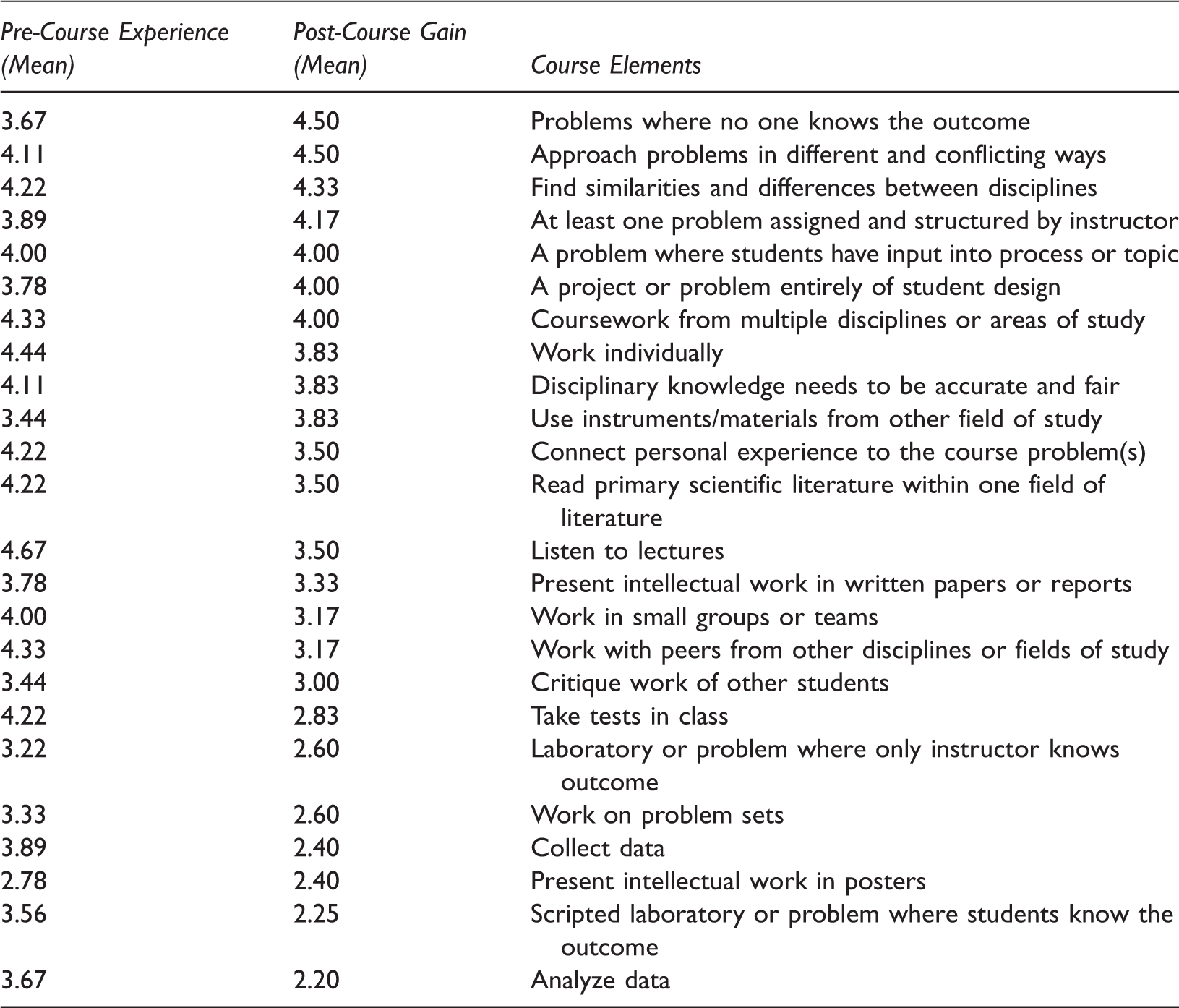
A Selection of the 48 Research on Integrated Science Curriculum Course Elements for Fall 2014
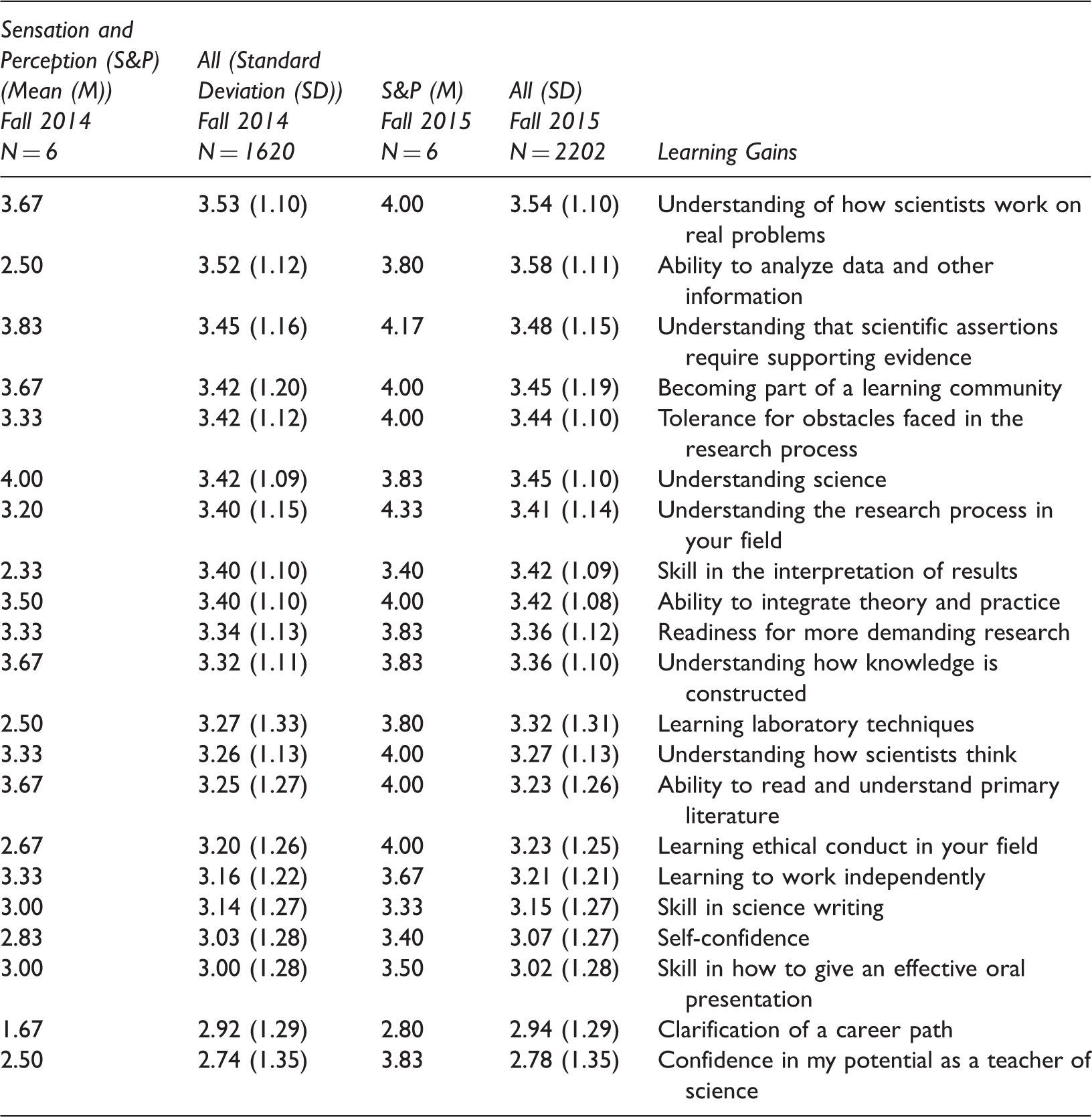
Learning Gains
To test the efficacy of our class’s integrated-science curriculum, we attended to two different aspects of the RISC responses. First, we hoped to find post-course gains significantly above 1 (“No gains or very small gain”). Additionally, insofar as integrated-science invites students to bring the full range of their experiences to bear on potentially domain-specific scientific questions, we hope to find that our class yielded greater post-course gains where students had greater pre-course skill – that is, more so than other classes with students participating in the RISC survey. Specifically, we predicted that this course would make more of the students existing skills and experience than would other integrated-science classes also participating in the RISC survey. To test this possibility, we weighted post-course gains in the RISC survey with pre-course skill ratings for students. We predicted that these weighted gains would be higher in this class than for all students taking other courses also attempting integrated-science curricula.
Method
Participants
The enrollment for the fall 2014 and fall 2015 offerings of S&P at a small liberal-arts college included nine and 19 upperclass students, respectively, having completed research-methods training in psychology or in an alternate science course. In fall 2014 and in fall 2015, nine and 18 students completed the pre-course survey. In both semesters, six students completed the post-course survey (see below: completion of RISC surveys is completely voluntary and not allowed to be tied to course requirements for grades). For the same semester, there were 1620 and 2252 students across all courses and schools in fall 2014 and fall 2015, respectively, who completed both the pre- and post-course surveys. The RISC survey includes questions about demographics, major field of undergraduate study, amount of science background, and plans for future science training. None of these questions bore on our general interest in the efficacy of an integrated-science curriculum, but we include them in the online supplemental materials (see Results).
Materials
Results
Learning Gains
The post-course gains on the Learning Gains ratings were within the 95% confidence interval of those for all students completing the RISC survey. Table 2 lists all Learning Gains, both for students in the S&P class and for all students completing the RISC survey the same semester.
Post-Course Gains
Post-course gains on the Course Elements across sections of the class (mean (M) = 3.42, standard error (SE) = 0.01) were significantly greater than the lowest possible rating of 1, t(47) = 167.14, p < 0.01. Post-course gains for Course Elements weighted with (i.e., multiplied by) pre-course skill ratings were higher for students in the S&P class (M = 12.88, SE = 0.07) than for all students taking the RISC survey (M = 11.28, SE = 0.04), t(47) = 24.53, p < 0.01. All RISC results are available as an online supplementary material at http://sites.google.com/site/foovian/PLAT-16-0043Supp.pdf.
Student Reactions
Students were very receptive to this integrated-science format for S&P. For instance, one student noted in end-of-course evaluations that “The open-ended projects were a breath of fresh air.” The projects helped the students reflect on elements of their own daily life that they had taken for granted. In the mash-up paper, one student commented “I never knew how difficult it could be to be a DJ. I have a lot more respect for producers now.” The collaborative conversations were full of impassioned observations. During the opening day of the cornstarch-monster project, students excitedly personified the cornstarch monster without any prompting from the instructor, for example, “Oh no, it wants to escape!” or “It doesn’t like that frequency.” The instructor transcribed these comments on the whiteboard as they were uttered, and students found it illuminating to see and puzzle over their own reactions. Overall, students found this approach to S&P to open their views of how science works, for example, “I liked how instead of just giving us facts to memorize, you showed us how there are progressively more complex questions and lots of different perspectives on how to answer them.”
Discussion
We hypothesized that this integrated-science framework for teaching S&P would provide a beneficial learning experience. We expected specifically to find greater-than-zero post-course gains on the RISC survey as well as to find that, compared to all courses using the RISC survey, our course was significantly better at translating pre-course skills into greater post-course gains.
These positive results suggest that the three term papers served well to carry the integrated-science values of culture, recombination, and emergence across to students in the S&P classroom. The biosketch paper helped to highlight domain-general values about the heritage of long-standing theoretical questions and the individual ways that scientists or their model systems can leave their own impressions on these questions. The mash-up paper helped to highlight how Fourier-based decompositions of acoustics can underpin the organization and re-organization of a subjective perceptual experience. The cornstarch-monster paper helped to give students the hands-on experience of engineering a perceptual system as a sometimes messy, surprising phenomenon extending into its context, producing new structures and potentially new stimuli. Overall, this S&P curriculum asked students to think twice about whether psychology-specific phenomena need psychology-specific explanations and encouraged them instead to start imagining how psychological questions embody scientific insights and principles from a wide range of domains and skills.
The present findings suggest that this format for teaching S&P may help to provide psychology students with new perspectives on psychology but also on integrating science through their own creative efforts. The results from the RISC survey speak not to divisions between hard and soft sciences but to the broader movement in science pedagogy to integrate science. Hard–soft distinctions may simply dissolve as psychology students learn to situate their domain-specific knowledge into the larger discourse of undergraduate science education. This hands-on approach inviting psychology students to learn more about engineering and materials sciences to better understand S&P further appears to cultivate student abilities in confidently developing hypotheses, searching for relevant information, and deploying proposed solutions for problems that may have no clear resolution.
Future Directions
The present work suggests that an undergraduate psychology course is well poised to provide students with integrated-science education. A longstanding focus on teaching critical thinking in undergraduate psychology teaching complements the newer vogue of integrated-science curricula (Ruscio, 2006; Solon, 2007). Further work might investigate how well this integrated-science approach fits better into other intermediate-level undergraduate courses like Cognitive Psychology, whose material boasts as much if not more diversity in its disciplinary roots as S&P. For instance, cognitive research in artificial intelligence has suggested equally the importance of pondering ancient philosophical questions and the importance of building robustly context-sensitive robots (e.g., Newell & Simon, 1976). Neither philosophy nor robotics necessarily touch upon strictly psychological research, but the blending of perspectives that worked well for S&P might help students see cognitive research in a novel and exciting light.
More generally, we expect that much of the work integrating science in psychological classrooms would benefit from a general focus on embodiment and action as an important part of psychology (Barsalou, Brezeal, & Smith, 2007; Goldstein, 2013) and on an action’s inevitable complement, namely, ecology (Gibson, 1979). What is it, we might ask when setting to work on a new curriculum, that the mind we study must do in the real world? Insofar as it attempts to zoom out and take a broader view of what scientists do when a single discipline or view alone fails, integrated science is all about recalling the kinds of behaviors that embody the articulation of any given scientific fact.
Footnotes
Acknowledgements
We acknowledge the Howard Hughes Medical Institute for generous funding of integrated-science curriculum development at Grinnell College (PI: Prof. Leslie Gregg-Jolly), as well as the invaluable support of Prof. David Lopatto and Leslie Jaworski in coordinating the RISC survey and assisting with compiling of survey data.
Declaration of Conflicting Interests
The author(s) declared no potential conflicts of interest with respect to the research, authorship, and/or publication of this article.
Funding
The author(s) disclosed receipt of the following financial support for the research, authorship, and/or publication of this article: This program was supported in part by a grant to Grinnell College from the Howard Hughes Medical Institute through the Precollege and Undergraduate Science Education Program. Award#: HHMI-52007542 (PI: L. Gregg-Jolly)
Ethics,Consent and Permissions
This article documents data from the Research on Integrated Science Curriculum (RISC) survey, for which participation is voluntary and exempted from Institutional Review Board (IRB) review. The RISC survey is administered by the Center for Teaching, Learning and Assessment (CTLA) at Grinnell College, and the CTLA regularly consults with Grinnell College’s federally compliant IRB to ensure ethicality of continued data collection.
Permission to Publish
All participants consent before completing the Research on Integrated Science Curriculum (RISC) survey to contributing their responses to the Grinnell College Center for Teaching, Learning and Assessment (CTLA) for research and publication purposes. The CTLA aggregates individual student responses into whole-class data summaries, and instructors whose students complete the RISC survey (e.g., the authors) receive this information only in terms of whole-class data summaries but receive no individual-student responses. Hence, this article only reports on class-data summaries and does not document any individual-student responses. Indeed, while the authors possess no information on individual-student responses, all individual-student responses remain secure in the records of the CTLA.