




Abstract
The purpose of the present study was to identify the core references in introductory textbooks in two sub-disciplines of psychology: social psychology and developmental psychology. One research question was the extent to which the common references in these textbooks present the trends in contemporary research in each sub-discipline. An analysis of the reference sections of 10 introductory social psychology textbooks and 15 developmental psychology textbooks found a small set of common references for each subject area. The results yielded three additional effects. First, there were more common references across social psychology textbooks than across developmental psychology textbooks. Second, authors of social psychology textbooks used journal articles as common references more often than books, whereas authors of developmental psychology textbooks used books as common references more than journal articles. Third, the majority of the core references were published prior to 2000. Implications of these findings for teachers of psychology were discussed.
The identification of core references included in undergraduate psychology textbooks is a topic of interest to teachers of psychology (e.g., Christopher, Marek, Dobbins, & Jones, 2004; Gorenflo & McConnell, 1991; Griggs, Proctor, & Cook, 2004; Whitehead, Smith, & Losonczy-Marshall, 2014). The present study sought to determine the core references included in textbooks of two sub-disciplines in psychology. Identifying common references in textbooks may shed light on the degree to which textbooks present trends in contemporary research in psychology. As a result, this information may be helpful to teachers in psychology in making pedagogical decisions as to what to include in their lectures and supplementary materials for their courses.
Specifically, the present study examined the references included in introductory textbooks for two sub-disciplines of psychology: social psychology and developmental psychology. We selected these sub-disciplines because a previous study (Whitehead et al., 2014) found a small set of core references in selected chapters in textbooks of each sub-discipline. We wanted to know the extent to which this was the case for the complete textbooks.
The identification of core references in sub-disciplines of psychology is important because it may help teachers address several of the five goals of American Psychological Association’s (2013) Guidelines for the Undergraduate Major: Version 2. For example, this study would help meet Goal 1.2, developing a working knowledge of psychology’s domains. Specifically, teachers may learn which historical figures in psychology are included in textbooks, and make sure to emphasize their links to contemporary research.
The study would also help meet Goal 2.5, incorporating sociocultural factors in scientific inquiry. Specifically, teachers will learn the extent to which the textbooks include studies on diversity. They can then supplement that information if necessary.
Information on references considered core in today’s textbooks is important also because they can be revisited to assess which references remain, and which are dropped or added as years go by. Thus, the results from this study serve as a baseline for future research on this topic.
Previous research has identified a relatively small number of sources in common across introductory psychology textbooks (e.g., Gorenflo & McConnell, 1991; Griggs et al., 2004) but, to our knowledge, no studies have examined core references in textbooks of the sub-disciplines of social and developmental psychology. The few studies providing textbook-referencing data in these sub-disciplines were limited in scope. For example, Christopher et al. (2004) found 28 common references across 10 editions of one social psychology textbook. Only 14 of these were included in two other social psychology textbooks. Whitehead et al. (2014) found no common references in one chapter across eight introductory social psychology textbooks and no common references in one chapter across six developmental psychology textbooks.
The present study extends the line of research on introductory social psychology and developmental psychology textbooks by examining the references across the textbooks for each sub-discipline. Given past research, we expected to find a small number of core references.
Method
Textbook Selection
For the social psychology textbooks, we used Griggs and Whitehead’s (2015) sample of 10 introductory social psychology textbooks with more recent editions of two texts. Copyright dates were two 2016s, three 2015s, two 2014s, and three 2012s. The textbooks were: Aronson, Wilson, Akert, & Sommers (2016), Baron, & Branscombe (2012), Baumeister, & Bushman (2014), Delamater, Myers, & Collett (2015), Franzoi (2012), Gilovich, Keltner, Chen, & Nisbett (2016), Greenberg, Schmader, Arndt, & Landau (2015), Kassin, Fein, & Markus (2014), Kenrick, Neuberg, & Cialdini (2015), Myers (2012).
For the developmental textbooks, an online search was conducted for “textbook publishers higher education.” This revealed numerous websites that were examined for lifespan textbooks. The list of textbooks derived from these sites was further reduced by: 1) using the most recent edition, 2) choosing the most comprehensive textbook from two written by the same author, and 3) choosing the chronological version if the author had written both a chronological and topical version. This resulted in a list of 15 lifespan developmental psychology textbooks with chronological formats. Copyright dates were three 2015s, four 2014s, four 2013s, two 2012s, and two 2011s. The textbooks were: Belsky (2013), Berk (2014), Berger (2014), Boyd, & Bee (2015), Crandell, Crandell, & Zanden (2013), Dunn, & Craig (2013), Feldman (2014), Fiore (2011), Kail, & Cavanaugh (2013), Newman, & Newman (2015), Papalia & Feldman (2012), Rathus (2014), Santrock (2014), Sigelman, & Rider (2015), Steinberg, Bornstein, Vandell, & Rook (2011).
Procedure
The reference sections from each textbook were scanned into plain text documents that were then converted into Excel documents with the author(s), publication date, title, source, and textbook in various columns. The references for each sub-discipline were compiled into a larger document alphabetically and a frequency count for references across textbooks was tabulated. These lists and frequency counts were checked by hand for accuracy by at least two researchers because occasionally authors would be listed with one or two initials for the same publication, or other small deviations.
The list for references in developmental textbooks sometimes showed various years of publication for the same work by the same author (e.g., Piaget’s The Origins of Intelligence of Children was published in 1936, 1952, and 1963). In those cases, it was counted as the same publication. Corporate authors, such as the American Psychological Association, were not included in the analysis.
To identify the core references in each of these sub-disciplines we used the following criteria: the references cited in 80% or more of the introductory social psychology textbooks and 80% or more of the developmental psychology textbooks are defined as the core references in each of these sub-disciplines.
Results
We tabulated the references in common for 80% or more of the textbooks in each sub-discipline. For social psychology that meant common references for 10, nine, and eight textbooks. For developmental psychology that meant common references for 15, 14, 13, and 12 textbooks. We report the number of references for the largest category of books. Specifically, the references cited in 10 social psychology textbooks are not reported in nine or eight textbooks and so forth. The references cited in 15 developmental textbooks are not reported in 14, 13, or 12 textbooks and so forth.
Frequently cited sources in social psychology textbooks.
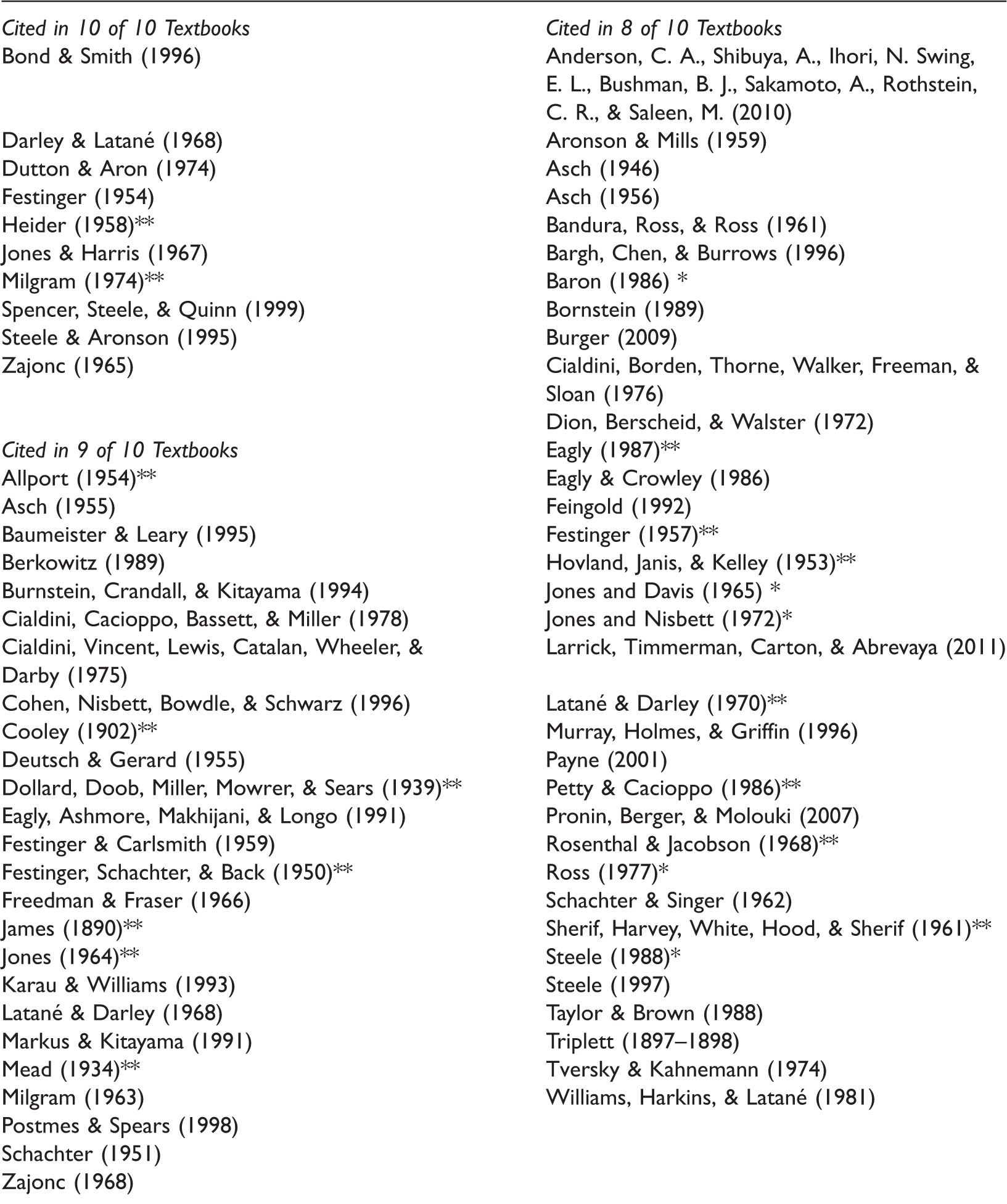
Article from a book.** Book. Sources without an asterisk are journal articles.
Social Psychology Textbooks
There were 10 common references across the 10 textbooks. Two of these references were books and eight were journal articles. The median year of publication was 1971 with a range from 1954 to 1999. There were 25 common references across nine textbooks. Seven of these references were books and 18 were journal articles. The median year of publication was 1966 with a range from 1890 to 1998. There were 34 common references across eight textbooks. Seven of these references were books, 22 were journal articles, and five were articles from edited books. The median year of publication was 1979 with a range from 1987 to 2011.
Out of the common references, 23% of the common references were from books, which had a median year of publication of 1957.5 with a range from 1890 to 1987; 70 % were from journal articles, which had a median year of publication of 1983.5 with a range from 1897 to 2011; and 7% were from articles in edited books, which had a median year of publication of 1977 with a range from 1965 to 1988. Only five of the 69 references (7%), all journal articles, were published in the 2000s.
Developmental Textbooks
There were five common references across 13 textbooks. Four of these references were books (Erikson, 1950, 1963; Erikson, 1968; Gilligan, 1982, 1993; Piaget, 1936, 1952, 1963), and one was a journal article (Gibson & Walk, 1960). Thus 80% of the common references were from books with a median year of original publication of 1959 with a range from 1936 to 1993and 20% were from a journal with a publication year of 1960. None of the references were published in the 2000s.
Comparison between Social and Developmental Psychology Textbooks
A one-sample chi-squared test indicated that there were more common references across social psychology textbooks (69) than across developmental psychology textbooks (5), χ2 (1, N = 74) = 55.35, p < .0001. Of those common references, 23% of the social psychology references were from books and 70% were from journal articles, whereas 80% of the developmental references were from books and 20% were from journal articles. Thus, social psychology textbooks cited journal articles in common more than books and developmental psychology textbooks cited books in common more than journal articles.
Discussion
The present study found a small core of common references across introductory social psychology and developmental psychology textbooks. For the small number of common references found in our sample of 10 social psychology textbooks, all were published prior to 2000. The number of common references increased for nine, and then again for eight textbooks. For nine textbooks, all of the references were published prior to 2000 and for eight textbooks five references were published after 2000. The majority of the core references were journal articles (70%) compared to books (23%).
With regard to the developmental psychology textbooks, there were no common references across our sample of 15 textbooks. No common references occurred until 13 textbooks and then there were only four books and one journal article. It is noteworthy that 80% of the common references across developmental psychology textbooks were books. These books or chapters in books were published at various times in more recent editions. All of the core references were published prior to 2000.
A question arises as to why there are so few core references across textbooks. One answer may be that textbook authors have many references to choose from to illustrate central concepts. The authors may vary in their reasons for choosing historical vs. recent references, or a specific reference. A second possibility is that some classic studies may have alternate citations in books, journal articles, and review articles. A third possibility is that the small set of common references may reflect the lack of scholarly agreement as to the core concepts that students need to be exposed to in each sub-discipline (i.e. Whitehead et al., 2014).
Textbook authors may be reluctant to examine competing textbooks in order to not be influenced by them, and certainly all textbooks do not need to be identical. There may be a need for more scholarly agreement on which investigations are important for students to learn. American Psychological Association could establish the process to reach this scholarly agreement. In the meantime, providing teachers with this information so that they can effectively plan lectures and supplemental readings to address the five goals for the undergraduate major will benefit students of psychology.
The present study was designed to provide a tabulation of the common references in two sub-disciplines in psychology that teachers can reference in preparing lectures and supplementary readings. Yet a comparison of the common references across social psychology and developmental textbooks revealed three additional findings.
First, we found more references in common across introductory social psychology textbooks than across developmental psychology textbooks. One explanation for this difference may lie in the breadth of the subject areas. Specifically, developmental psychology covers the lifespan from conception to death, whereas the focus of social psychology may be narrower. Recall that the sample of lifespan developmental textbooks we examined used a chronological rather than a topical approach. It could be then that the nature of these texts works against greater commonality in reference citation when compared to the topically organized social psychology textbooks. Future researchers may want to examine common references in lifespan developmental textbooks with a topical approach.
Second, we found the majority of common references in social psychology textbooks were journal articles rather than books, and the majority of common references in developmental textbooks were books rather than journal articles. One reason for this finding may reflect the ways in which historical figures in developmental and social psychology disseminated their findings. For example, Piaget and Erikson typically wrote books. Consequently, if an author wants to cite their theories, their only choice is books.
At this point we can only speculate on other reasons for this finding. Perhaps in the field of developmental psychology, there are more journal articles testing a theory from which textbook authors can select a reference than in social psychology. Alternatively, for social psychology textbook writers, a study may be a way of grabbing students’ attention. In this regard, Kruglanski’s (2001, p. 871) statement “A received wisdom in social textbook writing has been to go light on theory and heavy on the empirical …” may be relevant. Perhaps, developmental textbooks writers emphasize theory more than do social psychology textbook writers.
Kruglanski’s statement reminds us that one indicator of Goal 1 of the American Psychological Association (2013) Guidelines for the Undergraduate Major, Knowledge Base in Psychology, is “Use basic psychological terminology, concepts and theories in psychology to explain behavior and mental processes”. Teachers of psychology may consider the balance of theory and empirical findings presented in the core references in their textbook, as well as lecture material, and supplementary readings.
Third, we found only a few core references with a publication date of 2000 and beyond. Thus our data do not demonstrate the currency bias Griggs and Christopher (2016) found in their examination of introductory psychology books. Perhaps it takes time for new findings and theories to be incorporated into the existing structure of each sub-discipline because the research needs to be replicated. What is clear is the common references included in introductory social psychology and developmental psychology textbooks do not present to any great extent the contemporary research in either field.
Instead, the citations that are in common for the textbooks in each field of psychology reflect the pioneering scholarly works in each sub-discipline. Publications that have remained part of the core knowledge, for example Piaget (1936) and Erikson (1950) in developmental psychology and Festinger (1954), Heider (1958), and Mead (1934) in social psychology may be considered classics in their field. In keeping with Goal 1.2, of the American Psychological Association (2013) Guidelines for the Undergraduate Major: Version 2, instructors may choose whether or not to show students how these historical figures stimulated contemporary research.
A closer examination of the core references in social psychology textbooks reveals that, in addition to including references by historical figures, textbook authors include studies that stimulated a productive line of research such as Asch’s (1956) research on conformity and Asch’s research (1946) on impression formation, Darley and Latané’s (1968) research on bystander intervention, Milgram’s (1963) research on obedience, Festinger and Carlsmith’s (1959) research on cognitive dissonance theory, Freedman and Fraser’s (1966) research on foot-in-the door, Schachter’s (1951) research on deviance, and Jones and Harris’s (1967) research on the fundamental attribution error.
The more recent research includes meta-analyses on several of the topics noted above such as Bond and Smith’s (1996) meta-analysis on conformity, and Postmes and Spears’ (1998) meta-analysis on deindividuation as well as meta-analyses on other topics such as violent video games (e.g. Anderson et al., 2010). The more recent research includes several studies on stereotype threat (e.g. Spencer, Steele, & Quinn, 1999; Steele, 1997), automatic process in social psychology (e.g. Bargh, Chen, & Burrows, 1996), and replications of previous research (e.g. Burger, 2009). Many of these more recent citations focus on diversity and use newer research methods. The latter is related to Goal 2.4: describing research methods used by psychologists including the advantages and disadvantages.
In short, our findings suggest the following for teachers of social and developmental psychology. Textbooks generally cover historical figures and classic studies in their respective fields. They probably do not include the same contemporary research. Thus, if teachers want to include recent research in a field, they will need to include it in their lectures and supplemental materials.
Author Note
An earlier draft of this article was presented at the annual meeting of the Eastern Psychological Association, March 2016. The authors thank Victoria De Hoyos, Melissa DeSavage, Annastasia Forosisky, Brinkley Rayne, and Melinda Topel for their help compiling the data. We also thank Steven Blankenship, Mike Boolukos, and Duke Darrigo II for their technological assistance.
Footnotes
Declaration of Conflicting Interests
The author(s) declared no potential conflicts of interest with respect to the research, authorship, and/or publication of this article.
Funding
The author(s) received no financial support for the research, authorship, and/or publication of this article.
Notes
Author biographies
Address: 402 Tony Tank Lane Salisbury, MD 21801. Email: