




Abstract
Research on personality in the educational context has primarily focused on quantitative approaches, so this study used a mixed methods approach to capture the boarder aspects of students' learning processes. Goals were to ensure that student responses were reliable and normal (quantitative data), and to examine qualitative reflections on students’ personality scores for breadth and depth in the context of learning and achievement. To facilitate these goals, undergraduate psychology students (N = 307) completed a 50-item version of a measure of the Five Factor Model in a seminar and subsequently wrote a personal evaluation of their scores with reference to academic achievement. Quantitative analysis demonstrated that the data were reliable and demonstrated individual differences. Qualitative analysis was clustered around six themes – five personality factors and students' reflections on their overall scores. Students overwhelmingly endorsed their scores on the measure by presenting their reflective experiential narrative. Moreover, they reflected on personal strengths and challenges as they set goals for educational development. This facilitated enhanced awareness of qualities that complement ability, support learning and enhance achievement. Other outcomes included enhanced self-awareness and self-presentation and awareness of the role of traits in educational, social and emotionality aspects of their student experience.
Introduction
Personality traits have been defined as behavioural consistency over time and across situations, and with reference to hereditary components and early socialisation (Caspi, 2000; Pervin, 2003). Although traits do not account for all variance in human behaviour they do highlight enduring behavioural patterns deemed to be stable even in adolescence (Abe, 2005). They allow for the commonalities between people and the uniqueness of each individual (Allik & McCrae, 2004). The most widely used model in contemporary educational research is the Five Factor Model (FFM) of personality (Goldberg, 1999; Goldberg et al., 2006), comprised of Openness to Experience (or Openness), Conscientiousness, Extraversion, Agreeableness and Neuroticism (or Emotional Stability) (Vedel, 2014).
Personality has good potential for identifying the qualities linked to effective approaches to study and learning (Poropat, 2009; Vedel, 2014). For example, Conscientiousness captures the industrious spirit and taps motivation (Richardson & Abraham, 2009) through achievement striving and regulatory behaviours (Di Giunta et al. 2013). Openness is directly associated with intellect and captures the investigative and curious spirit that explores novel solutions (Duff, Boyle, Dunleavy, & Ferguson, 2004; Jauk, Benedek, & Neubauer, 2014; Laidra, Pullman, & Allik, 2007). Although Extraversion and Agreeableness are not as directly relevant to achievement as demonstrated in the meta-analyses, they have value in adjustment and adaptation to higher education as pro-social variables (Saklofske, Mastoras, Beaton, & Osborne 2012). Finally, emphasis on the importance of emotions in education has grown in recent years (Qualter, Gardner, Pope, Hutchinson, & Whiteley, 2012; Song et al., 2010) and this is represented by Emotional Stability or Neuroticism. Given that personality theory is extensively used in psychological and educational research (Richardson, Bond, & Abraham, 2012), it is a ready resource for the teaching and learning of psychology (Duff et al., 2004).
Framework for Learning
The large volume of research that links personality to learning (Duff et al., 2004; Poropat, 2009; Richardson et al., 2012) provides a foundation to build on for tracing the connections between learning behaviours and learning gain. However, in most if not all reported studies, the contribution of students starts and stops with the completion of personality-related self-report measures, usually including a variant of the FFM (Ackerman, Chamorro-Premuzic, & Furnham, 2011; Caprara, Vecchione, Alessandri, Gerbino, & Barbaranelli, 2011). Recent studies have called for more imaginative approaches to this research process (Poropat, 2014), and a qualitative or mixed approach are among the possibilities (Boag, 2015). Various reviews have overviewed the behavioural processes associated with the FFM that optimise learning and achievement (O’Connor & Paunonen, 2007; Poropat, 2009; Richardson et al., 2012). Di Giunta et al. (2013) argued that general personality traits translate more proximally into specific education behaviours. For students, the active and adaptive employment of their traits relates to transferring, translating and transforming their behaviours toward learning gain and achievement. Personality traits provide a framework for focus on behavioural regulation in the approach to study and learning (Duff et al., 2004).
Contextualised in Theory
The value of this study for teaching and learning psychology starts with the theoretical basis for the FFM (Goldberg, 1999; Goldberg et al., 2006), and its anchorage as a central component of individual differences (Pervin, 2003). Personality theory facilitates the presentation of both the biological basis and the cross-cultural commonality of the model (Pervin, 2003; Allik & McCrae, 2004). Within an educational context the model offers both direct and indirect links to learning and achievement (Mcilroy, Poole, Ursavas, & Moriarty, 2015; Poropat, 2009; Vedel, 2014), and impacts directly on educational choices, including choice of study programme (Sánchez-Ruiz, Pérez-González, & Petrides, 2010). What makes the personality construct appealing is that it not only captures a broad spectrum of human behaviours, but it is also measurable, operational and testable (Gow, Whiteman, Pattie, & Deary, 2005; Rosander & Backström, 2012). When the FFM is used in self-reflective exercises as in the present study, students can overview the content and apply it currently, retrospectively and prospectively at a personal level. The FFM has been applied in spheres as varied as work, stress, health, leadership, career and education (Matthews, Deary, & Whiteman, 2009). Teaching principles related to the FFM allow the presentation of a model that has a robust theoretical anchor point (Goldberg et al., 2006), and a strong empirical basis related to education (O'Connor & Paunonen, 2007; Richardson et al., 2012). Personality theory allows tutors to show where it is situated within psychology and how it can easily transfer into applied spheres as highlighted above.
Appropriated into Ownership
One of the key principles in learning psychology is that students would acquire ownership of their learning (Todd & Mcilroy, 2015). According to Rainer and Matthews (2002) definitions of ownership include both choice and voice, but also exploration of content domain, engaging in the pursuit of challenging content, a critical approach and the opportunity for self-assessment. Psychology students are in a privileged position in this process because of the empirical nature of the topic. The present study offered students the opportunity to work their personalised, reflective exercises into a theoretical base and an empirically validated measure in the form of the FFM (Gow et al., 2005). Although the model is typically used through quantitative research instruments (Trapmann, Hell, Hirn & Schuler, 2007), this study provided the opportunity for students to use the instrument in an ideographic way by reflecting and applying items and factors to processes such as trouble-shooting and goal-setting.
Personalised Cycle of Learning
A laudable goal in higher education is to support students toward independent work alongside collaborative learning activities (Hugh-Jones & Madill, 2007), and closely allied to that is the concept of ownership of learning (Rainer & Matthews, 2002). In almost any form of learning students can take ownership and stamp their individuality on their work. In preparing course work students can develop creativity in the selection and arrangement of materials and in designing the narrative constructed around them. They can also work systematically through the processes and stages that allow them to develop critical and holistic thinking (Allbutt, Becker, Tidd, & Haigh, 2008). Psychology is in a strong position to support these processes through self-reflective exercises, especially when these are based on validated tests (Furr & Bacharach, 2008) as in the present study. When participants are given the opportunity to complete, score, interpret and apply their own scores and findings, they have a unique opportunity for ownership through self-evaluation as highlighted by Rainer and Matthews (2002). Moreover, when this process is linked to a theoretical framework and validated measures then an iterative cycle of integrated learning can be completed (Allbutt et al., 2008). In a recent study involving student interviews, Entwistle and Ramsden (2015) continued to advocate that a meaning rather than a reproducing orientation, complemented with a strategic rather than non-academic orientation, were advantageous to effective learning. They also postulated that a balanced and integrated personality was consistent with deep and effective learning.
Integration of Methodologies
The overwhelming majority of personality research has been based on and built on self-report and psychometric measurement in a quantitative approach (O’Connor & Panounen, 2007; Poropat, 2009). However, Boag (2015) has been imaginative in suggesting a qualitative approach to personality assessment. Therefore the present study has integrated qualitative and quantitative methodologies through the use of an FFM measure (Goldberg et al., 2006) with reflective exercises that allowed students to construct a personalised narrative around their academic experience. This facilitated linking metrics to content and mathematics to narrative (see Furr & Bacharach, 2008). The added value in this approach builds on processing numeracy and literacy independently, and then in tracing the links between the two through integration, interpretation and application.
According to Johnson, Onwuegbuzie and Turner (2007), we are living in a research world that is configured by three methodological paradigms: qualitative, quantitative and mixed. In the latter the approach can be dominated by either qualitative or quantitative or a mixed balance of the two. They trace the philosophical roots of each approach and conclude that there is scope in research for all three approaches and perspectives. They assert that at the decision-making stage, full contingency theory should be taken into account, that is when and under what circumstances should each methodological perspective be taken into account. After drawing from definitions of mixed methods research provided by a full range of experts, they argue that the use of two or more methods can lead to convergence of findings and thus reduce the likelihood of methodological artefact. They further assert that between- or across-method triangulation ensures that more confidence can be placed in a proposition if it can survive the test of a variety of measures in spite of inherent error.
In summarising the value of mixed methods research, Johnson et al. (2007) conclude that such an approach can allow the methods to inform and complement each other at each stage – design, collection, analysis and interpretation. The method adopted for this study may be described by one of the many terms previously used including blended research, integrative research, mixed research or triangulated research. However, the term commended by Johnson et al. is ‘mixed research methods’ as this is probably the most popular and allows the term ‘methods’ to be seen in its broadest sense, and facilitates ‘breadth and depth of understanding and corroboration’ (p. 123).
Summary of aims
In addition to students presenting their personal narrative in response to their scores on the 50-item version of the FFM measure, they were given the opportunity to engage with a deeper understanding and personal reflections than they would have done as exclusively research participants. The project offered a structured and supported opportunity for developing self-awareness, knowledge and understanding and greater preparedness for self-presentation in a manner that would optimise employability (Yorke & Knight, 2006; Yorke, 2010). At a trait level the researchers explored issues such as the differences across scores, the individual differences within each trait score, the inter-correlations between traits and whether any scores emerged as particularly salient for the sample. However, at an ideographic level each student explored whether they had specific prominent traits or perceived their individuality as a balanced mix of traits. As noted, Entwistle and Ramsden (2015) concluded that a balanced and integrated personality was optimal for approaching study and learning. Their conclusion was based on observation from their empirical work and resonates with the research consensus indicating that achievement is based on a varied mixture of qualities and characteristics that include motivation, behaviours, self-regulation, emotional regulation etc. (e.g., Conard, 2006; Richardson et al., 2012).
A key issue for students was to explore whether their traits were translated and expressed in academic behaviours with reference both to strengths and challenges. This would in turn enhance understanding of how non-intellectual individual difference variables are vital in supporting learning and achievement (Laidra et al., 2007). It also afforded students the opportunity to engage with the instrument at a deeper level of processing and understanding, and to use their personal findings in self-knowledge and self-presentation.
Method
Participants
The opportunity sample was comprised of N = 307 undergraduate psychology students in the second year of their degree programme (mean age = 20.56, SD = 3.44), and the sample was made up of 80% females. Participation in the study was part of an assessed course requirement although students were at liberty to withdraw their personal data from the study.
Design
This was a mixed methods study in which the data were collected at two time points. First, students completed the 50-item version of a measure of the Five Factor Model (outlined below) as the quantitative aspect of the study. Around two months later, the qualitative component was available when students submitted their personal responses and evaluation of their scores.
Measures
Five Factor Model (Goldberg, 1999; Goldberg, et al., 2006)
This version of the FFM is a measure comprised of 50 items with five subscales, e.g. ‘I am the life of the party’ (Extraversion), ‘I feel others’ emotions’ (Agreeableness), ‘I follow a schedule’ (Conscientiousness), ‘I get upset easily’ (Emotional Stability) and ‘I have a vivid imagination’ (Openness to Experience). All items are presented with a 5-point Likert response format with linked anchor points ranging from 1 = Very Inaccurate to 5 = Very Accurate. Some items are reverse scored and each factor has 10 items. All five subscales elicited high reliabilities within this study: Openness, Emotional Stability, Conscientiousness, Agreeableness and Extraversion (respectively, α = 0.79, 0.85, 0.88, 0.81 and 0.87). The validity of this FFM version has been demonstrated with three different adult samples, evidencing good concurrent validity with other personality inventories and justification for a five factor solution (Gow et al., 2005).
Procedure
In the first phase of this study, students completed the 50-item version of the FFM self-report measure within a seminar in which they were guided in scoring and interpretation. Their data were submitted at the end of the session with detachable scoring sheets, while students retained the scored self-report measure and used this for their write-up and course work submission. Students subsequently submitted their course work after two months, giving them adequate time to evaluate their scores and write a personal profile of 400 words as part of their assessed course work and this accounted for 15% of their grade. The brief given to the students for this reflective task included guidance on interpreting and applying their scores on the FFM measure and comparing scores across the five factors. They were asked to evaluate whether they concurred with their scores, and if their findings were consistent with their approach to learning and assessment. In addition they were asked to provide examples of where their scores suggested points of challenge for adaptive change and points of strength for consolidation. Moreover, they were asked to ponder whether this task enhanced their ability for self-presentation, for example to potential employers. Finally the potential problem of social desirability was highlighted to the students with emphasis on the fact that only authentic responses would enable them to write an honest and comprehensive self-evaluation.
The activity was given ethical approval by the researchers' institution and students were free to withdraw their data from the study if they so desired. Student course work was submitted by their student numbers rather than names and this enabled the whole exercise to remain anonymous for research. However, students were under no obligation to allow their responses to go forward for research purposes and could later withdraw consent for use of data up until the end of their academic year. Quantitative data analysis on student responses included exploring indicators of normality and reliability and testing the associations between the factors to ensure independence. For the qualitative analysis, a simple thematic approach was used based on the five factors of the FFM: Openness, Conscientiousness, Extraversion, Agreeableness and Neuroticism/Emotional Stability. Given that students had to provide a personal evaluation of their scores, Overall Personalised Narrative provided a sixth theme. Comments used in the analysis were selected based on low, medium and high scores on each of the five factors and also the use of comments that were recurrent and typical as well as some that were unusual, such as one student justifying a low score on Agreeableness.
Results
Correlation coefficients, descriptive statistics and reliabilities for personality-related measures (Five Factor Model).
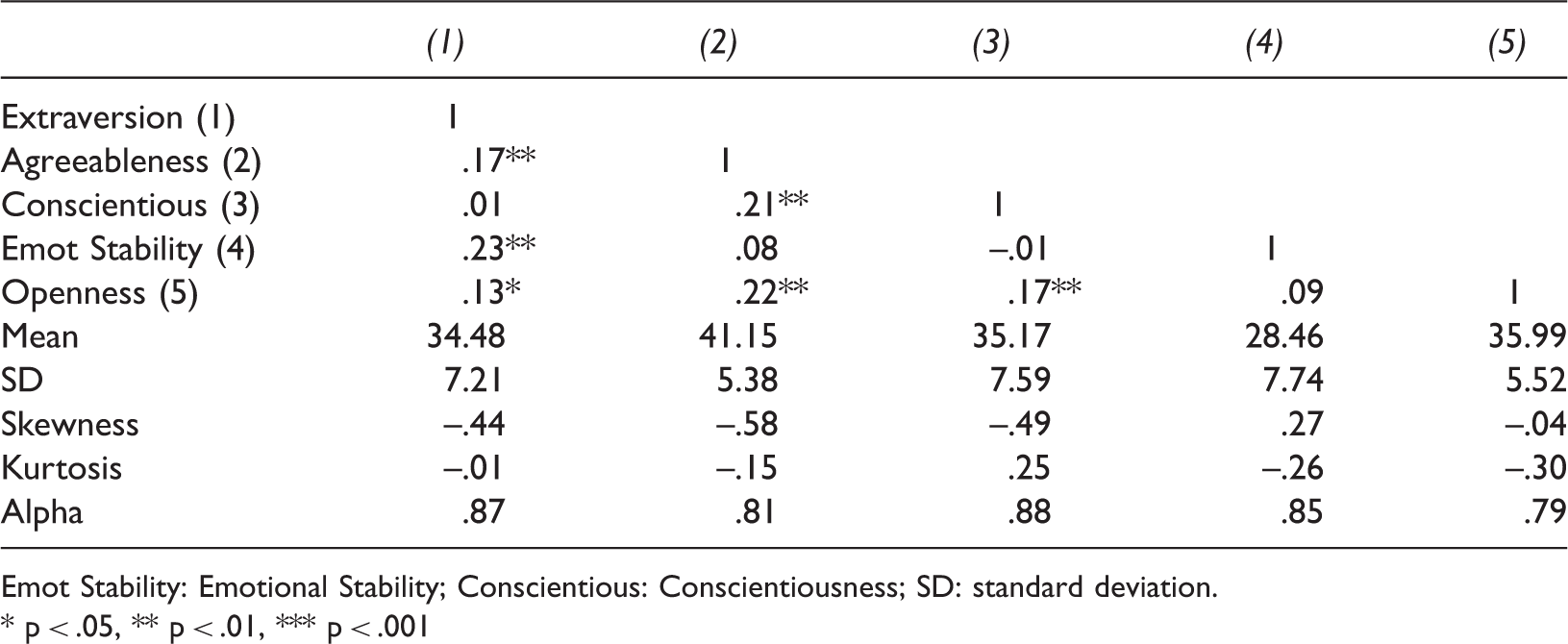
Emot Stability: Emotional Stability; Conscientious: Conscientiousness; SD: standard deviation.
p < .05, ** p < .01, *** p < .001
Qualitative Responses (Thematic)
In the first section below, students reflected on the overview of their scores holistically, and in the sections that follow they reflected on each of the five factors individually. Students were not given rigid questions to follow but examples of prompters are linked to each heading below. They were asked to address the factors with reference to their scores and in the context of their educational experience.
Overall personalised narrative – general overview of all your scores as a whole
Students’ personal endorsement of their scores provided a personalised narrative for the FFM with almost all believing their scores reflected their dispositional tendencies, and this was typified in the summary from the following students: These scores tend to match my personality fairly well My scores are representative of my character The FFM gives a good indication of my personality. My personality traits complement each other No score suggests I have any extreme personality traits. I have attributes on the extreme end of the scale, but at both ends My attributes have a tendency to counteract on each other.
Openness to experience – address your use of freedom in learning, willingness to explore an independent approach to your work
Openness is one of the two variables deemed most educationally relevant (Duff et al., 2004; Laidra et al., 2007) and students reflected on its value both for academic and life-wide learning. They recognised the value of Openness for adaptation to higher education and one typical student reviewed their university experience to date with pleasure and satisfaction: A valuable and enjoyable experience, meeting new people and confronting new challenges. I am open to change and value diversity. I am not a person who likes to explore and challenge myself I will stick to what I know rather than explore new possibilities.
In direct contrast, some perceived the qualities of Openness as a challenge to pursue: I will have to ensure that I am adaptable and versatile, and that I have a flexible approach. Not a good trait to have … I could work on this.
Conscientiousness – address your capacity for organisation, planning, regulation and routine
This is the other important educational trait and students recognised it as essential and were able to identify their strengths and challenges based on their scores. One summarised: I plan and organise well and am thorough and hardworking I respect order and always plan ahead I am reliable … I can work on a demanding schedule. I struggle with time management and get easily distracted I suffer from a lack of work ethic, caring too much for the social aspects of life I constantly find myself planning late, leaving deadlines late. I must start changing my ways soon as this trait can be traced back at least 5 years. get the best out of my ability and have enough time to develop. I need to work on my being inflexible and distressed when thrown off course. My flaws include being a perfectionist and overloading my routine with too many extra-curricular activities.
Extraversion – outline your inclination to sociability, talkativeness, impulsivity, novelty, risk taking in the educational context (or the opposite of these)
This is one of the two sociability traits and positive themes emerging from the data in relation to Extraversion include sociability, communication skills, adaptability to new situations and team work. Some students revelled in the good qualities their scores indicated: I am a sociable, talkative person who adapts well to new situations with great communication skills and the ability to work in teams.
In contrast, introverts felt disempowered by their introverted tendencies: I find it extremely intimidating to speak to a classroom of students, even in small groups I can be shy … something I need to work on as I am not a natural leader.
However, introverts did not typically identify their strengths in learning such as discipline and resistance to distraction. Modesty may be part of their nature, leaving them the challenge of positive self-presentation. Ironically, extraverts were more overtly likely to recognise the value of the qualities associated with Introversion as indicated below. However, it should be noted that the sample is oriented toward Extraversion as the mean score is nested on this side of the scale.
High scoring extraverts identified challenges in relation to being dominant, monopolising discussion, and easy distraction from important tasks: I tend to put my opinions across sometimes too heavily … often act before I think I must give those around me a chance to reciprocate, as I tend to go off on a tangent.
Agreeableness – address your inclination for acceptance of others, cooperation with others, support for others in the context of education
High endorsement of this sociability trait was highlighted in Table 1 and individuals saw advantageous repercussions for learning and working in groups, creating a workable environment and approachability through acceptance and understanding. Typical endorsements include: I am approachable, considerate and trustworthy – important to create a consensus and a workable environment Meeting new people and performing tasks in groups is satisfying … seeing others enjoying themselves or accomplish challenges is refreshing. Would like to be seen as approachable and for people to feel comfortable to confide in me. I could be open to manipulation and abuse … need to work on being a bit firmer with others in order to be cruel to be kind. Willing to agree, conform, understand and be empathic … but refuse to feel pressurised into accepting someone else's values I want to be taken seriously … not for people to think I am a pushover and to take advantage of my niceness Team work is one of my best qualities, but I must be careful that I do not ignore real problems or overlook injustices. My score is low but I am not totally disagreeable … I am willing for people to challenge themselves … and this makes progress with them.
Emotional stability/neuroticism – outline how your emotional experiences have helped or hindered your progress in learning
Data suggests that students are clearly sensitised to their emotions and their associated cognitive processes. Some felt vulnerable in their fluctuating or elevated emotions and yet recognised the value of emotions in motivation and reward. Many focused on the link between emotional regulation and adaptive planning as the way ahead. Students focused on their emotions and the relevance of those in education and in life generally in terms of their success in emotional regulation with reference to their scores. Some students enjoyed their emotional experience: I exhibit my emotions . . .this pleases me … better than being inactive I am passionate rather than flat and that is positive … I do not become too distressed over deadlines. I am calm and tend not to over react to things My score is good … I cannot become unhinged or volatile or take things personally. My high score suggests I am vulnerable, and easy to experience emotions such as guilt, anger and anxiety. I need to work at calming this trait I find it hard to keep myself relaxed … always very restless and stressed … can easily let my anxieties take control over me and lose my motivation. can result in lack of sleep as my motivation is affected by worry.
Discussion
A mixed methods approach to personality in the context of education provided a unique flavour to the study with reference to the incorporation of a qualitative dimension. At the quantitative level, all the indicators reported in Table 1 are testament to the good quality of the data. However, because the study was also ideographic and qualitative, each student passed their verdict on the measures with reference to their personal experience and observation. This ensured that students were afforded the opportunity to engage actively with deeper understanding (Allbutt et al., 2008), and this verifies the practical usefulness of the measure (see Furr & Bacharah, 2008). The FFM is an available and validated tool for use in both teaching and research (Goldberg, 1999; Goldberg et al., 2006).
Given that self-report measures can elicit social desirability responses (Szafranski, Barrera, & Norton, 2012), the seminar tutor presented a brief to encourage students to be as authentic as possible. The challenge for tutors at this point is to provide a clear brief to help minimise the problem. However, reported comments indicate that many students were transparent, for example in their need to improve on Conscientiousness. In administering personality tests and requiring student feedback there are always ethical issues to consider, and the first is to ensure ethical approval is obtained as in the present study. Students were required to submit their scores and comments as part of an assessed task but were free to withdraw their data from the research project. However, none did this especially after reassurances that no student would be named or traceable from the reported findings.
Recent reviews have highlighted some challenging limitations associated with exclusively self-report approaches to personality assessment (Boag, 2015; Poropat, 2014). Therefore, qualitative evaluation of the measure was invaluable with only one student questioning the adequacy of their trait scores. Typical responses indicated concurrence with scores, with students concluding that they represented their personality and behaviours fairly well. The exercise facilitated the opportunity for students to become more self-aware and more competent at self-presentation, with advantageous knock-on effects for employability (Yorke & Knight, 2006; Yorke, 2010). The students completed the measure as part of their assessment process and this provided the opportunity for depth of engagement with the set task.
The focus in previous personality studies in education has predominantly been on the association between traits and Grade Points Average (Farsides & Woodfield, 2003; O'Connor & Paunonen, 2007; Poropat, 2009) without reference to how the students themselves may perceive or trace the linkages between the two. This study in contrast allowed individual students to evaluate how their approach/avoidance behaviours might facilitate/debilitate the processes of learning and achievement. They did this with reference to their scores on each trait as their starting point in identifying strengths and challenges for progression in development and achievement.
As noted, Entwistle and Ramsden (2015) acknowledged the important role of an integrated and balanced personality in quality learning through a meaningful and strategic orientation approach to study. They based their assertion for this on their observed outcomes. Their observation is both intuitive and evidence-based because achievement stems from a spectrum of individual differences working together (Conard, 2006), and Richardson et al. (2012) demonstrated clearly from overviewing a series of meta-analyses that only a mixture of qualities and competencies can account for good achievement. However, Entwistle and Ramsden (2015) also provided a challenge for tutors to facilitate and stimulate these processes through creating appropriate structural contingencies. These, they argue, include good teaching, freedom in learning and assessment that is appropriate and not overloaded.
Openness emerges as significantly related to achievement in some studies (Richardson et al., 2012) but not in others (Farsides & Woodfield, 2003). In the present study some students saw this trait as a fulcrum for their academic growth as they highlighted such components as change, exploration, adaptability, versatility, or even saw their score as a trigger for new directions. In contrast some low scorers felt more secure in maintaining the status quo, preferring to remain within the safety and security of what had worked for them. The value of Openness may be in the spirit of curiosity, exploration and independence embodied within it (Duff et al., 2004; Mcilroy et al., 2015), impacting on lifelong and life-wide learning. This resonates with Entwistle and Ramsden’s (2015) postulate on freedom in learning.
In contrast to Openness, other students may prefer a curriculum that is more rigidly imposed, and this is consonant with the regulatory and mechanistic processes linked to Conscientiousness (Di Giunta et al., 2013). Students evidently valued this trait because of dimensions such as reliability, scheduling, planning and organisation. Others expressed disappointment at their low score, recognising the need to bring order, punctuality, promptness rather than procrastination into their scheduling. For many students this variable represented their greatest challenge and most disappointing score, although some identified potential pitfalls linked to Conscientiousness such as perfectionism, overloading and no allowance for small shortfalls (Cucina & Vasilopolous, 2005). Students were open about their struggles with sustaining conscientious behaviours, and one summarised that Conscientiousness did not come naturally to her. The challenged for tutors may be to help students find a balance between the freedom indicated by Openness and the discipline encapsulated by Conscientiousness.
Extraversion has also been positively related to the educational process because of its link to energy output, but this is countered by the distraction of social activities (Eysenck, 1992). However, given that group work is valued with reference to employability (Yorke, 2010), Extraversion is deemed important for the wider student experience. One student felt intimidated about speaking out even in small groups and another felt that introverted tendencies disqualified her naturally from leadership, but all appeared willing to work on the challenges their scores suggested. Conversely, many valued Extraversion’s positive qualities reflected in their scores. These included communication skills, adaptation to new situations, team work and sociability, while recognising challenges related to talkativeness, dominance and easy distraction from essential tasks.
Although the evaluation of groups or team work was not a goal in this study, the importance of Extraversion, and also Agreeableness, to team work was highlighted by a number of students. This may suggest that tutors could take personality diversity into account when allocating students to groups. Yorke (2010) concluded that graduate skills or employability ‘faces universities with the need to build them into curricula while at the same time not diluting the academic content’ (p. 8). He argues that in conjunction with lectures, students can be set curricular tasks requiring collaboration in problem-solving (cf. Yorke, 2016). He further argued that a group based approach can be envisaged while embracing the challenge of this in relation to assessment. For tutors who would like to pursue strategies for allocating students to teams, a recent study has presented and validated the Teamwork Quality Scale (Meslec & Curşeu, 2015) to assist in the decision-making process.
Although Agreeableness has not frequently been given prominence in educational studies (O'Connor & Paunonen, 2007; Richardson et al., 2012), there have been exceptions to the rule (Vedel, 2014). As a pro-social variable, Agreeableness may be operative adaptively through attendance at learning sessions and adherence to tutors' instructions (Lubbers, Van der Werf, Kuyper, & Hendriks, 2010
With reference to Emotional Stability or Neuroticism, its role in education has gathered momentum in the last decade (Song et al., 2010) in factors such as recovery, resilience and retention (Parker et al., 2006). An imaginative approach would be to evaluate the wider implications of Neuroticism. For example, students often have to move away from home for university study, meet new friends and experience various aspects of transition (Winstone & Bretton, 2013) that require emotional adjustment. Challenges that emerge are reflected in comments that include overreaction, for example to poor marks or perception of inadequate feedback (Todd & Mcilroy, 2015), impetuosity, vulnerability, emotional self-management in guilt, anger, anxiety, distress over deadlines and on the need to ‘calm the overall trait down’, as one student observed. Some students saw the value of negative emotions (McKnight & Kashdan, 2009) as a trigger for preservation or as motivation for change and improvement. For some, negative emotions under regulation serve an adaptive purpose in motivation and are preferable to emotional flatness. For others, being calm and relaxed and able to sustain steady mood was their optimal state for progress. This touches on a key point of the study – students recognising their individuality and making their traits and disposition work in their favour rather than accepting a universal formula assumed to be optimal for all. Poropat (2014) argues that the relationship between personality and performance is complex, interesting and potent and that there remains much more to be learnt about it.
In the quest for the ingredients that make a successful graduate, Smith and White (2015) have focused on fixed background bio-demographic characteristics such as birth characteristics, geographic characteristics, ethnicity, previous achievement and subject choice. Their approach is based on probabilities that a student will attain a higher degree classification based on these fixed factors, and the probability of success will go up or down according to this background profile. In contrast, the present study has focused on more fluid individual differences that can allow students to progress through personal agency. This approach is highlighted by Thoutenhoofd and Pirrie (2015) who focus on the internal characteristics of students in the construction of self in the context of learning and growth. However, they critically evaluate what they argue is an implicit difference between self-regulated learning and learning to learn. They suggest that the former is frequently understood with a narrow definition of the cognitive function of individuals, whereas learning to learn captures a ‘reflexive social epistemology of learning to learn’ (p. 73). They advocate an approach to learning that does not over emphasise personal autonomy, agency and responsibility in the pursuit of predetermined educational goals, and rather postulate a balanced approach that incorporates learning as a social performance.
The present study is contrary to the fixed approach adopted by Smith and White (2015) and is consistent with the more fluid approach advocated by Thoutenhoofd and Pirrie (2015). However, the study is congruent with their emphasis on the balanced approach that allows students to adapt to learning in a social environment. Although the Five Factor Model includes factors that are associated with a cognitive approach to learning (namely Conscientiousness and Openness to Experience), it also includes factors that incorporate the social elements (Agreeableness and Extraversion).
Summary and Conclusion
This study offers the prospect of improving the learning and teaching of psychology in a number of ways.
Encouraging students to evaluate theory in a practical and personal manner by reflecting on their personality scores, using a validated measure, and relating it to their educational and personal experiences. Demonstrating that the use of a mixed methodology can provide a rich set of data through integrating general trait and personalised approaches, as well as qualitative and quantitative analyses. In doing so students are given the wherewithal to integrate thinking and demystify the research and analysis process. Johnson et al. (2007) concluded that such mixed methods research provides a practical and intellectual synthesis that is well set to offer outcomes that are informative, complete, useful and balanced. Participative learning opportunities allow students to engage in deeper learning through an interrogative and interpretive approach to applying psychological concepts. Although this may be seen as challenging for academic staff, designing and constructing such learning opportunities would enhance classroom practice by pulling together psychological and pedagogical practices. Empowering students to take ownership of their learning encourages them to stamp their individual and unique traits to maximise their potential and improve their self-efficacy. In attempting to understand their unique characteristics, students can discover how this can support learning, complement ability and optimise achievement (Pintrich, 2000; Tuckman, 2003; Zucho & Pintrich, 2003). Reflecting on their strengths and challenges that emerge from their scores allows students to apply this understanding to the full range of learning opportunities and assessment tasks. Engaging in this research opportunity allows students to develop a deeper understanding of self-knowledge, self-awareness and articulation in self-presentation.
Any future work in this area should include a follow-up study to ascertain whether enhanced self-awareness would translate into adaptive changes in academic behaviours. In addition to using this material with students of psychology, an extension of this work to include students from other disciplines might show that personality factors influence discipline choice.
Footnotes
Declaration of Conflicting Interests
The author(s) declared no potential conflicts of interest with respect to the research, authorship, and/or publication of this article.
Funding
The author(s) received no financial support for the research, authorship, and/or publication of this article.