




Abstract
This study examined trends in how psychology internships are supervised compared to current experiential learning best practices in the literature. We sent a brief online survey to relevant contact persons for colleges/universities with psychology departments throughout the United States (n = 149 responded). Overall, the majority of institutions offered academic credit for internships through letter grading and had one faculty member supervising all psychology interns. The top three academic requirements for internship courses included: completing a reflection paper; completing a work diary; and individual meetings with the faculty supervisor. Although these practices promote experiential learning, one opportunity for improvement is promoting students’ professional development. Psychology departments can use these findings to inform their institution’s internship course design.
For psychology majors, internships can be a critical aspect of their undergraduate careers. Internships can provide students with a realistic job preview of careers in psychology and an opportunity to learn and practice professional skills in an applied setting. These are skills that employers value in prospective hires (Landrum & Harrold, 2003). Internships also promote employability by bridging the gap between the classroom and work environment (Shoenfelt, Stone, & Kottke, 2013). According to best practices in experiential learning, internship courses need requirements that promote ongoing student reflection on their work experiences (Kolb, 1984). For example, best practices may include individual meetings with a faculty sponsor, group discussions, or work diaries (e.g., Barber & Bailey, 2015; Blanton, 2001). However, the extent to which these practices are implemented is unclear.
In this study, we examined how current practices in undergraduate internship supervision match these best practices. Specifically, we gathered descriptive data regarding how psychology departments in the United States provide internship supervision to their psychology majors. We examined the following aspects of internship supervision: course design characteristics (grading and typical academic requirements beyond the internship itself); and the faculty supervision approach. The academic requirements and course structure reflect the internship course’s framework and goals for experiential learning. In examining these aspects, we compared current practices in internship courses to recommendations from the literature on internships and experiential learning.
Using the literature on best practices for internships and career preparation for psychology majors, we have identified four main considerations influencing the design of undergraduate psychology internships (see Figure 1). First, career preparation can be informed by qualities (i.e., skills and abilities) that employers value. In a survey on the most desirable employee qualities, employers from various psychology-related industries prioritized listening skills, willingness to learn, and the ability to get along with others and work as a team (Landrum & Harrold, 2003). Similarly, the qualities most highly valued by employers were leadership, ability to work in a team, and written communication skills (National Association of Colleges and Employers, 2015). The value of interpersonal skills and motivation are supported by the employability literature (Appleby, 2000; Hogan, Chamorro-Premuzic, & Kaiser, 2013).
Factors influencing the design of undergraduate psychology internships.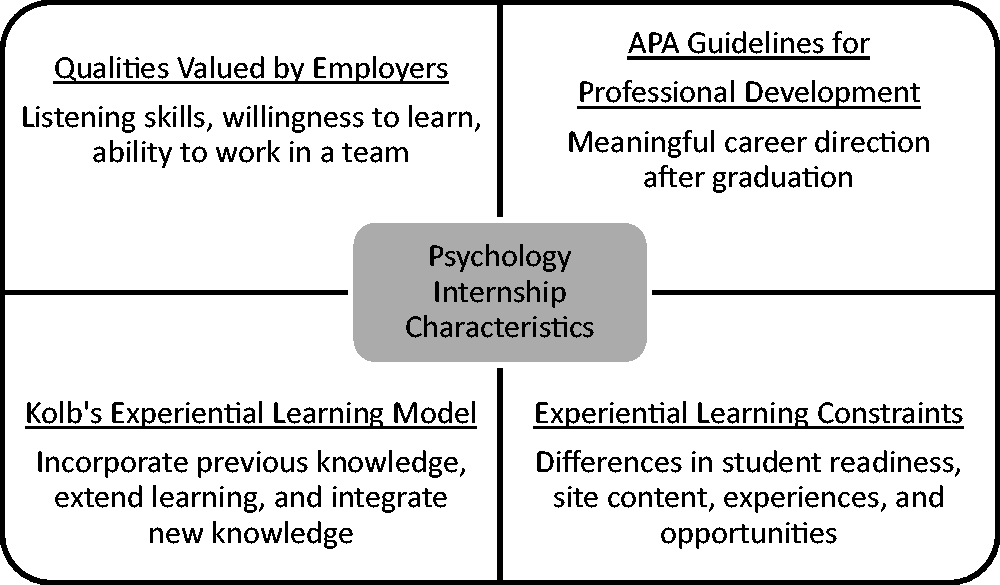
Second, the American Psychological Association (APA; 2013) guidelines for the undergraduate psychology major emphasize similar qualities in their professional development learning goal. In addition, the APA identifies “meaningful professional direction after graduation” as a valuable area of professional development. Many of the competencies that define meaningful professional direction overlap with opportunities in internship courses. For example, internship students can learn more about “settings in which people with backgrounds in psychology typically work” (APA, 2013, p. 35) by interviewing their colleagues. Internships also provide the opportunity to have students create resumes and update them to document the skills gained in their internships.
The experiential learning model (Kolb, 1984) is a third valuable source of best practices in designing internship courses. Per the experiential learning model, students incorporate previous coursework and training, extend psychological knowledge, and implement new knowledge during these requirements. Instructors could apply this model to internship courses by having students connect their internship activities with psychology course content in written reflections, group discussions, or research papers.
Finally, constraints on experiential learning practices inform internship design. Although the experiential learning model presents opportunities for developing content, internship courses can differ on student readiness, resources, and opportunities (Barber & Bailey, 2015; Fernald et al., 1982). For many undergraduates, an internship course may be their first experience emphasizing self-directed learning. Thus, students must exhibit some readiness to show personal initiative in completing course requirements and successfully managing relationships with an internship site. Another challenge in internship courses is the variability in opportunities at sites; what one student is able to do, another may not. Therefore, instructors may not be able to require specific activities or experiences for the course. To address these challenges, instructors must think proactively about internship requirements that keep students engaged in a self-directed learning environment. They also must emphasize the course’s learning objectives across various internship tasks and activities.
Internship Course Design Characteristics
Departments may differ on whether they view internship experiences as extracurricular activities or build in these experiences directly into the psychology major curriculum. Thus, departments can vary on course design characteristics, such as offering credit for internship completion, academic requirements for credit, and grading. The level of evaluation could reflect the detail in evaluating students’ internship experiences. For example, using satisfactory/unsatisfactory grading could emphasize students’ attendance and participation in internship meetings and other requirements. Conversely, letter grades can be more reflective of quality of work on long-term internship projects rather than just completion of activities (Barber & Bailey, 2015).
Unlike the traditional classroom environment, the internship setting is dynamic across sites and students. With the differences in internship sites and responsibilities, it can be challenging to design an internship course that is applicable across these various environments (Barber & Bailey, 2015). Additionally, differences in placement sites and site supervisors can make it difficult for instructors to evaluate the same behaviors across their students (Fernald et al., 1982). As a result, satisfactory versus unsatisfactory grading may be deemed more appropriate than letter grades, especially for quantitative indicators such as completing internship hours. However, the type of evaluation used for internship performance clarifies and reflects the instructor’s objectives for the course. Although students would vary in their internship sites and experiences, additional requirements can provide various opportunities for evaluating internship performance and students’ reflecting on internship experiences. For example, these requirements could include completing work journals and attending group sessions for reflection (Blanton, 2001), completing self-assessment surveys (Beard, 2007), or portfolios and presentations (Barber & Bailey, 2015). These requirements introduce the opportunity to evaluate students’ level of engagement in their internship experiences.
Faculty Supervision
Another consideration is who within the psychology department supervises the interns. Experiential learning requires continuous, active participation from students. To maximize their internship experiences, students must be purposeful in their goals, and seek guidance when facing obstacles (Bailey & Barber, 2015). The type of faculty supervision reflects the learning objectives that the instructor has for the internship course, as well as the type of guidance internship students receive. For example, the number of students enrolled in the internship course influences the time available for each student to discuss internship experiences with the group (Blanton, 2001). One option is to have interns work one-on-one with a faculty member whose training matches the internship site (e.g., an industrial-organizational psychologist supervising a human resources intern). This content expert approach can be advantageous for developing relationships with site supervisors for specific disciplinary areas. Furthermore, a subject-specific faculty supervisor can help integrate applied experiences with specific psychology material based on his or her expertise (Yancey, 2011).
Alternatively, departments may take a process expert approach to internship supervision. Here, the site supervisor is considered to be the source of content expertise, whereas the faculty member is an expert on the experiential learning process (Barber & Bailey, 2015). In designing the learning process, the faculty member structures students’ experiential learning. As a guide in their internship experience, the faculty member helps interns with setting personalized learning objectives, organizing their learning experiences, and reflecting on those experiences in relation to their career goals. The advantage of this approach is that all interns have a faculty supervisor who is trained in experiential learning techniques and students can receive standardized faculty supervision during the internship. This approach can help improve supervision quality and facilitate comparable assessments of learning outcomes across all interns. Additionally, interns can meet as a group under one supervisor to reflect on their learning experiences (Blanton, 2001). With the various ways that undergraduate internship courses can vary in their design, we examined existing trends among internship courses in the United States. Subsequently, we compared these current practices to guiding principles in experiential learning and professional development.
Method
Participants and Procedure
Research assistants created a database of relevant contact persons for colleges/universities with psychology departments through online searches. This database included contact information for the college/university’s psychology department chair, internship director, a faculty member who supervised the internship course, or a career service representative responsible for undergraduates. We selected the appropriate contact person based on the individual’s relevance to psychology undergraduate internships using the information available on each institution’s website. For example, if the website identified a faculty member as the undergraduate internship supervisor, we used that individual as the contact person rather than the department chair. We contacted these individuals via a recruitment email to complete a two-minute online survey. We also asked participants to forward the survey to anyone within the department who would be in a better position to take the survey if they were unsure of any information. Research assistants also collected the following information on each institution: whether the college was public or private; the size of the undergraduate population; the institution’s location; and the psychology department’s degree programs.
The final database consisted of 601 institutions, although we sent the survey to only 564 (93.8%) prospective participants due to technical issues (e.g., non-deliverable email addresses). A total of 149 participants continued with the survey after the consent page (response rate = 26.4%). Although the low response rate does create some limitations for generalizability, there were no significant differences in institution’s characteristics between the participating institutions and non-participating institutions. Of these participants, 128 (85.9%) indicated that their psychology department had an internship course, which we used in further analyses. Respondents consisted of 88 (68.8%) psychology department chairs, 19 (14.8%) faculty members, 7 (5.5%) internship directors, 2 (1.6%) career services representatives, and 12 (9.38%) miscellaneous. There were 86 (67.2%) private colleges and 42 (32.8%) public colleges across 36 states represented. The average undergraduate population was 6,329 students (standard deviation (SD) = 8,684, median = 2,891). In the sample, there were 71 (55.5%) participating psychology departments that offered only bachelor’s degrees, 33 (25.8%) that also offered master’s programs, 21 (16.4%) that had doctoral programs, and 3 (2.3%) that offered both bachelor’s and associate’s degrees. There were no significant differences in response rates based on institutional characteristics.
Survey Measures
After reading the informed consent, participants completed the five questions in the survey, which took approximately two minutes. First, participants verified whether their psychology department had an internship program (i.e., “Do students earn course credit for your psychology department’s undergraduate internship program?”). Next, participants answered a question about how students earn course credit for the undergraduate internship course. The response options were “yes, with letter grading (e.g., A, B, C, D, F),” “yes, with satisfactory/unsatisfactory grading (S/U),” or “no/not applicable” response. Participants then indicated the typical number of students they have completing an internship during the academic year (fall/spring) and summer session. The fourth question for internship supervision was, “How are undergraduate interns in your psychology department’s undergraduate internship program supervised?” The response options were “one faculty member/instructor for all interns,” “individual faculty/instructor supervisor for each intern,” or “other” box to place a specified response. The last question was on the academic requirements in their courses beyond the internship work hours, where participants used a multiple-choice list of 12 requirements. This list included requirements such as work diaries, group discussion sessions, audio/visual presentations, and research papers. Participants selected an average of 4.88 requirements (SD = 2.15, median = 5). There was an “other requirements” option on the checklist, where participants specified additional requirements such as a poster presentation. At the end of the survey, participants were invited to elaborate on the design of their internship course by sending additional information to the researchers. This approach was conducive to collecting informative data in an efficient way.
Results
Most Frequent Academic Requirements Across All Respondents
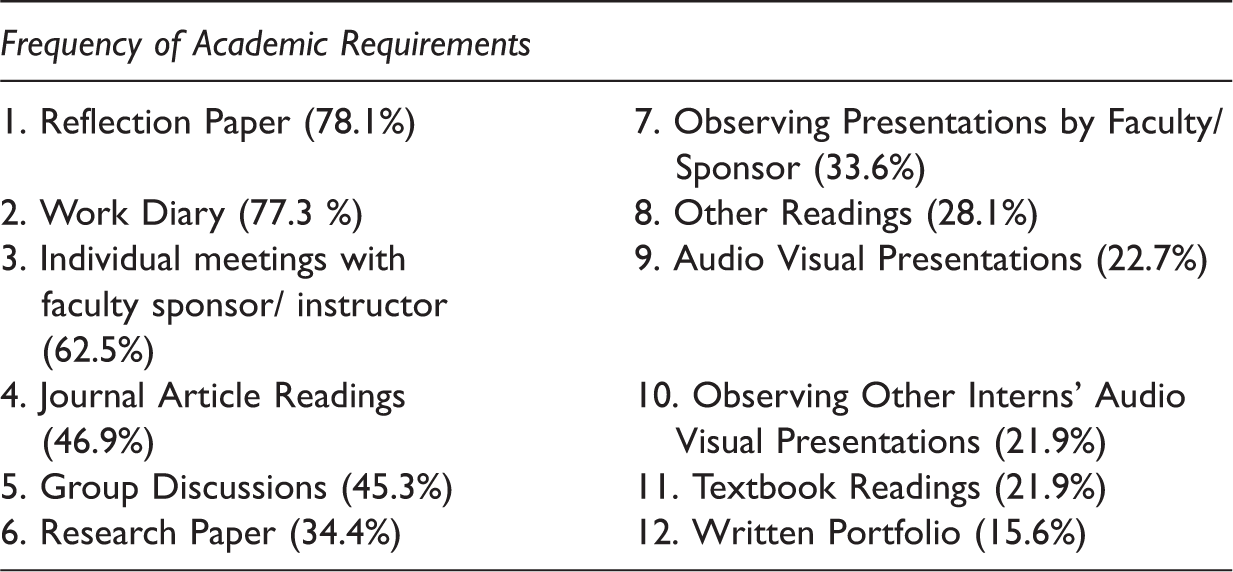
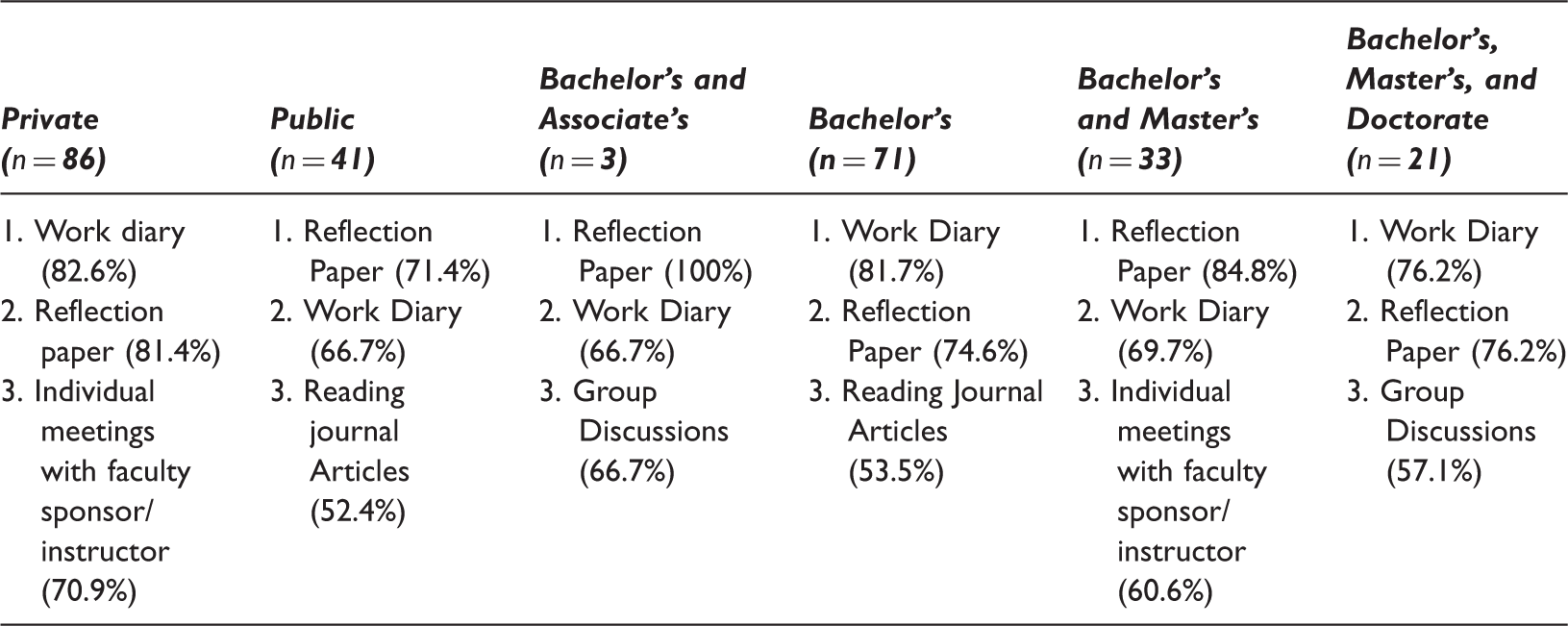
Top Three Academic Requirements
For course supervision, the majority of programs (n = 85, 66.4%) had one faculty member supervise all interns, and 29 programs (22.7%) that had an individual faculty member for each intern. There were 27 participants who used the “Other” option to specify their course’s supervision. Some participants clarified that students had an onsite supervisor (n = 8, 6.25%), multiple faculty members supervise a group of students (n = 8, 6.25%), or that the internship was an option for students’ senior capstone (n = 3, 2.34%). Independent samples t-tests showed no significant differences in the number of academic requirements or number of internship students by the type of internship supervision. Participants reported that their department supervises an average of 38 internship students (SD = 106, median = 12) during an academic year and an average of 16 students (SD = 66, median = 2) during the summer session.
Discussion
Internships are an opportunity for professional development and experiential learning, which is highly relevant to the American APA’s learning goals for the undergraduate psychology major (APA, 2013). The current study examined trends in structuring this learning experience. Programs more often used one faculty supervisor for all interns than an individual supervisor for each student. Regarding the type of student evaluation, the majority of programs used letter grading rather than satisfactory/unsatisfactory grading. Programs often had multiple academic requirements for the internship, with the most frequent requirements being completing a reflection paper, work diary, and having individual meetings with the faculty member supervising the internship. We viewed these trends within the context of four main considerations for designing the undergraduate psychology internship course: characteristics that employers value when making hiring decisions; the APA’s learning goals for the undergraduate psychology major (APA, 2013); principles of the experiential learning process (Kolb, 1984); and real-world constraints on the scope of the internship requirements.
Assessing the structure of internships encourages psychology instructors to reconsider to what extent the internship’s structure aligns with the intended learning objectives and outcomes. Furthermore, the four main considerations are useful for exploring opportunities to change and improve the structure of undergraduate psychology internships. For instance, the type of supervision could reflect the faculty member’s role in the internship process as a content expert versus process expert. The current study’s results suggest that the majority of undergraduate psychology internships are designed to use a process expert approach. Whereas the site supervisor could provide specific discipline knowledge, the faculty supervisor can guide internship students through the experiential learning process. However, we acknowledge that having one faculty supervisor does not necessarily mean that programs are using a process-oriented approach. It is plausible that the internship program only offers internships that match the faculty supervisor’s area of expertise. Furthermore, one faculty member may supervise the internship course, but not use the academic requirements to emphasize experiential learning.
Similarly, the internship course’s grading strategy would likely correspond with the course’s learning objectives and required activities. Our data show that the majority of programs in our sample currently use letter grades instead of the credit/no credit option. The use of letter grades among participants in our sample is conducive to providing ongoing developmental feedback on the quality of student projects or activities in the internship, whereas the credit/no credit approach may be best for merely completing activities. Letter grades could also be more appropriate for complex academic requirements (e.g., portfolio), whereas a credit/no credit grade would be appropriate for behavioral indicators (e.g., completing internship hours and minimum attendance requirements). However, our study data do not include what the student’s grade entails, and instructors have considerable flexibility on how they can structure their grading. An internship course letter grade could be based on behavioral indicators, such as attendance and timeliness of submitting assignments. Alternatively, a credit/no credit grade could be based on quality of assignments, with students needing to revise their work until it meets a certain standard. With either grading approach, it is essential for instructors to verify that the internship course’s design aligns with the learning objectives. As the learning objectives are the foundation for the course, these objectives should reflect the employer’s perspective, APA learning goals, and best practices in experiential learning, and work within the constraints of the course.
Academic requirements provide a common way of assessing students’ performance in various internship settings. Moreover, the academic requirements convey the learning objectives for the course to students, such as professional development and career preparation. Reflection papers and work diaries were the academic requirements most frequent among the undergraduate psychology internship programs. This is an encouraging trend, as reflection papers and work diaries promote the developmental, self-awareness aspects of internships (Blanton, 2001). They also provide a framework for students to make meaning of their internship experiences, and also integrate their new knowledge with their previous coursework (Barber & Bailey, 2015). With reflection papers, students could individually reflect on skills that they have learned during their internship. Although the topics of these reflection papers and work diaries were not reported in this study, supervisors should consider whether the topics for reflective learning activities match the internship course’s learning objectives (Barber & Bailey, 2015). The writing prompts for reflection papers are a valuable tool for guiding students’ learning. Writing prompts that require students to set goals, describe their reaction to a new experience, or compare and contrast their experiences with their coursework can encourage in-depth, meaningful reflection. By structuring the reflection activities with developmental activities (e.g., goal setting), internship supervisors can encourage students to reflect on their career goals and professional development.
Similar to written reflections, internship students can also reflect on their experiences through discussions with their peers (Blanton, 2001). Nearly half of the institutions reported using group discussions, which could be conducive for students sharing their experiences. When students discuss their internship experiences, they may receive both emotional support and career-related information from their peers. For example, a human resources intern can relate to a counseling intern on what it is like to feel overwhelmed with learning new tasks, or compare different procedures required for managing paperwork in each setting. Like the written reflections, instructors could provide students with discussion questions that guide students’ reflections. To connect these reflection methods, instructors could have students complete the written reflections to prepare for these group discussions (e.g., the interactive “think, pair, share” teaching technique; Lyman, 1987).
Instructors can also use assigned readings to have students use their internship experiences to plan the next steps in their career development. Given that journal article and textbook readings were not frequently selected academic requirements, internship instructors could be underutilizing these resources. Assigned readings from the career counseling literature (e.g., the RIASEC model of career interests; Holland, 1959) can direct students to reflect on their personal preferences for their professional development. Amid the differences in internship content, assigning some common readings could also promote coherence and similarity in the group internship experience.
The written portfolio was the least selected academic requirement. Although internship programs may be using other academic requirements that emphasize similar goals (e.g., create a résumé), programs may want to consider using written portfolios to teach students how to communicate their career skills and experiences. Considering this trend in the context of APA’s professional development goals, the written portfolio requirement is a valuable, yet underutilized, academic requirement in internships. One unique aspect of written portfolios is the opportunity for students to integrate past, recent, and future learning and career experiences. Creating a written portfolio is an opportunity to implement the knowledge and skills learned from the internship and create a final product based on the experiential learning process (Kolb, 1984). With written portfolios, students can identify and describe key assignments, opportunities in their coursework that prepared them for their internship, how it benefitted them in their internship, and the knowledge and skills they gained that they can bring to future career opportunities. For example, a student doing a school psychology internship could convey their interest and experience in school psychology by including previous work from a child development course, a test and measures course, a description of a community service project, and feedback on internship performance in his or her written portfolio.
Overall, these data provide a preliminary snapshot of current practices in psychology internship supervision at the undergraduate level. Examining these trends can provide some guidance to departments who wish to adopt – or modify – supervision for undergraduate psychology internships. When developing the structure of an undergraduate psychology internship, incorporating the employer’s perspective and the APA’s learning objectives on career direction emphasize employability and career development to students. Internship supervisors can use best practices in experiential learning, and recognize limitations in the activities, to design meaningful learning activities for internship courses. Using these four considerations and previous suggestions on psychology internship supervision (Barber & Bailey, 2015), the trends presented here can help inform the wide variety of choices instructors can make to maximize experiential learning for student interns.
Footnotes
Acknowledgements
We would like to thank Matthew Roder, Maria Senf, and Justin Taylor for their assistance with participant recruitment and data collection.
Declaration of Conflicting Interests
The author(s) declared no potential conflicts of interest with respect to the research, authorship, and/or publication of this article.
Funding
The author(s) received no financial support for the research, authorship, and/or publication of this article.