




Abstract
Educators in psychology should aspire to encourage students’ holistic growth in academic, personal, and civic domains. We propose that service learning is the most potent pedagogy for developing well-rounded, psychologically literate citizens capable of meeting the goals for the undergraduate psychology major. This article defines service learning, delineates the rationales for service learning, and summarizes research demonstrating the efficacy of this pedagogical approach. The article also describes the learning objectives derived from the American Psychological Association Guidelines for the Undergraduate Major (Version 2.0, 2013), with an emphasis on the ways in which service learning contributes to academic learning, civic learning, and personal growth. Finally, the article illustrates the four types of service learning, and it provides a concrete example for structuring reflection in order to connect community experiences with course content in a service learning psychology course.
Keywords
The term “psychologically literate citizen” has been proposed as a descriptor for the model undergraduate psychology major in several countries (Cranney, Botwood, & Morris, 2012; Halpern, 2010; Harré, Milfont, Helton, & Mead, 2011; Job, Lotto, & Tonzar, 2011; Karandashev, 2011; Mair, Taylor, & Hulme, 2013; Sarwono, 2011; Trapp et al., 2011). Through a rigorous undergraduate education, students will have attained not only fluency in their knowledge of the field (i.e., psychological literacy), but they will also be compassionate, engaged, and efficacious citizens. McGovern et al. (2010) describe the psychologically literate citizen as “someone who responds to the call for ethical commitment and social responsibility as a hallmark of his or her lifelong liberal learning” (p. 10). The vision of the psychologically literate citizen provides an important basis for understanding the centrality and value of an education in psychology that fosters civic development, civic learning, and civic outcomes for majors and nonmajors. We contend that service learning is the most effective pedagogical tool for psychology educators seeking to develop psychologically literate citizens. This paper will describe service learning, how it can facilitate meeting undergraduate goals such as those proposed by the American Psychological Association (APA), and empirically based rationales for integrating it into the psychology curriculum. We will outline suggestions for incorporating service learning into psychology courses, including an example for designing reflection in order to connect community experiences with course content.
Service learning can be defined as a course-based, credit-bearing educational experience in which students (a) participate in mutually identified and organized service activities that benefit the community, and (b) reflect on the service activity in such a way as to gain further understanding of course content, a broader appreciation of the discipline, and an enhanced sense of personal values and civic responsibility (Bringle & Clayton, 2012, p. 105; adapted from Bringle & Hatcher, 1996, p. 222).
The definition also highlights that regular and structured reflection activities are important in helping students make meaning out of their community-based activities. In this way, reflection treats the community service activities as a “text” that is to be interpreted, analyzed, and connected to other course content, to civic issues, and to their personal growth. Finally, the definition asserts that, in addition to students serving in order to learn (i.e., applied learning), service learning makes a distinctive contribution to learning because it also focuses intentionally on having students consider their “sense of personal values and civic responsibility.” Thus, service learning focuses on students learning to serve by having them consider, analyze, and critically examine their role in civic affairs now and in the future.
Altman (1996) proposed that the undergraduate psychology curriculum should support three learning domains: (a) foundational knowledge (i.e., the core content and methods of psychology), (b) professional knowledge (i.e., knowledge of the practice of psychology), and (c) socially responsive knowledge. The purposes of socially responsive knowledge include, “first to educate students in the problems of society; second, have them experience and understand first-hand social issues in their community; and third, give students the experience and skills to act on social problems” (Altman, 1996: pp. 374–375). More recently, the APA Guidelines for the Undergraduate Psychology Major 2.0 (APA, 2103; hereafter referred to as APA Guidelines 2.0) identified five learning goals: (a) knowledge base in psychology, (b) scientific inquiry and critical thinking, (c) ethical and social responsibility in a diverse world, (d) communication, and (e) professional development. The first two APA goals map onto Altman’s foundational knowledge, the fourth and fifth goals are most similar to Altman’s professional knowledge, and the third APA goal is consistent with Altman’s socially responsive knowledge. However, we contend that the psychologically literate citizen is the embodiment of a graduate who is proficient in all of these domains. We will use the APA Guidelines 2.0 as a basis for examining and illustrating how service learning can enhance the entire undergraduate psychology curriculum and all of the APA goals. This will serve as a model for how psychology instructors in other national contexts can explore and adapt service learning to enhance their learning goals.
The extant literature on service learning as a component of education in psychology is underdeveloped (Reich & Nelson, 2010). Bringle and Duffy (1998) examined the role of service learning in the psychology curriculum by offering theoretical analyses and examples of service learning courses. A few other analyses of the role of service learning have occurred in psychology (e.g., Altman, 1996; Chew et al., 2010; McGovern et al., 2010; Osborne & Renick, 2006; Ozorak, 2004; Reich & Nelson, 2010). However, most of the authors in the edited volumes Undergraduate education in psychology: A blueprint for the future of the discipline (Halpern, 2010) and The psychologically literate citizen: Foundations and global perspectives (Cranney & Dunn, 2011) did not mention service learning (exceptions were Charlton & Lymburner, 2011; Chew et al., 2010; Sokol & Kuebli, 2011).
In response to this lacuna, Bringle, Reeb, Brown, and Ruiz (2016) offered an extensive analysis of (a) the psychologically literate citizen as an organizing concept for undergraduate education in psychology; (b) a rationale for increasing civic learning and personal growth as explicit and intentional objectives in the undergraduate curriculum; (c) theoretical and empirical explications of service learning’s relevance to teaching the science of psychology; (d) a framework for generating service learning course objectives that includes the intersection of APA’s five learning goals with the three major learning domains (academic learning, civic learning, and personal growth); (e) examples of integrating community-based activities into a broad range of psychology courses from introductory through major courses to capstone courses; (f) concrete examples of reflection activities that can deepen the connections of community service activities to learning objectives; and (g) guidance for expanding faculty involvement, departmental civic engagement, research using service learning, and assessment of and research on service learning. This article is largely based on that work.
Rationales for Service Learning
Service learning fulfills several different educational agendas (Zlotkowski & Duffy, 2010), each of which provides a motivational basis for increasing the presence of service learning in psychology courses for both majors and nonmajors.
Academic learning: Service learning has been shown to engage students in their studies and enhance disciplinary learning of academic content (Fitch, Steinke, & Hudson, 2013; Jameson, Clayton, & Ash, 2013; Novak, Markey, & Allen, 2007). Furthermore, the psychology curriculum is enriched through community-based service activities that are educationally meaningful. Huber and Hutchings (2010) note, “When faculty from different disciplinary communities teach their fields wearing a civic lens, both the concept of citizenship and even the field itself (as taught and learned) are subject to change” (p. x). Instructor’s role: Consistent with Barr and Tagg’s (1995) advocacy for a shift from teaching-oriented approaches of instruction to a learning-oriented approach, service learning changes the role of the instructor from a “sage on the stage” to a facilitator of student learning. Also, it places additional responsibility on students to be active in the learning process through collaboration with community partners and peers. As such, service learning is aligned with Barr and Tagg’s recommendation that “a college's purpose is not to transfer knowledge but to create environments and experiences that bring students to discover and construct knowledge … to make students members of communities of learners that … solve problems” (p. 4). Social responsibility: Service learning has students confront social issues, analyze their origins, formulate responses, and engage in advocacy. Thus, service learning provides a means for making salient the systemic and structural characteristics of complex social issues facing communities and of marginalized and disadvantaged persons in society. This allows service learning to transcend a charity orientation to service and foregrounds issues related to social justice as a dimension of social responsibility. Partnerships: Based on the desire to teach democratic values and skills, the nature of partnerships in service learning should encompass democratic values (i.e., fair, inclusive, participatory) (Saltmarsh, Hartley, & Clayton, 2009) in order for students’ democratic skills to be most effectively developed. Examining Dewey’s contributions to the intellectual and practical foundations of service learning, Benson, Harkavy, and Puckett (2011) note: Dewey theorized that education and society were dynamically interactive and interdependent. It followed, therefore, that if human beings hope to develop and maintain a particular type of society or social order, they must develop and maintain the particular type of education system conducive to it; that is to say, if there is no effective democratic schooling system, there will be no democratic society. (p. 52) Research: Involving students in research in ways that (a) enhance their learning and civic-mindedness and (b) advance campus-community research endeavors, especially participatory community action research (PCAR) projects (e.g., Reeb, Glendening, Farmer, Snow, & Elvers, 2014), can broaden learning outcomes for students. Use of service learning pedagogy to support PCAR projects coincides with the third and fourth rationales noted above, which emphasized opportunities for students to examine social issues, learn democratic values and skills, and engage in advocacy. Minkler and Wallerstein (2003, p. 6) defined PCAR as follows: “A collaborative approach to research that equitably involves all partners … and recognizes the unique strengths that each brings … [PCAR] begins with a research topic of importance to the community with the aim of combining knowledge and action for social change to improve community.” Strand, Cutforth, Stoecker, Marullo, and Donahue (2003) contended that [PCAR], “when used as a teaching strategy, is an exceptionally effective form of service learning … appropriate for a variety of … curricular levels” (p. 137). Ethics: Service learning provides students with the opportunity to (a) become familiar with the codes of conduct of social agencies where they work, (b) obtain experiences that shape their professional behavior to align with those codes, and (c) recognize the correspondence between such codes and other professional codes (such as the APA (2010) Ethical Principles of Psychologists and Code of Conduct; see Chapdelaine, Ruiz, Warchal, & Wells, 2005). Effectiveness: A final rationale for making service learning an expected and pervasive component of the undergraduate psychology curriculum comes from the empirical support that is accumulating about its effectiveness. Reich and Nelson (2010) conclude that, “a … basic reason for bringing socially responsive knowledge and service learning pedagogy into our curriculum is that in many situations they simply are a more successful way to reach our students” (p. 142). Their conclusion is consistent with empirical analyses identifying service learning as a high impact pedagogy (Kuh, 2008). When examining research that both measured changes across time and research that compared service learning to traditional pedagogies across disciplines, Jameson et al. (2013) reported positive results supporting the efficacy of service learning. Novak et al.'s (2007) meta-analysis found moderate effect sizes favoring service learning for knowledge, grades, and academic motivation; cognitive outcomes had a smaller, but significant effect size favoring service learning. They also found that service learning produced positive and significant effects on personal and citizenship outcomes. Other meta-analyses have supported the conclusion that service learning is positively associated with academic, personal, and civic outcomes, with the effect sizes ranging from small through moderate to large (Celio, Durlak, & Dymnicki, 2011; Conway, Amel, & Gerwien, 2009; Novak et al., 2007; Warren, 2012; Yorio & Ye, 2012).
The Psychology Curriculum and Service Learning
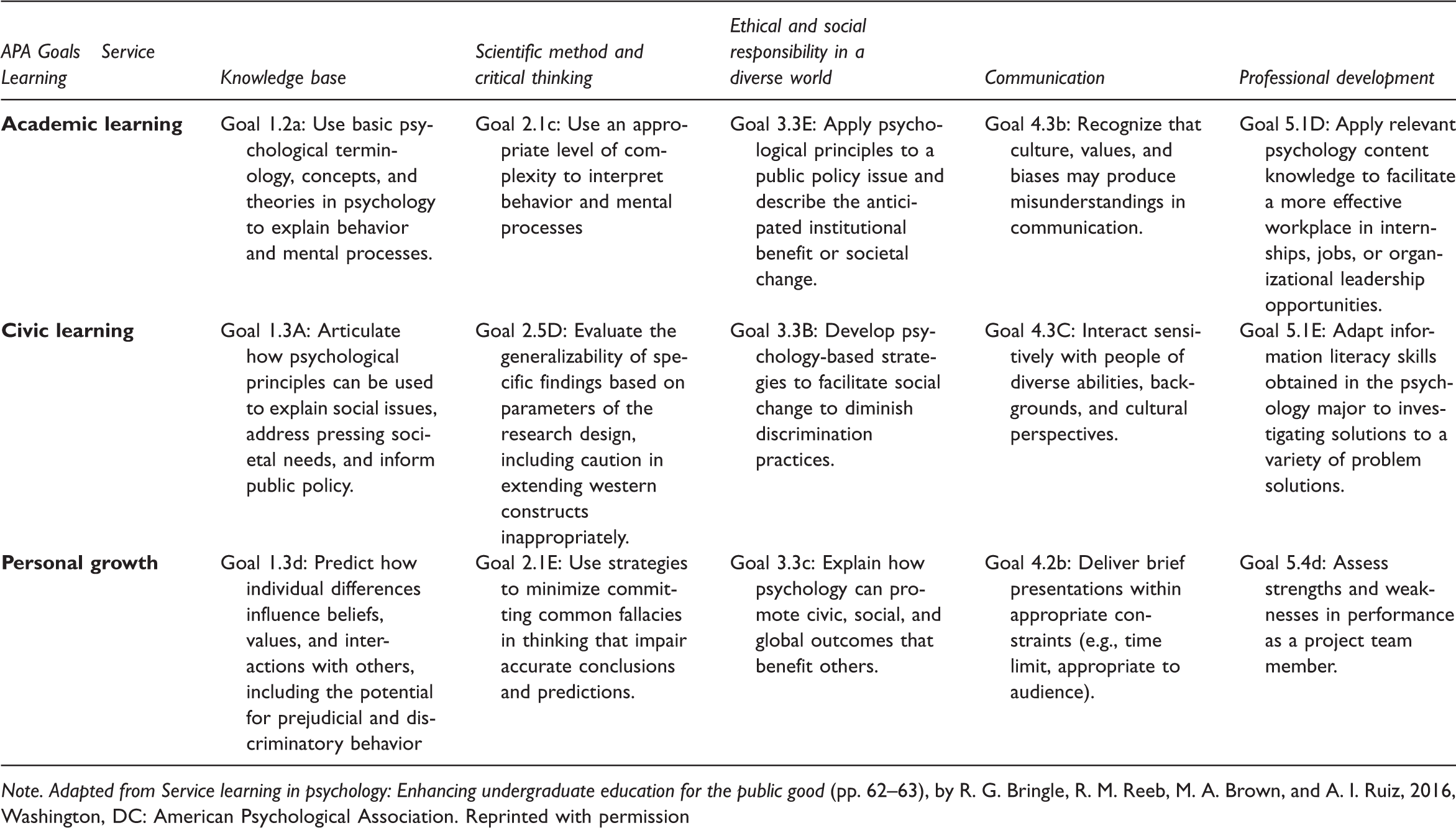
Reich and Nelson (2010) concluded that commitment to service learning in the undergraduate psychology curriculum is not widespread and that most emphasis is still on Altman’s foundational knowledge (i.e., APA Guidelines 2.0: goals 1 and 2) rather than on fostering socially responsive knowledge (civic learning) and personal growth (including communication and professional development). When service learning is mentioned in recent literature on the psychology curriculum (Charlton & Lymburner, 2011; Chew et al., 2010; Sokol & Kuebli, 2011), it is only aligned with APA goal 3, ethical and social responsibility in a diverse world. This reflects one of the strengths of service learning, but leaves unexplored how service learning can enhance learning associated with a variety of goals, such as the other four proposed by APA. Similarly, personal growth is readily aligned with APA goal 4, communication, and goal 5, professional development. But, again, psychology educators can further explore how personal growth can be aligned with other learning goals. One of the contributions of service learning to the undergraduate curriculum is demonstrating how teaching psychology can benefit from a broader conceptualization of academic learning, civic learning, and personal growth (the three core learning domains, see Figure 1). Table 1 contains an example from Bringle et al. (2016) in which learning objectives in a service learning course have been selected to illustrate the three learning domains combined with the five APA goals. This suggests to educators that experiences can be designed for students in which each one of the five goals and many of their subordinate indicators can have civic dimensions and contribute to personal growth, in addition to foundational, academic knowledge. When this is done, the empirical evidence supports the recommendation that service learning may be the best means for reaching this broader array of learning objectives.
Learning Domains That Community Service Can Enhance. Framework for Generating Learning Objectives for a Service Learning Course from APA Guidelines 2.0 Note. Adapted from Service learning in psychology: Enhancing undergraduate education for the public good (pp. 62–63), by R. G. Bringle, R. M. Reeb, M. A. Brown, and A. I. Ruiz, 2016, Washington, DC: American Psychological Association. Reprinted with permission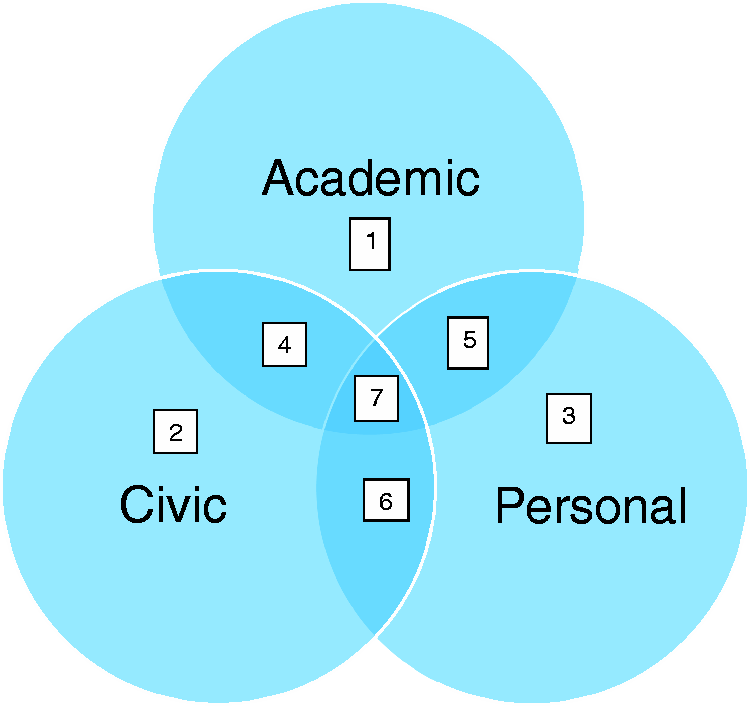
Four Types of Service Learning
Four types of service learning have been identified (e.g., Bringle et al., 2016; Florida Department of Education, 2009). First, with direct service learning, students interact with clients at a community agency or with residents in a neighborhood. Examples include assisting clients at a mental health center or homeless shelter, tutoring elementary students in a school, or providing social support to elderly persons in a nursing home. Second, indirect service learning involves students working behind the scenes to improve, expand, or coordinate resources for a community agency or neighborhood association. Examples include fundraising or developing resource materials (e.g., brochures, instructional aids, web design, or enhancing collaborative connections among agencies). Third, students in research service learning use psychological methods to collect, manage, or analyze data. Developing a survey or other instrument, conducting a program evaluation, or managing a data set are common examples. Fourth, in advocacy service learning, students apply psychological theory and research to explore underlying causes of a sociopolitical concern and/or facilitate transformative changes. Examples include conducting presentations to increase public awareness of an issue, advocating for rights of clients or marginalized persons, examining public policy, improving infrastructure in order to enhance access to resources, or lobbying (e.g., telephone calls, emails, letters, or face-to-face meetings) government representatives.
Examples of Service-Learning Projects in Health Psychology
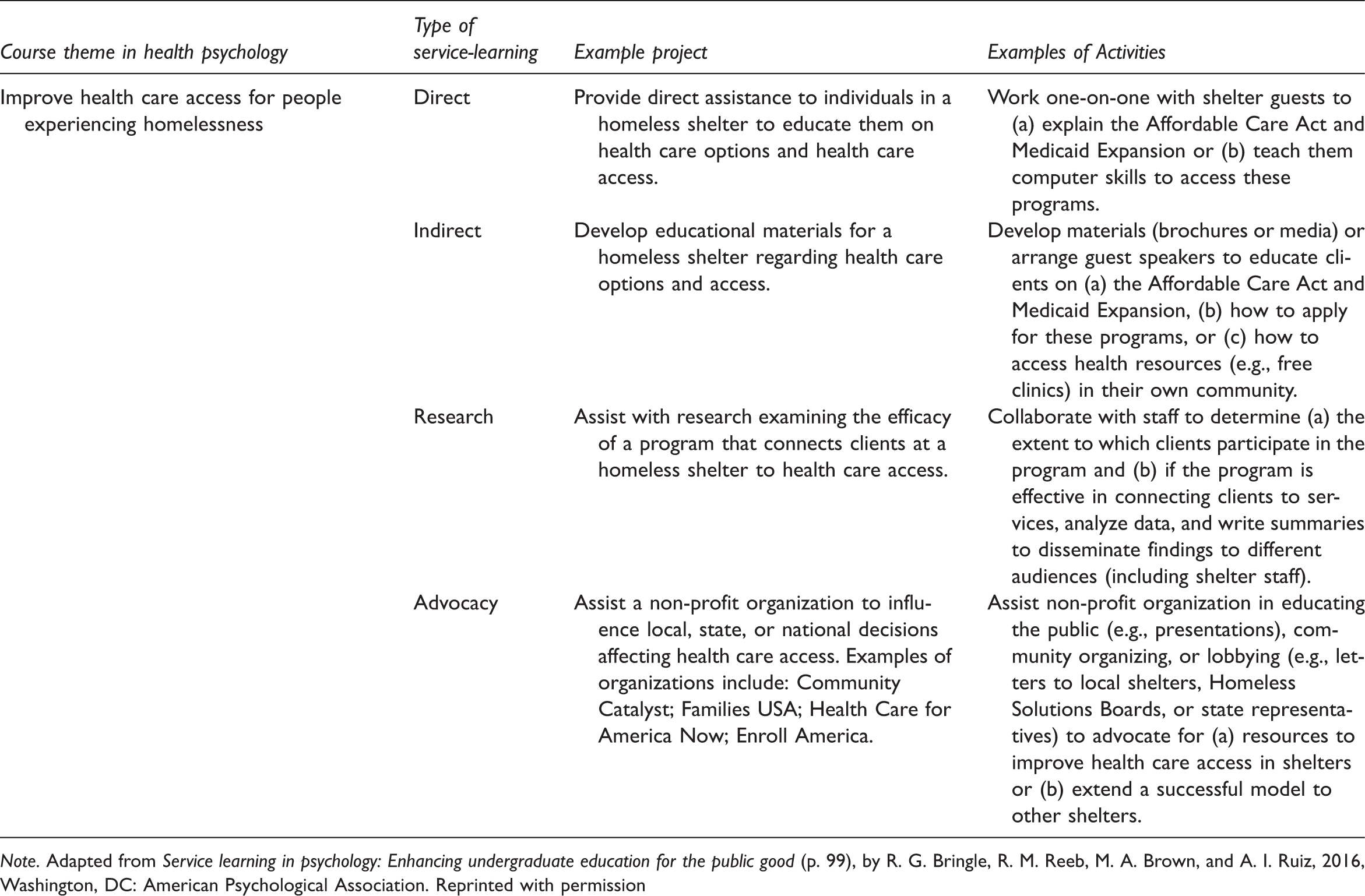
Note. Adapted from Service learning in psychology: Enhancing undergraduate education for the public good (p. 99), by R. G. Bringle, R. M. Reeb, M. A. Brown, and A. I. Ruiz, 2016, Washington, DC: American Psychological Association. Reprinted with permission
Reflection and Assessment
Reaching selected learning objectives through service learning is most likely to occur when there is regular, structured reflection that enhances the educational meaning of community experiences. Bringle et al. (2016) list numerous examples of service learning reflection exercises across a variety of courses in the undergraduate psychology curriculum using the DEAL (Describe, Examine, and Articulate Learning) model for critical reflection (Ash & Clayton, 2004; Ash & Clayton, 2009a, 2009b; Jameson, Clayton, & Bringle, 2008). The DEAL model incorporates the following steps in critical reflection: (a)
Sample DEAL Model Reflection Prompt
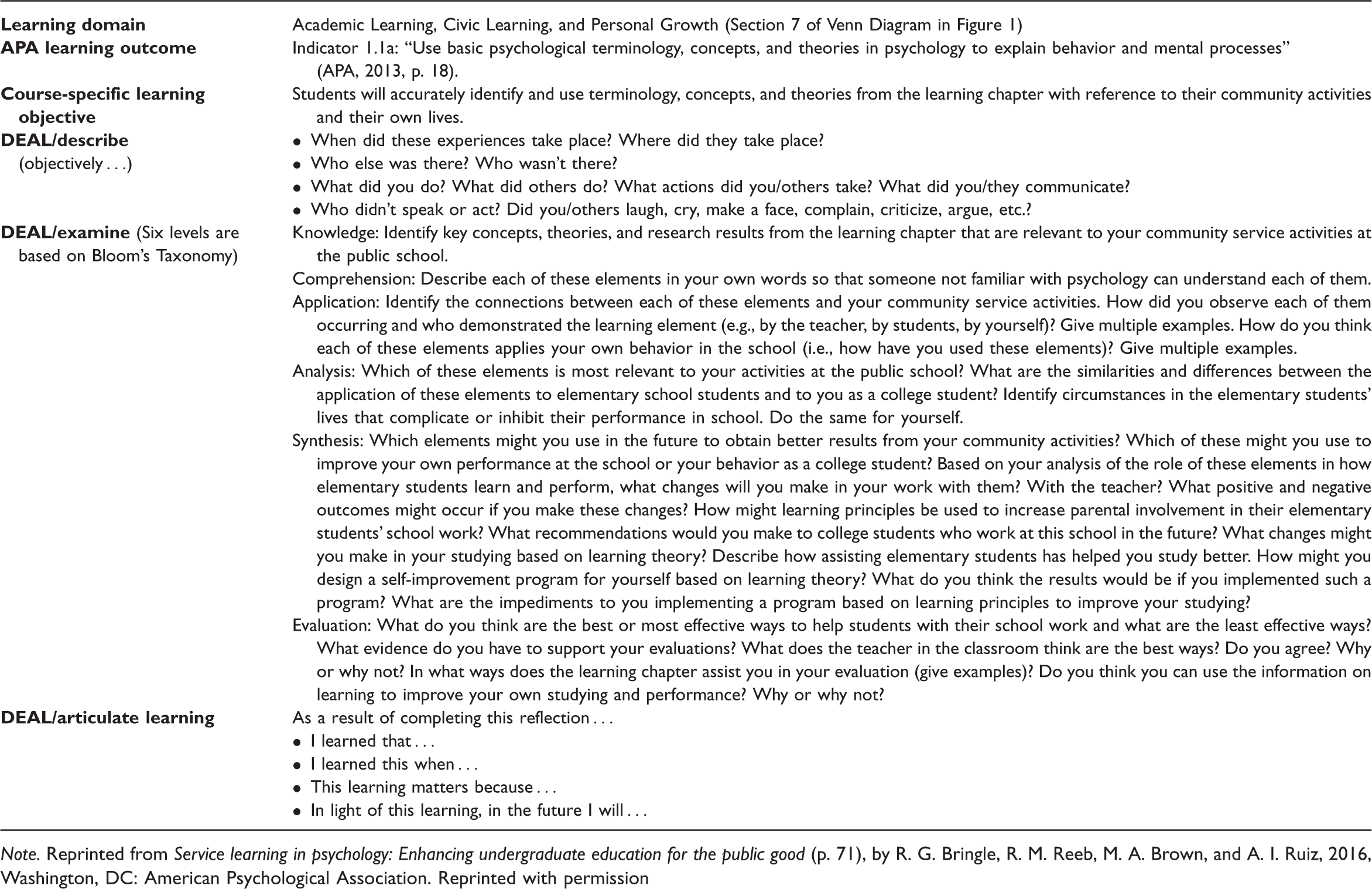
Note. Reprinted from Service learning in psychology: Enhancing undergraduate education for the public good (p. 71), by R. G. Bringle, R. M. Reeb, M. A. Brown, and A. I. Ruiz, 2016, Washington, DC: American Psychological Association. Reprinted with permission
Good reflection can occur before, during, and after the service activities and can result in students generating new learning and capturing their learning for assessment (Ash & Clayton, 2009a, 2009b; Bringle et al., 2016). An assessment plan should match the learning goals established for the course. The assessment may be based on traditional methods (i.e., examinations) as well as other approaches (self-report scales, APA guidelines 2.0 recommendations for assessment, DEAL model, and Bloom’s taxonomy). Assessment can include as many of the community partners involved in the service as possible and contribute to student learning through feedback given to students.
Conclusion
The APA Guidelines 2.0 are but one example for how the goals for the psychology curriculum can be articulated. Those in other contexts can similarly articulate their goals and determine how service learning and other high impact teaching practices can optimize reaching those goals. Serving in communities provides the opportunity to confront ill-defined situations and can spur students to consider how communities work and how psychological content can help them better understand diverse community members and themselves. Through service learning, students are exposed to critical civic issues and the ways that they can make a contribution to the public good. A growing body of research leads to the conclusion that service learning provides clear “value added” for reaching learning outcomes and producing psychologically literate citizens. The science of teaching and learning as evidence-based practice (Terry, Smith, & McQuillin, 2014) demonstrates service learning’s capacity to augment academic learning, civic learning, and personal growth of students, and should attract attention amongst all serious scholar-educators in psychology. See Bringle et al. (2016) for a more extensive analysis of service learning in the psychology curriculum and concrete examples for various courses in the curriculum.
In her analysis of the role of Thorndike and Dewey in higher education, Langemann (1989) concluded, “I have often argued to students, only in part to be perverse, that one cannot understand the history of education in the United States during the twentieth century unless one realizes that Edward L. Thorndike won and John Dewey lost” (p. 185). Dewey’s emphasis was on community praxis for developing rationally, morally, and civically grounded students, whereas Thorndike’s focus was on the quantification of learning, intellectual achievement, and the perspective that there is an inevitable and meaningful societal hierarchy based on intellectual and academic superiority (Lightfoot, 2013). In line with Dewey, and consistent with the ideal of developing psychologically literate citizens (Halpern, 2010; McGovern et al., 2010), we contend that the role of civic education in the psychology curriculum is crucial and warrants an adjustment to increase its salience through service learning. High quality service learning in psychology is predicated on democratic community partnerships to use developmentally appropriate opportunities for critical reflection. This method of designing and implementing service learning is the most powerful way of engaging both majors and nonmajors in their academic work and developing students’ civic identity that is anchored within the psychological curriculum (Bringle, Clayton, & Bringle, 2015).
Footnotes
Declaration of Conflicting Interests
The author(s) declared no potential conflicts of interest with respect to the research, authorship, and/or publication of this article.
Funding
The author(s) received no financial support for the research, authorship, and/or publication of this article.
Author biographies
 , and developed the Community service self-efficacy scale. He serves on numerous Editorial Boards (e.g., Michigan Journal of Community Service Learning). As a licensed clinical psychologist, he serves on the Homeless Solutions Board and the National Alliance on Mental Illness Board (Montgomery County, Ohio).