



Abstract
The aim of this paper is to demonstrate how poststructuralism and social constructionism can contribute to the empirical research on groups in problem-based learning (PBL). The paper outlines the analytical complexity and shows, through empirical examples, the potentials and limitations of this perspective as an alternative to traditional group psychology. While the potentials of poststructuralism and social constructionism as an analytical complex seem to be the endeavor for relentless critique, the limitations are the ‘empty subject’ and the avoidance of any kind of normativity that leave no guidance for practice. Though both limitations raise serious problems for the practitioner, I intend to argue that the potentials of the analytical perspective are far more important than the challenges when it comes to social psychological research in groups in PBL.
Introduction
Within the last 40 years, group work and project studies have become some of the most commonly used pedagogical methods at all levels of the Danish education system (Christensen, 2013; Knudsen, 1999). For this reason, group work and project studies constitute an important part of the curriculum in primary school and secondary school as well as at college and university level. In light of this, it seems strange that research into groups as part of the Danish Project Studies (DPS) is virtually non-existent (Christensen, 2013; Keldorff, 1996; Ulriksen, 1997). Instead, research has focused on project orientation and exemplary teaching (Borgnakke, 1996; Frello, 1996, 1997; Simonsen, 1996, 1997; Simonsen & Ulriksen, 1998; Ulriksen, 1997). The few existing studies of group work have examined the method from the traditional psychological perspective of role-theory (Bales, and Belbin) and psychoanalysis (Bion) (Keldorff, 1996; Keldorff & Mads, 1999). The lack of research into group work within Danish Project Studies means that such work rests on myths of its superiority compared to other pedagogical methods; group work, especially, seems to be resting on a myth of its qualities as an embracing and non-repressive forum for students’ learning (Christensen, 2013).
The aim of this paper is to demonstrate how poststructuralism and social constructionism can contribute to analyses of empirical data on group work in problem-based learning (PBL). This will be done through analyzing examples culled from a research project on the application of project studies as a method at two Danish universities (Christensen, 2013). Although there may be differences between PBL and DPS, there are also many resemblances. Thus, the analytical complex inspired by poststructuralism and social constructionism presented in this paper may also be applicable for studying and analyzing groups in PBL.
First, the DPS will be introduced and the differences between the DPS and PBL explained. Second, the methods for collecting data for the research project will be outlined. Third, the theoretical complex of social constructionism and poststructuralism will be introduced. Examples from the empirical findings will then be presented to illustrate the possibilities and limitations of this analytical framing. Finally, the paper will outline the pedagogical consequences of the findings, and, thus, the results of changing the analytical perspective from traditional group psychology to social constructionism and poststructuralism. This is particularly important, because the complex can provide the researcher with a relevant alternative to traditional group psychology in the study of groups in PBL.
Danish Project Studies
Although DPS resemble PBL in many ways, there are certain differences that have to be taken into account. To complicate matters further, there seem to be different ways of handling project studies at the different Danish educational institutions – also there are different ways of handling PBL. The most commonly applied model is the one introduced at Roskilde University in the early 1970s. A slightly modified version of this model is now widely used across the Danish education system from primary school to university (Christensen, 2013). It is also the model used by the two university programs I examined in a previous research project (Christensen, 2013).
The DPS involves six elements: (1) problem orientation (the topic must be a ‘real’ problem for somebody/a group of people in the ‘real world’, not just a theoretical discussion); (2) project orientation (the output must be presented in the form of a project, usually a written report); (3) participant management (the students themselves are responsible for the work process); (4) exemplary learning (the topic must be exemplary in order for students to gain an insight into a broader complex of problems/theory); (5) interdisciplinary learning (the project must involve theory and methods from several disciplines); and (6) group work (the project is supposed to be carried out in a group that works together as ‘a real group’, i.e., a thoroughly collective working process) (Christensen, 2013, p. 11; Jæger, 2002; Kristensen, 1995, p. 24).
Differences and similarities in between PBL and DPS.
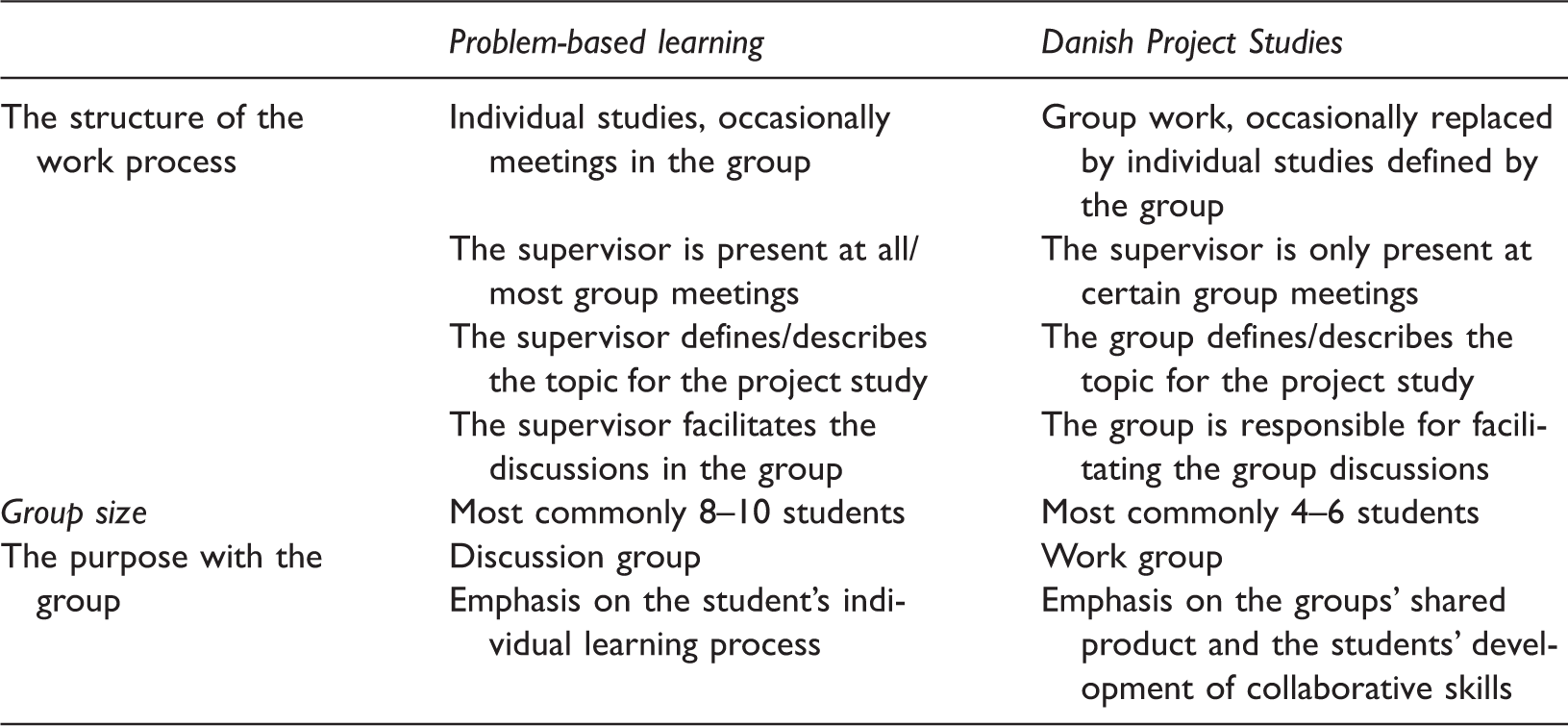
As may be apparent, DPS is more focused than standard PBL on the students’ collective work processes and on the development of collaborative skills, which are considered a natural spin-off effect. Additionally, DPS students are left with an expanded sense of responsibility for the group process. Thus, the students are much more autonomous in DPS than they are expected to be in some versions of PBL (e.g., Savin-Baden & Major, 2004).
At the two university programs I studied for my research project, project studies are conducted in groups, which the students themselves form based on either choice of topic or personal choice of fellow group members, or both. The group formation process is coordinated and arranged by the students themselves. The group work may not be mandatory, but the students are provided little or no supervision if they choose to work on their project alone, or if they cannot find a group to work with.
From the outset, the groups are formally leaderless, and leadership is ideally shared in the groups. This is very hard in practice, not least because the students are provided with no or only vague tools on how to coordinate the group work and group dynamics. In other words, the students are not thoroughly instructed on how to work in a group, nor about the advantages and pitfalls of group work. In Denmark, group work is taken for granted as part of project studies, and every student is assumed to have a natural disposition to act as a good co-worker in a group situation (Christensen, 2013; Illeris, 1981; Ulriksen, 1997).
These assumptions are rarely discussed or questioned; they are merely murmured among the students, who are struggling in the project groups: the long-term group work that is taken for granted is difficult and has severe consequences for the students who cannot make the groups function or cannot function in the groups (Hansen, 1997; Keldorff, 1996; Keldorff & Mads, 1999; Ulriksen, 1997). The main ambition of my research project was therefore to question this taken-for-grantedness of the group work that forms part of project studies (Christensen, 2013).
A Multi-Method Qualitative Study
My research project was based on a qualitative study combining several qualitative methods 1 . I observed two groups in the second year of their Bachelor program at two Danish universities throughout their semester’s project studies. Both programs are characterized by a significant portion of the course content consisting of DPS, and the majority, that is, at least 70%, of the students being women.
Data.
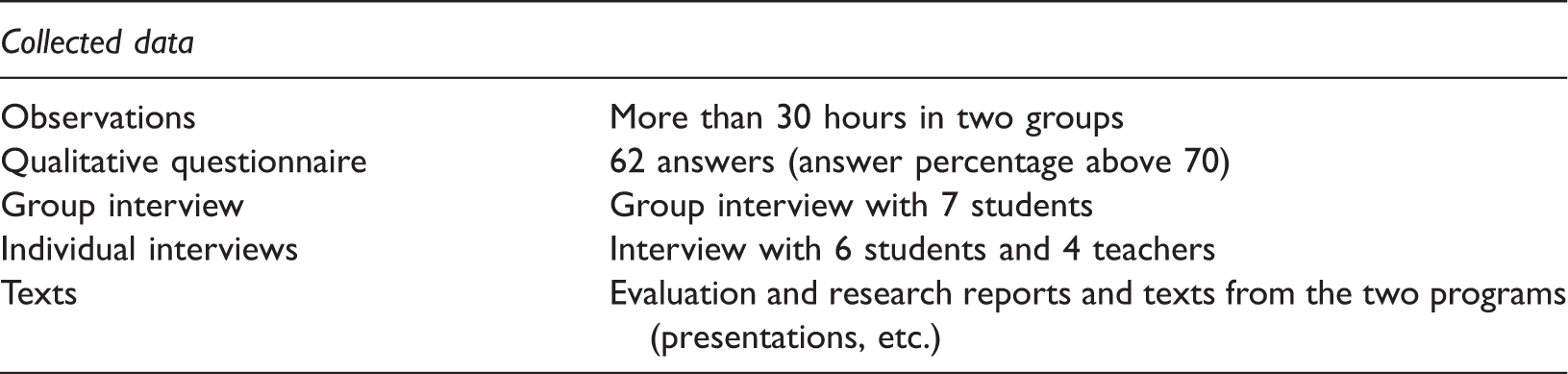
The advantage of using a multi-method study was that it gave me the opportunity to compare the findings from the different parts of the study. Thus, I read the students’ stories from in the interviews up against the findings in the observations, from the survey and from the text corpus. The reading was focused on identifying patterns of similarities and dissimilarities in the conceptualization of group work in project studies. The findings thus gave me a fuller insight into what was at stake among the students. The quotations in this paper are all from my interviews. Pseudonyms are used to protect participant anonymity.
The Analytical Complex: Social Constructionism and Poststructuralism
As mentioned earlier, my research concern was directed towards the superior and unquestioned status of DPS group work as part of DPS. In other words: I simply refused to accept this superior status of the group work. Instead, I wanted to investigate how the group work was comprehended and practiced by the students as part of DPS, and what effects it had on the students and the learning environment.
This critical viewpoint was the reason for my choice of an analytical complex inspired by social constructionism and poststructuralism. While traditional social psychology considers the human subject a prerequisite, this paradigm rejects that there is, or should be, the notion of an essential human subject. Instead of considering the individual as a free, rational agent (the universal human subject), this paradigm considers the subject as an effect of subjectification; a subject that is produced and re-produced through a variety of ongoing practices (Foucault, 1994).
Thus, the human subject is considered impermanent and socially saturated, which means that the subject is a product of social interaction (Gergen, 1991). The process of subjectification is constrained by the conditions set by what Michel Foucault called the ‘discursive formation’, ‘discourse’ or ‘discursive practices’: the formations of language and thinking which define what can be said and what can be thought in a given context (Foucault, 1980a, 1980b, 1984b, 1994).
In later versions of social constructionism and poststructuralism, this is reformulated into claiming that individuals are not only limited by discursive resources but also use discursive resources themselves in their production of selfhood and, thus, in the process of subjectification. In order to emphasize, on the one hand, that the individual is a co-constructor of her own subjectification, and, on the other, that this is limited by the possibilities of the discourse, Bronwyn Davies introduces the concept of positioning: Positioning, as we will use it, is the discursive process whereby selves are located in conversations as observably coherent participants in jointly produced storylines. There can be interactive positioning in which what one says positions another. And there can be reflexive positioning in which one positions oneself. However, it would be a mistake to assume that, in either case, positioning is necessarily intentional. One lives one’s life in terms of one’s ongoing produced self, whoever might be responsible for its production. (Davies, 2000, p. 91)
The possibilities and constraints are comprehended as relations of power. Though, they are not comprehended as relations of power in the traditional sense, that is, someone’s domination of others but rather as effects of the productive power concept of Foucault: power considered as a productive and not-necessarily possessed force, which is always tied to knowledge (Foucault, 1980a, 1988, 1994). This is not to say that knowledge is power, but rather that you cannot find the one without the other (Foucault, 1988). To emphasize the intertwined-ness, Foucault introduced the term power/knowledge (Foucault, 1980a, 1994). Power/knowledge is a generative force, which defines what can and cannot be said at a particular place at a particular time and, thus, what is included in and what will be excluded, silenced or displaced from the discourse. Thus, power/knowledge also defines what is legitimate and not legitimate, normal and not normal within the context (Foucault, 1979).
Theory in Practice: Focusing on Inclusion, Exclusion and Abjection
One of the ongoing discussions among researchers in the social sciences is how to transform a theoretical inspiration into an analytical complex. In other words, how can the researcher make the often highly theoretical inspirations applicable for practical usage in the analysis? In the case of the theoretical inspiration from social constructionism and poststructuralism, it is evident that an interpretation is required.
In order to operationalize the theoretical complex the researcher must focus on the contents of the theoretical assumptions: what do the theoretical concepts – in this case, positioning and subjectification – include? And how can they possibly be identified in the empirical findings? It may seem obvious that one cannot actually observe a process of subjectification. Subjectification is an analytical construct, a concept established in order to say something about a phenomenon observable only through its effects (Christensen, 2014; Collin, 1993).
The processes of positioning and subjectification can be, however, identified in constructions of similarities and dissimilarities, of sameness and difference. In this case, the theoretical complex is inspired by Jacques Derrida’s concept la différance (Derrida, 2001). La différance is the principle of differentiating or making a difference, which is a principle inherent in the use of language. Analytically, it may be comprehended in the relationship between presence and absence, between inclusion and exclusion of linguistic phenomena, practices and individuals. Thus, the phenomenon, which is brought into being in a sentence, always (perhaps tacitly) excludes something, which the phenomenon is not. This is a founding principle of the function of language (Derrida, 2001). And when a story is told, there is always something which is left out of the story as untold, and perhaps even as silenced or dismissed.
The relation between inclusion and exclusion can be further nuanced through the concept of abjection. Abjection means ‘non-object’ and defines the category of non-existence (Butler, 1993, p. 3). This category contains those excluded to such a degree that they have lost their status as subjects (Staunæs, 2004).
The Analytical Process
In the current research project, the analyses were conducted through interpretation of the students’ narratives. This was done with a specific focus on the students’ relational positioning strategies, the relationships between strategies of inclusion, exclusion and abjection, and the use and transformation of language, storylines and metaphors in the students’ narratives about themselves, the university, the teachers and their fellow students. The students’ narratives were analyzed against the texts from the universities (and thus the ideals) about group work in project studies, and the observations of the students in the groups were analyzed against their utterances in the interviews.
For group psychologists, aspects of the theoretical complex inspired by poststructuralism and social constructionism may seem familiar; the prerequisite seems to be that human beings are thoroughly social individuals, who interact with each other and are thus affected by each other (Christensen, 2014). In other words, human beings enter groups, and groups in turn fundamentally affect our identity. Furthermore, we form our identity as individuals and as groups through identification, differentiation and out-group processes (Chiriac & Hempel, 2013).
However, poststructuralism and social constructionism change the perspective since they reject essentialism of any kind (Hansen & Christensen, 2015); except for the prerequisite that human beings are thoroughly social (socially saturated), the complex rejects categories, traits and personality. Although the concept of positioning may share similarities with the well-known concept of roles, it has very different connotations (Davies, 2000, p. 96). The concept of roles implies universality; roles are preexisting categories, so to speak, that individuals can enter when they join groups (Davies, 2000, p. 96). While roles are fixed, preexisting and ‘a mask’ you can wear, positions are in a constant state of transformation depending on the context. Positions are not something you just ‘wear’; they may have fundamental implications for the subjectification, and, thus, for the person you become.
One of the challenges in the analyses informed by social constructionism and poststructuralism is therefore to dismiss all well-known categories. Instead of taking their point of departure in preexisting categories, the analyses must focus on how categories are produced, what they contain and what implications they have for the individuals affected. In the present case, I focused on how the students created positions for themselves and for each other, positions that had fundamental consequences for the students’ possibilities in the context. In the following, I will illustrate the potential of the analytical tool with some examples from the results.
Questioning the Myth of ‘The Including Group Work’
Since Project Studies was introduced on a large scale in the Danish education system in the 1970s, group work has attained mythical status as an ‘embracing’ pedagogical method capable of educating students to act as moral human beings (Illeris, 1974, 1981; Rogers, 1970). In the groups, the students were supposed to learn co-working skills, responsibility, and tolerance (Illeris, 1974, 1981; Rogers, 1970). The universities that had adopted DPS as part of their identity thus profiled themselves as including, accepting, welcoming – and, in the 1970s, also as Marxist – institutions accepting everyone regardless of their idiosycrasies (Hansen, 1997; Jensen, Jakobsen, Ebbe, & Clausen, 1997). These assumptions are still an integral part of the myth at some of the universities (Christensen, 2013).
As mentioned, the analytical complex invited me to focus on strategies of inclusion, exclusion, positioning and categorization through language. This encouraged me to consider the contents of the students’ narratives differently and, thus to look “behind” the myth in order to see what was actually going on. Contrary to the myth, I found that the emphasis on group work created a certain culture among the students at the two universities that was far from tolerant. On the contrary, the students seemed preoccupied with positioning themselves as legitimate and competent, often at the expense of their fellow students. The students’ stories are thus overflowing with examples of fellow students, who are incapable of group work. The importance of achieving the position of a “good student” is obviously intensified by the fact that the students depend on each other’s acceptance to create a project group. If the students failed to form or join a group, they may have been unable to continue their studies and graduate. As some students explained in an interview, this had a major impact on how they contributed, not only in the groups but also in class: Karina: Yes, and people are afraid to say anything in front of each other, and... Susanne: […] there is this social pressure on you, because it means so much which role you get. So, when we sit in the auditorium and we all belong to this big group, there is (whispering) no one who dares to say anything... (Student interview; author's own translation)
Once a student had been labeled, he or she would have problems joining a (good, ambitious) project group the following semester. Among others, I observed this phenomenon in connection to Johannes, an older student, who was having severe trouble in establishing a group (cited in Christensen, 2013, p. 286). His fellow students positioned him as ‘dominant’: ‘[…] Johannes will always have his will. Hen wants all the attention …’ (cited in Christensen, 2013, p. 286), and when he finally succeeded in establishing a group (of 3 students) it was positioned as a ‘sucker group’ by the other students (cited in Christensen, 2013, p. 286).
Although the project groups should ideally be formed on the basis of choice of topic rather than on personal preferences, the students still selected each other as persons, often on the basis of mere hearsay and rumors. It was also clear that the students’ attention and energy were focused on avoiding some fellow students, that is, ‘the unwanted’, in contravention of the ideal myth of ‘inclusive group work’.
Thus my results identified a blind spot in DPS: a program, which emphasizes group work as pedagogical methods evidently, places individuals under a different kind of pressure. The traditional way of assessing students’ academic performance is through a combination of continuous assessment and comprehensive exams at the end of the semester. Focusing on the mechanisms of inclusion and exclusion, positioning and subjectification my research shows that group work adds an assessment component, that is, students evaluate each other as future group partners. This potentially increases the tension in the group, which in turn can have severe implications for the subjectification of the vulnerable students. As some students and teachers described it, ‘This is Social Darwinism. Only the fittest will survive’.
My analytical focus on narratives and power/knowledge in discourse made it possible for me to recognize that the myth surrounding ‘inclusive group work’ prevents anyone from talking openly about the problems and, thus, from changing the practice. The myth blurs the actual proceedings and individualizes the problems in the groups: when groups are having problems co-working, it is dismissed as a problem related to individual students and their difficult ‘personalities’. The theoretical focus also made it possible to conceptualize that being positioned as a ‘bad student’ had severe consequences for the student’s subjectification.
De-legitimized Positions
During my analyses, I was stunned by how much effort the student invested in talking about fellow students. These ‘other students’ personified the challenges often experienced in connection with Project Studies: they did not know how to co-work; they were incapable of identifying a topic relevant to the project study; they were bad at writing, spelling, discussing, placing the commas; and were not able to socialize appropriately and in a timely manner. In other words, the ‘other students’ did not fit into the category of ‘good students’. This interview quotation illustrates how these positions were constructed: Mette: When I think about conflicts in groups, I always think about my first-semester group. In this group, there was one person who I … who I do not think had the competence to … attend university, or at least to be in the group … if I … I certainly would have had to spend a year on the project to compensate for the time spent trying to get him to understand what the project work was about. Not even when we tried to discuss the common focus of the project work, or what we wanted and things like that so, so there was no … there was nothing … there was nothing I could do. It was really exhausting, but then eventually he … he gave it all up … (Student interview; author's own translation)
During the analyses of the data, I was able to identify certain patterns that led to four categories of illegitimate student positions: the ‘stupid’ the ‘lazy’ the ‘dominant’ and the ‘anti-social’. All four positions were identified through the students’ narratives about fellow students, who seemed incapable of coping with the group and project studies. Thus, I did not consider the categories as existing prior to the students’ positioning of themselves and their fellow students. Instead, I tried to analyze the construction of the categories, that is, the contents and consequences of the categories.
The male student in Mette’s narrative is a representative of the category ‘stupid’. I met this category in numerous variations in virtually all of the students’ stories. Hence, the students told me about (anonymous or appointed) fellow students, who for many reasons (according to their fellow students) were not skilled for a university education. Though the teachers did not formally do this evaluation, the positioning had severe consequences for the student in Mette’s narrative. This was equally the case in other of the students’ narratives (Christensen, 2013, p. 283).
The category ‘lazy’ was identified through numerous stories about students ‘who are resting on the laurels […] which is the main problem’ as a male student told me (Christensen, 2013, p. 278). Students who are not contributing sufficiently to the project studies are a well-known problem (Keldorff, 1996; Keldorff & Mads, 1999). The category ‘dominant’ was, for example, identified through stories about students, who ‘tried to be the leader of the groups’ and ‘who tried to take over the project’ as the students told me (Christensen, 2013, p. 185). In some cases these students were even referred to as ‘alpha-males’ (Christensen, 2013, p. 185). Finally, the category ‘anti-social’ was outlined through the students’ stories about fellow students, who are pointing at fellow students' incompetence and lack of work effort. Students who tell tales about fellow students to, for example, the group’s supervisor (teacher) are thus appointed as ‘evil’ in the connotation ‘anti-social’ (Christensen, 2013, p. 297).
On the one hand, it seemed quite important for the students not to qualify for a position in one of the four unappealing categories. On the other hand, the definitions of the categories seemed rather open. One could be defined as ‘stupid’ if one spoke too little or too much in class, or if one did not agree with a group member, whom the other students considered as smart. The position ‘lazy’ was applied to students who preferred to work alone, that is, transcended the principle of group work. Not surprisingly, this category also applied to students who failed to show up at the group meetings. However, the students seemed to have different restraint in this matter. While some students were excluded from the important decisions of the group due to absence from one or a few group meetings, other group members could actually get away with being absent from several meetings without losing influence in the group. The sanctions seemed to be related to the status of the group member.
The position as ‘dominant’ was applied to students who were too explicit about wanting to be the leader of the group. This was considered as an act of domination and therefore illegitimate. It was my impression, however, that some students could actually act quite dominant without having problems finding a group; again much seemed to depend on the acceptance and tolerance of the fellow students. Finally, the position as ‘anti-social’ was open for students who pointed at fellow students’ incompetence or lack of work in the group. In other words, it was not only illegitimate to be lazy, stupid or dominant but also to bring such problems into the open.
Although I was able to identify the categories from the role they played in the students’ narratives, I was unable to identify the exact criteria for qualifying for one of the categories. Being ‘stupid’ was not necessarily a question of lack of academic or cognitive skills, as one would expect. The categories were also not mutually exclusive as some students were categorized as both ‘stupid’ and ‘dominant’. Furthermore, there seemed to be a profound difference in what the students accepted from different fellow students.
The openness and lack of exact definitions or boundaries did not make the categories less important or less real for the students who were somehow positioned in one or more of the categories and thus labeled as problematic; nor did it weaken the importance of the categories to the students who were able to remain uncategorized. Positioning fellow students as illegitimate seemed to confirm the other students’ position as ‘good students’. The relative positioning was quite obvious as well as effective in the DPS-oriented programs, and apparently had severe consequences for the individuals concerned.
Conclusion: Pedagogical Consequences
The aim of my research project was to question the taken-for-grantedness characterizing DPS, that is, the myth that the groups in project studies are unproblematic and embracing forums for project studies. This is one of the fundamental expectations of PBL as well as DPS. However, my results show that this is not always the case. Making groups an essential element of an education program awakens students’ alertness towards each other as future group partners and leads them to relentlessly evaluate each other. Contrary to expectations and the myth, group work does not automatically create an embracing or encouraging learning milieu. It can equally well foster Social Darwinism and lead to students who have somehow gained an unattractive position being excluded or rejected.
My results show that the universities that implement DPS or PBL have an important responsibility for framing project studies and not least the group work itself, for example, composing the groups. The students must not be left to do this for themselves with little or no support from the teaching staff. It also show that the study programs, which are applying group work have to train the students in the methods for this work pattern as well as to introduce them to the ethics of co-working. Although myths and gossip are unavoidable in a social setting like a university, much may be won through explicit and well-defined work patterns.
Additionally, the analytical complex allowed me to investigate the categories of students as constructions. As mentioned earlier, I was unable to pinpoint any particular ‘traits’ that led to a position in one of the four de-legitimized categories. The positioning seemed rather arbitrary and primarily determined by some of the other students’ ambition of gaining an attractive position for themselves. Positions are relative, and the de-legitimized positions define the boundaries of the position as ‘good student’. Thus, the de-legitimized positions must be obtained by some students in order for the rest to be able to define themselves as ‘good students’. Individuals are not considered as ‘fixed’ into a specific identity. On the contrary, the individual identity must be considered as dependent on the possibilities in the context. Hence, the theoretical complex encourages not only the researcher but everybody involved in a practice to be aware of the stories we tell and of the limitations they put on the individuals involved.
My results thus also point to a need for the institutions to teach the students that human beings are contextual and interpersonally dependent and may show or develop different skills depending on the possibilities and limitations they are exposed to in a specific social environment, that is, the group. This also suggests that there is a need to teach students some basic ethics and encourage them to consider fellow students as fellow human beings and to put aside prejudice and rumors. For this to be a success, the institutions must teach the students how to work in groups. I also believe that the institutions must be keener on taking the process of the students' academic evaluation seriously. If the authorities at the institution neglect this duty, the students will take over the process of evaluation themselves; this is the root cause of Social Darwinism.
Footnotes
Declaration of Conflicting Interests
The author(s) declared no potential conflicts of interest with respect to the research, authorship, and/or publication of this article.
Funding
The author(s) received no financial support for the research, authorship, and/or publication of this article.