




Abstract
Reviewed by: Kelly Campbell, Department of Psychology, California State University, San Bernardino, USA
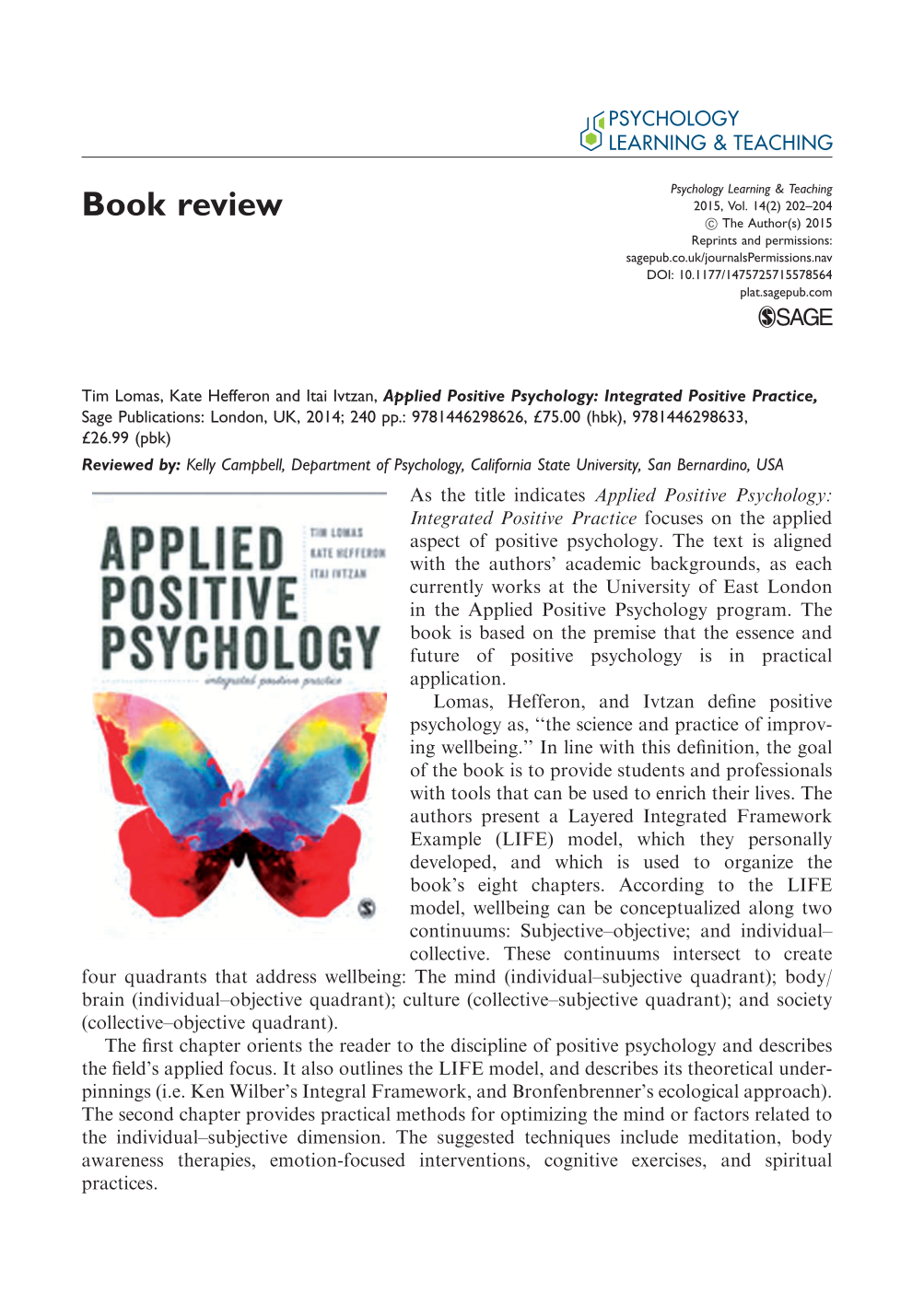
As the title indicates Applied Positive Psychology: Integrated Positive Practice focuses on the applied aspect of positive psychology. The text is aligned with the authors’ academic backgrounds, as each currently works at the University of East London in the Applied Positive Psychology program. The book is based on the premise that the essence and future of positive psychology is in practical application.
Lomas, Hefferon, and Ivtzan define positive psychology as, “the science and practice of improving wellbeing.” In line with this definition, the goal of the book is to provide students and professionals with tools that can be used to enrich their lives. The authors present a Layered Integrated Framework Example (LIFE) model, which they personally developed, and which is used to organize the book’s eight chapters. According to the LIFE model, wellbeing can be conceptualized along two continuums: Subjective–objective; and individual–collective. These continuums intersect to create four quadrants that address wellbeing: The mind (individual–subjective quadrant); body/brain (individual–objective quadrant); culture (collective–subjective quadrant); and society (collective–objective quadrant).
The first chapter orients the reader to the discipline of positive psychology and describes the field’s applied focus. It also outlines the LIFE model, and describes its theoretical underpinnings (i.e. Ken Wilber’s Integral Framework, and Bronfenbrenner’s ecological approach). The second chapter provides practical methods for optimizing the mind or factors related to the individual–subjective dimension. The suggested techniques include meditation, body awareness therapies, emotion-focused interventions, cognitive exercises, and spiritual practices.
Chapter 3 addresses the body and brain, or the individual–objective quadrant. In this chapter, Lomas, Hefferon, and Ivtzan describe biological influences on wellbeing and outline related approaches that can be used to improve quality of life, such as gene therapy, psychotropic drugs, nutrition, physical activity, and artistic expression. In Chapter 4, they discuss socio-cultural influences on wellbeing, which include both the collective–subjective and collective–objective LIFE quadrants. This chapter is organized according to Bronfenbrenner’s ecological theory, and identifies interventions that range from the micro (e.g. couples therapy) to macro level (e.g. policy change).
Chapter 5 takes a lifespan approach and identifies factors that improve wellbeing from pre-birth through old age. In addition to the authors’ practical recommendations for each life stage, they discuss the importance of secure attachments, positive parenting, and strong interpersonal relationships toward improving wellbeing. Chapter 6 demonstrates how the LIFE model quadrants can be used to explain happiness with work. The topics include work engagement, motivation, meaningfulness (individual–subjective quadrant), managing work stressors (individual–objective quadrant), creating a positive work environment (collective–subjective quadrant), and structural factors impacting the workforce (collective–objective quadrant).
In Chapter 7, the authors focus on spirituality and wellbeing. Positive psychology has historically contained a humanistic–existential component, so this chapter is especially relevant to the field. The authors first define religion and spirituality, and then demonstrate how each can be used to enhance quality of living. The discussion centers on mediation and yoga, as well as their respective roots in Hinduism and Buddhism. Of note, this chapter does not address Western spirituality and wellbeing (e.g. Judeo–Christian virtues of courage, and hope). In the final chapter, the authors discuss how practitioners might implement the interventions mentioned throughout the book. They address ethical and reflective practices, and provide tools to help practitioners engage in both. They also consider whether the field of applied positive psychology should be governed by the types of regulations employed in related fields, such as counseling and psychotherapy.
Applied Positive Psychology is written as a textbook for students in higher education. Each chapter contains features that both students and professors will find attractive, including a list of topics to be addressed, learning objectives, sample essay questions, case studies, points for reflection, practical tips that can be used to enhance wellbeing, sample measurement tools to assess related constructs, relevant media (e.g. musical suggestions), chapter summaries, quizzes, and additional resources (e.g. websites). Although this list is varied and extensive, the chapter add-ons focus mostly on case studies. It would be nice if the text included more practical tips and measurement tools because those are the most applied, and interesting components. It would also be nice to see illustrations added to the book as they would facilitate comprehension for the visual learners, and enhance overall appeal.
The authors purposely focused their book on the applied aspect of positive psychology, which they argue is at the discipline’s core. The text would therefore serve as an excellent required read for a course on applied positive psychology. Professors whose courses take a broader focus and examine the field of positive psychology as a whole might find the book more limiting. Although the nature of positive psychology includes an applied focus, there are additional, fundamental components that are not thoroughly covered by this text. For instance, the book does not provide a detailed explanation of concepts such as happiness, flow, self-actualization, optimism, hope, and resilience. Although most of these topics are included in the book, they are not elaborated upon in great depth. Therefore, this book is recommended as a useful companion or supplemental text for courses on positive psychology.
One of the main contributions of this text is the LIFE model. Given the myriad of factors that influence human development, teaching courses in the social sciences can be challenging. The LIFE model facilitates this process by providing a simple framework to help organize human experiences, and wellbeing. The model also serves as an effective guide for organizing the book’s contents; it keeps the text focused and unified. A major strength of the book relates to the diversity with which the material is presented. It is rare for a textbook to contain such a multitude of learning tools (e.g. case studies, measurement tools, media, and quizzes).
In sum, Applied Positive Psychology provides a thoughtful and thorough description of the practical realm of positive psychology. It is an appropriate textbook choice for courses with an applied focus, and a good companion text for courses with a broader focus on positive psychology.